
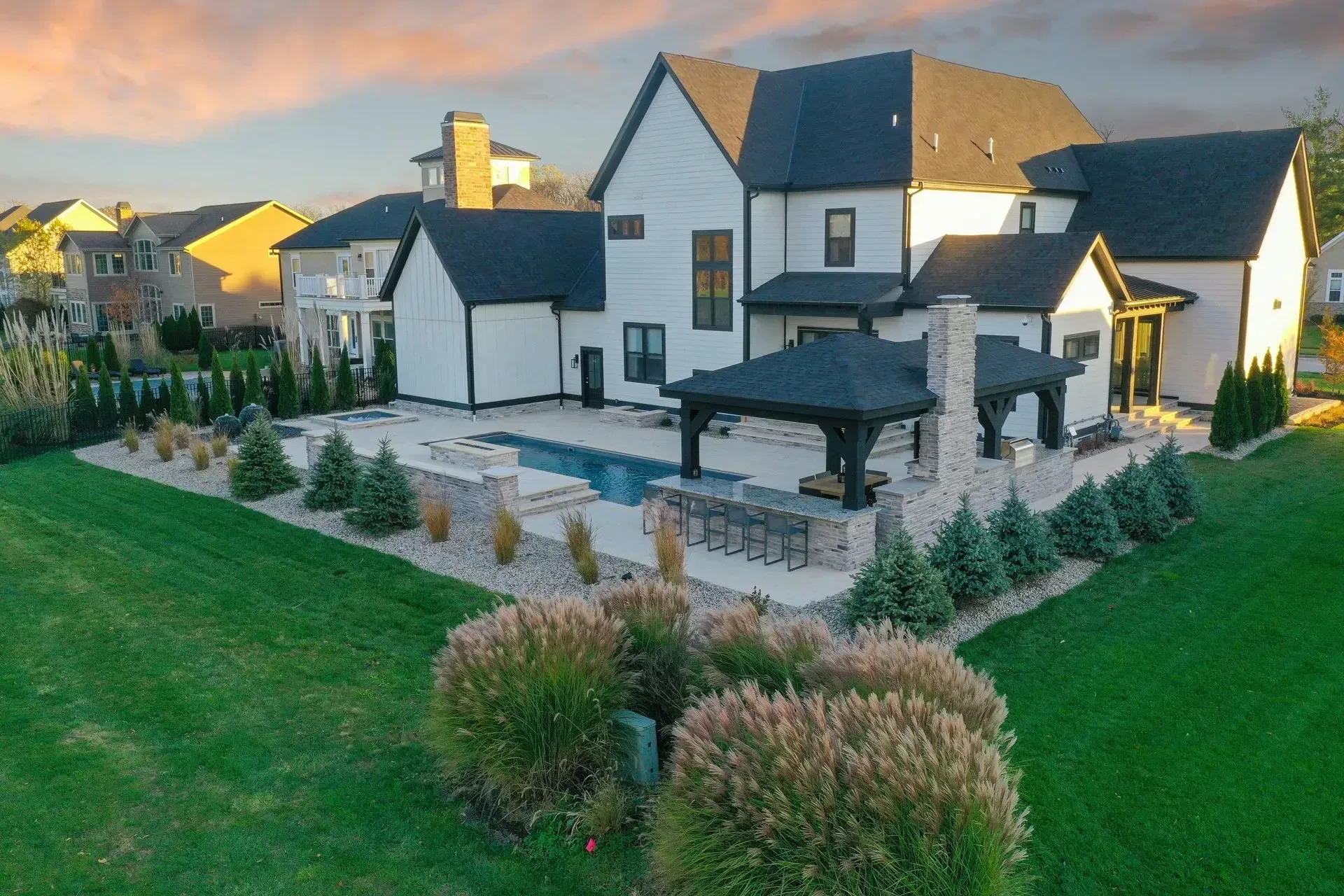
A client off Freemanville Road bought a 2019 modern-farmhouse on three acres — black standing-seam roof, white lap siding, cedar soffits, granite foundation veneer. She wanted a fire feature for the rear terrace and asked us to price a traditional round pit. We priced it, then priced something better, and six weeks later her architect called to say the 96-inch linear trough we installed had become the single most-photographed element of the house.
That project is the reason this post exists. Milton isn’t Alpharetta-plus. The architecture here leans heavily into the modern-farmhouse vernacular that dominated high-end residential builds from roughly 2015 forward, and the fire features that look right on these houses are not the fire features that look right on a Buckhead Colonial or a Cumming craftsman. Round is wrong. Field stone is wrong. A linear gas trough — narrow, long, low-profile, flush to the deck — is the form that matches the architecture. This piece walks through why, how we build them, what they cost in Milton specifically, and what the City of Milton Community Development office at 2006 Heritage Walk will ask you to prove before they stamp the permit.
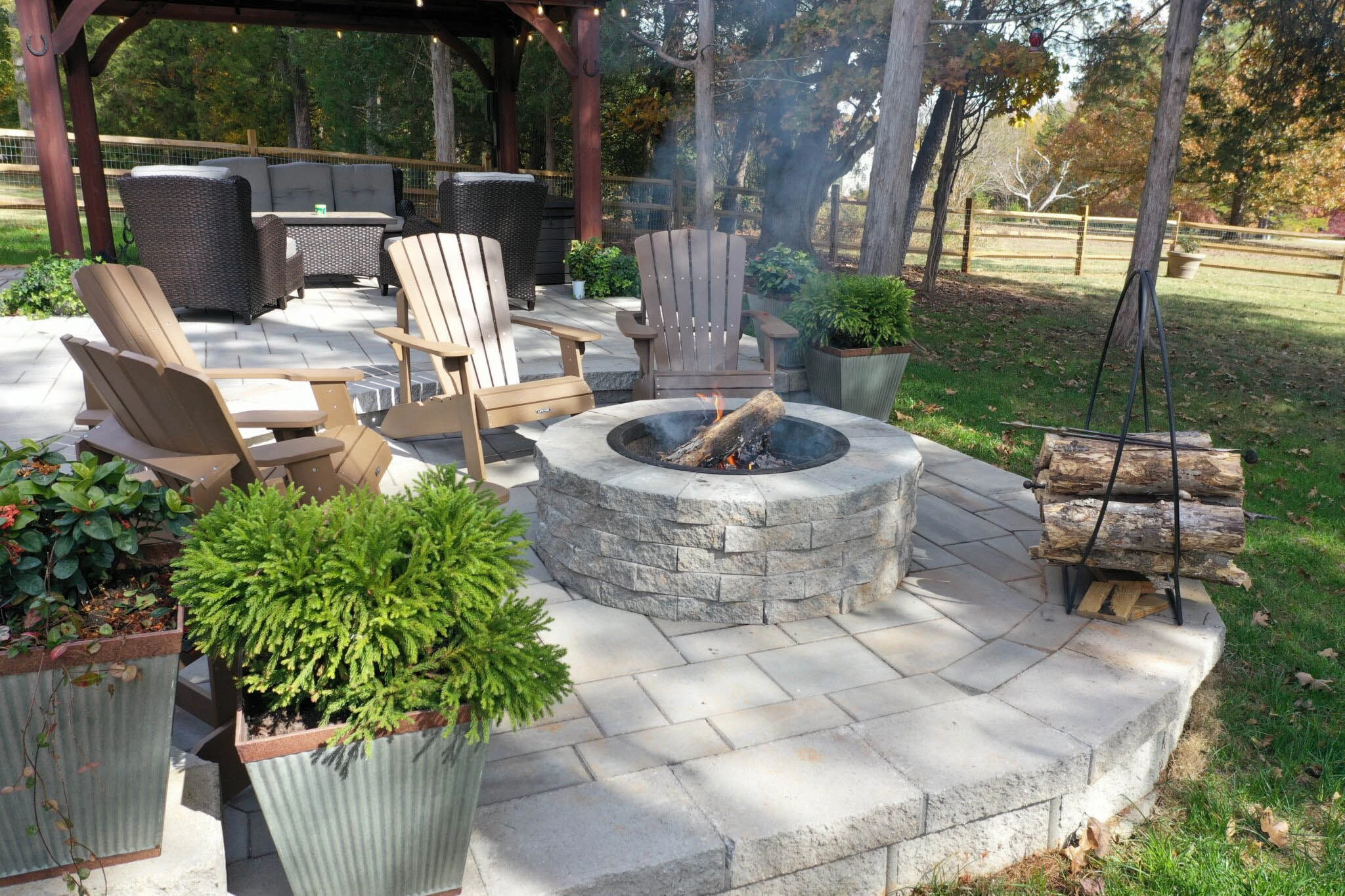
Why Round Pits Fight the Architecture of a Modern Farmhouse
Walk through Crooked Creek, The Manor Golf Club, White Columns on the Milton side, or Cogburn Estates, and the dominant new-build silhouette is the same: long, low, rectilinear masses, crisp gables, 12:12 or 14:12 pitched black metal roofs, shallow porch eaves, and horizontal white lap siding. The architectural DNA is rectangular. Every major plane of the house is a long, straight line — roof ridge, eave, siding course, window head, porch beam.
Drop a round 48-inch gas pit in the middle of a terrace attached to that house and your eye reads it as a foreign object. It doesn’t echo any line in the architecture. The circle competes with the rectangles instead of reinforcing them. Designers and photographers notice this immediately. Clients notice it about eight months later when the novelty of the fire feature wears off and the patio starts to feel busy.
A linear trough does the opposite. It extends an existing line. Parallel the long edge of a pavilion beam, the porch railing, or the pool coping, and the trough reads as an architectural datum — a low, glowing plinth — rather than a decorative object. On a modern-farmhouse build specifically, that alignment is the difference between a terrace that photographs like a magazine feature and a terrace that photographs like a house with a fire pit on it.
The Warming Trends Crossfire Burner — Why We Spec It by Default
The heart of every linear trough we build in Milton is a Warming Trends Crossfire brass burner. This is not product-worship — it’s an engineering choice we made after years of watching cheaper ring burners soot up pan interiors, pit glass media, and drop flame height after the first cold snap.
The Crossfire is a proprietary brass jet-burner system that pulls combustion air through the base, mixes it internally, and ejects flame at roughly two-to-three times the height of a comparable-BTU ring burner while burning significantly cleaner. On a linear trough, that height advantage is what sells the feature — a low flame on a long burner looks like a camping stove; a tall flame on a long burner looks like architecture.
For Milton builds we default to two sizes:
- 60-inch CFBL60 linear burner with a 25-jet configuration — roughly 290,000 BTU. Fits a 72-inch finished trough and suits a standard rear terrace on a one-to-two-acre lot.
- 96-inch CFBL96 linear burner with a 40-jet configuration — roughly 450,000 BTU. Fits a 108–120-inch finished trough and belongs on the estate-scale terraces common in Cogburn Estates, The Manor, and larger AG-1 parcels along Hopewell Road.
Above 96 inches we typically switch to a dual-burner layout (two CFBL48s on independent manifolds) rather than run a single custom burner. Flame distribution stays even, media wear stays predictable, and — if one side ever drops a jet — the feature still looks complete while the service tech is on the way.
Anatomy of a Linear Trough: What You’re Actually Paying For
From the outside a linear trough looks simple — a long, shallow rectangle of fire. Under the surface, six systems have to work together, and the line-item pricing below reflects what each one costs in Milton specifically, including local labor rates and the small surcharge we apply for estate-lot access (long driveways, gate codes, HOA coordination).
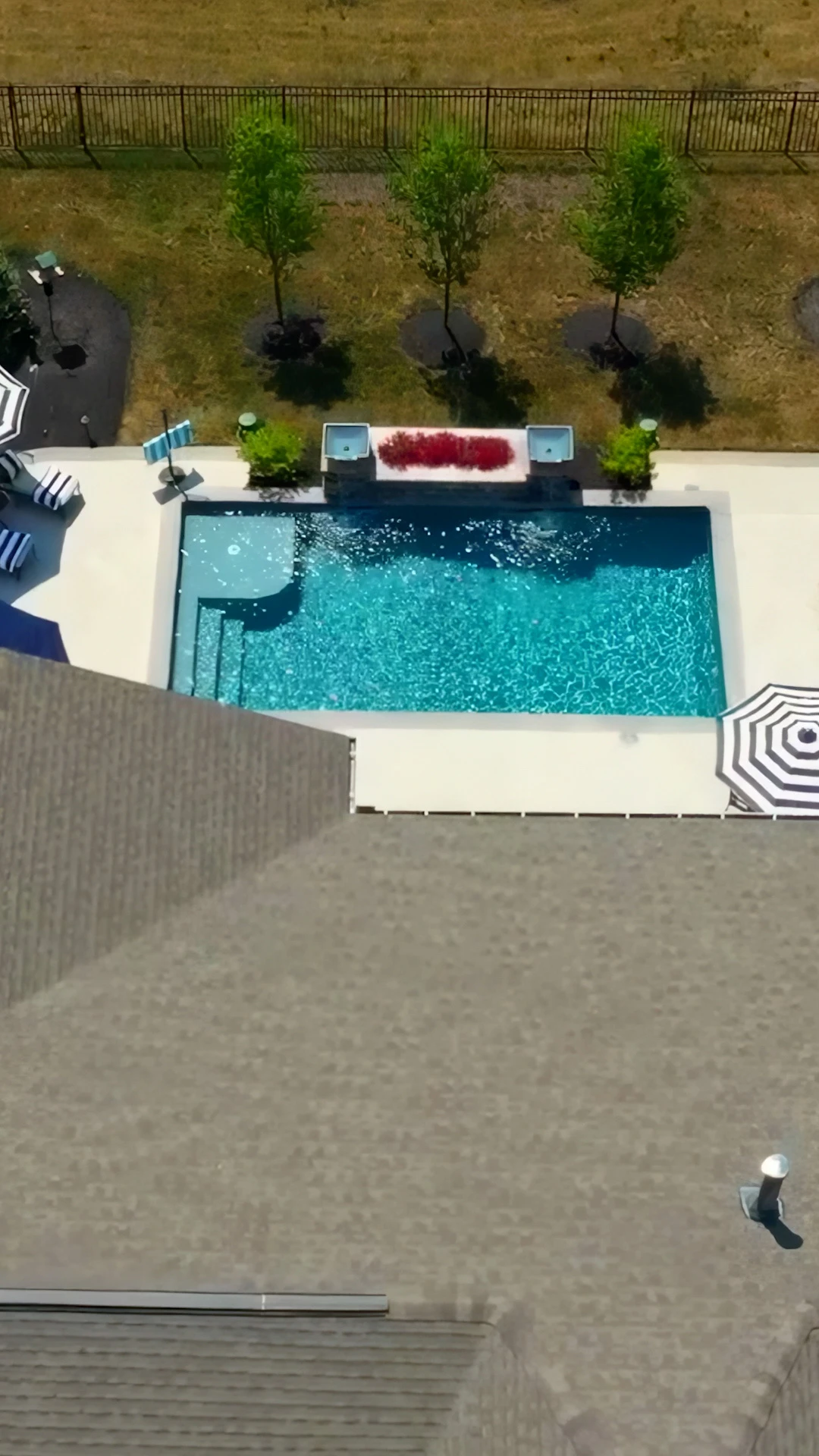
1. Steel pan. The pan is the fire-rated stainless box the burner sits inside. We use 14-gauge 304 stainless with fully welded seams, crimped drain holes, and a flanged lip that seats into the surround. A quality pan adds $600–$1,400 depending on length. Cheap pans warp after twenty burn cycles and telegraph through the media.
2. Burner assembly. Warming Trends Crossfire at the sizes above runs $1,400 (CFBL60) to $3,100 (CFBL96) for the burner alone. Add manifold, orifices, and mounting hardware.
3. Electronic ignition. Hot-surface ignition with flame-sensing safety shutoff — CSA-certified AWEIS module, $650–$950 installed. This is the component that lets the homeowner start the feature from a wall switch, phone app, or smart-home system instead of reaching in with a grill lighter. On a 96-inch trough, manual ignition is not a reasonable option.
4. Wind guard. Tempered glass rectangle on stainless standoffs, 6–8 inches tall, sized to the pan. On Milton’s north-facing ridgetop lots — Providence Park edge, the higher parcels along Birmingham Highway — wind shear off open pasture genuinely extinguishes an unguarded trough. The guard is $400–$900 and is not optional above 1,150 feet elevation.
5. Media. Tempered crushed fire glass (1/2-inch reflective black, onyx, or bronze is the modern-farmhouse palette) or lava rock. For the modern-farmhouse look, glass reads right; river rock and lava rock read traditional. Budget $200–$400 per trough.
6. Surround and cap. The masonry or metal housing the whole assembly sits inside. This is the line item with the widest range — $1,800 for a simple Techo-Bloc Borealis-clad block shell capped in limestone, $6,000+ for a fabricated Corten steel monolith or a full dry-stack granite surround with a bluestone cap.
All-in installed cost, Milton: 60-inch linear trough $8,400–$11,800; 96-inch linear trough $13,500–$18,200. Add $1,200–$3,800 if the gas run exceeds 50 feet from the meter or requires trenching across an existing hardscape.
Natural Gas vs Propane on Milton’s Off-Grid-Gas Estates
A meaningful share of Milton — particularly parcels north of Hopewell Road, stretches along Freemanville near the Forsyth County line, and most of the AG-1 zoned horse properties along Wood Road and Arnold Mill — sits outside the Atlanta Gas Light natural-gas footprint. Homes there run on buried propane, typically a 500-gallon or 1,000-gallon tank fed by Heritage or Blossman on a monthly monitor-and-fill contract.
This matters because the orifice sizing on the burner is different between fuels, and because the operating cost is different. A CFBL96 running at the specced 450,000 BTU consumes roughly 4.5 gallons of propane per hour at full flame height, or about 450 cubic feet of natural gas. At Milton propane rates in the $3.20–$3.60/gallon range and natural gas around $1.45 per therm delivered, propane runs roughly 20–30% higher per operating hour than natural gas for the identical feature.
The practical translation: if your rear terrace sits on natural gas, a 96-inch trough running a typical Milton fall schedule — two hours per evening, four evenings per week, mid-October through mid-April — costs about $240 for the season. On propane that same schedule is closer to $310. For most of our estate clients, that delta is inside the rounding on the monthly propane fill anyway, and the decision comes down to fuel availability rather than cost.
What isn’t cheap is under-sizing the tank. A 500-gallon tank running an outdoor kitchen, pool heater, and 96-inch trough on the same regulator will short-cycle in winter. We’ve set several 1,000-gallon tanks in Milton specifically to service multi-appliance outdoor living builds, and we always coordinate the tank sizing with the propane vendor before breaking ground on the trough.
Code, Setbacks, and the City of Milton Permit Path
Milton incorporated as a separate city in 2006 — a fact worth understanding because it means your permit does not route through Fulton County. It routes through the City of Milton Community Development office at 2006 Heritage Walk, Milton GA 30004. In practice this is a good thing. Turnaround on a standard gas-appliance permit is typically 10–14 business days, which is materially faster than Fulton County’s 4–6 week pipeline on comparable work.
Three code items drive every linear trough permit in Milton:
Creek-buffer setbacks. Milton enforces a 25-foot undisturbed and 50-foot impervious-surface setback from the centerline of any named state-waters tributary, and extends that to 75 feet on parcels adjacent to Chicken Creek, Cooper Sandy Creek, Lake Creek, and unnamed tributaries of the Etowah. Many estate lots along Bethany Bend and New Providence Road have a named creek running through the back third of the property. A trough set on a terrace inside the 50-foot line will not be permitted, full stop. We pull the creek-buffer overlay at the start of every site visit and site the feature accordingly.
Gas-appliance clearances. IFGC 2018 (Georgia amendments) requires 36-inch clearance from combustibles on the sides and ends of an open-flame gas appliance, and 10-foot vertical clearance to any overhang. The overhang line matters in Milton because so many of the terraces we build attach to covered porches — the 10-foot rule usually forces the trough 4–6 feet out from the porch edge, which, conveniently, is almost always the better design location anyway.
Architectural review. If the house sits inside The Manor Golf Club, Crooked Creek, Atlanta National, or White Columns, the HOA architectural review committee will want to see the trough rendered in the same package as the deck, pool, and any pavilion. The Manor’s committee meets roughly every other Thursday and typically turns a complete submission in 4–5 weeks. We’ve learned to submit the trough and the pool together rather than as separate packages — it’s the same review cycle either way.
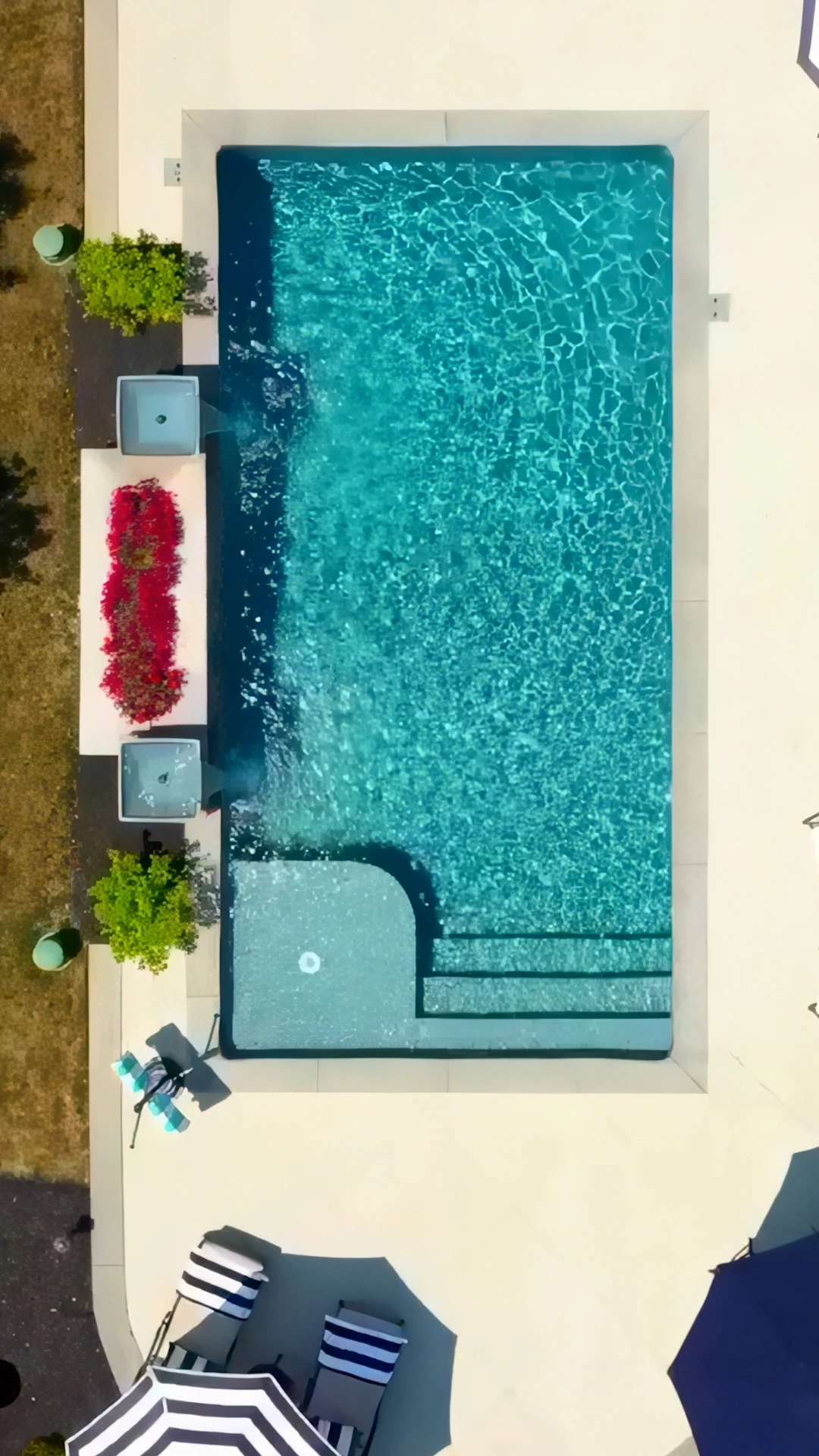
Surround Materials That Match a Modern-Farmhouse Exterior
This is the choice that determines whether the feature looks bespoke or looks like a catalog item. The house itself is the reference. Four surround strategies work reliably on Milton modern-farmhouse exteriors:
Dry-stack granite or weathered fieldstone. If the house has a granite or fieldstone foundation veneer — common on builds from Peachtree Residential, Monte Hewett, and Loudermilk Homes — match the surround to the foundation. Use the same stone, the same coursing, and the same mortar color. The trough reads as a continuation of the foundation line. Budget $4,200–$6,800 for surround and cap on a 96-inch build.
Techo-Bloc Borealis or Mondrik. For a cleaner, more contemporary read — particularly on houses with cedar accents and minimal stone — a Techo-Bloc linear unit in Shale Grey or Chestnut Brown, capped in a 2-inch honed bluestone slab, is the single most efficient combination we install. $2,800–$3,800, fast to build, ages gracefully.
Corten weathering steel. The modernist choice. A 3/16-inch Corten plate shell, fabricated locally and left to weather to the rust-patina stage over the first 9–12 months, reads phenomenally well against white lap siding and a black metal roof. This is the most expensive option — $5,400–$7,900 for the shell alone — and it is the option that photographers and magazine editors will respond to.
Board-form concrete. The quiet option. An 8–10 inch thick board-formed concrete surround, finished with a honed top, picks up the board-and-batten rhythm of the house siding when poured with a horizontal plank pattern. $3,800–$5,200. Ages well in Milton’s Zone 8a freeze-thaw cycle — we seal with a penetrating siloxane and we’ve seen zero spalling on installations past year seven.
What we don’t spec on modern-farmhouse exteriors: stacked cultured stone, heavily rustic rounded river rock, terra-cotta tile, or anything with a Tuscan or Mediterranean read. These materials fight the architecture the same way a round pit does.
Integrating the Trough with Pool, Pavilion, and Outdoor Kitchen
On Milton estate lots — typically 1–5 acre AG-1 parcels — a linear trough almost never sits alone. It sits inside a larger outdoor-living composition that includes a pool, a covered pavilion, an outdoor kitchen, and often a pergola, plunge spa, or pool-house structure. The trough has to earn its location relative to all of those.
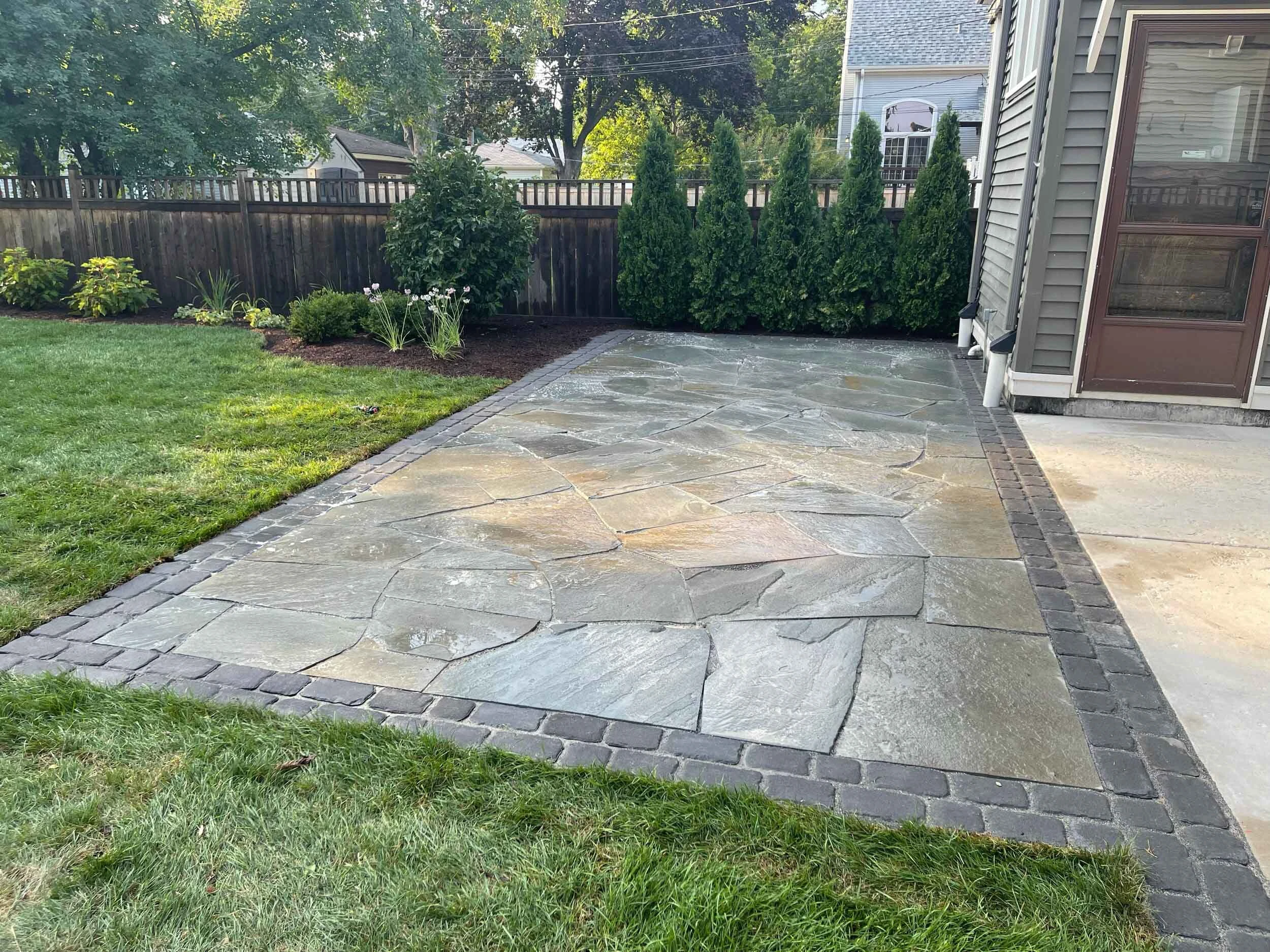
Three placement strategies we use repeatedly:
Terrace-edge plinth. The trough sits at the far edge of the terrace, paralleling the back of the lot. Sight lines from the house and from the pool both cross it. This is the most photographed placement because the flame reads as a horizon line behind the pool at dusk. Works on every lot orientation.
Pool-wall integration. The trough gets built into the raised wall of a perimeter-overflow spa or a beam-seat pool wall, with the flame facing the terrace. Shorter run (typically 48–60 inches) but the visual impact of flame over water at night is unmatched. Requires tighter coordination with the pool shell during shotcrete — we prefer to design both at once.
Pavilion-axis anchor. The trough sits on the axis centerline of a covered pavilion, between the pavilion and the pool. The pavilion fireplace and the linear trough share the same sight line — one covered, one exposed. On cold nights guests migrate between the two depending on wind direction. This is the most ambitious layout and, when the architecture supports it, the most successful.
Rule we won’t break: the trough length is always a whole-number multiple or clean fraction of the dominant deck dimension. A 96-inch trough on a 32-foot terrace edge reads as 1/4 of the terrace. A 60-inch trough on a 20-foot terrace edge reads as 1/4. Arbitrary lengths read as arbitrary.
Maintenance, Service, and What Goes Wrong at Year Three
A properly built linear trough on natural gas is a 15-year appliance with quarterly maintenance. The three service items that actually come up:
Jet cleaning. Spider webs and dauber mud inside the burner jets are the number-one cause of uneven flame on a Milton installation. We include a spring jet-cleaning visit in our service contract — compressed air, a soft brass brush, and a 10-minute burn test. $180 per visit standalone, or included on a service contract.
Media replacement. Tempered fire glass loses its reflective sparkle after 3–5 seasons of daily use. Budget $220–$360 to refresh the top 1-inch layer. Lava rock lasts indefinitely but loses its crisp black over the same period — most clients refresh it at year four or five.
Ignition-module failure. Hot-surface igniters are the one component that does fail on a predictable curve — roughly 2,500 ignition cycles, or about 4–6 years on typical use. Replacement module is $280 plus a one-hour service call. We keep AWEIS modules in truck stock.
What we don’t see on linear troughs, specifically, is the failure mode that plagues round pre-fab gas pits: thermal-shock cracking of the surround. The linear form distributes heat along a longer axis, and a properly flanged steel pan isolates the thermal load from the masonry entirely. Round pre-fab units concentrate all of that heat on a small refractory disk — which is why the bowls crack at year three and the units end up on Facebook Marketplace by year five.
What the Finished Piece Does for Milton Resale
We pay attention to what appraisers and listing agents say about our work when the house eventually trades. Three consistent observations on Milton modern-farmhouse builds with integrated linear troughs:
First, the feature reads as architectural in listing photos rather than decorative. Agents describe it as “outdoor room” or “terrace feature” rather than “fire pit,” and that reframing matters. Appraisers weighting outdoor-living builds in the $1.4M–$3.2M Milton resale bracket typically give 60–80% of installed cost back on appraisal — meaningfully higher recovery than on comparable round pits or modular stone fireplaces.
Second, the photography is better. Dusk shots — which are the shots that sell the house — read as magazine-quality when the flame is a horizontal line rather than a circle. Every agent we’ve worked with in Milton now asks for a dusk photo session with the trough lit as part of the listing package.
Third, the feature ages well. Modern farmhouse as a style has shown durability past the “trend” phase, and linear fire features have shown no sign of feeling dated. A round pit on a rustic patio is a 2010 build signal. A linear trough on a modern-farmhouse terrace is a 2020s signal and reads correctly for at least the next decade.
Linear gas fire troughs and estate outdoor living across 20+ cities within 30 miles of Winder, GA
If your Milton modern-farmhouse terrace is ready for a fire feature that matches the architecture, we’ll survey the site, pull the creek-buffer overlay, and price the build — burner, surround, ignition, and gas run — before you sign anything.