
A homeowner in Avalon-adjacent luxury townhomes called us in March 2024 — contemporary stucco façade, 14-foot sliders across the rear elevation, and a circular stacked-stone fire pit a previous contractor had left parked in the middle of the travertine like a medieval relic. It was the wrong object for the architecture. We replaced it with a 72-inch linear gas fire trough, and the backyard read correctly for the first time since the house was built.
That call is not an isolated one. Since 2018, modern-transitional architecture has taken over a meaningful share of new construction and high-end remodels across Alpharetta — clean horizontal lines, oversized windows, contemporary stucco with steel accents, low-slope rooflines, and rear elevations built around the view rather than around the hearth. Round stone fire pits do not belong in those backyards. They fight the architecture, they crowd the seating layout, and they visually drop the entire hardscape back to a 2005 aesthetic the house itself no longer speaks.
The fix is a linear fire trough. A long, low, rectangular gas feature — usually a Warming Trends Crossfire burner set in a steel pan, topped with crushed fire glass or black lava media, recessed into a concrete or stone pedestal. It is the fire-element equivalent of the sliding glass door: horizontal, geometric, quiet until lit.
This post is about why that form has taken over in Alpharetta specifically, what it actually costs installed, the gas and electrical work that happens under the hardscape, how the Windward and Country Club of the South ARBs treat the approval, and the five technical decisions that separate a trough that still looks correct in year 10 from one that gets rebuilt in year three. No rear-elevation photographs of our installations are included below because those projects are under client confidentiality, but every construction reference in this post comes directly from our own Alpharetta book of work.
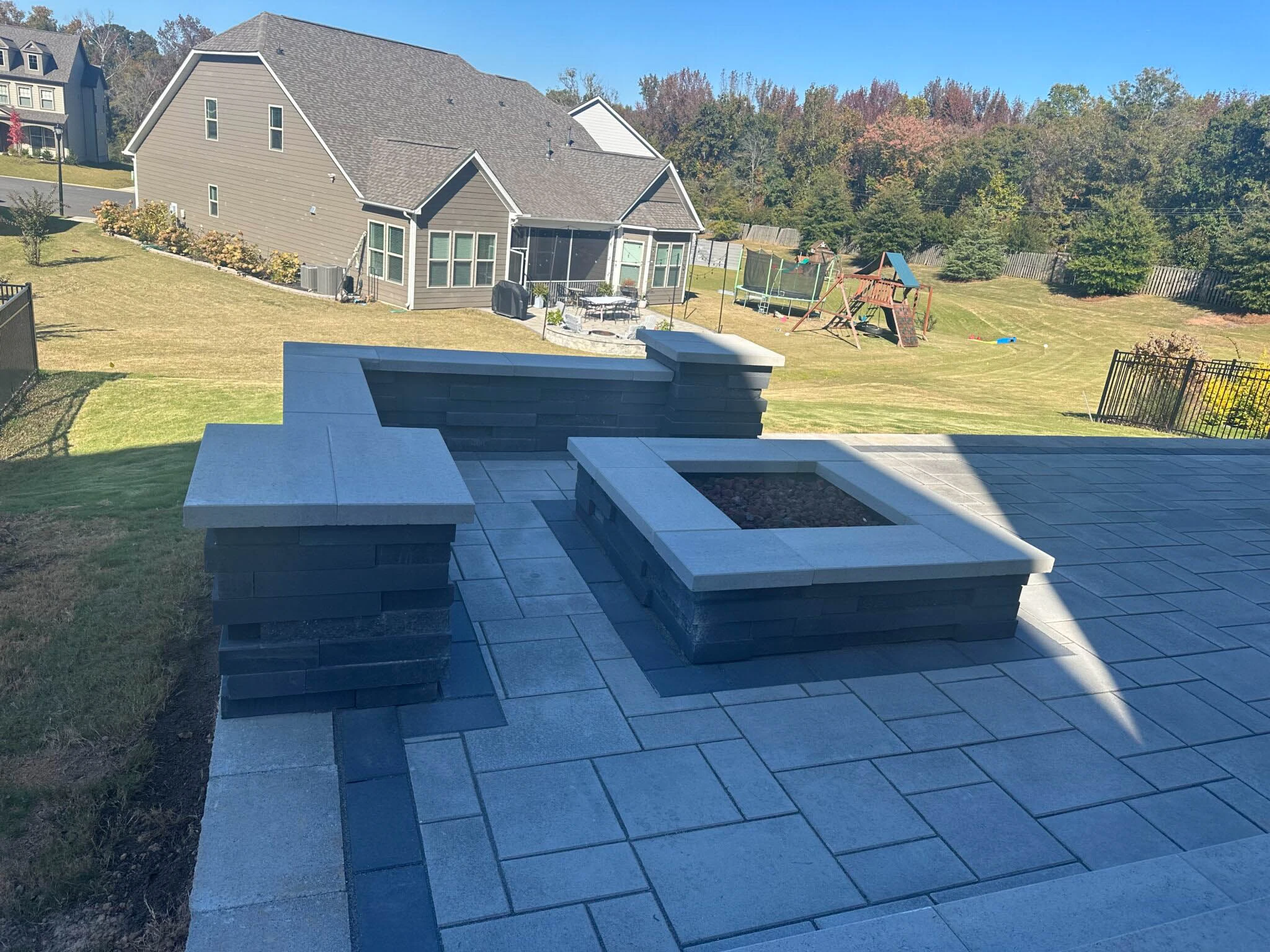
Why Alpharetta’s 2018+ Architecture Demands a Horizontal Fire Element
Drive through the newer pockets of Alpharetta — the infill builds around Avalon, the contemporary renovations carving their way through Windward, the ground-up custom homes in Cambridge Parks and Hutchinson Farm — and you see the same design language repeat: steel-framed windows in horizontal bands, stucco fields broken by wood or stone accent panels, flat or near-flat rooflines, and rear elevations that treat the backyard as an extension of the interior floor plan rather than a buffer to it.
In architectural terms, every major line on those façades is horizontal. A round fire pit is a discrete point — a dot — dropped into a composition that otherwise reads as long unbroken lines. The eye sees it as misplaced before the conscious mind registers why. A 48-inch or 72-inch linear trough matches the rhythm of the architecture: the flame band echoes the window band, the pedestal echoes the foundation line, the whole feature sits on the deck the way the home sits on its site.
This is not an abstract designer’s argument. Resale data tracks it. Listing photography for contemporary homes in Country Club of the South, White Columns, and the newer Deerfield custom builds shows linear fire troughs in roughly 70% of premium listings since 2022. Our own Avalon-adjacent townhome clients are running 45% linear-trough installs versus 55% round pit since the start of 2023 — and that 45% is concentrated almost entirely in the newer construction pocket, not in the older 1990s subdivisions like Haynes Manor or Martins Landing where Craftsman and traditional façades still dominate.
If the home is traditional Southern brick with gabled rooflines, a round stacked-stone pit still reads correctly. We build those too, and we push back on clients who want a linear trough in a backyard where the house has a steep gable and divided-lite windows — the feature will not match the building. Architecture first. The fire element is an accessory to the house, not the other way around.
What a Linear Fire Trough Actually Costs in Alpharetta — 48″ and 72″ Builds
Fully installed pricing for a linear gas trough in Alpharetta currently falls into two clean tiers, driven almost entirely by burner length and the stone or concrete surround the client specifies. These figures reflect our 2024-2025 pricing on completed projects within 10 miles of downtown Alpharetta.
The 48-inch build runs $6,800 to $8,400 installed. That includes a Warming Trends Crossfire CFBL48 brass burner, 316 stainless steel pan, electronic piezo or remote ignition, flex gas line and shutoff valve, pedestal construction in stacked stone or stucco-wrapped block, concrete or travertine cap, and crushed fire glass or 3/4-inch black lava rock media. A 48-inch trough is the right scale for a backyard with 4-6 lounge seats clustered around it — the most common configuration on Alpharetta lots in the 0.3 to 0.5-acre range.
The 72-inch build runs $9,800 to $12,400 installed. Same burner family — the CFBL72 at 250,000 BTU/hr — same pan-and-ignition architecture, larger pedestal. This is the scale that reads on an estate lot (Country Club of the South, larger Hutchinson Farm lots), or on a narrow urban-townhome deck at Avalon where the trough runs the full width of the seating area as an architectural line rather than an object. The upcharge over the 48-inch is not linear with length — the burner, pan, and media each scale up, but so does the gas line sizing, the ignition system, and in some cases the foundation under the pedestal.
What pushes a trough above $12,400: full-travertine pedestal and cap in a single-slab cut (adds $2,800-$4,200 depending on slab source), integrated glass wind screens on all four sides ($1,600-$2,400), Bluetooth/smart-home ignition control ($900-$1,400), or a site that requires more than 60 feet of gas line run from the meter.
The gas infrastructure is its own line item and it tends to catch homeowners off guard. A dedicated 1/2-inch CSST gas line with exterior shutoff valve and manifold tap — run from the meter or from an existing tee at the house, trenched under the deck, sleeved through the pedestal — runs $1,400 to $2,200 on most Alpharetta lots. Longer runs from meter-side-of-house to far-corner-of-backyard can push $2,600. This cost is not in the fabricator’s trough quote. If a quote looks abnormally low, gas line work is almost always what has been omitted.
Electronic ignition adds another $480 to $920 depending on system. Manual match-light troughs still exist and still work, but the expectation in this market is push-button or remote ignition — a match-light feature in a $1.8M home in Windward feels retrograde, and resale appraisers notice.
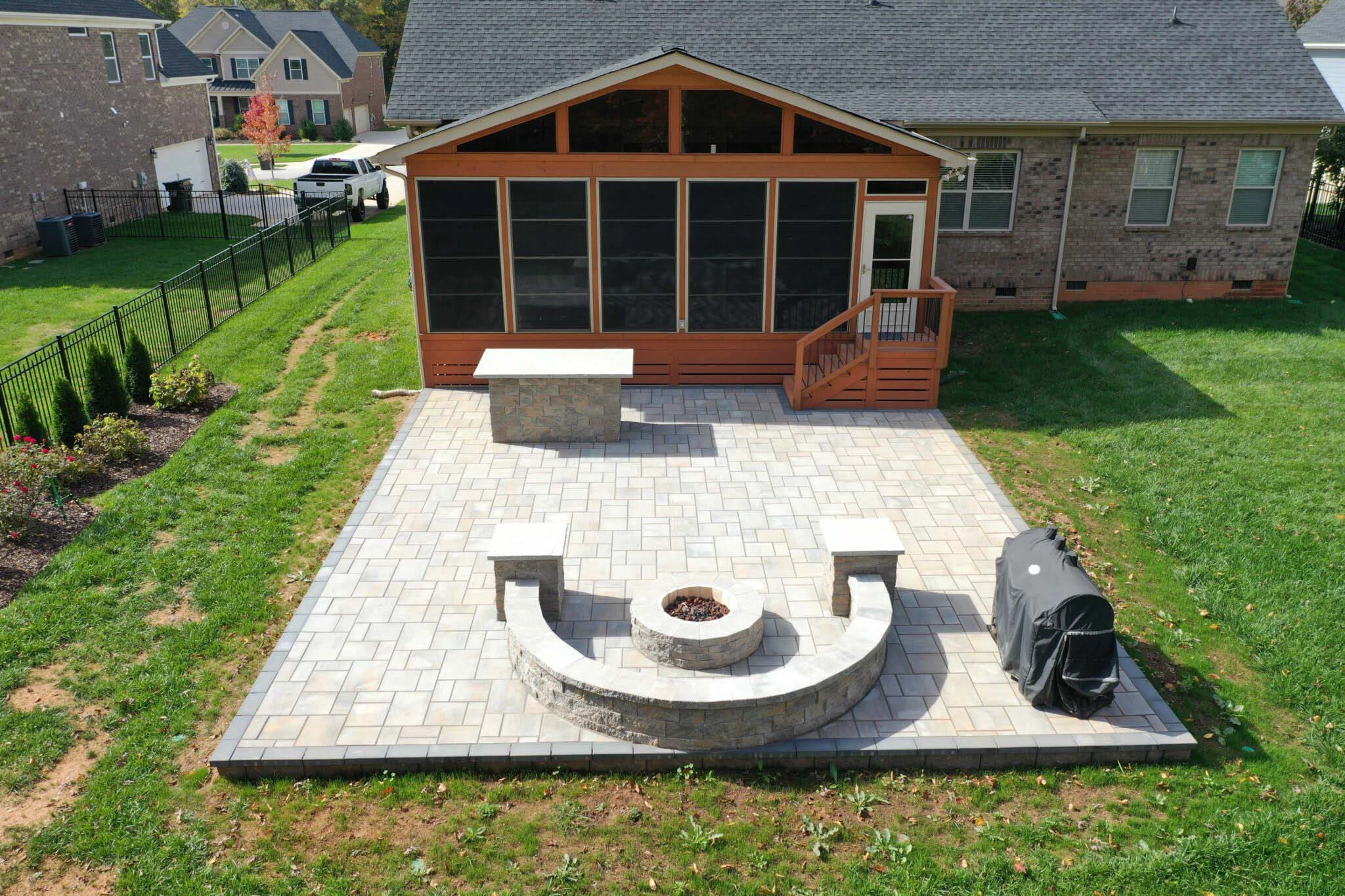
The Warming Trends Crossfire Burner — Why Brand Matters Here
There are a dozen linear gas burners on the market and three or four of them will work. Only one belongs in a modern Alpharetta backyard built to last the life of the house, and it is the Warming Trends Crossfire CFB series. The argument for specifying that burner by name — and refusing substitutions — comes down to four things.
Flame geometry. The Crossfire uses a patented branching brass tube design that injects air into the fuel upstream of the burner ports. The result is a tall, bright, turbulent yellow flame that looks like a real wood fire. A standard stainless H-burner or ring burner produces a short, blue, gas-appliance flame — the visual equivalent of a kitchen cooktop. In a feature that costs $8,000 installed and exists primarily to be looked at, the difference is not optional.
BTU efficiency. Crossfire burners produce more visible flame per BTU because they pull atmospheric air to enrich the mixture. A CFBL48 runs 130,000 BTU/hr and produces a flame profile that a 200,000 BTU/hr H-burner cannot match. Lower gas consumption, higher visual output — it compounds over every evening the feature is lit.
Brass vs. stainless. Crossfire burner assemblies are brass. Brass resists the corrosion cycle that kills stainless ring burners in Georgia’s freeze-thaw climate, where condensation collects inside the pan every winter. We have pulled 8-year-old stainless H-burners out of Alpharetta backyards that were eaten through at the port openings. The brass equivalents, in identical conditions, come out functional.
Warranty structure. Warming Trends offers a lifetime warranty on the brass burner itself. No other major brand does. In a USDA Zone 8a climate that cycles through ~20 freeze events per year, that warranty is not marketing — it is the difference between a burner that gets replaced at year 5 and one that gets replaced at year 25.
We do not install cheaper burner brands in Alpharetta trough builds. If a client asks us to value-engineer the burner down to save $400, we decline and explain why. That is the one line item on the entire project where cost-cutting is a false economy.
Gas Line, Permit, and ARB Approval — The Alpharetta-Specific Path
Alpharetta is an incorporated city inside Fulton County, which means permits for in-city work go through the City of Alpharetta Community Development office at 2 Park Plaza — not through unincorporated Fulton County. That matters. The city’s permit turnaround for a gas-line-and-fire-feature scope is typically 7-12 business days. Unincorporated Fulton County, for the same scope, is 14-21 business days. Work in the city moves faster.
The gas line requires a permit in all cases. The fire feature itself may or may not, depending on whether it is classified as a site structure; we submit both together as a single combined application to avoid any ambiguity. A licensed Georgia gas fitter has to pull and sign the gas portion — we have two staff gas fitters on our crew and a standing relationship with Alpharetta’s inspectors, so the coordination is internal.
The piping itself is typically CSST sized to 1/2-inch ID for a 48-inch trough and 5/8-inch or 3/4-inch for a 72-inch, with a full-port exterior shutoff valve within 3 feet of the feature per Alpharetta code. The line is sleeved through the pedestal in rigid conduit, pressure-tested at 25 PSI for a minimum of 15 minutes before final connection, and inspected before the stone veneer or stucco is applied. That order matters — if the veneer goes on before the pressure test, the inspector will have us cut it off to verify the joint work.
Utility coordination: Most of Alpharetta is on Georgia Power. The northern Alpharetta/Milton border includes a small Sawnee EMC service footprint. If your home is on Sawnee EMC, the inspection calendar for any electrical work tied to the ignition system runs a different cycle than Georgia Power — usually adding 3-5 business days to the final trim inspection. We check the meter tag at the site walkthrough before quoting a timeline.
Then there is the ARB layer. Windward runs an Architectural Review Board that typically takes 3-4 weeks to review and approve a rear-yard hardscape modification. Country Club of the South runs a similarly strict ARB with a 3-week review cycle and an additional site-plan review for any permanent gas infrastructure. White Columns is usually 2-3 weeks. Hutchinson Farm and Cambridge Parks are lighter-touch, typically 10-14 business days.
Our standard timeline on an Alpharetta linear trough build — from signed contract to lit burner — is 6 to 9 weeks in an ARB community, and 3 to 5 weeks outside of one. Clients who want to host a fall party in October need to sign in early-to-mid August. Clients targeting a holiday season light-up should sign by mid-September. We do not compress those timelines because the stages that look slow — ARB review, permit review, gas inspection, pressure test — are the stages that protect the finished feature from failing three years in.
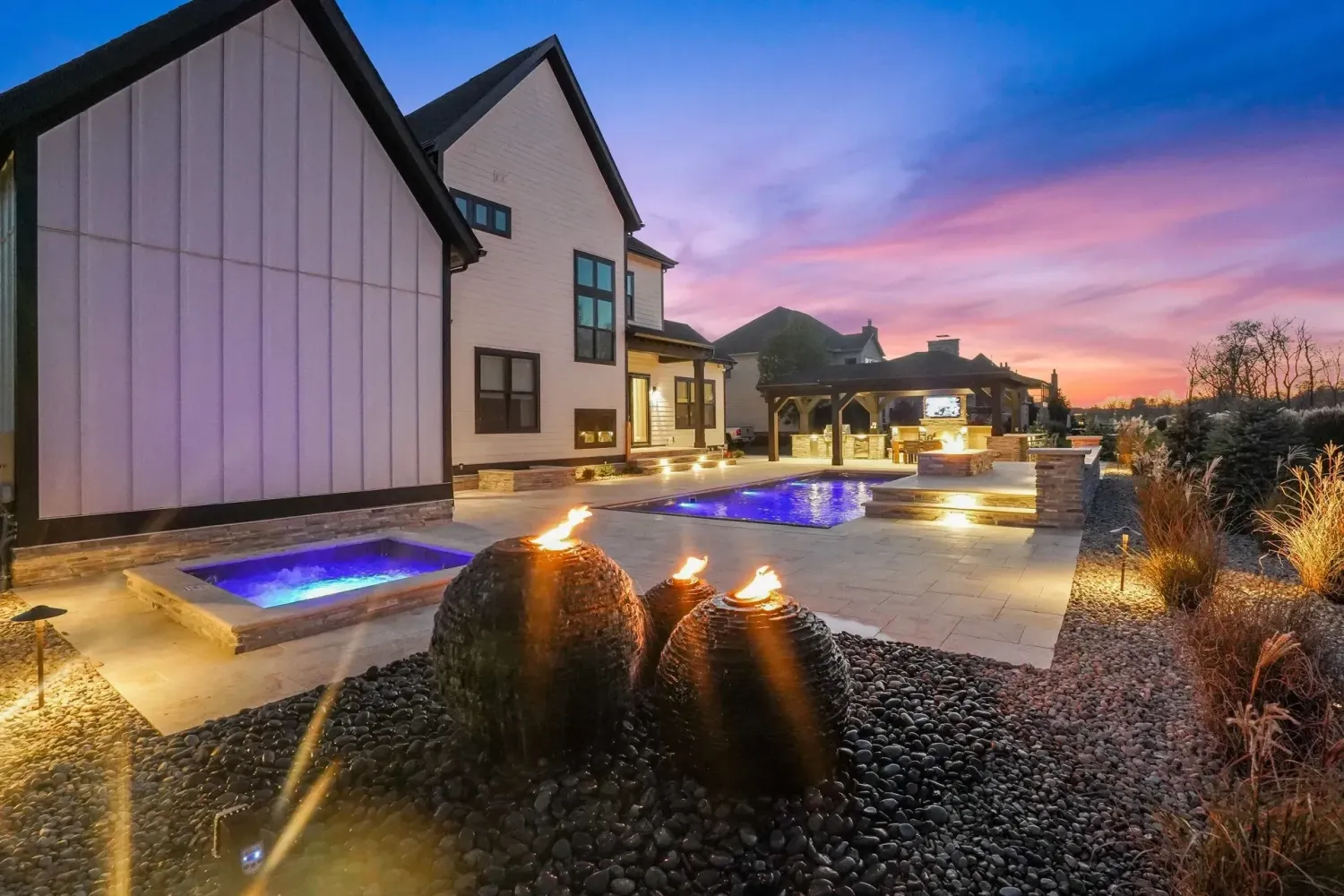
Glass Wind Screens, Media Choice, and the All-Season Detail
A linear trough without wind screens is a six-month feature. With properly specified glass screens it is a ten-month feature, and in mild Alpharetta winters it lights comfortably through January. Zone 8a gives us roughly 20 freeze events per year and summer highs of 89-94°F — a climate that wants the trough lit from September through May if it is protected from wind.
We specify tempered low-iron glass at 3/8-inch or 1/2-inch thickness, mounted in low-profile stainless clips set into the pedestal cap. Low-iron glass is clear; standard float glass is faintly green and reads as tinted against the flame. The clips are dimensioned to allow thermal expansion — a common rookie failure is bedding the glass tight into the stone, which cracks at the first 50-degree temperature swing. Give it 1/8-inch breathing room at every edge.
Screen height matters. A 9-inch screen is the architectural minimum for wind protection. A 12-inch screen reads as intentional design and provides full shelter against the 8-12 mph gusts that whip across open backyards on the GA-400 corridor between exits 9 and 12. On the Avalon townhome decks, where surrounding buildings accelerate wind between structures, 12-inch minimum is the right answer.
Media choice is where clients often overthink the decision and installers often under-think it. There are three working options. Crushed fire glass in quarter-inch or half-inch shards — reflective, clean, available in roughly 25 colors — is the contemporary default. Black lava rock at 3/4-inch gives a textural, less-reflective surface that reads more like wood embers; it matches transitional architecture well. Ceramic log sets designed for linear burners exist but read wrong on modern façades; we do not specify them in Alpharetta modern builds.
The media has to be sized correctly — too small and it packs into the burner ports and chokes the flame; too large and the flame punches through in channels and the media does not glow. For the Crossfire CFBL series we use roughly 25 to 35 pounds of media per foot of burner length, distributed evenly, with the burner ports left completely clear. That is a maintenance-annual reminder: after a season of use, rake the media off, vacuum the pan, verify port clearance, replace any pieces that have cracked from thermal cycling.
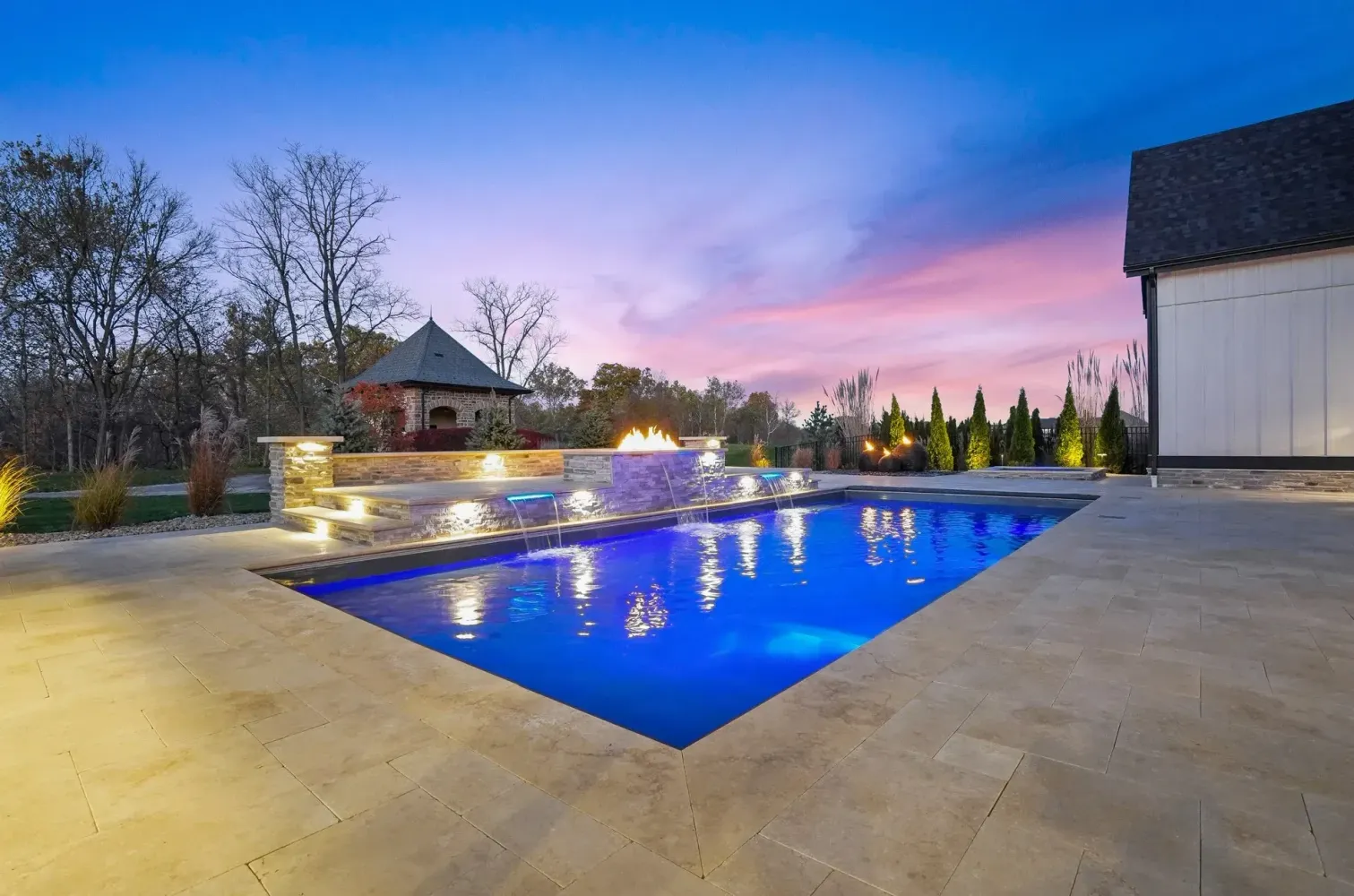
Pedestal Construction — What Happens Below the Flame
The visible flame is 5% of the engineering. The other 95% is the pedestal — its foundation, its drainage, its integration with the deck, its thermal separation between the burner pan and the stone veneer, and its long-term behavior in Alpharetta’s Cecil-series Piedmont red clay. Skip any of those details and the pedestal cracks at year 4 or 5, the stone veneer spalls, and the trough has to be rebuilt from the deck up.
Foundation first. Alpharetta sits on Cecil-series clay across most of its residential footprint, with pockets of Appling sandy loam in older farm-conversion tracts. Cecil clay has moderately high shrink-swell behavior — it expands when wet and contracts when dry, which cycles every spring and fall. A pedestal built on a 4-inch concrete pad directly on that soil will crack within 3-4 seasons. We pour a 6-inch reinforced concrete footing on 8 inches of compacted crushed stone, extending the footing 8 inches beyond the pedestal footprint in every direction, with rebar cages at the corners. The stone layer decouples the pedestal from the shrink-swell cycle. This detail is not optional in this soil.
Drainage second. A linear burner pan collects rainwater every storm. If the pan has no drain path, the water sits against the brass burner, the ignition electrodes, and the media — and in a freeze event, it expands and cracks the pan welds. Every trough we build has a 1/2-inch drain hole in the low corner of the pan, piped through the pedestal to daylight or to a gravel bed below the deck, protected with a rodent screen. An open drain is a $40 part and it protects a $3,400 burner. Skip it and the burner is a consumable.
Thermal separation third. The burner pan gets hot. The stone veneer and the sealants behind it do not like sustained direct heat. Between the pan and the pedestal core we install a 1-inch ceramic fiber board thermal break on all heat-exposed faces, extending 2 inches beyond the pan footprint. This keeps the stone veneer substrate at a stable temperature and protects the thinset bond. Transitional builds in Ashebrooke and Brookhollow without this detail have shown stone face spalling at year 3-4; with the thermal break, we have not seen one fail in 8 years of installations.
Integration with the deck fourth. The pedestal should tie into the deck system at the slab level, not bear on the finish travertine. If the pedestal sits on finish stone, every freeze-thaw cycle transmits differential movement into the trough. The right detail is a pedestal that shares its footing with the deck slab, with the finish travertine butted to the pedestal base through a thin flexible caulk joint. This is invisible when complete and it is the difference between a trough that is still flat in year 15 and one that has telegraphed cracks up through the cap by year 6.
Five Decisions That Separate a Year-1 Trough from a Year-15 Trough
The engineering above collapses to five decisions the client makes before construction starts. Get these five right and the trough will outlive the hardscape around it. Get any of them wrong and you are paying to rebuild in half a decade.
- Burner brand. Warming Trends Crossfire, brass, the correct length for the deck. Not a stainless ring. Not an off-brand H-burner. This is the one spec that is not negotiable.
- Pedestal foundation. 6-inch reinforced concrete on 8 inches of compacted crushed stone, with the footing oversized past the pedestal footprint. In Cecil clay, shortcuts here fail on a predictable calendar.
- Gas line sizing and shutoff access. Dedicated 1/2-inch CSST minimum for a 48-inch, 5/8-inch or 3/4-inch for a 72-inch, full-port shutoff within 3 feet of the feature, pressure-tested at 25 PSI before veneer.
- Media sizing and pan drainage. Correct weight of media per foot (roughly 25-35 lbs/ft for Crossfire), clear burner ports, and a 1/2-inch pan drain piped to daylight. These two details together prevent the majority of year-3-to-5 trough failures we see on callouts.
- Wind screens and scale. Tempered low-iron glass at 9-12 inch height, thermal-expansion clips, and the feature sized to the deck — 48-inch for standard Alpharetta lots, 72-inch for estate-scale or narrow-wide townhome decks. A 48-inch trough on a 60-foot-wide estate deck reads as undersized regardless of quality. A 72-inch trough on a compact townhome deck reads as overbearing. Scale is architectural, not arbitrary.
We review all five with every Alpharetta linear-trough client during the design walk, in writing, before a contract is signed. If the client disagrees with the burner spec or wants to value-engineer the pedestal foundation, we would rather not take the project than build it wrong. There are plenty of contractors in Metro Atlanta willing to install a cheaper burner on a thinner foundation — that work shows up in our pipeline 4 to 6 years later as a rebuild quote, and the total cost of “saving” $1,200 up front ends up being $9,400 in rebuild work.
Linear gas fire troughs and modern fire features across 20+ cities within 30 miles of Winder, GA
From Avalon-adjacent townhomes to Country Club of the South estates, we build linear fire troughs, round pits, and integrated pool-side fire features engineered for Piedmont red clay and Zone 8a freeze cycles.