
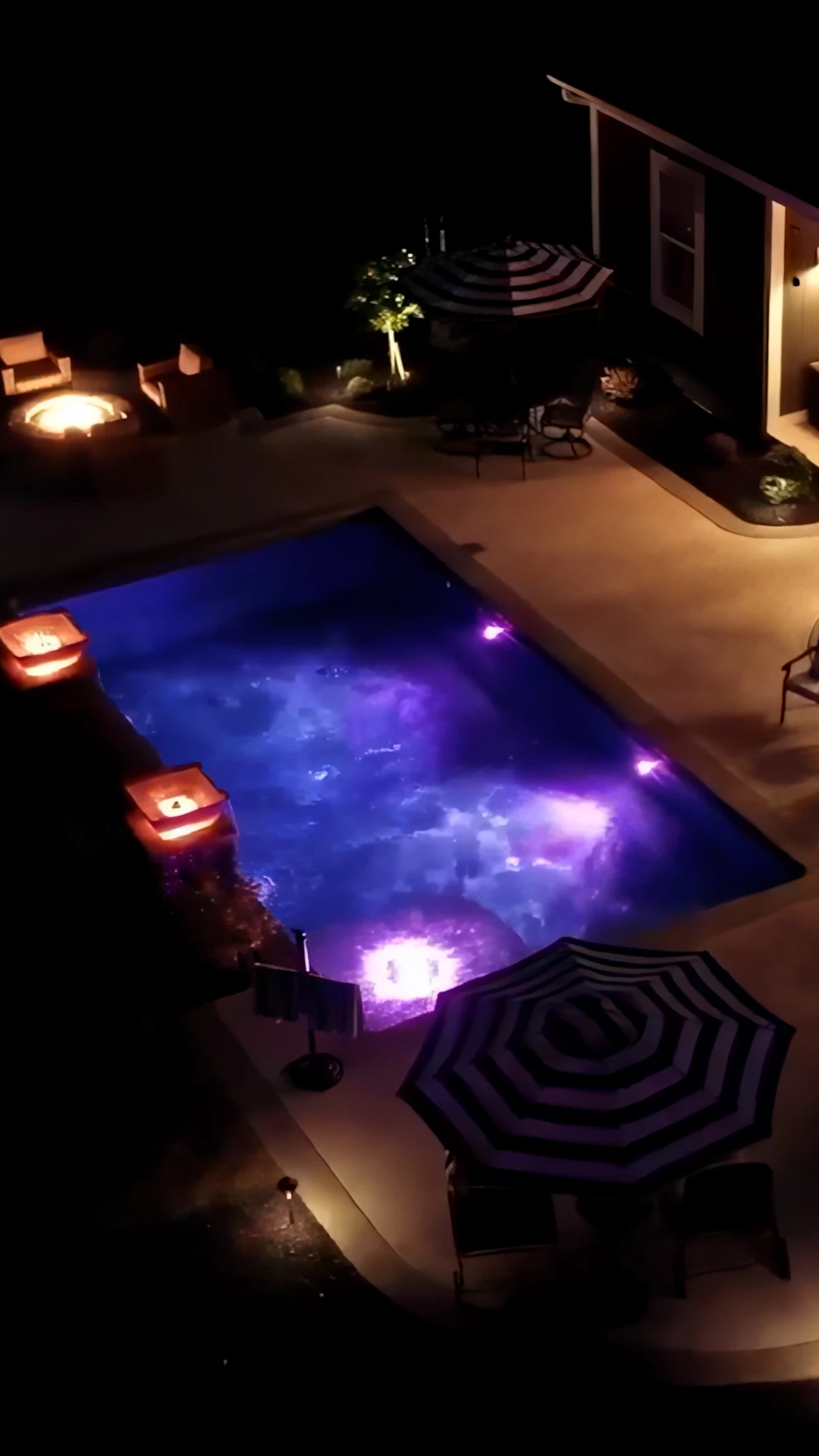
The client’s Burnt Hickory lot sat under a 60-foot white oak canopy so dense that by 7:45 p.m. in July the pool deck read as a gray silhouette — even with the house’s soffit cans on. We solved it with three separate lighting zones, a unified controller, and four pre-programmed scenes. This is the project, the parts list, and the reasoning.
We get this call from East Cobb more than any other Marietta submarket. The builder-spec pool lighting — a single Pentair fixture on the deep-end wall and a couple of soffit floods aimed at the coping — simply does not keep up with the mature tree canopy that defines neighborhoods like Indian Hills, Atlanta Country Club, Walton Woods, and Burnt Hickory. When ambient dusk light is already filtered by 80 feet of oak and poplar, one underwater LED can’t carry the whole backyard. It washes the waterline and leaves the rest of the yard dark.
The case study below documents a custom pool build we completed at a home off Lower Roswell Rd, 30068 — a 0.94-acre lot with roughly a 4-ft grade drop from the back patio down to the pool bench. The client had lived with a 2004-vintage pool for eleven years and finally tore it out. The brief was not “replace the pool.” The brief was “make the backyard usable after dark.” Here’s how we did it.
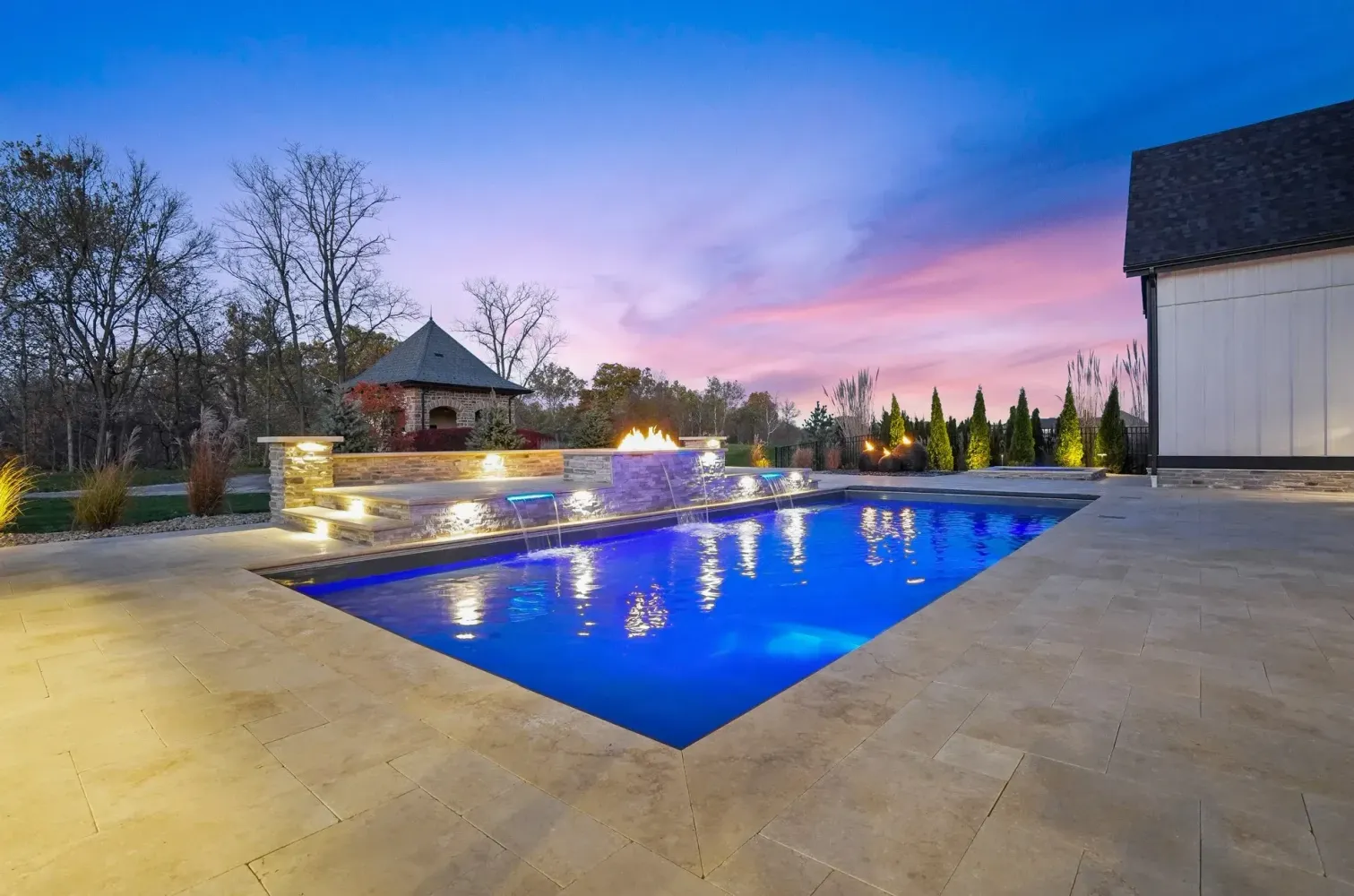
Why One Light Was Never Going to Be Enough on This Lot
Marietta sits at roughly 1,118 ft elevation, on the Piedmont plateau, with Kennesaw Mountain anchoring the north edge at 1,808 ft. That matters for lighting design in one specific way: older East Cobb subdivisions were platted in the late 1960s and 1970s, and the original developers planted — or left standing — the mature hardwoods we see today. Fifty years later, those trees are 60 to 80 ft tall with full crowns. Drive through Indian Hills Country Club at 8 p.m. in June. It’s darker at the curb than it is two miles away in a 2010-era subdivision with smaller, younger plantings.
When we ran a light meter on the client’s existing deck before demo, the reading at 9:00 p.m. was 0.08 foot-candles — roughly what you’d measure under a full moon in an open field with no trees at all. A single underwater LED can bring the pool itself up to maybe 3-5 foot-candles at the surface. But it does nothing for the deck, nothing for the outdoor kitchen, and nothing for the tree line that frames the whole experience. The yard still reads as a black void with a glowing blue rectangle in the middle.
This is the core argument for three-zone design on a canopy lot: the pool is one element in a three-element composition. Lighting the pool alone is like hanging one spotlight in an art gallery and calling it a show. The other two zones — deck accent and landscape uplight — do the heavy lifting of actually making the space feel habitable.
The foot-candle delta: Before, 0.08 fc at the deck surface. After, an average of 1.8 fc across the pool deck and 0.6 fc at the tree canopy uplight wash — a 22x jump in usable light without any single fixture feeling bright or glary.
Zone 1 — Pool Interior: Three Pentair IntelliBrite 5G LEDs
The pool is a 18 × 36 ft rectangle with a 6-ft tanning ledge on the shallow end and a 6.5-ft deep end at the far wall. At that footprint, one fixture is not enough. We specified three Pentair IntelliBrite 5G color LEDs at roughly $1,200 each installed, placed as follows:
- One on the deep-end wall, aimed along the pool’s long axis — the workhorse, the fixture you see from the house.
- One on the tanning-ledge wall, shallow-end, washing the ledge itself so the bench reads as a distinct feature at night.
- One mid-sidewall on the long run, filling in the center of the pool so it reads as fully illuminated rather than having hot-spots at each end.
The IntelliBrite 5G carries roughly a 30,000-hour lamp life and draws about 70 watts per fixture — all three running at full output pull less than a single incandescent floodlight from the 1990s. More importantly for a 30068 lot on Cobb EMC service, the combined load on the pool sub-panel is low enough that we didn’t need to upsize the 240V feed. (Note for anyone south of Windy Hill Rd: if you’re inside the Marietta city limits you’re likely on Marietta Power, not Cobb EMC — different utility, different outage patterns, same 240V spec at the meter.)
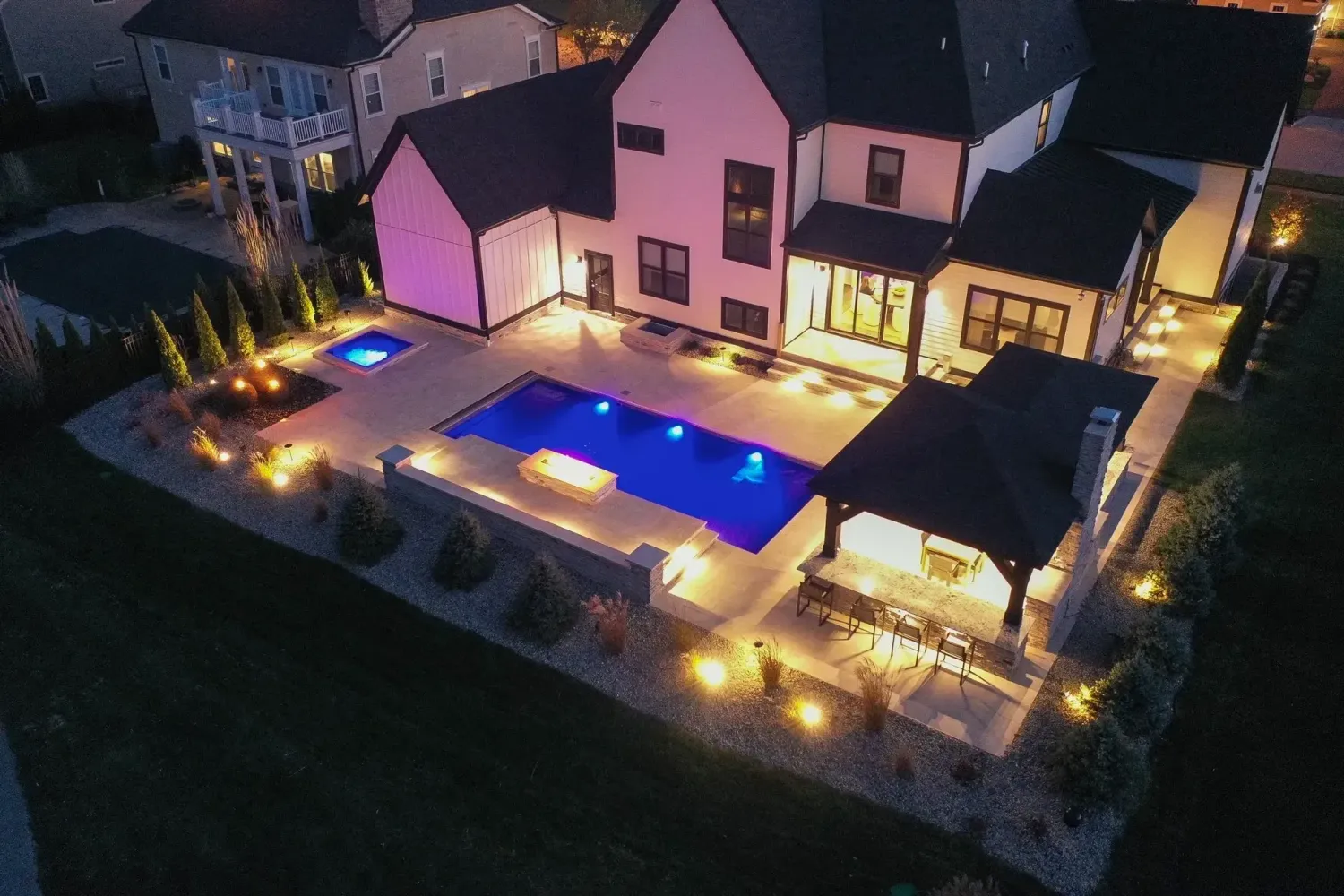
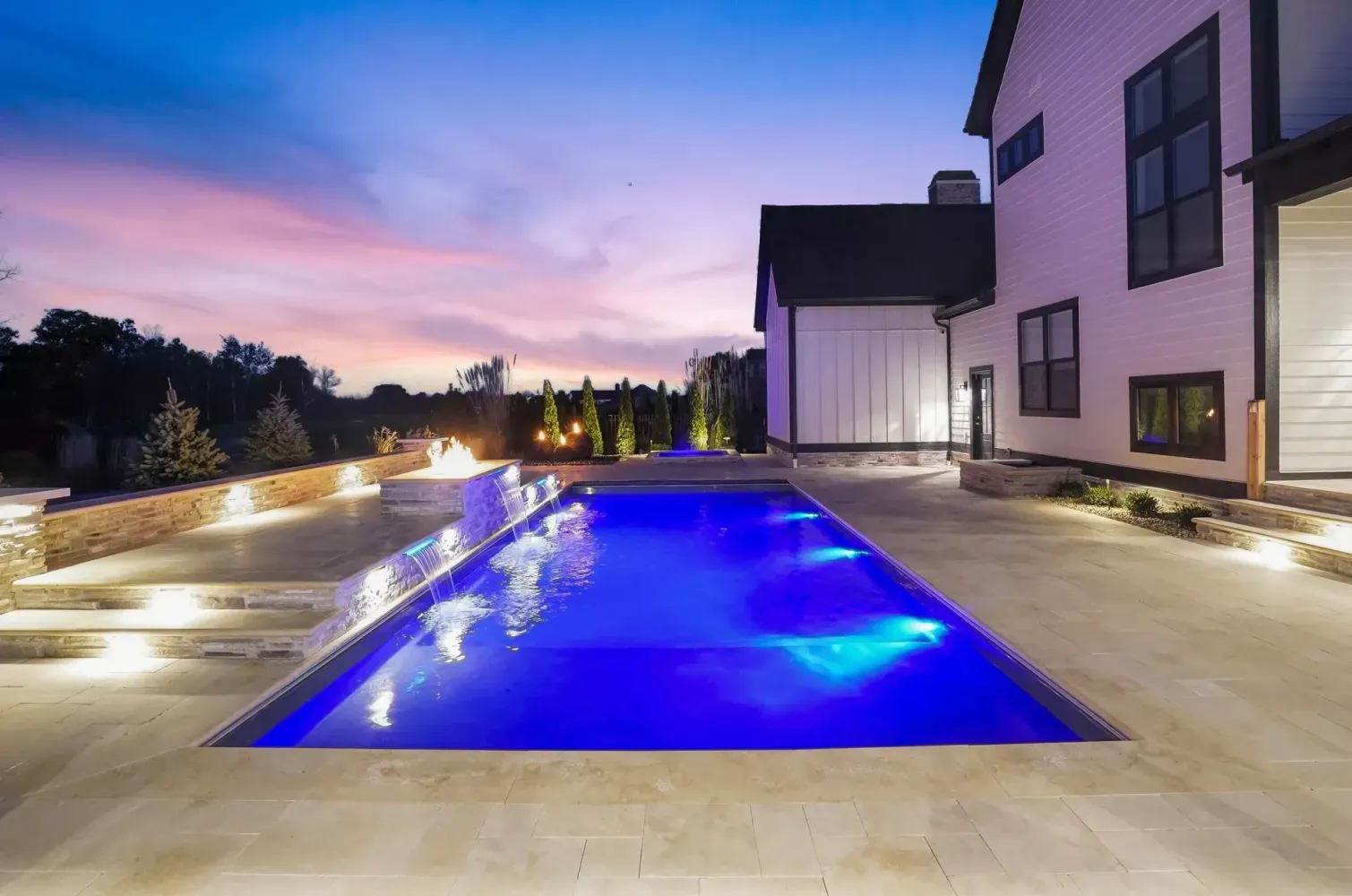
Color choice matters here and is the single most under-specified decision in builder-grade pools. The IntelliBrite 5G can run fixed white, fixed blue, a programmed color show, or any of seven preset scenes. For East Cobb clients under tree canopy, we default-program Zone 1 to a warm white (~3000K effective) for the “welcome” and “dinner” scenes, a pure deep blue for the “party” scene, and a dim amber for the “pool” scene — the scene used when someone is actually swimming laps and doesn’t want disco colors. Preset-color pool lighting in a heavily shaded yard reads as garish. Warm white reads as hospitality.
Zone 2 — Deck Accent: Twelve FX Luminaire LED In-Grades
This is the zone builders skip. And it’s the zone that makes a pool deck feel like a room after dark rather than a slab with a hole in it.
We placed twelve FX Luminaire brass in-grade fixtures at roughly $240 each, spaced on 6-ft centers around the pool coping and another four across the outdoor kitchen area. Brass, not aluminum — Piedmont red clay soil holds moisture against the housing, and aluminum fixtures corrode at the base within 4-6 years on Cobb County lots. Brass will outlast the pool shell.
The in-grades sit flush with the travertine deck, angled 15° from vertical, washing up the pool wall and across the coping. At night, the deck itself becomes the light source. From the house, you don’t see individual fixtures — you see a glowing perimeter. From the pool, you don’t see any fixture at all because the housings are below eye level and the optics are shielded.
A note on drainage. Marietta’s Piedmont Cecil-series clay does not drain well. Every in-grade fixture we install in Cobb County gets a 6-inch gravel drainage sump beneath it — non-negotiable. We’ve pulled builder-spec fixtures out of 10-year-old decks where the housing was sitting in a standing mudpuddle for a decade. The LED driver corrodes, the gasket fails, and the whole fixture has to be cut out of the deck. Specifying drainage up front is a $40 per-fixture upcharge that saves $1,500 in cut-and-patch masonry later.
Zone 3 — Landscape Uplight: 18 to 24 FX Luminaire Tree Fixtures
Zone 3 is the zone that converts this from a pool project into a backyard project. We specified 22 fixtures on this particular lot, distributed as follows:
- Six FX Luminaire PB (PathBrite) LEDs at $140 each washing the landscape beds along the pool’s long wall.
- Twelve FX Luminaire RF (RoofPeak Flood) LEDs at $200 each, angled up into the 60-80 ft oak and poplar canopy.
- Four FX Luminaire moonlight fixtures mounted 35-40 ft high in the crowns of two large white oaks — downlights that cast dappled shadow patterns on the deck, the way actual moonlight does.
The moonlight fixtures are the detail East Cobb clients remember. Mounted high in a tree, aimed down, they simulate moonlight filtering through leaves. On a windy night the shadow pattern moves across the deck. It’s the single most-complimented feature on every canopy-lot project we’ve ever finished.
The tree uplights are what convert a black tree line into a cathedral wall. In Atlanta Country Club, on Johnson Ferry Rd, on the older blocks of Indian Hills — the trees are the architecture of the backyard. Lighting them is how you honor that architecture. A backyard with uplit trees reads 3x the visual size of the same backyard with dark trees. You’re reclaiming the canopy as part of the usable space rather than letting it become a void overhead.
The Controller: Lutron RadioRA 2 vs. Pentair IntelliCenter
Three zones need one brain. Otherwise the homeowner is walking to three separate panels — pool equipment pad, landscape transformer, deck panel — every time they want to go from dinner mode to pool mode. That’s not a system. That’s three systems pretending to be one.
We price Lutron RadioRA 2 at $4,800-$6,200 installed for a pool-and-landscape scene controller, or Pentair IntelliCenter at $3,400-$4,200 when the client is comfortable running the landscape zones through the pool controller’s auxiliary circuits. Both work. The trade-off:
- Lutron RadioRA 2: higher ceiling. Integrates with house interior lighting, motorized shades, HVAC. If the client has a smart home already, Lutron extends the existing system outdoors. Scene transitions are silky — a 30-second fade from “dinner” to “party” with every fixture on every zone ramping together.
- Pentair IntelliCenter: lower cost, pool-first. The pool equipment is already getting an IntelliCenter anyway for pump/heater/salt control. Adding scene control for Zones 2 and 3 through the aux circuits uses hardware the client was already paying for. The ceiling is lower — you can’t integrate with interior lights — but for a pool-focused project it’s the right answer.
On this Burnt Hickory project we specified Pentair IntelliCenter. The client didn’t have a Lutron system indoors, the outdoor kitchen was the only non-pool electrical feature, and the $2,000 savings went into two more tree uplights.
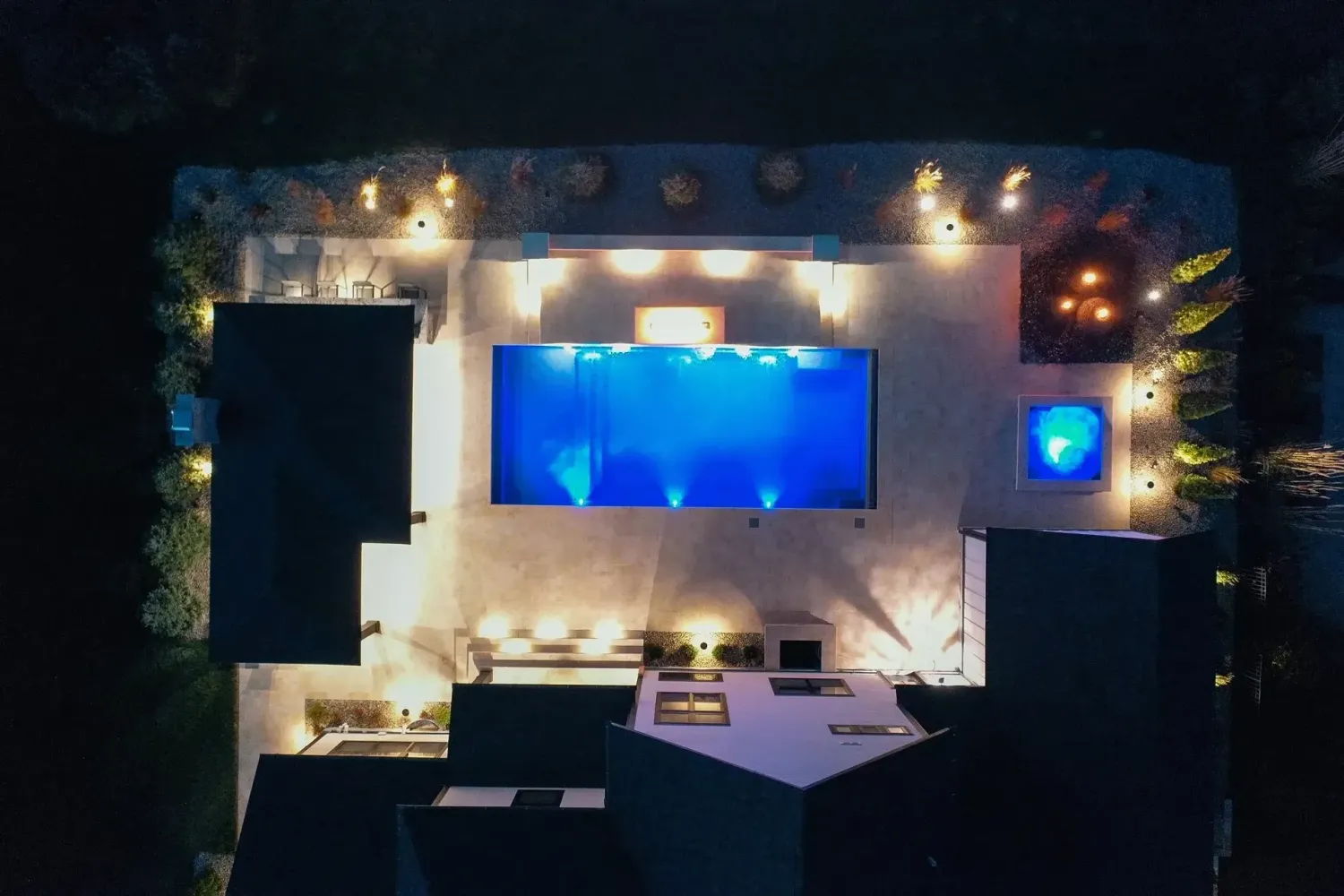
The Four Scenes: What the Client Actually Pushes
The system has infinite capacity. The client has four buttons. We pre-program four scenes and we explain each one to the homeowner on handoff day:
Welcome (push on arrival from work, 6:30-7:30 p.m.): Zone 1 at 40% warm white. Zone 2 at 30%. Zone 3 path lights only — no tree uplights. The yard reads quiet and hospitable. You can eat outside. You can walk to the pool bench. You’re not in “show” mode yet.
Dinner (push when the food goes on the table): Zone 1 at 50% warm white. Zone 2 at 60%. Zone 3 path lights plus four tree uplights at 40%. This is the scene for four couples at the outdoor dinner table. The trees have dimension. The pool is a warm glow, not a focal point. Nobody’s squinting.
Party (push when the guests arrive and it’s an event): Zone 1 at full deep blue. Zone 2 at 80%. Zone 3 full — all tree uplights, all wash fixtures, moonlights included. This is the social scene. The canopy is lit. The deck perimeter glows. The pool is electric blue. You can see faces.
Pool (push when someone is actually swimming): Zone 1 at amber (glare-reducing when you’re lap-swimming and looking up at ceiling). Zone 2 at 40% path-only. Zone 3 off entirely, no uplights. The swimmer isn’t blinded by colored pool light and isn’t distracted by the trees. This is the functional scene, not the showpiece scene.
The handoff rule: If the homeowner can’t explain the four scenes to a house guest in 30 seconds, we didn’t program them correctly. Four buttons. Four moods. No menu-diving. Press and hold to go back to “off.”
Permitting, Utility, and What Cobb County Actually Inspects
Every low-voltage lighting run on a pool project in Marietta gets bundled into the main Cobb County Community Development permit application, filed at 1150 Powder Springs St. The inspector who comes out for rough electrical is looking for three specific things on the lighting side: bonding of metallic fixtures within 5 ft of the water (NEC 680.26), GFCI protection on the line-voltage feed to the low-voltage transformers, and proper burial depth — 18 inches for direct-bury cable, 6 inches under a rigid conduit, per Cobb’s adoption of the NEC.
Cobb EMC and Marietta Power both require a load calculation submitted before the pool equipment sub-panel is energized. For a three-zone LED system running off two Unique PHL 300W transformers and a 20A circuit for the pool equipment, the combined draw is low — but the permit paperwork is not optional and is the most common source of delay on projects elsewhere in the metro. We build the electrical scope into week-one paperwork so the inspector isn’t the reason the project slides.
HOA review is the other thing that varies wildly inside the 30062/30068 boundary. Atlanta Country Club and Indian Hills have architectural review committees that will ask for a photometric plan before approving any landscape lighting over a certain fixture count. Walton Woods is looser. If you’re in an HOA subdivision, we pull the covenants and flag any lighting-specific language before we finalize the Zone 3 fixture list. It’s faster to design around the rules than to design past them and argue.
One more utility note specific to canopy lots near Kennesaw Mountain: wind patterns on the mountainside are different from the flatter submarkets further south toward the Chattahoochee. Tree-mounted moonlight fixtures on a lot close to the mountain see 10-15% more cable flex in a storm, and we specify a heavier-gauge lead (12 AWG instead of the usual 14 AWG) on any fixture rated to be mounted above 25 ft in a canopy tree. Minor detail. Prevents a warranty return five years in.
What This Actually Costs on a Typical East Cobb Lot
Every project is different. But for an average-sized East Cobb pool — call it 18 × 36 ft with a tanning ledge, on a 0.75-1.0-acre canopy lot in 30062 or 30068 — the three-zone lighting scope we’ve described lands in a fairly tight range:
- Zone 1 (three Pentair IntelliBrite 5G LEDs): ~$3,600 installed
- Zone 2 (12 FX Luminaire brass in-grades + 2 transformers + wiring): ~$5,400 installed
- Zone 3 (18-24 FX Luminaire tree/path fixtures + moonlight setups): $4,800 – $7,600 installed depending on count and tree height
- Controller (Pentair IntelliCenter scene programming): $3,400-$4,200; Lutron RadioRA 2 upgrade path: add $2,000-$2,400
- Permit, bonding, inspection coordination: rolled into the main pool permit
Call it $17,000-$21,000 for a full three-zone integrated system on a standard East Cobb canopy lot, as part of a new custom pool build. Retrofitting the same three zones onto an existing pool runs 20-30% more because of deck demo and re-trenching for Zone 2.
The clients who balk at the Zone 3 line item are the ones who, six months post-handoff, call us and ask us to come back and add the tree uplights. It happens on roughly a third of the “we skipped that zone” projects. It is always cheaper to install all three zones in the original build than to come back with a small crew a year later.
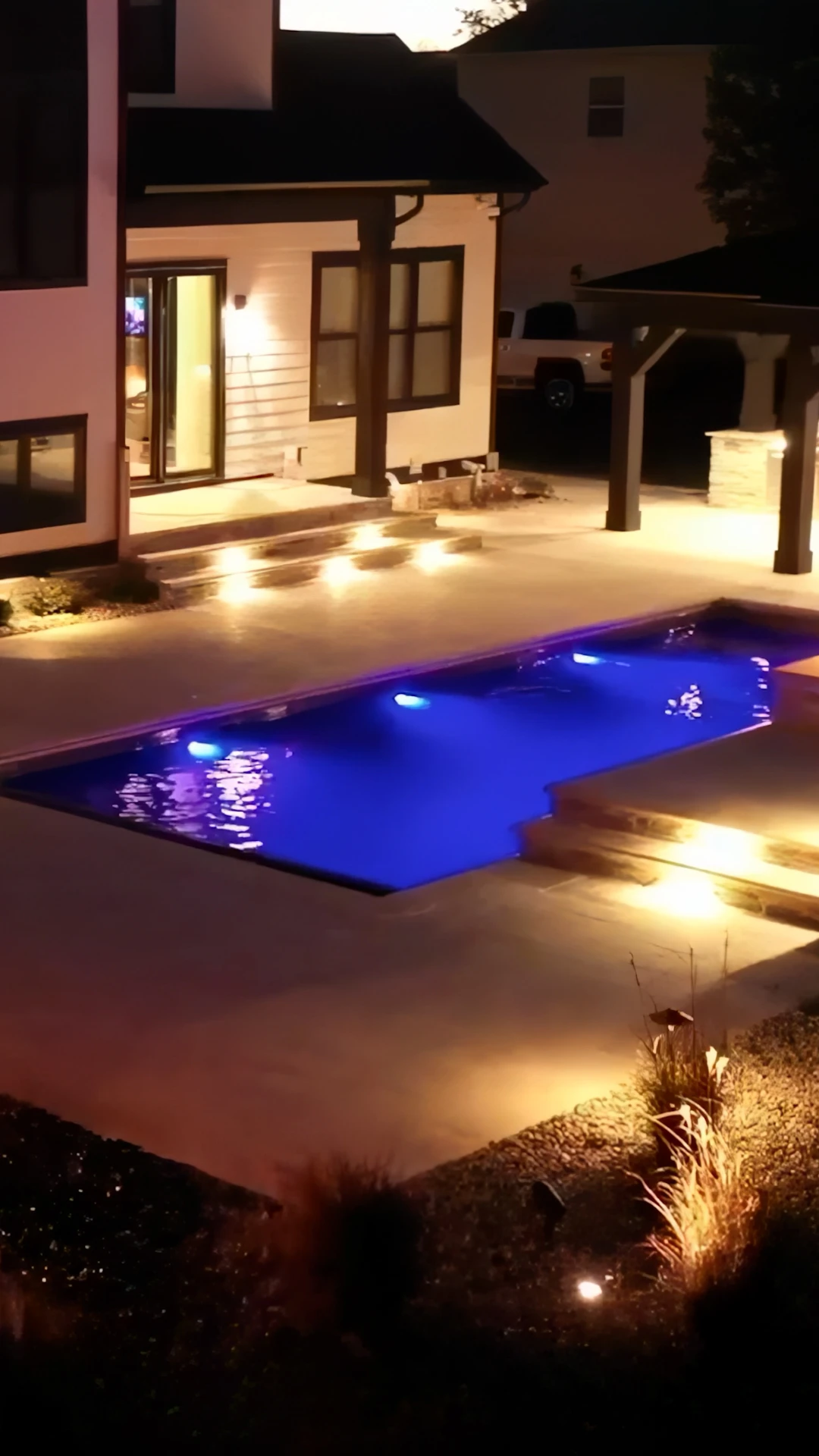
A final thought on why canopy backyards justify the full system. We measured light output on an identical three-zone spec at a client’s home in a 2015-era subdivision near Sope Creek — younger trees, more ambient dusk light, less canopy. The visual impact was strong. We measured the same spec at this Burnt Hickory project under 60-80 ft oaks. The visual impact was extraordinary — roughly 3x the perceptual difference between “lights off” and “lights on.” In a canopy backyard, every fixture works harder because the ambient is lower. The return on lighting spend is disproportionate to the spend.
If you’re sitting on an older East Cobb lot, under mature hardwood canopy, and you’ve been thinking about a new pool build or a pool-plus-landscape renovation — the lighting design is not a detail you add at the end. It is part of the original engineering brief. Done right, it converts a pool project into an evening-usable backyard. Done in the typical one-zone builder-spec way, it produces a pool you stop using after 7:30 p.m. in July.
Custom pool construction and integrated lighting design across 20+ cities within 30 miles of Winder, GA
From East Cobb’s oak canopy to Gwinnett’s pine ridges, we design three-zone lighting systems that make the whole backyard usable after dark — not just the pool.