
Every pool-lighting brochure shows the same glowing turquoise rectangle against a black sky — and every builder quietly knows that photograph was taken somewhere the photograph could actually happen. Milton is one of those places. Alpharetta, seven miles south, is not.
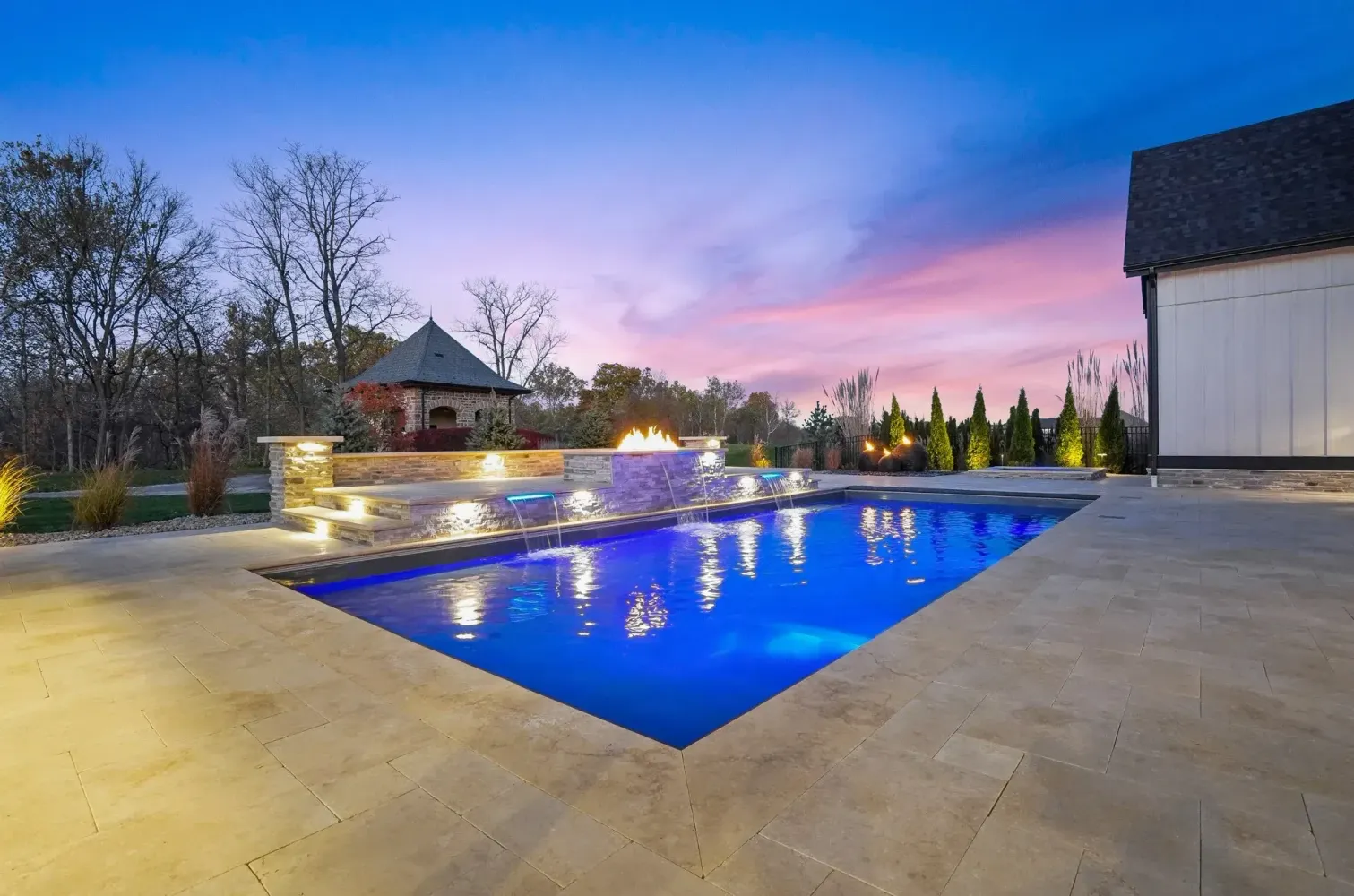
Here is the argument almost nobody in the Georgia pool trade will put in writing: a 55-watt Pentair IntelliBrite 5G Treo dropped into a Milton estate pool reads roughly three to four times more visually intense than the identical fixture installed on a subdivision lot inside the Alpharetta arterial grid. The bulb hasn’t changed. The water hasn’t changed. The sky has. Under the ambient 2700K street-glow that hangs over Windward Parkway and North Point, the human eye’s rod-cell contrast response is compressed — pupils stay half-closed, bright sources look washed out, and a $900 fixture behaves like a nightlight. Cross the Hopewell Road line into north Milton, kill the ambient spill, and that same fixture becomes architecture.
That single optical fact — dark-adapted contrast ratio — is the reason Milton pool-lighting packages read so differently from what you see in Johns Creek or Sandy Springs. It changes the spec sheet. It changes the fixture count. It changes the money. And it changes what a pool actually does for an estate at 9:47 p.m. in October. This post is about the argument, the numbers, and a specific project case study that makes the whole thing concrete.
Why Milton’s Sky Is Actually Dark — And Why Alpharetta’s Isn’t
Drive GA-372 (Birmingham Highway) north of Crabapple crossroads after sundown and the street-grid signature ends. Streetlights get sparse. Commercial spill drops to near zero. Lot density collapses from four houses per acre down to one house per three acres — a direct consequence of Milton’s AG-1 equestrian preservation zoning, which preserved the 1-to-3-acre-minimum lot pattern when the city incorporated as a separate entity in 2006. The ordinance wasn’t written for pool lighting. It was written for horses and creek buffers. But the second-order effect is a measurable night-sky contrast advantage that almost no Metro Atlanta municipality still has inside the 285-perimeter orbit.
Light pollution isn’t a vibe — it’s a ratio. The International Dark-Sky Association’s Bortle scale puts coastal urban Atlanta around Bortle 8 (inner-city, washed out), Alpharetta around Bortle 6-7 (suburban to bright suburban), and northern Milton consistently around Bortle 5 (suburban but recognizably dark, with visible Milky Way on clean nights). The gap between 5 and 7 is two full stops of exposure in photographic terms. That’s not subtle. That’s the difference between a pool that reads as a light source versus a pool that reads as a reflective puddle of ambient sky.
The practical consequence: an Alpharetta pool needs roughly 40% more installed lumens to achieve the same perceived brightness a Milton pool gets for free. Worse, most of those extra Alpharetta lumens are wasted — the ambient competition clips the top end of the contrast curve before the eye registers detail. You end up paying more to see less. Milton goes the other direction. Less competition means every watt counts. This is the structural argument behind the rest of this post.
The Milton Spec: What a Real Dark-Sky Lighting Package Actually Looks Like
Most builders quote pool lighting as a single line item — “LED pool lighting, included” — and walk away. That approach wastes Milton’s natural advantage. A proper rural-dark package isn’t one fixture. It’s an integrated scene with four layers that resolve into a single visual composition once the sun drops below the tree line around Cooper Sandy Creek.
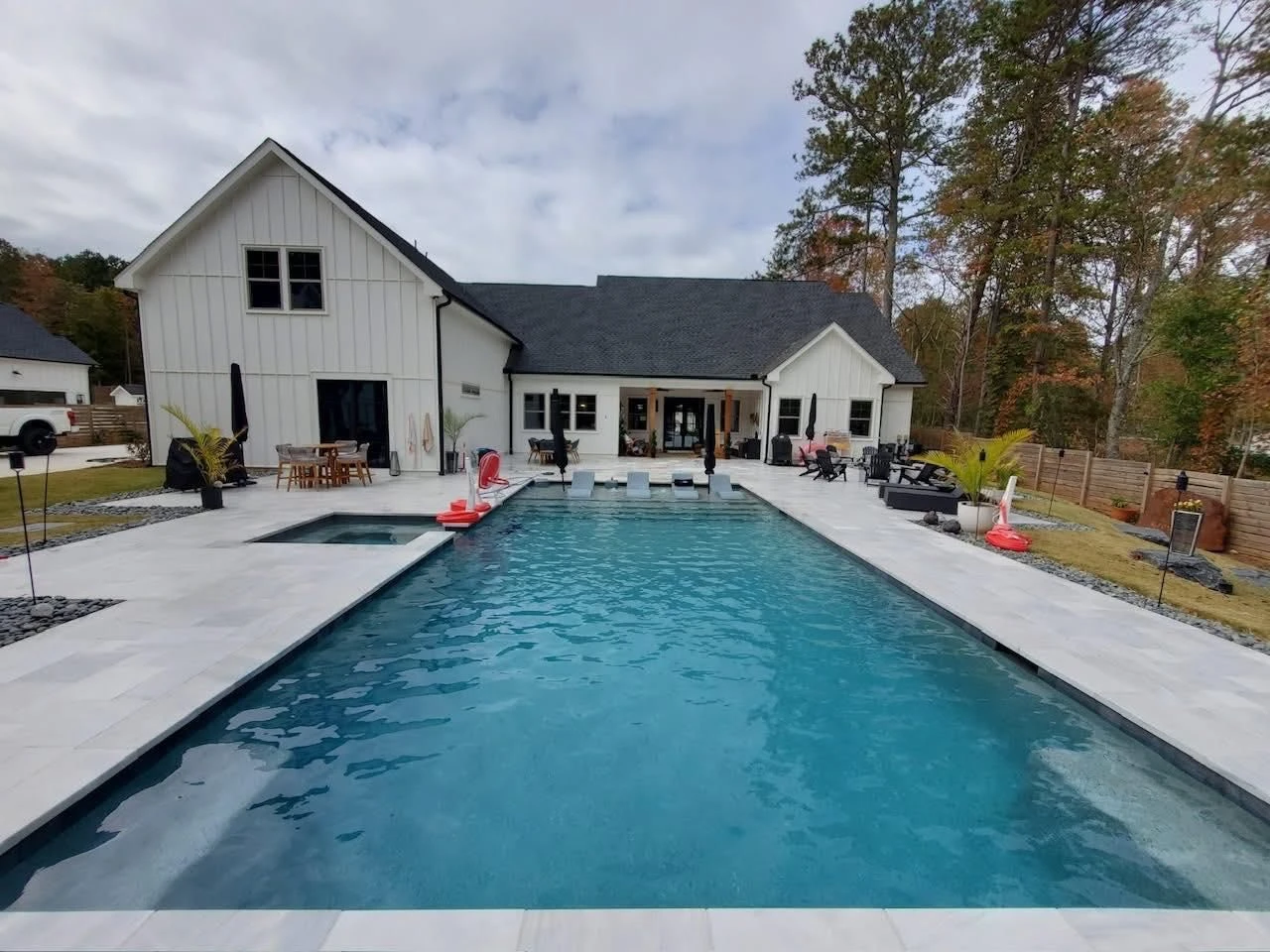
Here’s the package we built for a 6.2-acre Cogburn Estates project on a ridgeline lot east of Freemanville Road. The homeowner had already tried a two-fixture install from a previous builder and called it “disappointing.” The replacement spec — roughly $17,800 installed — produced the scene visible from the driveway 300 feet away:
- 3× Pentair IntelliBrite 5G Treo LED fixtures — 55W each, color-programmable, set to a 5700K white-ivory default with seasonal color programs. Positioned at 8-foot centers along the long wall of the 20×40 pool, approximately 18 inches below coping to prevent surface glare.
- 4× fire-bowl adjacent bubbler accent LEDs — 12W each, tuned to a warm 2700K to counterpoint the cooler pool water.
- 12× path-grade landscape LEDs — 4W each, 3000K, spaced along the pool-to-pavilion walkway and the transition into the outdoor kitchen.
- 18× specimen-tree uplights — 7W each, 3000K with honeycomb glare shields, placed on the 40-year-old white oaks and hickories that define the lot’s eastern boundary.
- 1× Hayward OmniLogic controller with a dedicated lighting zone pad, because the owner wanted phone-control separation between pool, pavilion, and landscape rings.
Installed cost breakdown: Fixtures + LEDs: $8,200. Low-voltage wiring, transformers, conduit runs through Cecil clay: $4,800. Programming, controller integration, scene commissioning: $1,400. Permits through Milton Community Development at 2006 Heritage Walk: $280. Labor across the 6-day install: $3,100. Total: $17,780.
The reason this reads so differently from a suburban install isn’t the fixture count — it’s the tiering. Four light temperatures (5700K pool, 2700K bubblers, 3000K paths, 3000K uplights) create what photographers call a “warm-to-cool vertical gradient.” Your eye reads the cool water as the primary subject and the warm fire-bowls as the intimate foreground. Trees fade into ambient 3000K silhouettes. Nothing fights anything else. On a Bortle 5 sky it’s cinematic. On a Bortle 7 subdivision lot in south Alpharetta it would look like a carnival.
The Project Case Study: A 6.2-Acre Lot in Cogburn Estates
The owners — a physician and a commercial-real-estate attorney relocating from Atlanta National — had bought the Cogburn lot specifically for the sky. He had grown up on a farm outside Macon and kept saying the same sentence during the design meeting: “I want the pool to feel like it belongs on the land, not the subdivision.” That sentence drove the entire lighting brief.
The site came with three real constraints. First, a named tributary of Lake Creek bisected the rear third of the parcel, triggering a 50-foot stream-buffer setback from the City of Milton Community Development code. That pushed the pool envelope about 28 feet closer to the house than the original concept drawing. Second, the lot had an 11-foot grade drop from the rear patio down to the back tree line — more aggressive than anything you’d hit in Alpharetta, and typical for northern Milton ridgeline properties. Third, the lighting plan had to integrate with existing 2700K coach-light sconces on the pavilion that the owners refused to replace.
The grade change was actually an asset. We terraced the pool three feet below main patio grade, which meant the pool shell sat in a natural bowl — useful acoustically, but critical optically. The edge of the coping reads below sightline from the house, so when the Treo fixtures activate the pool water appears as a pure floating light plane rather than a rectangle sitting on a deck. Total dig-to-water time, including a 14-day rain delay during an unusually wet stretch in early spring: 11 weeks.
Soil came back predictable — about 32 inches of Cecil clay topsoil over weathered granite, with a two-foot saprolite shelf encountered along the western pool wall. Saprolite is the half-decomposed granite layer typical of Milton’s ridgeline geology; it’s not hard enough to require blasting but it’s hard enough to break a skid-steer bucket if you underestimate it. We switched to a rented Kubota KX080-5 mini-excavator with a rock-tooth bucket for the final 18 inches of wall shaping.
Programming the Scene: Why Most Pool Controllers Look Cheap
A Pentair IntelliBrite or Hayward ColorLogic fixture has 10+ preset color shows out of the box — Mardi Gras, Royal, Tranquility, the full menu. Homeowners love them for about three weeks, then they almost universally settle on one of two defaults: slow-transition white or a static ivory-white around 5000-5700K. The color shows are a demo-day trick. The long-term scene is almost always cool-white.
That’s why the real value of an integrated controller isn’t the color menu — it’s the zoning. We programmed four named scenes into the Hayward OmniLogic pad:
- “Dinner” — pool at 60% white, bubblers warm at 100%, paths at 80%, uplights at 50%. Intimate foreground, softened background. Dominant for weeknight use.
- “Party” — pool at 100% rotating color cycle (45-second transitions), bubblers at 100%, paths at 100%, uplights at 100%. Weekend-only scene. Used maybe 18 nights per year.
- “Late” — pool at 35% white, bubblers off, paths at 40%, uplights at 20%. Post-midnight scene for when someone’s still in the spa but the household is going to bed.
- “Storm” — all fixtures off except path-grade walkway LEDs at 100%. Automated by a weather trigger during lightning within 8 miles, protecting the lighting control board without killing safety egress.
Commissioning took roughly 3 hours on-site with the owner walking from the house to the pool to the tree line and back, giving real-time feedback. That commissioning walk is non-negotiable. It’s also the step almost every builder skips — they program defaults in the truck and hand over a remote. The result looks like what it is: a computer’s guess at what the homeowner wanted. A real scene takes a person who knows the pool and a person who owns the land standing together at dusk.
Permits, Review, and the Milton-Specific Timeline
Because Milton incorporated as a separate city in 2006 and broke off from Fulton County’s permit process, pool projects here move through Milton Community Development directly — a genuine workflow advantage most people don’t realize. Standard pool plan review runs 10-14 business days, noticeably faster than Fulton’s 18-24-day backlog for equivalent Johns Creek parcels. Lighting plans attach as an addendum to the pool electrical submittal and clear in the same review window.
The catch: preservation review. If your lot falls inside the Crabapple Historic Overlay, or inside a subdivision with its own architectural review committee, the city’s fast track doesn’t save you. The Manor Golf Club ARC typically runs 4-5 weeks with a structural review committee that does scrutinize exterior lighting impact — particularly 5700K cool-white fixtures, which get flagged as “non-compatible with rural character” if they’re visible from the cart-path corridor. We’ve learned to submit Manor lighting plans with 3000K alternates on file for any fixture angled toward a neighbor lot.
Cogburn Estates doesn’t have an active ARC of that caliber, so the project we’re discussing cleared the city side in 12 business days. The lighting addendum, filed three days after the pool-shell permit, added zero additional review time. Total permit cost for the lighting component, split out from the pool-shell permit: $280.
Creek-buffer setbacks: City of Milton requires 25-foot buffers from unnamed tributaries and 50-75-foot buffers from named streams. On our Cogburn project, the named Lake Creek tributary triggered a 50-ft buffer, which drove the pool envelope 28 ft closer to the house than originally drawn. Flag this early in design.
Power service: Most northern Milton parcels are Sawnee EMC territory along the Forsyth County line, not Georgia Power. Load-calc filings go to a different utility. Plan accordingly.
What Comes Next — And Why Rural-Dark Pools Change the Math on Pavilions
Here’s the deeper effect almost no pool builder will tell you about because it inflates the scope of the project: a properly lit rural-dark pool raises the perceived value of every adjacent structure by roughly one construction tier. The pavilion that looked optional at the front-end meeting suddenly reads as undersized when the pool scene goes live, because the pavilion is now competing with cinema. Owners who originally wanted a simple covered patio end up adding fireplaces, outdoor kitchens, and specimen-tree lighting rings. It’s not upsell pressure — it’s optical logic. The eye resolves the entire scene together and pulls the weakest element into focus.
On the Cogburn project, the homeowner signed a change order four months after pool completion: a full Primetime Pools pavilion extension with an integrated outdoor kitchen, a linear gas fireplace, and specimen uplighting on two additional hickories. The lighting design drove the rebuild. The pavilion followed the pool, not the other way around — which is exactly backward from how these projects usually get budgeted.
This is why we tell every Milton client in the initial design meeting: do not value-engineer the lighting package in year one. You can trim fixture count. You cannot trim tiering. If you install a flat single-temperature package now to save $4,000, you will spend $40,000 in year three trying to fix what the scene is missing. Get the four-layer tier right on day one, even if you start with two path lights and six uplights instead of twelve and eighteen. Add fixtures later. Don’t retune scenes later.
Milton is genuinely one of the last dark-sky-adjacent pool markets inside the Atlanta orbit. Bethany Creek, Cogburn, the ridgelines along New Providence Road, the Potters Road estate corridor — all of it still has the night contrast that makes LED pool lighting do what the brochure says it does. That window closes within a decade as development pressure along GA-372 fills in the last open ridgelines. Lots that support a proper four-tier scene today will, in 2035, be reading like bright-suburban Alpharetta. Build the scene while the sky still cooperates.
Rural-dark LED pool lighting across 20+ cities within 30 miles of Winder, GA
If your Milton lot still has a real night sky, a tiered four-layer LED scene will outperform any flat-suburban install by a factor most homeowners don’t believe until they stand at the edge of the water at 9 p.m.