
Almost every Laurel Springs lighting spec we quote arrives with the same assumption: one light per end, factory-blue glow, and a phone app. That assumption is exactly why half the twilight shots in the neighborhood look flat, and why the other half flicker within two seasons. A Pentair IntelliBrite 5G build done properly on a River Club or Laurel Springs estate pool is a four-light minimum system, wired to a house-scale automation backbone, protected against Jackson EMC line events most homeowners never see.
Suwanee is not a generic Gwinnett pool market. The 30024 zip covers two of the most tightly controlled residential communities in the county — Laurel Springs and The River Club at Suwanee — where the architectural review process dictates not just the pool shape but how the pool reads from the street at 8:45 p.m. on a Friday in June. Lighting is the difference between a pool that photographs well for the HOA submittal and a pool that photographs well five years later when the homeowner sells. That gap is entirely about fixture choice, fixture count, the control protocol running on top of the pad, and the surge protection sitting between the panel and the transformer.
This post walks through how we build LED lighting for the premium Suwanee builds: why the four-light minimum matters on a 20×40, why Lutron RadioRA 2, Control4, and Savant integration changes the workflow, what preset scenes actually look like on site, and what the real cost range runs when you add it up honestly at the end. No filler. No generic “add a light for ambiance” content. Every number in here came off a recent pad we commissioned.
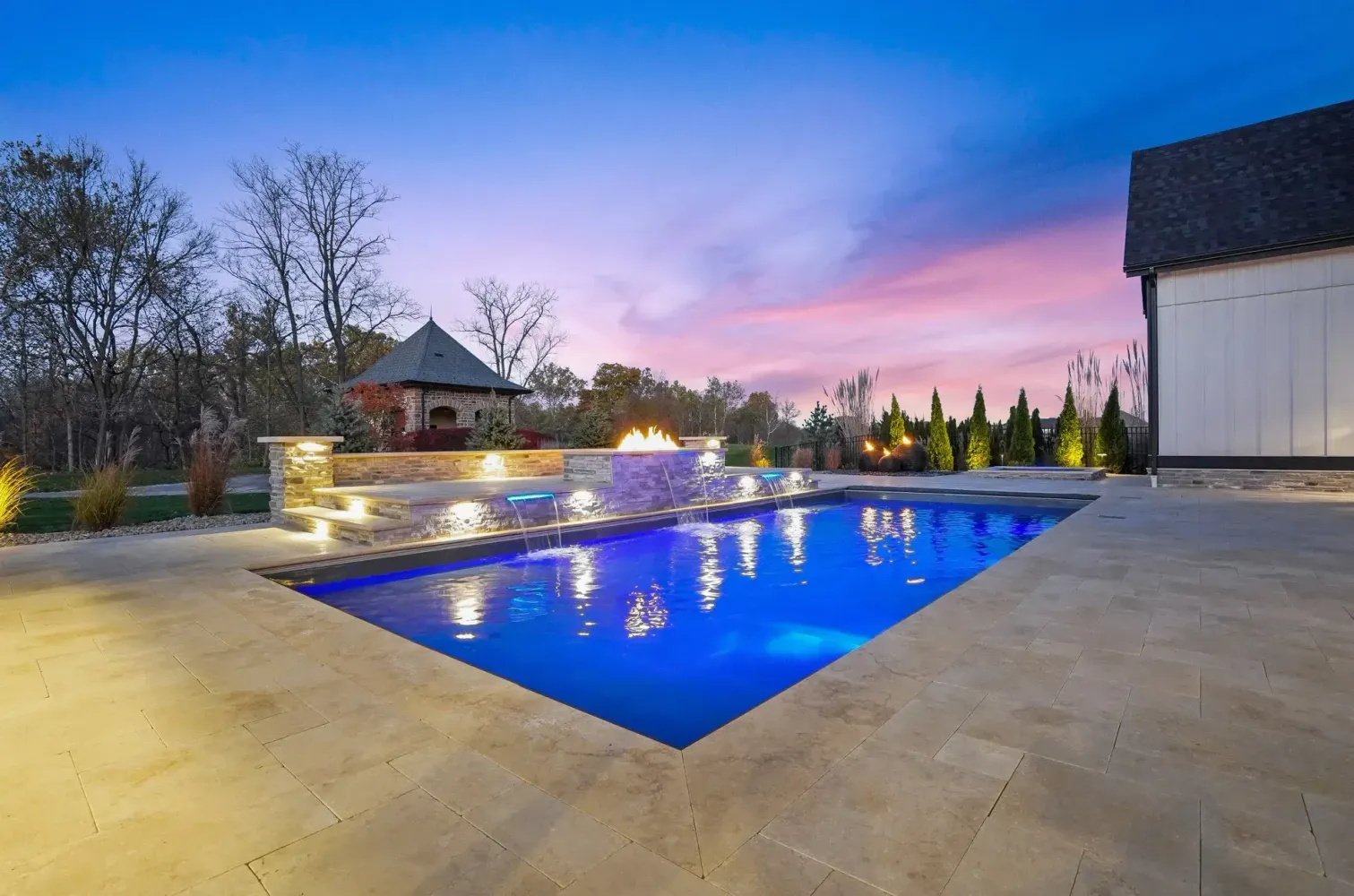
Why Four Lights Minimum on a Premium Laurel Springs Build
The default pool-industry spec for a rectangular 20×40 is two lights — one at each end. That spec exists because it meets code, not because it looks good. NEC §680.23 sets the electrical rules for pool lights; it does not tell you how many fixtures produce an evenly lit waterline at twilight. On a dark-plaster or pebble finish (which is what virtually every Laurel Springs build gets specified to hit that royal-blue glow), two lights produce a bright patch at each end and a noticeable dark valley in the middle. You see it the first time you swim after dusk. You see it worse when the home is listed.
Four lights is our minimum because it solves the dark-valley problem on pools 35 feet and longer, which is the dominant footprint in Laurel Springs and The River Club. At that length, the lumen fall-off from a single end-wall fixture hits about 15 feet in — light intensity drops roughly 60% at the midpoint of a 40-foot pool with only two end lights, measured at the waterline. Add two mid-span wall lights at the 10-foot and 30-foot stations and the fall-off stays under 20% across the length. That’s the difference between a pool that photographs like a hero shot and a pool that photographs with a black stripe through the middle.
Four also gives us redundancy that matters on estate-scale projects. When a single IntelliBrite 5G fails at year six or seven on a two-light system, you are looking at a hemisphere of the pool going dark until a service call. On a four-light pool, a single failure is barely visible to a guest and buys you a scheduled replacement window instead of an emergency truck roll. Owners in Laurel Springs and River Club notice the difference because they entertain on weekends. The pool lives on display.
The fixture choice matters as much as the count. We standardize on Pentair IntelliBrite 5G fixtures for premium Suwanee projects because it gives us seven fixed colors plus five pre-programmed color-changing shows, a published lumen spec (roughly 7,200 lumens at 12V), and a 10-year prorated LED warranty from Pentair. Jandy WaterColors and Hayward ColorLogic are acceptable alternatives; we run the full system with whichever brand the rest of the pad is from, because mixed-brand automation is where most of the field problems start.
Fixture math for a 40-foot Laurel Springs pool: 4 × Pentair IntelliBrite 5G 12V at $700–$1,200 each installed = $2,800 to $4,800 in fixtures alone. Spa adds $600–$900 for one MicroBrite. Budget the high end on retrofit; new construction runs lower because the conduit and niche work happens inside the shell schedule.
One more count note specific to Suwanee. Pools under 32 feet can still run three lights cleanly — we drop the 20-foot station and shift the two end lights in 2 feet to tighten the pattern. Pools over 45 feet (the River Club estate footprints) need five to six, particularly if there is a raised tanning ledge that creates a shadow line. The right answer is always pool-length-driven, not package-driven.
Smart Integration: Lutron RadioRA 2, Control4, and Savant
The second assumption we correct on every Laurel Springs spec is that the pool app is the control system. The Pentair IntelliCenter or ScreenLogic app is fine for the pool-pad side of the equation — pumps, heater, salt cell, cleaner schedules, and the pool lights themselves. It is not a house-scale lighting controller, and it is not talking to the pavilion sconces, the pergola uplights, or the scene your homeowner actually wants at 7:30 p.m. with guests on the deck.
On the premium Suwanee builds we integrate with the home’s existing automation backbone. In practice that means one of three systems: Lutron RadioRA 2 or HomeWorks QSX, Control4, or Savant. About 60% of the homes we work on in Laurel Springs and River Club already have one of these running the interior lighting and AV. Our integration work sits on top of it, not next to it. The goal is that the homeowner taps one “Evening Entertain” scene on the same keypad or panel they use for the dining room, and the whole yard responds in sequence.
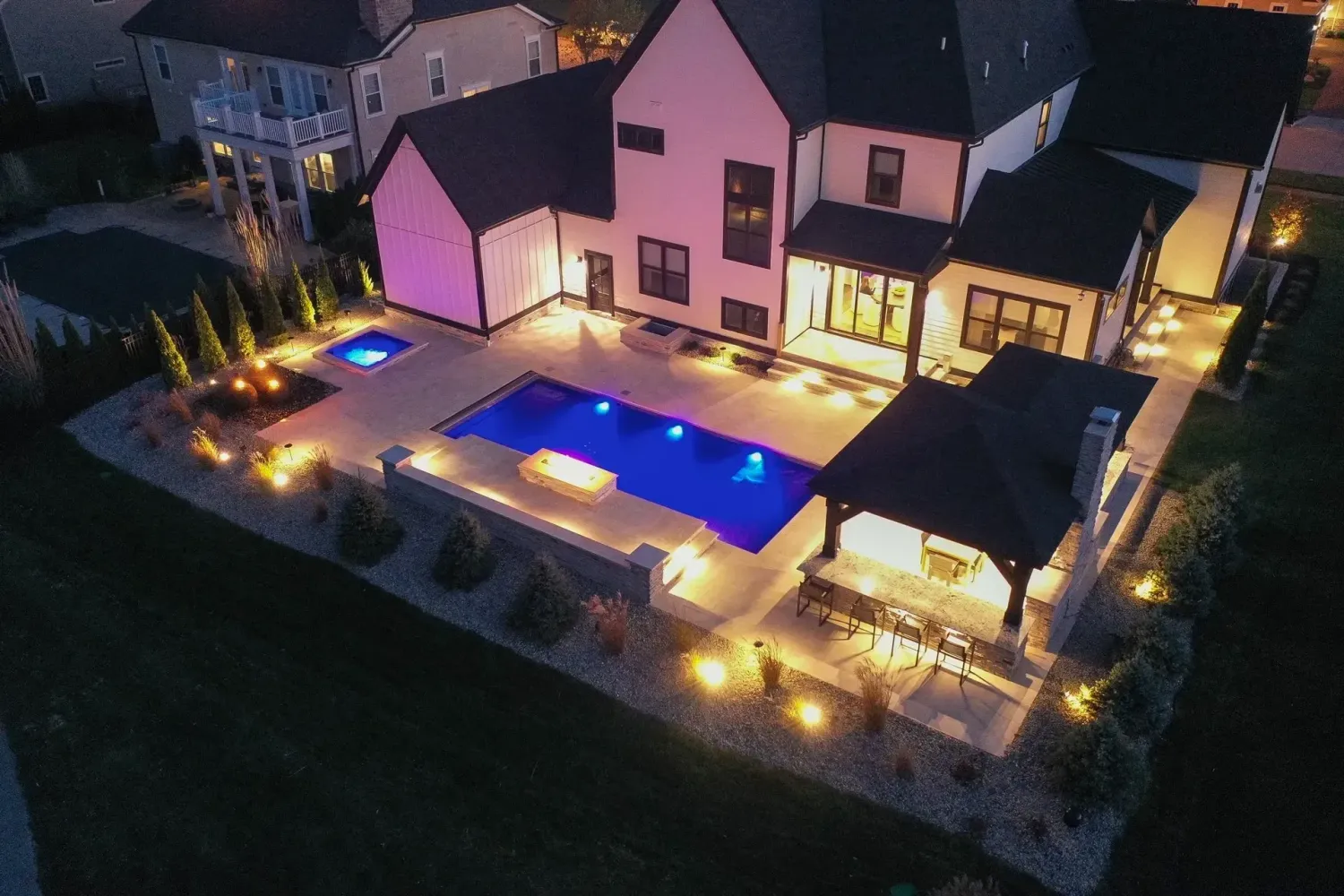
Mechanically, integration happens through one of two paths. The cleaner path is Pentair IntelliCenter with its Lutron, Control4, or Savant driver enabled — the pool pad speaks directly to the home system over the local network, and the scene sits inside the home OS without a separate app. The second path, which we use when IntelliCenter isn’t in scope, is a Pentair SunTouch or EasyTouch board with dry-contact relays wired into a Lutron or Control4 output module. Either path lets the house system call the pool scene; the tradeoff is that the direct-driver path gives feedback (pool confirms the scene is live) while the dry-contact path is one-way (the house says go, pool goes, no confirmation).
We spec the driver path almost every time on new construction. The extra cost is modest — typically $400 to $700 in additional automation hardware — and the reliability difference over five years is significant. Dry-contact relays are a perfectly acceptable retrofit strategy when the pad is already built; they are not what we want to hand a homeowner on a $180,000 new build.
The full integration scope for a premium Suwanee project runs $1,400 to $2,400 beyond the pool lights themselves, including the driver, the relay module if needed, the programming labor, and one post-commissioning tuning visit 30 days after handoff. That tuning visit is where we dial in the scenes based on how the homeowner is actually using the yard, and it is the single most underrated line item on the whole lighting spec.
What Gets Wired In Beyond the Pool Lights
A proper integration isn’t just “pool lights on a keypad.” The Lutron or Control4 scene calls the pool LED color, the pavilion interior warm-white downlights, the pergola uplights, the landscape path and bollard lights along the rear lot line, and the sconces on the house wall facing the pool. On the River Club estates we have also tied in the sheer-descent scupper pump and the gas firebowl valve, so one button brings up the water sound and the flame in the same sequence as the blue glow. That is the experience the neighborhood sells.
The wiring topology matters more than most builders admit. We run a dedicated low-voltage control cable from the pool equipment pad to the home’s structured-wiring closet, even when the network-based driver is in scope, so that a future protocol change (Lutron swapping out a hub, Control4 pushing a firmware generation that deprecates a driver) can fall back to hard-wired contact closures without digging up the yard. Cable of choice is Belden 9841 or equivalent shielded low-cap data cable, pulled in a dedicated 1-inch PVC conduit from the pad to a pull box at the house foundation. Extra cost on a new build is under $600 and it buys 15 years of forward compatibility on a system whose consumer protocols turn over every 4 to 6 years.
Preset Scenes: The Laurel Springs Aesthetic in Practice
Preset scenes are where the whole system either clicks or fails the homeowner. Out of the box, every automation platform ships with a generic set of “on / off / party / romance” presets that nobody actually uses. We reprogram every Suwanee install with named scenes the homeowner recognizes, tuned to how the Laurel Springs aesthetic reads at different times of the evening. Three scenes do roughly 90% of the work on a typical property.
Twilight Blue. This is the sunset-to-9-p.m. scene, and it is what you see in virtually every hero shot taken on these properties. The pool runs steady royal blue on the IntelliBrite 5G. The spa runs one shade warmer — teal instead of cobalt — so the two water bodies read as related but distinct. Pavilion downlights come on at 2700K and 40% dim. Landscape path lights come on warm and low. Sconces on the house go to 2200K at 30%. The overall look is cool water, warm architecture, and a sky that still has color left in it. This is the scene we program to auto-trigger at astronomical dusk via the automation’s sunset offset.
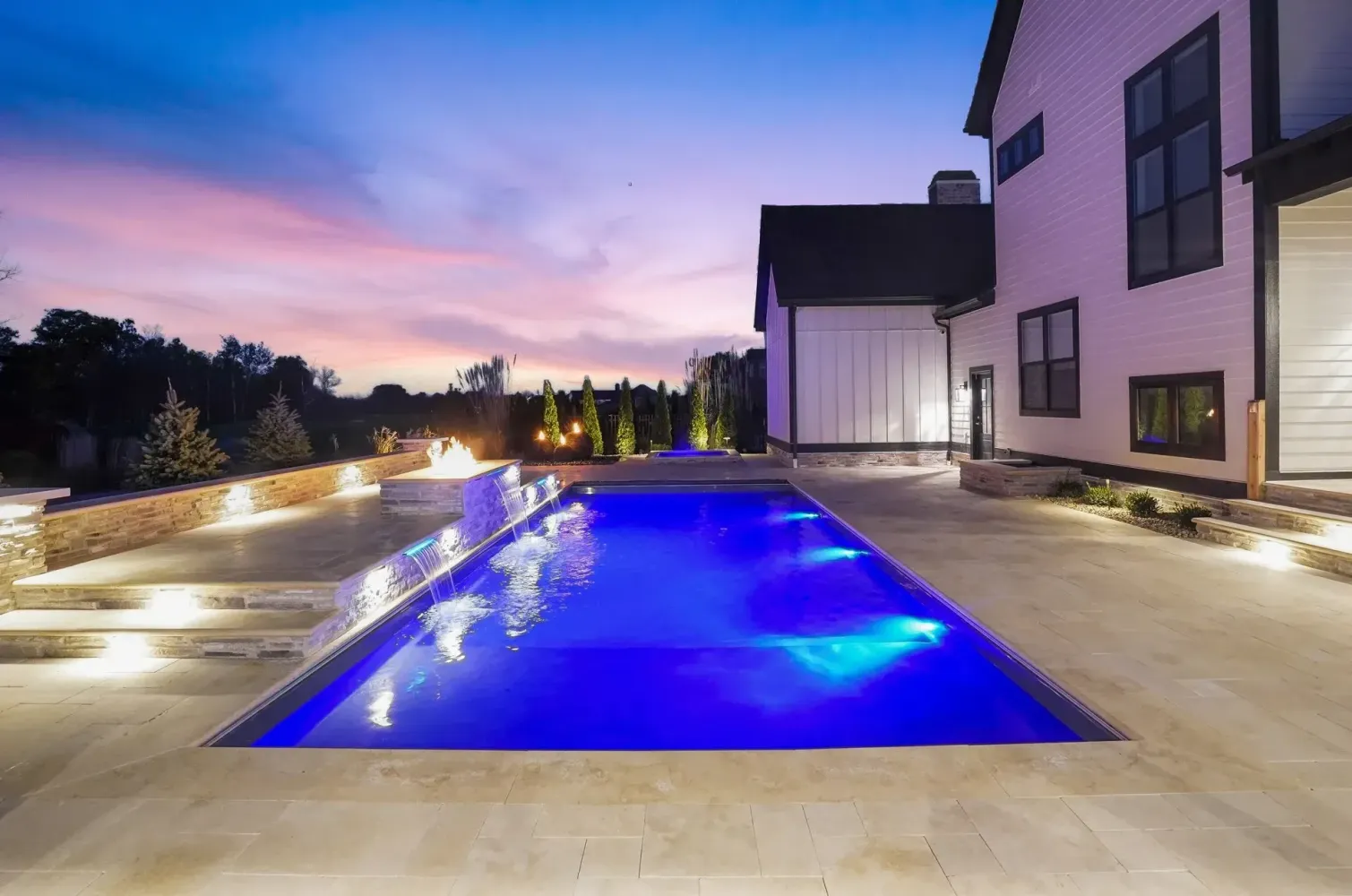
Fire Accent. Post-dinner, the pool drops to about 50% brightness on the same royal blue, the pavilion downlights come up slightly, and any gas fire features (firebowls, fire troughs on raised ledgestone walls) fire up. On homes with a Savant or Control4 shade package, the pavilion side shades drop here too. The effect is that attention shifts from the pool itself to the fire. We usually program this at 9:15 p.m. on a timer override for homeowners who entertain on a schedule.
Evening Entertain. The loudest preset. Pool lights run the IntelliBrite 5G “American” or “SunSet” color-changing show at full brightness, spa matches, the pavilion goes to 70%, music zone wakes up on the Control4 or Savant AV side. This is the Fourth of July scene, the graduation-party scene, the scene the homeowner actually tells us they use most in the first year. We always program it to a named keypad button that anyone in the household can hit.
Beyond those three we typically layer in two or three smaller scenes: “Swim” (full-brightness white on IntelliBrite, pool heater on, everything else off), “All Off” (a single-tap shutdown including pool lights, landscape, and equipment), and “Cleaning” (pool lights on white for a service visit, other zones off). The named scenes are what the homeowner lives inside. The raw app sits in the background as a fallback.
Why Preset Programming Is a One-Visit Job That Takes Two Visits
We schedule scene programming as a two-visit process on every Suwanee premium build. First visit is commissioning day — scenes go in based on the spec. Second visit is 30 days later, after the homeowner has used the yard under real conditions, and we re-tune brightness, timing, and scene triggers based on what actually happened. This is the visit that turns a technically correct lighting system into a lighting system the homeowner praises at year three. Skipping it is the single most common reason luxury pool lighting underperforms its spec, across every market we work in.
Jackson EMC Surge Protection and Why It’s Non-Negotiable
The last piece of the premium Suwanee lighting system is the one nobody talks about until it fails. Suwanee is on Jackson EMC for electric service — not Georgia Power — which matters for two reasons. First, Jackson EMC’s distribution network covers the rural and semi-rural edges of northeast Gwinnett and northern Hall County, where overhead line exposure to lightning is genuinely higher than urban Georgia Power territory. Second, Jackson EMC’s call-out response for isolated line events is slower than Georgia Power’s, which means surge events tend to propagate through the house before they are cleared.
What that translates to on a pool pad: the LED drivers inside the Pentair IntelliBrite 5G fixtures, the IntelliCenter or EasyTouch automation board, and the integration hardware on top of it are all sensitive electronics sitting on a 240V circuit with a direct path to the panel. A single nearby lightning strike — and we average around 40 thunderstorm days a year in Gwinnett — can take out an LED driver, an automation board, and a Control4 relay in one event. Replacement cost runs $1,800 to $3,400 in parts and labor, usually in the middle of pool season.
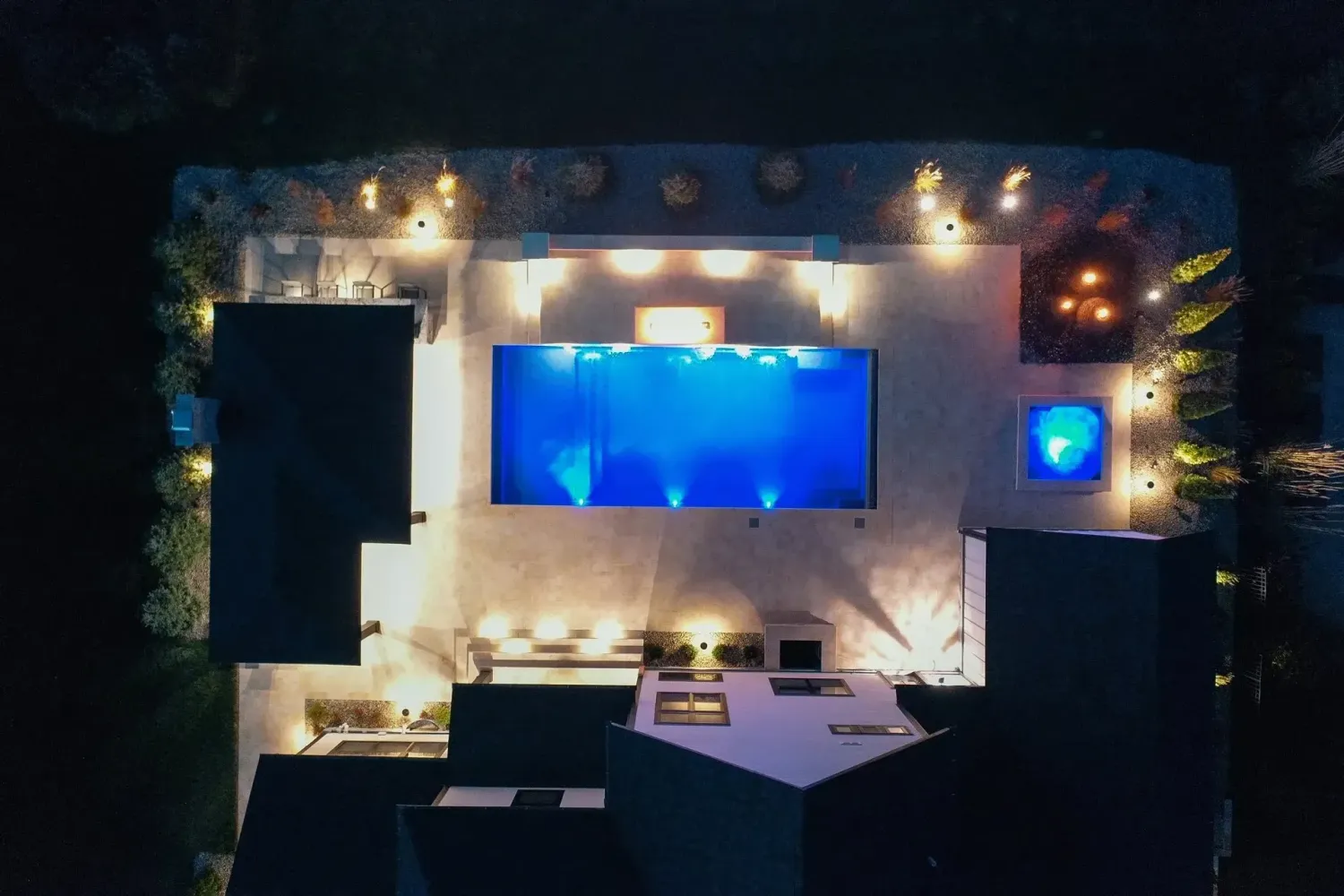
Our standard spec for every premium Suwanee pool lighting system includes three layers of surge protection: a whole-home Type 1 SPD at the main panel (if one isn’t already installed), a Type 2 SPD at the pool sub-panel, and a point-of-use surge device on the automation board itself. Good choices are Intermatic AG3000 for the pad or Eaton SPD series at the panel. Total installed cost for all three layers runs $650 to $1,100. That is the cheapest insurance on the entire build.
Two other code points worth naming because they come up in every Suwanee permit review. All pool lighting on a Laurel Springs or River Club build has to go through Gwinnett Dept. of Planning & Development at 446 W. Crogan St. in Lawrenceville, and the inspector will check that every 12V fixture is fed from a GFCI-protected transformer per NEC §680.23(A)(3). The bonding grid on the pool deck — required under NEC §680.26 — is also tied to the fixture niches, which means a cut in the bonding grid during a deck repair can silently desensitize surge protection on the light string. We document the bonding grid on the as-built and hand the homeowner a copy at close-out.
Finally, the Laurel Springs HOA architectural review process adds a lighting-specific wrinkle most builders don’t handle well. The HOA typically requests a photometric rendering showing that pool and landscape lighting will not spill beyond property lines, particularly on estate lots backing the golf course. Review turnaround is 3 to 4 weeks. We build that rendering into the design deliverable so it doesn’t become a post-permit rework.
One more surge detail worth spelling out because it is the failure mode we see most often in the field. The IntelliBrite 5G family runs on a 12V low-voltage transformer sitting in the pool sub-panel. When a surge pushes through the 240V line, it takes out the transformer first, then cascades to the fixtures only if the transformer fails open rather than clamping. A properly sized Type 2 SPD at the sub-panel clamps the event before it reaches the transformer roughly 95% of the time, based on what we have replaced in the field since 2019. Homes with only a main-panel Type 1 SPD and no sub-panel protection see fixture-level failures at about 3x the rate of homes with the full three-layer stack. It is the single cheapest reliability upgrade on the entire build, and nobody specs it unless we write it in.
Full premium Suwanee lighting package — real numbers:
Fixtures (4–6 IntelliBrite 5G + 1 MicroBrite spa): $2,800 to $4,800
Smart integration (Lutron / Control4 / Savant): $1,400 to $2,400
Three-layer Jackson EMC surge protection: $650 to $1,100
Photometric rendering + HOA submittal: $400 to $650
Commissioning + 30-day tuning visit: included
Typical all-in add to a new Laurel Springs pool build: $5,250 to $8,950.
That number looks large until you put it against the build cost it is protecting. On a $180,000 to $285,000 River Club pool, the lighting system runs 2% to 5% of total spend, carries a 10-year fixture warranty, and drives most of the visual outcome the homeowner pays for. The Peachtree Industrial Blvd corridor (Hwy 141) that gets our crews and equipment into these neighborhoods is also the same corridor Pentair and Jandy distributors use, so parts availability for the IntelliBrite line is next-day if a fixture fails mid-season. Every piece of the spec is chosen with Suwanee’s specific infrastructure in mind.
Premium pool lighting and smart integration across 20+ cities within 30 miles of Winder, GA
From Laurel Springs IntelliBrite 5G scenes to Jackson EMC surge protection, we build pool lighting systems that still look right five years after the pour.