
I was standing on a bond beam in Foxcreek at 9:40pm last October, waiting for the homeowner to walk down from the driveway. I could see the pool lights glowing underwater. I could not see him at all — he was only sixty feet away, but a band of laurel and a four-foot grade change swallowed his flashlight until he reached the patio. That was the moment the job went from a pool lighting project to a full site lighting plan.
Dawsonville is unlike any other service area Primetime Pools works in. The city sits at roughly 1,270 feet of elevation — the highest point in our coverage map — and lots roll in every direction off the North-Georgia foothills. Subdivisions like Etowah River Club, Mountain Laurel, and Kensington Ridge carve building pads into slope, which is beautiful during the day and disorienting after sundown. A pool light is a point source. It illuminates water. It does not illuminate the thirty feet of stone steps you just built between the driveway and the pool gate.
This post is the full field specification for a ½-acre mountain lot in Dawson County — 18 to 24 low-voltage fixtures, one 300-watt transformer, Kichler 2700K LEDs, and a wiring plan that assumes the terrain is going to fight you. If you’ve ever stood on a patio at dusk wondering why the pool looks gorgeous but the rest of the yard feels like a cave, this is the piece that explains why and what to do about it.
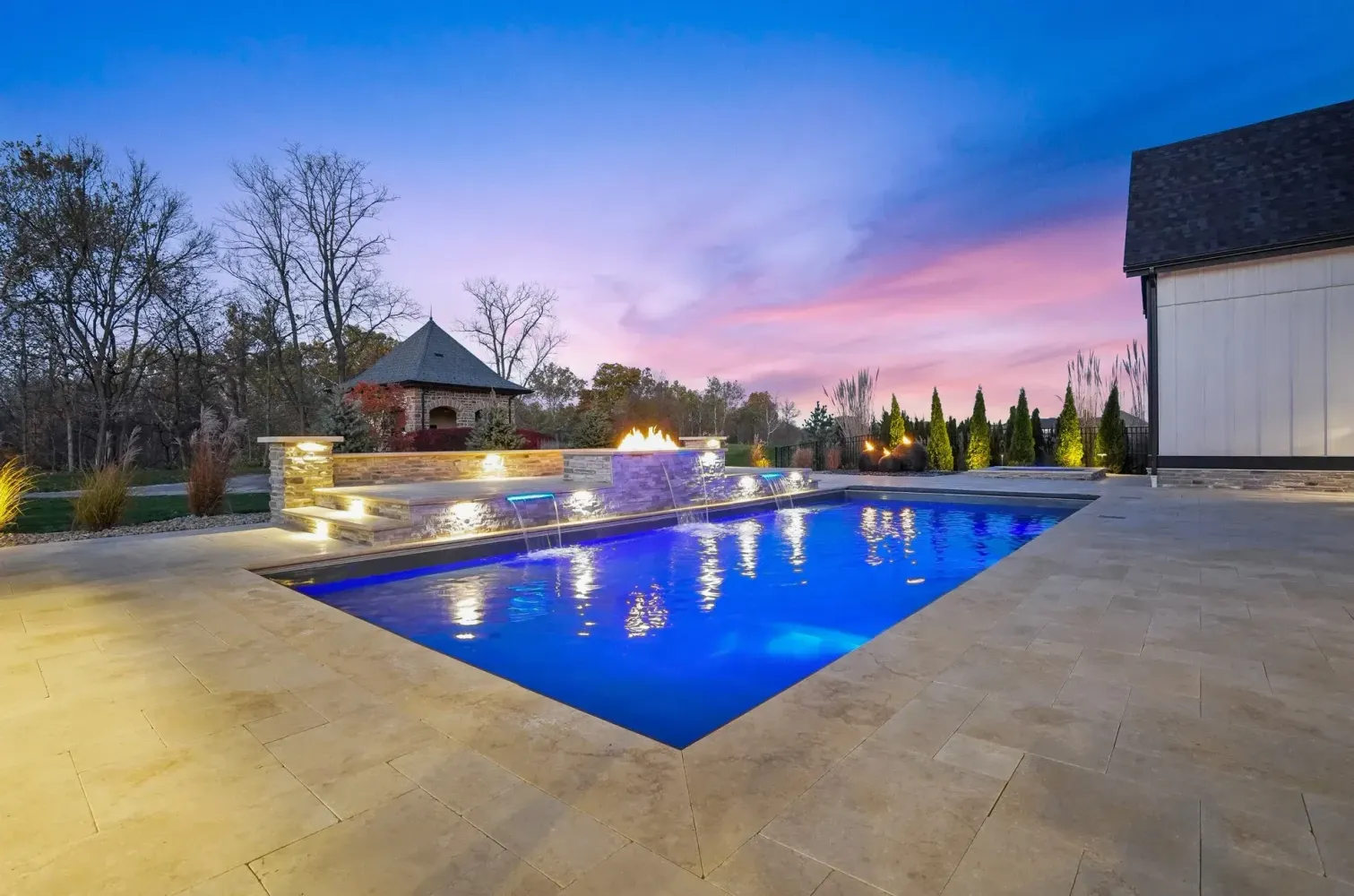
Why Pool Lights Are a Point Source, Not a Plan
A typical inground pool in Dawsonville carries one or two Pentair IntelliBrite 5G or equivalent color-change LEDs recessed into the shell wall, 18 inches below the water line. They output roughly 150 to 300 lumens of emitted light after water attenuation. Underwater. Pointed horizontally. Through a lens that sits below grade. That light does one job exceptionally well: it makes the pool glow. It does not climb a retaining wall. It does not cross a patio. It certainly does not reach a driveway that sits 12 vertical feet above the coping.
On a flat Gwinnett lot the surrounding grade picks up a little bounce from the pool and from the house’s soffit lighting, and the yard reads as a continuous surface. On a Dawsonville lot, the pool sits in a cut — a flat pad carved into slope — and every edge of that cut is darker than the water because the water is the only thing lit. The homeowner reads this as “the pool looks amazing” for about two weeks and then starts asking why guests keep tripping on the step up to the grill.
The fix is not a brighter pool light. Dimming a Pentair IntelliBrite from 100% to 60% is actually standard practice in our spec — over-driving the pool light in a dark yard creates a harsh visual well that makes the surrounding darkness worse by contrast. The fix is fill. Specifically, a 12-volt low-voltage fixture layout that terraces light up the slope so the eye has something to land on before it gets to the pool.
Rule of thumb for sloped lots: if the vertical distance from the driveway apron to the coping exceeds 8 feet, you need a minimum of three lighting zones — driveway / transition, mid-path, and pool perimeter — each on its own transformer output or timer circuit.
What a Pool Light Does Well (and Where It Stops)
Underwater fixtures handle pool perimeter and shallow shelf reading. They handle spa spillover water. They handle a tanning ledge if the LED is stepped up to a second fixture at the ledge depth. They do not handle: adjacent hardscape, equipment pads, gate hardware, step transitions, screen enclosure posts, tree canopy, or any grade change outside the bond beam footprint. Assuming one does is the single most common design error I correct on a Dawson County rebid.
Specifying the System: 12V, 300W Transformer, Kichler 2700K
Every landscape lighting system Primetime Pools installs in Dawsonville runs on 12-volt low-voltage. Line voltage (120V) is legal and occasionally specified for very long runs, but for a residential pool pad we want the safer Class-2 circuit the NEC allows for 12V work — no bonding of fixture housings to the pool’s equipotential grid, no expensive inspections for each junction, no arc risk if a kid hits a path light with a mower. The trade-off is voltage drop: run too much cable and the last fixture in a string comes in dim. We solve that with a transformer sized to the load and a hub-and-spoke wiring topology, not a daisy chain.
The transformer we specify for a ½-acre mountain lot is a 300-watt stainless-steel multi-tap unit — typically a Kichler 15PR300SS or Volt VX300. The multi-tap matters because on a steep lot some runs are 180 feet and some are 40 feet; we want to push 13V or 14V to the long runs and 12V to the short ones so every fixture lands within ±0.3 volts of spec. A single-tap transformer cannot do this, and the dim-fixture-at-the-end problem is the calling card of an installer who doesn’t understand voltage drop.
On lumens and color: we standardize on Kichler 2700K LED across the entire yard. 2700K reads as warm incandescent — amber-tinged, flattering to skin, and a visual match for the glow pool owners remember from the halogen era. 3000K creeps toward white; 4000K is a security-lighting color that makes every outdoor dinner feel like a gas station. Staying locked at 2700K across path, uplight, downlight, and step light means the eye never registers a color-temperature shift as it moves across the yard, which is what sells the “this feels intentional” reaction.
Fixture Families in the Spec
- Path lights: Kichler 15315AZT or equivalent, 14″ stem, 2.5W LED, spaced 8 feet on center along any step run or walkway.
- Well lights / uplights: Kichler 15753BKT in-grade, 4W, aimed 15° off vertical at the trunk of any specimen tree within 20 ft of the pool deck.
- Downlights / tree-mounted: Kichler 16105BKT 30° spot, mounted 18–24 ft up in a hardwood canopy to produce the “moonlight” wash across patio and lawn.
- Hardscape step lights: Volt Salty Dog recessed in stone risers, 1W, 12V — one per tread for any run exceeding three steps.
- Wall wash: Kichler 15761BKT 60° flood on any retaining wall over 3 ft tall bordering the pool deck.
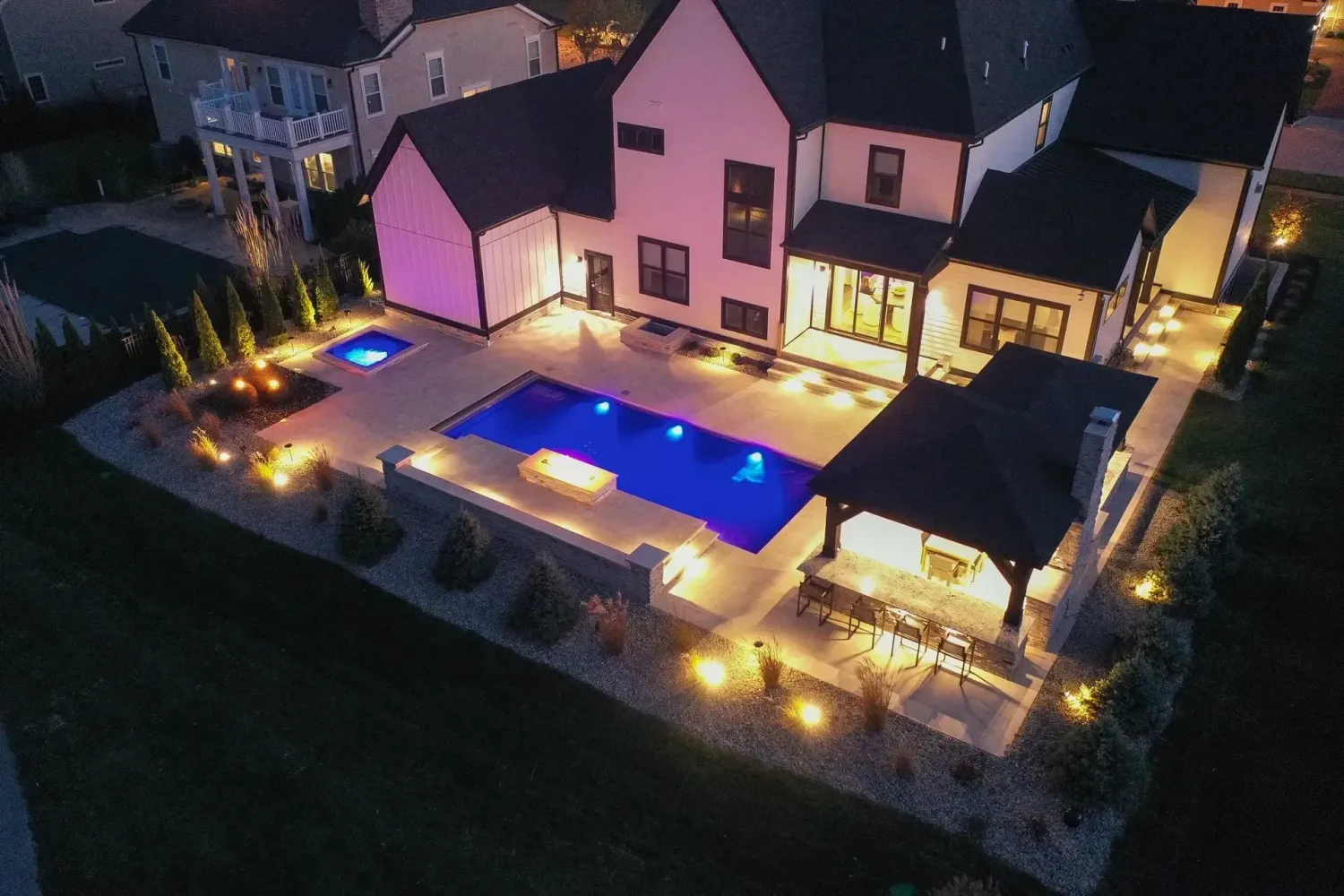
18 to 24 Fixtures on a ½-Acre Dawson County Lot: The Actual Count
For a typical ½-acre Dawsonville lot with a 20×40 rectangle pool, spa, and a driveway that runs uphill from Hwy 53 or GA-400, our working count is 18 to 24 fixtures. Anything under 18 and the yard reads as spotty — islands of light with gaps the eye notices. Anything over 24 on a half-acre starts to feel like a runway, which is the other failure mode. The spec below is a mid-range 21-fixture plan.
Driveway & transition zone — 5 fixtures. Two path lights flanking the garage apron, one path at the pivot where the walkway turns toward the pool gate, two step lights where the drop into the yard begins. This is the zone where nearly every mountain-lot injury happens. Dawson County isn’t flat. A guest parking at the garage does not know there are three stone steps between them and the patio, and a single dark gap is enough.
Walkway to pool — 6 fixtures. Path lights at 8-foot spacing across the run from transition to pool deck. On a straight 48-foot walkway that’s six fixtures; on a curved or terraced walkway we often land at seven or eight. Curves eat light because the eye can’t extrapolate past the turn.
Pool perimeter hardscape — 4 fixtures. Two hardscape wall washes on the retaining wall behind the pool, two step lights at the spa-side riser. Critically, these do not double up with the pool’s interior LED — they face away from the water and onto vertical stone, which lifts the whole bond beam visually without washing out the pool itself.
Landscape accents — 6 fixtures. Four uplights on specimen trees (typically Cecil-soil-tolerant hardwoods — red oak, tulip poplar, white oak — the native canopy that survived the original grading), two downlights into lower ornamentals or a planter bed. This is the layer homeowners remember from the first walkthrough. Uplit canopy is the single biggest emotional-impact move in a landscape lighting plan.
Installed cost for the 21-fixture spec above in Dawsonville: $3,400 to $5,800 depending on transformer size, cable run lengths, and whether rock conditions force hand-trenching around the pool equipment pad. Rock-hand-dig on Dawson County saprolite typically adds $8 to $14 per cubic yard over Gwinnett clay rates.
Why the Budget Swings $2,400 on the Same Yard
Three variables move the number. First, trenching conditions. A Dacula yard is clay — a Ditch Witch 1030 trencher eats it at 60 feet per hour. A Dawsonville yard at 1,270 ft elevation hits weathered granite or saprolite between 8 and 36 inches down. Cable trenches have to wander around the rock, and on bad runs we shift to a rock saw or a hand dig with a three-pound chipping hammer. That alone can add a full install day.
Second, transformer count. A simple lot runs one 300W unit. A complex lot with a detached spa, a pool house, and a driveway gate 200 feet from the pool pad often needs a second 150W transformer at the gate so we’re not pushing low-voltage cable across the entire property. Two transformers add roughly $600 in material.
Third, controls. Basic astronomical timer on the transformer is included. Adding a smart controller (Kichler Design Pro or equivalent Wi-Fi module tied to Amicalola EMC service drop) for zone-by-zone scheduling adds $400 to $700 and is worth every cent on a mountain lot where dusk in October and dusk in June are 2.5 hours apart.
Motion-Activated Security at the Driveway Transition
Every Dawsonville lighting plan we build includes motion-activated security fixtures at the driveway-to-yard transition. Not because the area is unsafe — Dawson County crime data is quiet — but because a mountain driveway at night is an objectively dangerous piece of geometry. The grade is steep, the surface is often gravel, and deer move through these corridors at dusk. A guest walking from a parked car to the front of the house is negotiating a 10–20% grade, a curve, and an unfamiliar surface simultaneously.
The fixture we spec for this is a Kichler 49082BKT 180° motion detector flood wired into the same 12V transformer as the path lighting but on its own zone, with a passive infrared sensor at the driveway apron. When a car door opens or a person crosses the sensor, the floods ramp from 20% standby to 100% over 0.8 seconds — fast enough to feel instant, slow enough not to startle. They drop back to standby 4 minutes after the last motion event.
This is a $280-per-fixture add. On a mountain lot with a long driveway, we install two — one at the apron, one at the mid-driveway curve. That $560 is the most valuable part of the whole spec from a liability-and-comfort standpoint, and it is the single line item homeowners ask to add first after seeing the initial walkthrough.
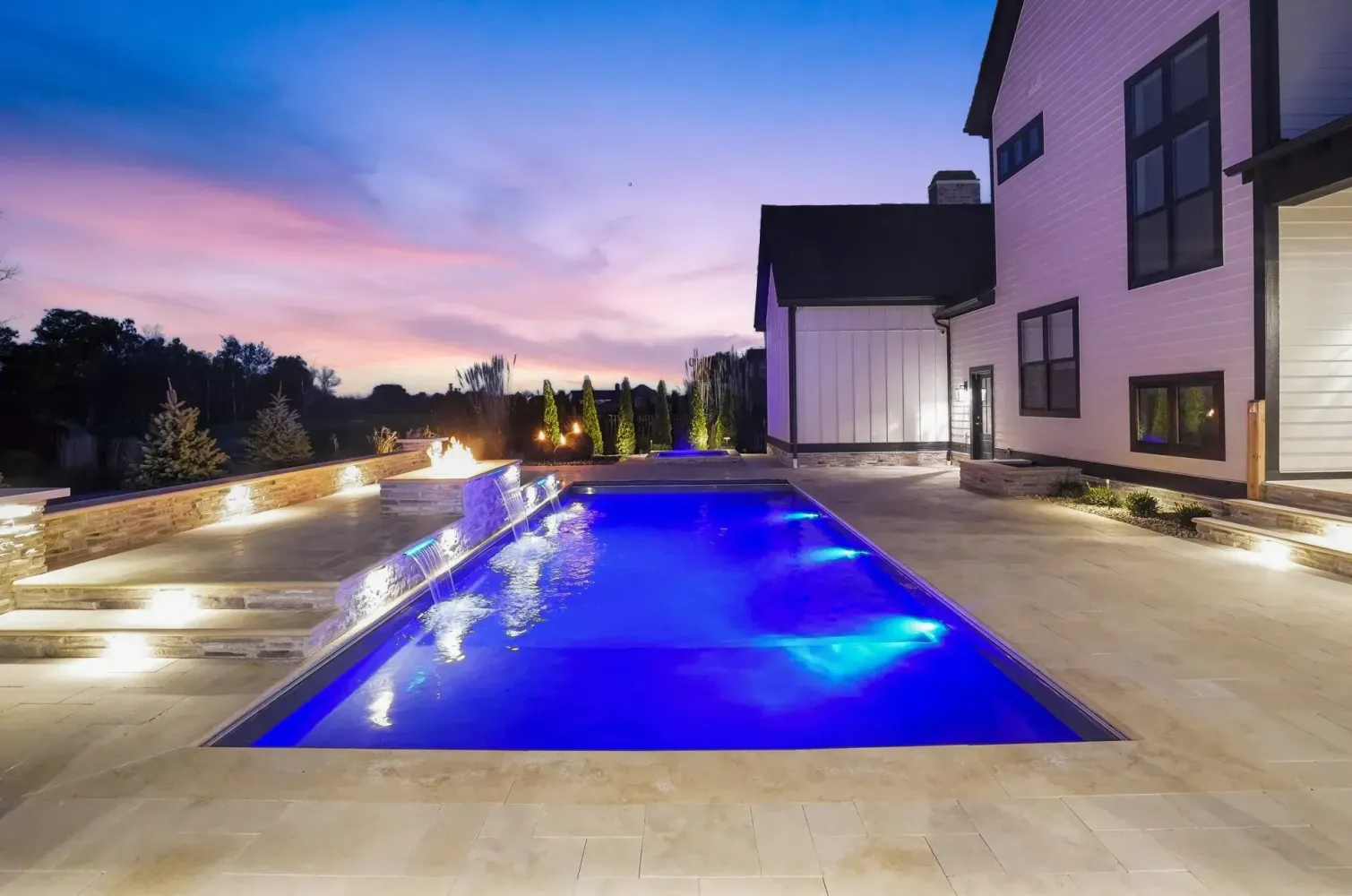
PIR Sensor Placement on Slope
Placing a passive infrared sensor on a sloped driveway is slightly different from a flat install. On level ground you aim the PIR parallel to grade, 8–10 feet up, with a 30-foot detection radius. On a 12% grade you tip the sensor roughly 6 degrees so the detection cone lands on the slope surface, not on the sky above it. Miss this and the sensor either false-triggers on tree motion above the apron, or misses pedestrians because the cone is aimed over their heads. Six-degree downward tilt is the number we pencil into every spec for any driveway above 10% grade.
Freeze, Moisture, and the Dawson County Wiring Reality
Dawsonville averages 30 freeze events per year — roughly 50% more than Dacula’s 20. Combined with the mountain-storm rainfall pattern (55 inches annually, often in summer thunderstorm bursts), a landscape lighting system installed here sees freeze-thaw and saturated-soil cycles that punish cheap fixtures. This is why we spec brass and stainless bodies across the board, not aluminum or composite. Brass path lights from Kichler, FX Luminaire, or Volt run $60 to $120 per fixture versus $25 for a big-box aluminum. The aluminum corrodes through in Dawson County soil in three to five winters. The brass outlives the transformer.
Cable matters too. We run 12-gauge direct-burial landscape cable on every job, never 14-gauge even if the load calculation allows it. 12-gauge is 60% more copper, which means voltage drop on long runs is cut nearly in half, and the jacket survives rodent pressure on mountain lots. The Etowah River corridor is a vole highway in spring, and 14-gauge cable in a vole run has a mean-time-to-failure of about two growing seasons.
Every splice on a Dawsonville job goes into a King Innovation DryConn silicone-filled wire nut, then into a waterproof junction box. Never a simple wire nut in a trench. Never an exterior-rated nut without the silicone. We’ve opened failed systems in Dawson County and found raw wire nuts six inches deep in saturated soil from the previous contractor. They fail at the third freeze, and the homeowner pays to dig up 80 feet of buried cable to find the fault.
Permitting & code: 12V low-voltage landscape lighting does not require a separate Dawson County permit in most cases when installed concurrently with a pool project under the main pool permit (filed with the Dawson County Department of Planning & Development, 25 Justice Way, Dawsonville). If added after pool completion, a simple electrical permit is typical for the 120V supply side only — the low-voltage distribution is unregulated.
Grounding, Bonding, and the NEC 680 Question
One question we answer on nearly every Dawson County consultation: does the landscape lighting tie into the pool’s equipotential bonding grid? Short answer — no. NEC Article 680 requires bonding for any metallic object within 5 feet of the pool water edge. Landscape lighting fixtures outside that 5-foot envelope are not part of the equipotential grid. Fixtures within 5 feet are either (a) bonded to the grid with a #8 solid copper conductor, or (b) specified as non-metallic. We default to option (b) — composite step lights within the coping zone — because bonding brass step lights into the pool grid means that if the grid develops a fault every step light becomes a shock risk. Keeping them out of the grid keeps them electrically independent. This is a small detail most generalist landscapers miss, and it is one of the three things we check first on a remediation bid.
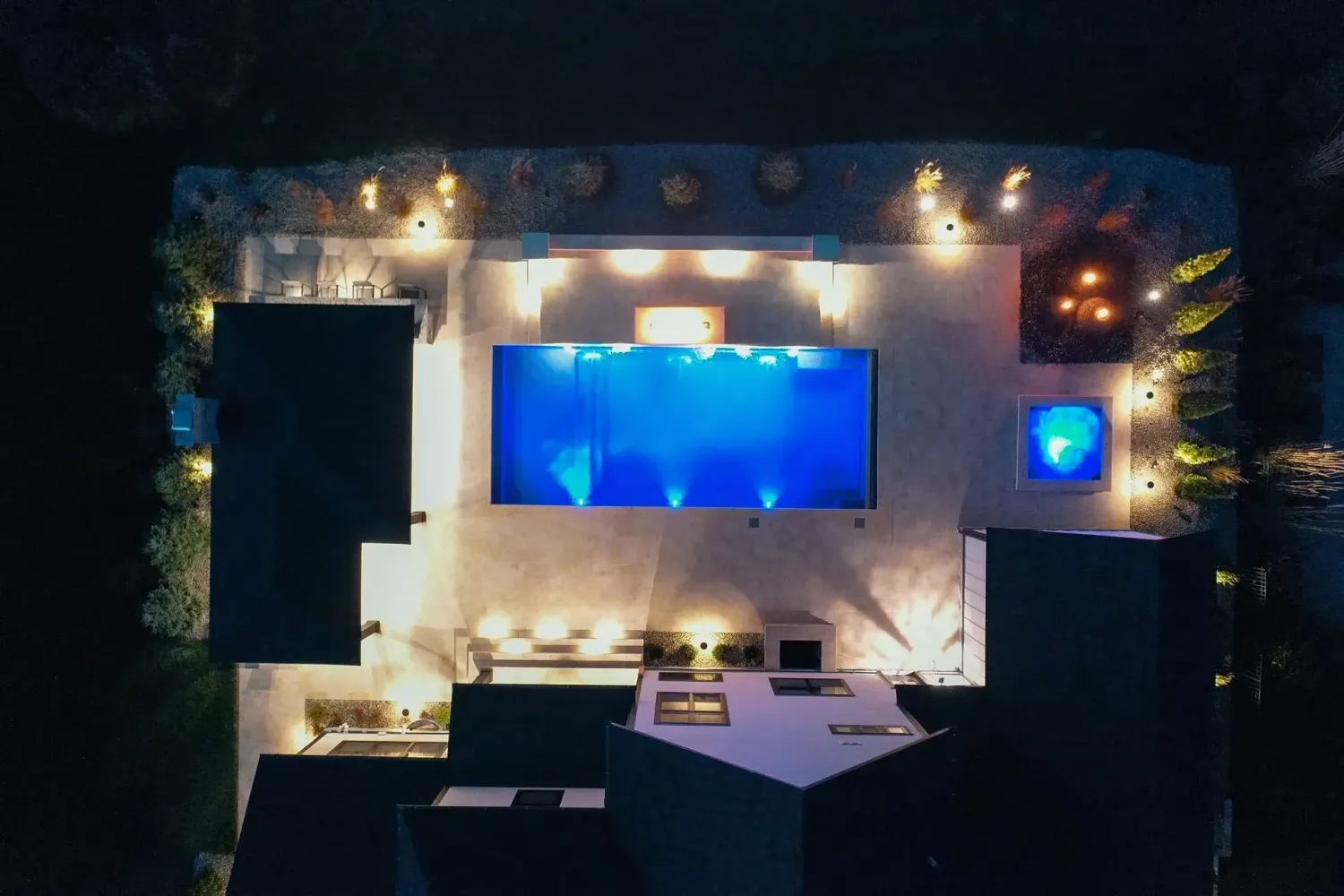
Why This Post Was Written by a Dawsonville Builder, Not Pulled from a Database
Almost every “landscape lighting” article you’ll find online was written for a flat suburban lot. It assumes 8-foot path-light spacing on a level walkway, a single transformer beside the house, and a homeowner who wants to dim the pool from a phone app. None of those assumptions hold in 30534. The terrain is different, the soil is different, the freeze count is different, and the way light travels across a mountain lot after sundown is different. Building a plan off a flat-lot template is why homeowners in Big Canoe and Applewood end up calling Primetime for remediation six months after the original installer walks away.
The spec above — 18 to 24 fixtures, 300W transformer, 2700K Kichler, hub-and-spoke wiring, brass-only, motion at the driveway, six-degree PIR tilt, DryConn splices — is what a Dawsonville mountain lot actually needs. The numbers are not guesses. They are what we land on after roughly two dozen builds across Foxcreek, Riverbend, Kensington Ridge, and the northern edge of the Etowah River Club over the last several seasons. When a plan honors the site, the site rewards you with a yard that reads as one continuous space from the driveway to the pool steps, and that is the difference between lighting a pool and lighting a property.
Landscape lighting designed for steep lots, across 20+ cities within 30 miles of Winder, GA
Dawsonville mountain lots demand more than an underwater LED — they need layered, 12V, 2700K fill lighting engineered for grade, freeze, and saprolite. That is what Primetime Pools builds.