
The grill is the part most Alpharetta homeowners obsess over. But the base — the cabinet wrapping it — is what the Country Club of the South ARB looks at first, what cracks in year 4 or 5, and what determines whether your outdoor kitchen still looks like a finish-grade build a decade from now.
Three materials dominate residential Alpharetta builds: stone veneer, stucco over a CMU or metal-stud frame, and cedar cladding over a treated frame. Each one wins on a different axis — cost, permanence, or warmth. None of them is wrong. But the ARB in your neighborhood has a strong preference, the Piedmont clay under your slab has a strong opinion, and the ~20 freeze events per year Alpharetta logs will punish whichever choice you don’t detail correctly.
This piece walks through all three, material by material, with the pricing, the maintenance curve, the failure modes we’ve repaired, and the neighborhood-by-neighborhood ARB reality in Windward, CCOS, White Columns, Deerfield, and Ashebrooke. If you’re building inside Alpharetta city limits you’re pulling a permit through City of Alpharetta Community Development at 2 Park Plaza, and that inspection calendar doesn’t forgive sloppy substrate work.
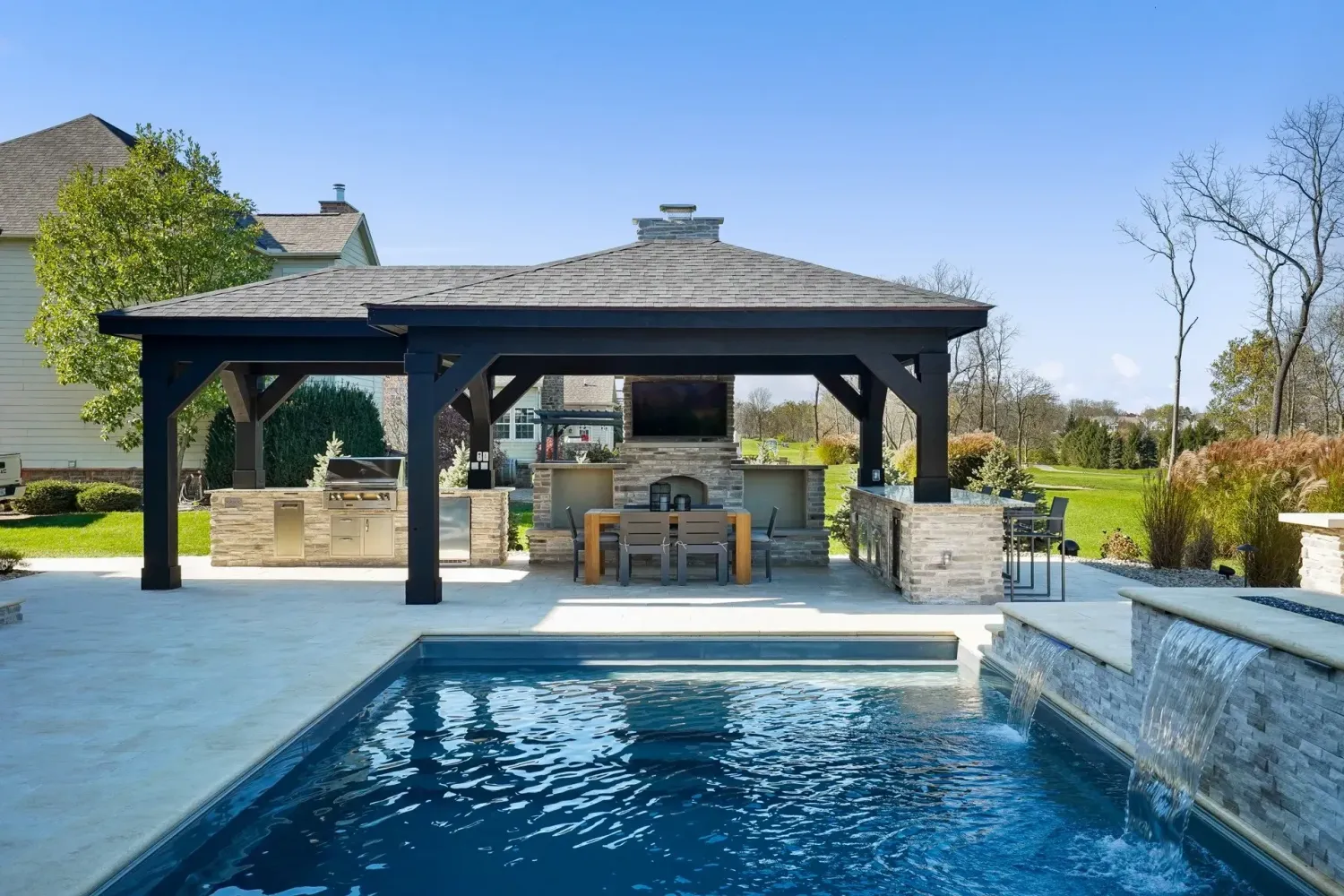
Stone Veneer: the default for CCOS, White Columns, and Windward’s north tract
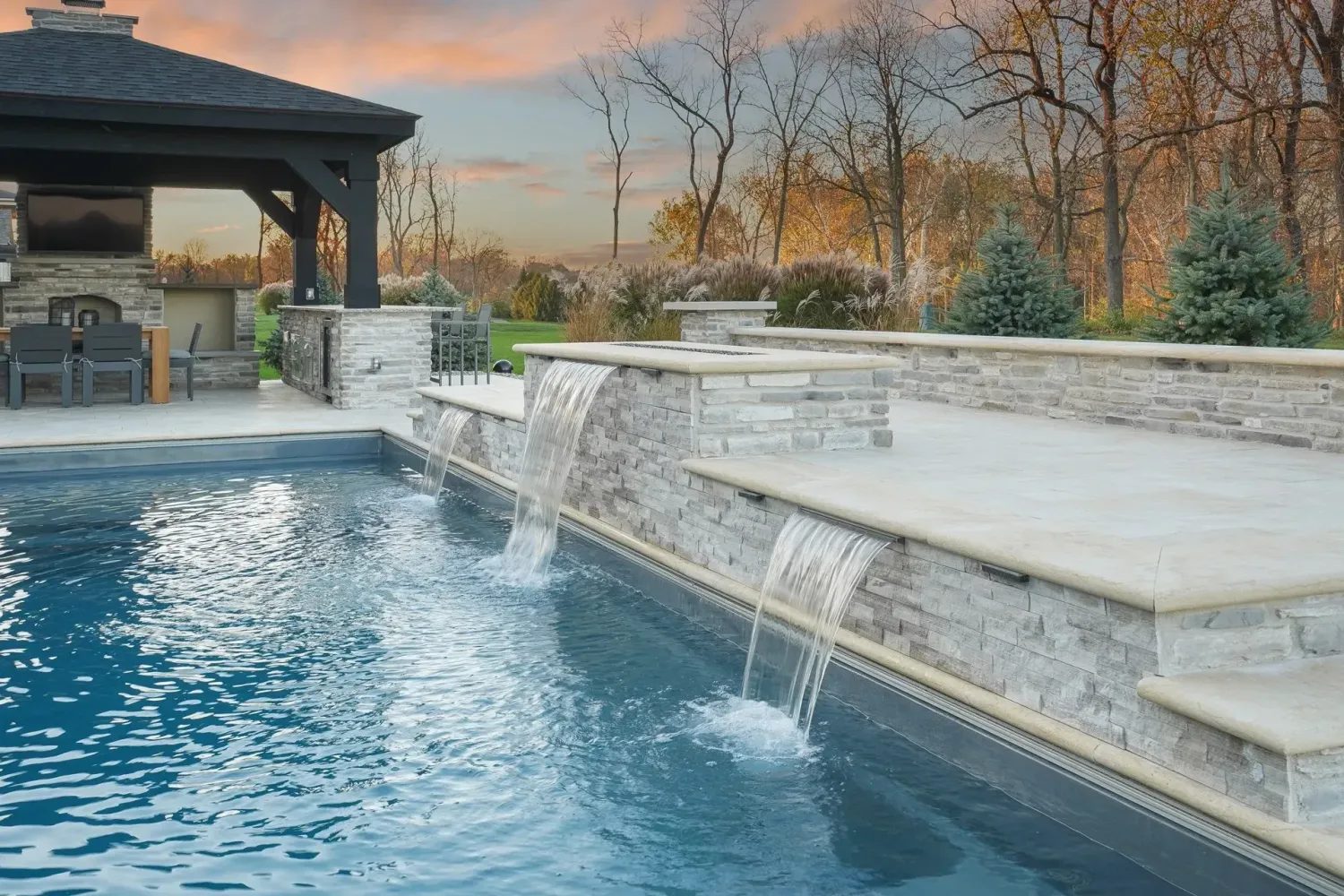
Stone veneer is the safest ARB submission in Alpharetta, full stop. In Country Club of the South and White Columns — the two most scrutinized ARB boards in the city — we have never had a stone-veneer kitchen base rejected. In Windward’s north tract the answer is the same. The reason is simple: the homes those ARBs protect are mostly brick, stacked-stone accent, or stone-and-hardie. Putting a stone base on an outdoor kitchen reads as an extension of the house, not a new material introduced into the envelope.
The three product families we specify are Boral Cultured Stone, Eldorado Stone, and Coronado Stone. All three are manufactured thin-set veneers (1-3/4″ to 2-1/2″ thick), lighter than full-bed stone, and approved by the 2018 IRC (which Alpharetta enforces) as a Class A veneer cladding over a code-compliant substrate. Pricing sits in the $32 to $48 per square foot installed range depending on the blend, the joint profile (tight-fit mortar, overgrout, or dry-stack), and whether the corners are full-wrap or mitered flats.
The substrate is where bad installs hide. A veneer base that will actually last 30 years in Piedmont clay gets built on a 6-inch CMU core anchored to a grade beam, wrapped in 2 layers of grade D building paper (not one — one is a warranty failure waiting to happen), then a galvanized expanded-metal lath fastened every 6 inches vertical and 16 inches horizontal into the block. Scratch coat, brown coat, veneer. If a contractor is mounting stone directly onto cement board over 2×4 studs with no air gap and no drainage plane, that’s the build you’ll be paying to tear off at year 8 when the mortar joints start shedding.
Drainage-plane spec to write into the contract: “Two layers grade D building paper over CMU or sheathing, expanded 2.5-lb galvanized diamond-mesh lath, mechanically fastened at 6″/16″ pattern, minimum 1/2-inch scratch coat, minimum 1/2-inch brown coat, stone veneer set in Type S mortar with weep screed at base.” Without the weep screed, the wall will fail in freeze-thaw — Alpharetta’s ~20 annual freeze events move water behind the stone and it has nowhere to exit.
Where we see real money spent is on the corner detail. Mitered flat corners — two stones beveled to meet at 45 degrees — read as finish-grade work and add roughly $18 to $26 per linear foot of corner to the bid. Factory-cast wrap corners are faster, cheaper, and read as a production build from ten feet away. On a kitchen in Hutchinson Farm last year the owner specifically asked us to re-bid with mitered corners after seeing the wrap-corner version — it was a $1,400 swing on an otherwise $28,000 base and he made the call in five minutes.
The recurring maintenance on stone veneer is almost nothing for the first decade. Around year 12 to 15 the mortar joints — particularly the horizontal bed joints facing weather — will show hairline recession where freeze-thaw and rain have leached the lime binder. That’s re-pointing work, roughly $8 to $14 per square foot, and it buys another 15 years.
Stucco: the entry-point material, and what the crack-seal schedule actually costs
Stucco runs $18 to $28 per square foot installed, which makes it the cost leader by a meaningful margin — on an average 14-linear-foot L-shape kitchen with a 36-inch-tall base, you’re looking at $1,200 to $2,400 less than the stone-veneer equivalent. For an owner who wants to put the savings into better appliances (a Bull Grills Angus head at ~$4,200 vs a builder-grade head at $1,800, for example), that math gets compelling fast.
But the maintenance curve on stucco in Alpharetta’s climate is not what most brochures advertise. Stucco — even modern acrylic-finish systems like Sto or Parex over a fiber-cement substrate — is a rigid skin. When it moves, it cracks. The freeze-thaw cycle in Zone 8a, combined with the shrink-swell behavior of Cecil-series Piedmont clay under the slab, guarantees seasonal movement. You will see hairline cracks in the stucco by year 3, and you will need to seal them annually from year 4 onward or water will get behind the system and the cracks become delamination.
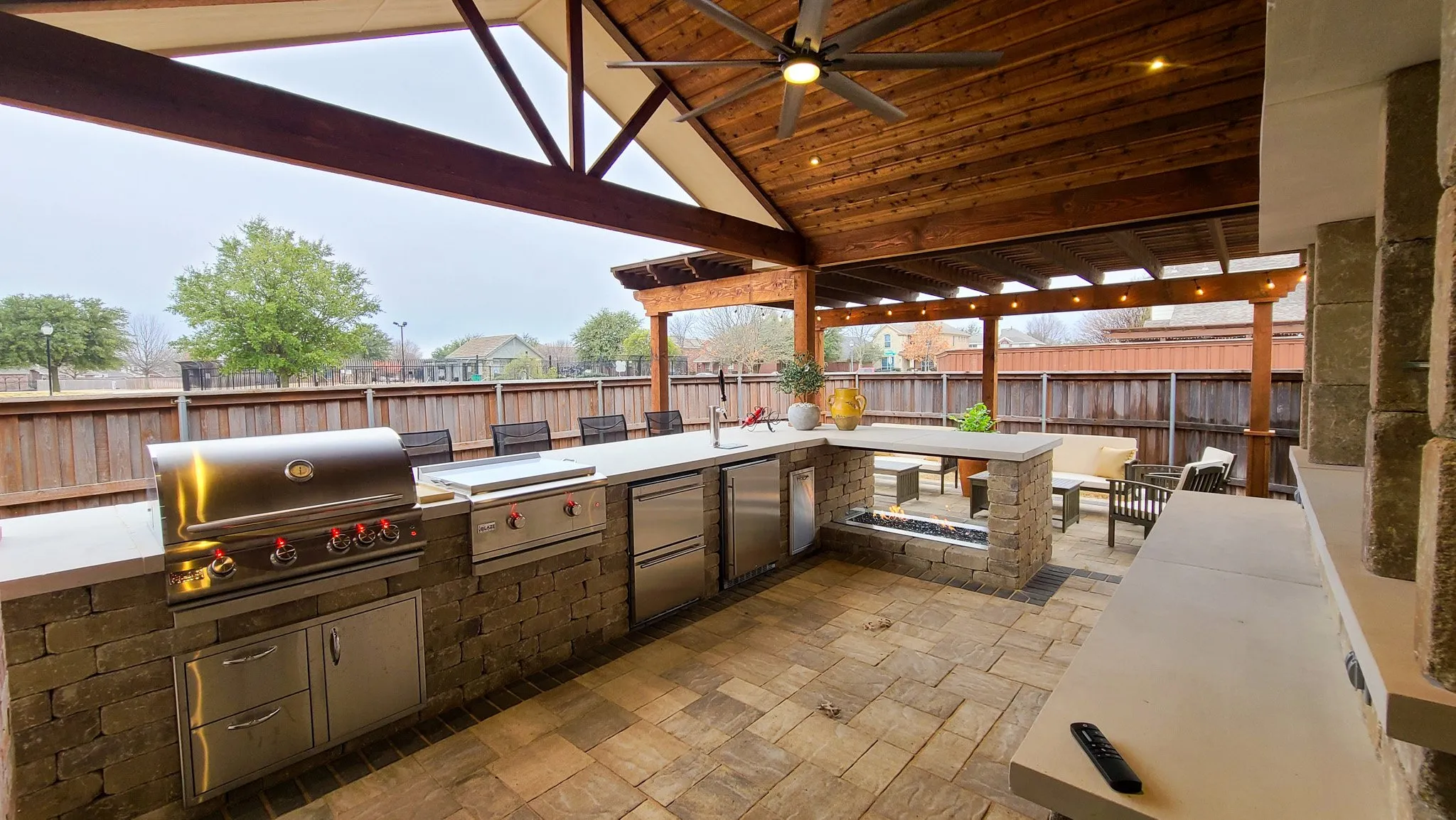
The annual crack-seal budget is small — $150 to $400 per visit — but it’s real, and owners who skip it two years in a row end up paying for a full re-skin at around year 10, which in current Alpharetta labor markets is $4,800 to $7,500 depending on linear footage. The total cost of ownership over 15 years on a stucco base can actually exceed the stone-veneer total cost of ownership if the maintenance is deferred.
The ARB reality on stucco is split. Windward‘s ARB accepts stucco as a standalone finish for outdoor kitchens without extra conditions — the community already reads as a mix of stone, brick, and stucco, and the board doesn’t treat it as out of context. Deerfield and Ashebrooke, by contrast, will approve stucco as the primary base finish only when it includes a stone accent band — typically a 12 to 18-inch high kickplate of stacked stone at the base and sometimes a matching cap band under the countertop. That accent-band condition adds roughly $900 to $1,600 to the build, which narrows the cost advantage over full-stone veneer.
Country Club of the South and White Columns push back on stucco as a standalone material for outdoor structures, period. We’ve had stucco submissions come back marked up with handwritten notes suggesting stone veneer instead. In those two neighborhoods, stucco is a conversation, not a default.
The stucco contract line most homeowners miss: Ask for the system manufacturer and the exact part number on the base coat, mesh, and finish. “Stucco” is not a spec. “Sto PowerWall over fiber-cement with reinforcing mesh at all inside corners and expansion joints at every 15 linear feet” is a spec. The first version gets you whatever’s on the truck that morning.
Cedar-clad frame: the warmth premium, and why it’s not a 30-year material here
Cedar is the material homeowners fall in love with in the showroom — the warmth, the grain, the way it matches the underside of a cedar T&G pavilion ceiling. When the kitchen sits under a cedar pavilion, cladding the base in matching stained cedar reads as one unified outdoor room. That aesthetic argument is real, and we build a lot of cedar-clad bases for that exact reason.
The cost is $24 to $38 per square foot installed, between stucco and stone. The frame underneath is typically pressure-treated 2×4 or steel-stud with cement board facing, and the cedar is 1×6 or 1×8 vertical or horizontal plank with either a Sikkens Cetol or Penofin penetrating oil finish. Western red cedar is the default species — it’s stable, takes stain well, and the cell structure resists insect pressure better than pine or spruce. Eastern white cedar is the budget step-down and reads warmer but silvers faster.
Here’s where the material argument gets honest. Alpharetta humidity averages ~70% from June through September, and rainfall is ~51″ per year. Cedar in that climate, even stained, needs re-staining every 3 to 4 years to maintain its appearance. Skip two cycles and the finish fails, UV drives out the natural oils, and the wood starts checking and cupping. Re-staining is $3.50 to $6.50 per square foot of face, plus prep, so a 60-sqft kitchen base costs $350 to $600 every third year to stay on its maintenance curve.
Beyond year 12 to 14, even with diligent maintenance, cedar in this climate starts to fail at the bottom course where splash-back and ground moisture accumulate. That’s when owners rip the cedar and either re-clad in cedar (another $4,000 to $7,000 depending on kitchen size) or step up to stone veneer. We’ve done that swap a half-dozen times in the last three years — usually on kitchens originally built between 2010 and 2014.
ARB-wise, cedar cladding gets approved in every Alpharetta HOA we work in if the primary home has cedar somewhere on its envelope — column wraps, gable accents, shutters, or soffits. If the home is pure brick or stucco with no cedar on it, the ARB boards in CCOS and White Columns will push back on cedar as an introduced material. Windward accepts cedar cladding broadly, regardless of the home’s envelope.
How each material fails — and what the repair bill looks like
Understanding failure modes is how you avoid them in the build. Each of these three materials fails in a different, predictable way in the Alpharetta climate, and the repair economics are wildly different.
Stone veneer fails at the mortar joint. Water works into hairline recession cracks, freezes, expands, shears the mortar off the stone face. You’ll see it first on the horizontal bed joints that face weather — the south and west faces, usually. Repair is re-pointing with a compatible Type S mortar, grinding the failed joint back 3/8″, packing fresh mortar. Cost: $8 to $14 per square foot. The stone itself almost never fails — it’s the joint. A stone-veneer base built correctly on a drainage plane with weep screed will go 30 years before it needs joint work.
Stucco fails at the crack. Every stucco base in Alpharetta will crack — the question is whether you seal the cracks annually or let water get behind the system. If you seal: $200 a year, no delamination. If you don’t: the water intrusion blisters the finish coat, the finish coat separates from the brown coat, and you need a partial re-skin. Partial re-skin on a section is $28 to $42 per square foot, which is often 80% of the cost of a full re-skin because the labor to tie new stucco into old always shows. At that point, homeowners usually just full-re-skin.
Cedar fails at the bottom course and at the fasteners. Moisture wicks up from the slab into the bottom course of cedar, and the fasteners — even stainless ring-shank trim nails — eventually fail to hold as the wood cycles through moisture expansion and contraction. You’ll see the bottom plank start to cup and pull off the frame around year 10 to 12. Repair is a full course replacement — not a patch — because cedar colors don’t match once one course is replaced. Full replacement of the bottom course on a 14-foot L-shape is $1,800 to $2,600.
The failure mode that will void all three: Skipping the cap flashing under the countertop. Water runs off the granite or concrete counter, hits the top of the base, and without a proper metal drip edge and sealant it runs down the back of the veneer or siding. We’ve repaired all three material types with this exact failure pattern. Specify a painted aluminum or copper drip edge under the countertop, sealed with a polyurethane (not silicone) caulk at the counter-to-flashing joint. That detail costs $80 in materials and prevents a $3,000 repair.
The Alpharetta HOA layer: how each ARB actually reviews
This is where Alpharetta diverges from most of metro Atlanta. The established-subdivision ARBs here take 3 to 4 weeks for full architectural review on outdoor kitchen submissions. Country Club of the South and White Columns run the tightest process — design review board meets on a fixed cadence, and miss the submission window by a day and you’re 30 days back. Windward’s ARB is faster and more pragmatic; typical turnaround is 10 to 14 business days. Deerfield and Ashebrooke sit in between.
The ARB packet for an outdoor kitchen in these neighborhoods includes, at minimum: a site plan showing setbacks from the rear and side property lines (Alpharetta zoning requires 5 feet minimum in most residential zones, but HOA setbacks are often deeper — CCOS requires 10 feet on many lots), an elevation drawing showing finished height and face materials, a material sample board with actual veneer or stucco or cedar swatches, appliance specs, and a stamped drainage plan if grade changes are involved.
The detail that shortens a 4-week review to a 2-week review: submitting the material sample board in person with the application, not mailed. Alpharetta city permit is a separate track. For work inside Alpharetta city limits you file through City of Alpharetta Community Development at 2 Park Plaza, and the in-city permit runs parallel to the HOA review. Alpharetta’s in-city permit turnaround averages 5 to 8 business days — noticeably faster than unincorporated Fulton, which is why we often push clients in boundary-zone neighborhoods to annex if the option exists.
One more local wrinkle: utility service matters for the kitchen’s gas line and electrical run. Georgia Power serves almost all of Alpharetta; Sawnee EMC has a small footprint along the Alpharetta/Milton border in the northern tracts. The two utilities run different inspection calendars and different pre-construction utility locate processes. If your home is on Sawnee, budget an extra 5 to 10 business days for the locate-and-service coordination before trenching can start.
Matching the base to your home, your ARB, and your ownership horizon
The material choice isn’t really a style choice — it’s a three-way intersection of what your home already shows, what your ARB will approve quickly, and how long you plan to own the property. We walk every Alpharetta client through that intersection before we quote anything.
If the home is brick or stone-and-hardie, the ARB is CCOS, White Columns, or the north tract of Windward, and the ownership horizon is 10+ years, stone veneer is the obvious answer. The premium over stucco is recovered in avoided maintenance and in the property’s resale presentation — buyers in the $750K to $3.5M+ Alpharetta market read stone as finish-grade and stucco as builder-grade, fairly or not.
If the home is stucco or has significant stucco accents and the ARB is Windward or Deerfield, stucco with a stone accent band is the coordinated choice. It reads as an extension of the house’s envelope language, the ARB accepts it readily (with the accent band), and the cost savings over full-stone veneer can fund a real upgrade in appliances.
If the home has cedar on column wraps, soffits, or gable accents — common in the 2015+ infill builds near Avalon and the downtown historic district — cedar cladding over a treated frame is the choice that ties the outdoor kitchen visually back to the architecture. The maintenance premium is real, but the aesthetic unity is unmatched.
The Alpharetta tech-corridor buyer profile — Microsoft, CDW, and other GA-400-corridor relocations — tends to hold properties for 7 to 12 years before the next corporate move. That horizon favors stone veneer or stucco-with-accent-bands over cedar. If the ownership horizon is under 5 years, the math on stucco (with diligent maintenance) starts to make more sense — you’re not going to hit the year-10 re-skin before you sell, and the lower initial cost frees budget for appliances and finish details that move buyers faster at list time.
The worst decision we see homeowners make is choosing the material first and fitting everything else around it. The right sequence is: ARB requirements first, home envelope second, ownership horizon third, budget fourth. When those four inputs line up, one of the three materials lands as the clear answer. When homeowners come to us having already fallen in love with a specific look and then try to force-fit the ARB, the substrate, or the budget to it, the project drags, the review cycles, and the final build is a compromise on something that mattered.
Build the base right and you don’t think about it again for a decade. Build it wrong and you think about it every season — every crack, every stain job, every time you host and notice the bottom course of cedar pulling away from the frame. The cost gap between the right answer and the wrong answer, amortized across 15 years of ownership, is almost always smaller than the gap between a builder-grade appliance and a professional-grade one. Put the money where it won’t have to be spent again.
Outdoor kitchens across 20+ cities within 30 miles of Winder, GA
From HOA-scrutinized stone veneer bases in Country Club of the South to budget-conscious stucco-with-accent-band builds in Windward and Deerfield, we match the base material to your ARB, your home, and your ownership horizon.