
On a one-acre lot in Laurel Springs, a fire feature looks like a blank canvas. Then you walk the property with a tape measure and a compass and a notebook, and four things start squeezing the map at once: Jackson EMC overhead service lines, tree canopy that touches those lines, the septic field, and the Gwinnett residential setback. By the end of the walk, you have three viable placements — maybe four — not thirty.
Here is what most Suwanee homeowners don’t realize about large-lot fire feature design. Space is not the constraint. Invisible easements, airborne hazards, and utility geometry are the constraints. That plays out differently in Suwanee than anywhere else in Gwinnett because of one specific factor: this is not Georgia Power territory. A large share of Suwanee north of I-85 is served by Jackson EMC, a member-owned cooperative that still runs a lot of its primary and secondary distribution overhead, especially along the wooded corridors of Settles Bridge, McGinnis Ferry, and the back halves of the estate subdivisions.
That changes the math on where you can place a gas fire pit, a masonry fireplace, or a linear fire wall. We’re going to walk through the real setback numbers, the clearance rules from overhead conductors, the tree-canopy issue that most contractors ignore, and a numbered placement process we use on every estate-scale Suwanee project. At the end, I’ll walk through a real River Club two-acre job where the only workable placement was the one the homeowner ruled out first.
Here’s the four-part frame we’ll work through in order. One, why Jackson EMC’s overhead distribution changes the clearance math compared to the underground-only subdivisions in other parts of Gwinnett. Two, the tree canopy issue that compounds the overhead-line problem in the kind of wooded lots Suwanee is known for. Three, the actual four-setback geometry on a typical 1–2 acre property. Four, the River Club case study that illustrates how all four stack up in practice. If you’re planning a fire feature on a Suwanee estate lot, each section is something you’ll want to hand your contractor before they sketch anything.
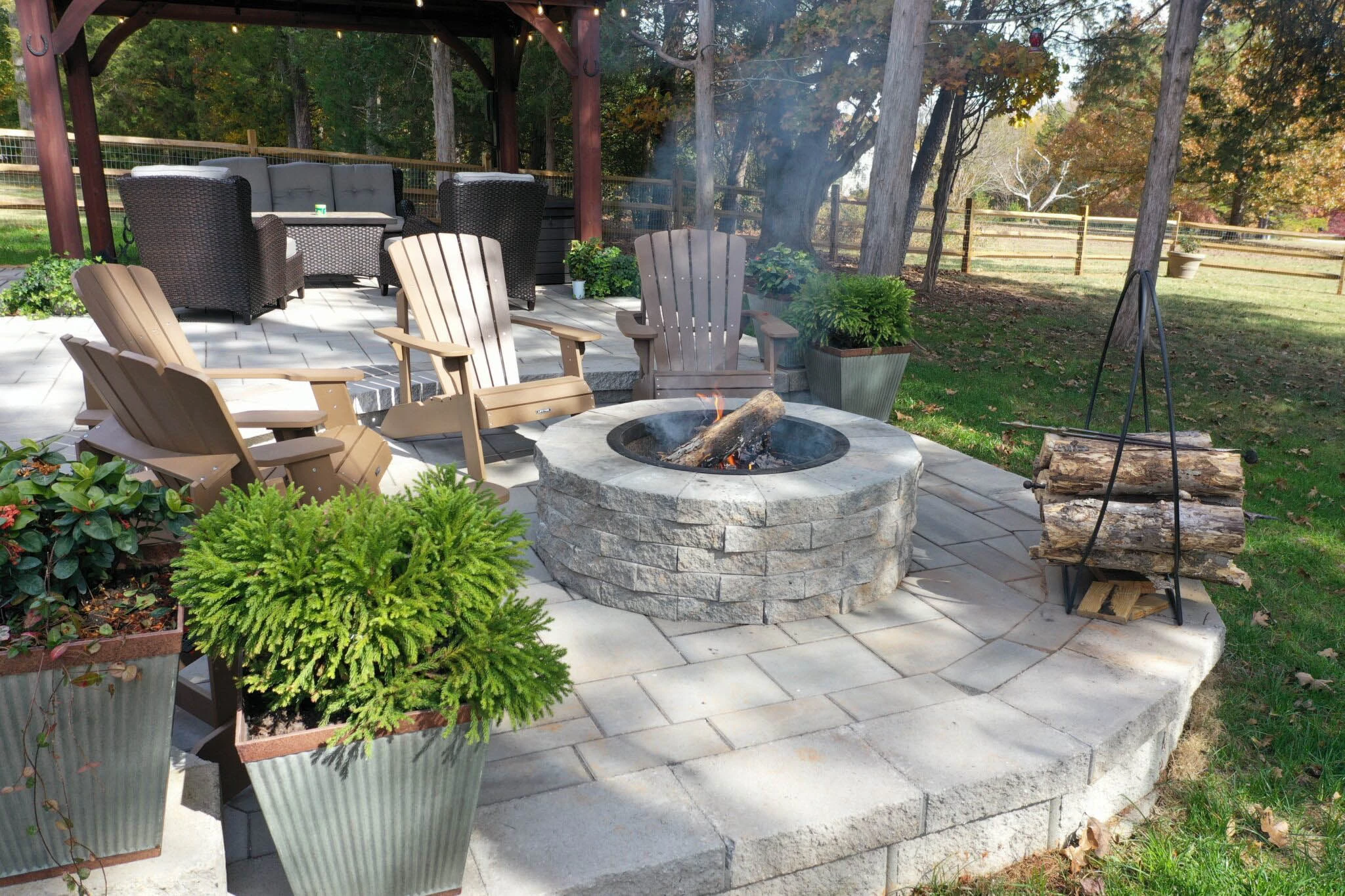
1. Why Jackson EMC Overhead Service Changes the Entire Layout
Start with the utility. Newer Suwanee subdivisions built after about 2005 — The Manor, parts of Bear’s Best Atlanta, the interior of River Club — have underground primary distribution. That makes the backyard a lot simpler. But a huge percentage of 30024 lots still run overhead, particularly:
- Older Settles Bridge Road frontages (a lot of 1990s traditional homes on 1–2 acre lots).
- Older parts of Village Grove and Highgrove where lot lines predate the subdivision buildouts.
- Laurel Springs estate sections where the primary is underground but the secondary drop from the transformer pad to the house is sometimes run overhead across the backyard.
- Anything along Old Peachtree Road and McGinnis Ferry where the pole line predates the residential buildout.
Jackson EMC’s residential service is typically 240V single-phase, which doesn’t change the clearance rules much compared to Georgia Power’s equivalent. But the physical reality of overhead conductors on a residential lot does. NESC (National Electrical Safety Code) clearance rules require minimum 10 feet vertical clearance over a residential lawn area, and a minimum 7.5-foot horizontal setback from any combustible structure — and outdoor fireplaces absolutely qualify.
Here’s what that means in practice. If the secondary drop to the house crosses your backyard at 16 feet off the ground, and you want to build a 6-foot-tall fire pit seat wall plus a 12-foot chimney on a masonry fireplace, you just lost the entire envelope under that conductor. The fireplace flue opening cannot be within 10 feet vertical of that line, period, and we run a wider 15-foot horizontal buffer as our internal standard because embers and radiant heat are not something you want anywhere near an energized secondary.
Jackson EMC clearance standard we build to: 15 feet horizontal from any overhead conductor to the nearest edge of a fire feature, and zero tree canopy over the conductor within 25 feet of the fire feature itself. That’s stricter than NESC. We do it because a fire feature generates convective updraft, and updraft carries embers higher than the 10-foot NESC minimum would protect against.
2. The Tree Canopy Problem Almost Everyone Misses
Suwanee lots sell on their trees. That’s half the appeal of Laurel Springs, The River Club, and the older Settles Bridge properties — mature oak, hickory, and loblolly pine canopy that’s been there 60 to 120 years. But tree canopy plus overhead service plus a fire feature is the stack of conditions where things go sideways, often years after the pool is built.
Jackson EMC maintains a 10-foot right-of-way around primary conductors and typically asks homeowners to clear back branches that grow within that envelope. In practice on residential lots, they show up when there’s an outage and the branches have already contacted the line. A fire feature installed under a tree whose crown is within contact range of an overhead conductor is a risk the homeowner usually doesn’t see. We do.
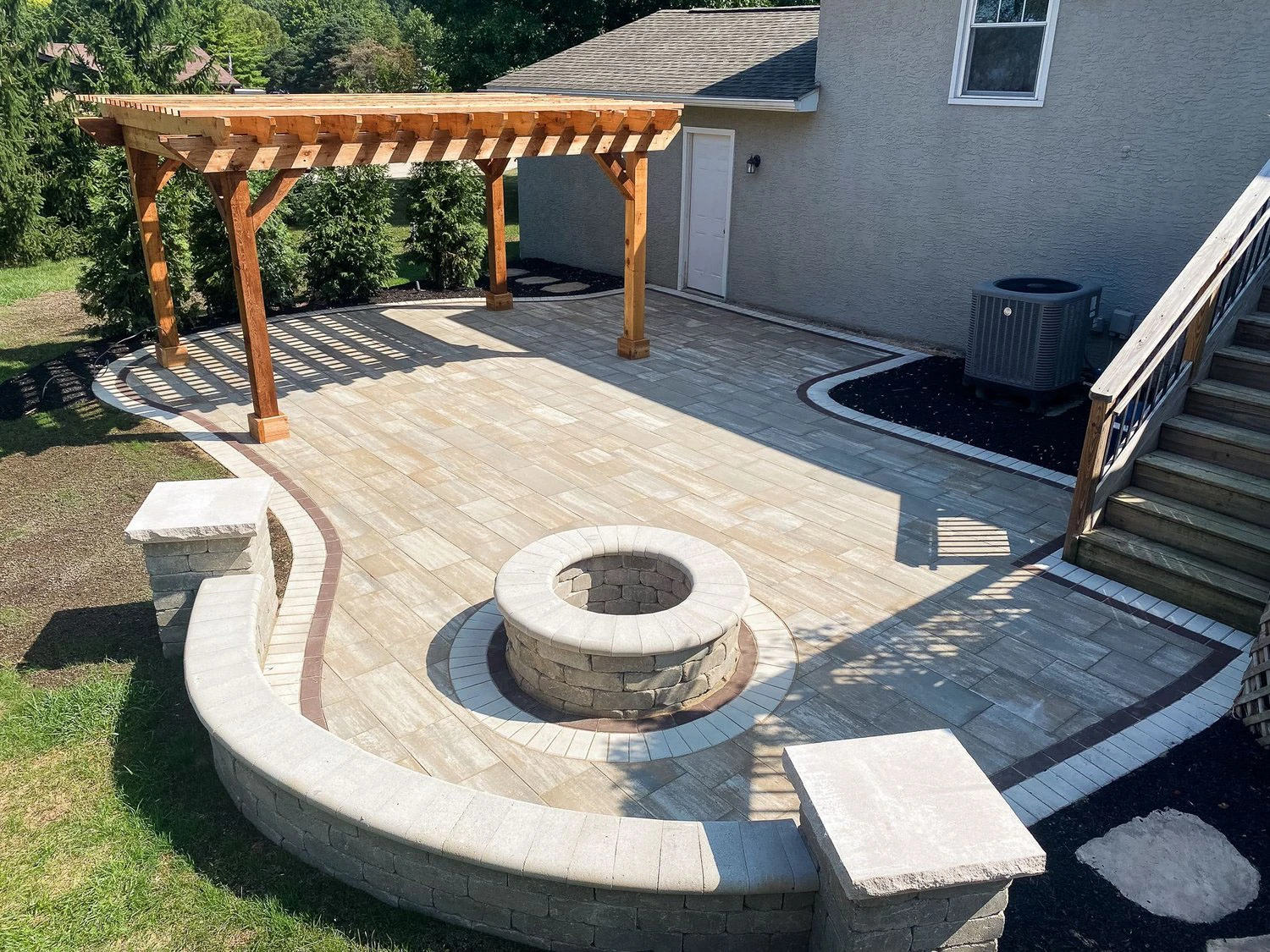
The rule we run at Primetime is simple and we write it into the site plan every time:
- No overstory branch within 25 feet of the fire feature (ember drift zone).
- No branch of any size within 10 feet vertical or 5 feet horizontal of an overhead conductor, anywhere on the walked path between the feature and the nearest pole.
- No gas line trenching within the dripline of any oak larger than 24 inches DBH (diameter at breast height) without a certified arborist letter — root damage to mature oaks is a Laurel Springs HOA flashpoint.
That last one surprises homeowners. Cutting a trench for a 1-inch gas supply through the root zone of a mature oak is the kind of detail that gets caught in the Laurel Springs HOA architectural review, which has one of the strictest processes in Gwinnett County. Typical turnaround is 3 to 4 weeks if everything is clean; longer if the committee wants a tree-impact plan.
3. The Four-Setback Math on a Suwanee Estate Lot
Now stack the setbacks. On a typical 1–2 acre lot in Suwanee, a fire feature has to clear four separate minimum distances, and they don’t add up — they intersect. Here’s the checklist we run before we stake a single corner:
- From the house. We use 10 feet minimum from a masonry fireplace with a proper flue and 20 feet from a wood-burning fire pit. Nearly every Suwanee job we build is gas, so the 10-foot figure governs.
- From the property line. Gwinnett County residential setbacks for accessory structures vary by zoning, but 10 feet side and 15 feet rear are typical minimums for a structure taller than 6 feet. A 12-foot masonry fireplace chimney is unambiguously a structure.
- From the septic field. Suwanee has a meaningful number of septic properties, especially on the older larger lots. Gwinnett Environmental Health requires 10 feet minimum from any heat source to the nearest drain field line, and we push to 15 feet because soil disturbance for gas trenching can compromise field drainage.
- From overhead Jackson EMC service. Our internal standard is 15 feet horizontal, as noted above, plus zero canopy contact.
On paper, that sounds like lots of room. Now draw it on a two-acre Suwanee lot. Subtract the house footprint and its 10-foot no-fire zone on all four sides. Subtract the pool envelope (if it’s already built or planned). Subtract the septic field if present. Subtract the dripline of every oak over 24 inches DBH. Subtract the 15-foot cone around every overhead conductor and pole. Subtract canopy overlap.
What’s left is usually three to four viable placement zones per acre of usable backyard. Not thirty. Three. That surprises almost every homeowner who calls us thinking “we have plenty of room.”
4. The River Club Two-Acre Case Study
This is the job that made us start writing the overhead-line rule into every Suwanee site plan. River Club at Suwanee, 2.1-acre lot, full-sun rear yard, grade dropping about 14 feet from the house to the back property line. Homeowner wanted a masonry fireplace integrated with a covered pavilion and a raised spa, roughly $185,000 scope on the hardscape and fire-feature package alone. Underground primary in the subdivision — but the secondary drop ran overhead from a pole at the rear corner of the lot, across roughly 80 feet of yard, to a weatherhead on the back of the garage.
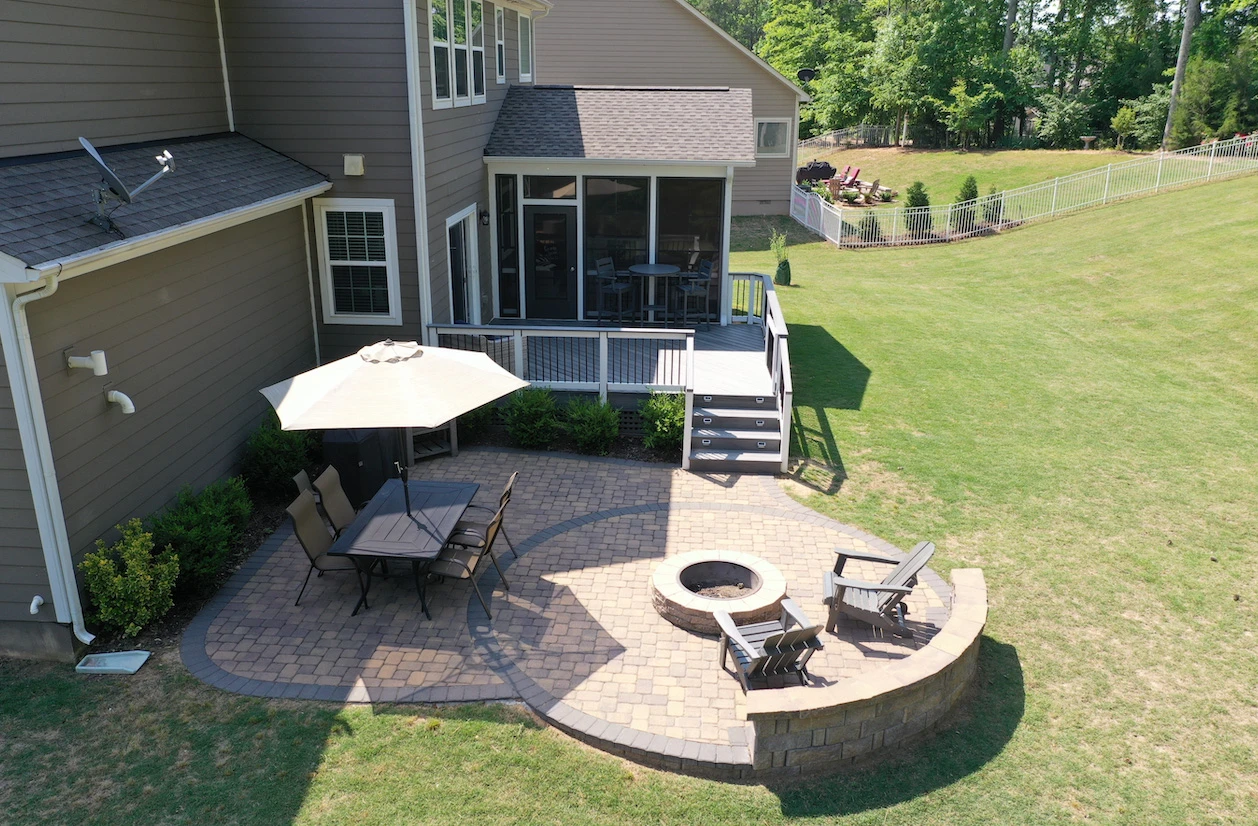
The homeowner’s first placement, and it was a good instinct, was centered on the rear of the pavilion, facing the lawn. It looked beautiful on the rendering. It was also directly under the overhead secondary — the conductor passed about 14 feet above the planned chimney top. Eleven feet of updraft ember zone plus a masonry chimney with a 12-foot height meant the flue opening was almost exactly at the conductor elevation. That is not a placement we will build.
Second option: pivot the fireplace 90 degrees and push it to the east side of the pavilion. Cleared the overhead line. Put the flue within 7 feet of a 36-inch white oak’s dripline. Arborist letter said no. Third option, the one the homeowner had ruled out on day one: the west corner, farther from the pool, set into a small grade change that had to be built up with a 3-foot segmental retaining wall. That added about $14,000 to the scope but it cleared every setback cleanly: 22 feet to the house, 31 feet to the side lot line, 41 feet horizontal to the nearest overhead conductor, 18 feet from the nearest oak dripline, and a full 140 feet from the drain field.
What the retaining wall actually bought: The extra $14,000 paid for 3 feet of grade change, which let the fireplace sit on a level pad 9 feet below the conductor elevation. That dropped the flue height from 18 feet above grade to 15 feet above grade relative to the conductor, buying another 3 feet of vertical separation on top of the 41 feet horizontal. Belt and suspenders. That’s how we like it.
The lesson from that job wasn’t that the homeowner was wrong about the first placement. The lesson was that the Peachtree Industrial Blvd corridor equipment delivery constraint, combined with the overhead secondary, combined with two mature oaks, combined with the pavilion footprint — meant only one zone on a 2-acre lot worked. We needed to walk the site with a compass, a tape, and a pole-line survey before drawing anything. On Suwanee estate projects, that’s now standard procedure.
One more detail worth sharing from that River Club job. The homeowner’s original rendering showed the pavilion oriented to the pool, not the lawn, and the fireplace sitting at the short end of the pavilion. When we pulled the secondary drop into the drawing, that orientation put the chimney almost directly beneath the conductor. We could have built it and been within the NESC 10-foot vertical minimum. We would not have been within our own 15-foot standard. The homeowner didn’t push back. That’s the thing about estate clients in Suwanee: they’ve generally done the research, they’ve talked to two or three builders, and when you tell them why a rule matters, they want the stricter rule. You just have to be able to say why.
That project wrapped in 11 weeks from ground-break to gas-on. Three weeks in the Laurel Springs architectural review cycle (they also hit River Club’s committee for the neighboring HOA overlap), three weeks of hardscape, two weeks of masonry on the fireplace itself, and the balance for plumbing, gas-on, and punch. The retaining wall didn’t add schedule — it got stacked in parallel with the masonry.
How We Walk a Suwanee Site Now
Here’s the sequence, in order, that we run before we sketch anything:
- Identify the utility. Is this Jackson EMC or Georgia Power territory? Call 811 for underground locates and pull the Jackson EMC service map if available.
- Map every overhead conductor path. Pole to weatherhead, pole to pole, any guy wires, any secondary drops. Mark them on the site plan.
- Overlay the 15-foot horizontal buffer on each conductor path, and the 25-foot ember-drift buffer on any candidate fire feature location.
- Mark the dripline of every tree over 24 inches DBH. Those are no-trench zones without arborist sign-off.
- Confirm septic field location with the county records if the lot is on septic. Add the 15-foot buffer.
- Check HOA rules. Laurel Springs, River Club, and Bear’s Best Atlanta all have architectural review committees. Build 3–4 weeks of HOA approval into the schedule.
- Check flood zone. Some Settles Bridge and Chattahoochee-adjacent properties are in Zone AE. That doesn’t kill a fire feature but it does affect the gas line depth and any structural footings.
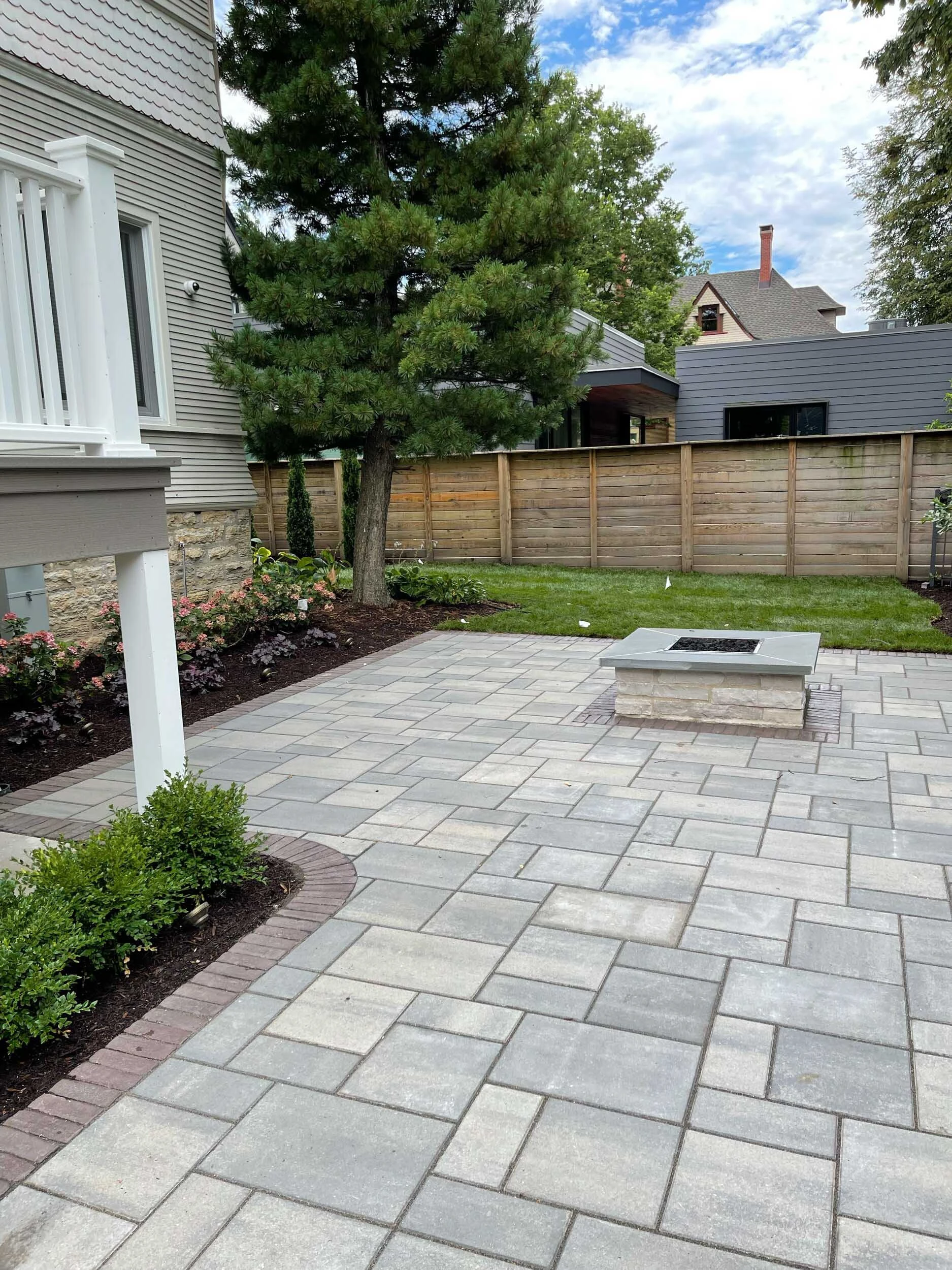
Only after all seven steps do we talk about what the fire feature should look like. Material selection — limestone veneer, bluestone cap, full masonry chimney versus a prefab insert, gas burner pan sizing, linear trough vs. round bowl — is honestly the easy part of the job. It’s aesthetic. The hard part is already done: picking the one zone on the property where you can legally, safely, and durably put it.
The Gwinnett Permit Angle
Fire feature permits in Gwinnett run through the Dept. of Planning & Development at 446 W. Crogan St. in Lawrenceville — same office that handles the Dacula, Lilburn, and Grayson jobs. A gas fire pit connected to a new 1-inch supply line usually triggers a plumbing permit (for the gas work) plus a mechanical permit if the fireplace is attached to a structure. Freestanding gas fire pits typically don’t need a structural permit but the gas line does.
A masonry wood-burning fireplace above 8 feet in height will trigger a structural permit, and if it’s within 10 feet of a property line, a zoning variance might be required. Jackson EMC doesn’t issue the permit — Gwinnett does — but a savvy permit reviewer will catch an overhead clearance problem on the site plan and send it back. Better to catch it in the pre-design walk than in the submittal.
The timing window matters too. Gwinnett runs fire feature and hardscape permits on a roughly 2–3 week cycle if the submittal is clean. Add another 3–4 weeks if the project is in Laurel Springs, River Club, or another HOA-governed community. If you want a fire feature operational by Memorial Day weekend — which is what every Suwanee homeowner who calls us in March actually wants — the real deadline to start design is Valentine’s Day. That’s the truth of it. Suwanee’s summer concert series at Town Center Park starts up Memorial Day weekend, so the social calendar is real and the deadline is real.
A Note on Chattahoochee-Adjacent Properties
If your Suwanee property is on the Chattahoochee River side of McGinnis Ferry or along the Settles Bridge corridor near the river, there are two more issues that layer on top. First, some lots sit in Zone AE flood designation, which means any structural footing has to be above base flood elevation or engineered for flood loads. Second, the morning river fog that’s typical on fall mornings can affect the draft performance of wood-burning fireplaces built too close to grade — we don’t build full masonry wood fireplaces within 50 feet of the river bluff edge for that reason.
Those are edge cases. The bulk of Suwanee fire feature work is inland, gas-fed, and geometry-constrained more than elevation-constrained. But if you’re on a river-frontage lot, name that up front and we’ll adjust the site walk accordingly.
The other piece of Suwanee-specific context worth naming: elevation. At roughly 1,063 feet, Suwanee sits higher than most of Metro Atlanta, and the rolling Piedmont topography means a lot of backyards step down from the house. That matters for fire features because a terraced patio with a 2–4 foot grade change actually creates more placement flexibility, not less. Lower elevations can drop a fireplace chimney away from an overhead conductor without needing a full retaining wall. We take advantage of that whenever the existing grade allows — an extra foot of drop is usually free. The alternative, building up from existing grade to clear a conductor, is what costs money.
Suwanee’s freeze cycle matters too. At USDA Zone 8a with roughly 20 freeze events a year, gas line freeze protection is real. We bury all gas supply lines at 18 inches minimum and wrap any above-grade exposed gas piping near the fire feature with heat tape on a thermostat if the line runs outside of insulated chase. Wood-burning fireplaces are more forgiving — they don’t freeze — but the flue has to stay clear of ice accumulation where conductors pass nearby, which is another vote for pushing the flue opening as far from any conductor as the yard allows.
The short version: Large Suwanee lots have fewer viable fire-feature placements than large Cumming or Dacula lots, because Jackson EMC overhead service is more common here than in the underground-only subdivisions up north. Plan around the overhead lines first, tree canopy second, and setbacks third. Aesthetics last. It sounds backwards but it’s the only order that produces a feature that’s still correct in year 15.
Fire-feature design and construction across 20+ cities within 30 miles of Winder, GA
Every Suwanee fire-feature walkthrough starts with a pole-line survey and a tape measure, not a rendering. If your property has overhead Jackson EMC service or a heavily wooded lot, that’s exactly the project we’re built for.