
Every Cumming pool heater we open after year seven tells the same story, and the story is written in green-white crust on copper fins. Water hardness at 180 to 240 ppm around Lake Lanier runs roughly twice Atlanta metro — and inside a gas heater’s cupro-copper heat exchanger, that doubling isn’t linear. It’s exponential.
Q: Our Raypak heater is only six years old and it’s already failing. The guy who installed it said it would last twelve. What happened?
Your water did. If your pool sits anywhere from Vickery to St. Marlo to Lake Windward, the well-blended Sawnee-area supply is feeding calcium and magnesium carbonate into your heater at roughly 2.5x the rate of a pool in softer-water pockets of DeKalb or Fulton. Heat exchangers don’t die of old age in Forsyth County. They die of scale and the galvanic pinhole corrosion scale hides.
We’ve pulled failed exchangers out of Pentair MasterTemp 400 units in Hampton Park, Jandy JXi 260 units in Polo Fields, and Raypak 406A units in Three Chimneys — every single one scaled past the manufacturer’s service limit, every single one pinholed through copper tubes that should still have had five years of life. This post is the math on why, the exact descale schedule that saves you from it, and when to pay the $400 to $680 premium for a cupro-nickel exchanger upgrade instead of a like-for-like copper replacement.
The Sawnee Hardness Math — Why 210 ppm Isn’t Just a Number
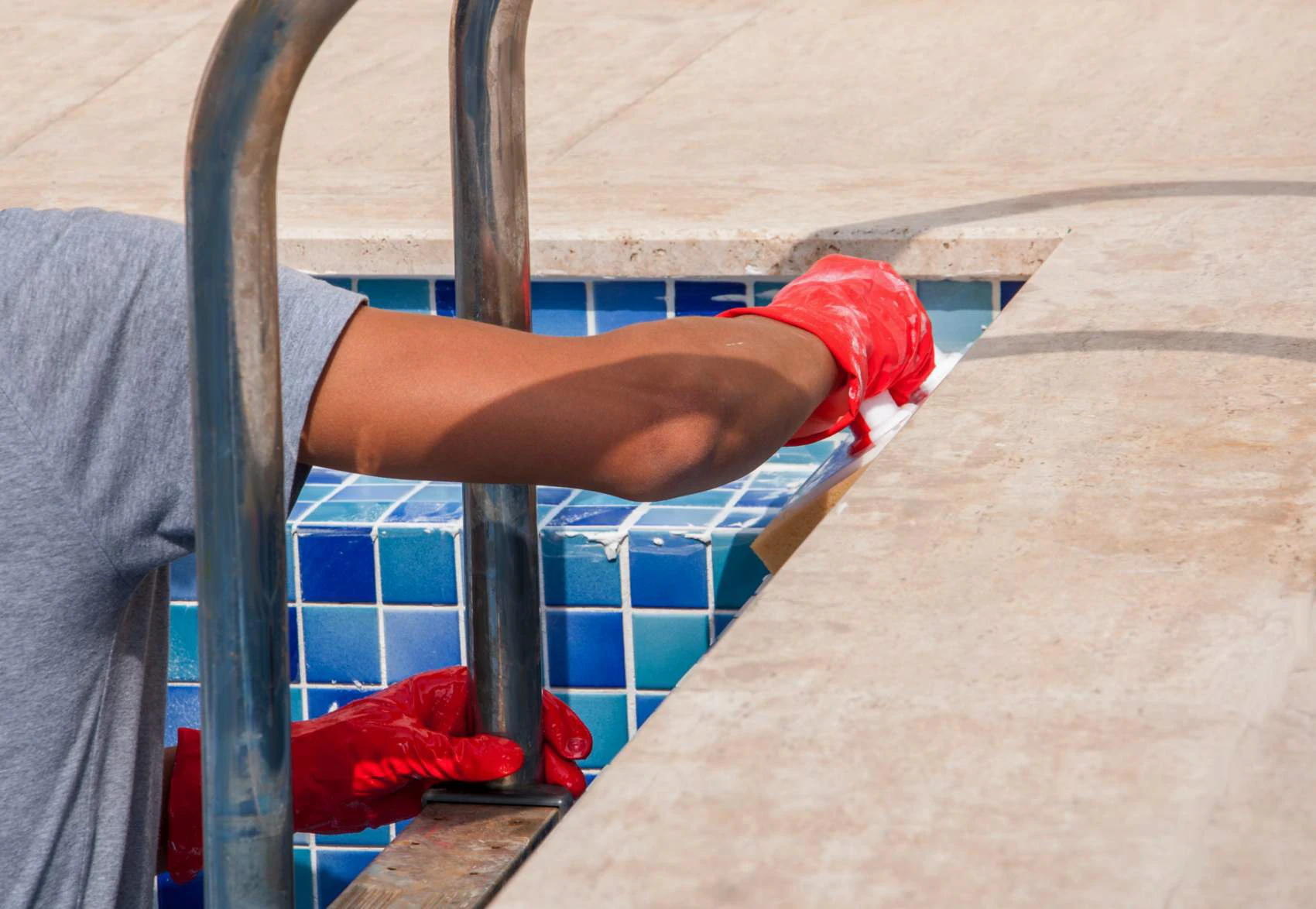
The Cumming supply sits in a hard-water band that most homeowners never measure. We’ve logged 180-240 ppm calcium carbonate on residential test kits from Bethelview Road to McFarland Parkway, with occasional 260-ppm readings in the older Sadie Farms and Haw Creek stretches. The Atlanta metro average runs roughly 90 to 130 ppm. That alone is a 2x spread on paper.
Inside a heat exchanger, the spread isn’t 2x. It’s closer to 2.5x, because scale deposition accelerates with temperature — and the inside of a copper exchanger tube at full burn runs around 180°F at the tube wall. The Langelier Saturation Index, which is what every pool chemist uses to predict scale, goes positive (scale-forming) the instant hardness crosses 200 ppm paired with a pH above 7.6. Cumming water routinely hits both numbers before you even add stabilizer.
So what actually happens: calcium carbonate plates out on the inside of your copper tubes at a measurable rate per heating hour. In a Dacula or Tucker pool pulling 120 ppm water, you’re looking at roughly 0.015 inches of scale per heating season. In a Cumming pool pulling 210 ppm water, you’re closer to 0.038 inches per season. After three Georgia winters of shoulder-season heater use, that’s a measurable flow-restriction event — and a measurable failure risk.
Scale is not a cosmetic problem: When scale reaches roughly 1/16 inch (0.0625″) on the waterside of copper exchanger tubes, you lose approximately 30% of heat transfer efficiency AND the fireside of the same tube starts running 100-150°F hotter because the heat can’t get through. That overheated copper is where pinhole corrosion begins.
How Copper Actually Fails — It’s Not the Scale, It’s What the Scale Hides
Here’s the piece most homeowners and a surprising number of service techs miss: the scale itself doesn’t kill the heat exchanger. The scale creates the conditions under which galvanic pinhole corrosion kills it. When you read manufacturer warranty language from Raypak, Pentair, and Jandy, every one of them voids coverage for “scale-induced failure” — but what they’re really excluding is the chloride-pitting corrosion that forms under the scale.
The mechanism: scale deposits on the copper tube waterside. Pool water continues to flow around and through the scale. Chloride ions in pool water (from salt-chlorine generators, from trichlor tablets) concentrate in the tiny gaps between scale and copper — we call these crevice zones. pH in those crevice zones can drop to 4.0 or lower while the bulk pool water still reads 7.6. At pH 4.0, chloride attacks copper aggressively. The copper pits, then perforates. You get the telltale pinhole leak at the U-bends of the exchanger, typically at the hottest section nearest the burner tray.
We opened a Jandy JXi 400 last month in a Mashburn Plantation backyard — year 6 of service, scaled to about 0.04 inches, three perforations at the U-bend. The original install had never been descaled. The homeowner ran the heater around 400 hours per year for spring and fall shoulder seasons. By the math, he had about 1,600 total heating hours on that unit when it failed. A softer-water pool in Loganville would have delivered closer to 4,000 hours on the same exchanger.
The Descale Schedule That Extends Cumming Heater Life From 7 Years to 12
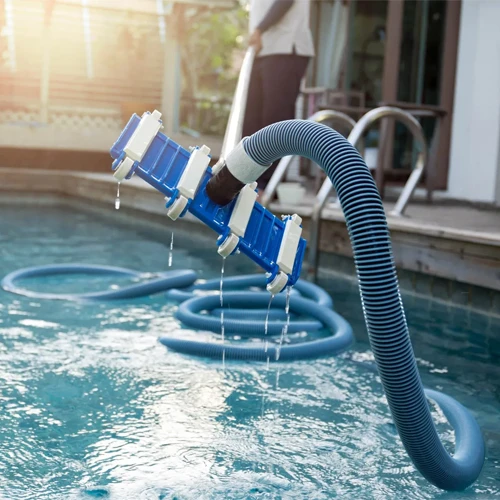
If you only read one section, read this one. Every pool heater in the 30040 and 30041 zip codes should be on a chemical descale cycle. Not “as needed.” Not “when the tech notices scale.” On a cycle, based on heating hours, not calendar time.
The protocol we run on Cumming systems: a citric-acid closed-loop flush at around 500 heating hours, a stronger sulfamic acid descale at 1,200 heating hours, then the citric flush again at 2,000 hours. Priced at $140 to $240 per service call, depending on heater size and access. Two descales per year is typical for a heavily-used Polo Fields or St. Marlo spa-attached system. One descale per year is typical for a pool-only Vickery setup.
The numbers that matter: a descaled heater delivers full-rated BTU output and runs its exchanger tube wall at the 180°F design temperature. A scaled heater pushes its tube wall to 280-330°F to deliver the same pool-side BTUs. Every degree of tube wall over-temperature shortens copper life by a measurable margin. The heater industry uses a rough rule: for every 25°F of tube wall over-temperature, copper fatigue life halves.
Descale cycle for a typical Cumming 400-kBTU heater: Citric flush at 500 hours ($140-180), sulfamic descale at 1,200 hours ($180-240), citric flush at 2,000 hours ($140-180). Annual budget roughly $320 to $420. Skipping this schedule shaves 4-5 years off exchanger life and guarantees an out-of-warranty failure.
Brand-specific notes from our Forsyth County service logs: the Pentair MasterTemp 400 holds up slightly better than the Raypak 406A under our local water chemistry because its waterside flow geometry is less prone to dead zones where scale sets up. The Jandy JXi in 260 and 400 configurations sits between the two. If you’re specifying a new heater for a Cumming pool and you’re staying with stock copper, MasterTemp is the conservative pick. If you’re willing to upgrade the exchanger metallurgy, the brand matters less — we’ll cover that next.
Cupro-Nickel: When the $400-$680 Upgrade Is Obvious Money
A cupro-nickel heat exchanger is a 90/10 or 70/30 copper-nickel alloy tube, typically in the same geometry as the stock copper exchanger it replaces. It costs $400 to $680 more at time of install or replacement. In Cumming water, it doubles the realistic service life — from the 7 to 9 years we actually see on copper, to 14 to 16 years on cupro-nickel.
The metallurgy: nickel shifts the alloy’s galvanic potential, making it dramatically more resistant to chloride pitting. The 70/30 version is the heavy-duty spec; the 90/10 is the mid-tier. Both handle salt-chlorine pools without the rapid perforation failure mode that kills copper. Both handle scale deposition (which still happens — the upgrade is about what the scale hides, not the scale itself) without the underlying tube wall failing as quickly.
Every Raypak, Pentair, and Jandy gas heater in the 250-kBTU-and-up class has a cupro-nickel exchanger option. Raypak calls it the “Low-NOx Cupro-Nickel” spec, Pentair calls it the “ASME Cupro-Nickel” upgrade, Jandy calls it the “Versa Cupro-Nickel” kit. Same idea, same math.
When to take the upgrade: if you run a salt-chlorine generator (Pentair IntelliChlor, Jandy AquaPure, Hayward AquaRite — any of them), the cupro-nickel decision becomes obvious. Salt systems push free chloride through the exchanger continuously, and chloride is the killer. If you run a traditional trichlor-tablet pool and you descale religiously, stock copper may last you 10-11 years in Cumming water — and the upgrade math gets tighter, but still generally pencils out.
When to skip: a small 200-kBTU spa-only heater on a seasonally-used second home in Lake Windward, with diligent chemistry management, reasonably sees 9-11 years on stock copper. The $400 upgrade premium on a smaller unit is a larger percentage of the total install — sometimes 15-18% — and the payback math gets soft.
Replacement-Timing Math: Year 7 Pinhole vs Year 14 Planned Swap
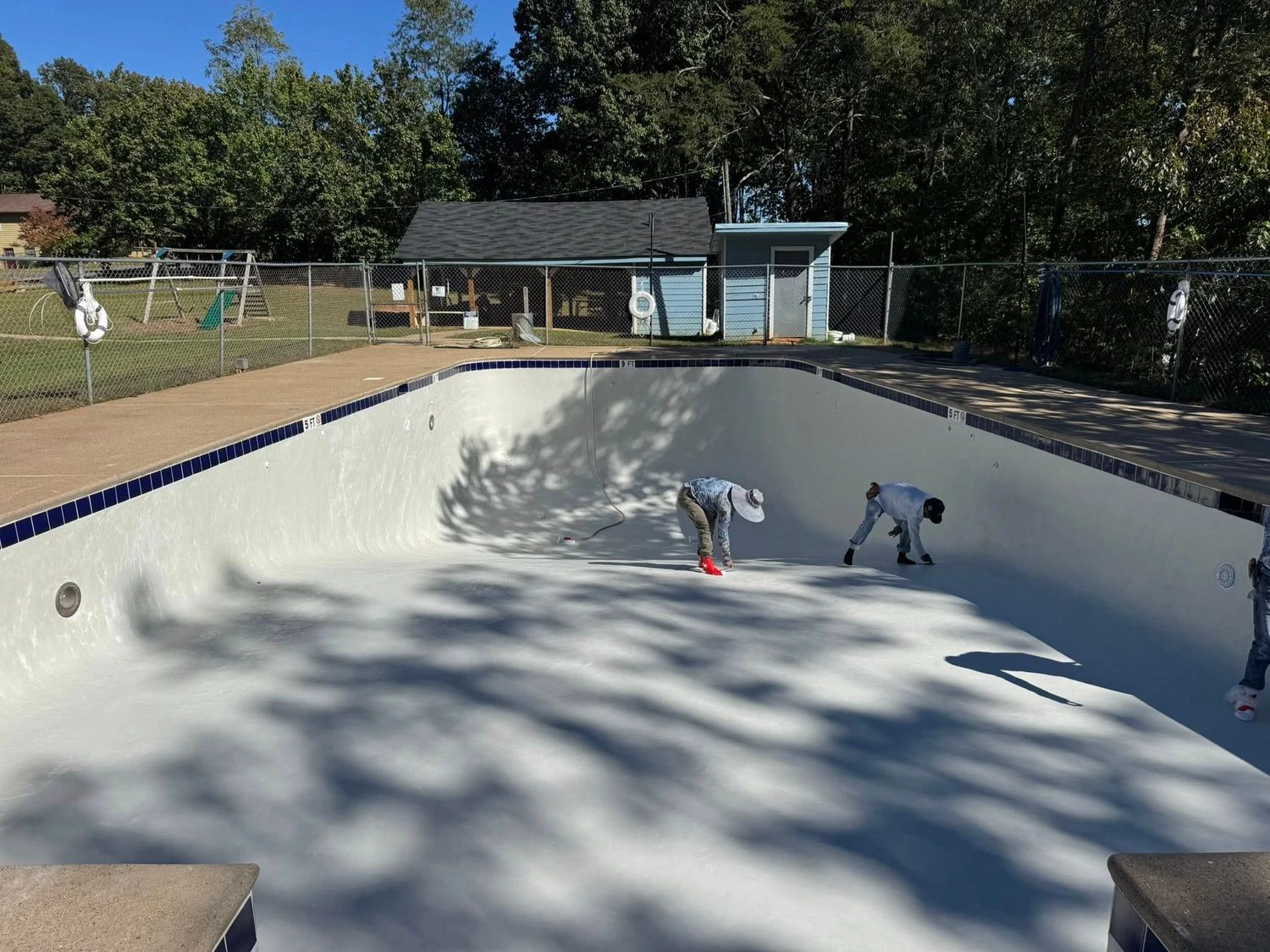
Here’s the decision tree we walk Cumming homeowners through when a heater starts showing symptoms: reduced BTU output (takes longer to heat the pool than it used to), visible green-staining on pool plaster near returns (dissolved copper from a corroding exchanger), sooting at the exhaust flue (burner struggling against scaled tubes), or the obvious one — water showing up in the burner compartment.
If your unit is year 5-7 with no descale history, and it’s showing reduced output only: you can often save it. Full sulfamic descale ($180-240), replace the pressure switch and gasket set ($120-180), and run it another 3-4 seasons. Total intervention cost around $300-420.
If your unit is year 7-9 with visible plaster staining or sooting: the exchanger is compromised. Replacement exchanger kits run $780 to $1,240 for stock copper, $1,180 to $1,900 for cupro-nickel. Installed labor adds roughly $320-480. You’re looking at $1,100-2,400 to extend the original heater cabinet another 7-10 years.
If your unit is year 10+ with any failure symptom: replace the whole heater. A new Pentair MasterTemp 400 installed runs roughly $3,200-3,900. A new Raypak 406A similar. This is when we push the cupro-nickel upgrade hardest — you’re about to spend $3,500 on a cabinet anyway, and the $480 metallurgy adder buys you real service-life certainty in Cumming water.
Forsyth County Permit Note
Gas-appliance replacements in the county require a mechanical permit pulled through the Forsyth County Dept. of Planning & Community Development at 110 E. Main St., Cumming. Any credentialed pool contractor handles this — don’t let a service tech talk you into a “no-permit” heater swap. Inspected installs are covered by manufacturer warranty; uninspected ones are not.
Sawnee EMC service note: Forsyth County pool heaters are typically gas-fired, but heat-pump heaters need 240V 50-amp service from Sawnee EMC. Confirm your subpanel has headroom before you spec a heat-pump replacement — it’s a $900-1,400 panel upgrade if it doesn’t.
What We Pre-Check Before Installing Any Heater in Cumming Water
Every heater we install in Forsyth County starts with a water-chemistry baseline, not a model number selection. The chemistry dictates the metallurgy, which dictates the budget, which shapes the whole conversation.
The five tests we run on-site before writing a heater proposal: total hardness (target 180-220 ppm for pools in this region — higher needs softening or sequestrant), total alkalinity (target 80-120 ppm), pH (target 7.4-7.6), cyanuric acid (target 30-50 ppm for chlorine pools), and total dissolved solids. If hardness comes back above 250 ppm, we bring up sequestrant chemistry (Jack’s Magic Magenta Stuff or Pro Team Metal Magic) into the ongoing maintenance plan — not optional on those systems.
We also pressure-test the existing plumbing upstream of the heater. A heater is only as long-lived as the filter, pump, and plumbing feeding it — if the filter laterals are compromised and DE is passing through, that’s abrasive media scouring the exchanger waterside, and no metallurgy upgrade survives that. We run the same pressure and flow-rate checks on every install, with specific attention to whether the existing pump (usually a Pentair IntelliFlo3 or Hayward TriStar VS in newer builds) is actually delivering manufacturer-spec flow to the heater.
For Vickery Village-area installs, we often also check for shared HOA architectural review on equipment-pad enclosures — several Cumming HOAs require equipment screening that changes the heater cabinet we can spec. St. Marlo and Polo Fields both run 2-3 week ARB turnarounds on equipment changes. Plan accordingly.
Cumming water isn’t the enemy. Ignoring Cumming water is. Homeowners who put their heater on a proper citric-and-sulfamic descale cycle, pair it with the right sequestrant chemistry, and upgrade to cupro-nickel at the right decision point routinely get 14-16 years out of a Pentair or Raypak or Jandy cabinet. Homeowners who treat a pool heater like a water heater — install it and forget it until it fails — cash out at year 7 and write a $3,500 check on a frozen Saturday in February.
The math isn’t complicated. It’s just unflinching. If you’re within the 30040 or 30041 zip, you live with harder water than most Atlanta-metro pool owners, and your heater knows it before you do.
Pool repair and equipment service across 20+ cities within 30 miles of Winder, GA
Heat exchanger descale, cupro-nickel upgrades, and full heater replacements in Cumming, Forsyth County, and the surrounding metro — specced against your actual water chemistry, not a catalog default.