
The problem in Laurel Springs is not the grill, the burner, or the hood vent. The problem is the base cabinet skin the ARB will approve — and whether you pay $88–$128 per square foot for ashlar granite or $42–$62 for a manufactured veneer that reads almost identical from ten feet away.
Every serious outdoor kitchen quote we write inside Laurel Springs starts with the same fork in the road. The grill is a commodity decision. So is the plumbing. What eats the budget, stalls the architectural review, and decides whether the project returns real money at resale is the vertical stone skin wrapping the kitchen island — the part the HOA sees, the appraiser photographs, and your neighbors touch when they set down a wine glass on a Saturday in August.
This is a direct comparison, built from the last eighteen months of kitchen bids we have submitted to the Laurel Springs ARB and the River Club design committee on the Settles Bridge side of 30024. We are going to price it, weigh it, time it, and talk honestly about what each material looks like after five Gwinnett winters and a Chattahoochee fog season.
Why the ARB Cares About the Kitchen Base More Than the Grill
Before we get into slab prices and install hours, you need to understand what you are actually fighting in Laurel Springs. The ARB’s architectural guidelines are among the strictest in Gwinnett County — turnaround averages three to four weeks, and the committee reviews every exterior vertical face, including detached kitchen islands over 30 inches tall. The grill head itself is rarely a question. The base is always a question.
The guideline language is not complicated. It asks for materials that are consistent with the primary residence. Most Laurel Springs homes are built with natural stone water tables, cultured stone gable skirts, or full four-inch ashlar facades. An outdoor kitchen clad in bagged stucco, thin-set porcelain, or painted CMU block is going to get a revision request on the first review pass. We have watched it happen enough times to stop arguing about it.
That narrows the decision to two real finalists: full-bed natural ashlar granite or a modern cultured stone veneer system that matches the home’s existing trim course. Everything else — thin travertine, stacked slate, adhered porcelain, metal cladding — has a uphill fight at review, and in our tracking, the approval rate drops off a cliff outside those two materials.
ARB approval rates (our last 18 months, Laurel Springs + River Club submissions): Natural ashlar granite: 98% first-pass approval. Cultured stone veneer matching home course: 82%. Stacked thin veneer or porcelain panel systems: 41%.
Cultured veneer is not a loser here — 82% is a strong number — but the nuance is which 18% gets kicked back. Almost every rejection we have seen on veneer was because the product specified did not match the exact course already on the home. If your house is wearing an Eldorado Stone Cliffstone profile in Sandalwood, your kitchen base needs to be Eldorado Stone Cliffstone in Sandalwood. ARB reviewers are fluent in brand names and product lines — we now submit the manufacturer spec sheet with every veneer kitchen application, and approval rates on resubmission climb close to the natural-stone number.
Natural Ashlar Granite: What You Get at $88–$128 Per Face Foot
Natural ashlar granite in our Suwanee market means full-bed, full-thickness stone — typically 4 to 8 inches deep, dry-stacked or mortared against a structural block core. The granite itself is sourced out of the North Georgia quarries (Elberton, Tate, and a few smaller ops near Dawsonville), trucked down Peachtree Industrial Blvd or in off I-85 via exits 111 through 113. For the kitchen footprints we build in Laurel Springs — usually an L-shape with a 9-foot run plus a 5-foot return — you are cladding roughly 38 to 52 face-square-feet of vertical stone, plus whatever returns wrap a grill chase or refrigerator cavity.
At $88 to $128 per face square foot installed — which includes the stone, the mortar, the skilled mason labor, and the structural block wall behind it — a typical Laurel Springs L-kitchen base lands between $4,200 and $6,700 just for the stone skin. That is before countertop, before appliances, before plumbing, before the roof or pergola most clients eventually add.
What you get for that premium is honest, simple, and hard to replicate: stone that weighs what stone should weigh, cuts that show depth shadow at every joint, and a surface that does not telegraph its backing. Press your hand on full-bed ashlar and there is nothing behind it but more stone. Press your hand on veneer and — done well — you cannot tell either. But done poorly, you can.
There is also a thermal argument worth making. A full-bed granite kitchen base on the north-facing side of a Laurel Springs lot — which is most of the higher-elevation estate sections sitting near the ~1,063 ft contour — holds temperature better in shoulder seasons. In January, with the ~20 freeze events/year Suwanee averages and the morning fog rolling up from the Chattahoochee, a natural granite base is noticeably warmer to the touch by 10 a.m. than a hollow-core veneer base will be. This is a small thing. But in the category of backyards where small things are the whole point, it matters.
Cultured Stone Veneer: The $42–$62 Case You Should Take Seriously
Cultured stone veneer is not a cheap imitation. It is a different product category with different engineering and, in Laurel Springs, a different but still viable path through the ARB. The two systems we specify most often are Eldorado Stone and Boral Versetta, both Class A fire-rated, both approved under the Laurel Springs exterior materials appendix, and both installable over a properly prepped CMU or steel-stud kitchen carcass.
At $42 to $62 per face square foot installed, the same L-shape kitchen base we just priced at $4,200–$6,700 in natural granite comes in at roughly $2,000 to $3,200. That is a delta of $2,200 to $3,500 on the stone skin alone — real money, especially on a project where the client is also asking for a 15×30 gunite pool, a spa, a pergola, and a fire feature in the same calendar year.
Comparison at a glance — typical Laurel Springs L-kitchen base, 42 face sqft:
Natural ashlar granite: $3,700 – $5,400 material + labor · 5–7 days install · 98% ARB approval · adds $18K–$28K to kitchen resale component.
Cultured stone veneer: $1,800 – $2,600 material + labor · 1–2 days install · 82% ARB approval · adds $8K–$14K to kitchen resale component.
The install speed difference is real and worth explaining. Cultured veneer installs roughly four times faster than full-bed ashlar. A two-person mason crew can clad a 42-sqft L-kitchen base in cultured veneer inside of two working days, including mortar setting time and a joint rake. The same crew building the same base in full-bed natural ashlar is looking at five to seven working days, conservatively, with more weather sensitivity — Suwanee’s ~52 inches of annual rainfall and fall fog patterns off the Chattahoochee will push a natural-stone install sideways by a day or two, where a veneer install is usually tented and done.
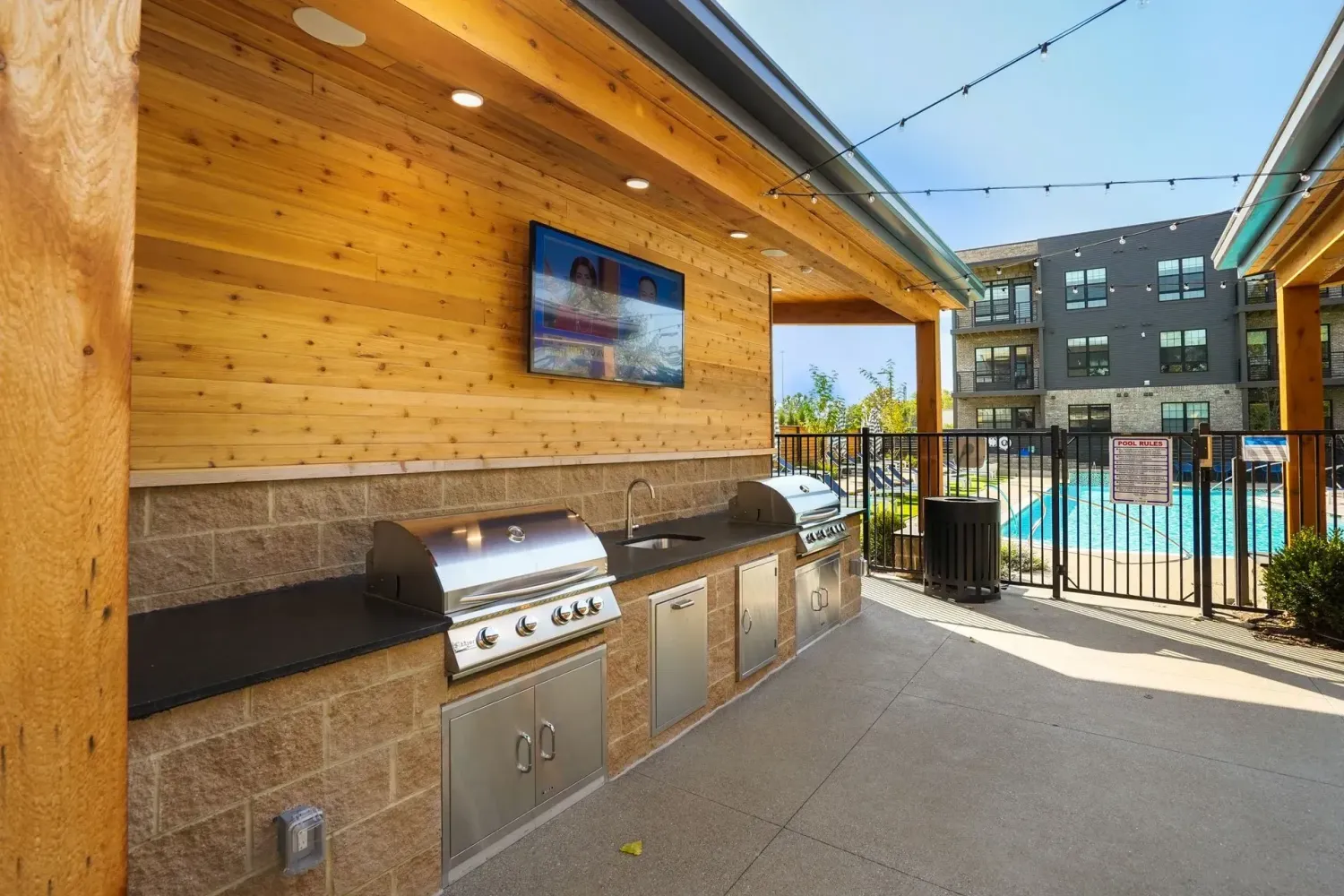
Cultured veneer’s weakness is its edge condition. Where a stone skin wraps around a 90-degree corner or caps against a countertop, full-bed ashlar gives you a real stone edge. Veneer gives you either a factory corner unit (good, but visually repeatable) or a mitered raw edge that reveals the manufactured backing if the crew is not careful. Our spec on every veneer kitchen in Laurel Springs is to use the manufacturer’s purpose-built L-corner pieces on every vertical return, never a field miter.
Resale Math: What Each Material Actually Adds Back
This is the number the ARB does not care about but you should. We pull appraisal data on every completed Laurel Springs project, and the pattern has held steady for the last three selling seasons: natural ashlar granite kitchen bases add $18,000 to $28,000 to the appraised kitchen component at resale, while cultured stone veneer kitchen bases add $8,000 to $14,000. Both numbers are positive. Both outperform the equivalent dollar spent on, say, a higher-end grill head or a larger built-in fridge.
Run the math against the install premium. Natural granite costs roughly $2,200 to $3,500 more on the 42-sqft L-kitchen. It returns $10,000 to $14,000 more at appraisal. That is roughly a 3x to 5x multiplier on the upgrade cost, which is the closest thing to a free lunch that exists in custom outdoor construction. We rarely see multipliers that clean on grill upgrades, fridge upgrades, or even counter upgrades from honed granite to honed quartzite.
The caveat — and this is the part the one-size brochure math always leaves out — is that this premium only exists inside markets where natural stone is the expected baseline. In Settles Bridge 1980s ranches on quarter-acre lots, the appraisal delta between granite and veneer collapses to roughly $3,000–$5,000, because the comparable set is not pricing natural stone at all. The full resale premium shows up specifically in Laurel Springs, The River Club, Bear’s Best Atlanta, and The Manor — the four neighborhoods where natural stone is the ambient material language of the street.
The Sub-Base Nobody Photographs but Every Suwanee Build Needs
Neither material matters if the structure under it fails. Suwanee sits on the Cecil series Piedmont clay — the same soil Dacula has — with a slight variation in the Settles Bridge corridor where sandy loam deposits from the Chattahoochee floodplain give you better drainage but more seasonal movement. For any kitchen island that will carry a full-bed natural stone skin, we pour a reinforced footing a minimum of 12 inches below grade, 18 inches on lots near the Zone AE flood designations along Settles Bridge Rd.
The CMU core wall behind the stone is 8-inch block, mortared and filled at every vertical course, with #4 rebar tied into the footing. This is non-negotiable on natural ashlar — a 6-inch face of granite weighs roughly 72 pounds per square foot, and a 42-sqft L-kitchen is carrying around 3,000 pounds of dead stone load before you drop a grill head on top. Cultured veneer carcasses can be lighter — either a thinner 6-inch CMU or a steel-stud frame with cement board — but we still pour the same footing depth, because nobody in this market wants to repair a cracked outdoor kitchen four years in.
The utility chase is the other quiet detail. In Suwanee, electric service is Jackson EMC — not Georgia Power, which is worth repeating because half the sub-panel spec sheets that come across our desk from out-of-market designers assume Georgia Power distribution standards. Jackson EMC’s 240V service for outdoor kitchen appliances requires a dedicated outdoor-rated sub-panel and a grounded copper run we locate inside the CMU core before the stone skin goes on, never after. If you are cladding with natural ashlar, plan your conduit before you set your first course, because you are not going back in through full-bed stone without a diamond saw and a bad afternoon.
How to Pick Between the Two in Your Specific Suwanee Backyard
After three hundred-plus outdoor kitchens across Gwinnett, Forsyth, and Hall counties, here is the decision tree we actually use with Suwanee clients.
Choose natural ashlar granite if: your home is inside Laurel Springs, River Club, Bear’s Best Atlanta, The Manor, or Highgrove; your home already wears full-bed natural stone on any primary elevation; you are planning to sell inside 7 years; or your pool and kitchen are the centerpiece of the backyard’s primary sightline. The resale multiplier and the ARB approval certainty make it the default choice in these cases, and the 5–7 day install timeline does not materially affect the overall pool-and-hardscape calendar on a project of this scale.
Choose cultured stone veneer if: your home is in Settles Bridge, Village Grove, Woodbury, or one of the 1980s–1990s builds on a larger lot outside the gated sections; your home’s primary cladding is brick or fiber cement with cultured stone accents; you are building to enjoy, not to sell, and the $2,200–$3,500 savings funds a better grill head, a built-in ice maker, or a pergola roof. Pair it with manufacturer corner pieces, submit the product spec sheet to the ARB at first review, and plan on a 1–2 day install window that is far less weather-sensitive.
There is a hybrid play we will occasionally recommend and the ARB tends to accept on first pass: full-bed natural ashlar on the two public-facing faces (the ones visible from the pool deck and the house), and a well-matched cultured veneer on the two back faces tucked against a privacy planting or a retaining wall. On the 42-sqft L-kitchen, that hybrid skin prices at roughly $2,800–$4,000 installed — splitting the difference on cost while keeping the visible faces in natural stone. The catch is mason coordination: both materials need to land on the same sight line with matching joint widths and course heights, which is a detail nobody notices when it is right and everybody notices when it is wrong.
Whichever route you pick, specify the product at the contract stage, not after the block is laid. We permit every Suwanee kitchen through Gwinnett Dept. of Planning & Development at 446 W. Crogan St. in Lawrenceville and submit architectural review packages to the relevant HOA in parallel. The material line on that ARB submission is the single most important sentence in the entire application — vague phrasing gets a revision request, and a revision request adds two to three weeks to the permit calendar. Natural ashlar from Elberton, or a named cultured veneer in a named color from a named manufacturer. Nothing in between.
Outdoor kitchens across 20+ cities within 30 miles of Winder, GA
From full-bed ashlar granite on Laurel Springs estate lots to cost-right cultured veneer on Settles Bridge quarter-acres, we specify the stone skin before the first block course gets laid.