
Every competent builder in Gwinnett County will tell a Suwanee homeowner the same thing when they walk a sloped rear yard: flat-fill the pad, set the pool low, call it done. That advice costs the homeowner somewhere between $65,000 and $95,000 in lost resale value — because the grade is not the problem. The grade is the entire opportunity.
We have built across Laurel Springs, The River Club at Suwanee, Settles Bridge, and the McGinnis Ferry corridor long enough to know the math. A rear yard that drops three to five feet from foundation to rear property line is not a penalty. It is the only geometry that lets you build a raised spa at house-side elevation, a drop deck mid-pool, and an engineered retaining wall at the rear — three tiered rooms of outdoor living stacked across the same footprint a flat lot cannot deliver. The neighbors with the $285,000 builds on flat fill ended up with a single deck plane and a view of their own fence. The homeowners who embraced the drop ended up with a pavilion looking across water to a tree line a half mile out.
This post walks the specific engineering sequence we use on a typical 4-foot-drop Suwanee lot. What the wall costs. What the Jackson EMC subpanel requires. What the Laurel Springs architectural review committee signs off on and what it rejects. And why a terraced build appraises the way it does when the comp set is flat-graded.
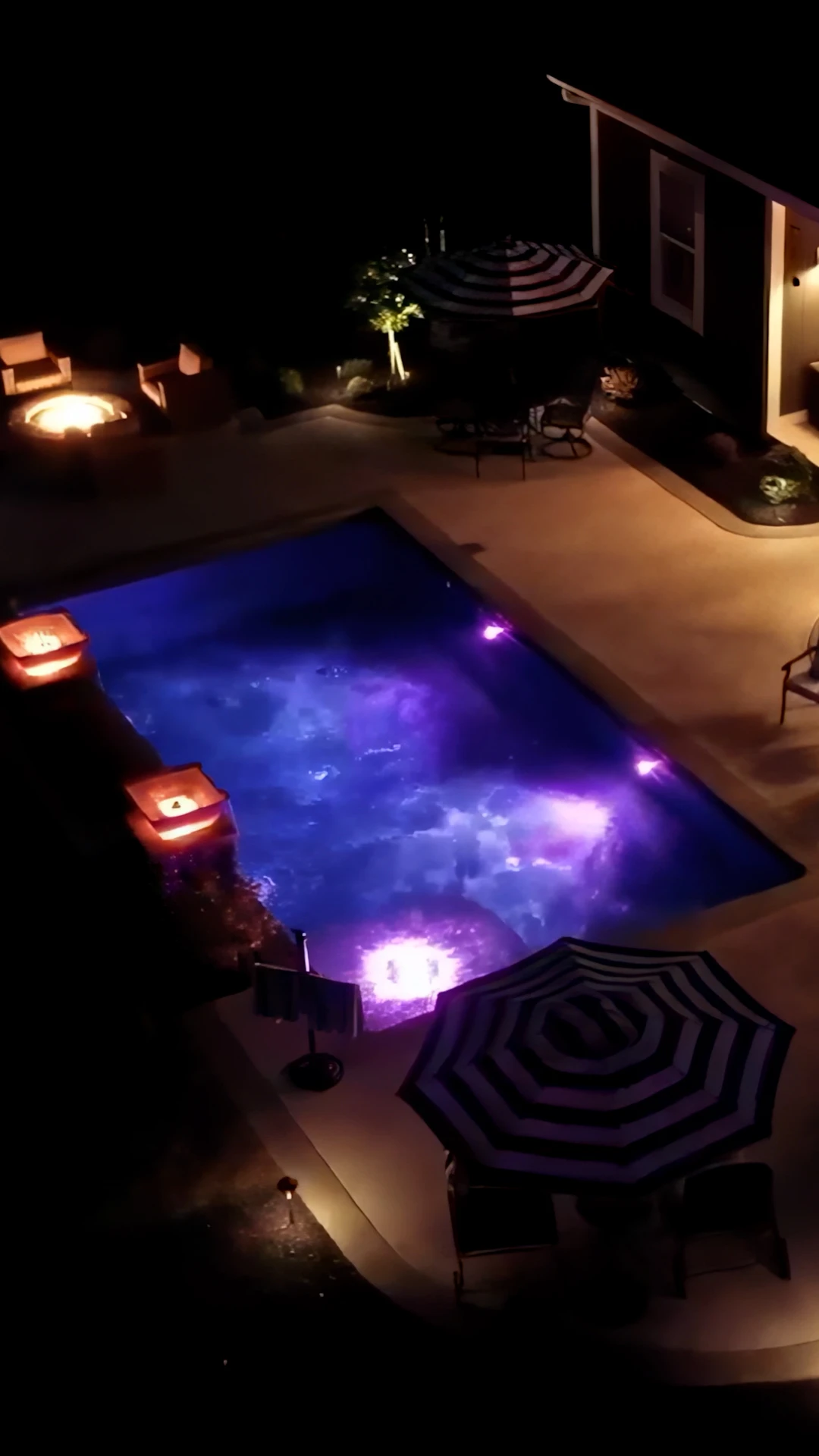
Why The Flat-Fill Default Costs Suwanee Owners Resale
The default quote on a sloped Suwanee lot looks seductive on the bid sheet. A builder hauls in forty to sixty cubic yards of structural fill, compacts it in lifts, sets a rectangle pool at the lower end of the slope, pours a flat concrete deck, and wraps the low side in a railroad-tie or timber wall pretending to be a retaining system. That package comes in fifteen to twenty percent cheaper than the terraced alternative. On paper, the homeowner saves $38,000 to $62,000.
What the bid sheet does not show is the exit price. We pulled the Laurel Springs and River Club resale comps over three years through early 2026 and the delta is not subtle. Homes with a flat-graded pool and visible timber retaining at the rear trade at market. Homes with an engineered segmental block wall, raised spa at house elevation, and a drop deck trade $65,000 to $95,000 above the pool-equipped comp line. In a neighborhood where the list prices already sit above $1.4 million, that premium is not rounding error. It is the difference between a pool that pays for itself at exit and a pool that is treated by the buyer as deferred maintenance.
The underlying reason is simple. A flat-fill install on a sloped lot does not hide the slope. The rear yard still drops four feet beyond the coping, the timber wall still rots, and the pool sits in a bowl. A terraced install uses the slope. The rear wall becomes a design element. The drop deck becomes a lounge zone. The grade becomes the view.
Reading A Suwanee Lot Before You Commit To A Layout
Before any layout conversation, we walk the lot with a laser level and a hand auger. On a typical Suwanee build — whether it is a 1995-era ranch on Old Peachtree Road or a 2012 River Club estate — three readings drive the entire design.
The first reading is the foundation-to-property-line drop. On the majority of Settles Bridge, Highgrove, and Village Grove lots this runs three to five feet across a rear yard depth of sixty to one hundred feet. That is a two to five percent slope, which is steep enough to require engineering but gentle enough to terrace well. Anything over seven percent gets a different treatment and a different number.
The second reading is the soil column. Suwanee sits on the same Cecil series Piedmont clay that runs across northern Gwinnett. Near the Chattahoochee floodplain, specifically the band of lots along the southwest edge of town, the top eighteen to thirty inches shifts to sandy loam — better drained, friendlier to deadmen anchors, but you still hit Cecil clay below. The clay holds water, swells, and applies lateral pressure to any retaining structure that is not engineered to take it. This is not a minor note. A timber wall retained against saturated Cecil clay has a useful life of about twelve years before it starts to bow.
The third reading is water. We probe for perched water tables, look at downspout routing, check whether the uphill neighbor’s lot sheets toward the build area. In the Chattahoochee-proximate zone along Settles Bridge Road, flood zone AE designations pull in and they change what the wall has to handle. We also note morning river fog patterns in the fall — humidity load matters for equipment pad siting.
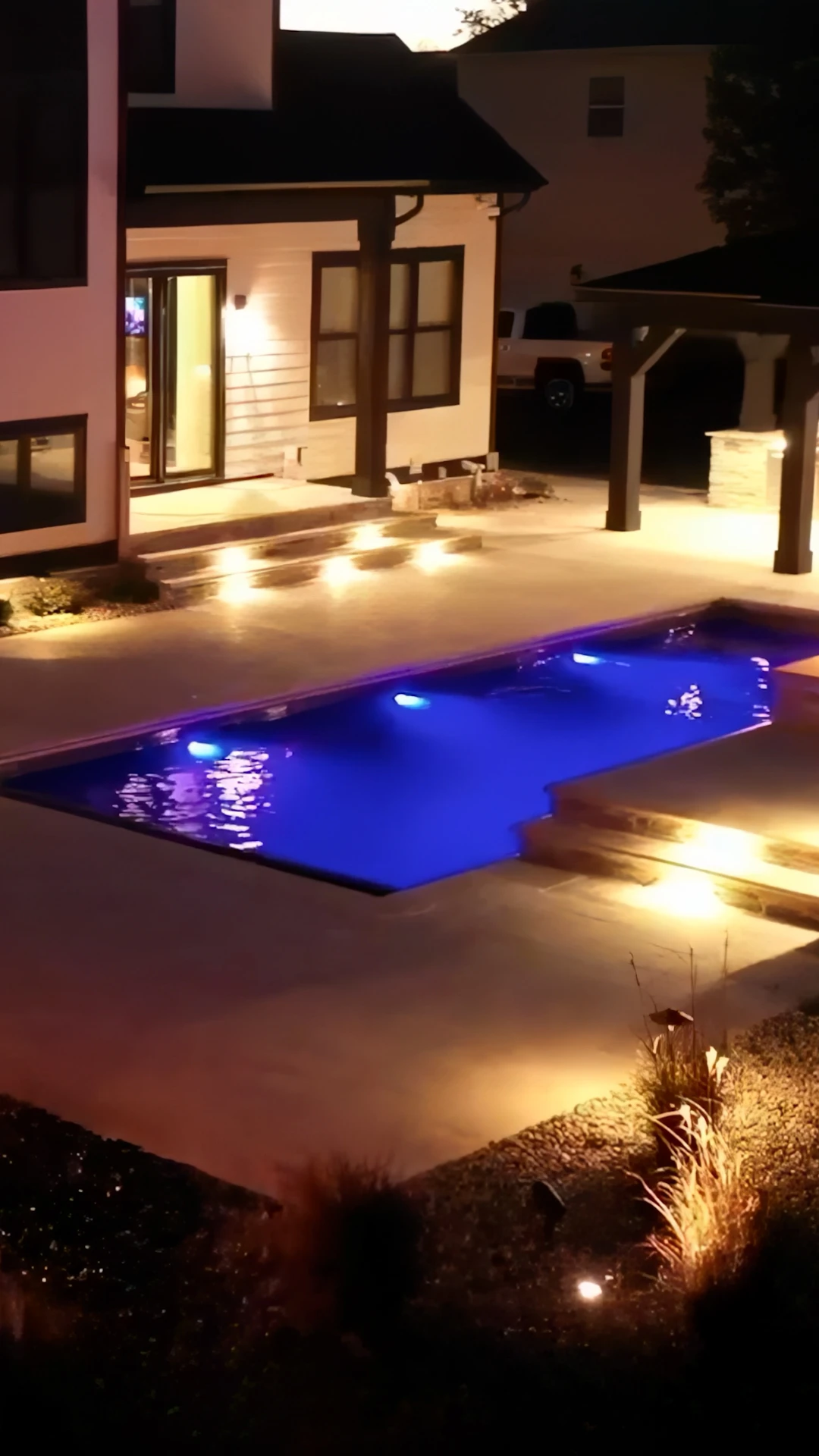
The Three-Tier System We Build On A 4-Foot-Drop Lot
The layout we recommend on a standard Suwanee four-foot-drop rear yard is not complicated, but every element is load-bearing on the ones around it. We call it the three-tier system because it breaks the vertical drop into three usable horizontal planes.
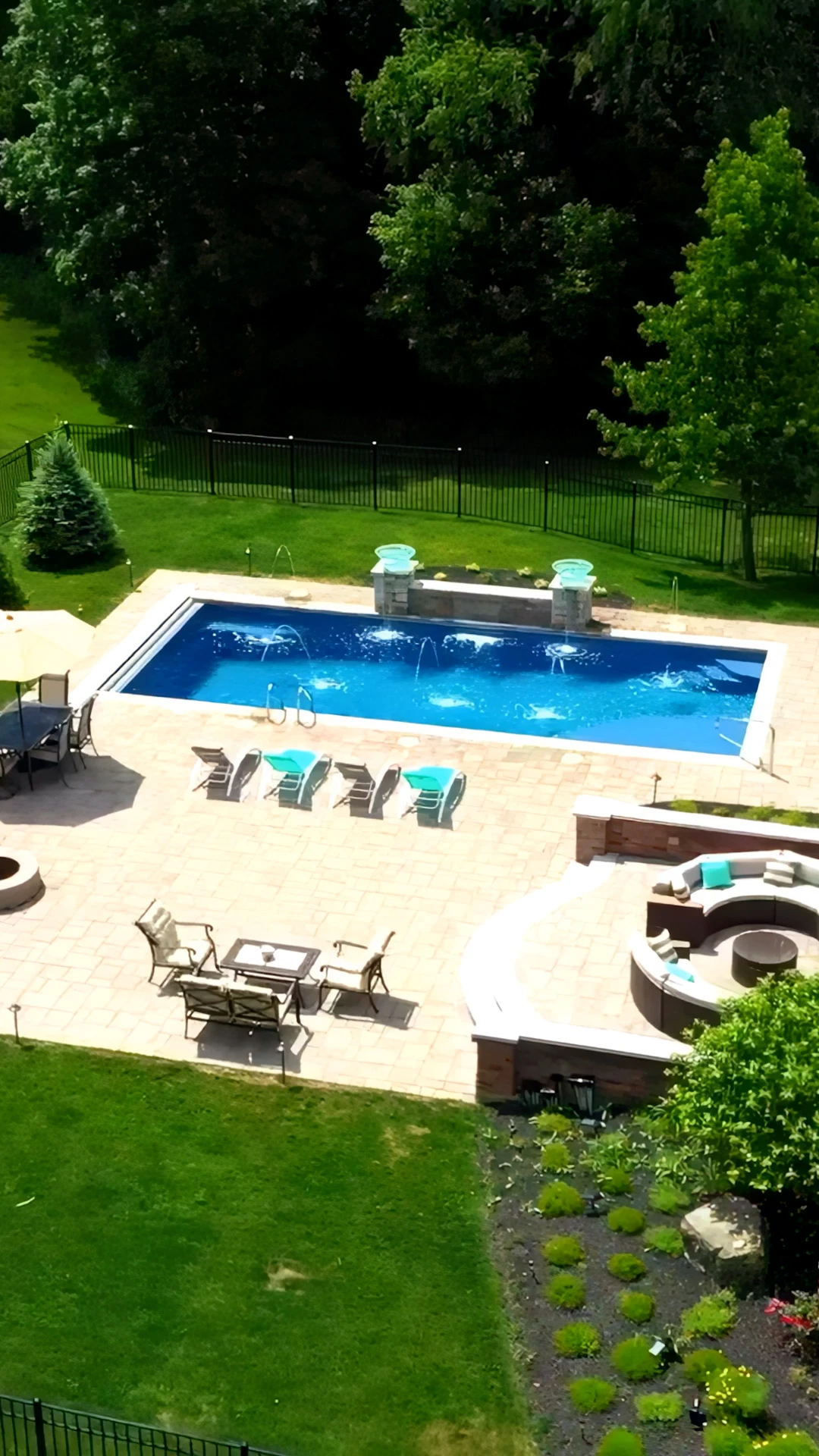
Tier one sits at house-side elevation — level with the back door or back porch. This is where the raised spa lives, along with the outdoor kitchen if the scope includes one, a pavilion if the architectural review committee allows it, and a narrow lounge margin. The raised spa is not a plumbing afterthought. It is the structural pivot. It anchors the top tier, stores water mass to stabilize the elevation change, and spills into the pool on the middle tier. On a Laurel Springs or River Club build we typically hold the spa rim eighteen to twenty-four inches above pool rim, which is enough to deliver a real spillover but low enough that the sightline from the tier-three retaining wall is not interrupted.
Tier two is the pool plane and its immediate deck. We set pool rim roughly eighteen to thirty inches below house-side finished floor, which gives the spa its spill and sets the waterline at a height that looks across the rear of the property without dropping into a pit. The deck around the pool on the house side is narrow — six to eight feet — and widens on the long side where the chaises and umbrellas go. On a rectangle pool, this is where we put the sun shelf or tanning ledge. Deck jets, if the scope includes them, sit on the long side facing the lower tier.
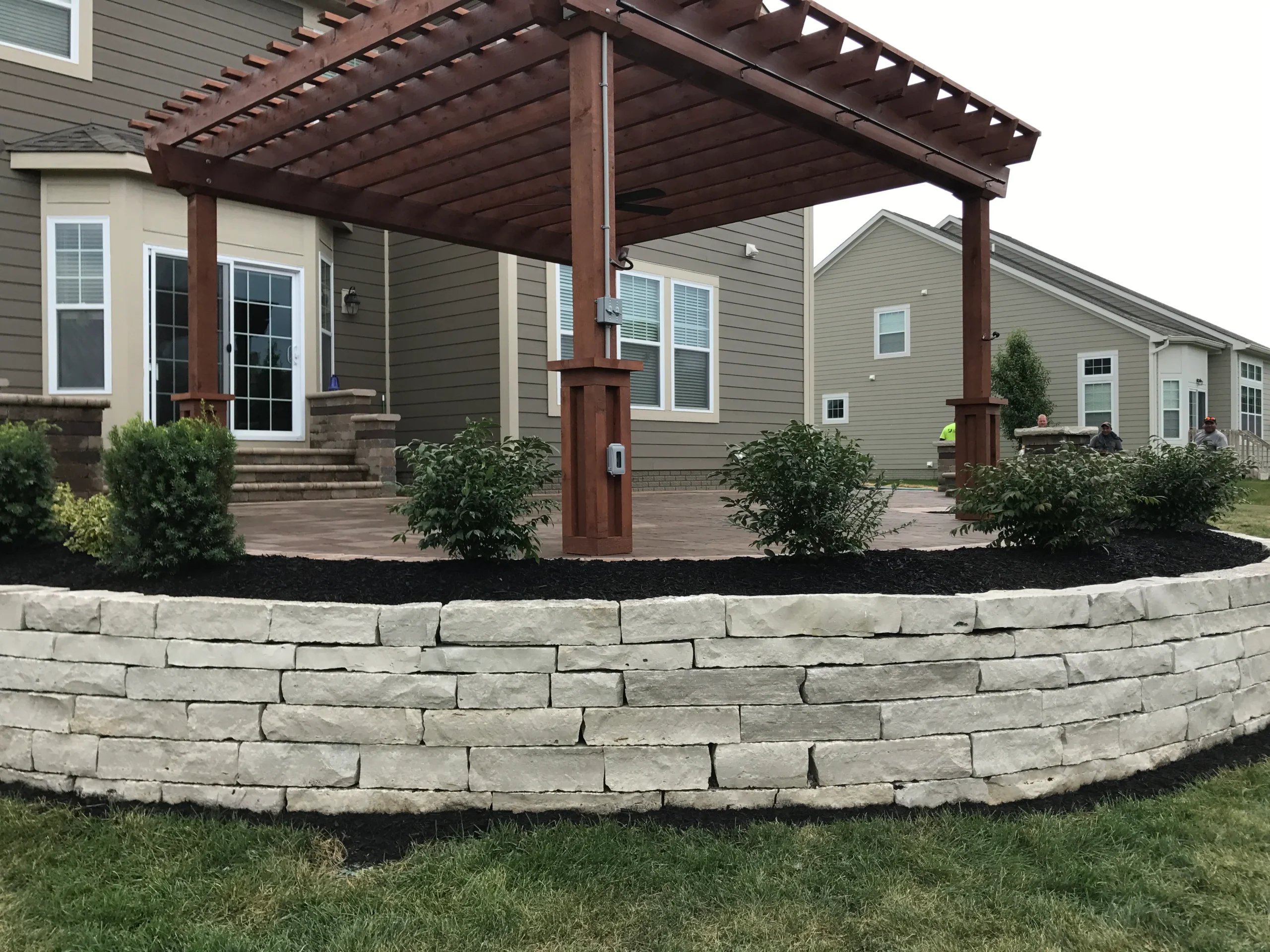
Tier three is the drop zone between the pool coping and the engineered retaining wall at the rear. This is the tier that separates a premium build from a builder-grade build. On a flat-fill install, this zone does not exist. On a terraced install, it is either a second lounge patio eighteen inches below pool deck, a firepit circle sunk into the lower plane, a dining patio, or in some Laurel Springs builds a combination of all three. The retaining wall at the back of this tier is engineered segmental block — we spec Allan Block AB Classic or equivalent with Miragrid 3XT geogrid tails at eighteen-inch vertical spacing, backfilled with three-quarter-inch clean aggregate and a drain tile daylighted to the side property line.
Retaining wall spec we run standard on a 4-foot-drop Suwanee build: Allan Block AB Classic or Belgard Anchor Diamond Pro, heights up to 48 inches with Miragrid 3XT geogrid at 18″ vertical courses, 12-inch leveling base of compacted #57 stone, drain tile at base daylighted to the side of the yard, and batter angle of 6 degrees toward the fill. Engineered-stamped plans required by Gwinnett County Planning above 36 inches exposed.
What The Retaining Wall Actually Costs In 2026 Dollars
The retaining wall is the line item where flat-fill bids and terraced bids diverge, and it is also the line item most likely to be value-engineered by a builder who does not want to explain it. Here is what it actually runs on a Suwanee build in current dollars.
A straight-run segmental block wall, engineered with geogrid, drain tile, and an approved base, at an exposed height of thirty-six to forty-eight inches, runs $95 to $135 per face foot depending on block line. On a typical rear yard with sixty linear feet of wall and an average exposed height of forty-two inches, that comes to roughly 210 face feet — call it $22,000 to $28,000 for the wall alone. Add the grading mobilization, excavation haul-off of Cecil clay, geotechnical confirmation on fill compaction, and curved returns at the wall ends, and the total wall-and-grade package runs $38,000 to $62,000 on top of the base pool scope.
That number scares homeowners who compared two bids side by side. It should not. The comparison that matters is not bid-versus-bid. It is wall-package-cost-today against resale-delta-at-exit. We have watched Laurel Springs resales where the terraced pool package cost an incremental $54,000 to build and added $78,000 to the exit price. The net gain at exit was real. More importantly, the eight to twelve years of ownership in between were lived on a backyard with three outdoor rooms instead of one.
The wall finish choices change the number. A plain charcoal segmental block finish is the low end. A textured block in a tan or buff tone runs ten to fifteen percent higher. A full natural stone veneer over the block structure — ledgestone, Tennessee fieldstone, or a custom blend to match the house — adds another $35 to $60 per face foot on top of the block. On a River Club build where the architectural review committee is specifying materials, the veneer spec is almost non-negotiable.
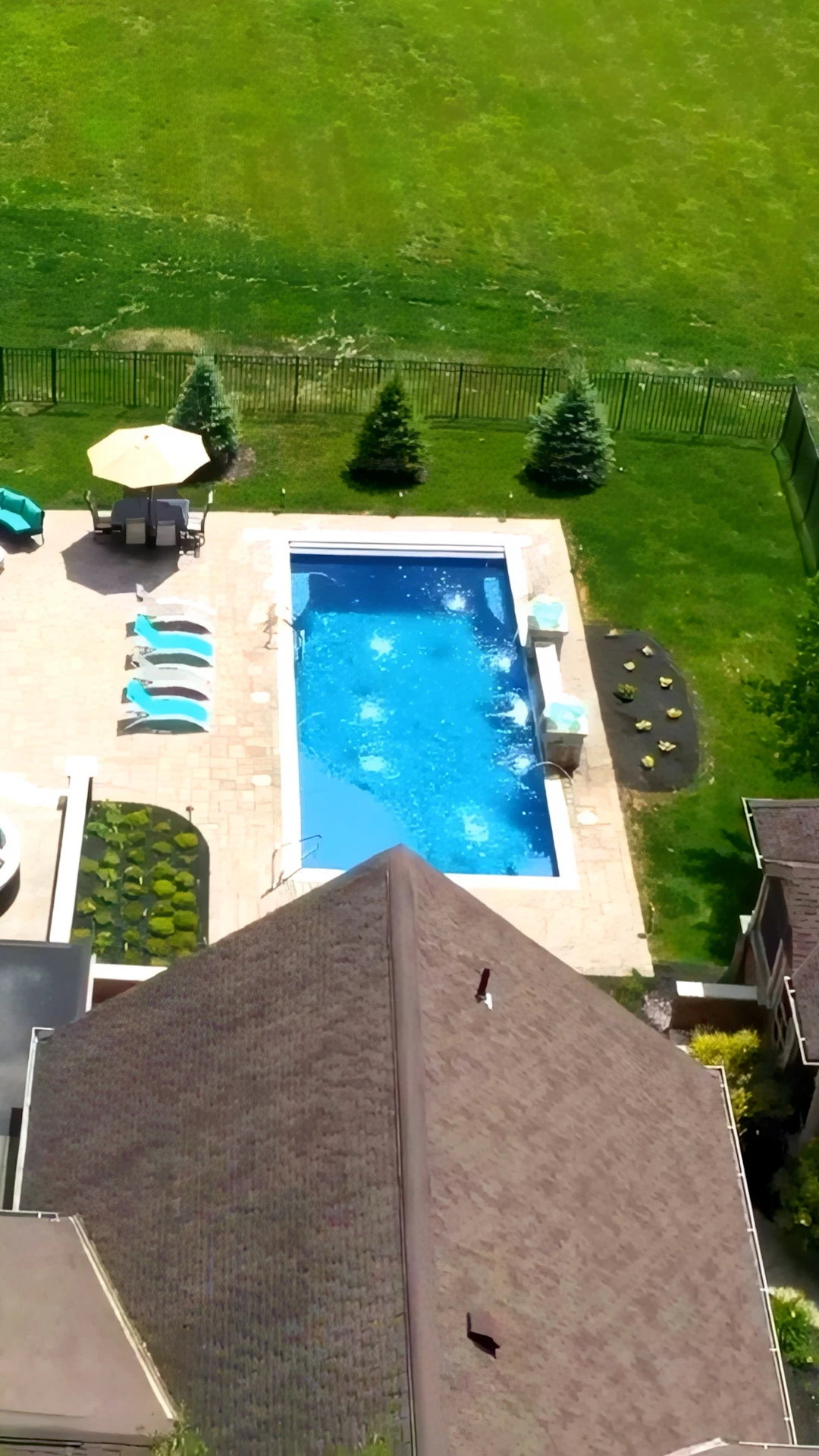
Jackson EMC Power Load And The Dual-Level Equipment Pad
Every Suwanee pool conversation eventually hits the power question. Suwanee is served by Jackson EMC, not Georgia Power, which matters at two points in the build. First, the service upgrade process. Jackson EMC’s turnaround on a new meter loop or a subpanel tap is typically two to three weeks from application to energization, which is competitive with Georgia Power but runs through a different engineering office. Plan the inspection sequence accordingly.
Second, and specifically relevant to a terraced build, a three-tier layout almost always needs a 100-amp subpanel dedicated to the pool and equipment pad. The reason is load count. A typical premium build on a terraced Suwanee lot includes the main pool pump (variable speed, 240V), a booster pump for the spa or water features, a heat pump or gas heater ignition circuit, LED transformer, salt chlorine generator, automation controller, pool and landscape lighting circuits, and often a secondary pump for tier-three water features. Running all of that off the house main panel creates nuisance trip issues and pulls the service dangerously close to rated load on a summer afternoon when the HVAC is also running.
The clean solution is a 100A subpanel at the equipment pad, fed off the main panel with 4 AWG or 2 AWG copper depending on run length. On a terraced build we split the equipment pad itself into two elevations — primary equipment (filter, main pump, heater) at tier-two elevation adjacent to the retaining wall, and water-feature equipment at tier-three lower elevation. The subpanel feeds both. Trench runs for the subpanel feed need to be coordinated with the wall construction sequence so the conduit is set before the geogrid goes in.
Jackson EMC 240V service note: Jackson EMC requires a completed site plan with the subpanel location marked and load calculation before they will schedule the meter loop or subpanel tap. Budget two to three weeks from application to energization. Pool permit inspections through Gwinnett County Planning & Development (446 W. Crogan St., Lawrenceville) run on a separate track — don’t confuse the two timelines.
What The Laurel Springs ARC Signs Off On And What It Rejects
If the lot sits inside Laurel Springs, The River Club at Suwanee, Bear’s Best, or The Manor, the architectural review committee is the second design partner on the project — whether the homeowner wants it or not. We have run builds through the Laurel Springs ARC process since 2018 and the turnaround has held steady at three to four weeks for a complete submission.
What the ARC signs off on, in order of least friction to most: engineered segmental block walls with natural stone veneer. Travertine or stone deck surfaces in cream, buff, or warm tan tones. Raised spas clad in stone veneer matching the house. Pavilions with shingle roofs matching house roofing. Plant screens along property lines. Dark aluminum perimeter fencing. LED pool lighting in white or soft blue.
What the ARC rejects, in order of most common rejection: timber retaining walls of any kind. Exposed smooth concrete walls without a veneer. Vinyl deck surfaces. Bright LED color palettes (purple, magenta, red). Chain link fencing of any description. Aluminum or corrugated pavilion roofs. Equipment pads without a screening enclosure visible from neighboring property.
The rejection patterns are not arbitrary. They track with the neighborhood’s resale thesis. A Laurel Springs home sells in part on aesthetic cohesion with its neighbors, and a terraced pool with a timber wall breaks that thesis visibly. Submit a complete engineered plan set, including wall elevations with veneer specs, equipment pad screening details, and a planting plan at the rear retaining wall, and the ARC tends to approve on first pass. Submit a wall elevation without veneer specifications and the committee will return the packet with comments.
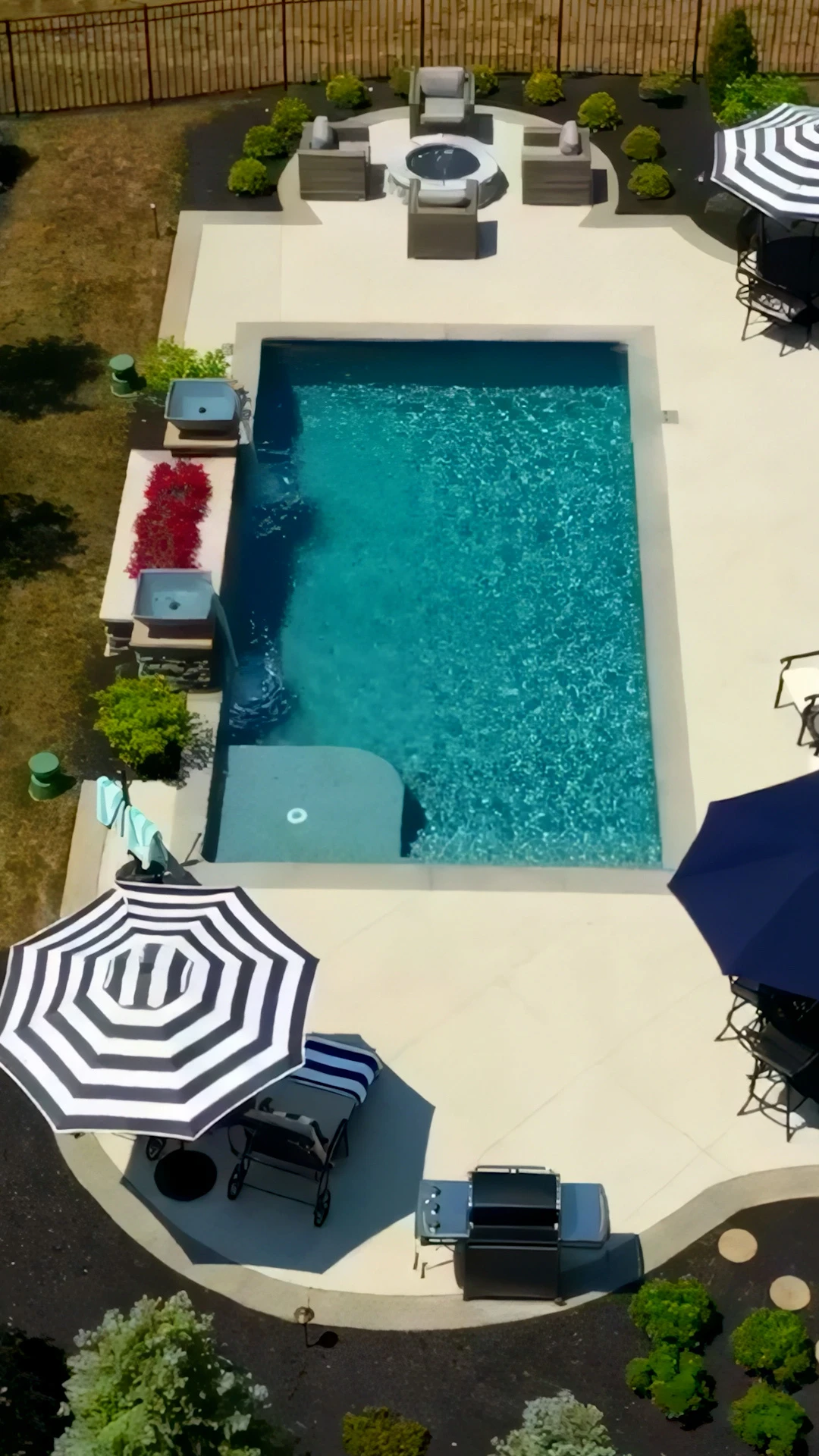
The Sequence That Keeps A Terraced Build Inside Schedule
A three-tier Suwanee build on a 4-foot-drop lot runs eighteen to twenty-four weeks start to finish when the sequence is held. It stretches to thirty weeks when the sequence is broken. The delta is entirely about the order of operations — which has more to do with the retaining wall and subpanel than with the pool itself.
The sequence we hold to on a typical terraced build. Week one through three: final site survey, engineered wall plans stamped, permit submission to Gwinnett County Planning & Development at 446 W. Crogan St. in Lawrenceville, ARC submission if the lot is governed, Jackson EMC load application filed.
Week four through seven: bulk excavation, grading to finished subgrade, retaining wall base and first two courses set, drain tile installed and daylighted. Pool hole excavated. Plumbing rough-in trenches run, including subpanel feed conduit.
Week eight through eleven: pool shell shot in shotcrete or gunite, plumbing pressure-tested, retaining wall completed to full height with geogrid set at each eighteen-inch course. Equipment pad rough-in. Jackson EMC subpanel set and tagged for inspection.
Week twelve through fifteen: deck subbase and compaction, travertine or paver deck laid, wall veneer installed if specified, perimeter fence set, landscape beds prepared. Electrical final for the subpanel. Plumbing trim-out.
Week sixteen through twenty: pool finish applied (plaster, pebble, or quartz), waterline tile laid, coping set, pool fill begins, water chemistry balanced over seven days, equipment commissioning, landscape plant-out. Final inspection by Gwinnett County.
The schedule breaker on terraced builds: Eight of the last ten schedule slips on our Suwanee terraced projects traced back to one item — the retaining wall engineered plans landing late with the permit office. If the engineered-stamped wall set is not in the permit packet at week three, the entire downstream sequence bumps by two to four weeks. We now submit engineered wall plans before pool plans to eliminate this risk.
A Project Walk-Through — What A Laurel Springs Build Actually Looked Like
One project from the last year frames the full scope. Homeowner in Laurel Springs, 1.1-acre lot, existing 2009 custom home, rear yard drop from back porch to rear property line measured at four feet three inches over a horizontal run of seventy-four feet. Initial budget conversation was anchored at $165,000 for a flat-fill pool and deck.
Walk-through conclusion: flat-fill would put the pool in a bowl relative to the neighboring lots, hide the tree-line view, and require a four-foot timber wall at the rear that the ARC would not approve anyway. Revised scope: three-tier terraced build with raised spa at back-porch elevation, rectangle pool on tier two with attached tanning ledge, drop deck on tier three with a firepit conversation area, and a forty-eight-inch engineered segmental block wall at the rear in Allan Block AB Classic with tumbled ledgestone veneer to match the house.
Final scope numbers. Pool and spa: $168,500. Wall and terraced grading package: $54,000. Travertine deck, coping, and paver tier-three patio: $38,500. Firepit and gas line: $6,800. Jackson EMC 100A subpanel and electrical scope: $11,200. Landscape at rear retaining wall and pool perimeter: $14,800. Total delivered scope: just under $294,000.
ARC submission at week three, approved at week six, one round of comments on equipment pad screening. Permit issued through Gwinnett County at week seven. Shovel in the ground week eight. Final inspection and water chemistry certification week twenty-two. Pool operational for Memorial Day weekend as targeted. Appraisal conducted eleven months post-completion for a refinance returned an incremental home value of $362,000 against comparable non-pool homes on the same street, with the appraiser citing the terraced hardscape system as the primary driver of the premium over the neighborhood’s flat-graded pool comps.
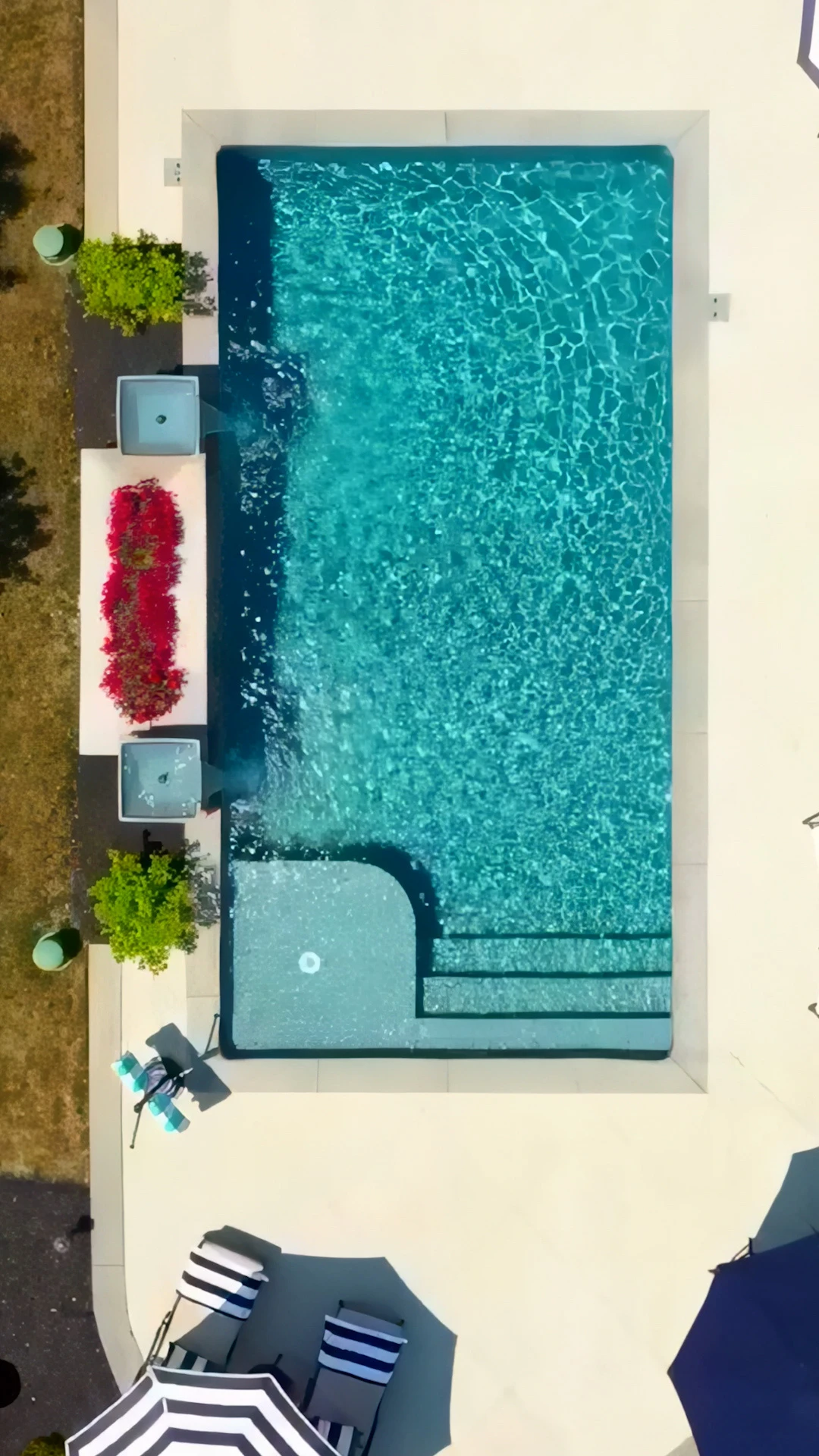
The homeowner’s own framing, eighteen months after pool completion, is worth noting. When asked what they would change, the answer was that they would not have negotiated the wall scope down. Their initial instinct was to value-engineer the wall from forty-eight inches back to thirty-six inches to save $8,400. We kept it at forty-eight inches because the geometry of the spa spillover and tier-two deck required it. In hindsight, they said, the full-height wall was the element the appraiser cited by name.
That is the point of the post. A Suwanee rear yard that drops four feet is not a penalty to be engineered away for the lowest possible dollar. It is the geometry that makes a layered pool build possible, and the wall is not an expense against the project — the wall is the project. Build it once. Build it engineered. Build it with the veneer the ARC is going to ask for anyway. The comps at exit will pay the difference back with interest.
Custom Pool Construction across 20+ cities within 30 miles of Winder, GA
If your Suwanee lot has a three- to five-foot rear yard drop, that is not a problem — it is the geometry your raised spa, drop deck, and engineered retaining wall are already designed around. Let’s walk the grade.