
Q: “We’re building in Vickery and our designer keeps pushing a freeform pool. The lot is a quarter acre. Should we fight for it?” A: No. And the reason is not taste — it is the 46-foot rear setback after the HOA’s pool-decking buffer eats the yard. Freeform needs room to breathe. Your lot doesn’t have it.
That exchange — or some version of it — happens a dozen times a year in our design office. Forsyth County homeowners have been sold the idea that a “custom” pool has to mean curves, coves, and a kidney silhouette. The reality is stricter and more interesting. The shape your pool should take is not a style preference. It is a spatial equation written by your lot, your subdivision’s design review committee, your soil profile, and the architectural grammar of the house already sitting there.
Forsyth County is the fastest-growing county in Georgia for the past decade, now home to roughly 260,000 residents across 247 square miles. The planning department approves north of 200 pool permits per year. We’ve built in most of the subdivisions those permits land in — Vickery, Hampton Park, St. Marlo, Windermere, Polo Fields, Haw Creek, Shoal Creek, and the older estate parcels north of Hwy 20 toward Coal Mountain. The shape decision splits along a clean line, and we’ll map exactly where it falls.
The Forsyth Subdivision Lot Is Too Narrow For Freeform (Almost Always)
Drive through Vickery off Post Rd. Measure the typical backyard from the rear wall of the house to the rear setback line. You’re looking at something in the neighborhood of 55 to 80 feet of depth, with side yards of 15 to 25 feet once you account for side setbacks and the mandatory grading easement. Hampton Park on Majors Rd — similar. Polo Fields off Kelly Mill — same math. St. Marlo, despite its acreage reputation in the golf-front sections, still dictates tight pool placement because of cart-path easements and the lake buffer.
Freeform pools are not just curvy rectangles. The geometry is fundamentally different. A kidney or lagoon shape needs a minimum of 8 to 12 feet of breathing room on every curve to look intentional rather than crammed. Squeeze a freeform into a space that wants a rectangle, and the eye reads it as a deformed oval. The curves lose tension. The deck around the convex bulges becomes dead space you can’t furnish. And because pool decks in Forsyth County HOAs usually require a 4-foot minimum walk zone around the entire perimeter per the community design standards, you end up pushing the water further from the house than a straight-sided rectangle ever would.
Rectangles are honest about constraint. A 16×36 rectangle fits inside a 24×44 footprint with 4 feet of deck on every side. Fit the same 572 square feet of water into a freeform with matching curves, and the exterior footprint swells to roughly 30×52. In a Vickery backyard, that’s the difference between buildable and not.
The Forsyth setback rule that kills most freeforms: Pool water must sit 7.5 feet inside the rear property line in most Forsyth subdivisions, with an additional 10-foot HOA-imposed deck buffer common in Vickery, Hampton Park, and Windermere. That’s 17.5 feet gone before your shell even starts. Freeform geometry rarely survives that subtraction on a quarter-acre lot.
Cost Alone Favors Rectangle — By $8K To $14K
Shape is not neutral on the invoice. A rectangular shell costs meaningfully less than a freeform of equivalent square footage, and homeowners almost never hear this from designers who are shape-agnostic on purpose (they charge the same fee either way). Here is where the savings actually live.
Shotcrete volume. A rectangle’s bond beam is shot along four straight lines with standard form work. A freeform’s bond beam follows a variable radius curve that requires more shotcrete to achieve consistent thickness at the tighter radii — typically 12 to 18% more yardage of 4,500-psi shotcrete. On a 500-square-foot pool at $11 to $13 per cubic foot installed, that’s $1,200 to $2,100 of additional shell cost for a freeform before you’ve poured the first deck panel.
Steel schedule. The rebar cage for a rectangle uses straight #4 bar on a 12-inch grid, bent at four corners. The cage for a freeform requires field-bent radius bar or pre-fabricated curved sections, with more tying labor per square foot. Figure $800 to $1,400 more on reinforcement for a comparable freeform.
Form work. Straight forms are plywood-and-2×4 rentals. Curved forms are custom flexboard or site-fabricated masonite curves, staked every 18 inches instead of every 4 feet. Labor on form work alone often runs $2,000 to $3,500 higher on a freeform of matching size.
Tile and coping. Most waterline tile is sold in 6×6 or 1×1 sheets. On a straight wall, those sheets install cleanly with minimal waste. On a freeform, tile on outside curves requires diamond-saw cuts on nearly every sheet to follow the radius, and on inside curves the tile has to be stacked with wider grout joints to keep the pattern from cracking. Add 18 to 25% labor premium on tile. Coping cut to follow a curve runs about the same premium.
Stack all of that: a freeform of identical square footage routinely costs $8,000 to $14,000 more than a rectangle in Forsyth County pricing as of 2026. That’s not a number we quote to steer you — it’s what shows up on the change-order line when clients request a shape switch mid-design.
The Architecture Problem: Curves Fight Modern Farmhouses
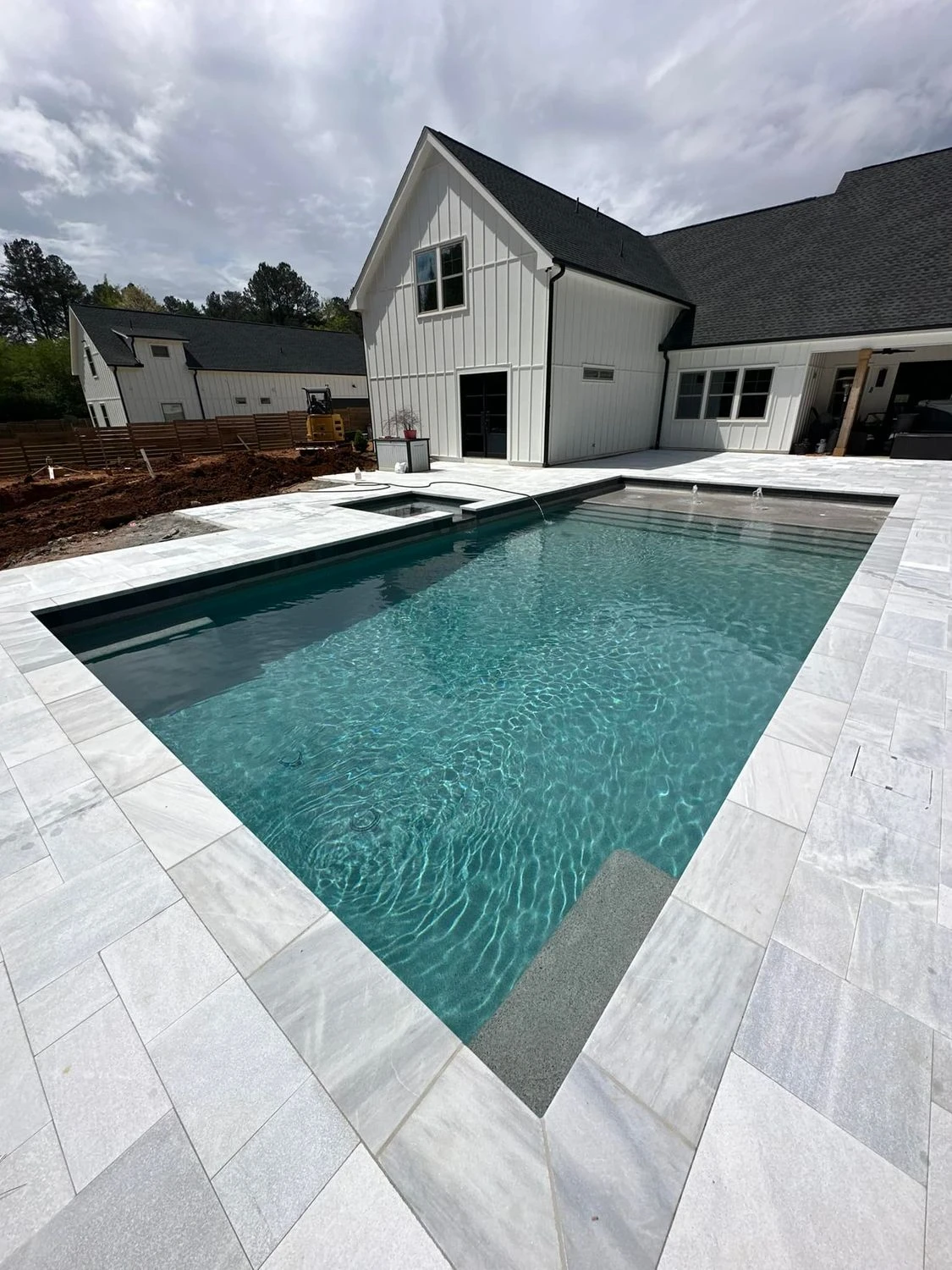
Walk any street in the Hampton Park, Traditions of Braselton-adjacent, or newer Bethelview corridor builds and you’ll see the same architectural vocabulary: board-and-batten siding, black window frames, standing-seam metal roof accents, low-slope gables, rectilinear massing. This is the Forsyth builder vernacular circa 2018 through today — “modern farmhouse” or “transitional” depending on who’s selling it.
Architectural design works on a principle called formal continuity. Curves complement curves. Rectangles complement rectangles. A freeform kidney pool set behind a strictly rectilinear modern farmhouse reads as a visual non-sequitur. The pool fights the house. Every photo of the backyard — and your house will be photographed, because that’s what Forsyth buyers do at resale — captures a mismatch the human eye picks up on even when the viewer can’t articulate why.
Conversely, a rectangle or L-shape pool mirrors the house’s lines. The waterline becomes a horizontal extension of the rear wall. The coping echoes the roof eave. The tanning ledge bump-out reads as an intentional corner response, not a random blob. If your house is a modern farmhouse or transitional colonial — and in Forsyth subdivisions, odds are it is — geometric is not the conservative choice. It’s the correct one.
Where Freeform Does Belong In Forsyth
The freeform envelope does exist in Forsyth County, and when it’s right, it’s deeply right. Three conditions have to be met.
Condition one: the lot is one acre or larger. This isn’t a preference — it’s a spatial necessity. Haw Creek, Shoal Creek off Hwy 369, the older equestrian parcels north of Hwy 20, and the handful of estate sections in Windermere and St. Marlo offer enough room for the shell to breathe. On an acre, you can set a freeform 40 feet off the house with 20 feet of meandering deck and natural planting beds on every side. That’s the geometry the shape was designed around.
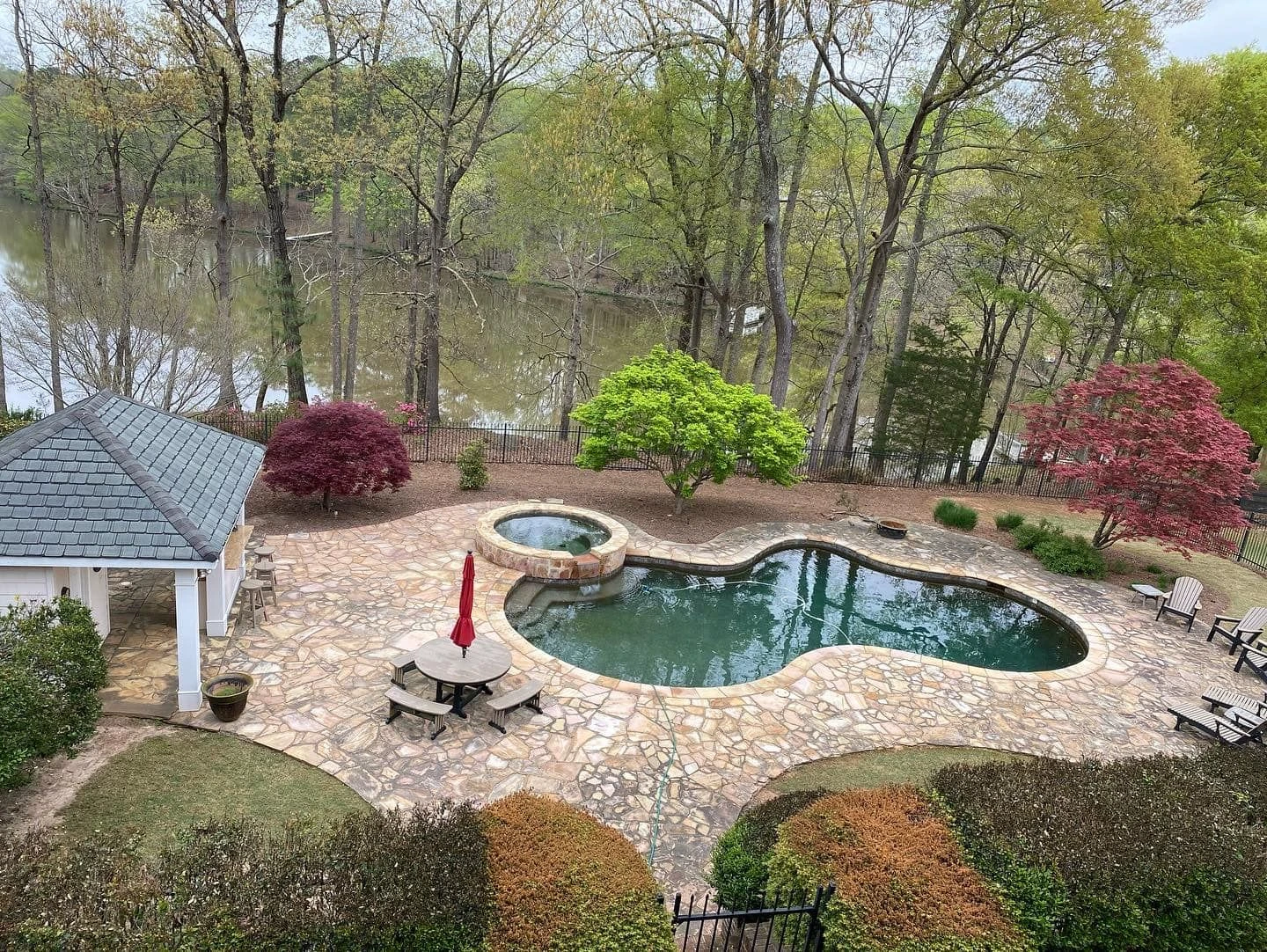
Condition two: the architecture supports it. Traditional ranch, Craftsman, log-and-stone lake houses along the Lanier south shore, or rambling Southern estate homes with curved porches and asymmetric massing — these absorb a freeform naturally. The shape echoes the house’s informal geometry. Modern farmhouse does not.
Condition three: the surroundings are naturalistic. Wooded perimeter, sloped topography, an informal planting palette — freeform reads as an integrated landscape element. Tight suburban turf framed by 6-foot black aluminum fence reads as a kidney stuck in a rectangle. The fence always wins the visual argument. Build freeform where the fence isn’t the dominant line, or don’t build freeform.
Rectangle With Sun Shelf Is The #1 Forsyth Shape — Here’s Why
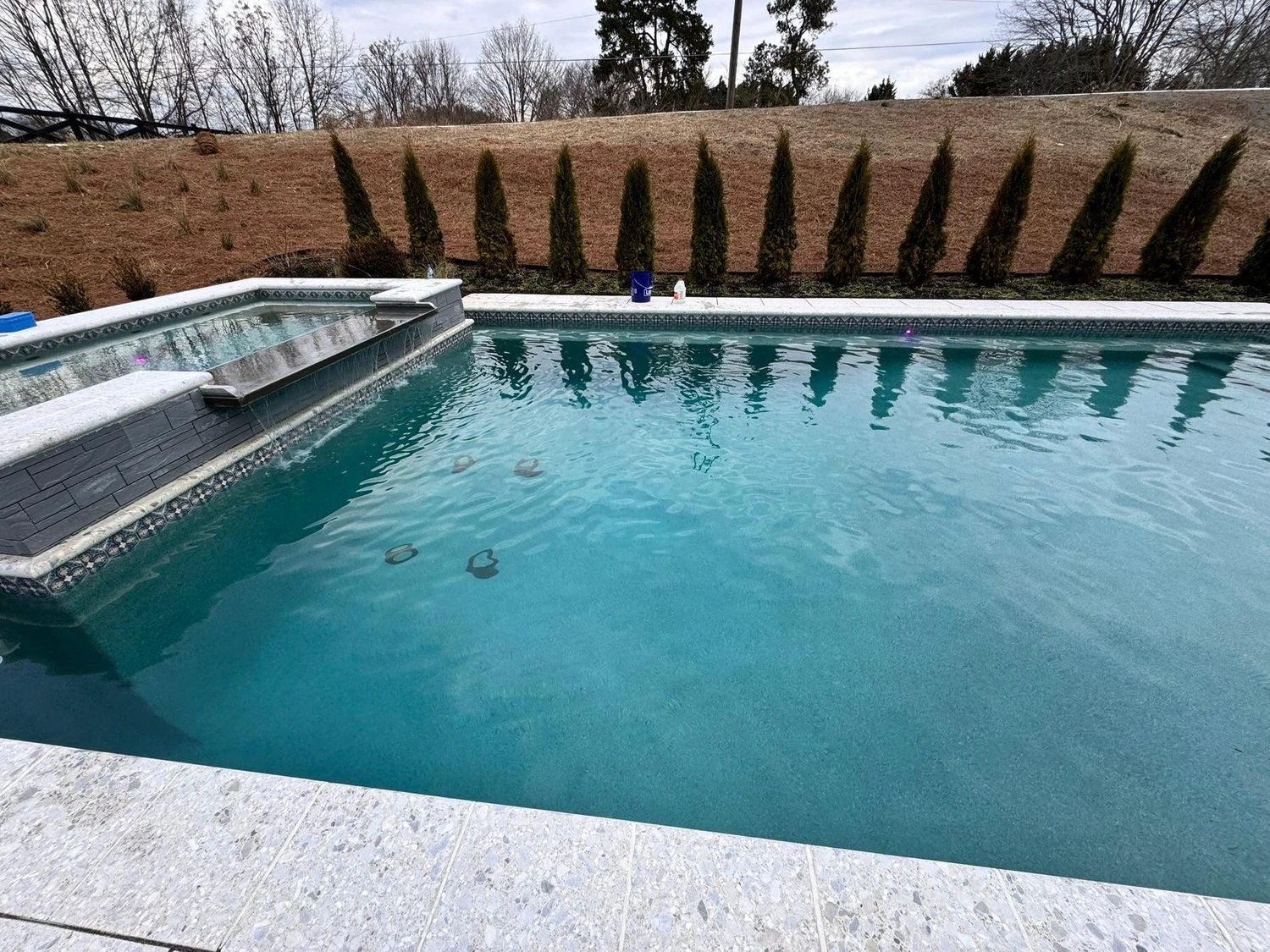
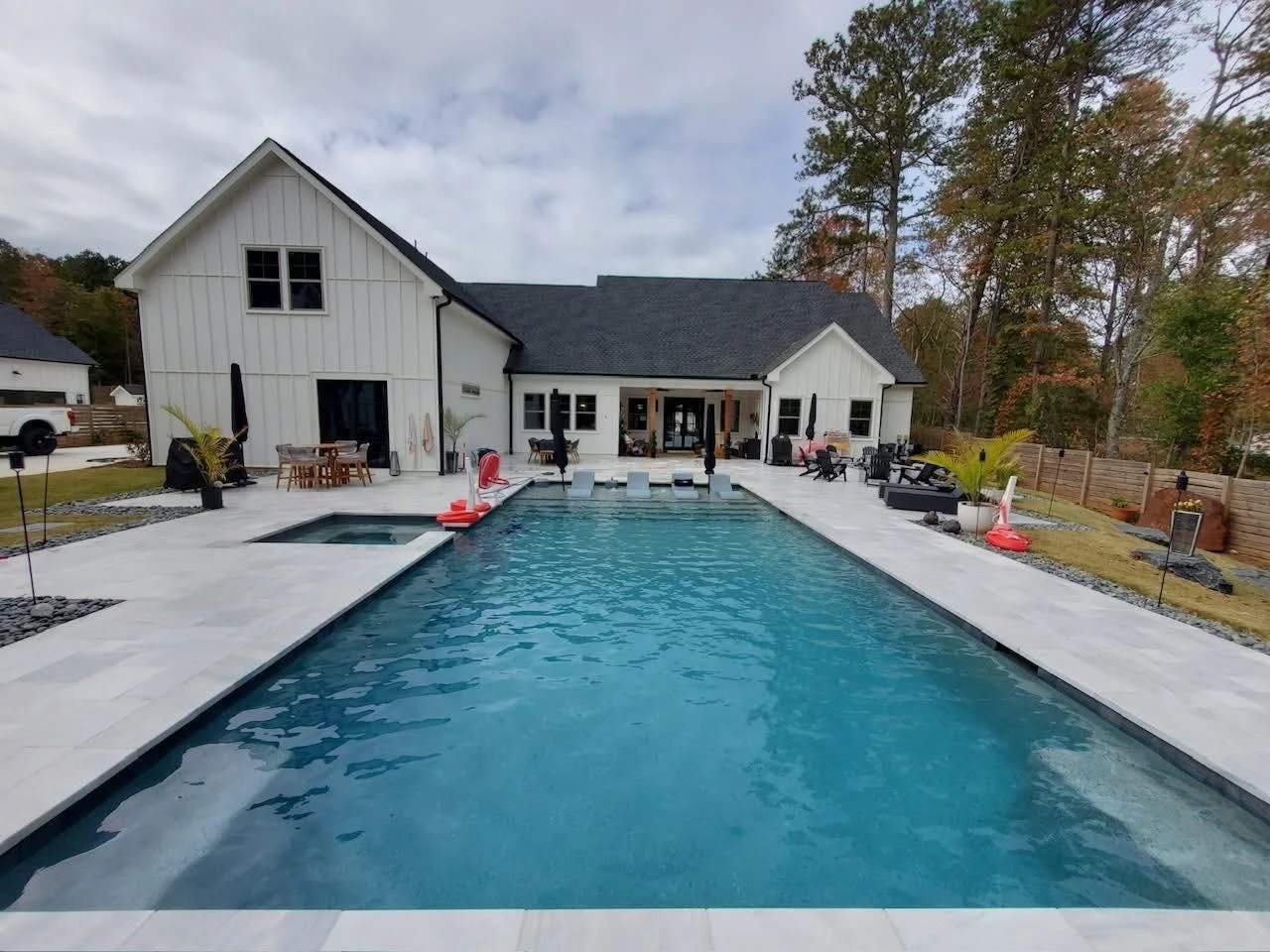
If there is a signature Forsyth County pool shape across those 200+ annual permits, it is this: a true rectangle — typically 16×36 or 18×38 — with an integrated 6-by-12 sun shelf at the shallow end, often extended with an in-pool bench seat at 19 inches below waterline. The tanning ledge hosts two or three Pentair MagicBowl scuppers or a trio of bubbler jets, both for daytime sound and a low-voltage LED accent at night.
This configuration solves four problems simultaneously. It keeps the overall footprint inside the Hampton Park / Vickery / Polo Fields setback envelope. It gives the house a sun-shelf “lounging theater” that photographs beautifully without requiring extra yard. It integrates a water feature without demanding a raised spa wall, which on a flat Forsyth lot would read as a retaining wall with no purpose. And it holds resale value because the next buyer doesn’t inherit a stylistic choice they have to defend to their neighbors.
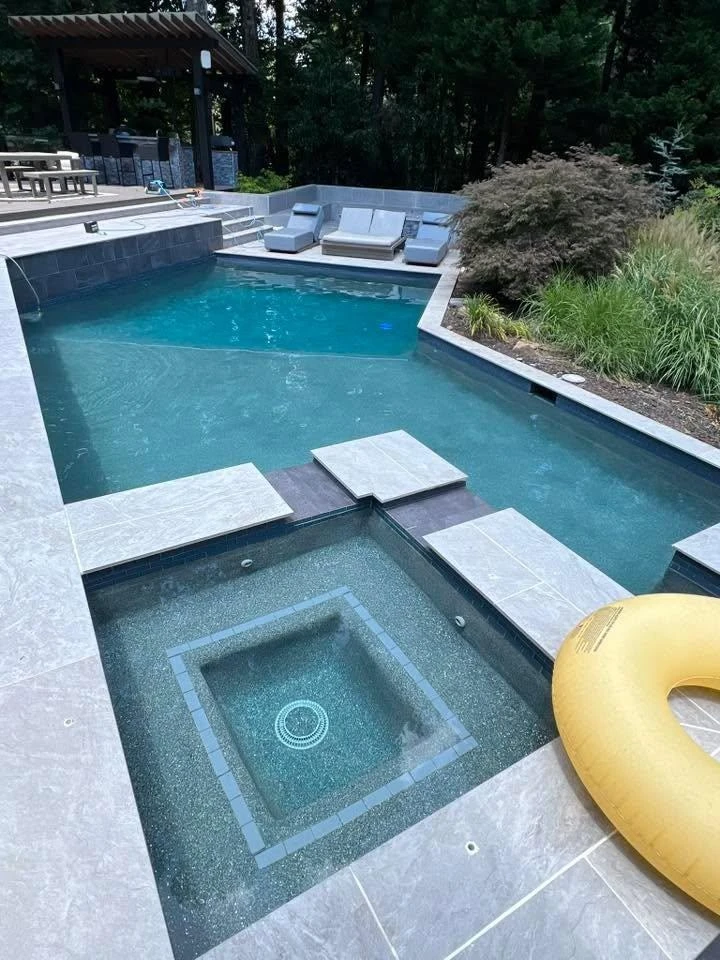
On sloped Forsyth lots — and Forsyth has plenty of sloped lots, especially the engineered-cut subdivisions off Browns Bridge Rd (Hwy 369) and the Coal Mountain foothills — we frequently pair the rectangle with a raised spa on a stacked-stone veneer wall with a full-wall sheer descent. That gives the yard a vertical feature, handles the grade difference as a usable element rather than a retaining scar, and provides architectural weight against the house. Our tag for this: the “rectangle-with-spa-wall” detail, and it shows up on roughly 40% of our Forsyth builds.
The Forsyth soil reality — Cecil series Piedmont clay: Most of Forsyth County sits on Cecil series red clay with variable depth to saprolite. It excavates cleanly, compacts well, and holds pool walls securely once backfilled with #57 stone to 18 inches below deck. Freeform shells on this soil require more careful backfill sequencing because the irregular wall profile creates uneven earth pressure during hydrostatic loading. Rectangles load evenly. Another quiet argument for geometric on Cecil clay.
L-Shape And Geometric-With-Radius Corners: The Middle Path
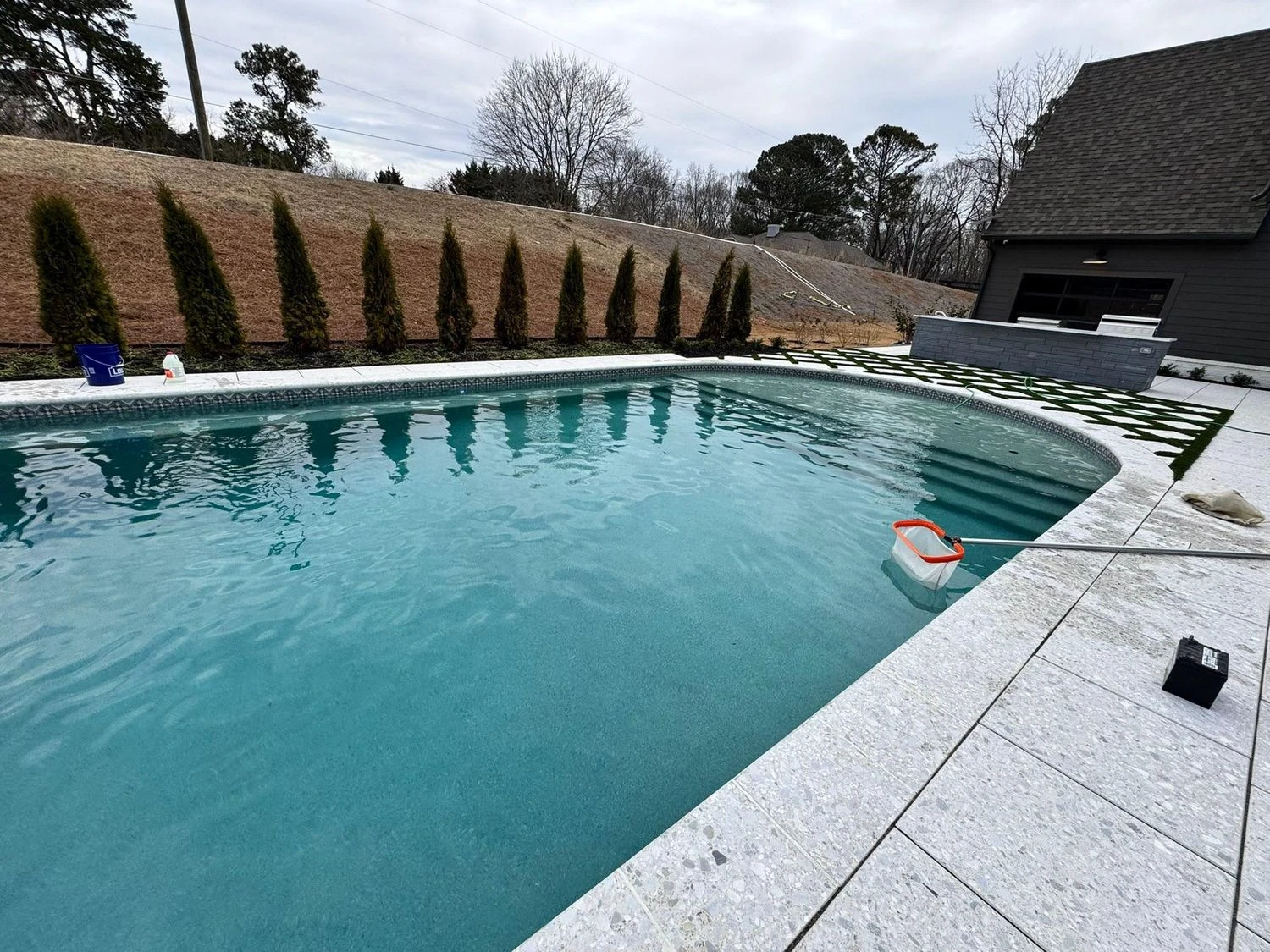
Between pure rectangle and true freeform sits the shape most Forsyth homeowners actually want when they say “custom”: the L-shape, or a rectangle with one or two radiused corners. These read as geometric — they respect the architecture, they cost closer to a rectangle than a freeform, they photograph cleanly — but they break the room-wall monotony a pure rectangle can project on a large deck.
The L-shape in particular solves the common Forsyth problem of a yard that’s wider than it is deep. In a subdivision lot that reads 80 feet wide by 50 feet deep from house to setback, a 14×32 main body with a 14×14 return creates a distinct spa / lounging zone separated from the primary lap axis. Furniture flows into the L; the sightline from the kitchen looks down the length of the pool; the return wall gives the sun shelf a defined edge.
Geometric-with-radius corners — a rectangle with two 4-foot-radius corners on the far end, or a “Roman end” with a semicircular shallow end — cost roughly $2,500 to $5,000 more than a true rectangle. That’s a fraction of the $8K to $14K freeform premium, and it gives you the softness many homeowners want without the spatial or architectural penalty of a full lagoon shape. In Forsyth subdivisions where the lot allows another 5 feet of width, this is often our design office’s recommendation.
The Permit, HOA, And Engineering Layer — What Shape You Pick Affects All Three
Shape doesn’t just decide how the pool looks. It decides how long permitting takes, how many HOA design review cycles you endure, and what your structural engineer has to certify. Forsyth County processes pool permits through the Department of Planning & Community Development at 110 E Main Street in Cumming. Standard residential pool permits in Forsyth turn around in 10 to 15 business days when the submission is clean.
A rectangle submission is almost always clean. The engineered drawings are templated — structural engineers in the Metro Atlanta market have rectangular pool plan sets ready to stamp in under a week. The HOA design review committee in Vickery, Hampton Park, Polo Fields, Windermere, St. Marlo, and most other subdivisions approves rectangular submissions on the first cycle roughly 85% of the time in our experience. They don’t have questions. The drawing is self-explanatory.
Freeform submissions generate questions. HOAs ask about sightline compatibility with neighboring yards. They ask about fence geometry. They ask about drainage because irregular deck edges create irregular runoff patterns they’d rather not adjudicate. Structural engineers charge more for custom stamping because each freeform shell requires its own bond beam calculation and wall-thickness variation schedule. Expect 2 to 4 additional weeks between drawing completion and permit-in-hand on a freeform, plus $600 to $1,200 more in engineering fees. On a tight build season — Forsyth crews book out March through August — those four weeks can push your fill date from May into August.
There’s also a specific Forsyth County code wrinkle worth knowing. Section 18-2 of the Forsyth County development code requires safety barrier compliance per NEC §680 and a 48-inch minimum self-closing self-latching perimeter gate. On a rectangular pool with straight deck edges, the fence run is obvious. On a freeform, the fence often has to follow a more complex path to maintain the 4-foot minimum setback from water’s edge — which in turn can force the perimeter fence into more linear feet and more posts. Another invisible freeform premium.
HOA approval reality — the five-subdivision rule: In Vickery, Hampton Park, Windermere, Polo Fields, and St. Marlo, the design review committees have approved rectangular pool submissions at roughly 85% first-pass and freeform submissions at roughly 55% first-pass over the past three years we’ve tracked. The difference isn’t prejudice against curves — it’s that rectangles produce fewer questions the committee has to write answers to. Fewer questions, faster approval, earlier shell shoot.
The North Forsyth Exception — Lake Lanier, Sawnee Foothills, And Estate Lots
Everything above applies to the dominant Forsyth County market: south Forsyth commuter subdivisions, the GA-400 corridor from exit 13 to exit 18, and the newer Bethelview / Post Rd / Kelly Mill builds. North Forsyth is a different country.
Up past Hwy 20 — in the unincorporated Coal Mountain, Ducktown, Shady Grove, and Big Creek pockets, and along the south shore of Lake Lanier where the 30028 zip code dominates — lots get larger. Three to five acres is common. Mature hardwoods frame the backyards. Homes skew toward stone-and-cedar lake houses, rambling traditional estates, or log-and-beam custom builds rather than production modern farmhouses. Topography rolls — the Sawnee Mountain foothills and the Lake Lanier moisture effect create genuine microclimates.
This is freeform country. On a three-acre wooded lot with a walkout basement lake house, a kidney or lagoon pool with an attached round spa, flagstone deck, and mature Japanese maples reads exactly as intended — a naturalistic water element woven into an informal landscape. The shape echoes the coves of Lake Lanier, which is literally visible from many of these properties. The same pool in Vickery would look ridiculous. In north Forsyth, it looks inevitable.
The rockier soil up toward Coal Mountain changes excavation math as well. Shallow saprolite and occasional boulder encounters add roughly $3,000 to $8,000 of blasting or hoe-ram work to any shape. That cost applies equally to rectangle and freeform, but the larger footprint a freeform demands means more linear feet of excavation face, and sometimes more rock to hit. A clear-eyed north Forsyth budget should include a rock allowance line regardless of shape, and homeowners on the Sawnee Mountain side should plan on test digs before final shell layout.
How To Decide — A Five-Minute Forsyth County Shape Audit
Before you argue shape with your designer, walk your yard with a measuring wheel and a pad. Here’s the checklist we give Forsyth homeowners when they come in asking which shape is right.
- Measure your buildable rectangle. House rear wall to rear property line minus 7.5 feet (county setback) minus your HOA deck buffer. Side-to-side: fence or side setback to opposite fence or side setback. This is your real canvas.
- Subtract 4 feet of deck on every side. Whatever’s left is your maximum pool footprint. If that rectangle is smaller than 16×32, you’re in plunge-pool territory regardless of shape preference.
- Photograph the house from the back. If the architecture is rectilinear — board-and-batten, black windows, straight rooflines, linear porches — rectangle or geometric-with-radius is the correct answer. If the architecture is informal — stone-and-cedar, curved porches, rambling massing, Craftsman detailing — freeform is on the table.
- Pull your HOA’s architectural review document. Vickery, Hampton Park, Polo Fields, Windermere, and St. Marlo all publish pool design guidelines. Read them. Some communities effectively ban full freeforms by requiring “geometric shapes compatible with home architecture” — which your review committee will enforce even if they can’t cite the exact clause.
- Price the delta. Ask your builder to price the rectangle AND the freeform of equivalent square footage in the same proposal. See the $8K-to-$14K number in writing. Decide whether that money is better spent on shape or on coping, pebble finish, raised spa, automation, or landscape.
Most Forsyth homeowners, after running this audit honestly, end up building rectangles or geometric-with-radius shapes. Not because rectangles are safe. Because the lot, the HOA, the architecture, the soil, and the budget are all quietly pointing the same direction — and at some point it becomes easier to listen than to fight.
Custom pool design and construction across 20+ cities within 30 miles of Winder, GA
Whether your Forsyth County lot wants a clean rectangle with a sun shelf or a freeform lagoon on three acres north of Hwy 20, we build the shape the site actually dictates — and we show you the reasoning before the shovel hits the ground.