
The pool deck looked flawless for the first two summers. By the third, the polymeric sand had washed out of every joint along the downhill edge, and a chalky white bloom had crawled across the coping. The homeowner blamed the installer. The installer blamed the weather. Both were wrong — the drainage plan never existed.
Alpharetta backyards present a drainage problem that almost never gets priced correctly. The terrain along the GA-400 corridor runs as gently rolling ridge-and-valley, with typical residential backyards moving only three to six feet of grade from the back of the house to the rear property line. That reads, on paper, as flat. It is not flat. It is a 3-6% slope — just enough pitch to deliver a steady volume of runoff into whatever you build at the bottom of the yard, and just little enough that the homeowner (and often the pool contractor) assumes the deck can drain itself.
It cannot. A 900-square-foot pool deck set into a Cecil-series red-clay lot in Windward or Hutchinson Farm will reliably produce more sheet-flow than the ground can absorb inside the first fifteen minutes of any storm over half an inch. Alpharetta gets about 51 inches of rain a year, concentrated into bursts. Without an engineered drainage system, that water has exactly two places to go: through the deck joints, and into the pool.
This post is about what a correctly-specified pool deck drainage system looks like on a gentle-slope Alpharetta lot — what it costs, which brand-name components actually hold up, and how to spot the undersized builds that will fail on a predictable schedule.
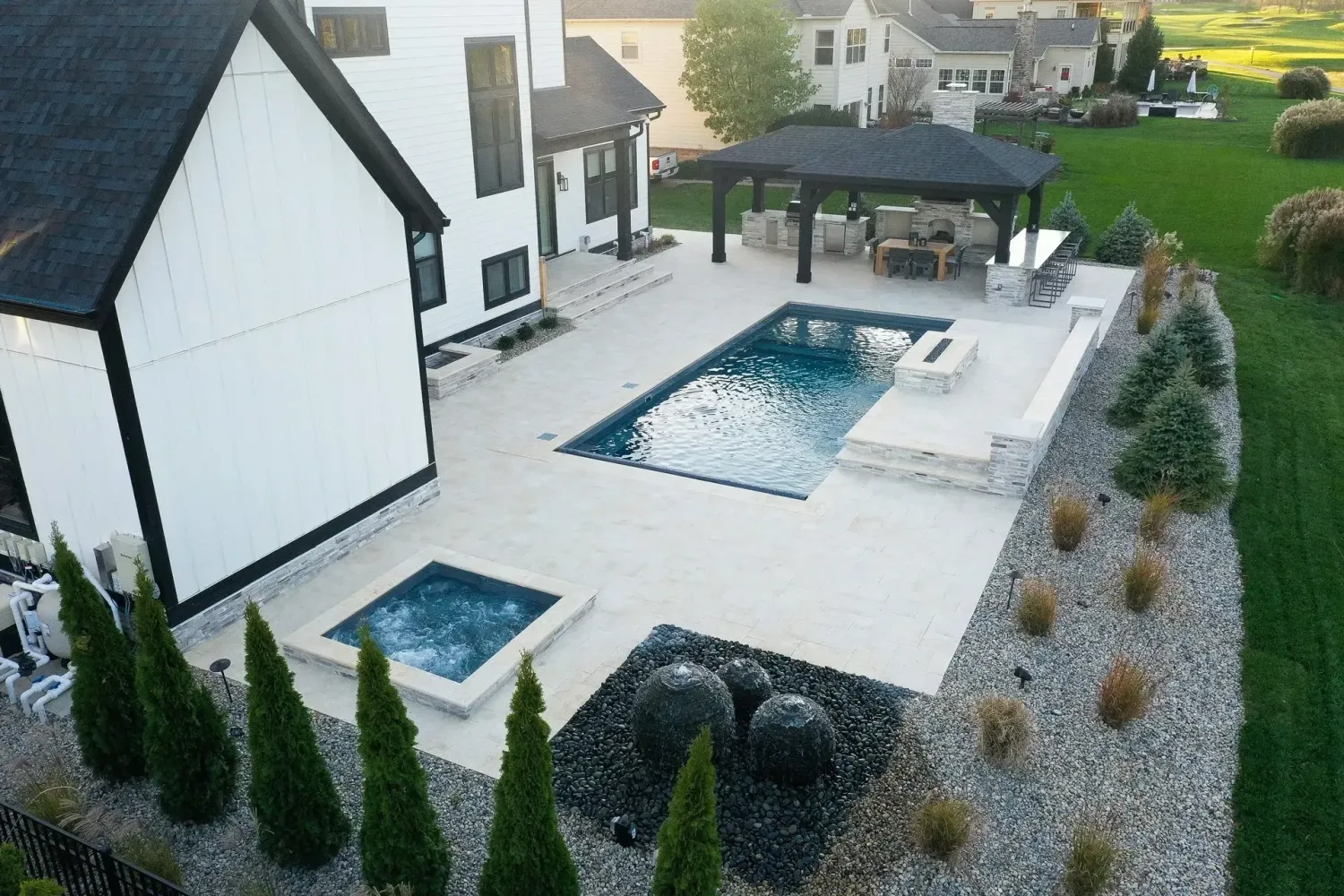
Why Alpharetta’s “Almost Flat” Lots Are the Hardest to Drain
A steep lot is easy to design around. Gravity does most of the work, and every contractor in Fulton County knows to build a positive-pitch deck toward daylight. A pancake-flat lot is also straightforward — you build a central dished deck, put a pair of area drains in the low point, and tie them to a sump.
Alpharetta’s terrain falls between those two cases, and that is the trap. A backyard in Country Club of the South or Ashebrooke will show a 3-foot drop across 60 linear feet of lawn. The pool contractor walks the yard, eyeballs it as gentle, and specs a deck with a standard 1/4-inch-per-foot pitch running away from the house. That pitch is correct for the deck itself. It does nothing about the uphill watershed — the 40 to 80 feet of lawn, mulch bed, and roof runoff above the pool that now aims directly at the deck’s high edge every time it rains.
On the Cecil-series Piedmont red clay that dominates Alpharetta soils, infiltration rates collapse to near zero once the top four inches reach field capacity. After the first heavy rain of a wet week, every subsequent storm produces pure sheet flow. Appling sandy loam pockets behave slightly better in the older farm-conversion tracts near Rucker Road, but not enough to change the design calculus. If you build a pool deck in this soil without intercepting the uphill water above the deck, the deck is the drain.
What “3-6% slope” actually does to a deck
At 3% grade, sheet-flow velocity across a dry deck is roughly 1.5 feet per second during a typical Alpharetta thunderstorm. At 6%, it passes 2.5 feet per second. Those numbers matter because polymeric sand joint-lock begins to fail under sustained flow above about 2 feet per second. Once the sand starts moving, the joints open. Once the joints open, water moves faster, and the failure accelerates. This is the failure mode behind the 18-month polymeric sand washout we see in 60% of the deck drainage quotes we’re called out to rework.
Signature Alpharetta number: A 900 sqft pool deck on a 4% slope receives roughly 560 gallons of runoff from its own surface during a 1-inch/hour storm — before counting any uphill watershed. Add a 60-foot uphill lawn, and the total can exceed 2,400 gallons in fifteen minutes.
The Three-Layer Drainage Stack (And Why 60% of Quotes Skip Layer Two)
A correctly-engineered pool deck drainage system on an Alpharetta gentle-slope lot is a three-layer stack. Each layer handles a different water source. Skipping any one of them is why decks fail.
Layer 1 — The pool-edge channel drain. We spec a Stegmeier deck-drain channel in flush-with-coping configuration, a 1/8-inch slot running the full pool perimeter on the downhill-from-pool sides. The slot is invisible from standing height but carries any water that sheets toward the pool itself. This layer protects the waterline from organic staining and keeps deck-surface runoff out of the pool.
Layer 2 — The uphill interceptor. This is the layer that gets cut from 60% of Alpharetta pool quotes we review, and it is the single most important line item. A linear French drain — 8 inches deep, 6 inches wide, wrapped in filter fabric, with a perforated 4-inch SDR-35 PVC pipe bedded in #57 washed stone — runs along the uphill edge of the deck, intercepting lawn and mulch-bed flow before it reaches the deck’s high edge. Without this interceptor, Layer 1 is overwhelmed.
Layer 3 — The discharge path. Both collection lines (the Stegmeier channel and the French drain) tie into a 4-inch solid SDR-35 main that has to go somewhere. In Alpharetta yards that somewhere is usually one of three outlets: daylight at a downhill property corner (preferred, cheapest to maintain), a dry well sized for 50-year storm volume (when the lot has no daylight option), or a sump pump with a battery backup (last resort, used when the yard is truly landlocked by neighboring grades).
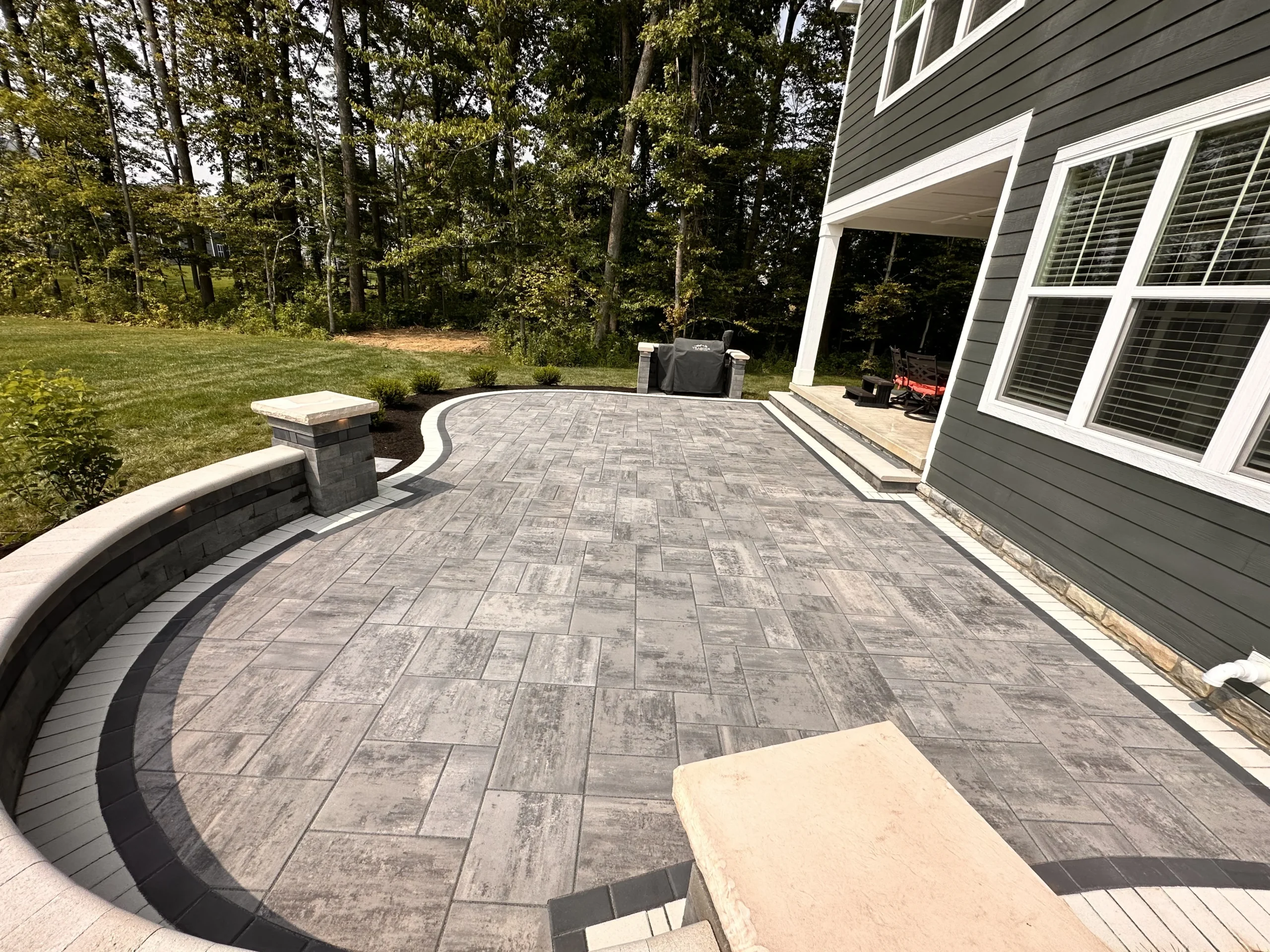
Why daylighting beats pumping
We push for a daylight outlet on every Alpharetta build where the grades allow. A gravity-discharge line has no moving parts, no electrical load, no battery to replace, and no inspection interval other than checking the daylight terminus for rodent infiltration once a year. A sump pump introduces a single point of failure that runs hardest precisely when the power is most likely to be out — the same thunderstorm that produces the runoff is the one that tripped the Georgia Power transformer at the end of the cul-de-sac.
In the sliver of northern Alpharetta served by Sawnee EMC along the Milton border, outage patterns differ slightly, but the principle holds: if you can move water with gravity, move it with gravity. Where we do install a sump, we spec a battery backup plus a water-powered secondary pump tied to city water pressure, so the system continues draining during a multi-day outage.
What the Three Layers Actually Cost on a 900 sqft Alpharetta Deck
Fully-installed drainage cost on a typical 900 sqft pool deck in Alpharetta, tied into existing lot grading, ranges from $4,800 to $8,600. That range is not contractor fuzziness — it is the real spread between the simplest case (daylight discharge, no obstruction, one uphill edge to intercept) and the hardest case (sump pump, two uphill edges, driveway or patio tie-in requiring saw-cutting). Here’s the breakdown we share with Alpharetta homeowners at proposal:
- Stegmeier pool-edge channel, 80 linear feet installed: $1,600 – $2,200 including flush coping integration and endcaps
- Linear French drain, 60 linear feet: $1,800 – $2,900 (filter fabric, #57 stone, SDR-35 perforated pipe, excavation, backfill)
- 4-inch solid SDR-35 main to daylight, 50 linear feet: $900 – $1,400
- Dry well (when daylight unavailable), 300-gallon storage: add $1,200 – $1,800
- Sump pit + submersible pump with battery backup: add $1,800 – $2,400
A quote that lands materially under $4,800 on a 900 sqft deck is almost always missing the uphill interceptor, the filter fabric, or both. Those are the two components that determine whether the system lasts five years or twenty-five.
Why Efflorescence Shows Up in Year Three (And What Causes It)
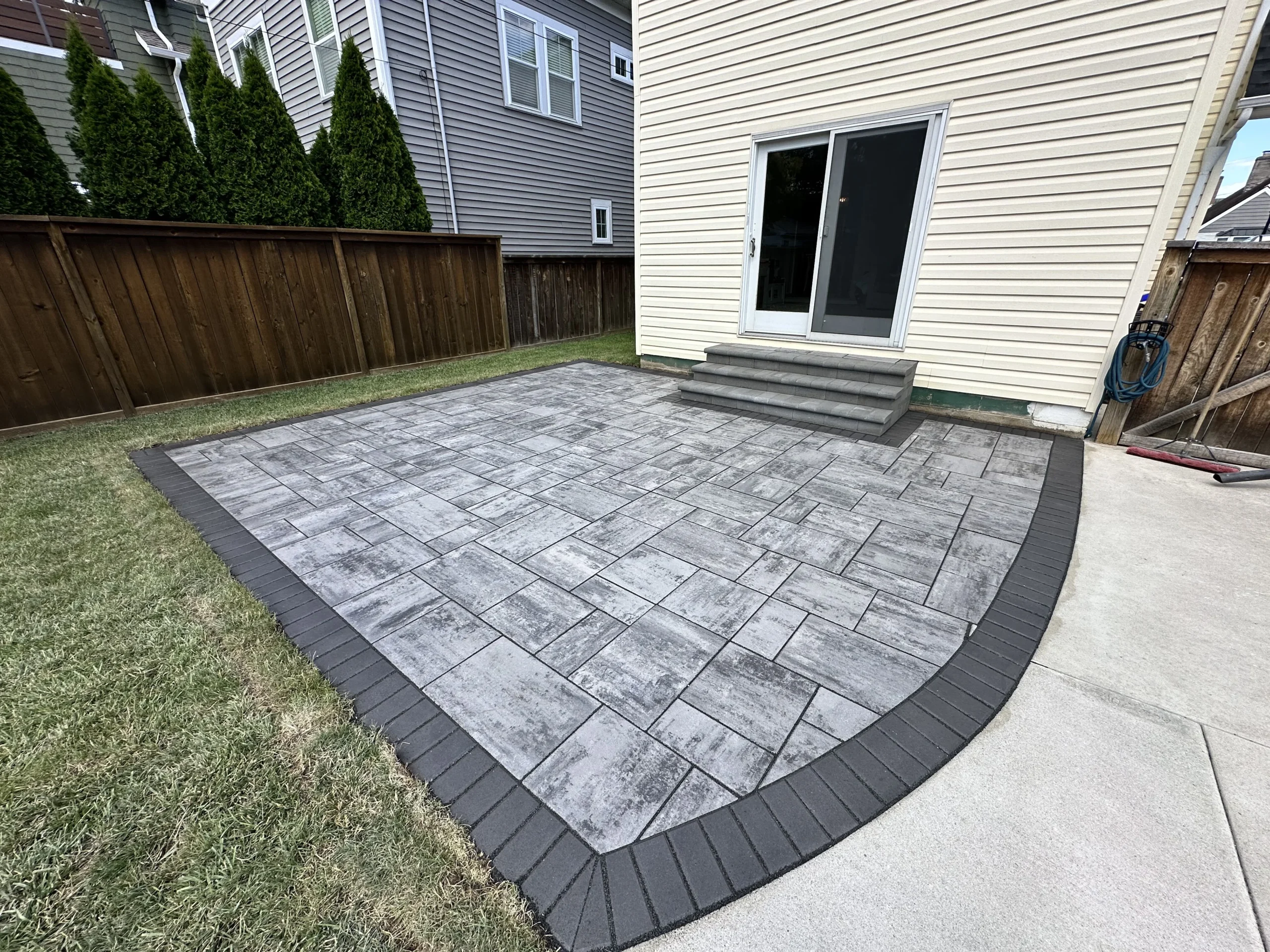
Efflorescence — the chalky white crystalline bloom that appears on travertine coping, concrete, and some paver surfaces — is a long-tail symptom of a drainage system that failed at Layer 2. The mechanism is worth understanding because it drives the inspection schedule for every deck we warranty.
When uphill water is not intercepted, it pools at the deck edge and wicks sideways through the coping and the top course of pavers. The water carries dissolved calcium compounds from the bedding sand, the mortar under the coping, and the concrete footing below. That water evaporates at the surface — daytime sun, summer highs of 89 to 94 degrees in Alpharetta — and leaves the calcium behind as a visible crystalline film. You cannot pressure-wash it away permanently. You can acid-wash it, but it returns the next wet season because the source (wicking from lateral water movement) has not been fixed.
This is the tell. If a pool deck in Avalon or Haynes Manor develops efflorescence between year two and year four, the drainage was undersized. The only permanent fix is retrofitting the missing interceptor drain — a retrofit that runs two to three times the cost of building it right at original construction because it now requires excavating around a finished deck and finished landscaping.
The freeze-thaw compounding problem
Alpharetta averages roughly 20 freeze events per year — not a full hard-freeze climate, but enough thermal cycling to punish water that is already sitting in the wrong place. A deck whose joints are saturated at 4 p.m. on a Sunday in January, and drops to 28°F by 3 a.m. Monday, will experience micro-fracturing in the joint material on every one of those twenty nights. That fracturing widens the joints fractionally, which lets more water in on the next storm, which drives more fracturing. The decay curve is not linear — it is geometric, which is why decks that drain poorly tend to look fine for two years and then deteriorate rapidly across years three through five.
Permitting, HOAs, and the Alpharetta-Specific Approval Path
Permitting for a pool deck drainage system in the City of Alpharetta runs through Community Development at 2 Park Plaza, separate from Fulton County unincorporated permits. For in-city addresses in zip codes 30004, 30005, 30009, and 30022, this is a measurable speed advantage — city review typically returns comments in 10 to 14 business days, against 18 to 25 for unincorporated Fulton.
The bigger schedule risk is not the city. It is the HOA. The Windward architectural review runs on a strict 3-week cycle with a submission deadline on the first Monday of the month. Country Club of the South’s ARB runs 3 to 4 weeks, and requires a drainage-plan overlay on the existing property grading plan — not a sketch, a real overlay. Miss the HOA deadline in either community and the project slides a full month. We build those cycles into the project timeline at proposal, which is why our Alpharetta permit-to-break-ground window is typically 5 to 8 weeks instead of the 3 to 5 you’d see on a no-HOA lot.
Neighborhoods without ARB review — parts of Deerfield, older sections of Martins Landing, scattered Cambridge Parks lots — move faster. Downtown Alpharetta infill near Academy Street and the Avalon-adjacent luxury townhomes sit in a mixed pattern where some clusters have HOA review and some do not. We check the recorded covenants on every Alpharetta address before quoting the timeline.
Neighborhood detail: In Country Club of the South, the ARB requires drainage discharge to stay on-lot or tie into a shared HOA easement drain — never discharge onto a neighbor’s property. This alone eliminates daylight discharge on roughly a third of the lots and forces either a dry well or a sump design.
What a correct drainage-plan submission looks like
A drainage plan we submit for ARB and city review shows four overlaid layers: existing contour lines at 1-foot intervals, the proposed deck footprint with pitch arrows, the interceptor drain run with invert elevations called out every 10 feet, and the discharge path with terminus type labeled. A hand-sketched bubble diagram is not a drainage plan. It is a reason for the reviewer to reject and reset the clock.
Red Flags to Spot in Other Contractors’ Quotes
If you’re collecting competing bids on an Alpharetta pool deck, the drainage line items on those bids are where the quality difference lives. The deck surface itself — paver choice, coping profile, color — is visible on the final walkthrough. The drainage system is buried. You only find out whether it was done right by watching what happens in years two, three, and five.
Five specific red flags we’ve seen repeatedly on Alpharetta competitor quotes:
- “Drainage included” with no line-item detail. If the proposal does not separately list the channel drain, the French drain, the main discharge line, and the discharge terminus, those components are almost certainly not being installed. Ask for the breakdown.
- No filter fabric on the French drain. Fabric-free French drains silt up within 24 to 36 months on Alpharetta’s fine-grained clay soils. The drain becomes a pipe full of mud.
- Corrugated black flex pipe instead of SDR-35. Flex pipe has ridges that trap debris, collapses under root pressure, and cannot be snake-rodded for maintenance. SDR-35 is the correct spec.
- Discharge terminating at a splash block against a foundation. This is a foundation-water-intrusion lawsuit waiting to happen, and no competent Alpharetta inspector will sign off on it.
- A Stegmeier channel listed without flush coping integration. A surface-mounted channel drain looks aftermarket on a premium deck. If the quote doesn’t include the coping modification to integrate the slot flush with the pool edge, the finished result will not match the renderings.
How to read the bedding-course spec
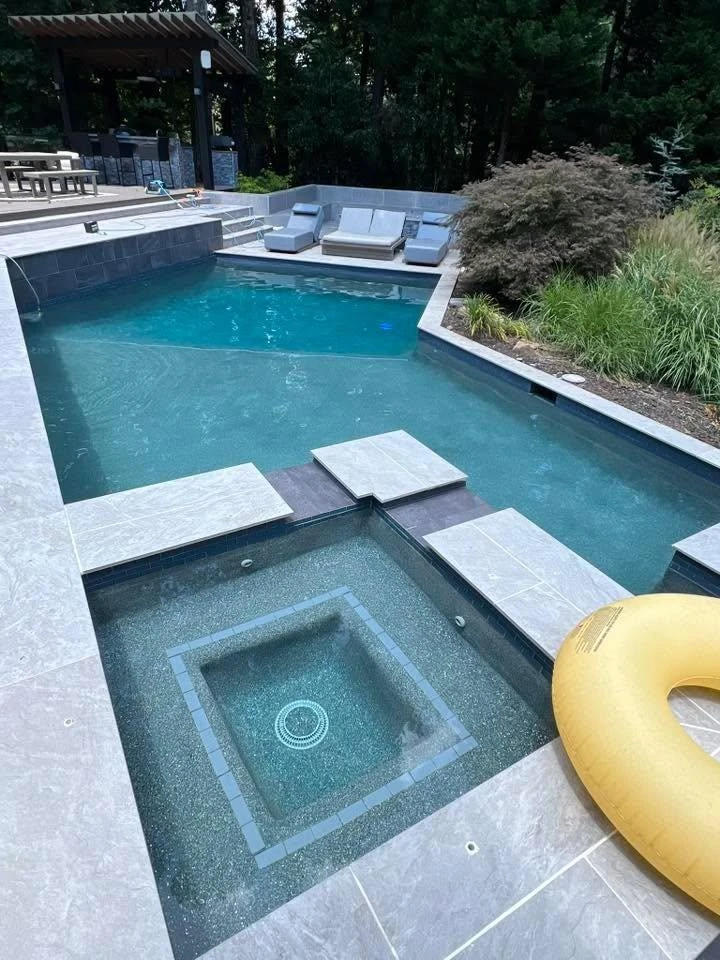
Below the deck surface itself, the bedding course tells you whether the installer is planning for long-term drainage performance. A correct bedding course for an Alpharetta pool deck is 1 inch of ASTM C33 #8 washed stone screed, over 4 inches of compacted #57 stone base, over 6 inches of compacted #2 stone or compacted aggregate base. That stack lets subsurface water move laterally to the collection drains even when the surface joints are saturated. A bedding course of “sand over dirt” — which we still see on low-bid Alpharetta quotes — turns into a bathtub the first wet week and delivers exactly the wicking problem that produces year-three efflorescence.
The bedding spec is the part of the quote that nobody ever looks at. It is the part that most determines whether the deck reads as premium in year ten.
The Alpharetta-specific timeline reality
Between the HOA review window, the Community Development permit cycle, the Georgia Power service-drop coordination if the project involves a sump pump on a new circuit, and the simple fact that good excavation crews in North Fulton are booked 6 to 10 weeks out during peak season, a properly-engineered pool deck drainage system in Alpharetta is not a two-week add-on. It is a 5 to 8 week planning-and-permitting effort that starts before the pool shell is even scheduled to be shot. The homeowners who end up happiest with their deck in year five are the ones who understood this at month one.

Pool deck drainage engineered for Alpharetta across 20+ cities within 30 miles of Winder, GA
We design the three-layer drainage stack into every Primetime Pools deck build — pool-edge channel, uphill interceptor, and gravity or pumped discharge sized to the actual lot and the actual watershed. That is how decks stay tight past year ten.