
A fully loaded premium kitchen with a 48″ grill, 36″ side burner, 60″ smoker, and pizza oven draws 240,000 BTU at peak. A standard 1/2″ feed from the meter moves 90,000 BTU at 3 feet. The math does not work — and every cold spot, yellow flame, and roll-out in Laurel Springs backyards comes from the same place: a pipe that was never sized for the load.
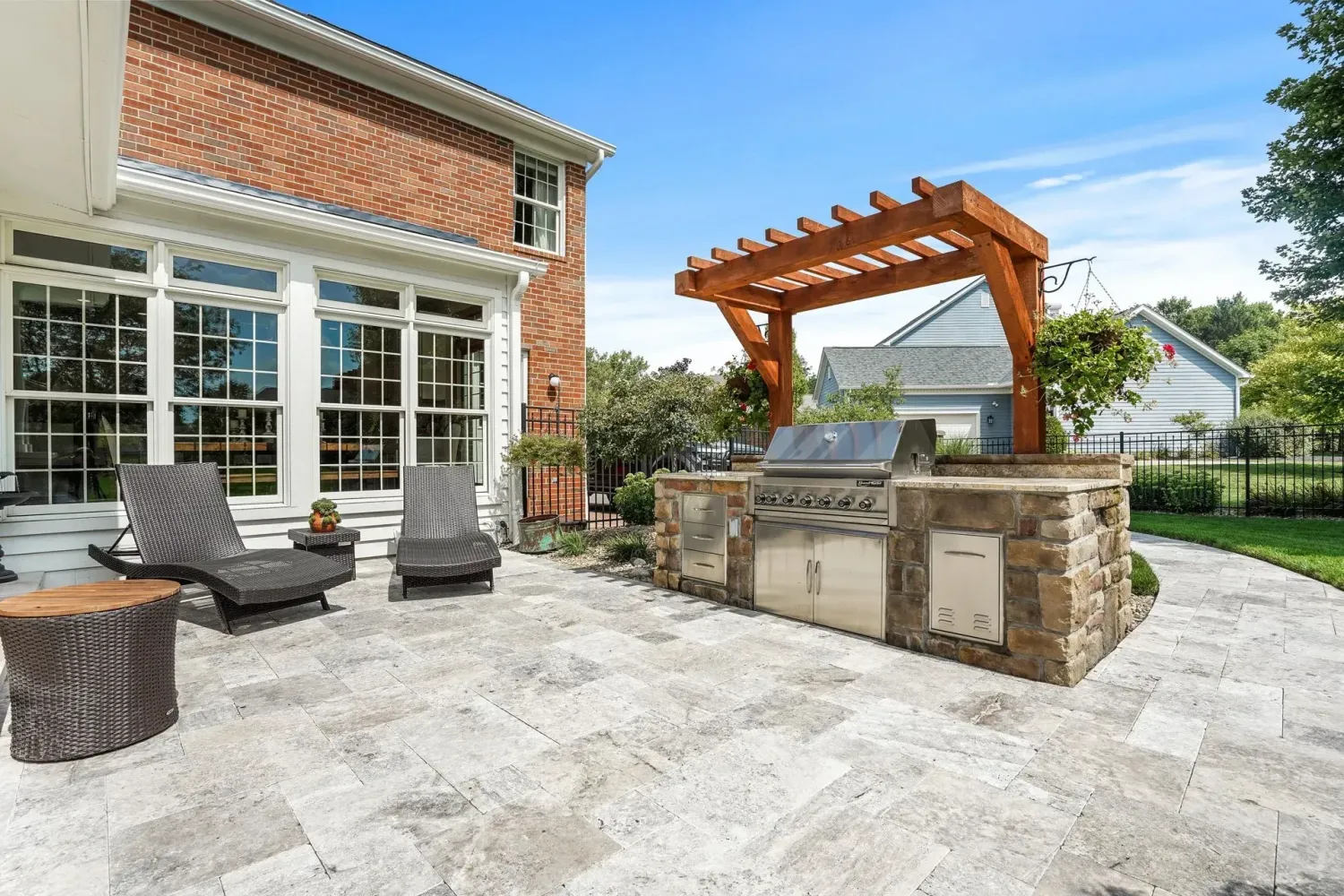
We see it two or three times a year in Suwanee. A homeowner hires a builder to install a gorgeous stacked-stone U-shape kitchen under a cedar pavilion. The finishes are flawless. Then the Kamado Joe runs lean, the side burner will not hold a simmer, and the Lynx 48 roasts unevenly on the left side because the right four burners are starving the left. The stone is perfect. The gas line is 3/4″ black iron branched off a 1/2″ tee that was sized for a pool heater and nothing else.
This piece is not about appliance brands. It is about the invisible infrastructure underneath — manifold sizing, regulator staging, and the decision tree we walk through on every premium kitchen build inside the Gwinnett County permit envelope. If you are spending $45,000 to $90,000 on an outdoor kitchen, the gas system is the single component most likely to quietly ruin the result.
01 — Why 90K-BTU Math Fails Above Settles Bridge Road
Most Atlanta-area outdoor kitchens land between $28,000 and $42,000, built around a single 36″ 4-burner grill pulling roughly 60K to 70K BTU and maybe a side burner adding 15K. Total peak load sits near 90K BTU. The integral regulator on the grill handles delivery pressure. A 3/4″ black iron feed off the house manifold, even running 30 feet with two elbows, will comfortably deliver that load without pressure drop. Nobody notices because nothing is wrong.
Premium Suwanee kitchens are a different animal. In Laurel Springs, The River Club, and Bear’s Best Atlanta estates, we routinely spec four appliances that together draw 240,000 BTU at simultaneous peak: a 48″ grill at 90K, a 36″ double side burner at 45K, a 60″ pellet or kamado smoker at 65K, and a pizza oven at 40K. That is 2.7 times the load of a standard build and the exact load at which 3/4″ pipe stops being adequate and code requires you to step up.
The NFPA 54 sizing table — the one every Gwinnett inspector references — makes it brutal. At 0.5″ water column pressure drop and 30 feet of developed length, 3/4″ Schedule 40 black iron is rated for 145 cubic feet per hour of natural gas, which is about 145,000 BTU. A 240K load needs 1-1/4″ pipe over that same run, full stop. No exceptions, no “close enough.”
The 240K rule of thumb: any time the sum of your appliance nameplate BTUs crosses 180,000, assume 1-1/4″ black iron from the meter and a dedicated second-stage regulator at the kitchen. Never size by the largest single appliance — size by the simultaneous peak.
02 — The Premium Kitchen Gas Load: Appliance-by-Appliance BTU Math
Here is the load sheet we run on every premium Suwanee build before we price a single stone or trench a single foot. The numbers below are manufacturer nameplate BTU from the four brands we install most often — Lynx, Twin Eagles, Hestan, and Alfresco for gas appliances; Kamado Joe Big Joe III, Big Green Egg XXL, and Traeger Ironwood XL for kamado or pellet integration.
- 48″ built-in gas grill — Lynx L54ATR, Twin Eagles TEBQ54G, Hestan GMBR48, or Alfresco ALXE-56BFG. Nameplate load: 90,000 to 110,000 BTU. We design around 100K. These grills have six or eight independent burners plus an infrared sear zone and rear rotisserie burner — the full stack lights simultaneously during a brisket sear.
- 36″ double side burner / power burner — 40,000 to 50,000 BTU. Used for stock pots, seafood boils, and sauce work. The Hestan AGPB double power burner is 45K. Design around 45K.
- Pizza oven — Alfa 5 Minuti propane/NG, Forno Piombo Toscana 60, or Il Fornino F2C. Nameplate: 35,000 to 45,000 BTU during the 30-minute heat-soak, settling at about 20K steady-state. Design peak: 40K.
- Built-in pellet or kamado smoker gas igniter — kamado units themselves use charcoal, but the gas lighter assembly many Laurel Springs clients specify for fast start draws about 25K. A full gas-fired rotisserie cabinet smoker (Twin Eagles TESM30 at 30K, or Primo gas kit) adds 30K to 65K. Design around 55K if spec’d.
- Outdoor-rated sink-side steam unit or hibachi plancha — Hestan AGTPL36 36″ teppanyaki runs 30K. Design around 30K if included.
A full Laurel Springs stack — 48″ grill + 36″ side burner + pizza oven + gas smoker — totals 240K peak. Add a plancha and you are at 270K. That number is the entire starting point for the supply system design.
03 — The Supply Chain: Meter, Manifold, Regulator, Trench
Once you have the peak load, the supply design works backwards from the kitchen to the meter. On a typical Suwanee build serviced by Atlanta Gas Light at the meter and Jackson EMC for electric (important — most of Suwanee is Jackson EMC territory, not Georgia Power, which matters for your rough-in coordination), here is the sequence we run on a 240K load.
Step 1 — Verify Meter Capacity
Pull the meter spec plate. The standard residential AGL Class 250 diaphragm meter delivers 250 SCFH at 7″ WC inlet pressure. That is roughly 250,000 BTU of natural gas. A 240K kitchen plus an 80K tankless water heater plus a 100K furnace puts you at 420K nameplate — well over meter capacity even if not simultaneous. If the home was built before 2005 and still has a Class 175 meter, you will need an AGL meter upgrade (typically no cost to homeowner; 3-6 week lead time). On two Bear’s Best Atlanta builds last year we had to pull a meter swap before we could even pressure-test the new run.
Step 2 — Size the Service Line to the Kitchen Manifold
From meter to kitchen, developed length (straight run + equivalent length of fittings) dictates pipe diameter. A 240K load running 40 feet with four 90° elbows has a developed length of about 52 feet. At 0.5″ WC drop on 7″ inlet pressure, NFPA 54 Table 6.2(a) requires 1-1/4″ Schedule 40 black iron, or 1″ CSST (corrugated stainless steel tubing) if you run Gastite or TracPipe. We default to black iron for buried sections because rodent damage to CSST insulation in Piedmont clay crawlspaces is a real thing we have repaired three times.
Step 3 — Install a Second-Stage Regulator at the Kitchen
At the kitchen island, step down from the 7″ WC house pressure to the 11″ WC the appliances expect using a Maxitrol 325-3L or equivalent line regulator. This is not optional on premium builds. Each appliance has its own integral regulator, but they are sized for a stable upstream feed. When four appliances light simultaneously off an unregulated manifold, the pressure sags below 5″ WC during the first 30 seconds and your grill burners run yellow until the meter catches up. The second-stage regulator at the island eliminates this entirely.
Step 4 — Manifold the Appliances on a Sized Header
Inside the island, a 1″ or 1-1/4″ header feeds tee-branches down to each appliance shutoff valve. Each appliance gets its own quarter-turn ball valve inside the island, keyed and labeled, accessible through a stainless door panel. This is both a code requirement and a sanity requirement — when your 48″ grill needs a burner orifice cleaning three years from now, you do not want to shut down the entire kitchen to do it.
04 — The Cost Gap: $1,400 Standard vs $5,400 Premium Gas Install
Budget transparency matters, so here is exactly what you pay for gas work on a typical 90K kitchen versus a premium 240K kitchen on a build anywhere in 30024.
Standard 90K-BTU Kitchen Gas Install — $1,400 to $2,200
- 3/4″ black iron from existing exterior stub, 20-30 feet to kitchen island
- One or two 90° elbows
- Single shutoff valve inside island
- No second-stage regulator (appliance integrals are adequate)
- Pressure test at 10 PSI for 15 minutes per Gwinnett inspection protocol
- Permit fee and inspection through the Gwinnett Dept. of Planning & Development at 446 W. Crogan St., Lawrenceville, typically $95-$140
- Labor: one plumber, one day
Premium 240K-BTU Kitchen Gas Install — $3,800 to $5,400
- 1-1/4″ black iron from meter, 40-60 feet of buried run in 18″-minimum trench with yellow warning tape 6″ above pipe
- Meter verification and, if required, AGL meter upgrade coordination (typically 3-6 week lead)
- Maxitrol 325-3L second-stage regulator at kitchen
- 1″ or 1-1/4″ manifold header inside island with four or five quarter-turn ball valves, labeled and stainless-panel-accessible
- Corrosion-resistant factory coating (X-Tru-Coat or equivalent) on buried sections
- Tracer wire and locate-tape along the full buried run
- Two pressure tests: 10 PSI system test for 30 minutes plus appliance-level functional test after regulator commissioning
- Gwinnett permit + inspection, typically $180-$260 for the larger work scope
- Labor: one licensed plumber + one helper, two to three days
The $3,800-$5,400 figure scales with trench length. A 25-foot run from a meter on the same side of the house as the kitchen lands at the low end. A 65-foot run around the perimeter to reach an outdoor kitchen on the opposite corner from the meter — the situation we hit twice last summer in The River Club — pushes the high end and sometimes past $6,000 when rock chipping is involved. The Cecil series Piedmont clay under most of Suwanee is workable, but the scattered saprolite rock shelves near the Chattahoochee floodplain can cost another day of trench work.
05 — What Undersized Gas Actually Does to Your Cooking
The math is abstract until you see what it costs at the grate. Here is what walks through our service door every year from homeowners who had a kitchen installed by a builder who did not size the gas correctly.
Cold-spot cooking on 48″ grills. The first symptom. A Lynx L54 with eight independent burners expects 11″ WC at the manifold when all burners are lit. On an undersized feed, by the time the first six burners are ignited the line pressure has sagged to 6-7″ WC. The last two burners on the left light with a smaller flame and stay smaller the entire cook. You see it immediately — the left side of the grill is 150°F cooler than the right at steady state. On a brisket or a reverse-sear ribeye this is ruinous.
Simmer failure on side burners. A 36″ side burner is engineered to idle at about 5,000 BTU per burner head at low setting. That idle requires steady upstream pressure. When another appliance lights on the same undersized line, pressure drops, and the side burner flame lifts off the burner or goes out entirely. You cannot hold a low simmer on a saucepot. Every homeowner who has tried to reduce a jus on an underpowered side burner knows this problem.
Flame roll-out and yellow tipping. Yellow flame at the tip of a burner is incomplete combustion. It happens when the gas-to-air mixture is off — either too much gas (high manifold pressure against a clogged venturi) or, more commonly on undersized systems, low pressure causing the burner to draw more air than gas can properly mix with. Yellow flame deposits carbon soot on the inside of the grill hood, discolors cast-iron grates, and — critically — produces carbon monoxide. On an enclosed kamado or pizza oven this is a genuine safety issue.
Pizza oven heat-soak failure. A Forno Piombo Toscana 60 wants 30 minutes at full 45K BTU input to soak the refractory dome to 750°F for a proper Neapolitan bake. On a starved line, the burner modulates down, heat-soak takes 55-70 minutes, and the floor never crosses 650°F. Your leopard-spotted crust becomes pale and chewy instead. Not a construction defect — a gas engineering defect.
Kamado gas-lighter starvation. If you spec’d the optional Kamado Joe or Big Green Egg gas ignition assembly so you can be cooking in 6 minutes instead of 20, it needs a clean 25K at 11″ WC. On a shared undersized line running concurrent with a side burner, the lighter does not maintain enough heat to establish the coal bed and you are back to a chimney starter.
Field signature: if one half of your grill runs cooler than the other at steady state, or if your side burner cannot hold a simmer when the grill is also lit, your gas line is undersized. Finish stone and hood appearance are irrelevant — this is a pipe diameter problem.
06 — The Suwanee-Specific Engineering Details (Permits, Regulators, Jackson EMC)
Every Gwinnett County permit goes through the Gwinnett Dept. of Planning & Development at 446 W. Crogan St., Lawrenceville. Premium kitchen gas work is a Mechanical permit plus, if the supply line crosses more than 40 feet of new buried run, a Plumbing permit. Plan check typically runs 5-10 business days on a detail-complete submission. In our office we keep a pre-approved 240K manifold detail on file that accelerates this to 3-4 days when we reference it in the submittal.
Suwanee-specific considerations that shape the engineering on every premium build inside 30024:
Laurel Springs Architectural Review
Laurel Springs HOA runs one of the strictest architectural review processes in Gwinnett County — the standard turnaround is 3-4 weeks, and outdoor kitchens with visible vent hoods or chimney flues require elevation drawings and material samples. We submit gas regulator enclosures as a painted-to-match stucco detail, which routinely clears without resubmission. A raw galvanized regulator bolted to a stone island does not.
The Chattahoochee Floodplain Factor
Properties in lower Settles Bridge and parts of The River Club at Suwanee sit in Zone AE of the FEMA flood maps. Buried gas line in an AE zone must be below the base flood elevation and protected from scour — we use X-Tru-Coat black iron with a concrete cap ribbon over the pipe and tracer wire 6″ above. Slightly more trench work, a real regulatory requirement.
Jackson EMC vs Georgia Power Coordination
Most of Suwanee west of Peachtree Industrial Blvd (Hwy 141) is Jackson EMC territory for electric, not Georgia Power. This matters for outdoor kitchen builds because the 240V sub-panel drops for refrigerator drawers, wine columns, and lighting get scheduled through Jackson EMC dispatch instead of GA Power — different lead times, different inspection windows, and Jackson EMC will not coordinate directly with AGL on meter upgrades the way GA Power’s project coordinators do. We build that coordination work into our Suwanee project timeline as a standing 2-week buffer.
Cecil Series Clay + River Valley Sandy Loam
Trench conditions vary more in Suwanee than in most of Gwinnett. The standard Cecil series Piedmont clay that covers most of the city holds a trench wall well and accepts standard bedding. But properties near the Chattahoochee at lower elevations around Settles Bridge sit on sandy loam deposits that need trench shoring on depths over 3 feet and a sand bedding layer under the pipe to prevent point-loading against buried cobbles. We add $400-$700 to the estimate for river-adjacent properties to cover the shoring and bedding.
Peachtree Industrial Blvd Delivery
Heavy appliance delivery — a 1,200-pound Alfa 5 Minuti pizza oven or a crated Twin Eagles 54″ grill — runs in through Peachtree Industrial Blvd (Hwy 141) and off I-85 at exits 111-113. Laurel Springs and Bear’s Best Atlanta have HOA-mandated delivery windows (generally 8 a.m. to 5 p.m. weekdays, no Saturday heavy-truck traffic). We schedule regulator and manifold components for the same delivery window as the finish appliances to avoid a second freight charge. On a premium build this line item can save $300-$500.
What the Right Gas Engineering Looks Like on Day One of a Cook
Here is the outcome you are paying for when you spend the extra $3,000 on premium gas work instead of the $1,400 budget version.
Saturday morning, 10 a.m., you fire the Kamado Joe gas lighter to build a coal bed for a 12-hour brisket. At the same moment your pizza oven starts its 30-minute heat soak to hit 750°F for an 11 a.m. neighborhood brunch pizza. You light the 48″ Lynx to sear strip steaks for the appetizer course and the 36″ side burner to render guanciale for a carbonara base. Four appliances, 225K BTU, simultaneous.
Nothing sags. Every burner sits at design flame height. The pizza oven climbs through 500°F at 12 minutes and hits 750°F at 28 minutes. The Lynx sear burner hits 1,200°F surface temperature. The side burner holds a rolling 180°F simmer on the rendering guanciale without flame-lift. The Kamado coal bed establishes at 6 minutes and you shut the gas lighter off.
That is what the 1-1/4″ line, the Maxitrol regulator, and the labeled manifold buy you. Not a flashier finish. A kitchen that actually cooks the way the appliances were engineered to cook.
When to Walk Away From a Bid
If you are interviewing outdoor kitchen builders in Suwanee and the proposal does not include — in writing — (1) a peak BTU load calculation, (2) a specified pipe diameter from meter to kitchen, (3) a second-stage regulator at the island for loads over 180K, and (4) a manifold detail with labeled shutoffs, that builder is going to hand you an undersized gas system and discover the problem after you have paid final invoice. Ask for those four items up front. A builder who has done the work can produce them in 30 seconds. A builder who has not will send back a vague paragraph about “code-compliant gas connections.” That is the tell.
Premium outdoor kitchens engineered from the gas line up, across 20+ cities within 30 miles of Winder, GA
Every Primetime premium kitchen build in Suwanee starts with a stamped BTU load sheet, a meter verification, and a manifold detail — before we price a single stone.