
Every outdoor kitchen that fails in Dawsonville fails for the same reason. A builder priced it like it was going in Smyrna or Snellville, where a hard freeze happens maybe eight times a winter. Up here at 1,270 ft of elevation, the same build gets hit roughly thirty times — and by year two, the copper is split, the faucet is shot, and the GFCI is tripped so often the homeowner stops using the kitchen by October.
Most outdoor-kitchen articles you’ll read about Georgia are written for the metro piedmont — Brookhaven, Dunwoody, the inner I-285 ring. That content is wrong for Dawson County. Dawsonville sits in USDA Zone 7b/8a border country along the GA-400 corridor, and our climate data shows roughly 30 freeze events per year versus 20 for Dacula and 12–15 for most of Atlanta proper. That difference is not cosmetic. It rewrites the plumbing plan, the electrical rough-in, the appliance spec, and the roof decision.
This is the piece I wish homeowners in Foxcreek, Kensington Ridge, and Etowah River Club had read before they signed a contract. The cold-weather hardening package runs $3,400–$5,800 over a standard metro build, and it pays for itself the first time the thermometer drops to 19°F at 3 a.m. — because it will.
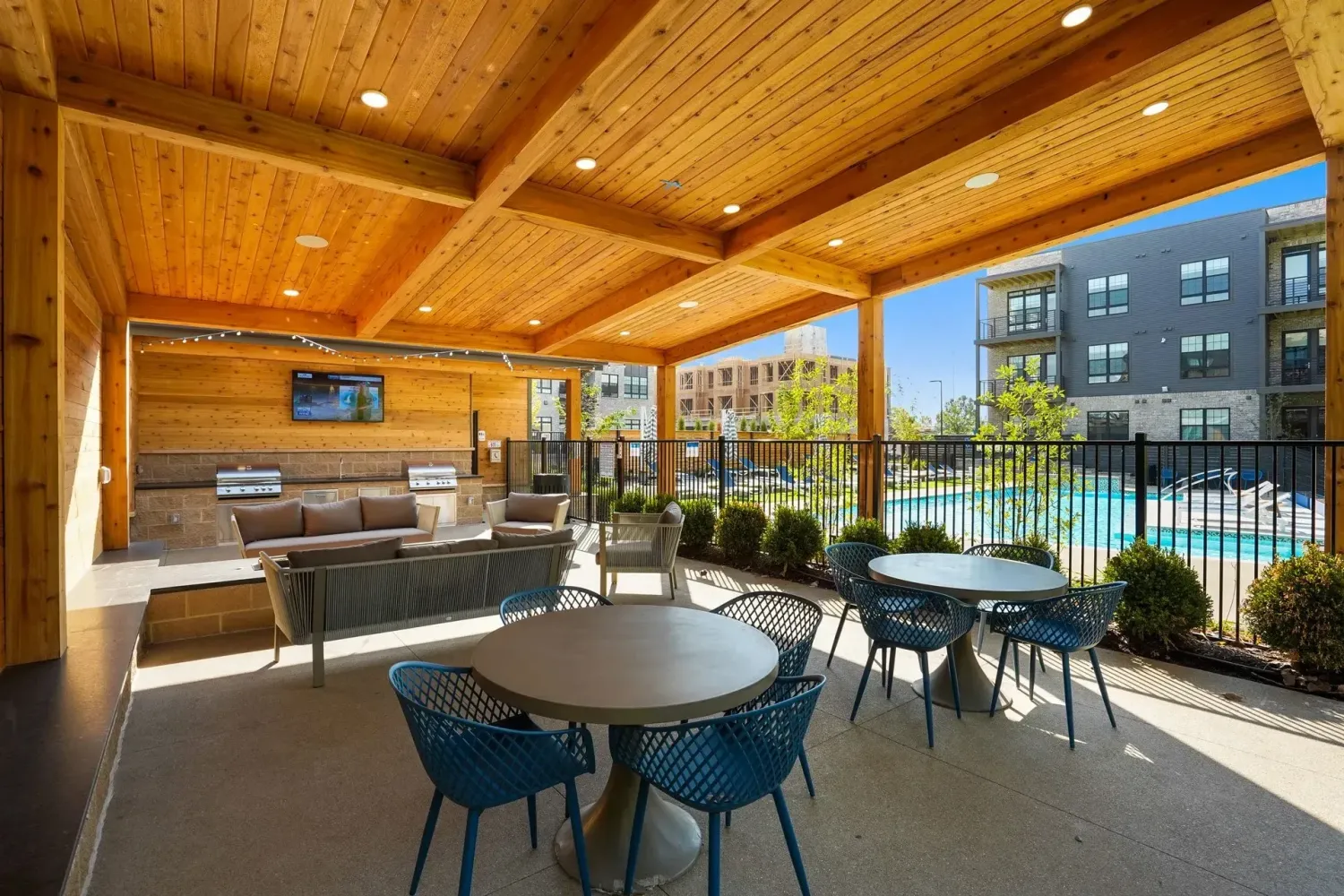
Why 30 freeze nights changes everything about the build
A freeze event, per the NWS Peachtree City office, is any 24-hour period where the air temperature drops at or below 32°F. In Atlanta proper, that happens a dozen times a winter. In Dawsonville, at 1,270 ft elevation, cold air pools off the Amicalola ridge and the Etowah river valley and gives us roughly 30 freeze nights between mid-November and early April. Ten to fifteen of those will drop below 25°F. Three or four will hit the teens.
Water freezes at 32°F. Copper splits between 28°F and 20°F depending on fill volume. Sealed-box GFCI outlets start derating below 15°F. A standard Metro-Atlanta outdoor kitchen — PEX-only supply, exposed valves, wide-open undercounter cavities — is spec’d for an environment that never tests those thresholds. Here, it gets tested every year.
What a Dawsonville kitchen needs is not “more insulation.” It needs a different order of operations. The supply lines, the valves, the appliance enclosures, and the electrical boxes all have to be designed as a system that either (a) drains dry before the freeze, or (b) stays above 32°F on its own. Most of this post is about that system.
Question 1: Should I use copper, PEX, or CPVC for outdoor-kitchen supply lines in a 30-freeze zone?
Short answer: Type L copper for everything inside the kitchen island, with a single PEX-A home-run from the interior wall feeding it, and a properly located stop-and-waste valve at the source.
Here is why. PEX tolerates ice expansion about three times better than copper — that’s the marketing story, and it’s true. But PEX fittings don’t. The brass crimp ring fittings inside the cold-weather zone are the first thing to fail. Copper, on the other hand, fails predictably and visibly — a split you can see and repair — while PEX tends to weep at a crimp ring under the cabinet where you won’t notice it until the first GFCI trip of the season.
CPVC is a non-starter outdoors. UV light and a single 15°F night are a death sentence.
The build-out I recommend in Foxcreek, Applewood, and Chestatee: run one PEX-A line underground from the basement or crawlspace, bring it up inside the kitchen island through a heated-cavity sleeve, and transition to Type L copper before any fitting sees outdoor air. Every shut-off valve is indoor-side, at a stop-and-waste fitting that drains the outdoor run to daylight. If you cannot drain the outdoor side empty with a single valve turn, the kitchen is not winterizable — period.
Spec that matters: Type L copper is 0.050″ wall thickness versus Type M at 0.032″. The extra wall is $0.80/ft more at a Cumming supply house but buys you a second freeze cycle before a split propagates. Over a 40-foot kitchen run, that’s $32 on a $4,500 line item. Take it.
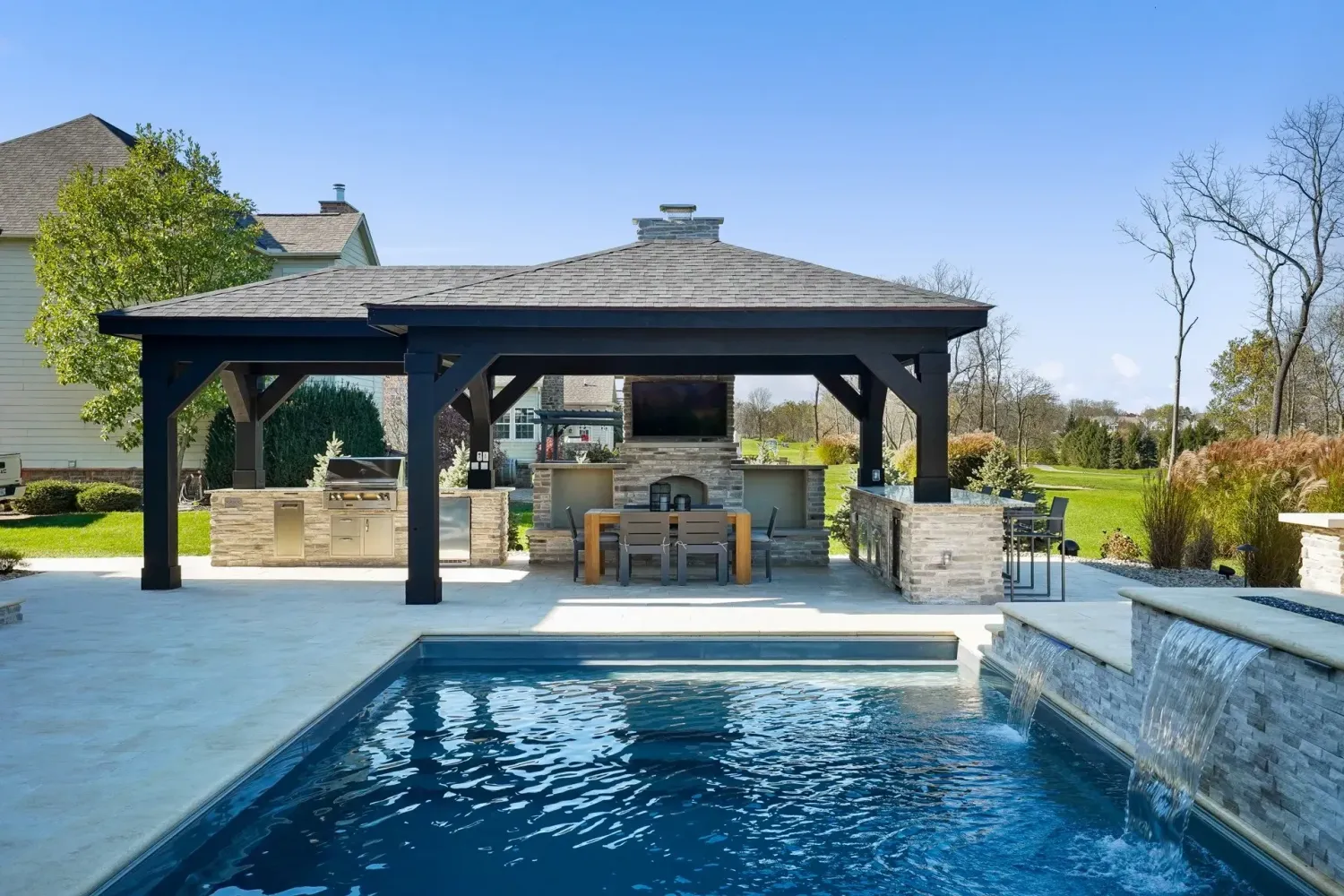
Question 2: Where should the shut-off valves go, and why does recessed matter?
The single biggest freeze-damage call we get in Dawson County is a split ball valve that was mounted on the outside of the cabinet under the sink. Looks clean. Installs in twenty minutes. Freezes in one night because there’s no thermal mass around it.
A freeze-resistant outdoor kitchen puts every valve inside a recessed, insulated, access-hatch cavity that sits on the conditioned side of the house envelope. Practically, that means the valves live in the basement or crawlspace, and you drop down through an interior wall to reach them. The outdoor kitchen itself has zero valves — just the terminations (faucet, icemaker tap, kegerator supply) that drain back when you hit the indoor shut-off.
For a detached pavilion build — the Kensington Ridge and Etowah River Club-style layouts where the kitchen is 30+ feet from the house — you use a freezeless yard hydrant at the house as the indoor shut-off, and the entire buried run is pitched a minimum of 1/4″ per foot back toward the hydrant so it gravity-drains when closed.
Question 3: What about the hose bib and icemaker — the things people forget?
Every outdoor kitchen I’ve built in Dawsonville has at least one of: a hose bib for wash-down, an icemaker line, a sink faucet, and sometimes a kegerator water supply. Each one is a potential failure point, and each one needs a dedicated strategy.
Hose bib: Use a frost-free sillcock with a 12-inch stem. Not 4-inch. Not 8-inch. Twelve. The valve seat has to sit inside the heated envelope of the adjacent wall, and our foot-thick stone pavilion wall needs a longer stem than the standard big-box stock.
Icemaker line: The smallest-diameter line is the fastest to freeze. If the icemaker is going to sit idle all winter, install a dedicated 1/4-turn shut-off indoors and a tee with a drain petcock at the lowest point. Winterize by closing the valve and opening the petcock into a cup. Ninety seconds of work in November saves a $340 icemaker line replacement in March.
Sink faucet: Disconnect the supply lines at the basement valve and blow the line out with a shop-vac or compressor set to 30 PSI. Walk the faucet handle to open position. You want zero liquid water trapped between the shut-off and the spout when the first 19°F night hits.
Kegerator: Use a stainless braided line, not vinyl. Vinyl embrittles below 30°F and splits at the fitting.
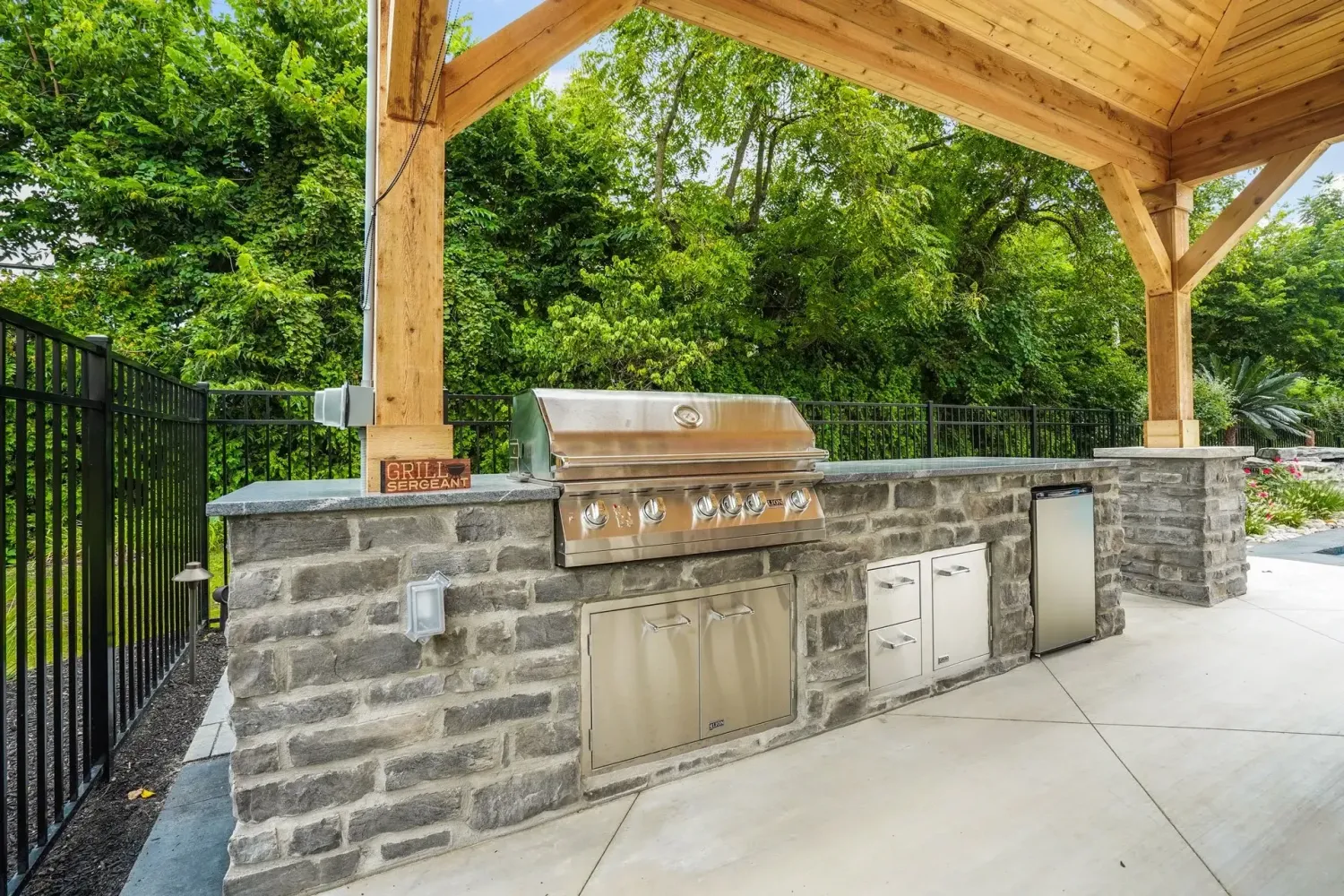
Question 4: Which appliances hold up to Dawson County winters?
This is where brand matters more than most contractors will admit. An outdoor grill is not an outdoor grill — the electronics inside a cheap built-in are spec’d to 40°F minimum operating temperature, and at 15°F they crack, warp, or stop firing on the first try.
Two brands I’ll put my name on for Dawsonville:
- Lynx appliances — all sealed-electrical components on their built-in grills are rated IP-65 or better, and their warranty doesn’t void below 20°F. The Professional 30″ and 36″ models have internal heat-tracing on the gas-control module. Pricing runs $6,200–$9,800 for the grill head alone.
- Blaze — their LTE Marine and Premium LTE lines include a written cold-weather warranty. Their stainless gauge is slightly thinner than Lynx, but the electrical package is tougher for the money. Expect $2,400–$4,200 for a comparable built-in head.
Brands I will not build into a Dawsonville kitchen without a written disclaimer to the homeowner: most big-box house-brand built-ins (Nexgrill, Kenmore, Master Forge). Their operating-temperature ranges are spec’d for warmer climates and they will deliver four to six seasons before the electronics die.
For refrigeration — the undercounter fridge or kegerator — spec a true outdoor-rated unit. Summit, Perlick, and Lynx all make units rated to 0°F ambient. A standard indoor undercounter fridge will cycle itself to death trying to heat the compressor against a 19°F night.
Question 5: What’s the right roof for 30 freeze nights and occasional snow?
Dawsonville gets snow. Not every year, but enough years that the roof decision has to account for it. The average Dawson County winter drops one or two accumulating snow events per season, usually 2–4 inches. About every four years, we get a 6–8 inch event.
Your three options, from worst to best for this climate:
- Open pergola (no roof): Wrong for this climate. You lose 4+ months of use and you give up the first line of freeze defense. Keep the pergola if you want it for shade, but don’t pretend it’s a weather envelope.
- Louvered slat roof: Better for ventilation, worse for weather. The gaps let radiative heat loss through on clear nights — which is exactly when 19°F happens here. Skip.
- Solid pavilion (gable, hip, or shed): The answer. A solid roof with cedar T&G underside delivers three benefits: sheds precipitation, traps radiative heat from the grill and ceiling fan, and creates a buffered air zone that runs 8–12°F warmer than ambient on a still winter night.
Between gable and hip, hip is the better choice for our snow load. A hip roof pushes weight down four planes instead of two, so a 6-inch wet snow event loads each plane at roughly half the psf of a comparable gable. If you’re already investing in the pavilion, pay the extra $2,800–$4,400 for hip framing over a simple gable.
Dawson County permits: Any pavilion attached to the house or with a footprint over 144 sq ft needs a permit through the Dawson County Dept. of Planning & Development at 25 Justice Way, Dawsonville. Expect 10–14 business days for review. Pavilions freestanding and under 144 sq ft are typically exempt — confirm with your permit tech before pouring footings.
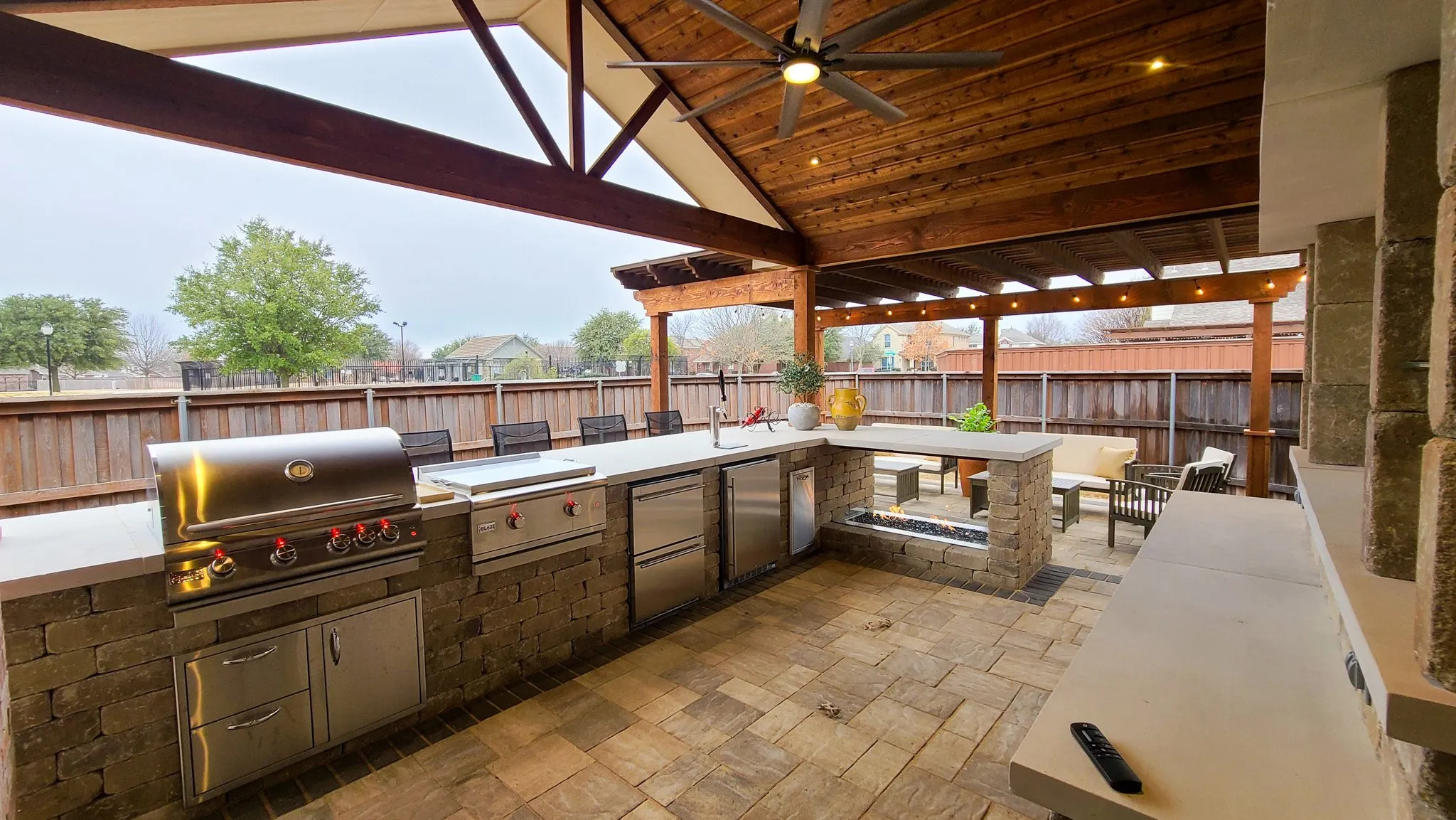
Question 6: How do I rough in the electrical so GFCIs don’t trip all winter?
Dawsonville’s electric utility is Amicalola EMC, and their service drops run 120/240V single-phase to residential pads. That’s not the problem. The problem is that NEC 2020 requires GFCI protection on all outdoor kitchen circuits, and GFCIs are thermally sensitive. Below about 15°F, some brands false-trip from condensation alone.
Three rules for cold-weather-resilient outdoor electrical:
1. Use in-use “bubble” covers on every receptacle — not the flat snap-shut style. The bubble cover seals against driven rain and snow, and it creates a dead-air gap around the receptacle face that slows down condensation.
2. Spec commercial-grade GFCI receptacles, not residential. Leviton’s SmartlockPro Extreme and Hubbell’s GFTR20 are rated to -35°F operating temperature. The big-box residential GFCI is rated to -4°F but nuisance-trips at +15°F in our experience. The commercial unit costs $38–$52 each instead of $18. Buy the upgrade.
3. Pull every cable through watertight LB fittings with a drip loop before it enters the kitchen island. Water that follows the cable jacket is the single most common cause of persistent GFCI trips by February.
Question 7: What drainage and grading does the kitchen slab need?
Dawson County subsoil is different from the Piedmont clay most Atlanta contractors are used to. We are sitting on stony residuum — a thinner topsoil layer over weathered granite and saprolite. Drainage is generally better than Dacula clay, which is good news. The bad news is that our ground freezes faster and thaws irregularly, which means the slab under the kitchen sees more freeze-thaw movement than a comparable Dacula build.
The prescription: a 6″ reinforced concrete slab on 4″ of compacted #57 stone, sloped 1/8″ per foot away from the house, with saw-cut control joints on a 10-ft grid. This is heavier than the typical metro Atlanta kitchen slab (which is usually 4″ on 2–3″ of base), but it’s the minimum that won’t show hairline cracking by year three up here.
If the excavation hits rock — and in Foxcreek, Mountain Laurel, and near the Etowah it will, often between 2 and 6 feet down — expect a $8–$14 per cubic yard premium for blast charges or hoe-ram breaking. A 40 ft × 15 ft kitchen pad with 18″ of rock to clear out is roughly 33 cubic yards, so that’s a $260–$460 rock-removal line item that simply does not exist on a Snellville build. Don’t let a general contractor surprise you with it — ask for rock-removal contingency pricing upfront.
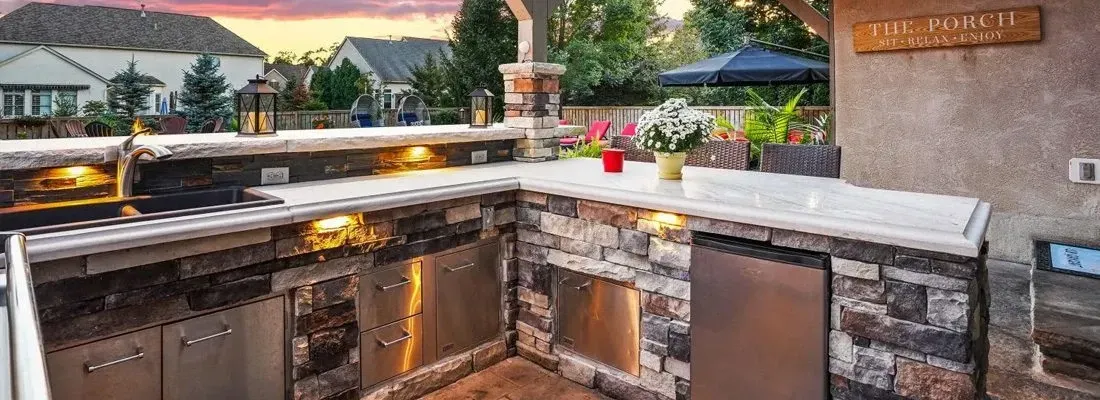
Question 8: What does the full cold-weather hardening premium actually cost?
Here is the honest line-item breakdown for a roughly 180 sq ft covered outdoor kitchen with grill, undercounter fridge, sink with faucet, and one icemaker tap. This is the delta over a standard Metro Atlanta spec, not the total kitchen cost.
- Type L copper upgrade over PEX through the kitchen island: $340–$580
- Frost-free sillcock + 12-inch stem + stop-and-waste valve: $180–$290
- Commercial-grade GFCI receptacles (qty 4–6): $120–$240
- Bubble in-use covers on every receptacle: $60–$110
- Insulated, recessed valve-cavity millwork: $420–$780
- Hip-roof framing upgrade over simple gable: $2,800–$4,400 (if you already planned a pavilion) OR $0 if an open pergola was the original scope and you’re now choosing solid from the start
- 6″ slab on #57 base over 4″ slab on subgrade: $420–$680
- Outdoor-rated refrigeration upgrade over residential undercounter: $380–$720
- Lynx or Blaze grill head upgrade over mid-tier built-in: $1,200–$3,800 (wide range — depends on what you were comparing against)
Roll it up and you’re at the $3,400–$5,800 hardening premium on top of whatever the standard metro Atlanta build was quoted at. A typical full outdoor kitchen in Dawsonville, including pavilion, comes in between $32,000 and $68,000 depending on footprint, appliance tier, and stonework.
The payback is simple math: avoided freeze-damage repairs on a non-hardened build average $600–$1,200 annually — split copper, faucet replacement, tripped breaker service calls, rebuilt icemaker line, occasional fridge failure. At the low end, the hardening package pays back in under five years. At the high end, under three.
A note on the Big Green Egg question
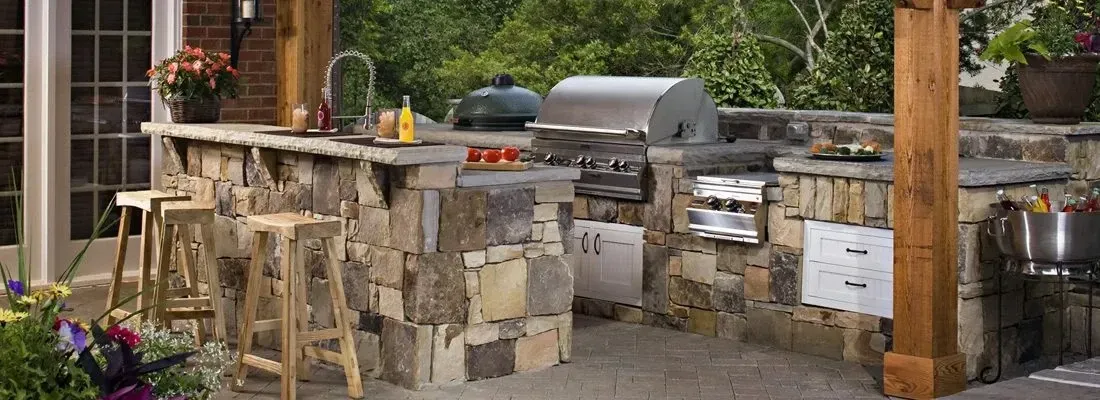
If you’re building in Dawsonville and you grill year-round, build a dedicated bay for a Big Green Egg or Kamado Joe. Ceramic kamados are the single most cold-tolerant cookers on the market — the thick ceramic shell handles freeze-thaw without complaint, and they cook confidently in 15°F weather when a standard gas grill is still trying to warm up its igniter.
Spec a 28″ or 30″ round cutout, a stainless-lined bay with vented base, and clearances of at least 4″ side and 6″ rear. Cost: $1,100–$1,800 for the Egg itself plus $600–$1,100 for the built-in cutout work.
The build order that actually works in Dawson County
If you’re starting a kitchen project in the next 12 months, here is the sequence I recommend:
- Soil + rock survey first. Spend $450–$700 on a test dig with your contractor before finalizing the slab spec. A two-hour site visit with a mini-ex tells you whether you’re hitting saprolite at 3 feet or 6 feet, and that single data point reshapes the budget.
- Permit through Dawson County Dept. of Planning & Development at 25 Justice Way. Submit pavilion drawings with footing detail, grill cutout spec, and electrical one-line. Allow 10–14 business days.
- Frame the pavilion before any appliance shows up on site. You want the roof up and dry before the cabinet carpentry lands — protects the millwork from an unexpected November rain.
- Rough plumbing and electrical with the stop-and-waste valve installed and tested, then drywall or stone-cladding the island around it. If you can’t open the indoor valve and hear the outdoor lines gravity-drain, stop and fix it before any finish goes on.
- Appliance drop-in last. Lynx, Blaze, and the refrigeration unit should be the final install — after every trade with a saw and a hammer is off the property.
Total timeline from permit to first cookout: 8–12 weeks for a build of this scope. If you start in March, you’ll be grilling by Memorial Day. If you start in October, you’ll be winterizing the new kitchen before you’ve ever used it — which is fine, but budget emotionally for that.
Where Dawsonville differs from Cumming, Dahlonega, and Gainesville
A reasonable question: we’re close enough to Cumming and Gainesville that the same contractors work all three markets. Why does Dawsonville get a separate spec?
Cumming sits at roughly 1,100 ft and sees about 22–24 freeze nights. Gainesville, at 1,250 ft but shielded by Lake Lanier’s thermal mass, sees 18–22. Dawsonville’s mountain-foothill exposure pushes us up to 28–32 freeze events depending on the year, and our 3 a.m. low temps typically run 4–7°F colder than Cumming for the same weather system. That’s the gap that changes the spec. A kitchen built for Cumming will mostly survive Dawsonville — but it will need more repairs, more often, and it will never feel comfortable below 25°F.
If you live in Big Canoe or north toward Amicalola Falls, push all the specs in this article harder. Those elevations run another 500–700 ft higher than Dawsonville proper and see 35–40 freeze nights in a hard year.
Freeze-resistant outdoor kitchens across 20+ cities within 30 miles of Winder, GA
If your property sits at elevation along the GA-400 corridor — or anywhere else in Dawson, Forsyth, or north Hall County — we build the kitchen to the climate you actually have, not the one the brochure was written for.