
It’s 42 degrees and raining sideways off the Etowah ridge. Your neighbor in Foxcreek is eating takeout on a wet grill cover. You’re searing ribeyes under a cedar pavilion with a radiant heater humming overhead, a bourbon on the counter, and the TV calling the Dawgs. That’s the break-even you’re buying — and in Dawsonville’s climate, the math works faster than most builders tell you.
A Dawsonville homeowner off Hwy 53 walked us through his numbers last fall. He’d put in an open cedar-pergola kitchen in 2022 — gorgeous on a July evening, useless from mid-October through April. He tracked his usage with a habit app for 18 months. He cooked on it 46 times a year. Not bad for a summer amenity. Terrible for a $38,000 investment.
So in 2024 he added a solid-roof pavilion with three enclosed sides, a louvered vent gable, and a pair of infrared radiant drops rated for 1,500 square feet of coverage. Cost to retrofit: $31,000. His 2025 cook count landed at 162 — a 3.5x increase. Roughly 280 usable days versus the 180 he had before. That’s the shift this post is about: not should you build an outdoor kitchen in Dawson County, but what does the roof over it actually cost you in days, and when does the math flip.
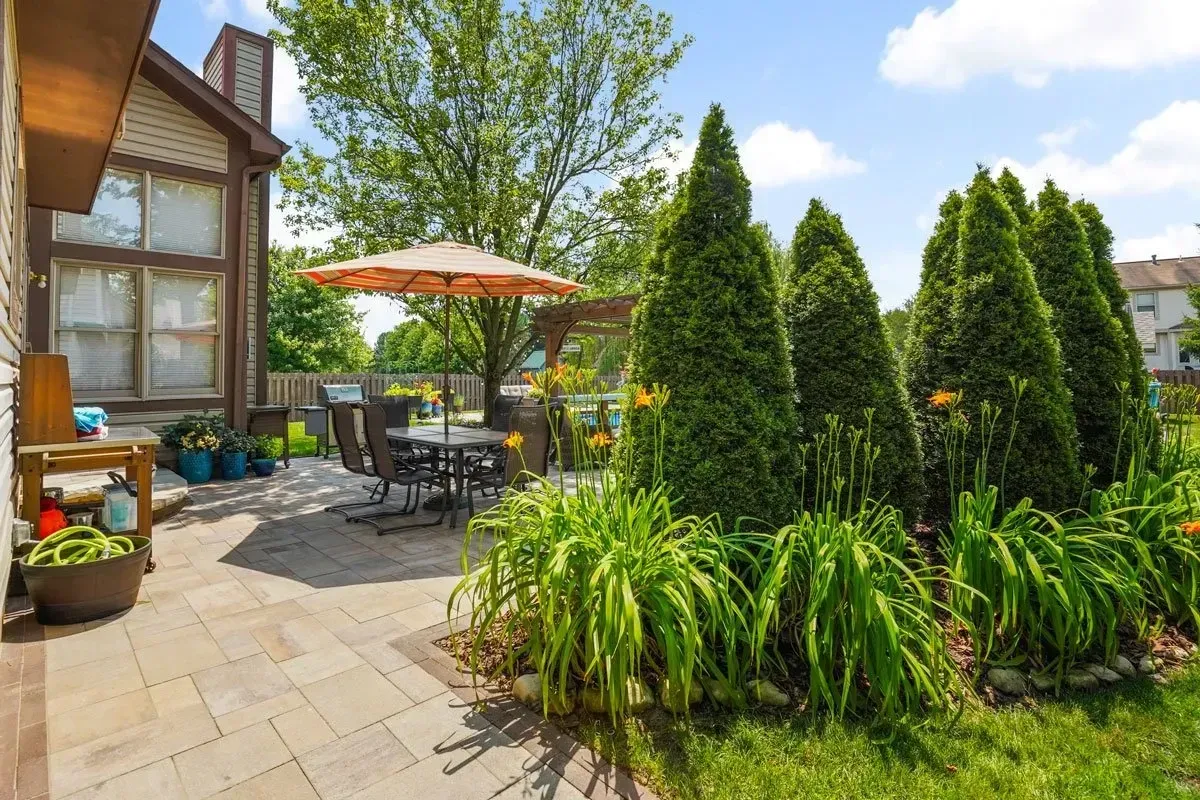
The Climate Math Nobody in Atlanta Metro Writes About
Dawsonville sits at roughly 1,270 feet of elevation — the highest point in Primetime’s service footprint, and a material jump over Snellville (1,020 ft) or Dacula (980 ft). That altitude is a small number on paper and a big number on a thermometer. Dawson County records about 30 freeze events per year versus ~20 in Gwinnett. Summer highs cap about 3 degrees lower. Spring comes two weeks later. Fall cools two weeks earlier.
Translate that into cooking days. An open pergola — the arbor-only model with no side enclosure — gives you a comfortable grill environment when ambient air is between 58 and 87 degrees, winds are under 12 mph, and there’s no active precipitation. In Dawsonville’s weather tape, that envelope runs roughly mid-April through mid-October. Call it 180 days. After that, the wind off the foothills cuts right through a slatted cedar top and the cook becomes a chore.
A solid-roof pavilion with three partial walls, a ceiling fan, and 4,000-watt infrared radiant heaters changes the envelope. You can cook comfortably from 35 degrees up to 95 degrees, in light rain, in sustained winds up to 20 mph. That envelope covers roughly 280 days in Dawson County — including December grill nights when your house smells like lemon candles because your wife banned indoor searing in 2019.
The 100-day gap: Pavilion buys you approximately 100 additional usable cooking days per year versus an open pergola in Dawsonville’s 7b/8a climate. At a modest 3 cooks per week during those marginal months, that’s ~45 extra meals.
Pergola vs. Pavilion — A Dollar-for-Dollar Comparison
Here’s where most contractor blogs get soft. They’ll tell you a pavilion is “a great upgrade” without putting concrete numbers against it. We’ll be direct. For a 16×20 footprint — the most common size for a serious Dawsonville outdoor kitchen with room for a U-shape counter and a four-top table — here’s what you’re actually choosing between in our 2026 pricing:
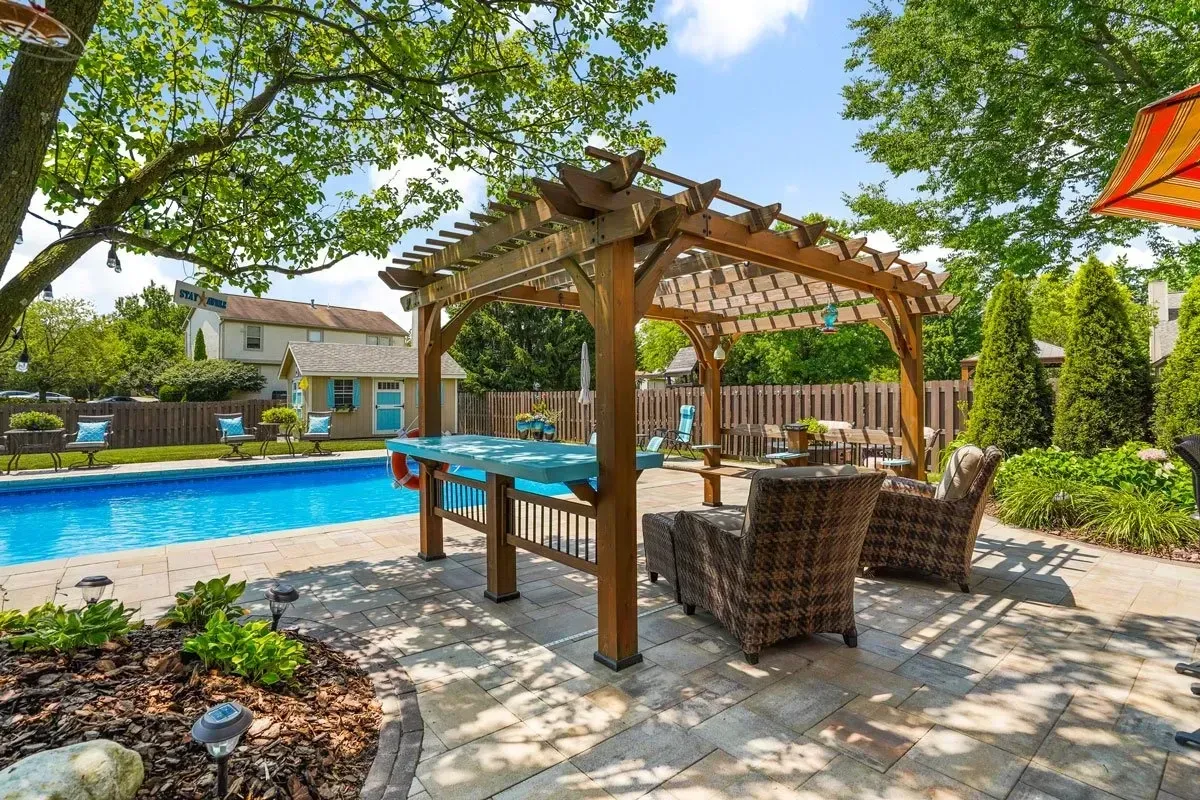
Option A: Open Cedar Pergola ($28,000)
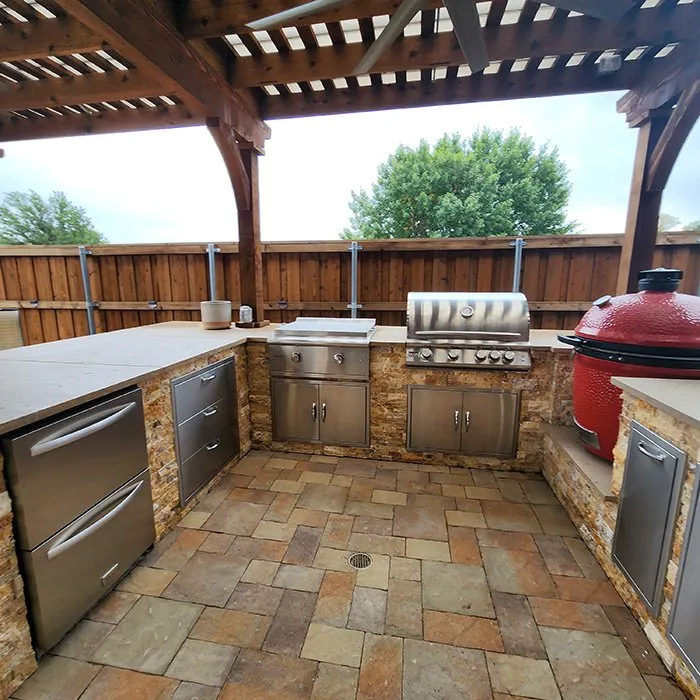
Rough-sawn #2 Western cedar, 6×6 posts on stacked-stone pier bases, 2×10 beams, 2×6 slat top at 45% open density. Semi-transparent oil stain, every-3-years maintenance. Classic look — the kind you see in Riverbend and Mountain Laurel subdivisions. Rain protection: effectively zero. Wind protection: zero. Lifespan with proper stain cycle: 20–25 years. This is photo #2 in this post.
Option B: Western Red Cedar Pavilion with Solid Shingled Roof ($34,000)
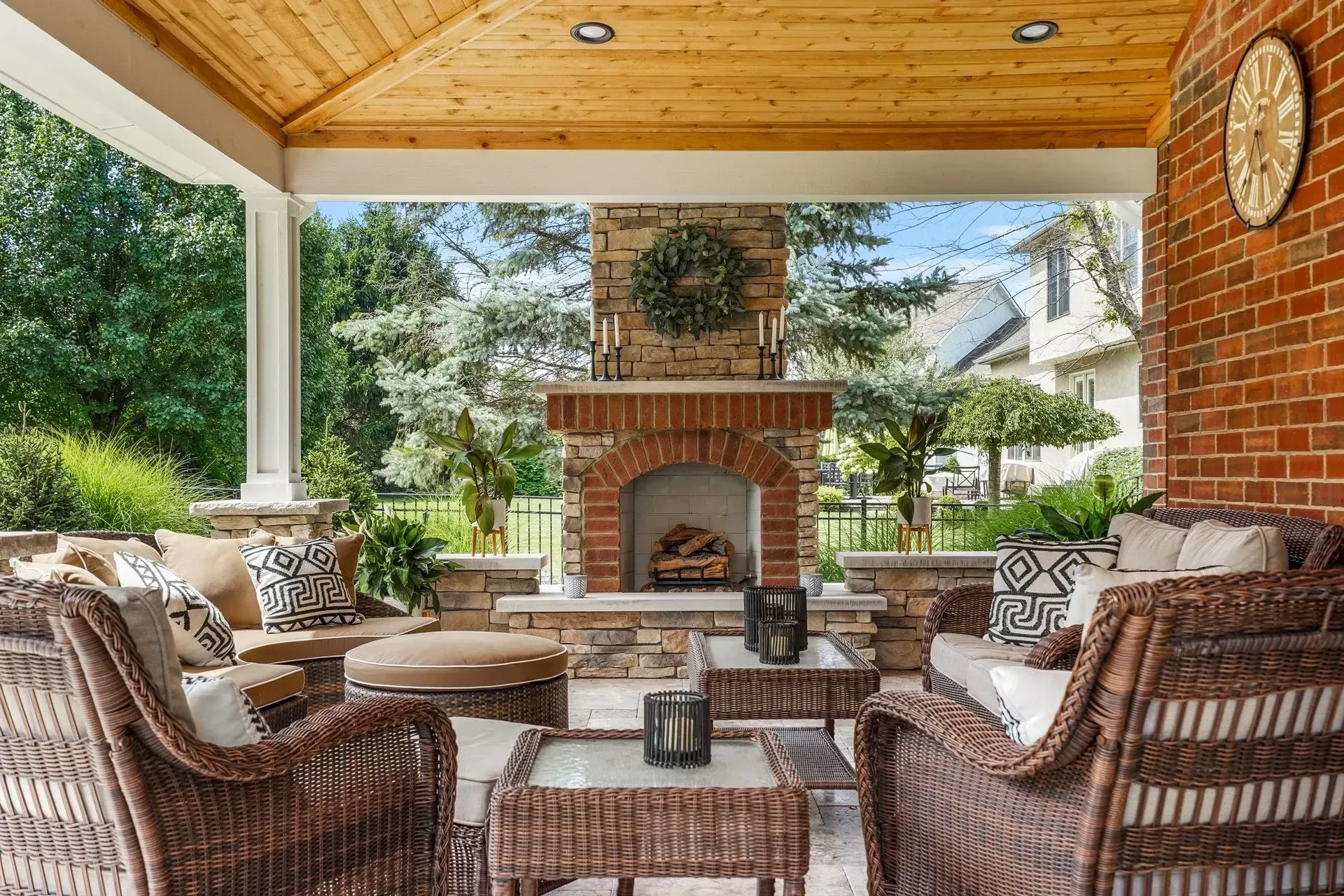
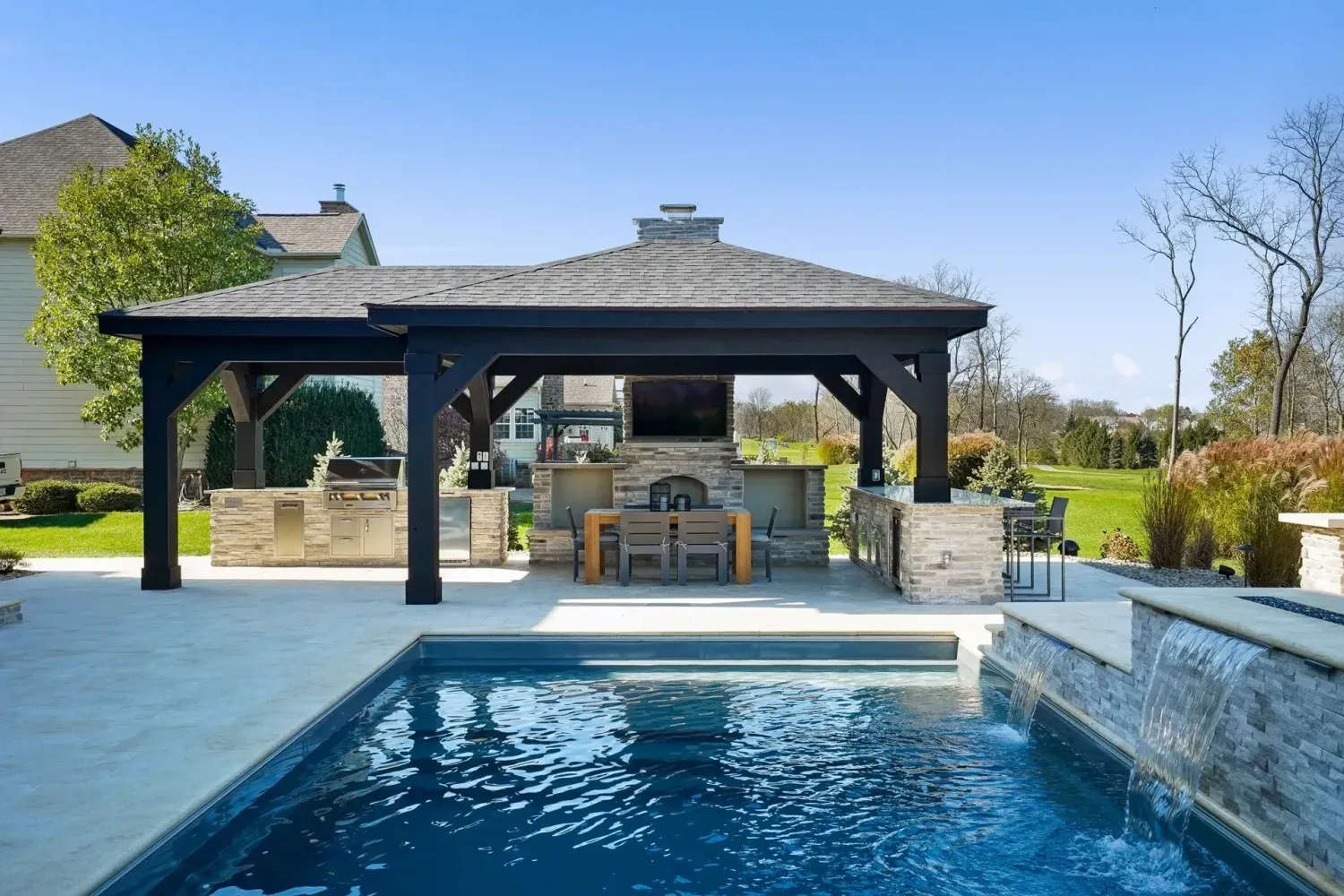
Upgraded heavy-timber WRC, hip-roof or gable design, 30-year architectural asphalt shingles over ice-and-water shield, T&G cedar underside ceiling with recessed cans. Open sides or partial knee-walls. Full rain protection. Partial wind protection. Lifespan: 25–30 years on the structure, shingles replaced once mid-life. The hip-roof pavilion we’ll show you later in this post is built this way.
Option C: Aluminum Louvered Pavilion ($44,000)
Powder-coated aluminum frame, motorized louvers that close fully in rain and open to a pergola in sun, integrated gutters, LED perimeter, wind rating to 90 mph, 40-year structural warranty. Zero maintenance. Premium look — more modern than traditional. Lifespan: 40+ years, nothing to stain or replace. This is the option a lot of Dawson County buyers in newer builds (2015+, Etowah River Club, Kensington Ridge) are gravitating toward.
Now run the annualized cost. Amortize the upfront over a 20-year useful life and add maintenance:
- Open cedar pergola: $28,000 / 20 = $1,400/yr + ~$300/yr stain cycle = $1,700 per usable year for 180 days = $9.44 per usable day.
- WRC pavilion with shingles: $34,000 / 25 = $1,360/yr + ~$150/yr stain/spot repair = $1,510/yr for 280 days = $5.39 per usable day.
- Aluminum louvered: $44,000 / 40 = $1,100/yr + $0 maintenance = $1,100/yr for 290 days = $3.79 per usable day.
The most expensive option upfront is the cheapest option per usable day. That’s the inversion people miss when they default to “cheapest pergola that looks nice.” A Dawson County winter flips the math against the pergola hard.
The Break-Even Formula for a Dawsonville Kitchen
If you want the cleanest way to think about whether a pavilion earns itself back, here’s the formula we run with clients in our design studio:
Break-even years = (Pavilion upcharge) ÷ (Extra usable days × value per use)
Plug in real Dawsonville numbers. The pavilion upcharge over an open pergola runs $6,000–$22,000 (depending on material tier). Extra usable days: ~100. Value per use — and this is where clients push back, but hear us out — is what you’d spend on a restaurant meal for your family instead. In Dawsonville, a decent sit-down dinner for four at a GA-400 corridor restaurant runs $95 including tip. If you cook at home instead, you save $60 on groceries-to-restaurant delta.
At 3 extra cooks per week across the pavilion’s 100-day shoulder season, you’re netting $60 × 42 cooks = $2,520 per year in restaurant avoidance. A $6,000 WRC upcharge pays back in 2.4 years. A $22,000 louvered-aluminum upcharge pays back in 3.5 years.
This is why we tell people: if you’ll use the kitchen three or more times per week once it’s covered, stop debating. The numbers are already in. If you know you’re a two-cooks-a-month griller, build the open cedar and save the money for a spa.
The Specs That Make a Pavilion Actually Work
A pavilion that looks like a pavilion but doesn’t function as one is a common regret. We see homeowners whose contractors went 8-foot on ceiling height, skipped radiant drops, and used standard outdoor outlets rated for moisture but not for a high-output rotisserie. Here are the specs that separate a working four-season pavilion from an expensive canopy.
Ceiling height: 10 feet minimum
An 8-foot ceiling over a grill is a smoke trap. You want 10-foot minimum at the low side of a hip or shed roof, 12-foot at the peak of a gable. That gives smoke a ceiling volume to rise into before it rolls forward into the dining zone. Under a Kamado Joe or Big Green Egg on a long low-and-slow cook, this is the difference between guests laughing and guests squinting.
Electrical: IP65 outlets on a dedicated 30-amp subpanel
Standard outdoor-rated outlets are IP44 — fine for a string light, thin for a built-in kitchen. Spec IP65 outlets on every island face. Pull a dedicated 30-amp subpanel to the pavilion, fed from the main via Amicalola EMC-compliant direct-bury conductor in conduit, min 18 inches deep per Dawson County code. Don’t skip this. A fridge + griddle + music system pulls more than one pulled from the garage circuit.
Radiant heater drops: two 4,000-watt units on a 16×20
Infrared radiant (Bromic, Infratech) beats ceiling-fan heat every time. Mount two units at the perimeter aimed inward at a 30-degree angle. Install on a dedicated thermostat with a manual override. Cost installed: roughly $1,600 per unit, including wiring. This is the single component that converts the pavilion from three-season to four-season.
Louvered vent gable or ridge vent
Shingled roofs trap summer heat. A louvered gable end or full ridge vent drops interior temperature by 8–12 degrees on a July afternoon. The Kamado Joe pavilion we’ll show you next has a fixed-louvered slat roof specifically for this reason — venting is designed in, not added later.
What Dawson County Dirt Does to Your Budget
Here’s the local wrinkle Atlanta-metro contractors underestimate on their first Dawsonville project. The soil north of GA-400 is not Piedmont clay. It’s stony residuum — weathered granite and saprolite left over from millions of years of mountain erosion. Cecil series is present but the topsoil is thinner. At typical pavilion footer depth (30 inches) you’re often in partially-weathered rock, not soil.
For a pavilion, that’s mostly a good thing. Footers on saprolite bear better than footers on wet clay, and you won’t get the seasonal heave you fight in Loganville. But if you’re pairing the pavilion with a pool dig — which 60% of Primetime’s Dawson County projects include — rock becomes a budget line. Blast charges run $8 to $14 per cubic yard above standard excavation in pricing scenarios where hydraulic ram and rock drilling are required. On an average 35,000-gallon pool that’s $5,000–$14,000 in blast work your Lilburn neighbor never had to pay.
Knowing this going in lets you stage smart. Place the pavilion footings on the outer edge of the project so drill rigs can access straight off the driveway. If you’re off Hwy 53 or Hwy 9 with deep setbacks, we bring our equipment trucks in via GA-400 → Hwy 53 east rather than trying a Hwy 136 route, which adds 40 minutes and doesn’t improve anything.
Dawson County permitting note: Pavilion projects over 200 sq ft require a building permit from the Dawson County Dept. of Planning & Development at 25 Justice Way, Dawsonville. Electrical permit is separate. Plan 3–5 weeks for plan review on custom designs. Pre-engineered aluminum louvered pavilions often clear faster because the manufacturer’s stamped drawings ride along.
Where the pavilion sits — layout against a Dawsonville lot
Dawson County lots we work on run half-acre to two acres with real grade change. That’s different from the flat quarter-acre Gwinnett pad most outdoor kitchen articles assume. The pavilion placement question is actually a site question first, not a building question.
Three rules we use for Dawsonville siting, refined over a dozen projects in the Foxcreek / Applewood / Kensington Ridge corridor:
- Place it at the grade break, not above it. If your lot falls 8 feet from the back door to the property line, don’t stick the pavilion at the top of the grade. Site it at the transition where you’d naturally put a retaining wall anyway. The wall becomes the back wall of the kitchen. You save $8,000 in retaining and you block the prevailing winter wind off the ridge.
- Orient the open side east or southeast. West-facing opens eat late-afternoon summer sun. In Dawsonville’s thinner tree canopy (hardwoods recover slower at elevation), that means 4pm to 7pm becomes an oven zone for three months a year. Flip it 90 degrees and you gain cool morning light and shaded evening cooking.
- Pull the pavilion off the house by 8–12 feet. An attached pavilion looks unified but traps indoor HVAC exhaust, blocks second-story windows, and telegraphs kitchen smoke into the master bedroom. A detached pavilion connected by a covered breezeway gets you better aesthetics and better function.
A Real Dawsonville Build — Start to Finished Cook
To make this tangible, here’s a composite build drawn from three recent Primetime projects in Dawson County. We’ll call the client the Hargraves. House: 2018 build in Etowah River Club subdivision, 1.3-acre lot, modern farmhouse architecture, two-kid household, husband serious about smoked brisket. Budget target: under $65,000 all-in for pavilion + kitchen.
Site prep (week 1–2)
Grade survey, footings marked, Dawson County permit filed. Rock probed at 36 inches at the rear footer — an extra $3,400 in rock break work absorbed into the contingency line. Amicalola EMC service upgrade request filed for the new 30-amp drop.
Structure (week 3–5)
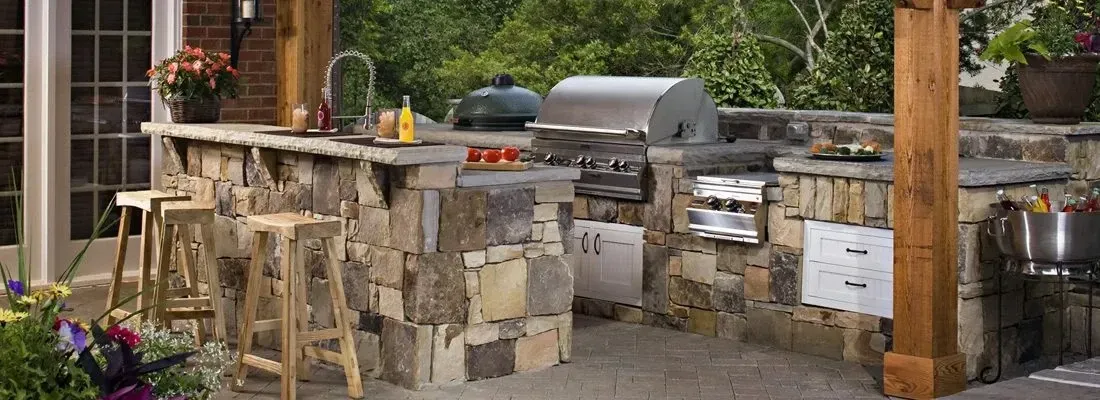
Heavy-timber WRC pavilion, 16×20, hip roof, 10-ft ceiling, T&G cedar underside. Stacked-stone pier column bases wrapping the 8×8 cedar posts — material cue pulled from photo #5 in this post. Architectural asphalt shingles (charcoal). Louvered gable-end vents on the short sides. Structural total: $33,800.
Kitchen island (week 6–7)
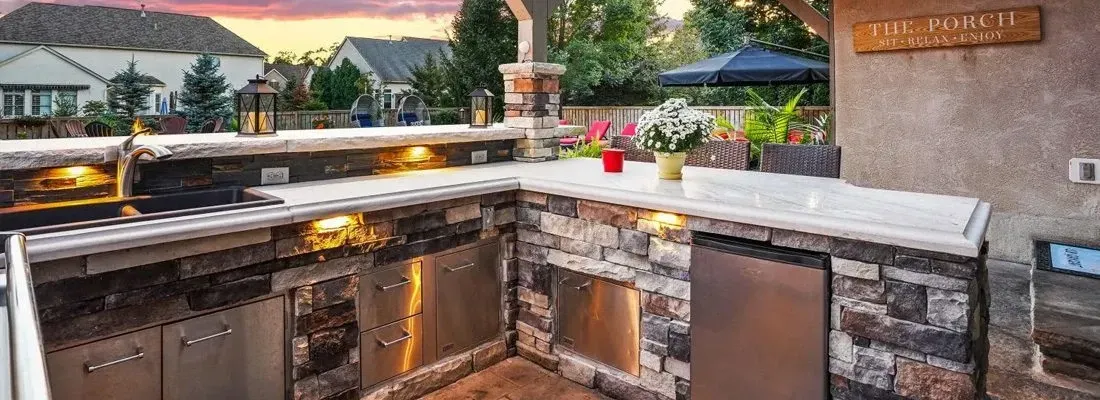
U-shape, 14 linear feet of counter, dry-stack fieldstone veneer base, flamed-limestone countertop. Built-in 36-inch stainless grill, Kamado Joe red-ceramic bay cutout, flat-top plancha griddle, double stainless fridge drawers, under-counter LED strip, IP65 outlets at three positions. Kitchen total: $21,200.
Mechanical (week 7)
Two Bromic 4,000W radiant heaters, ceiling fan on variable speed, Sonos architectural speakers (two in-ceiling), 55-inch weatherproof Séura TV on motorized pull-out arm. Mechanical total: $7,800.
Hand-off (week 8)
Final inspection, gas test, electrical sign-off. First cook: Saturday afternoon, late September. Hargraves counted 11 friends on the covered deck by 6pm. By Thanksgiving, they’d cooked on it 24 times. Their projected 2026 cook count is tracking to 140+ — well past the break-even threshold.
When the math doesn’t favor a pavilion: If your lot has zero westerly exposure, you already have a covered porch with 9+ foot clearance, and you cook outdoors fewer than 6 times a month — build the open cedar. An enclosed pavilion is wasted investment on a light user, and we’d rather tell you that than sell you one.
The case for the pavilion isn’t aesthetic — it’s arithmetic. Dawsonville’s 30 freeze events, 1,270-foot elevation, and mountain-pattern rainfall carve a wider comfort gap than metro-Atlanta averages suggest. Close that gap with a solid roof, three enclosed sides, and two radiant drops, and you turn a six-month amenity into a nine-to-ten-month room that pays for its upgrade in restaurant avoidance inside 3.5 years. Build it right, site it at the grade break, orient it east, and it’s the single highest-use outdoor structure on your property for the next 25 years.
If you want a design-studio walkthrough with actual numbers against your lot — grade, soil expectations, Amicalola EMC drop availability, permit timing — reach out through Primetime’s custom pool construction page below. Every Dawson County project we take on starts with a site visit, a grade survey, and an honest conversation about whether a pavilion earns its place on your property. If it doesn’t, we’ll tell you.
Outdoor kitchens and four-season pavilions across 20+ cities within 30 miles of Winder, GA
From Dawsonville’s stony residuum to Dacula’s red clay, Primetime designs pavilions against your actual lot — grade, soil, exposure, and how you’ll really use it through December.