
Four things decide whether a fire pit belongs under your oaks: the canopy’s lowest limb, the species of tree directly overhead, the fuel you burn, and the wind coming off Kennesaw Mountain. Get those four right and the feature lasts thirty years. Get any one wrong and you’re either rebuilding or calling an arborist.
Marietta has the most layered tree canopy of any suburb in Metro Atlanta, and East Cobb is the thickest section of that layer. Drive through Indian Hills, Walton Woods, or the older streets around Sope Creek and you’ll see white oaks, willow oaks, and tulip poplars that were mature before the houses were built. That shade is why people move here. It’s also the single biggest constraint on fire feature placement.
This post walks through the four decisions, in order, using a real Indian Hills lot that had four possible fire pit locations and only one that actually worked. By the end you’ll know how to rank sites on your own property before you ever call a contractor out, and you’ll understand why the placement choice matters more than the fire pit itself.
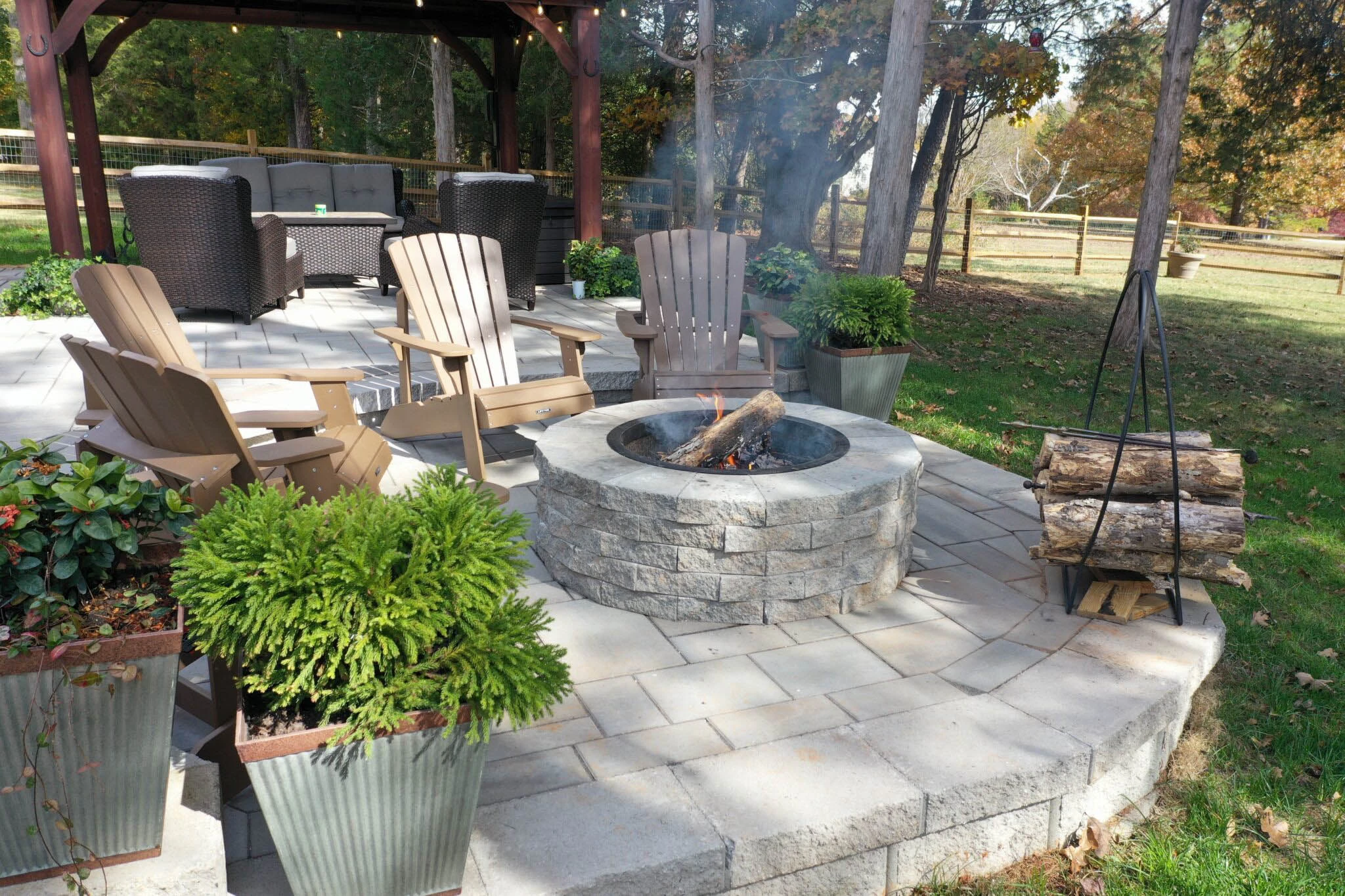
The Four Decisions: Limb, Species, Fuel, Wind
1. Measure the Lowest Limb Before You Pick a Spot
Every fire pit conversation in Cobb County should start with a tape measure pointed straight up. Not a landscape plan. Not a Pinterest board. A measurement. The international residential code, as adopted in Cobb, treats any open flame under a canopy as a chimney that has no cap, and it cares specifically about vertical clearance to the nearest combustible material.
The numbers you need: 15 feet minimum vertical clearance for a wood-burning pit, 8 feet minimum for a natural-gas or propane pit, measured from the top of the burner to the lowest overhanging branch. These figures come out of NFPA 1143 (wildland fire) and NFPA 1 Chapter 10 (open-flame devices) and they are what the Cobb Fire Marshal will cite if someone complains or a claim is filed.
On a typical East Cobb lot the lowest working limb on a mature white oak sits somewhere between 22 and 38 feet. That sounds like plenty until you remember two things: the branch sags three to five feet in summer under leaf weight, and the flame column on a well-fed wood pit is four to six feet tall on its own. Your 22-foot limb minus four feet of sag is 18 feet of real clearance, which works for wood. A 22-foot limb over a gas pit is comfortable. A 16-foot limb over a wood pit is not.
The measurement that ends most conversations: Stand under the proposed pit location on a July afternoon. If you can see daylight between the leaves in any direction overhead, that’s your escape path for sparks. If it’s a solid green ceiling, pick another spot.
2. Species Matters More Than Height
Not every tree over a fire pit is the same tree. Cobb’s dominant canopy species in the older neighborhoods — white oak, willow oak, post oak, southern red oak, and tulip poplar — behave very differently around heat and embers, and the species directly overhead changes your placement math.
White oak is the best neighbor. The leaves are thick, slow to dry, and the bark is corky enough to resist radiant heat at distance. Willow oak is similar but drops a lighter, papery leaf that can carry further in a thermal plume. Southern red oak is fine but the acorn crop is heavy and the crown tends to be lower and broader. Tulip poplar is the one to worry about — the leaves are large, they cure fast in the fall, and the bark is shallowly ridged and catches embers. Pines (white pine, loblolly) are a different category entirely and no fire feature should sit under one, regardless of clearance.
The practical rule we use: add three feet of vertical clearance if the dominant tree overhead is tulip poplar rather than oak, and move the pit 15 feet away from the nearest pine regardless of the pine’s height. On the Indian Hills site we’ll walk through below, two of the four candidate locations were eliminated on species alone — both had tulip poplars dropping 12-inch leaves directly into the canopy footprint.
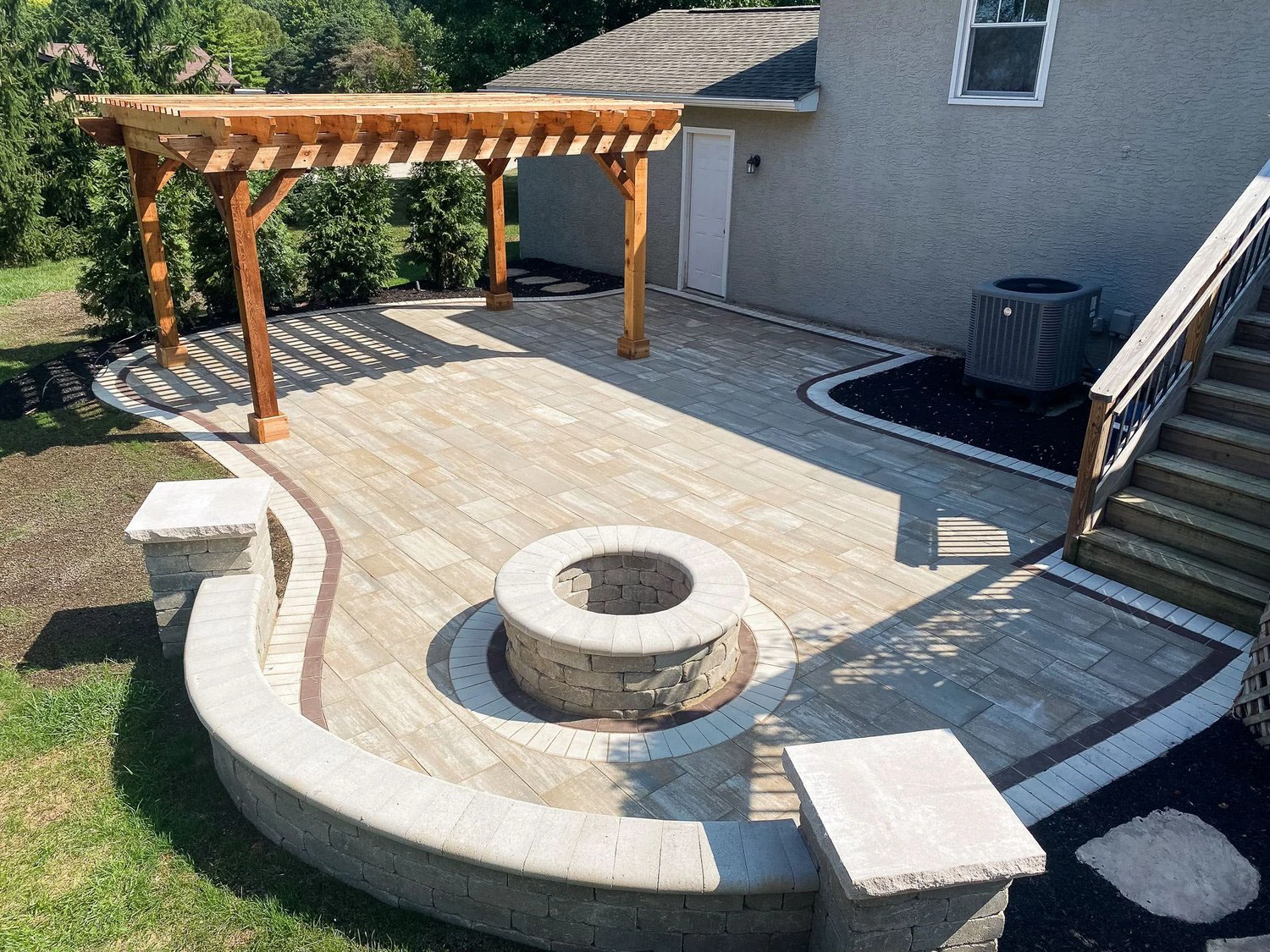
3. Gas Changes Everything (And It’s Why We Usually Recommend It)
Under an East Cobb canopy the honest conversation is almost always about gas, not wood. The clearance math gets easier, the ember risk drops to near zero, and the Cobb specimen tree ordinance stops being a problem.
That ordinance — Article V of the Cobb County Code — protects any tree 30″ DBH (diameter at breast height) or larger, plus any listed specimen species. On most East Cobb lots, the oaks overhead qualify. The ordinance means you cannot limb up or remove protected canopy to make a wood-burning pit work. You have to place around the trees, not under them. A gas pit with its 8-foot clearance requirement gives you far more sitable spots than a wood pit’s 15-foot requirement, without cutting a single branch.
The other piece is the utility infrastructure. Most of Marietta’s older neighborhoods are served by Atlanta Gas Light on the gas side, and the incorporated city residents get electricity through Marietta Power while unincorporated Cobb runs on Cobb EMC or Georgia Power. If you already have natural gas at the house, a stub-out to a backyard pit is typically a $1,400 to $2,800 plumber run depending on distance and whether you need to trench under a pool deck. Propane is the fallback — a buried 250-gallon tank runs about $1,800 installed plus fill.
The numbers that usually surprise homeowners: A quality gas fire pit with a CSA-listed burner, lava media, and a stone surround runs $4,800 to $9,200 installed in Marietta. A comparable wood-burning pit (masonry ring, proper non-combustible apron, spark screen) runs $3,200 to $6,500. The gas version is more expensive to build and cheaper to live with — no ash disposal, no stored cordwood, no ember worry in a dry October.
4. Wind, Slope, and the Kennesaw Mountain Effect
The fourth variable is the one nobody accounts for until they’ve lived with a pit for a season: airflow. Kennesaw Mountain rises to 1,808 feet on Marietta’s north boundary, and lots on the mountainside or in its lee see markedly different wind behavior than lots down in the Chattahoochee River corridor on the east side of town.
In Burnt Hickory, Seven Oaks, and the ridge-top sections of Indian Hills, the prevailing summer wind comes around the mountain from the northwest and accelerates through the gaps between ridges. Winter wind reverses and draws down off the mountain at night. Either pattern will push flame and smoke predictably in one direction, and that direction needs to be toward open sky, not toward the house or toward the thickest canopy.
Slope matters for the same reason. Most Marietta backyards have a 3 to 6 foot grade change across the rear lot line — Piedmont topography doesn’t give you flat. A fire pit placed at the low point of the yard sits in a cold-air sink, which is comfortable on a 40-degree night but also concentrates smoke. A pit placed on the ridge or shoulder gets wind dispersion but may expose seating to the worst of the gust. The sweet spot is usually a bench cut on a moderate slope, 8 to 14 feet of elevation below the highest point of the yard, oriented so the main wind direction carries smoke away from the house and away from the nearest canopy edge.
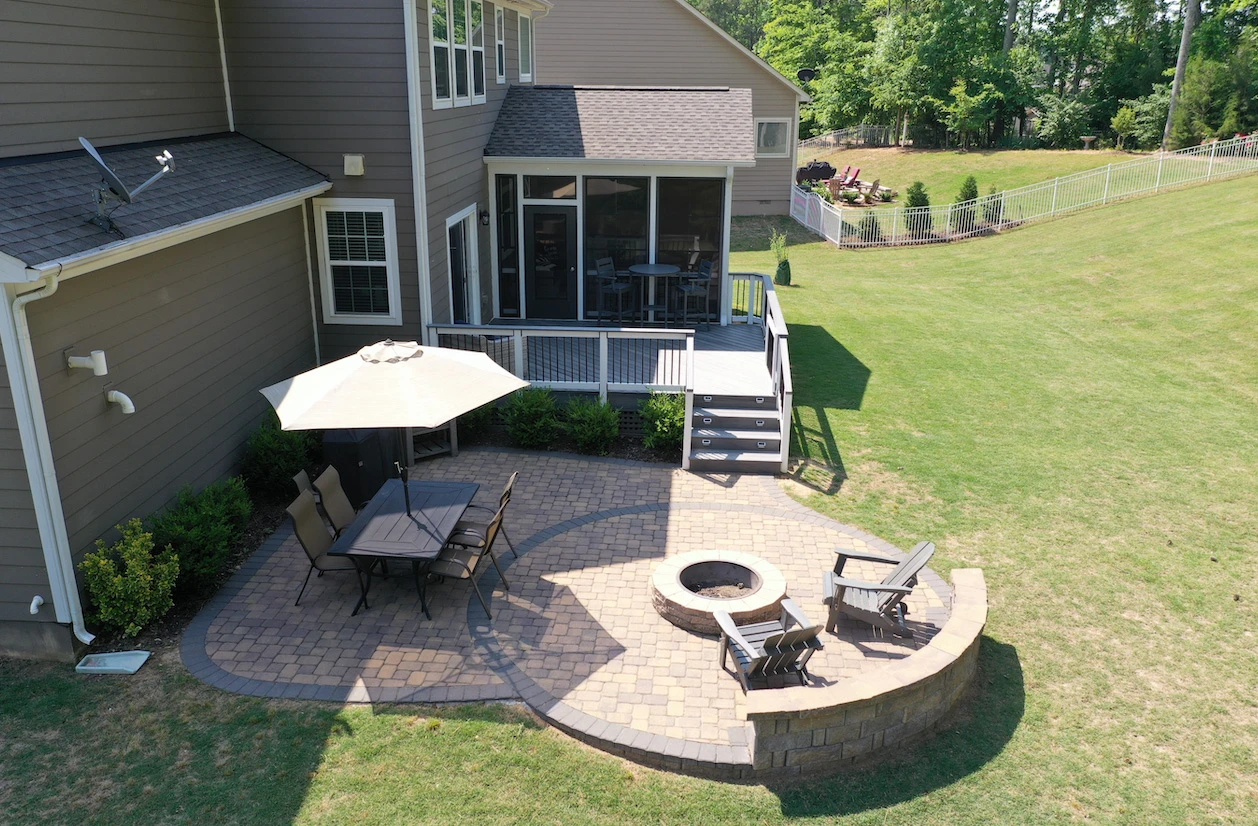
The Indian Hills Case Study: Four Sites, One Winner
Here is how the framework plays out in practice. Last season we walked a 1.1-acre lot in Indian Hills — a 1970s ranch on a corner lot, roughly 40% canopy coverage, a mix of mature white oak and tulip poplar with two loblolly pines near the back fence. The homeowner wanted a wood-burning pit with a seating wall and a pea-gravel apron. Four spots were in the running.
Site A — center of rear lawn, 22 feet from house. Visually the obvious pick. A huge tulip poplar was 28 feet overhead at the nearest limb. Species penalty of three feet took the effective clearance to 25 feet, which is fine for wood. But the poplar’s crown extended 12 feet further across the pit footprint than the trunk line, and in September the leaf drop would sit directly on the apron. Rejected on ember risk and maintenance.
Site B — southwest corner near pines. Open to the sky above, good wind dispersion from the northwest flow. Two loblolly pines sat 18 and 22 feet away at the trunk. No wood-burning pit goes within 15 feet of a pine, full stop. The 18-foot pine would have needed removal, and the homeowner wasn’t willing to do that. Rejected on species proximity.
Site C — low corner, 4 feet below grade. Open to the sky, 40 feet from the nearest canopy. On paper the best site. In practice it was the cold-air sink on the lot, and the homeowner already knew from experience that the low corner held smoke for hours after a gathering. Rejected on airflow.
Site D — bench cut into the east slope, 60 feet from the house. The only natural opening in the canopy, framed by two mature white oaks about 48 feet apart with a clean sightline to open sky above. Lowest limb measured 26 feet at the nearest point. Grade dropped 3 feet from the house side to the fire pit center, giving the wind from the northwest a clean exit across the rear property line toward a neighboring yard of similar open canopy. Selected.
Site D got a 6-foot inside-diameter stone ring with a stainless-steel liner, a 12-foot diameter flagstone apron on a compacted base, and a 14-foot curved Techo-Bloc seating wall to the windward side doubling as a wind deflector for the seated area. Total investment: $11,400. What mattered more than the spec sheet was that the placement decision came first, and the design followed the placement.
Permits, HOAs, and the Cobb Specifics
Permitting for a residential fire pit in unincorporated Cobb goes through Cobb County Community Development at 1150 Powder Springs Street. A freestanding wood-burning pit under 5 feet tall with no permanent gas connection generally doesn’t require a building permit, but a gas connection does — and the gas work has to be permitted and inspected separately. A fireplace or pavilion hearth is a different animal and requires a full permit package including footing detail and clearance verification.
For incorporated Marietta residents (zip codes 30060, 30062, 30064, and parts of the others) the application goes through the City of Marietta Development Services on Lawrence Street instead. Processes are similar, inspectors are not the same people, and turnaround is typically a week faster in the city than in the county.
HOA review is the step people forget. Atlanta Country Club, the older Indian Hills subsections, and Marietta Country Club all have architectural review committees that meet monthly and can require everything from specific stone selection to flame-height limits to screening plantings. Budget four to six weeks for ARC approval in those neighborhoods. In newer luxury infill subdivisions the turnaround is often two weeks. In unincorporated areas with no HOA the only review is Cobb’s.
Specimen tree ordinance in one sentence: You cannot limb, top, or remove any tree 30″ DBH or larger on your property without a permit from Cobb Community Development, and that includes “making room” for a fire feature. Plan placement around the trees, not through them.
Skimmer Leaf Load, Pool Connection, and the Last Check Before Breaking Ground
The canopy-to-pool handoff
If the fire pit sits within 20 feet of a pool — and on most of the Marietta projects we build, it does — the canopy conversation feeds directly into the pool maintenance conversation. East Cobb’s mature oak canopy creates above-average skimmer leaf load from mid-October through late November, which affects how we orient the pit, the coping, and the deck drainage.
A fire pit placed on the upwind side of a pool acts as a leaf catcher, which is good for skimmer load but requires an apron large enough that blowing embers from a wood pit can’t reach the pool’s vinyl cover or automatic cover slats. A pit downwind of the pool keeps ember concerns away from the cover but means every fall leaf ends up in the pool instead. The trade-off runs in both directions and we tend to resolve it with a gas pit on the downwind side and a properly sized leaf net for the skimmers.
Deck drainage is the other place pit placement and pool design intersect. A pit apron that sheds toward the pool deck creates soot-stained runoff lines in Piedmont clay soil, especially on the light-colored travertine and limestone coping that’s become standard in this market. Grading the apron to shed away from the pool, or separating the two zones with a 4-inch planting strip, solves it before it starts.
A three-part verification before you dig
Before any dig, we run a three-part verification on the proposed location. First, lowest-limb measurement with a laser rangefinder in July or August, leaves fully out — not in winter when the canopy lies. Second, a 30-minute smoke test using a non-toxic smoke pellet at the exact pit footprint to visualize actual airflow, because what the wind app says and what your lot does are often different stories. Third, a walkaround with the homeowner at the two hours of day they actually plan to use the feature — usually dusk and mid-evening — to check sightlines from the house, neighbor exposure, and lighting coverage.
That last check catches the things nobody accounts for on a drawing. The neighbor’s upstairs window looking directly down into the pit area. The security light that backlights every guest. The path from the kitchen to the pit that crosses an irrigation zone. Twenty minutes on site, pre-dig, saves a year of small regrets.
A fire feature under Marietta’s mature oak canopy is one of the best outdoor amenities in the Southeast when it’s placed correctly, and one of the most frustrating when it’s not. The decision sequence is short: measure the limb, name the species, choose the fuel, read the wind. If the placement survives all four, the design is easy. If it fails any one, pick a different spot before you pour a single cubic yard of base.
Fire pit and fireplace design across 20+ cities within 30 miles of Winder, GA
From canopy-heavy East Cobb lots to open Forsyth County builds, we place fire features around the trees you want to keep — then design the stonework and seating to match.