
Three ways to put fire into a paver patio. One sits flush with the pavers. One rises inside a seat wall. One drops into a patio you already own. Each one rewrites the paver layout, the base under your feet, and the final invoice differently, and the $2,400 to $16,500 spread between them has surprisingly little to do with the fire itself.
Approach one, the flush-set built-in, gives you the cleanest look and the hardest layout: every paver has to answer to a circle. Approach two, the raised seat-wall firepit, costs the most because it turns a patio into a room. Approach three, the drop-in insert, is the one Clarkston homeowners ask about first, because thousands of backyards between Memorial Drive and Rockbridge Road already have a patio. The question is whether that patio can take a fire ring.
Every number below assumes Clarkston conditions: Cecil-series Piedmont clay under thin topsoil, 8 to 14 freeze events a winter, and about 52 inches of rain a year under the canopy along Pole Bridge Creek. Those conditions punish shortcuts around heat and water, and a firepit concentrates both.
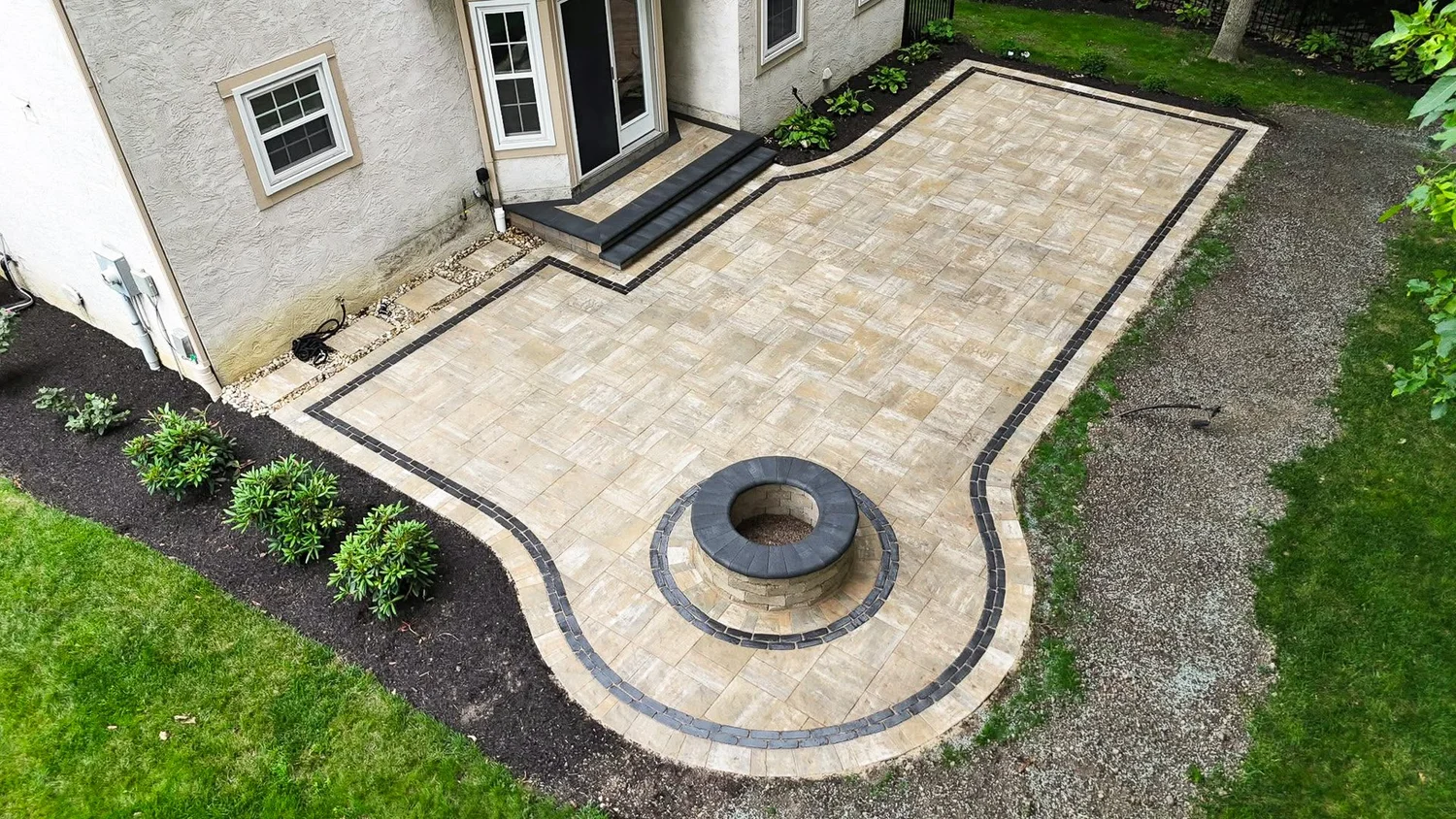
Approach 1 — The Flush-Set Built-In: Fire as Part of the Paver Field
The flush-set firepit is designed with the patio. The ring is a structural element inside the paver field, with its own drainage core and a cap at or just above finished grade. From above, it reads as one continuous surface with the fire as a deliberate focal point.
The case: a 1970s ranch in Toney Valley
A typical flush-set job for us in Toney Valley starts with a brick ranch, a cracked 1970s concrete slab off the back door, and a yard that falls about 18 inches over 30 feet toward the rear fence. The homeowners want eight chairs around a wood fire. We tear out the slab, cut the grade, and lay patio and firepit as one design.
The fire ring we specify for this kind of build is a steel liner with a 44-inch inside diameter. That size holds a split log laid flat without the ends hanging over the rim. Inside the steel we line with firebrick, because standard concrete pavers and wall block are not rated for direct flame and can spall or crack within a couple of seasons.
Below the ring, the flush-set approach gets serious. The fire ring’s footprint receives a deeper excavation than the surrounding patio, backfilled with clean crushed stone rather than dense-graded base. That open-graded core does two jobs. It lets rainwater drain down instead of sitting in the ring and freezing, and it keeps heat off the clay under the fire. On Clarkston’s slow-draining subgrade, we also run a perforated line from the core to daylight. Skip that pipe, and the pit becomes a bucket every summer thunderstorm.
Budget-wise, a flush-set wood-burning firepit built into a new patio typically adds $3,800 to $6,500 on top of the patio cost itself. The range moves with ring size, cap material, the drain, and how many paver cuts the pattern demands.
Flush-set checklist to write into your contract: steel liner ring with firebrick lining, open-graded stone core under the ring (not dense-graded base), a drain path from the bottom of the core to daylight, and a cap or coping ring that is rated for heat. If any of those four lines is missing from the bid, the price is lower for a reason.
What a Flush-Set Ring Does to the Paver Layout and the Base Below It
Pavers are rectangles. Fire rings are circles. Everything difficult about the flush-set approach lives in the collision between those two facts.
Three layout strategies around a circle
The radial circle kit. Several manufacturers, including Belgard, Techo-Bloc, and Pavestone, sell circle kits: tapered units that radiate out from a center point in concentric rings. Around a firepit, a circle kit looks intentional and elegant. The catch is the transition, the spot where the circle ends and the rectangular field begins. Every paver along that boundary gets cut on an arc. On a 16-foot circle, that can be 60 to 90 individual cuts.
The soldier-course collar. A cheaper option runs the field pattern up to the ring and frames it with a single soldier course in a contrasting color. The collar hides the cut edge and gives the eye a clean line, the same job the charcoal border does in the first inline photo.
The detached fire pad. The third strategy avoids the collision entirely: build the main patio as a rectangle off the house and put the fire on its own circular pad out in the yard, connected by a walk. You get near-zero arc cuts and real distance between the fire and the house.
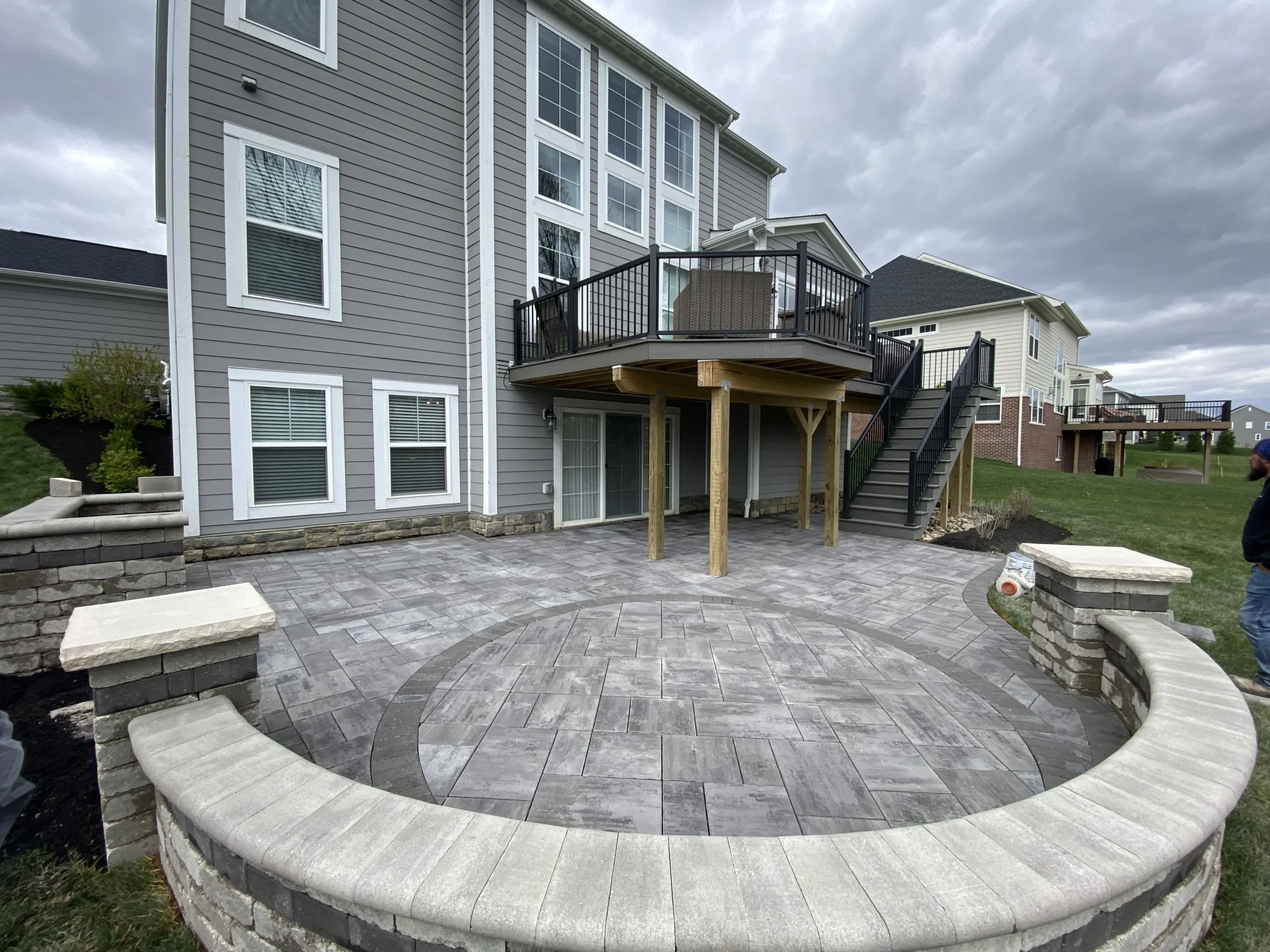
Waste factor and base depth
Arc cuts eat material. A straight running-bond or three-piece random pattern on a rectangle usually needs about 5 percent overage. Wrap that same pattern around a flush-set ring and we order 10 to 12 percent overage, because every cut paver along the arc produces an offcut too small to reuse. On a 400-square-foot patio, that difference is 20 to 30 extra square feet of material plus the labor to cut it.
The base changes too. For a residential patio on Clarkston clay, we build an 8-inch compacted base of graded aggregate, compacted in lifts, over a non-woven geotextile separator. Around a flush-set firepit, that base has to terminate cleanly against the stone core under the ring. If dense base bleeds into the core, the core stops draining; if the core washes out, the collar settles. A vertical geotextile wrap and a compacted shoulder under the collar pavers solve both.
Approach 2 — The Raised Seat-Wall Firepit: Case Study Off Brockett Road
The raised approach builds the fire into a wall. Sometimes the wall is the firepit itself, a freestanding raised ring or rectangle with a wide cap you can prop your feet on. Sometimes the firepit sits in the center of a curved seat wall that wraps the patio and doubles as permanent seating. Either way, the fire lives above the paver field, not in it.
The case: a split-level lot that falls away from the house
Take a common Clarkston situation off Brockett Road: a 1960s split-level with a rear yard that drops about four feet from the back door to the property line. We turn the slope into the design: a curved seat wall on the low side holds the grade, defines the edge, and becomes the bench for the firepit inside the curve.
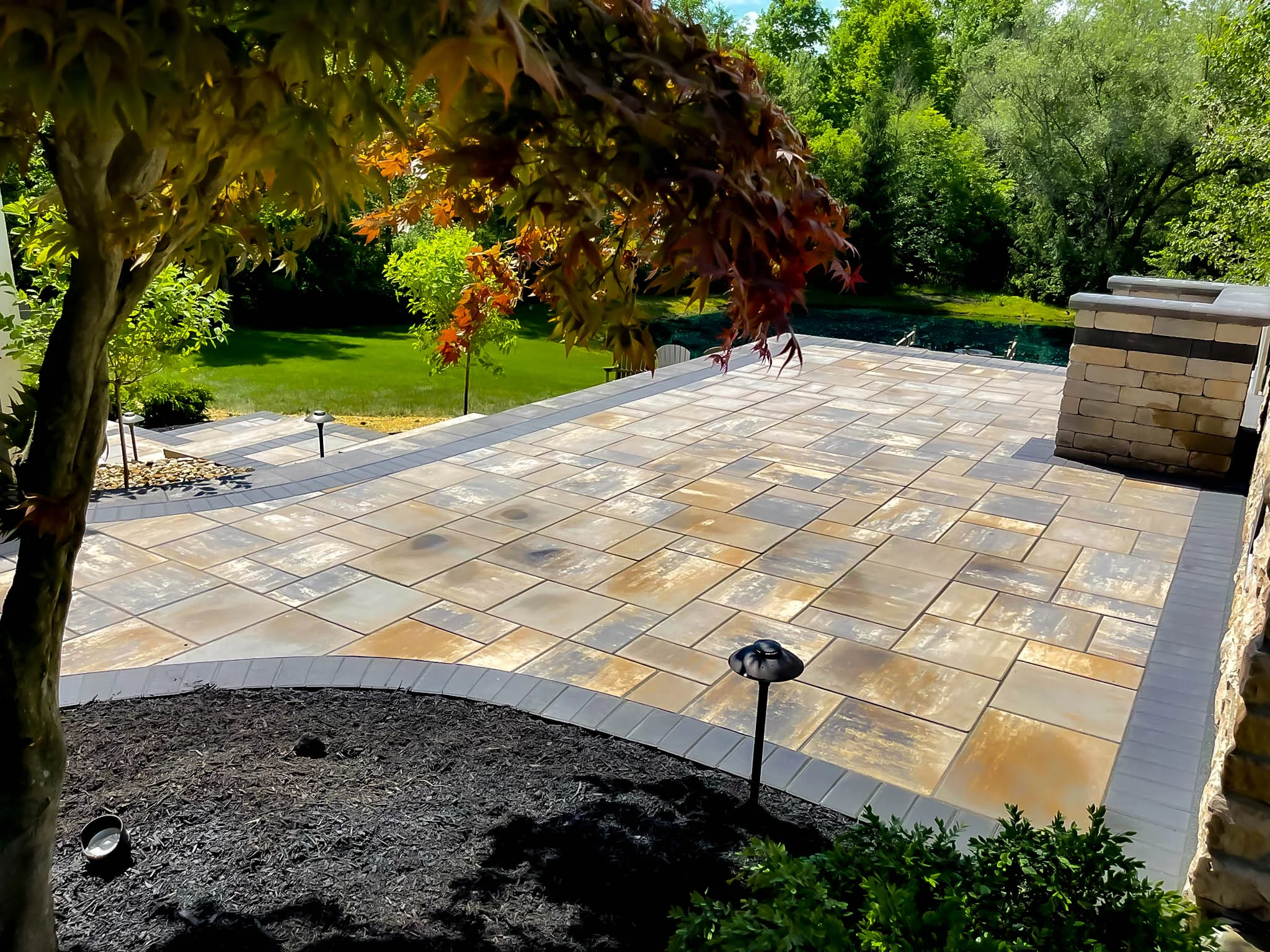
Seat walls live or die by height. Finished seat height, cap included, should land between 18 and 20 inches above the patio. Lower and knees end up at chests; higher and feet dangle. A 1.5- to 2-inch cap overhang keeps calves off the block face.
What the wall does to the paver layout
A seat wall simplifies the field pattern and complicates the edges. Because the fire is contained in its own raised structure, the paver field can run in a clean pattern right up to the wall face, and the pavers only need to be cut along the wall line. On a curved wall, those cuts follow the arc just like a circle kit, but there are far fewer of them, usually 30 to 50 instead of 60 to 90, because only one side of the field meets a curve.
The sequence matters. We build the wall footing first, then the wall, then the paver field. Wall block sits on its own compacted base trench, typically 6 inches of compacted stone below a buried first course, with a perforated drain behind any wall that holds back soil. Set block on top of finished pavers and the wall rides every seasonal movement of the patio, which is how a seat wall leans an inch by year five.
Gas or wood, and what the raised version costs
Raised firepits are where gas makes the most sense, because the structure hides the burner pan, key valve, and line. Burner systems from brands such as Warming Trends and HPC Fire are common choices, and the flame media ranges from lava rock to tempered fire glass.
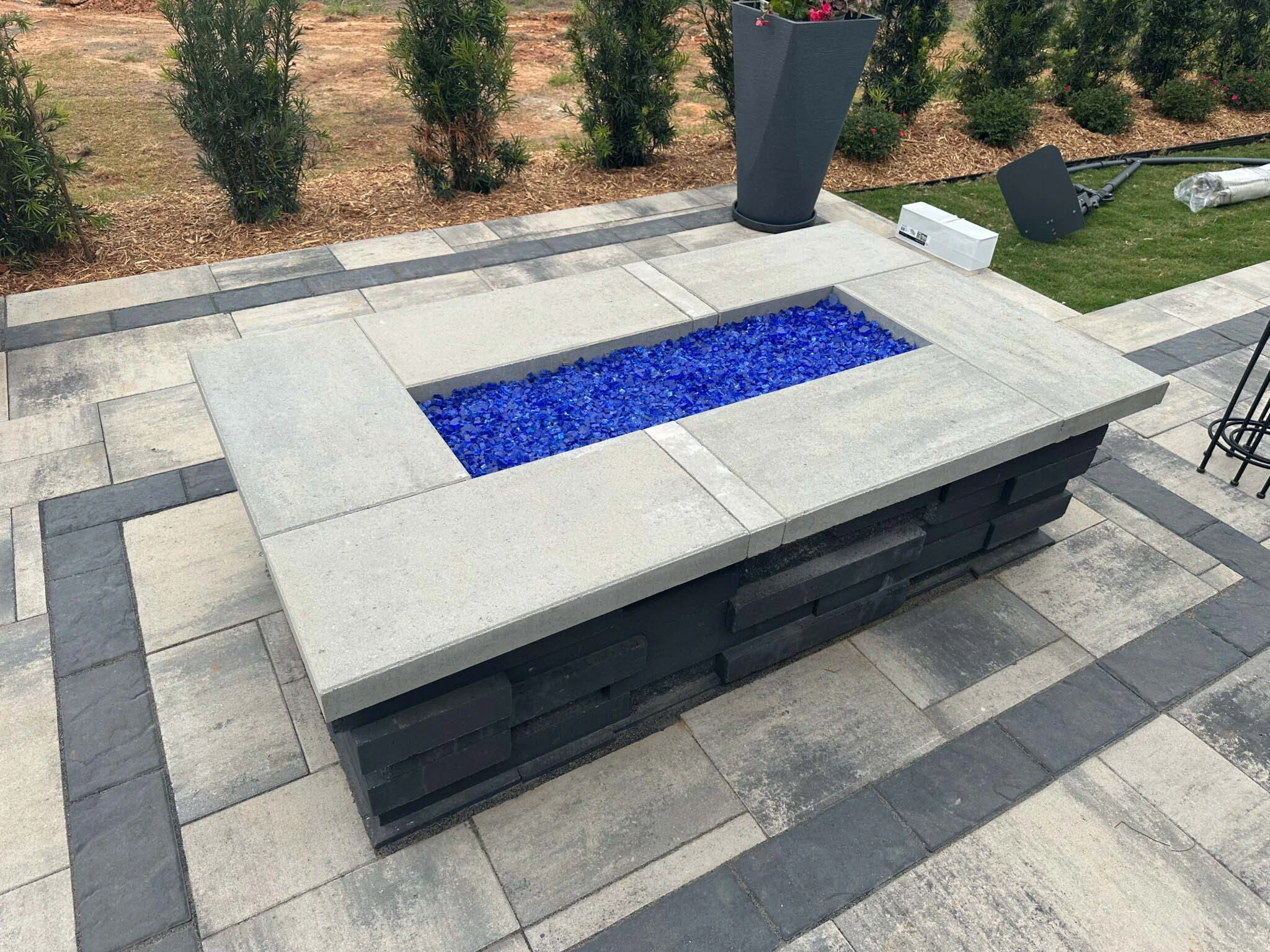
Running gas adds real cost and real paperwork. In Clarkston, natural gas is delivered by Atlanta Gas Light, and a new outdoor gas line needs a licensed installer, a pressure test, and a permit. A raised seat-wall firepit with a gas burner, 20 to 30 linear feet of seat wall, and a gas run from the meter typically lands between $9,500 and $16,500. The wood-burning version of the same wall, with a steel liner and no gas, usually comes in $2,500 to $4,000 lower.
Approach 3 — The Drop-In Insert on an Existing Patio: Case Study in Lake Capri
Clarkston is a renovation market. Plenty of backyards in Lake Capri and Idlewood already have a patio from the last 20 years, and tearing out a sound one makes no sense. The drop-in cuts an opening into the existing patio and sets a ring into it.
The case: a 1960s Lake Capri backyard with a 15-year-old patio
A typical Lake Capri call goes like this: a 1960s ranch, an original-era pool long since filled in or renovated, and a tan paver patio added by a previous owner. Before we quote, we pull pavers at the proposed firepit spot. That single test pit decides the whole job.
What we are looking for under the pavers
Older patios in DeKalb County were often built on 3 to 4 inches of base, sometimes less, sometimes laid over nothing but sand on scraped clay. Add a ring and a heavy cap, and you concentrate load on a thin base over clay that swells when wet. If the test pit shows under 4 inches of compacted base, we rebuild the base in a zone that extends at least 2 feet beyond the ring in every direction.
How the drop-in changes the existing layout
A drop-in cuts into a pattern that was never designed for a circle. We mark the ring location, saw-cut the opening slightly larger than the ring, and pull the pavers. The field pavers along the new edge get trimmed, and the collar course covers the cut line. We choose a contrasting collar on purpose, because matching a faded 15-year-old paver with new product almost never works.
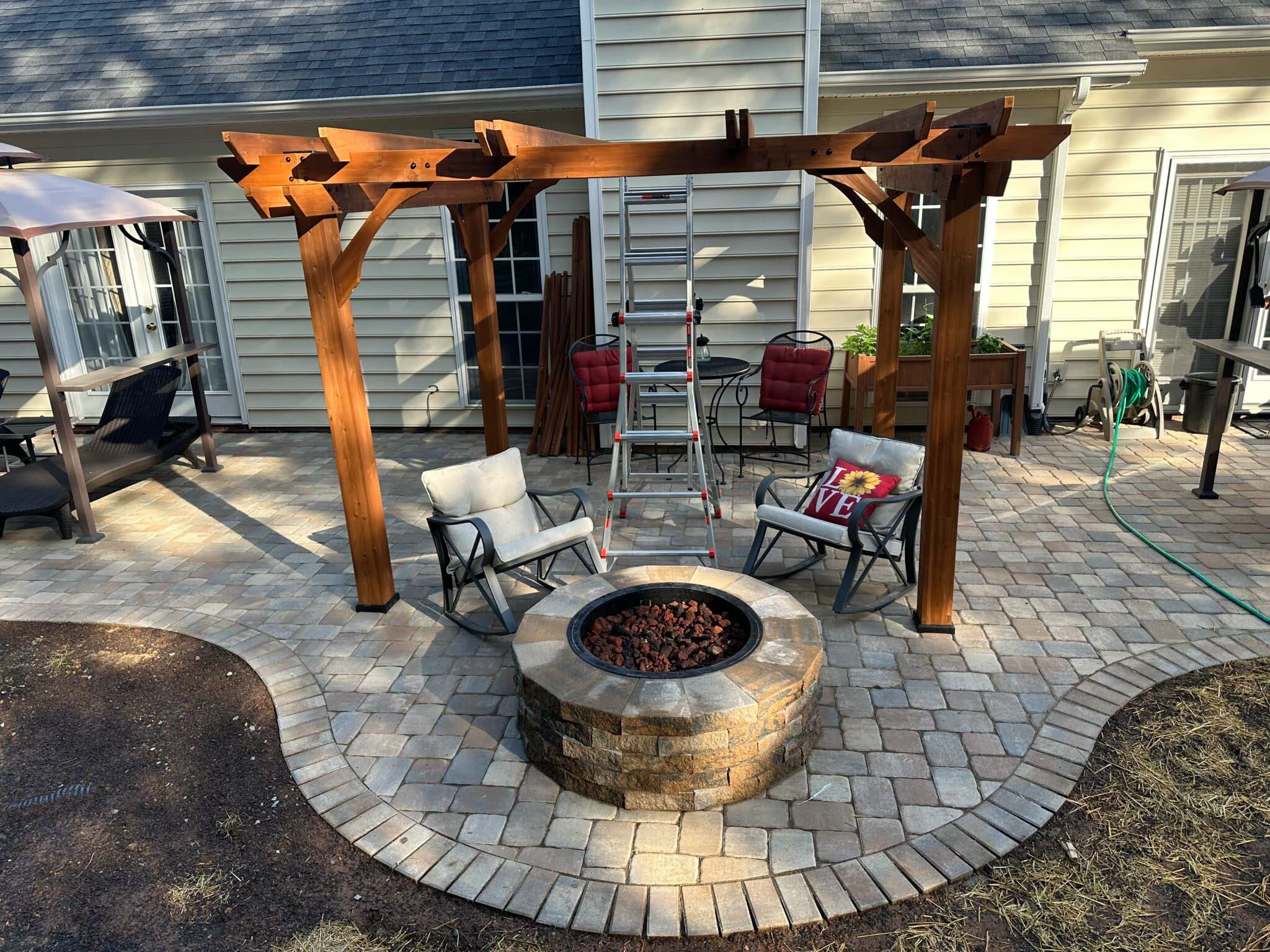
Clearance is the other drop-in problem. Patios built before anyone planned for fire often sit tight against the house, under a pergola, or under a tree. The photo above shows a pit beneath an arbor; overhead structures and fire require careful clearance planning and, for wood, a clear view of the sky. When the existing patio simply has no spot with safe clearance, the right answer is often a small new pad out in the yard rather than a drop-in.
Drop-in pricing, straight: A wood-burning steel ring dropped into a sound existing patio, with a new soldier collar and localized base repair, typically runs $2,400 to $5,200. A gas drop-in with a burner pan, key valve, and a new line run under the patio runs $4,500 to $8,000, depending on how far the meter sits from the pit.
Side by Side — Layout, Base Depth, and Cost for All Three
Here is the whole comparison in one place. The numbers are typical ranges for Clarkston projects, not quotes. Your lot, your materials, and your gas-line distance move them.
Flush-set built-in
- Paver layout: The field is designed around the circle. Expect 60 to 90 arc cuts with a circle kit and 10 to 12 percent material overage.
- Base: 8-inch compacted base under the field, with a deeper open-graded stone core under the ring and a drain line to daylight.
- Added cost: $3,800 to $6,500 on top of a new patio.
- Best for: New patios on flatter lots, wood fires, and homeowners who want a clean, minimal look.
Raised seat-wall
- Paver layout: The field runs clean up to the wall. Cuts happen only along the wall line, usually 30 to 50 on a curve.
- Base: Separate compacted footing trench for the wall, built before the pavers, plus drain behind any wall that holds soil.
- Added cost: $9,500 to $16,500 with gas; roughly $2,500 to $4,000 less for wood.
- Best for: Sloped lots, gas burners, and families who want built-in seating.
Drop-in insert
- Paver layout: Cut into an existing pattern. A contrasting soldier collar hides the cut line.
- Base: Depends on what is already there. Localized rebuild if the test pit shows under 4 inches.
- Added cost: $2,400 to $5,200 wood; $4,500 to $8,000 gas.
- Best for: Sound existing patios with a spot that has safe clearance.
Notice the pattern. The flush-set approach spends its money on cutting and drainage. The seat-wall approach spends its money on masonry and gas. The drop-in spends its money on repairing whatever the previous installer skipped. The fire ring itself, a few hundred dollars of steel and firebrick, is the smallest line on every one of these invoices.
Choosing Your Approach on a Clarkston Lot — Gas vs. Wood, Setbacks, and DeKalb Permits
1. Where does the fire fit in the way you use the patio?
A patio is rarely one room. Sketch where you eat, where you lounge, and where people walk to the yard. The fire should anchor the lounge zone and stay out of the path.
2. Wood or gas?
Wood gives you crackle, smell, and a cooking fire. The hero photo at the top of this post shows a round stacked-stone pit with river rock and a black cooking grate, surrounded by four Adirondack chairs. That is a wood-fire setup built for grilling and long nights. Wood also means smoke, ash, and larger clearances. Gas gives you flame at the turn of a key and no smoke in the neighbors’ windows, at the price of a permit and a licensed line.
3. Do you have the clearance?
The International Fire Code, IFC Section 307, sets clearance standards for open burning, and for recreational wood fires the benchmark distance from structures and combustible material is 25 feet, with smaller distances allowed for certain approved appliances. Local fire officials apply these rules, and manufacturer instructions for gas units set their own clearances. On the smaller Clarkston lots in Edinburgh and Hambrick, 25 feet from the house, the fence, and the neighbor’s shed can eliminate a wood pit entirely, which pushes the decision toward gas. Check low branches too.
4. What does DeKalb County need from you?
Residential construction permits for Clarkston properties generally run through DeKalb County Planning & Sustainability at 178 Sams Street in Decatur. A simple wood-burning ring on a patio often needs no building permit on its own, but a new gas line does, along with a licensed installer and an inspection. Seat walls that retain soil can trigger additional review depending on height. DeKalb review times typically run 3 to 4 weeks, longer than the 10 to 14 days common in Gwinnett, so a gas firepit you want ready for October should be in permit review by late summer. And before anyone digs, call Georgia 811 to locate buried lines, because older lots often have utility runs nobody remembers.
The short version: Building a new patio on a flat lot and want wood? Go flush-set. Have a slope, want seating, or want gas? Go seat-wall. Have a sound patio and a spot with real clearance? Go drop-in, but only after a test pit proves the base can carry it.
Whichever approach you choose, the fire is the easy part. The layout decisions, the base under the ring, and the drainage out of the pit decide whether that firepit still looks right in ten winters. Get those three things into the drawing and the contract, and the fire takes care of itself.
Fire pits and fireplaces across 20+ cities within 30 miles of Winder, GA
Flush-set, seat-wall, or drop-in, we design the paver layout, the base, and the drainage around the fire before a single paver gets cut, so your firepit looks as good in year ten as it does on night one.