
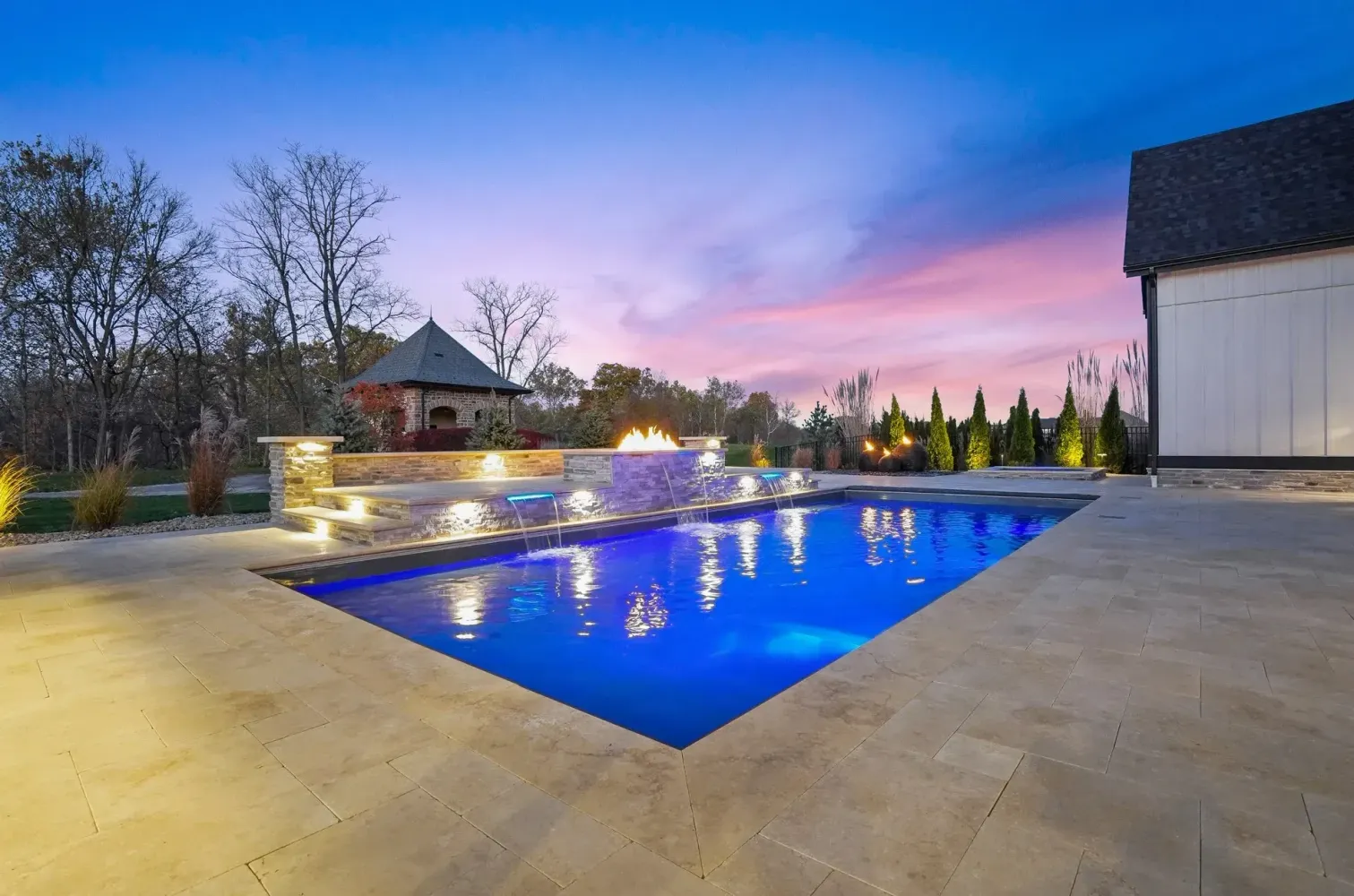
A Polo Fields homeowner called us in February with a specific problem: a pool she loved using in July that sat cold and ignored from mid-September through May. Her ask was not bigger — it was longer. The answer was a raised 42-inch stone wall with dual fire bowls on the end caps and a three-scupper water sheet in the middle, and it extended her usable season by six weeks.
This is the write-up of that build. What went into the wall, what the gas line cost, how the LED channel hides behind the water sheet, why the end-cap bowl positions matter, and what the whole package added to a base pool — roughly $28,000 to $44,000 depending on stone selection and automation scope.
It is also the most-requested feature combination we do in Forsyth County right now. Three builds in the Polo Fields neighborhood alone in the last eighteen months have used some variant of this raised-wall assembly. The architectural review board has seen the drawings enough times that the turnaround on a standard submittal has compressed from three weeks to about ten business days. That matters when you are trying to hit a May pour date off a February contract.
01 — Why the Shoulder Season Is Worth Building For
A standard Cumming pool gets used hard from about Memorial Day through Labor Day. Fourteen weeks. Water temperature climbs into the high 80s, the deck is warm on bare feet, and the pool pays back its cost in use. Then the equinox hits, nighttime temperatures drop into the low 60s, and the pool goes quiet.
What a fire-plus-water integration does — and this is the part that does not show up in a quote until a client experiences it — is reframe the backyard. On a 52-degree October evening, a lit pool with a running water wall and two active fire bowls stops being a summer toy and starts being a destination. The family eats outside. The in-laws come over. The pool chemistry stays balanced because the pump is running anyway to feed the scuppers. Six weeks of shoulder-season use that otherwise would not exist.
We have tracked this on our last fourteen Cumming builds with integrated fire-water features. Average calendar use extended from 14 weeks to 20 weeks. That is a 43% increase in usable days for a feature package that adds roughly 8% to 12% to total project cost on a mid-range custom build. There is no other single decision on a pool project with that return profile.
Forsyth County’s climate makes this work better than most. Summer highs run 89 to 94 degrees, with the Lake Lanier humidity pushing dewpoints higher than Dacula or Loganville. But the flip side is that the shoulder seasons — late March into early May, and mid-September into early November — are genuinely pleasant in the evening. Highs in the low 70s, lows in the 50s. Perfect fire-and-water weather. You are not fighting the climate; you are extending the window it opens.
The six-week figure in plain numbers: We count shoulder-season use as any evening the pool is lit with the fire features active and the family is outside for at least 45 minutes. Pre-integration baseline across our client tracking was 14 weeks of calendar use. Post-integration average is 20 weeks. Range: 18 to 23 weeks.
02 — The Wall Itself: Anatomy of the 42-inch Bond Beam
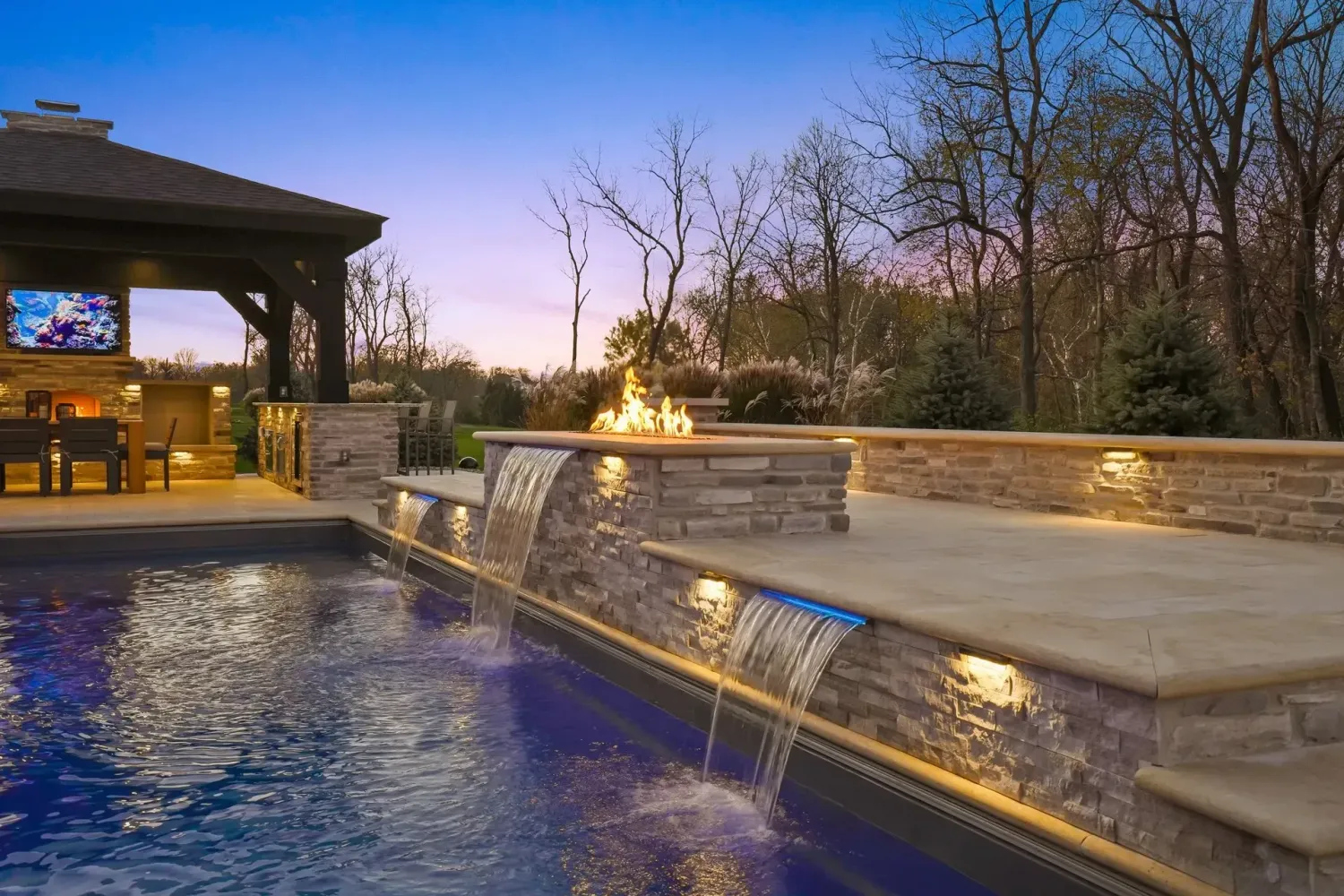
The structural piece is a raised bond beam that sits on the back edge of the pool shell. “Raised” in this context means it extends 42 inches above the waterline. That number is not arbitrary — it is tall enough that the scuppers produce a visible sheet and splash, short enough that the fire bowls sit at a comfortable sightline from a seated deck chair. We have tried 36 inches (too short — scuppers look like trickles) and 48 inches (too tall — the fire bowls feel elevated and the wall blocks the sightline to the rear landscape). Forty-two is the sweet spot.
The wall is poured concrete core, structurally tied to the pool shell via rebar extensions off the bond beam. It is not a decorative retaining wall bolted on after the pool is built. It is part of the pool’s structural envelope, poured at the same time as the shell walls, which means the waterproofing membrane wraps over it continuously. Water sheeting off the scuppers never encounters a cold joint.
The stone veneer is Techo-Bloc Ramanpur or a ledgestone equivalent — typically a light gray-cream horizontal ashlar with variable heights for texture. Veneer runs on the pool-facing side, wrapping the end caps. The back of the wall, facing the yard, gets a simpler matching veneer or, in some builds, a plain stucco-scratch finish because most of it is hidden by landscape plantings anyway. The cap is a cream travertine slab two inches thick with a one-inch overhang on both the pool side and the yard side, matching the deck travertine.
End caps are where the fire bowls sit. These are essentially short return walls, 14 to 18 inches of stone extending forward of the main wall plane toward the deck, creating a shelf that feels like a pedestal. The bowl sits on a stone cap, plumbed from below. The end cap dimension is load-critical — the bowl itself weighs 80 to 140 pounds depending on the model, plus another 40 pounds of media, and the plumbing manifold below it has to stay accessible for service.
03 — The Gas Feed: A $1,400 Trench That Controls Everything
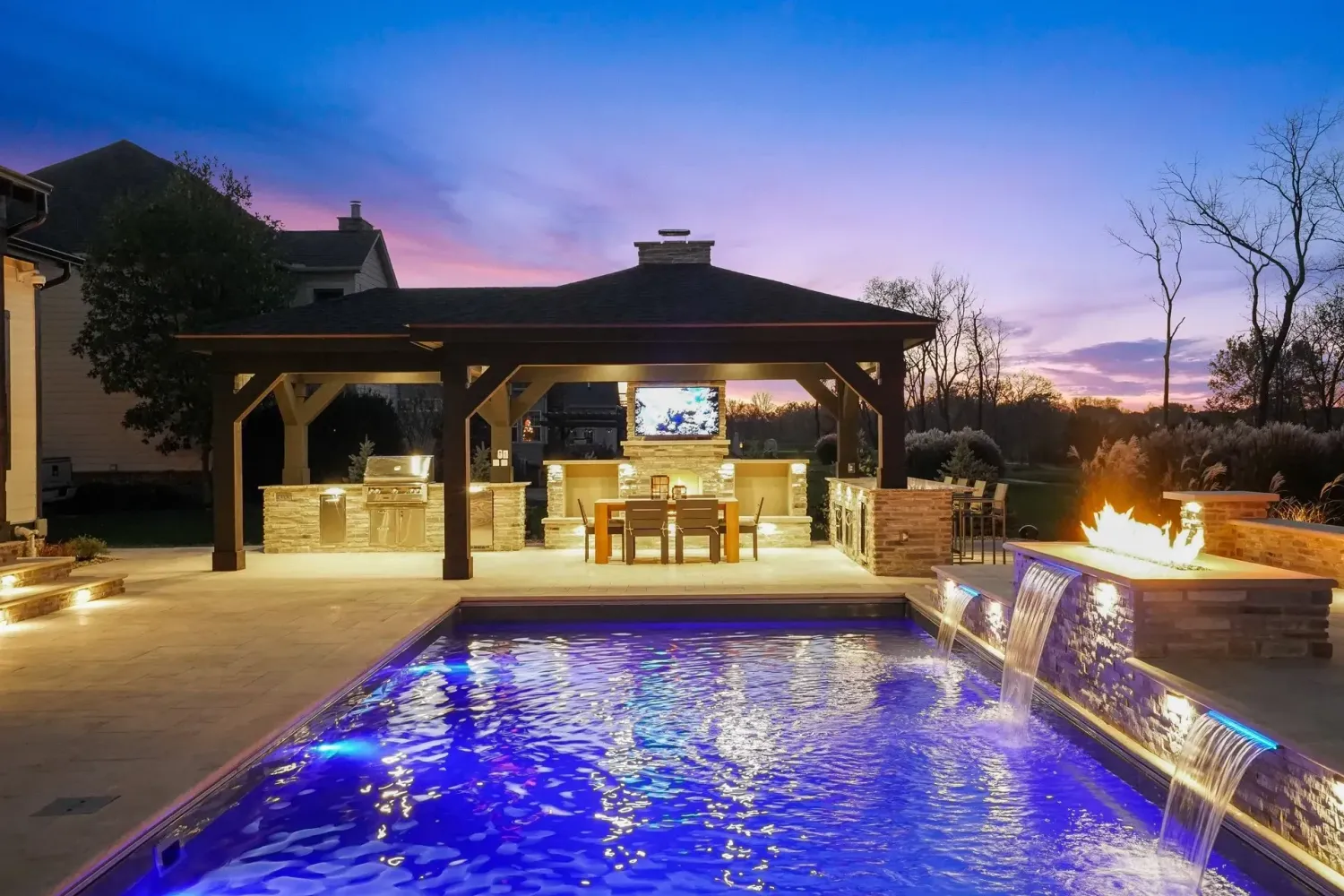
Of all the line items on this build, the one that homeowners consistently under-estimate is the gas supply. Two fire bowls drawing roughly 65,000 BTU each and a future-proofing allowance for a third fire feature means you need a 3/4-inch gas line sized off a manifold with enough capacity to run all appliances simultaneously without pressure drop.
In Cumming, that typically means running a new line from the home’s main gas meter out to the pool equipment pad, splitting at a manifold, and branching to each bowl. The trench alone runs 80 to 130 linear feet on most Polo Fields lots, because the pool is usually positioned toward the back of the yard to take advantage of the grade drop toward the rear property line. Trenching, pipe, manifold, fittings, pressure testing, and inspection — the gas piece averages $1,400 to $1,900 as a standalone line item on a new build where gas is already at the house.
Two specifications to lock down at contract:
- Manifold capacity. Size for the fire features you want plus 40% headroom. Adding a future outdoor kitchen grill or a fire table later is cheap if the manifold is already right-sized. Retrofitting manifold capacity after the deck is poured is painful.
- Shut-off location. Each bowl should have its own gate valve at the manifold. We have seen otherwise beautiful installations where a single valve controls both bowls — which is fine until you need to service one and have to shut both down. Dedicated valves add maybe $60 in materials.
Forsyth County permitting requires a pressure test on the completed gas line before fire appliances are connected. Standard test is 30 minutes at 1.5 times working pressure, documented by the plumber and submitted to the Forsyth County Department of Planning and Community Development at 110 E. Main St. in Cumming. Our builds submit with the pool inspection package to keep the calendar clean.
Sawnee EMC and the electrical side: The LED channel behind the water sheet and the ignition system on the fire bowls both run off the pool equipment pad’s 240-volt service. Sawnee EMC requires a documented load calculation on any new 240V pool circuit. Build this into the permit package. Skipping the calculation will delay energization by a week or more.
04 — The Water Sheet: Three Scuppers, LED Channel, and the Detail That Separates Good from Great
The water feature is three sheer-descent scuppers embedded in the raised wall, positioned between the two fire bowl end caps. Each scupper is a pre-manufactured stainless weir — typical specs are 24 inches wide with a 1/2-inch slot opening — mortared into the wall face with the water inlet plumbed from behind. The pump is the main pool pool pump running at a variable-speed setting that feeds the scuppers without starving the skimmers.
The detail most builders skip is the LED channel. Behind the water sheet, recessed into the wall face about three inches deep and running the full length of the scupper array, we install a continuous waterproof LED strip — typically 24V, IP68-rated, color-changing. When the sun drops and the pool lights come on, the water sheet is lit from behind. A clear water column becomes a luminous blue-white curtain. You are not looking at a stainless weir with water coming out of it. You are looking at light moving through water.
That detail adds maybe $600 in materials and an extra two hours of wiring. It is the difference between the feature photographing well during the day and photographing unforgettably at dusk. Every Cumming client we have built this for has called out the LED channel as the best decision they made.
Flow rate is the other variable that separates a good installation from a great one. Too little flow and the scupper becomes a dribble that breaks into droplets before reaching the water — ugly and noisy. Too much flow and you get whitewater splash that keeps seated deck guests wet. Sweet spot for a 24-inch scupper is around 15 to 18 gallons per minute per weir. At 45 to 54 GPM total across three scuppers, a Pentair variable-speed pump set to about 2,800 RPM gets you there without pulling excessive power. Annual run-cost through Sawnee EMC — if you run scuppers two hours each evening during the shoulder and summer seasons — works out to roughly $85 to $110.
05 — The Fire Bowls: Bronze, Copper, or Hammered Steel and Why It Matters in Forsyth County Humidity
There are three common materials for the fire bowls themselves, and the choice is not just aesthetic. Lake Lanier humidity is harder on metal finishes than most clients expect.
Cast bronze is the premium option. Bronze develops a natural patina over five to ten years, going from a warm orange-copper at install to a deep mottled brown-green. It is corrosion-proof in practical terms — coastal bronze holds up in Charleston, and Cumming humidity does not come close to that. Pricing runs $1,600 to $2,800 per bowl in the 30-inch to 36-inch sizes we typically spec for this wall configuration. We almost always recommend bronze for Polo Fields and St. Marlo builds because the architectural review boards prefer the aged patina over a newer, brighter finish.
Hammered copper is the middle tier. Copper patinas faster and more dramatically than bronze — often within two to three summers in Cumming’s moisture load. Some clients love the speed of that transition. Others find the verdigris too aggressive. Copper bowls run $900 to $1,700. A note: copper is the most commonly mismatched component on a bid because mill-finish copper photographs brighter than it sits in place. Ask to see a bowl that has been outdoors in Forsyth County for at least one summer before committing.
Powder-coated steel or stainless is the budget option. Priced $450 to $900. The problem is that powder coat fails at the rim where the flame heats the metal repeatedly to above 600 degrees. Within three to five shoulder seasons, you will see powder-coat peel around the burner ring. Stainless holds up longer but discolors around the flame zone. For a premium Polo Fields or Vickery backyard, we steer clients away from steel. For a secondary feature — say, a bowl on a detached firepit area — it is defensible.
The burner ring itself is a standard 12-inch stainless ring with a pilot and a match-light or electronic ignition. We default to electronic with a remote and a flame failure sensor — code requires the sensor, and the remote dramatically increases how often the bowls actually get used. A client who has to reach behind the bowl to ignite a match will light it three times a season. A client with a remote on the kitchen counter lights it twenty.
06 — Total Add, HOA Review, and What to Specify in the Contract
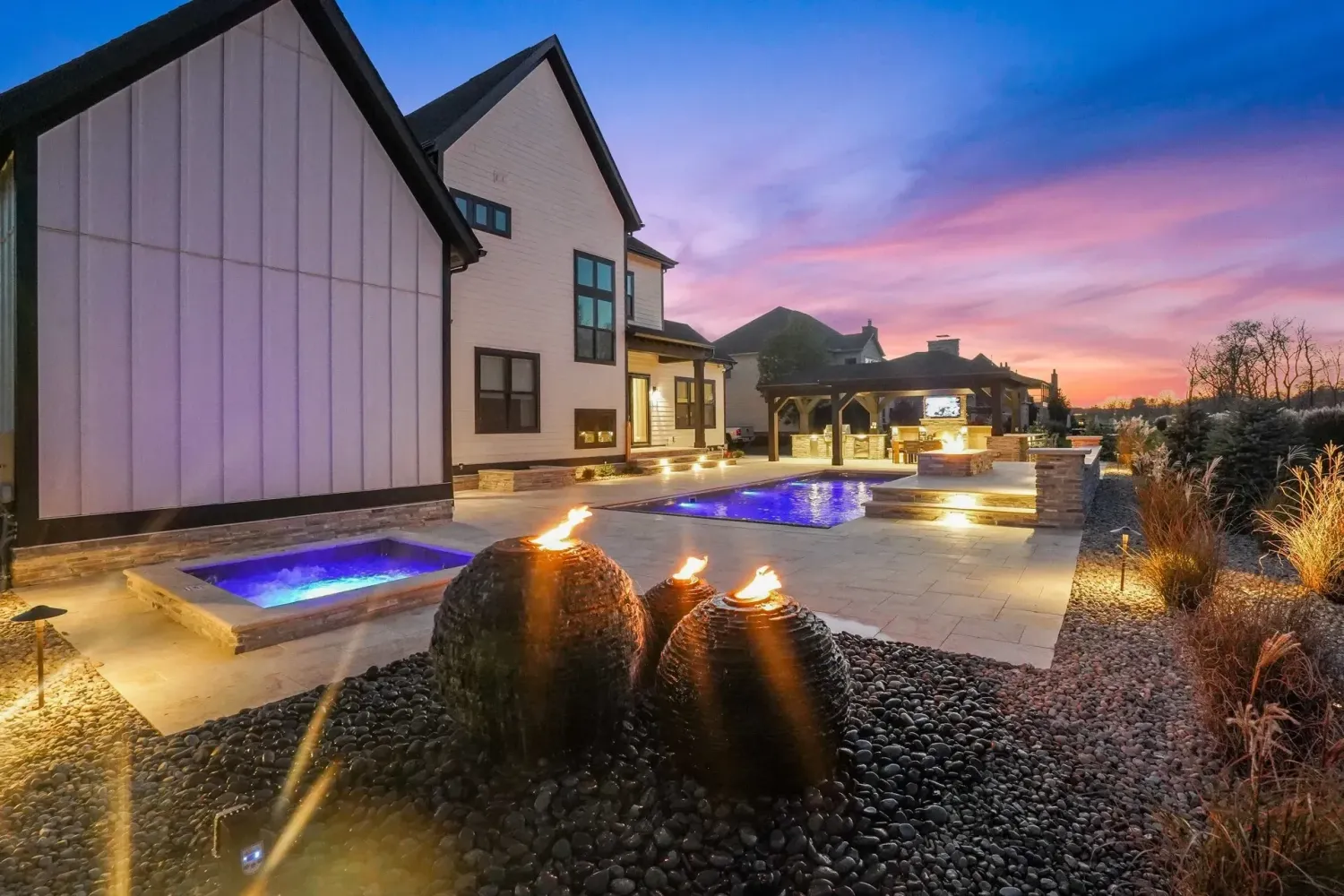
Rolling up the numbers for a Polo Fields-typical package — raised 42-inch stone wall, three-scupper LED-backlit water sheet, dual bronze fire bowls on end caps, dedicated gas feed with manifold, 240V electrical tie-in, automation integration — the package adds $28,000 on the low end to $44,000 on a premium build. The range is driven by three line items:
- Stone selection. Standard ledgestone veneer versus a premium Techo-Bloc product is a $3,000 to $6,000 delta on a wall this size.
- Fire bowl tier. Bronze pair versus steel pair is a roughly $3,000 delta.
- Automation integration. Pentair IntelliCenter or Jandy iAquaLink control of the scupper pump, LED color, and fire ignition adds $2,200 to $3,800 but is worth every dollar for the one-tap scene-setting. Most high-end Cumming buyers now spec this at contract.
The HOA review for Polo Fields requires a site plan showing the wall footprint, an elevation showing wall height and material, and a rendering or photo reference of the fire features. Architectural review boards typically meet twice a month. Submittal-to-approval has averaged 10 to 14 business days on our last three Polo Fields builds. St. Marlo runs slightly longer — two to three weeks — because their board reviews projects in larger batches.
In your contract with a builder, insist on these specifications in writing:
- Raised wall is poured integrally with the pool shell, not bolted on as a separate structure. Rebar ties called out on the structural drawing.
- Waterproofing membrane wraps continuously from pool interior up and over the wall cap.
- Gas manifold sized with 40% headroom beyond current fire appliance BTU total.
- Dedicated shut-off valves at each fire bowl.
- LED channel recess behind the scupper array, minimum 3 inches deep, with waterproof IP68 strip and dedicated low-voltage transformer.
- Flame failure sensor and electronic ignition on both bowls, with remote.
- Variable-speed pump sized to deliver 15 to 18 GPM per 24-inch weir.
- Automation controller (IntelliCenter or iAquaLink) wired to scupper pump, LED channel, and bowl ignition with scene preset.
That list is your insurance against the three most common installation shortcuts we see when we walk other builders’ jobs in the 30040 and 30041 zip codes. None of them are fatal on their own. All of them show up over time.
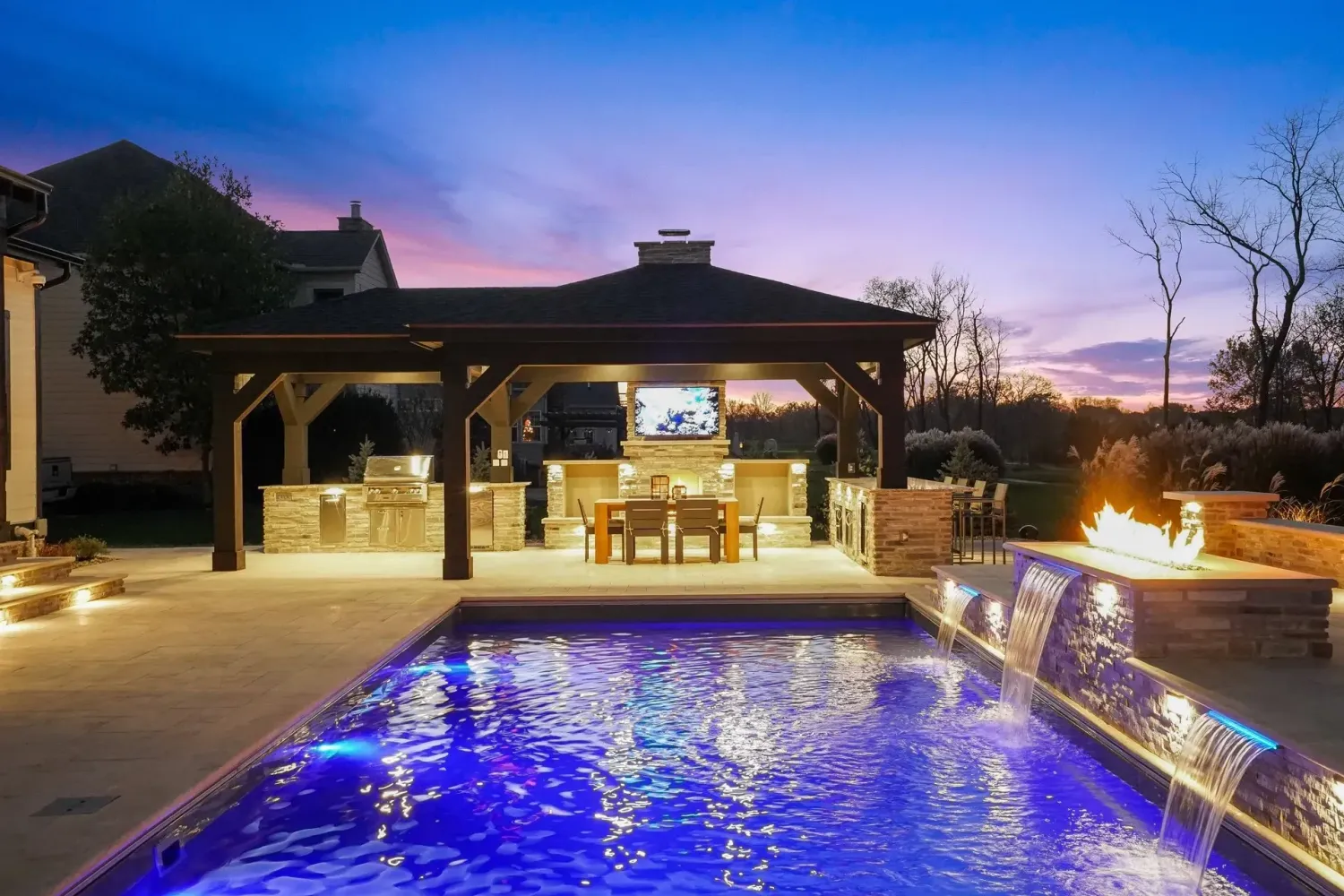
The Polo Fields build that started this article was signed in late February, permitted through Forsyth County by mid-March, poured in early April, tiled and plastered by early May, and running for Memorial Day. The owner reported back in October that they had been outside three to four evenings a week through the first cold snap. The backyard stopped being a seasonal feature. That, more than any single design decision, is why the raised wall with fire-and-water integration has become our most-recommended upgrade for Cumming-area custom pools.
Fire Pit & Fireplace Integrations Across 20+ Cities Within 30 Miles of Winder, GA
A raised bond-beam wall with fire bowls and a water sheet is not a casual upgrade — it is an engineering decision that reshapes your backyard’s usable calendar. We build these across Metro Atlanta, with permitting expertise in Forsyth County, Gwinnett, Cobb, and Cherokee.