
“The NFPA says ten feet. My builder says ten feet. So why did the Dawson County inspector make me move the pit?” That question came in from a homeowner off Hwy 53 last fall, and it’s the question that drives this entire post. The answer is that 10 ft is the floor, not the ceiling — and in Dawsonville it’s almost never the right number.
Here’s the short version: the National Fire Protection Association publishes a 10-foot clearance as a minimum for permanent outdoor fire features. That number assumes flat ground, no canopy, no prevailing wind of consequence, and combustion that stays contained. Dawson County doesn’t look like that. We sit at roughly 1,270 ft elevation in the southern foothills, with stony residuum underfoot, steeper-than-average residential lots, and a tree canopy that throws pine duff into the air every September. The real-world setback for a wood-burning pit in Foxcreek or Kensington Ridge is closer to 15 to 20 feet from the nearest combustible wall — and for a reason you can measure.
This post is the one we hand to homeowners before they spec a fire feature on a 0.45-acre lot. It walks through what the code actually says, what the permit office adds on top, how the canopy and wind rewrite your geometry, and then does the worked math on a typical Dawsonville parcel. If you want to know why your neighbor’s firepit ended up exactly where it did, keep reading.
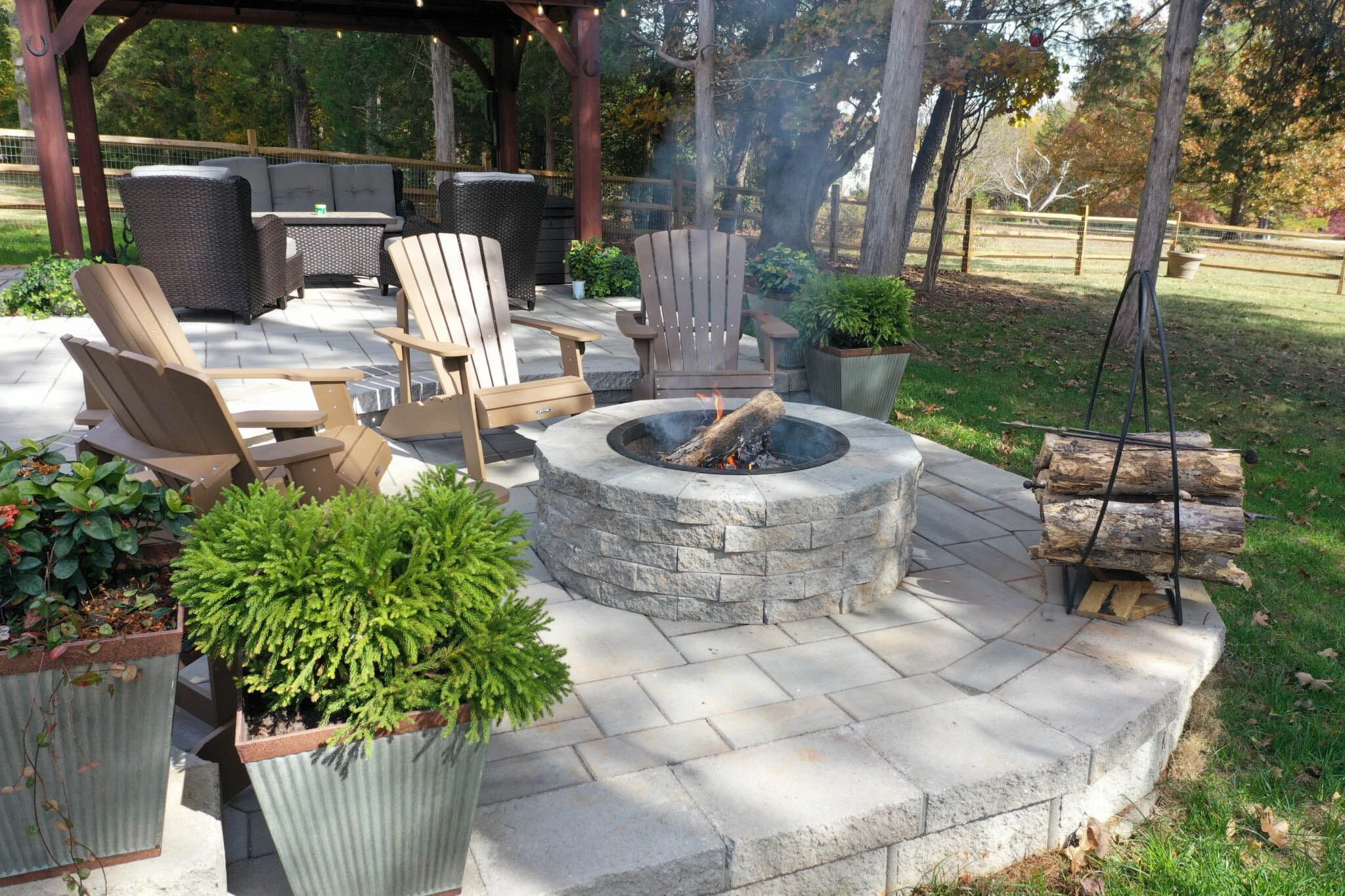
1. What the NFPA number actually covers — and what it leaves out
Open NFPA 1 Chapter 10 and the language is narrower than homeowners think. The 10-foot minimum separation from a structure applies to recreational fires with a fuel pile of no more than 3 ft in diameter and 2 ft in height. Move past that size and you’re into the “bonfire” category where the minimum jumps to 50 ft. Most homeowners never realize they’ve drifted out of the category they budgeted for — they size a 48-inch stone surround, load it with three splits of hickory, and the flame tip is now pushing the same heat radius as a permitted bonfire.
The other thing the NFPA number doesn’t cover: soffits, eaves, gutter runs, wood fences, cedar pergolas, and pine canopies hanging overhead. NFPA 1 addresses vertical clearance separately and most builders skip that clause. The wording we care about is “not within 12 feet of any combustible overhang.” In Chestatee and Etowah River Club where mature pines and hardwoods are the whole reason people bought the lot, that vertical line is where 80% of real-world setback issues come from.
So step one is understanding you have two numbers to solve for, not one. There is a horizontal setback from the house and outbuildings, and there is a vertical clearance to any combustible overhang. Failing either one puts the feature out of compliance, even if the paper drawing looks fine.
Two numbers, not one: NFPA 1 §10.11 requires a minimum 10 ft horizontal separation from any structure, AND a minimum 12 ft vertical clearance to combustible overhang. Both must be satisfied independently.
2. What Dawson County adds on top — the burn-permit layer
Dawson County Department of Planning & Development (25 Justice Way, Dawsonville) handles residential permitting, and they pull fire-feature review in tandem with the Dawson County Fire Department when the plan includes a wood-burning element. That secondary review is where the 10-foot minimum quietly becomes 15 to 20 ft in practice.
The county’s burn-permit framework treats a masonry wood-burning firepit as a recurring open-air combustion source, not as a single recreational fire. That classification changes the math. Inspectors routinely flag plans that sit below 15 ft from any structure wall with a combustible finish — cedar shake, board-and-batten wood siding, Hardie with wood trim details — because Dawson’s fire history in the GA-400 corridor includes several structure fires that started from ember drift off backyard wood pits during drought-category burn advisories.
Gas-burning features get easier treatment. A natural-gas or propane unit with a certified burner pan, a gas-pressure solenoid, and a remote shutoff typically clears at the NFPA 10-foot minimum without further question. That’s a real design lever. If the only way to fit the feature on your lot is to hold to 10 or 11 ft, the gas conversion is usually the cheapest path to approval.
Amicalola EMC service drops play into this too. If the feature is sited under the drip line of an overhead service lateral — and a lot of Dawsonville homes built between 1978 and 2004 have overhead service — the utility requires 10 ft horizontal clearance from conductor to nearest flame source independent of NFPA. We’ve redesigned feature placement three times in the past two years because the first location put the flame directly below an overhead service drop on a half-acre lot in Applewood.
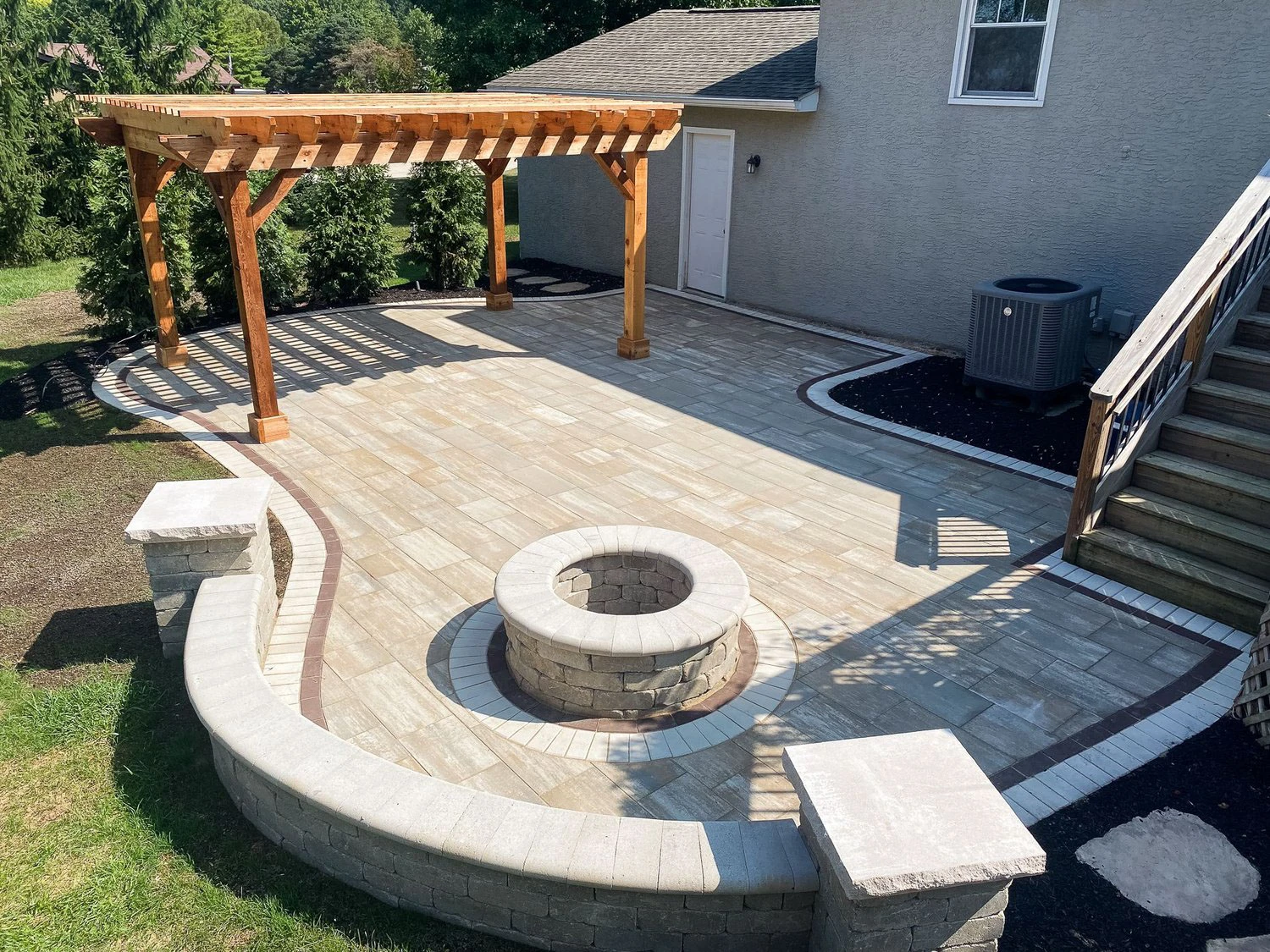
3. How tree canopy, wind, and topography rewrite your setback
Here is where Dawsonville parts ways with a flatter lot in Lilburn or Norcross. Three environmental factors push the practical setback outward from the paper minimum, and all three show up on almost every parcel north of Hwy 136.
Canopy: Loblolly pines drop resin-heavy needles that accumulate on roofs, in gutters, and in any horizontal crevice the wind can reach. Dry pine duff ignites at surprisingly low ember temperatures — we’ve logged fresh duff reaching autoignition at around 510°F under field conditions, well within the ember throw of a 3-foot-diameter wood fire at 15 ft. The fix is a 12-foot vertical clearance measured from flame tip to the lowest combustible overhang, not from the top of the stone surround. That usually means either pruning, relocating, or going gas.
Wind: Dawsonville’s prevailing summer wind is out of the southwest at 5 to 9 mph. Winter prevailing flips to the northeast, often gustier. That matters because it dictates which wall of the house actually sees the smoke and ember plume. A firepit sited on the west side of the house clears smoke away from the siding in summer but pushes it directly at the house every January. The right move on a rectangular lot is to place the feature on the downwind side of the envelope for the season you’ll use it most — and on a lot where you use it year-round, accept a longer setback on at least one axis.
Topography: Foothills lots aren’t flat. A 6-foot grade drop over 30 horizontal feet — common in Foxcreek and Mountain Laurel — means your firepit at elevation 100 is radiating at a house sitting at elevation 106. Heat rises. Ember throw from an elevated fire onto a house ABOVE it is minimal; onto a house BELOW it, meaningful. Always site the fire feature at the same elevation as the house envelope or lower. Never higher.
Dawsonville wind default: Summer SW at 5–9 mph, winter NE gusting higher. Site wood-burning features on the summer-downwind face unless a gas conversion lets you hold a tighter year-round setback.
4. Worked example — a 0.45-acre Dawsonville lot, optimized
Let’s put real numbers on a real-sized lot. A 0.45-acre parcel in Riverbend — say 130 ft wide by 150 ft deep — with a 2,600-square-foot ranch on a walk-out basement. Rear yard is roughly 130 ft × 70 ft of usable zone. Grade falls 4 ft from the rear foundation line to the back property line, and there’s a Loblolly canopy over the back third of the lot. Owners want a 54-inch-diameter wood-burning stone firepit with seating for eight.
First pass, most builders will sketch the pit 10 ft off the rear deck, centered on the house, under the canopy opening. That plan fails on three counts: it’s tighter than Dawson County’s practical threshold for wood-burning, the canopy overhang is 9 ft vertical (fails the 12-ft rule), and the seating ring pushes a guest within 6 ft of the deck post on the deep side — Fire Department won’t sign off.
Second pass: push the feature 18 ft horizontal from the rear wall, shift 12 ft east of centerline to get out from under the dominant pine canopy (opens vertical to 17 ft), and turn the seating ring so the longest arc faces southwest (summer downwind). That gives a compliant horizontal setback, compliant vertical, a seating arrangement that clears the deck structure by 11 ft, and a plume that drifts off the house envelope six months of the year. The homeowner loses 4 ft of lawn but keeps the feature.
The other lever: if the 18-foot setback eats too far into the play zone for kids, convert to a gas feature. A Warming Trends crossfire burner on a propane line drops the ember-throw risk to near zero, which lets us pull the feature back to 11 or 12 ft from the rear wall. That saves 6 or 7 ft of yard depth. On a quarter-acre lot that’s often the difference between a firepit and no firepit.
The setback-to-cost trade: A gas conversion on this lot runs roughly $3,800 to $6,200 above wood-burning cost (burner, valve, trenched gas line from meter, permit, inspection). It buys back 6 to 8 ft of usable rear yard.
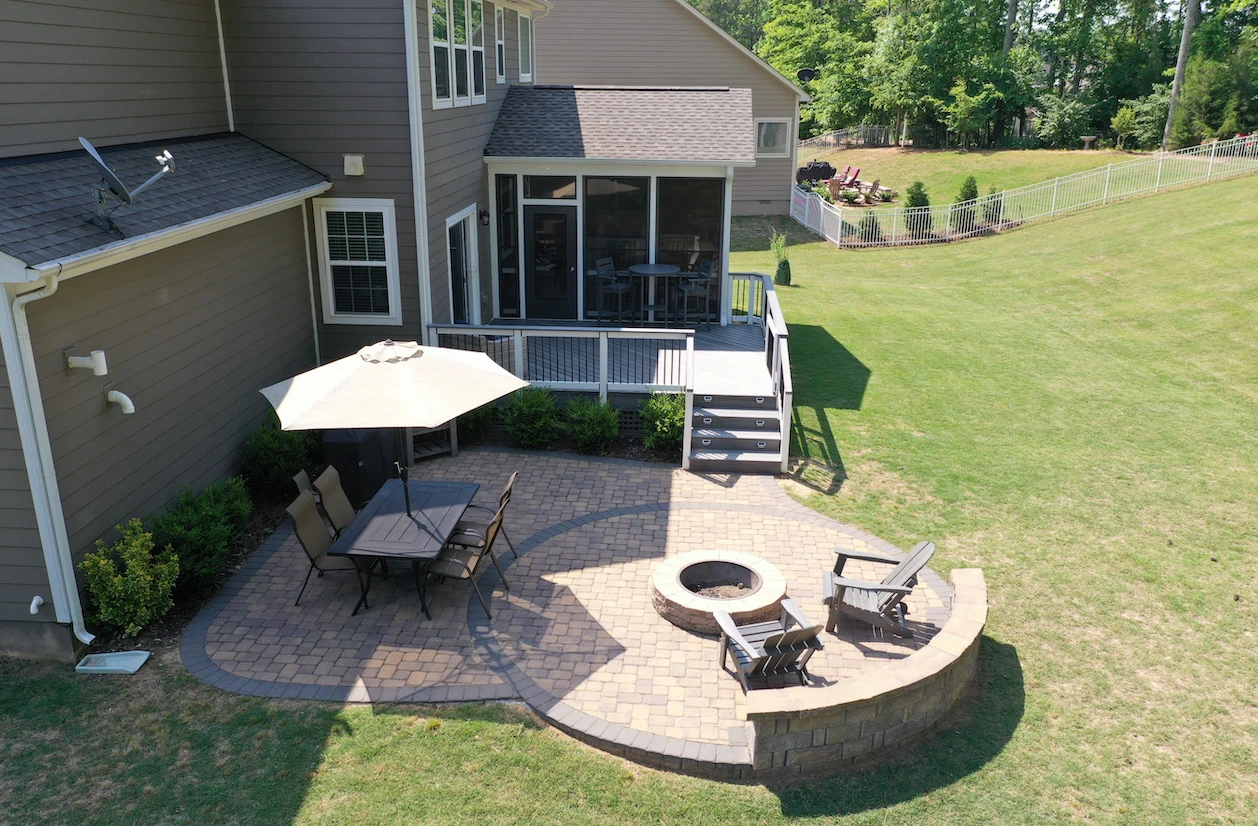
Rock and excavation — the hidden Dawsonville cost
Every Dawsonville fire-feature dig runs into the same thing: the stony residuum layer starts shallower here than anywhere else in the Primetime service area. Typical excavation depth for a masonry firepit footing is 24 to 36 inches, and on a lot in Etowah River Club or northern Mountain Laurel you’re hitting weathered granite and saprolite at 18 to 30 inches. That’s not a blocker — it’s a cost line.
On a clean Piedmont clay dig we price excavation at roughly $14 to $19 per cubic yard. When the dig turns up rock that needs mechanical breaking or, occasionally, an engineered blast charge on pool-depth excavations, the premium runs an additional $8 to $14 per cubic yard. For a firepit footing that’s a small number — maybe 2 to 4 yards of rock premium — but it’s worth pricing in up front. GA-400 access makes equipment trucking straightforward out of the southern metro; a 12,000-lb breaker attachment on a tracked skid steer gets on-site inside an hour from our Winder yard.
The upside of the rock layer: drainage is better than it is on Dacula clay. A Dawsonville firepit footing rarely needs the perimeter drain tile we’d spec in Gwinnett or Walton county. Water moves through the residuum and doesn’t pond under the slab.
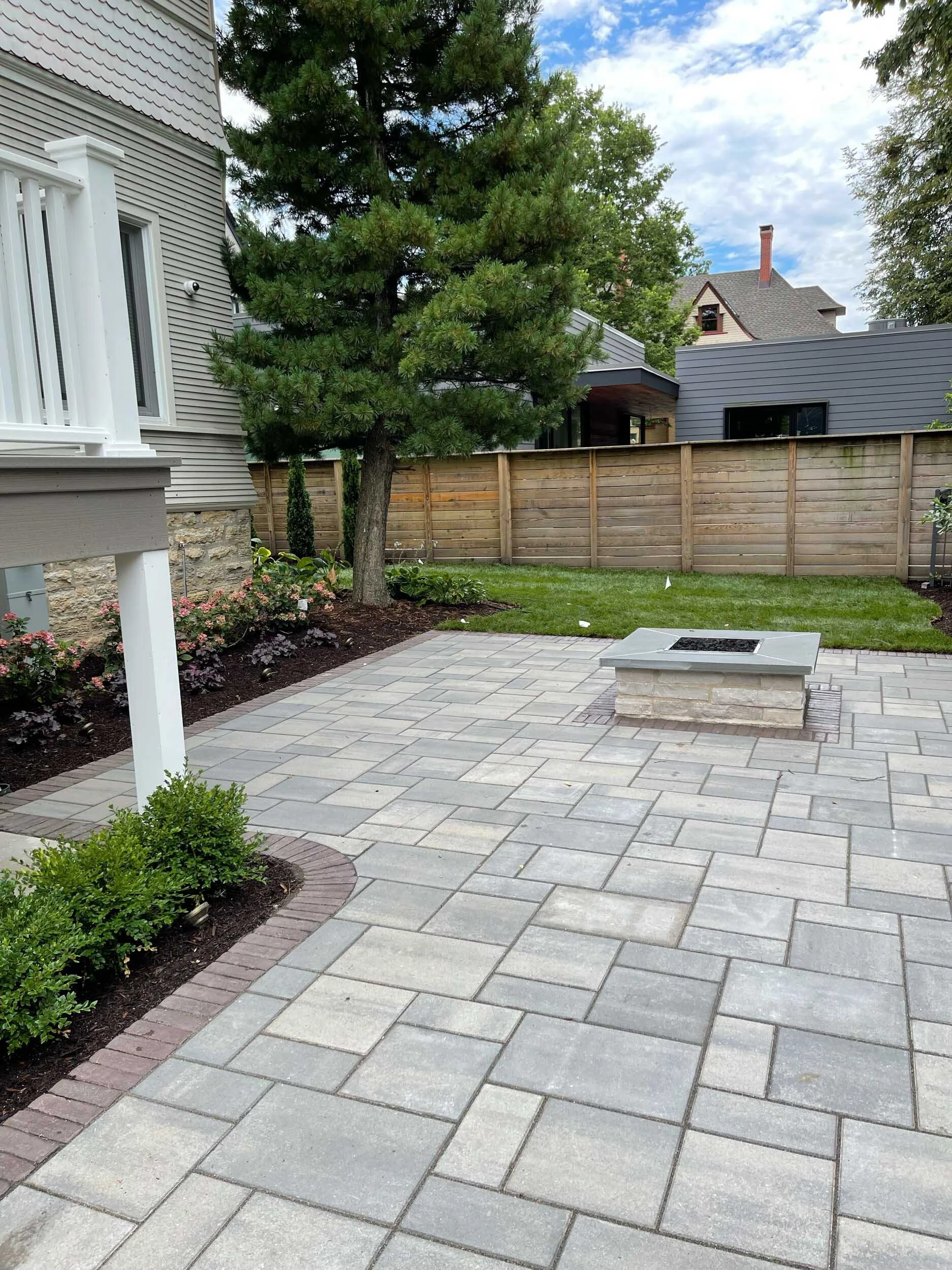
Freeze events and the mortar-line question
Dawsonville averages about 30 freeze events per year, compared with 20 in Dacula and 14 in Snellville. That’s a 50% jump in freeze-thaw cycles on any mortar joint you build. It matters for fire features because the mortar line around a firepit takes the worst of both worlds — absolute thermal shock from the fire side, then absolute freeze on the exterior face when nobody’s lit it in three weeks and a cold front rolls through.
Standard Type N masonry mortar is not the right call here. We spec Type S mortar rated for a minimum 1,800 psi on every Dawsonville fire feature, and we add a high-temperature refractory liner bed on the inner wall — typically a 1-inch poured refractory shell behind the stone veneer. That combination carries freeze-thaw durability into the 15-to-20-year range, rather than the 7-to-10 years we’d expect from a standard-mortar build at this elevation.
On gas features the refractory matters less because the flame is contained inside a burner pan — but the freeze exposure on the outer veneer is identical, so Type S stays.
Dawsonville spec defaults: Type S mortar (1,800+ psi), 1-inch refractory liner on wood-burning, 24–36 inch footing, 18 ft horizontal + 12 ft vertical clearance minimum on wood-burning designs.
When the permit office says no — common rejection reasons
Three specific flags come up consistently on Dawson County fire-feature plan review:
- Proximity to property line. County code layers a separate 10-ft setback from any property line onto the NFPA structural setback. On lots under half an acre you can trip this before you trip the house setback.
- Septic field intrusion. Most Dawsonville lots outside the Etowah River Club sewer district run on septic. Dept. of Health will reject any masonry footing that sits within 10 ft of a leach field or 5 ft of a septic tank cap.
- Overhead service drop. Amicalola EMC requires 10 ft from any live conductor to the nearest flame source. On older homes this often forces a lot-plan change, not just a feature location change.
The practical workflow: before anyone swings a shovel, we overlay the septic as-built, the EMC service drop, the property-line setback, the structural setback, the canopy line, and the wind rose on a single scaled site plan. The feature goes where all six circles overlap. On a constrained lot there’s often only one small window that works — and finding it on paper is 10 times cheaper than finding it after the footing is poured.
Why homeowners get this wrong even when they hired a contractor
Most pool and hardscape contractors pull fire features off a catalog spec sheet that quotes NFPA 10 ft and moves on. The NFPA number is accurate for the category of feature it addresses — a 3-ft-diameter recreational fire on flat, open ground. It is not accurate for a 54-inch stone-surround wood feature under a Dawson County canopy on a 6-foot grade drop. The contractor isn’t lying; they’re answering the wrong question.
The right question is: given this specific parcel, this specific feature size, this specific fuel type, and this specific county, what’s the setback that passes inspection and performs safely for 20 years? That requires a county-specific framework — the one above — not a number pulled off a data sheet. If you’re evaluating a builder for a Dawson County fire feature and the first answer out of their mouth is “10 feet, same as everywhere,” you’re not getting the right answer.
We build in Dawsonville because we’ve learned the soil, the elevation, the code layering, and the utility rules specific to Amicalola EMC and Dawson Planning & Development. That’s not a marketing claim — it’s what makes the setback math come out right on a real lot with real trees and real grade.
Fire pits and fireplaces designed for the real-world setbacks of Dawson County and 20+ cities within 30 miles of Winder, GA
Setbacks, canopy clearance, wind direction, and freeze cycles are not one-number problems — and we’ll walk your site before we quote the feature.