
Fiberglass manufacturers love to sell you a pool in a week. What the glossy brochure never mentions is what a 30-degree overnight temperature swing does to a gelcoat-skinned plastic shell sitting in Gwinnett County’s shrink-swell red clay, or why shells that perform beautifully in central Florida develop hairline spiderwebs and coping separation in their second winter off Hog Mountain Rd.
We build custom pools in Dacula. We choose not to install fiberglass here, and the reason isn’t brand loyalty to shotcrete or an allergy to anything pre-fabricated. The reason is physics. Specifically, the physics of a fiberglass-reinforced polyester (FRP) shell with a thermal expansion coefficient roughly three times higher than the cementitious backfill and rigid coping it’s bonded to, sitting in a Piedmont clay soil that swells when wet and shrinks when dry, in a climate that hits the freeze-thaw threshold about 20 times every winter.
This post unpacks that physics. Not the marketing version, not the quick-comparison-grid version. The actual materials science — thermal expansion coefficients, water absorption rates, shell flex tolerances, and the way freeze-thaw cycles work on a closed-cavity coping joint — applied to real Dacula job sites we’ve walked. If at the end you still want a fiberglass pool, that’s a legitimate choice. But you should make it with open eyes, not because someone in a tent at a home show told you “fiberglass is zero maintenance.”
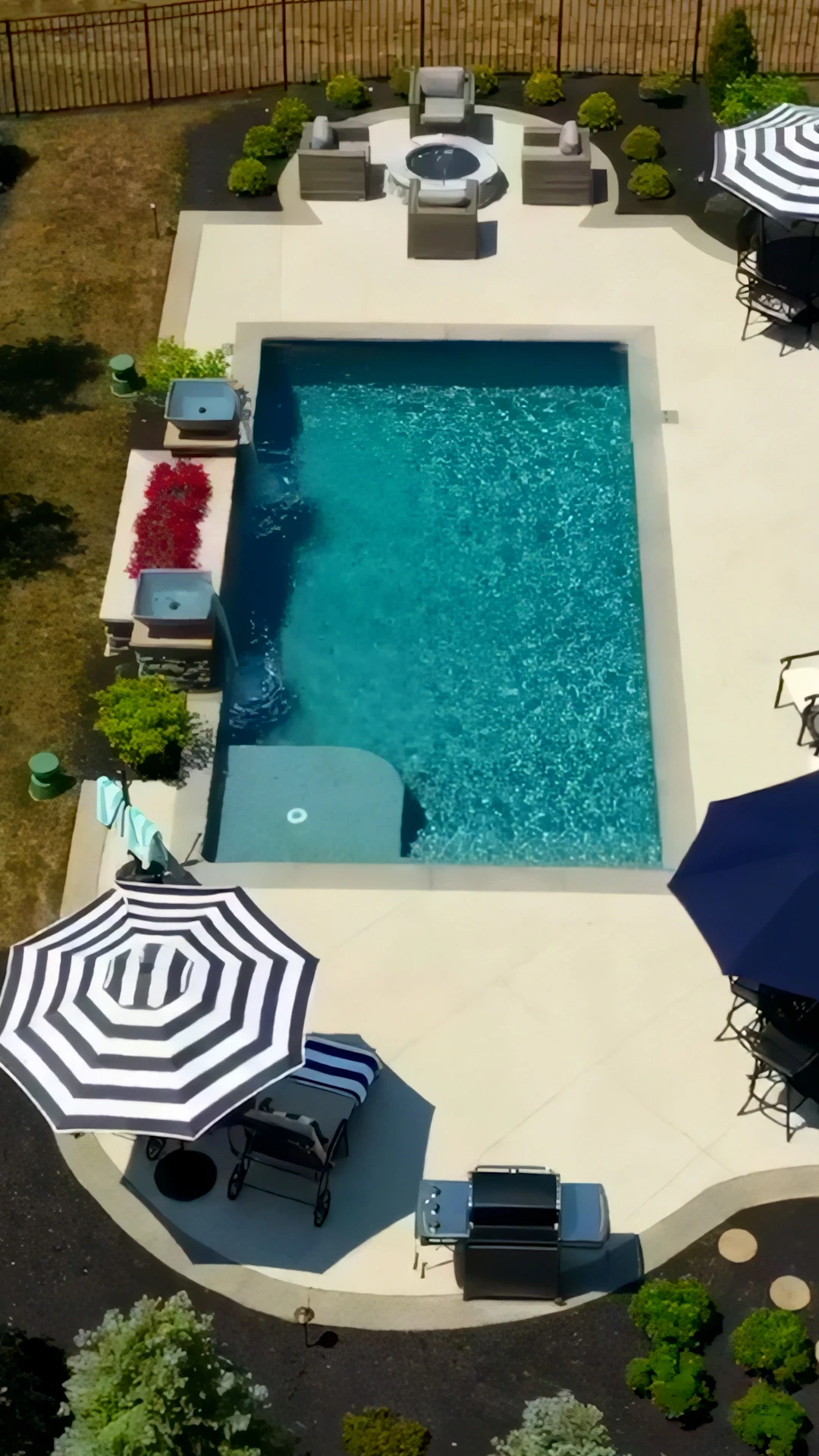
The Thermal Expansion Problem Nobody on a Sales Call Will Draw Out
Every material expands when heated and contracts when cooled. The rate at which it does this is called the coefficient of thermal expansion, measured in inches per inch per degree Fahrenheit. For practical pool construction in Dacula, here are the numbers that matter:
- Fiberglass-reinforced polyester (FRP) shell: approximately 15–20 × 10⁻⁶ per °F
- Gunite/shotcrete: approximately 5–7 × 10⁻⁶ per °F
- Travertine or concrete paver coping: approximately 4–6 × 10⁻⁶ per °F
- Compacted granular backfill (pea gravel): negligible (the material just shifts)
Read those numbers carefully. A fiberglass shell wants to expand and contract roughly three times as much as the gunite, coping, stone veneer, or concrete deck it’s glued to at the waterline. Manufacturers know this. That’s why fiberglass coping is typically a narrow overhang bonded with a flexible sealant, not a structural bullnose integrated into the shell.
Now add Dacula’s January diurnal temperature swing. A cold front rolls through on a Monday evening — clear sky, low humidity, radiational cooling. By 3 a.m. the air is at 24°F. The pool water itself, if filled, is buffered at around 42°F. By 2 p.m. the next afternoon, air temperature is 54°F and the sun is hitting the south-facing coping stones directly at a 42-degree angle. The coping surface reads 78°F on an infrared thermometer. That is a 54°F daily swing at the bond line between the fiberglass flange and the rigid coping, and it happens 15 to 25 times every Dacula winter.
On a 32-foot-long pool, the fiberglass shell is expanding and contracting along the coping line by roughly 0.030 inches each day relative to the stone. Over 90 cold-season days, the bond line sees more than 2,700 individual micro-movements. Flexible polyurethane sealant is rated for about 25% elongation before fatigue failure. You do the math. Or you drive past a fiberglass-coping failure at 4 years old and look at the caulk joint — it’s separated, grass is growing in the gap, and the homeowner has started calling pool companies.
Thermal expansion, applied: Fiberglass FRP expands ~15–20 × 10⁻⁶ per °F; gunite expands ~5–7 × 10⁻⁶ per °F. On a 32-foot shell in Dacula’s 54°F January diurnal swing, the fiberglass-to-coping bond line moves roughly 0.030 in per day — over 2,700 cycles per winter — against a sealant rated for limited elongation before fatigue.
Why Gunite Doesn’t Have This Problem
A shotcrete shell and a travertine bullnose coping are thermal cousins. Their expansion coefficients are within 20% of each other. When the temperature drops, they contract together. When the sun bakes them at 2 p.m., they expand together. The mortar bedding the coping onto the bond beam sees a tiny differential movement — well within the elastic range of the Type N or Type S mortar used — and nothing fatigues.
That’s why a properly built gunite pool in Dacula, with travertine coping set in a full mortar bed on a poured bond beam, can run 25 or 30 years without ever needing the coping joint re-caulked. It’s not better craftsmanship. It’s physics doing less work at the bond line.
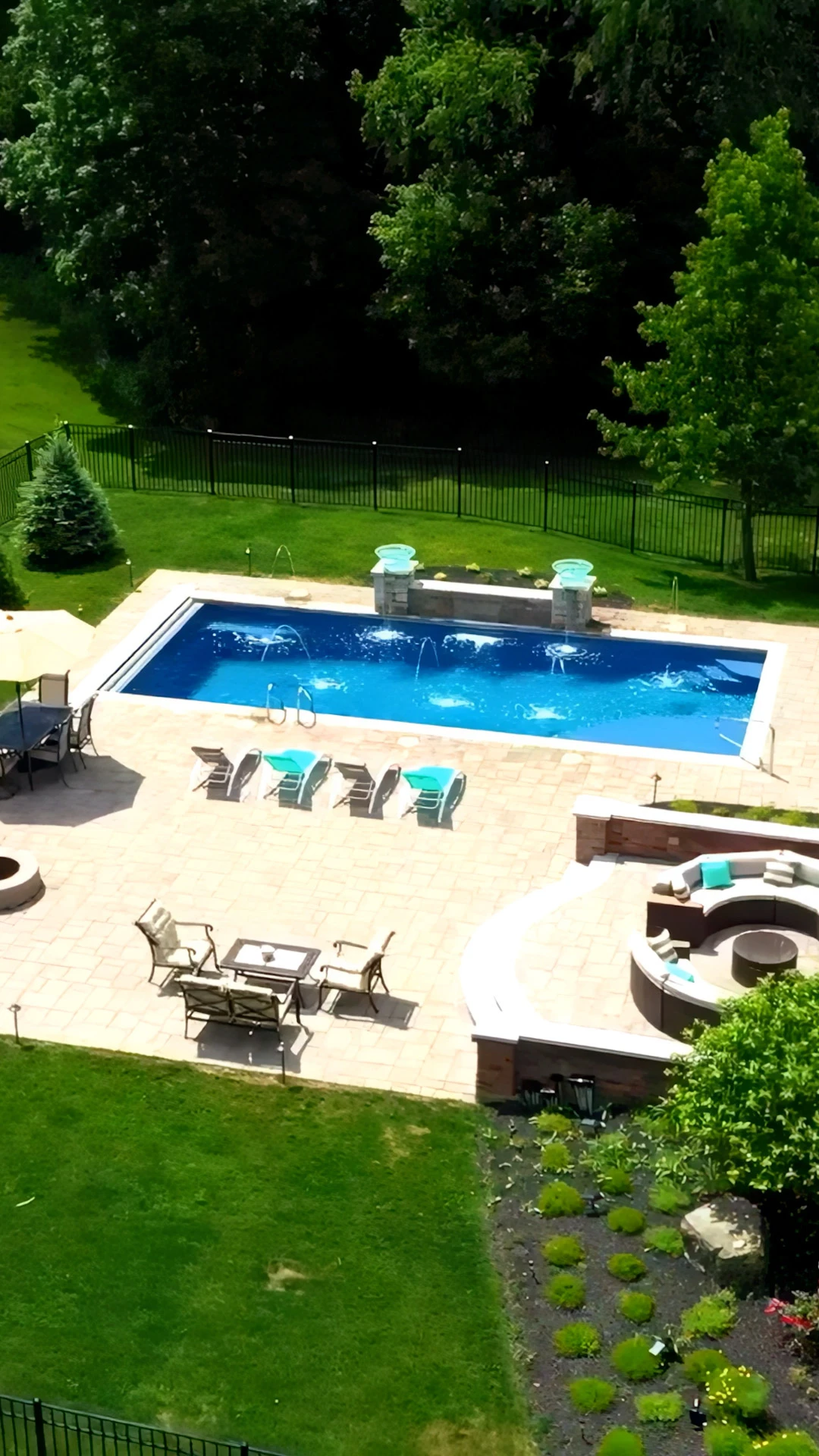
Water Absorption, Gelcoat Osmosis, and the Freeze-Thaw Multiplier
Here is the second physics problem, and in our field experience it’s the one that kills more fiberglass shells in northeast Georgia than any other factor.
A fiberglass pool is not waterproof in the way most homeowners think. The polyester gelcoat on the inside of the shell — the smooth, glossy finish — has a water absorption rate of approximately 0.2 to 0.4% by weight over the long term. That’s two to four grams of water per kilogram of gelcoat, soaked into the resin matrix over 3 to 7 years of continuous immersion. For comparison, properly cured shotcrete with a standard plaster finish absorbs less than 0.05% — roughly one-tenth the rate.
So far, not a problem. Water in resin is fine as long as it stays liquid. But this is Gwinnett County, and this is where Piedmont clay soil and USDA Zone 8a climate collude against the manufacturer’s warranty language.
In late fall and early winter, that absorbed water sits inside the gelcoat matrix at around 42°F in the shell wall. When a hard freeze drops soil temperature down into the mid-20s at the pool’s backfill depth — which happens reliably 6 to 10 times a winter in Dacula, especially on north-facing slopes off Hamilton Mill Pkwy — that absorbed water crystallizes. Ice occupies 9% more volume than liquid water. The gelcoat is a rigid composite with no room to expand. Each freeze event opens a microscopic void. Thaw, refill, re-freeze. Repeat.
Field result: the osmotic blistering manufacturers grudgingly acknowledge as “cosmetic” in Florida becomes full-on gelcoat crazing in Dacula by year 5 to 7. We’ve cut core samples from failed shells in Sycamore Ridge and in an infill lot near Little Mulberry Park. The gelcoat back-face, where it bonds to the fiberglass mat, shows a spider pattern of micro-cracking that transmits directly through to the interior surface. Once the cracking reaches the laminate, water penetrates the structural layer, and the shell is past the point of cosmetic repair.
Gunite simply doesn’t have this failure mode. Properly mixed and placed shotcrete at 4,000 psi is dimensionally stable against freeze-thaw cycling when the water-cement ratio is controlled and air entrainment is present in the mix. The plaster interior, at less than 0.05% absorption, never carries enough water to crystallize destructively. This is a 100-year-old material science problem that concrete solved in the 1930s.
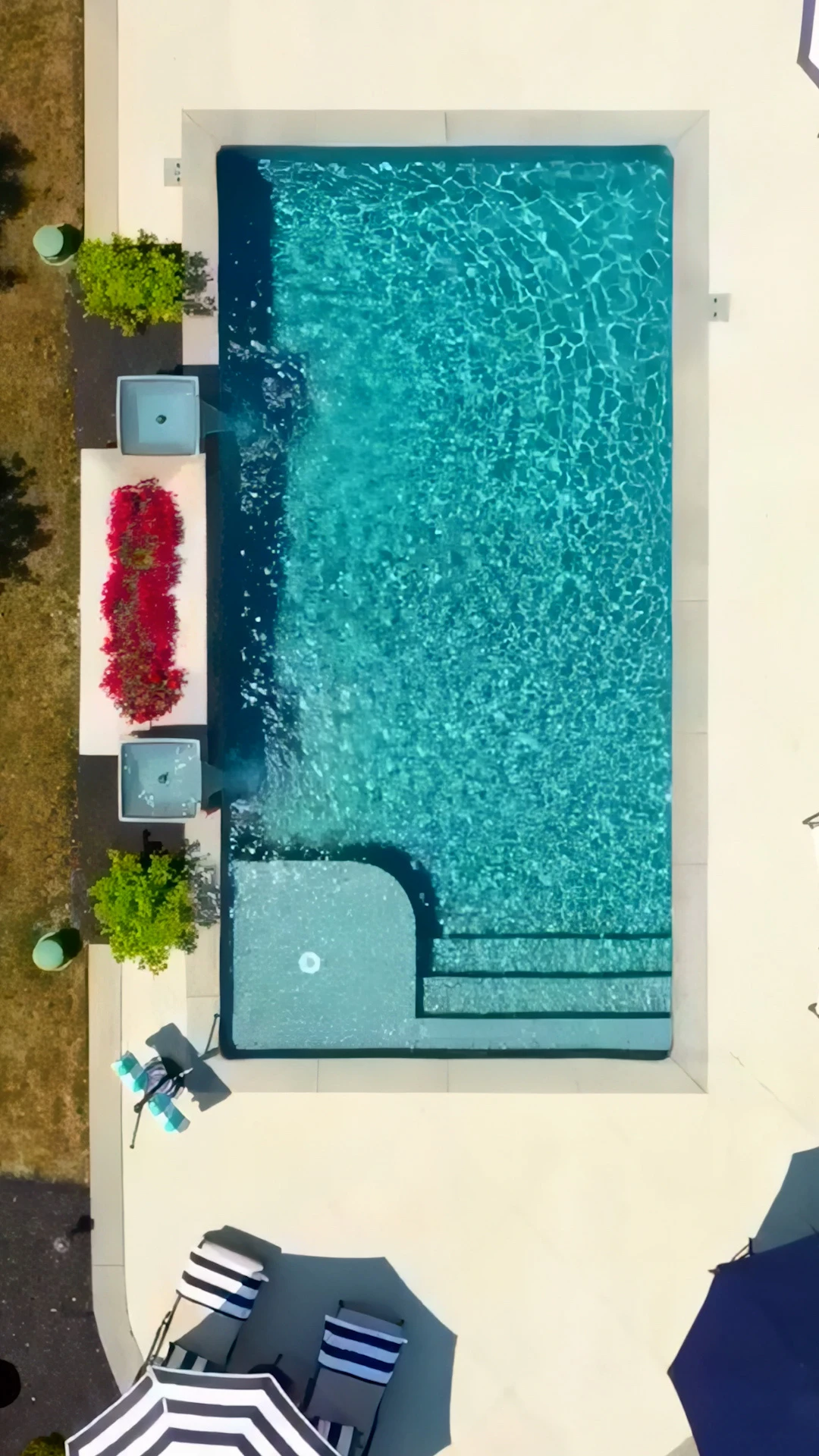
Shell Flex, Backfill, and What Expansive Clay Does Underneath
The third physics problem is the one fiberglass installers talk about least publicly and the one we see most often on remodel estimates — shell deflection under Gwinnett’s shrink-swell Cecil-series clay.
A fiberglass shell is not a rigid structure. It’s a flexible composite engineered with intentional give. Manufacturer specifications typically allow shell flex in the range of 0.2 to 0.4 inches per 100 linear feet of pool perimeter over the service life of the shell. That’s considered normal and acceptable from the factory. For comparison, a properly engineered gunite shell is designed for essentially zero measurable deflection — less than 0.05 inches over the same span — because the shotcrete plus rebar cage plus bond beam acts as a monolithic rigid tank.
Now consider the soil this shell sits in. Piedmont Cecil-series topsoil in Dacula runs over saprolite with weathered granite bedrock at depths typically between 8 and 18 feet. The clay itself has a plasticity index of roughly 15–25, which classifies it as moderately expansive. Wet it in March after a week of storms rolling in off I-85, and the soil volume increases 6 to 12 percent. Let it bake dry under a July drought, and it shrinks back, opening vertical cracks an inch wide in unprotected sections.
Around a pool, this means the backfill zone — the 18-inch space between the shell wall and the native excavation — is under constant seasonal pressure cycling. With fiberglass, two things happen: the flexible shell bows inward when the clay swells, and when the backfill isn’t a properly graded structural gravel all the way to grade, the shell can settle non-uniformly and hold its deflected shape. Once the shell is out of true, the coping starts to telegraph hairline cracks, the skimmer pulls away from the deck slab, and the liner step in the plumbing shifts far enough that the face-piece gaskets start to weep.
A gunite shell in the same soil doesn’t deflect. It cracks hairline cosmetically in the plaster if the rebar cage is undersized or if the soil engineer’s drainage recommendations were ignored, but the structural shell itself remains dimensionally stable. Repairable. Re-plasterable. Still a tank.
The Delivery-Day Problem Nobody Mentions
There is also a practical constraint in Dacula that has nothing to do with materials science and everything to do with geography. Fiberglass shells ship as single-piece units on flatbeds, typically 40 to 45 feet long and 15 to 16 feet wide. They require crane placement — and that crane needs a minimum 12-foot-wide clear corridor from the street to the pool pad, with no overhead utility lines, no mature hardwoods across the path, and enough hardstand for an 80-ton crane to set up and swing.
Hamilton Mill and the Chandler Ridge tracts have that kind of access on about one in five lots. Older Dacula infill subdivisions on 1/3-acre lots built between 1995 and 2005 almost never do. Even when access exists, the crane setup alone adds $3,500 to $6,500 to the project cost, and if a neighbor’s mature hickory needs limbing to clear the swing arc, the homeowner is writing another check for arborist work plus a reimbursement to the neighbor.
A gunite build requires no crane. Rebar comes in on a rack truck, shotcrete comes in a pumper hose that can snake 200 feet around a house, and the crew builds the shell in place. On Dacula’s narrow-access lots, this alone is often the deciding factor — not because fiberglass can’t be installed, but because the logistical cost erases the installation-time savings that was supposed to be the selling point.
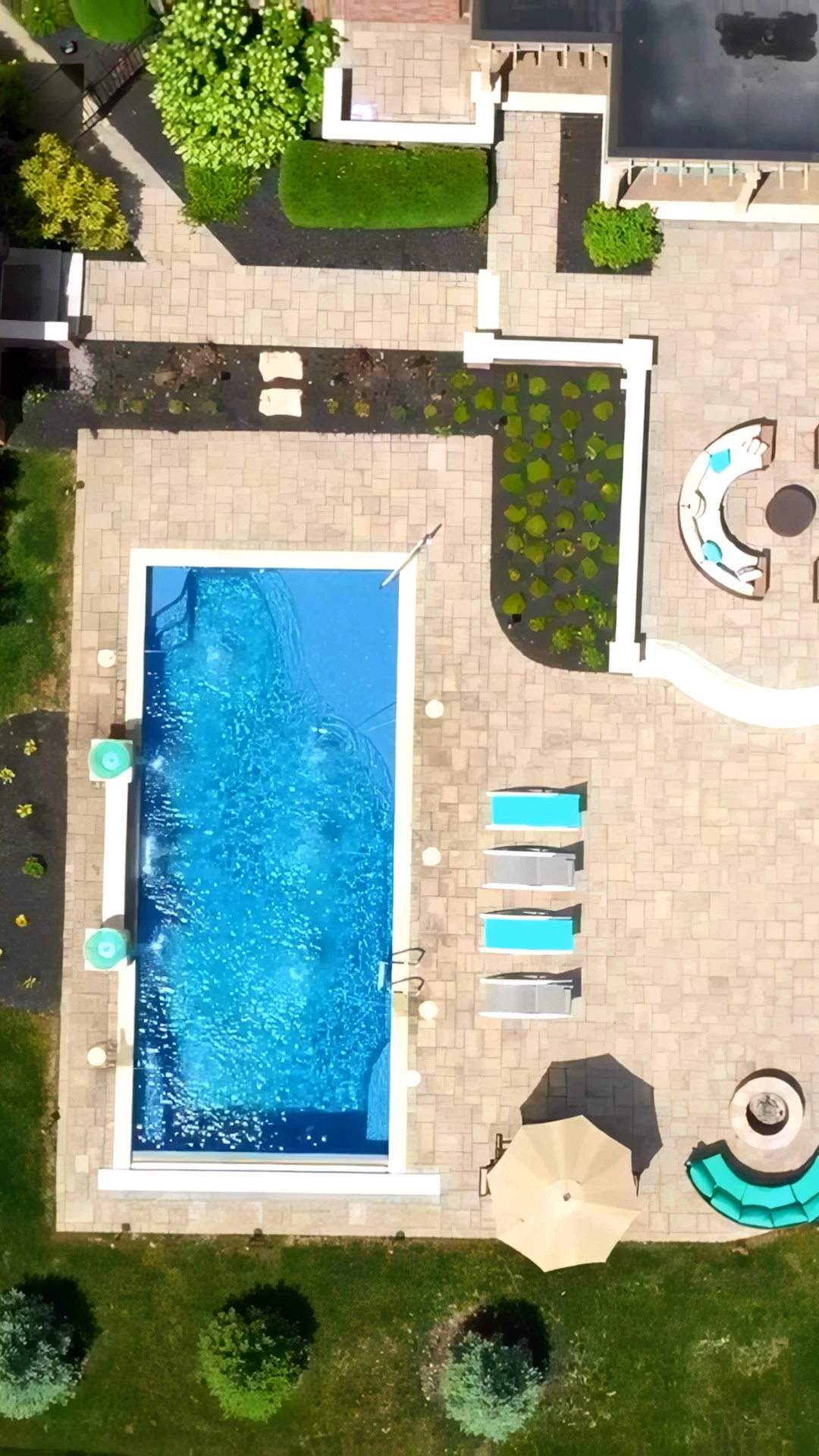
What We Tell Dacula Homeowners Who Are Still Considering Fiberglass
We are not anti-fiberglass. There are markets where fiberglass is an excellent choice — central Florida on sandy loam with no freeze risk, Phoenix on stabilized desert pads with no shrink-swell soils, coastal California where the shells can be installed on well-drained grade. In those markets, the material’s strengths (factory-controlled laminate quality, predictable lead times, smooth interior finish) line up with a climate and soil profile the engineering was designed for.
Dacula is not that market. The specific combination of the climate and the soil stacks three independent failure modes against the material:
- Thermal differential at the coping bond line — fiberglass expands at roughly three times the rate of the stone it’s glued to, cycling 2,700+ times per winter.
- Gelcoat water absorption plus freeze crystallization — gelcoat takes on 0.2–0.4% water over years; freeze cycling opens microfractures through the gelcoat-to-laminate bond.
- Shell flex in shrink-swell clay — the factory-tolerant 0.2–0.4 in/100ft flex becomes a structural deformation when Cecil clay cycles wet-dry seasonally.
Any one of these is manageable in isolation. Stacked, they produce the repair calls we see most often on fiberglass shells older than 6 years in Gwinnett: gelcoat crazing, coping separation, shell deflection, and in the worst cases, structural laminate failure that is not cosmetically repairable.
Our recommendation for Dacula is almost always the same. Gunite shell. Shotcrete at 4,000 psi with controlled water-cement ratio and air entrainment. #4 rebar cage on 12-inch centers with waterline bond beam. Plaster, pebble, or quartz interior finish selected for chemistry and aesthetic preference — not for freeze resistance, because it’s already freeze-resistant. Travertine or full-thickness paver coping bedded in Type N mortar directly on the bond beam. Structural drainage gravel backfill with a compacted perimeter to prevent hydrostatic pressure spikes during heavy-storm saturation.
That specification costs 20–35% more upfront than an equivalent fiberglass shell installation. It also outlasts it by a margin that pencils out clearly over any 20-year ownership horizon, and it lets you design the pool you actually want — sun shelves wider than a shipped mold allows, attached spas with raised column piers, curved seat walls, and coping that lines up flush with a travertine deck. That design freedom is inherent to on-site formed construction. It disappears entirely when your pool shape has to fit in a standard 8-foot-6-inch highway-width shipping envelope.
Ownership Economics Over 20 Years
Here is the line-item comparison we walk clients through during a consult, using Dacula-typical numbers for a 16×32 pool with integrated spa and 900 square feet of paver deck. A comparable-footprint fiberglass package typically lands between $68,000 and $82,000 installed, including the crane set and the flexible coping system. The same project built in gunite typically runs $88,000 to $108,000 installed with travertine coping and a bonded deck. That’s a delta of roughly $18,000 to $28,000 at signing.
Now run the ownership tail. A fiberglass shell in Dacula frequently needs its first significant caulk-joint refresh at years 3 to 5, a full coping re-seal at years 6 to 8, and depending on shell condition, either a gelcoat resurfacing ($12,000–$22,000) or a full replacement decision between years 10 and 15. The gunite shell, properly specified with air-entrained mix and structural backfill, is typically on a 10-to-14-year plaster refresh cycle at $6,500 to $11,000, with the shell itself untouched. Over a 20-year window, the gunite pool usually comes in $8,000–$18,000 cheaper in total ownership cost — before factoring in the design freedom value or the resale premium on a pool that doesn’t show visible cosmetic fatigue at showing time.
A note on fiberglass warranties: Read the structural warranty language carefully. Most manufacturers warrant against “structural failure” only — defined narrowly as shell collapse or catastrophic cracking. Gelcoat crazing, osmotic blistering, cosmetic spiderweb, coping separation, and shell flex-related settlement are almost always excluded or covered for a much shorter period (often 3 to 5 years, prorated). The headline “25-year warranty” usually does not cover the failure modes described in this post.
If you’re reading this and you already own a fiberglass pool in Dacula, the guidance doesn’t change: keep the water chemistry tight, keep the coping caulk inspected every fall before the first freeze, and address settling issues before they compound. Your shell can absolutely deliver another 10 or 15 years of service if you catch the early-stage issues. The physics described here are cumulative, not catastrophic overnight.
But if you’re reading this before the pool is in the ground, the decision is worth a second conversation. Bring in two bids — one for the fiberglass package you’re considering, one for a comparable gunite build. Compare not just the installed price, but the 20-year ownership cost, the warranty language, and the design freedom. In Dacula specifically, the math has landed the same way every time we’ve run it with a client who actually worked through the numbers.
Custom gunite pool construction across 20+ cities within 30 miles of Winder, GA
Engineered for Piedmont clay, Zone 8a freeze cycling, and a 25-to-30-year service life — not for a weekend install and a warranty-expiration surprise in year six.