
There are four winterization mistakes that account for nearly every expensive equipment failure we pull out of Dawsonville backyards between November and March. Miss any one of them and you are looking at $3,200 to $6,800 in replacement parts before Memorial Day — on a job that costs $280 to $420 to do correctly.
Dawsonville sits at roughly 1,270 feet of elevation — the highest residential terrain in the Primetime service area. That altitude, combined with the cold-air drainage off the Etowah River valley and the ridges east of GA-400, produces an average of 30 freeze events per year. That is ten more freeze-thaw cycles than Dacula or Snellville see, and every one of them is a stress test on PVC unions, copper heat exchangers, polypropylene pump volutes, and salt-cell titanium mesh.
The four failures below — in order of how often we replace them for clients in Foxcreek, Riverbend, Mountain Laurel, and the Etowah River Club — are not exotic. They are boring. They happen because somebody skipped a drain plug, trusted a closed valve, or forgot that a heat exchanger has to be physically blown clear of water. This post walks you through each one, what it costs when it fails, and exactly what gets checked on a proper 30-freeze winterization visit.
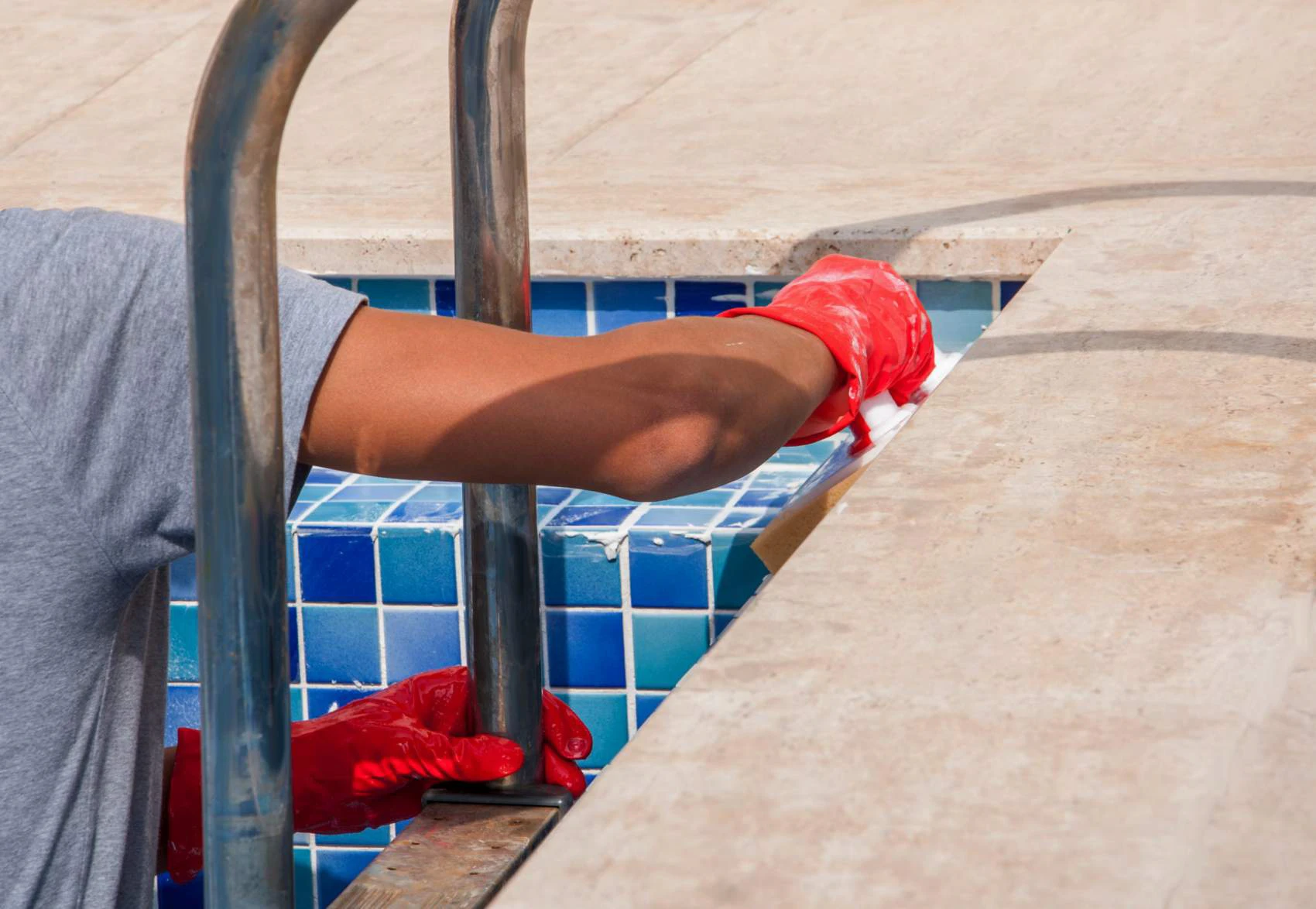
Failure #1: Skimmer Lines That Were Never Blown Clear
Roughly 60% of the freeze-cracked plumbing we dig up in Dawsonville every spring traces back to skimmer suction lines. The failure pattern is almost identical every time. The homeowner dropped the water level below the skimmer mouth in October, assumed that was enough, and never got compressed air into the line itself.
Here is what actually happens. The skimmer throat drains, yes — but the horizontal PVC run from the skimmer basket down to the equipment pad is buried 24 to 36 inches below grade, pitched very slightly back toward the pool. Water sits in the belly of that line. In a Piedmont yard at 900 feet of elevation, frost pushes maybe 4 inches deep and the pipe rarely sees freezing temps. In 30534 — Dawsonville — frost routinely drives 8 to 10 inches down, and on a thin-soil rocky lot in Mountain Laurel or the Chestatee neighborhoods, the pipe itself is sitting in saprolite that conducts cold far better than Cecil clay.
When the water inside that line freezes, it expands 9%. PVC has no give. The pipe splits lengthwise, usually at a fitting shoulder. You do not see it until April when the skimmer starts losing prime and the equipment pad floods every time the pump turns on.
What this costs when it fails: Locate-and-excavate for a cracked skimmer line runs $1,400 to $2,600 depending on whether the break is under the pool deck or open yard. If the crack is beneath a poured concrete or paver deck, add $800 to $1,500 to cut, repair, and patch the deck. A proper blow-out of the skimmer line during winterization takes 6 minutes.
How to tell yours was done right
Three checks. First, the skimmer should have a gizmo or rubber winter plug physically seated in the suction port — not just the basket removed. Second, the valve at the equipment pad controlling that skimmer line should be set to the closed position with an air pocket behind it. Third, you should have watched (or had photographed) your pool tech run 30 to 40 PSI of compressed air through the skimmer line for at least 90 seconds until bubbles stopped rising from the skimmer port. Any of those three missing, the line was not winterized.
Failure #2: Pump Housings That Were Not Drained
The second-most-common failure we see on the December-through-February emergency calls is a cracked pump volute. This one is almost always avoidable and almost always expensive. A Pentair IntelliFlo3 variable-speed pump retails for $1,850 to $2,200. A Hayward TriStar VS is in the same range. When the volute cracks, the motor is fine — but the pump head is a single-piece casting and it is not repairable. You replace the whole wet end.
The mechanism is simple. Pump housings hold roughly 1.5 gallons of water between the suction and discharge ports. Two drain plugs — one at the bottom of the volute, one at the bottom of the pump basket chamber — have to come out physically. Not loosened. Removed. Set in a Ziploc bag taped to the pump lid so you can find them in March. If either plug stays in, water sits in that chamber, freezes, and splits the housing on a single 26°F night.
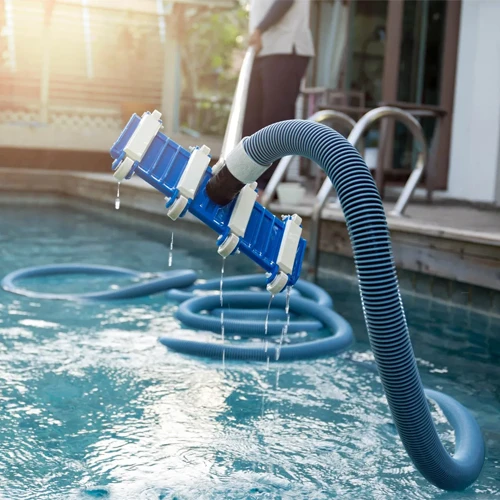
Why Dawsonville is worse on this than metro Atlanta
Equipment pads in the foothills are almost always positioned away from the house for noise — which in the older split-levels on half-acre Foxcreek and Applewood lots means the pad sits 40 to 80 feet from any exterior wall. No ambient heat bleed, no foundation-effect. On a 22°F night with a clear sky, a pump housing on an exposed pad in Dawsonville hits ambient air temp within 90 minutes. A pump pad tucked against a warmed basement wall in Dacula stays 15°F warmer through the same night. Same equipment, very different freeze exposure.
The two drain plugs, named: Most current Pentair and Hayward pumps use a 3/8″ square-drive plug at the volute and a 1/2″ hex plug at the basket chamber. If your tech pulled only one, the housing is not drained. Both out, always.
There is a secondary pump failure pattern worth naming — the shaft seal. When the pump volute drains properly but the seal cavity still holds a teaspoon of water, freezing pops the ceramic seal face. The pump runs fine in April but leaks steadily at the seal plate. That is a $180 to $240 repair if caught early, a burned-out motor if ignored for a season.
Failure #3: Heater Heat Exchangers That Split at 28°F
This is the most expensive single failure in the Dawsonville freeze data. A cupronickel heat exchanger inside a natural-gas pool heater — Pentair MasterTemp, Raypak 406A, Hayward H400 — holds roughly 3 to 4 gallons of water distributed across dozens of thin-wall copper tubes. Those tubes have almost no expansion tolerance. One freeze event with undrained water inside and the tube bundle splits, usually in multiple locations simultaneously.
Replacement heat exchangers run $1,400 to $1,900 in parts alone. Labor to pull the heater shroud, disconnect gas, swap the exchanger, and re-fire the unit adds another $600 to $900. Total damage from a single skipped winterization step: $2,000 to $2,800. We see this failure three or four times a spring in the Kensington Ridge and Big Canoe corridors, almost always from a homeowner who closed their pool themselves and didn’t know a heater had to be independently drained.
Why 28°F is the death threshold
Heaters have internal bypass check valves designed to keep water moving through the exchanger when the pump runs. When the pump is off and the system is static, water sits in the tubes. At 32°F the water starts forming ice crystals. Copper has a coefficient of expansion that can tolerate about 1% elongation before yielding. Ice expansion at 28°F is already past that threshold on the narrow 5/8-inch tubes. A 20°F Dawsonville morning — which happens roughly a dozen times between mid-December and late February — is twice the margin required to split tubes.
The fix is mechanical, not chemical. You open the header drain petcocks on both the inlet and outlet manifolds, you tip a shop-vac blower into the skimmer side of the plumbing, and you push air through the heater until no more water comes out of the drains. Then you plug the inlet and outlet. Ten minutes of work. No antifreeze required if done correctly.
Failure #4: Salt Cells Killed by Chloride + Freeze
If your Dawsonville pool is salt-chlorinated — and roughly half the new builds we do in Dawson County are — there is a fourth failure pattern you will not read about in generic winterization guides. Salt cells are titanium mesh plates inside a plastic housing, and they do not tolerate standing salt water that freezes around them.
Here is the chemistry. A typical saltwater pool runs 3,000 to 3,500 PPM sodium chloride. When that water freezes inside a cell, the ice crystals exclude the salt — a process called brine rejection. The unfrozen liquid around the crystals becomes hyper-concentrated brine, sometimes 8x normal salinity. That hyper-concentrated brine is aggressive enough to pit the titanium mesh coating even when the plates are not energized. The cell still works in April, but at 40% reduced chlorine output, and it fails completely by June.
Replacement salt cells are $680 to $1,100 depending on brand — a Pentair IC40, a Hayward TurboCell T-15, or a CircuPool model in that range. The proper winterization step is to physically remove the cell from the plumbing line, rinse it with fresh water, store it indoors in a utility closet or garage, and leave an inline replacement dummy cell in the line. Five minutes. And yet we see a handful of $900 salt-cell replacements every spring in the Applewood and Chestatee areas because the cell was left in line all winter.
The IntelliChlor / AquaPure exception
Newer units have a temperature-sensing feature that shuts off chlorine production below 55°F water temp to protect the cell from low-flow damage. That protection does not cover freeze damage to the cell housing itself. Do not let your tech tell you “it shuts off automatically” means you can leave it installed through a Dawsonville winter. Different protection, different failure.
What a Professional 30-Freeze Winterization Actually Includes
Most of the homeowner DIY guides online were written for Florida, the Gulf Coast, or a single-digit freeze climate like Orlando. They are not wrong — they are just calibrated for 3 to 6 freeze events per season, not 30. The Dawsonville protocol has a longer checklist because the cumulative stress on equipment is roughly 5x higher per winter.
Here is what gets checked and documented on a Primetime Pools 30-freeze winterization visit — a service that runs $280 to $420 depending on equipment count, pool size, and whether you have a spa integrated with the system:
- Water level drop — 4 to 6 inches below skimmer mouth, verified with tape measure.
- Chemical balance — alkalinity 100 to 120 PPM, pH 7.2 to 7.4, free chlorine at 2.0 to 3.0 PPM, copper/iron tested and stain treatment applied if needed.
- Winter algaecide — quaternary ammonium or polyquat, not copper-based, dosed per pool volume.
- Skimmer gizmos — installed in every skimmer throat, not just water lowered.
- Suction line blow-out — compressed air at 30 to 40 PSI through skimmers and main drain until bubbles stop.
- Return line blow-out — same protocol, return lines plugged at the wall fittings with threaded winter plugs.
- Pump drain plugs — both plugs pulled, bagged, and labeled.
- Filter drain — DE or sand filter drained fully, cartridge filter elements pulled and stored indoors.
- Heater drain + blow-out — header petcocks open, shop-vac blower until dry, inlet and outlet capped.
- Salt cell removal — cell unplumbed, rinsed, stored indoors, dummy cell installed in line.
- Automation freeze protection — Pentair IntelliCenter or Hayward OmniLogic freeze-mode verified and set to activate at 37°F if the pool is left open.
- Cover installation — safety cover or solid winter cover properly tensioned, water bags as needed.
That is twelve distinct line items. Miss any one of them — especially #5, #7, #9, or #10 — and you have a spring claim in the $1,400 to $2,800 range on a job that cost you $340 to do right.
Why Dawsonville Freezes Harder Than the Rest of Metro Atlanta
It is worth spending a paragraph on the climate math because it explains why generic winterization advice keeps failing Dawson County pools. The city sits at the southern end of the Blue Ridge foothills with an elevation of 1,270 feet. Snellville sits at 1,030 feet. Dacula at 980 feet. That 240-to-290-foot elevation difference produces a lapse-rate temperature drop of roughly 1.3°F per overnight low — meaning a 30°F morning in Dacula is routinely a 27°F morning in Dawsonville.
Add in the cold-air drainage effect. Dawsonville’s residential lots in Riverbend, Mountain Laurel, and along Hwy 53 toward Amicalola Falls are frequently in low-lying hollows below the ridge lines. Cold air, being denser, pools in these areas overnight. We have seen 5 to 7°F temperature differentials between a ridge-top property and a valley-bottom property within the same subdivision on a clear calm winter night.
Third factor: rocky subsoil. Standard metro-Atlanta winterization assumes the pool plumbing is buried in Cecil-series clay, which has relatively low thermal conductivity. Dawsonville’s saprolite-and-weathered-granite subsoil conducts cold roughly 40% faster. Frost driving 8 to 10 inches down in rocky soil is routine. Frost driving 6 inches down in red clay is a cold event. Same winter, different physics.
For Dawson County pool owners: Your winterization window is narrower than metro-Atlanta by roughly two weeks on each end. We recommend closing by November 10 and not opening before April 5 in a typical year. That is a 2-week longer close than you would see in Lawrenceville or Duluth.
The Math on Professional vs. DIY Winterization in Dawsonville
Let us do the arithmetic on a representative Dawsonville property — a 20,000-gallon gunite pool with integrated spa, variable-speed pump, natural gas heater, salt chlorinator, and a safety cover. That is the median equipment spec for the new builds we complete in Foxcreek and Kensington Ridge.
Professional winterization: $380 (mid-range of our $280 to $420 fee).
Expected equipment failures per season without proper winterization, weighted by frequency from our own call data:
- Skimmer or return line crack — 35% probability, $1,800 average repair
- Pump volute crack — 22% probability, $2,000 average replacement
- Heat exchanger split — 18% probability, $2,400 average replacement
- Salt cell degradation — 28% probability, $850 average replacement
Add those weighted costs — (0.35 × $1,800) + (0.22 × $2,000) + (0.18 × $2,400) + (0.28 × $850) — and you get an expected-loss figure of roughly $1,740 per uninsured winter. That is 4.6x the cost of doing it right.
The math gets worse year over year. A pump volute that cracks from freeze in year one and a salt cell that pits in year two is $2,850 in cumulative damage against $760 in two years of professional winterization. And that is without counting the acid-wash or re-plaster you may need if a filter cracks and dumps DE or sand into the pool mid-winter.
One nuance worth naming for Dawsonville specifically: insurance does not cover this. Homeowner policies treat freeze damage to uninsulated pool equipment as a maintenance failure, not a covered loss. We have watched three separate clients in the Etowah River Club corridor argue freeze claims with State Farm and Allstate over the past four winters — all three were denied. The policy language is nearly identical across major carriers: damage from freezing is excluded unless the loss is caused by another covered peril (fallen tree, fire, vandalism). A cracked pump from a skipped drain plug is not a covered peril. It is a judgment call made last October that is now $2,000 out of pocket in April.
That insurance gap is the single most important reason to treat the 30-freeze checklist as non-optional. You are not insured against your own winterization skipping. The only protection you actually have is the work itself getting done correctly, in documented form, by someone who puts the checklist in writing.
Permitting, Inspections, and the Dawson County Detail
This section is less critical than the four failure patterns above, but it matters for anyone doing equipment replacement after a freeze failure. Dawson County permits equipment replacements through the Dawson County Department of Planning & Development at 25 Justice Way, Dawsonville. A heater replacement requires a gas-line permit ($75 to $125 depending on scope). A panel or sub-panel upgrade for a variable-speed pump on Amicalola EMC service requires an electrical permit and an EMC coordination call.
We have also run into a subtler issue on freeze-replacement jobs in Dawsonville: the rocky residuum subsoil sometimes requires rock blasting to re-excavate a plumbing line repair. Standard dig rates of $8 to $14 per cubic yard premium apply above the normal excavation baseline when saprolite or weathered granite is present. We have seen this add $600 to $1,400 to a single cracked-line repair on lots along Hwy 9 and in the Chestatee corridor. Yet another reason the math on doing it right the first time is so lopsided.
The Shortlist — What to Ask Your Current Pool Tech Before October
If you already have a pool tech and you are not sure whether your last winterization was done to a 30-freeze standard, here are the six questions that will tell you in under five minutes:
- “Did you pull both drain plugs on my pump, and can you show me the photo?”
- “Did you blow compressed air through my skimmer and return lines, and at what PSI?”
- “Did you drain the heat exchanger via the header petcocks and blow the tubes clear?”
- “Did you remove my salt cell, rinse it, and install a dummy cell for the winter?”
- “Did you install skimmer gizmos, or did you just drop the water level?”
- “If any of those steps failed and I have freeze damage in April, is that covered under your service agreement?”
If the answer to question 6 is anything other than a clear “yes, in writing” — you do not have a winterization. You have a water-level drop. Those are not the same service, and your equipment insurance deductible is about to find out the hard way.
A final note on timing. The Dawsonville freeze window opens earlier than the rest of metro Atlanta. We have logged 28°F mornings in Dawson County during the third week of October in four of the last seven seasons. If your pool is still chemically open and your equipment is still plumbed on November 1, you are already gambling. The pros close by the first week of November. The homeowners who wait until Thanksgiving weekend are the ones we meet in April with a flooded equipment pad and a salt cell that won’t hold output above 40%.
Pool Repairs and Winterization across 20+ cities within 30 miles of Winder, GA
Dawson County’s 30-freeze winter does not forgive skipped drain plugs or unblown heat exchangers. We winterize to a documented 12-step checklist — and we put it in writing.