
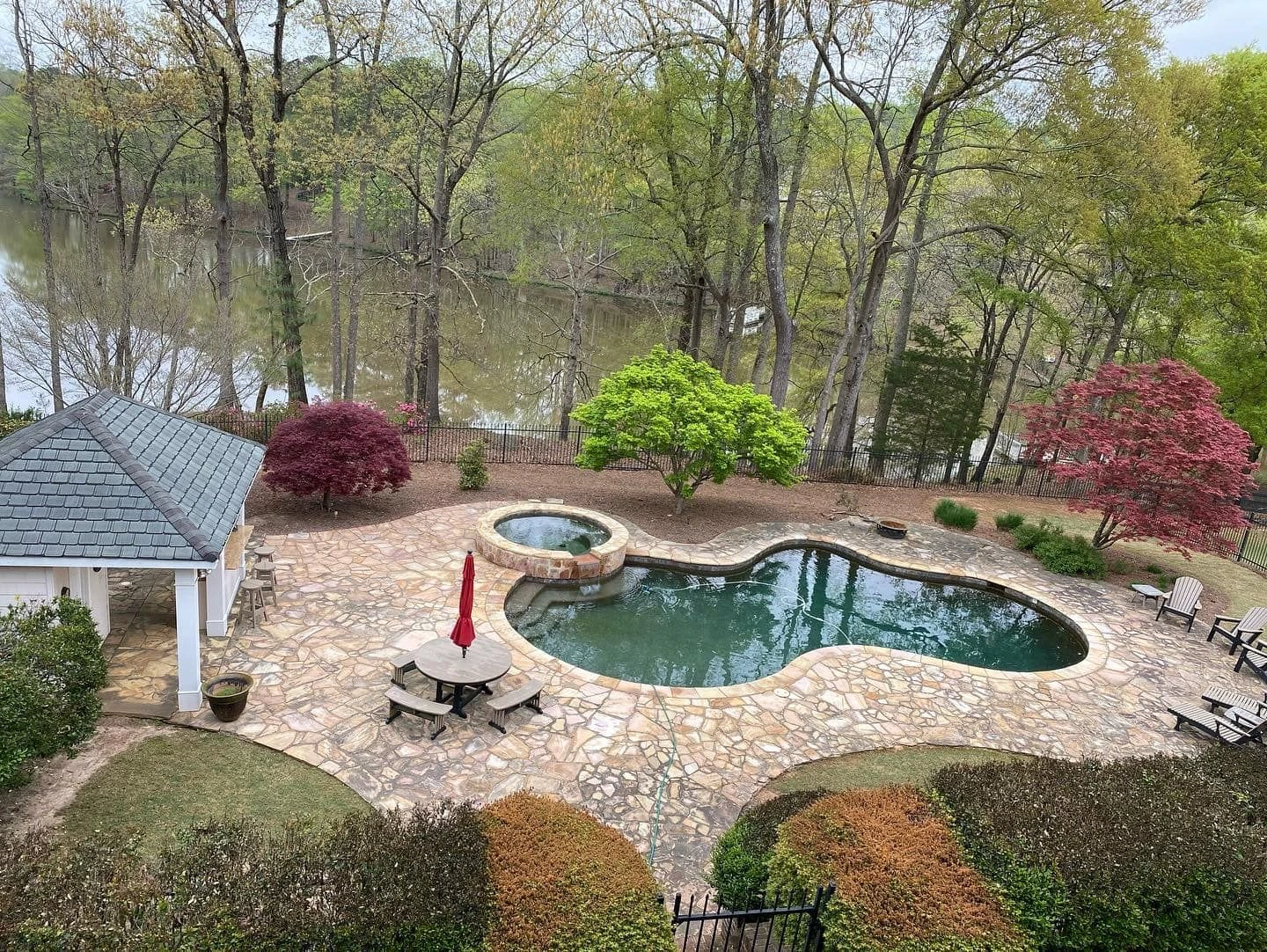
The client owned 3.8 acres off Freemanville Road — a cleared paddock, a 6-stall barn, a seasonal tributary of Cooper Sandy Creek cutting across the northeast corner, and a 1,150-foot elevation dropping nine feet from driveway to barn. She wanted a 20′ × 44′ gunite pool, a 600-square-foot pavilion, and an outdoor kitchen. Milton’s AG-1 overlay decided the rest.
This is not a generic custom-pool overview. This is a case study of one project — permitted through the City of Milton Community Development office at 2006 Heritage Walk, engineered around three overlapping setback zones, and built through a rain-heavy April on a saprolite shelf that turned up eight feet below finished grade. Every decision we made was shaped by the preservation overlay. If you own an estate lot in north Milton and you are about to start this same conversation, read what follows carefully. The numbers are real. The sequence is real. The surprises are the ones you should be planning for now.
Why AG-1 Zoning Rewrites the Whole Build Sequence
Most pool builders in metro Atlanta work a standard sequence: site visit, HOA approval, county permit, dig, shoot, plumb, deck, finish. On an AG-1 parcel in Milton, three of those steps change shape before the first excavator arrives.
Milton incorporated as a separate city in 2006, pulling permit authority out of Fulton County and consolidating it at 2006 Heritage Walk. For standard residential pools in R-2 subdivisions, this is a net win — turnaround is typically 10–14 business days, faster than the 21–28 days we still see in unincorporated Fulton. But AG-1 parcels hit a different track. Preservation review, creek-buffer review, and specimen-tree review all run parallel, and if any one of them flags a condition, the whole file goes back to intake.
On this project, the creek-buffer review came back first. The seasonal tributary on the northeast corner feeds Cooper Sandy Creek, which is a named tributary under the Metropolitan River Protection Act and Milton’s local stream-buffer ordinance. Named tributaries carry a 25-foot state buffer plus a 50-foot local impervious setback — 75 feet total from top of bank. That pushed the pool shell 11 feet west of where the client originally sketched it.
The Three Setback Rings That Actually Shape the Site Plan
On any AG-1 lot with a barn and a creek, you are not designing around one setback. You are designing inside the overlap of three.
Ring one — property line setbacks. AG-1 carries a 50-foot side and rear setback for accessory structures, which includes pools, pool equipment pads, and pavilions. This is not the 10-foot setback a suburban R-4 lot gets. Fifty feet in, fifty feet across.
Ring two — barn and stable setbacks. Fulton County’s environmental health code requires a 100-foot minimum between any permanent animal-keeping structure and a swimming pool. The intent is fly and water-quality management. On a 1-acre lot this kills the project outright. On this 3.8-acre parcel it just meant the pool had to land on the south side of the driveway spine, 118 feet from the nearest barn wall.
Ring three — creek buffer. The 75-foot total buffer from the seasonal tributary, running diagonally southwest-to-northeast across the site, clipped the northeast corner of the usable build envelope.
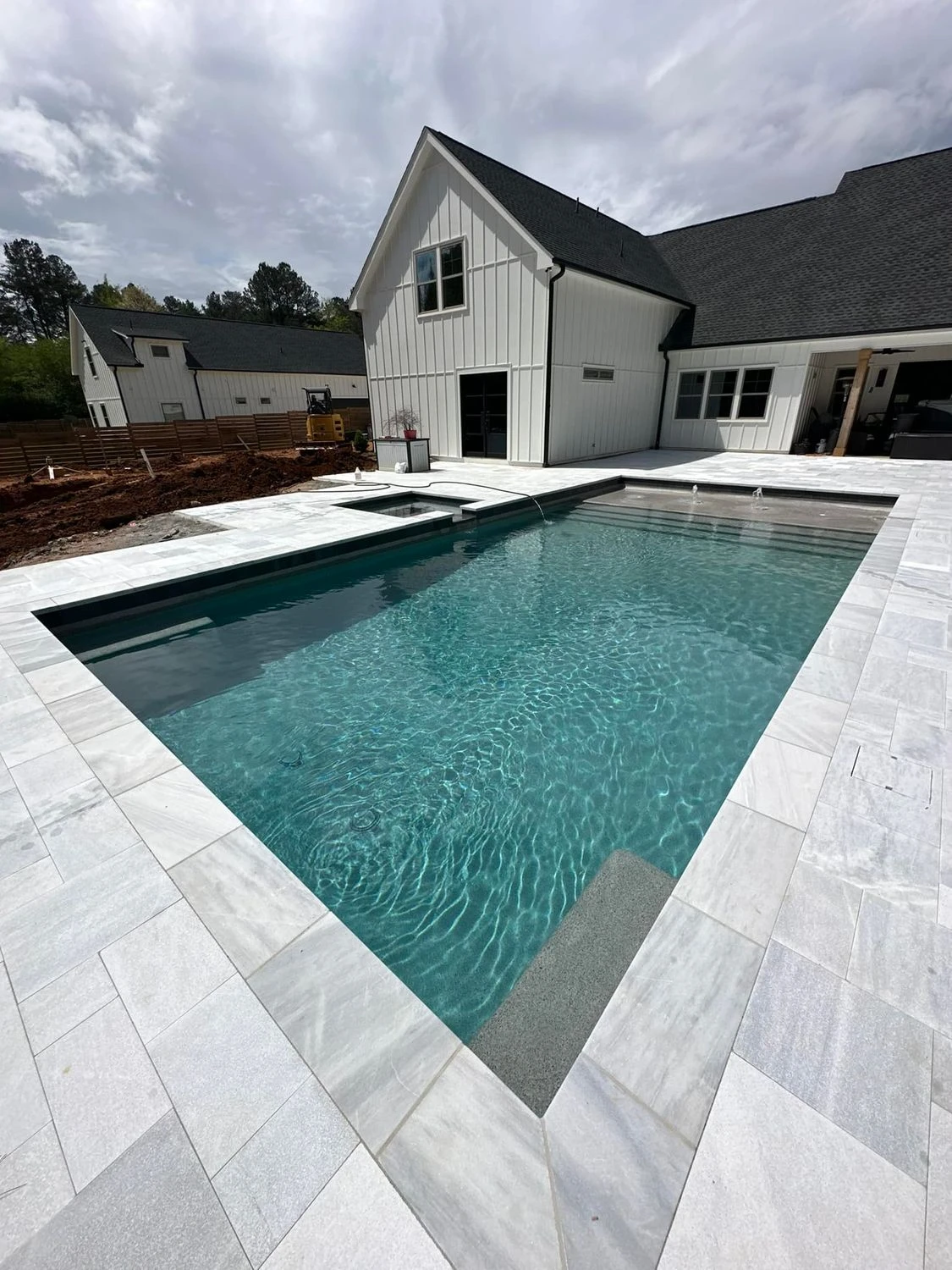
When we laid all three rings on the survey, the usable build envelope was a roughly trapezoidal piece of ground about 84 feet wide at its narrowest. The 20′ × 44′ pool, an 8-foot Baja shelf, a 14-foot decking perimeter, and the pavilion footprint fit with 3 feet to spare at the tightest point. We do this exercise in CAD before the contract is written, because on AG-1 parcels the envelope drives the design — not the other way around.
AG-1 setback summary: 50-ft property line (all accessory structures) · 100-ft barn/stable-to-pool (Fulton health code) · 25-ft state + 50-ft local creek buffer on named tributaries (75 ft total). Specimen-tree protection zone = 1.25 × DBH in feet.
Permit Sequencing Through 2006 Heritage Walk
Milton Community Development runs AG-1 pool applications through four parallel desks: building, stormwater, arborist, and preservation. On this project we submitted the full package on a Monday morning in early March. Building came back clean in 6 business days. Stormwater held for 9 days pending a revised grading plan. The arborist flagged a 34-inch white oak inside the spoil-staging zone and required a modified Tree Protection Plan. Preservation review came back on day 12 with no comments.
The full permit cleared on business day 14 — the outer edge of Milton’s typical window, but on the AG-1 track that counts as a clean run. The arborist hold alone can add two to three weeks if the protection plan is not written well the first time. Our standard practice on any Milton estate build: the arborist walks the site with our superintendent and the homeowner before the permit submission, not after, so the Tree Protection Plan reflects actual conditions and gets signed the first time through.
Three practical notes for anyone sequencing a permit in Milton right now:
- Submit the ALTA survey with all three setback rings pre-drawn. The reviewers will draw them anyway; submitting them yourself saves a cycle.
- Include a preliminary erosion and sediment control plan even if the disturbance is under one acre. Milton’s stormwater desk reads AG-1 parcels more conservatively than the state NOI threshold.
- Pre-meet the arborist. A 30-minute site walk eliminates the single most common reason AG-1 files hold.
Cecil Clay, Saprolite, and What Happens Eight Feet Down
Milton’s soils are textbook piedmont — Cecil clay over weathered granite, thicker topsoil in creek bottoms, thinner residuum on ridgelines. On this parcel we had a ridgeline lot with a clean three feet of topsoil, five feet of firm clay, and then saprolite — the partially weathered granite zone that looks like soil but behaves like rock once you hit it.
At approximately 8 feet below finished grade on the deep-end excavation, our operator hit a saprolite shelf that ran diagonally under the shallow end toward the north. We’d expected it — the geotechnical bore we ran at contract showed the shelf at 8.5 feet — so we had a Kubota SVL-75 with a hydraulic breaker on site the morning of the deep-end dig. Breaking through saprolite adds $3,800–$6,200 to a typical Milton estate build if the shelf is encountered above design grade. On this one it added $4,600 and one extra day.
The reason this matters beyond the cost line: saprolite-heavy subgrade is unforgiving under a gunite shell that is not properly bonded. The ground is effectively rock, but fractured rock with water pathways between the planes. If the gunite is shot against irregular saprolite without a compacted #57 stone bedding layer, the shell develops hairline cracks at the fracture points within 18–30 months. Our crew pulled six inches of subgrade back beyond the design line and laid four inches of compacted #57 limestone under the entire deep-end footprint. This is standard on our Milton AG-1 builds. On a Buckhead in-town lot we might skip it. On Freemanville Road, it is non-negotiable.
Engineered Drainage on a 9-Foot Fall
The lot fell nine feet from the driveway to the barn pad. That is a mild grade for Milton — we routinely see 12–14 feet on Hopewell Road parcels and 16+ feet on the wooded parcels off Birmingham Highway. But nine feet is still enough to require an engineered drainage plan when the pool and equipment pad sit in the path of surface flow from the driveway and roof plane of the main house.
We designed around three drainage elements:
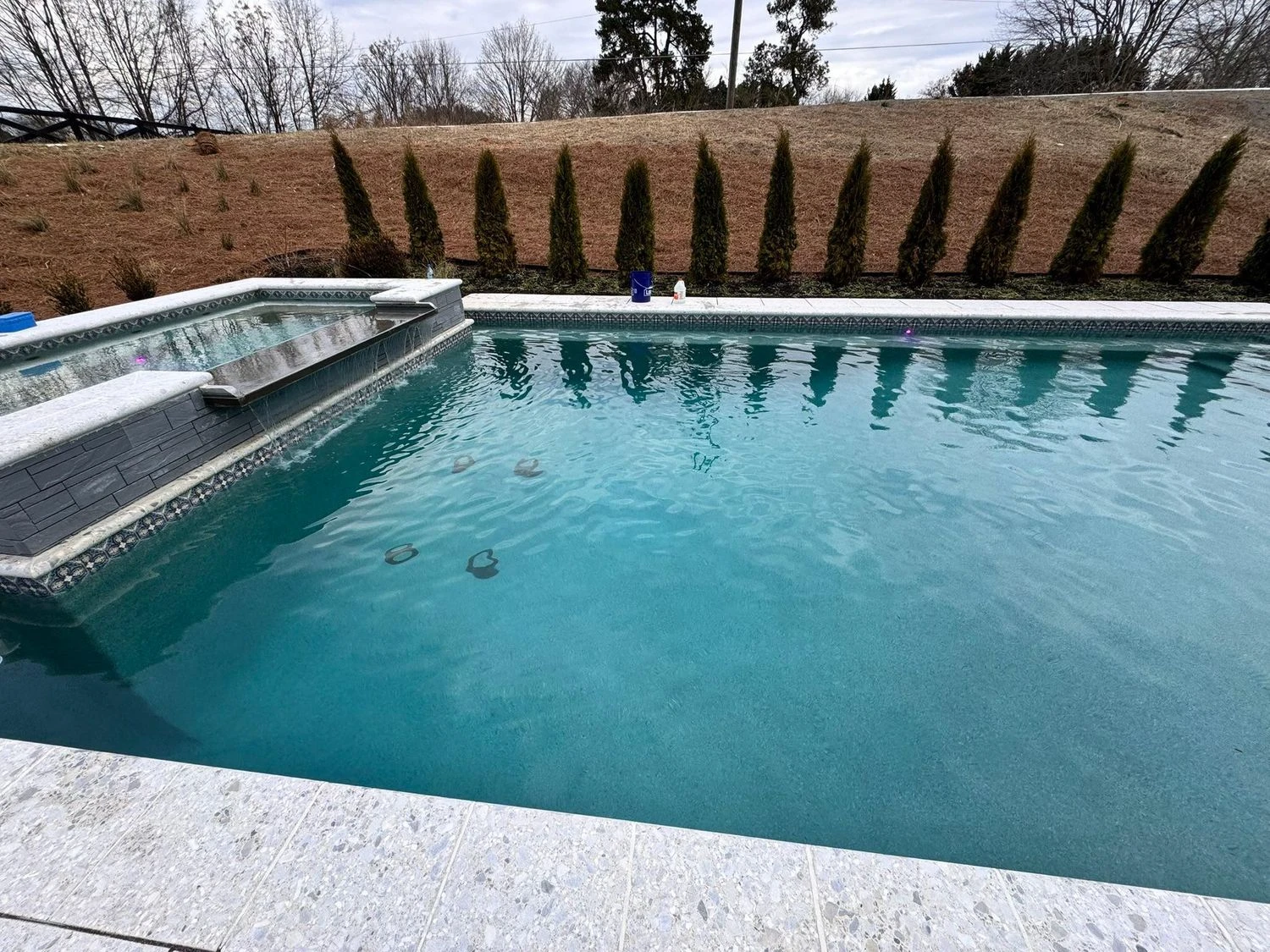
- A 6-inch French drain along the uphill side of the pool deck, draining to a rocked swale that daylights 42 feet downhill, 18 feet outside the creek buffer.
- Two Trench Drain 4″ NDS cast-iron-grate channels across the pool-decking-to-lawn transition, tied into the same swale.
- An engineered dry well — 6 feet × 6 feet × 5 feet, #57 stone, filter-fabric wrapped — under the outdoor kitchen pad to catch roof runoff from the 600-square-foot pavilion.
The dry well was Milton’s stormwater desk’s requirement, not ours. They calculated 340 square feet of new impervious from the pavilion roof and kitchen pad and required on-site retention for the 2-year, 24-hour storm event. The dry well held it. Without the dry well, the runoff would have sheeted across the creek buffer and triggered an MS4 violation the first spring storm.
Specimen Trees and the Preservation Overlay
Milton’s overlay treats any hardwood over 27-inch DBH as a specimen tree. Lose one without an approved removal permit and the fine is $500 per caliper inch plus mandated replacement at 2:1. On a 34-inch white oak that is $17,000 in fines alone.
On this parcel we had three specimens inside the broad work zone: the 34-inch white oak near the spoil-staging area, a 29-inch tulip poplar on the south edge of the driveway, and a 41-inch willow oak 22 feet off the pool decking line. The willow oak was the one we had to engineer around. Specimen-tree protection zones in Milton are defined as 1.25 × DBH in feet, which meant a 51-foot radius of undisturbed root zone around the willow oak. The pool decking clipped into that radius by 7 feet.
The solution: air-spade the root zone inside the disturbance area before any decking subgrade work, prune roots cleanly at the decking edge rather than tearing them with an excavator bucket, and install a geo-grid pedestal system under the decking in that zone so the pavers float above the root plate instead of compacting soil onto it. The arborist signed off, the tree came through the build without canopy decline, and the homeowner kept the 80-year willow oak that anchors the view from the kitchen window.
Rural Character, Pavilion Integration, and Architectural Review
Milton’s preservation overlay is not just about trees and creeks. It also governs visible character — rooflines, fencing style, outbuilding materials. On AG-1 parcels in the rural-character corridor (which this Freemanville property sits inside), the overlay pushes pavilion and outbuilding designs toward board-and-batten siding, standing-seam metal roofing, and natural stone or brick bases. It discourages vinyl, stucco, and flat contemporary rooflines.
The client’s architect specified a 12:12 gable pavilion with white oak exposed rafters, board-and-batten Hardie siding painted warm white, a 24-gauge Galvalume standing-seam roof, and a dry-stack Tennessee fieldstone base around a Wolf 42-inch gas grill, a side burner, a 30-inch beverage center, and a concrete countertop poured in place. Material schedule cleared preservation review without a comment.
If your lot is in The Manor Golf Club or Atlanta National, the review layer doubles — you clear Milton’s overlay AND the subdivision’s architectural review committee, which adds roughly 4–5 weeks on top of city permitting. Plan the schedule around it.
Budget reality for Milton AG-1 builds: a 20′ × 44′ gunite pool with engineered drainage, saprolite allowance, specimen-tree protection, a 600-sq-ft pavilion, and full outdoor kitchen lands in the $245,000–$385,000 range. This project finished at $298,400 — below median for the scope, above median for the site complexity.
Equipment Pad Siting, Utility, and Winter Resilience
Two utility conditions you only run into on Milton estate lots: long runs from the meter, and split utility territories. The client’s meter sat 186 feet from the chosen equipment pad location. That is a long run for a pool on a 1-horsepower variable-speed pump — but a non-issue if the conduit and wire are sized correctly at the start. We pulled #6 THWN copper in 1.25-inch Schedule 80 PVC from the sub-panel, which keeps voltage drop under 3% at full load.
The split-utility issue is unique to north Milton. Most of the city is on Georgia Power, but the northeast strip along the Forsyth County line, including portions of Hopewell Road, sits in Sawnee EMC territory. This parcel was on Georgia Power — easy. If your lot is near the Forsyth border, confirm the utility with the county assessor’s map before the electrician bids the work. Sawnee’s service-drop schedule and inspection fee structure are different from Georgia Power’s, and a bid written under the wrong assumption can land 12–18% high.
Winter resilience matters here. Milton’s USDA Zone 8a designation includes roughly 22 freeze events per year — not as punishing as Dawsonville to the north, but enough to put real stress on exposed plumbing. We specified a freeze-protect auto-sensing controller wired to the variable-speed pump, a heated equipment pad enclosure with a thermostat-controlled 1,500-watt resistance heater for sub-25°F nights, and insulation-wrapped suction lines to the skimmer and main drain. None of this is overbuilt for a rural Milton parcel where the nearest neighbor is 400 feet away and nobody is going to notice a frozen pipe at 3 AM.
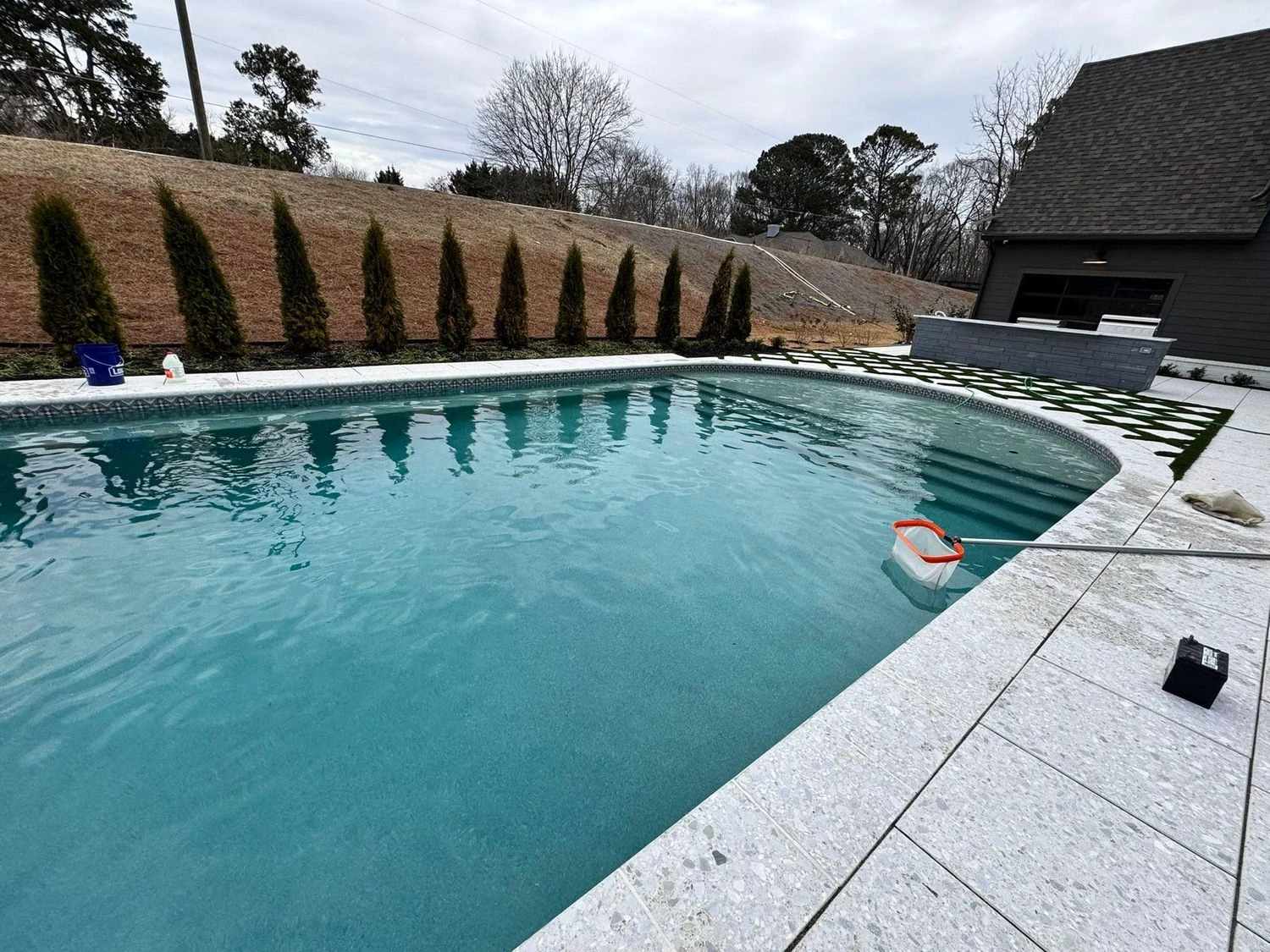
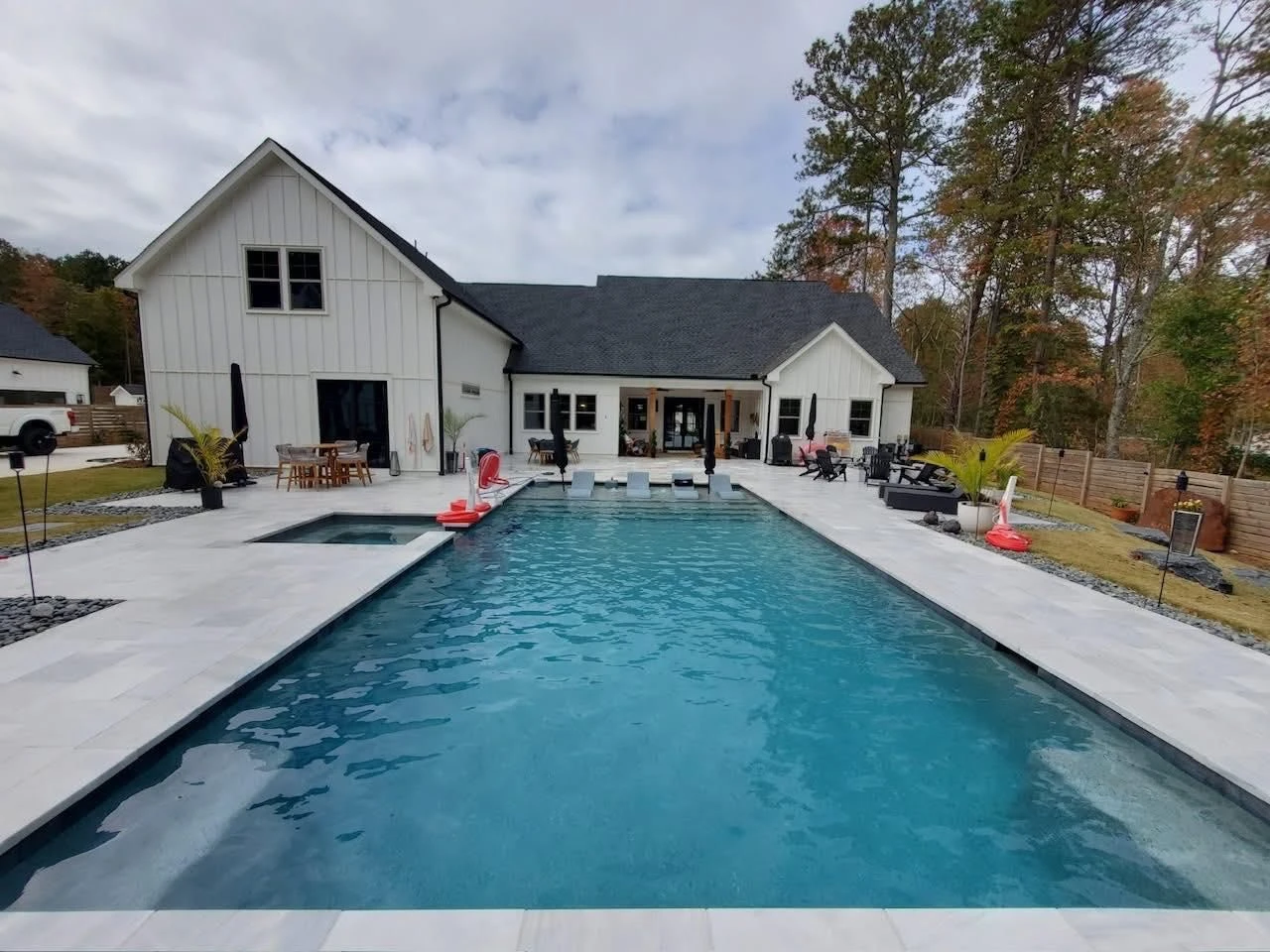
The build wrapped 11 weeks from excavation start to final inspection. The homeowner swam the pool the last weekend of June. The specimen willow oak leafed out without canopy decline the following spring. The creek buffer held through two 2.8-inch storm events in July, and the dry well performed to the engineered design. These are the metrics that matter on an AG-1 build — not square footage, not tile selection, not hardscape inches. Did the site survive the construction? Did the overlay clear without enforcement action? Did the drainage work when it rained?
If you are sitting on an estate lot off Freemanville, Hopewell, Birmingham Highway, or New Providence Road and thinking about a pool, the path forward is not a quote sheet and a catalog of tile. It is a site walk with a builder who has read Milton’s overlay and can draw the three setback rings on your survey from memory. Everything downstream — design, budget, sequence, schedule — lives inside that envelope.
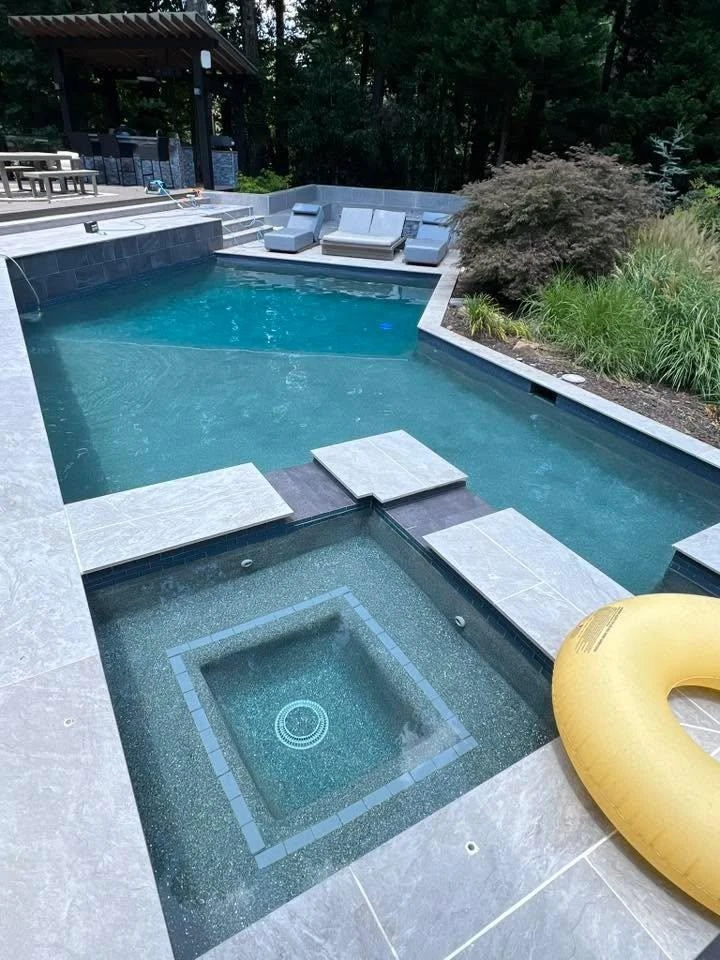
Custom Pool Construction across 20+ cities within 30 miles of Winder, GA
Milton AG-1 overlay, Forsyth septic setbacks, Hall County rural-character review — the engineering logic changes with the zip code. We build the pool the overlay allows, and we build it to survive the site.