
It’s 11:47 PM on a July Tuesday in Crooked Creek. The line of thunderstorms that rolled south from Dawsonville an hour ago has just finished tearing through your back acre, and when you flip on the pool lights, a 34-foot oak limb is floating across your tanning ledge — bark shredding into the plaster, leaves clogging the skimmer weir, and a forked branch wedged hard against the spillway.
This is the Milton version of emergency pool repair. Not a cracked pump seal on a quiet afternoon. Not a slow leak discovered over three weeks of falling water lines. This is a mature oak canopy dropping fifteen hundred pounds of green wood into twenty-four thousand gallons of chlorinated water at midnight, and the decisions you make in the next four hours determine whether you’re looking at a $380 service call or a $4,200 plaster refinish.
Milton’s estate lots carry a premium that very few of the newer Forsyth subdivisions match: the mature tree canopy is part of the reason home values from The Manor Golf Club through Cogburn Estates clear $1.2M to $6M. The rolling topography that gives Freemanville Road its character also means one-acre minimums in AG-1 zoning, preserved hardwoods along creek buffers, and — when the summer thunderstorms arrive — a material amount of those hardwoods ending up where your pool cover used to be.
We’ve been doing storm-debris emergency triage across Fulton County pools for two decades. This is the sequence that protects your shell, your equipment, and your deductible — in that order.
Before the sequence, a note on what this post isn’t. This isn’t a generic “Top Ten Tips After a Storm” listicle. It’s the actual decision tree we run when a Milton client calls after midnight with a tree in the pool — the order we execute in, the dollar figures we quote on the phone before we leave the truck, the line between what a homeowner should do in the first four hours and what needs a licensed pool contractor on the property before anybody touches the water. If you own a pool anywhere in Milton’s AG-1 zoning — one acre minimum, preserved hardwoods, creek buffers on the back property line — this is the playbook. Print it. Tape it inside the pool shed.
1. Power Down Before You Touch Anything
The first move is not extraction. The first move is the breaker panel.
A limb in the pool means wet debris pressed against the shell, skimmer, main drain, and potentially the pool light niche. If your light’s wet-niche seal compromised during impact — rare but possible with a direct hit from a heavy branch — energized water becomes a lethal problem the moment you or anyone else steps onto the tanning ledge. Kill the pool sub-panel at the main service. If you don’t know which breaker feeds the pool equipment pad, kill the whole run and call the number in the repair note below.
Milton is mostly on Georgia Power, with portions along the Forsyth County line pulled off Sawnee EMC. If the storm knocked out utility power for the neighborhood, great — you’ve been done the first step for you. But if power is live, you’re the one responsible for making the pool safe to work on.
Two adjacent points worth flagging. One: the 2023 NEC requires equipotential bonding of every metal component within five feet of the pool coping — coping itself, ladder anchors, handrail cups, and any metal table or umbrella base. Storm impact that dislodges a bonding wire creates a pathway for stray current the next time a neighbor’s tree crew brings a chainsaw onto the ground grid. Two: salt cells draw their own 5–8 amps continuously. If your pool ran salt mode through the storm, pull the cell breaker as part of the power-down — even if the pump breaker is off, some automation setups maintain cell voltage independently on the lower-current circuit. Rare, but we’ve seen it on older Jandy AquaPure installs from the mid-2010s.
Electrical triage rule: Pool sub-panel off, pump off, salt cell off, pool light breaker off. Do not reset anything until the debris is out of the water and a licensed tech has bonded-tested the equipment pad. 2023 NEC 680.26 grounding requirements apply to all Milton installs.
2. Get the Big Wood Out in the First Four Hours
This is the hinge point of the entire repair bill.
Fresh oak, fresh pine, and fresh sweetgum bark all contain tannins that leach into plaster and dye it brown within 18–36 hours of sustained contact. A 20-foot white oak limb sitting on a tanning ledge from midnight Tuesday until Saturday afternoon will leave a coffee-colored stain that no amount of muriatic acid wash will fully remove. A limb extracted in the first four hours leaves almost no trace.
For branches you can physically move — say, anything under 10 feet long and 4 inches at the thickest end — use a pool rake from the long side of the deck. Never enter the water. Never climb the branch. Never try to break it in half while it’s still floating; the spring-load when you snap green wood can whip the butt end into your shin or, worse, into your pool tile.
For anything larger, you are outside the homeowner competence window. Call a tree-service crew. In north Milton the going rate for a nighttime or pre-dawn pool-extraction call from a bucket-truck crew runs $800 to $2,400 depending on limb size, access, and how many men they pull off another job. That feels like a lot of money until you price out a replacement interior finish.
One caution on tree-service extraction: not every crew is trained to work over a pool shell. The failure mode is dropping a rigged limb into the water under control — a controlled lower using rigging slings and a speedline off the bucket truck — versus free-dropping a cut limb onto the coping and hoping for the best. A free-drop onto Bethany Creek-grade travertine coping can snap three to five coping pieces in one hit, a $600–$1,800 repair on top of the extraction invoice. Ask the crew before they climb whether they’ll rig-and-lower or free-drop. If they can’t answer, call a different crew. Primetime keeps a short list of pool-aware tree companies across north Milton — we’ve vetted them on prior jobs at Hopewell Plantation and White Columns.
Between extraction and the first daylight, skim the pool surface every 30 minutes with a leaf rake. Bark flakes, acorns, and small twig fragments will continue to settle out of the suspended organic load and onto the pool floor for several hours after the big debris is out. Each one of those small fragments is its own micro-stain if it sits long enough on a light-colored plaster finish.
3. Inspect the Shell Before You Refill Chemistry
Once the big debris is out, walk the coping perimeter with a flashlight and look for four specific failure points.
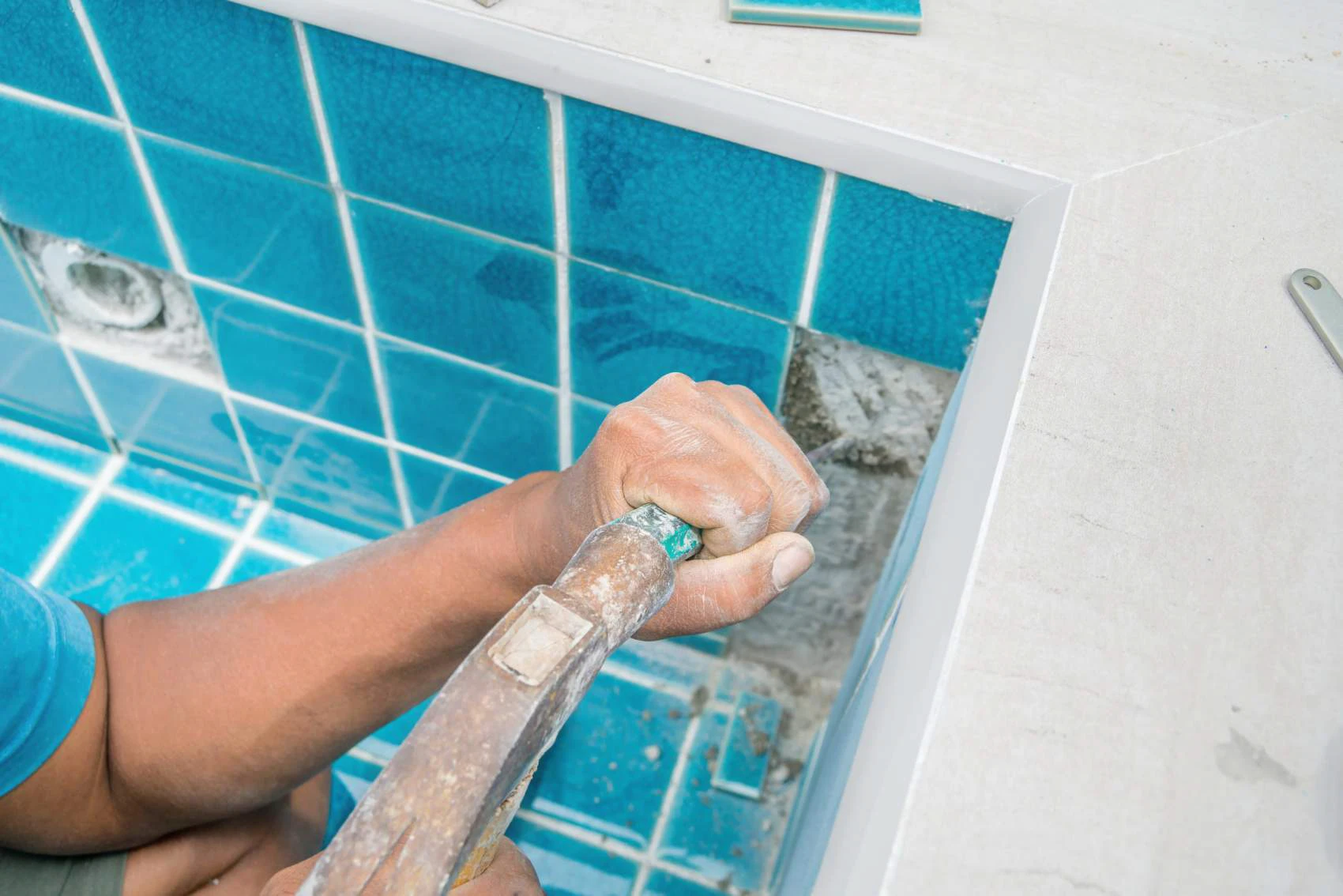
- Waterline tile. Limb impact commonly shears two to six tiles along the waterline where the branch landed. You’ll see hairline cracks radiating from the impact, or you’ll see a tile missing entirely, sitting on the shell floor.
- Plaster gouges. Bark scrape from a branch dragging along the tanning ledge or swim-out steps leaves visible grooves. A gouge deeper than a credit-card edge needs a patch.
- Skimmer throat and weir door. The floating weir door is plastic and breaks first. A cracked weir means full-pool circulation contamination until it’s replaced.
- Pool light niche. If the branch hit directly over a niche, verify the trim ring is still seated flush. Compromised gasket = wet-niche water intrusion = future ground fault.
This is the pass that separates a $380 service call from a $1,400 to $4,200 interior repair. Document everything with phone photos — timestamped, wide angle and close-up. Milton homeowners who carry umbrella policies (most do, above the $1M home threshold) will need that documentation for claim filing with the typical $500 to $1,000 deductible tier.
A sub-note on tile repair scope: waterline tile on a Milton estate pool is frequently specified as 1×1 or 1×2 glass mosaic in a custom color run — not a stock pattern from the big-box catalog. If the original tile is no longer produced, a storm repair often forces a decision between buying a full replacement run for the entire waterline ($4,800–$9,500 material plus install) or accepting a visible two-tone band where the repair section was installed. Ask your installer to pull the tile code off the back of any spare pieces in the garage storage before you commit to one approach or the other — most original builds leave a box of spares at handoff, and the few clients who saved them saved themselves a $6,000 decision.
4. Water Chemistry: Don’t Shock a Dirty Pool
The instinct after pulling a tree out of the water is to dump five pounds of dichlor in and call it even. Don’t. You’ll waste the shock against organic load that the filter should be catching first.
Correct sequence, in order:
- Manual removal of every leaf, twig, and shard of bark. Skimmer basket, main drain pot, pump basket — empty all three. Leaves will disintegrate and re-enter circulation if you skip this.
- Filter backwash or cartridge rinse before any chemical addition. Sand filters need a full backwash cycle. Cartridge filters need pulled, rinsed with a fan-pattern nozzle, and reseated — a set of Pentair Clean & Clear Plus cartridges can handle one bad storm and still run clean if you rinse within 24 hours.
- Shock — calcium hypochlorite at 2 lb per 10,000 gallons, added at dusk with the pump on high. Milton’s typical 20,000–28,000-gallon estate pool needs 4–5.6 lb. Skip trichlor tablets for this; you want the fast kill, not the slow feed.
- Clarifier the next morning. Any polyquat clarifier will do — this pulls the ultra-fine particulate the filter can’t catch on its own.
- Retest chemistry 24 hours later. Tannin exposure typically drops pH a full point and burns through cyanuric acid faster than expected. Rebalance to 7.4–7.6 pH, 80–120 ppm alkalinity, 30–50 ppm CYA.
Milton water-chemistry note: The Etowah River tributaries that run through north Milton — Cooper Sandy Creek, Chicken Creek, and Lake Creek — drain into many estate pool areas. Runoff after major storms pushes fill water toward slightly acidic. Budget an extra pound of soda ash per 10,000 gallons for post-storm rebalance.
5. Equipment Pad Damage: The Part Owners Miss
Pool shells are the dramatic-looking damage. Equipment pads are the expensive-to-fix damage.
A straight-line wind event — the kind that dropped a 38-foot oak in Bethany Creek last August — doesn’t just throw branches into the pool. It throws them onto the equipment pad: variable-speed pump, salt cell, filter manifold, automation panel, heater. Any of these getting hit by a falling limb is thousands of dollars of silent damage you won’t notice until the pump runs rough a week later.
Walk the pad. Look for:
- Cracks in the Pentair IntelliFlo3 or equivalent VSP housing, especially at the strainer lid and priming pot.
- Bent union fittings or cracked Jandy/CMP check valves between equipment and pool returns.
- Punctured filter tank (DE filters are the most vulnerable — the pressure vessel is thin-wall).
- Cracked automation panel housing (Jandy iAquaLink or Pentair ScreenLogic enclosures). Water intrusion into the board fries it within days.
- Heater flue or top panel crushed. A natural-gas heater with a compromised flue will not pass the next combustion test.
Pad damage commonly shows up three to ten days post-storm when the micro-crack you missed finally separates under thermal cycling. Catch it now, not after the next 93°F weekend when everybody wants the pool running.
One equipment-pad callout specifically for Milton estate builds: many of the larger pools on Hopewell Road and Freemanville Road are built on a secondary pad that sits 60 to 120 feet from the pool, often concealed behind a pool house or tucked into a planting bed for aesthetics. A storm-track limb that misses the pool entirely can still take out the remote equipment pad. Walk the full equipment run, not just the deck. Loose PVC conduit, separated union fittings, cracked sight glasses on filter manifolds — all visible from the outside once you know what to look for.
Heaters deserve a closer look than pumps. A natural-gas heater with a crushed flue, dented top panel, or compromised combustion sensor will present as “not firing” when you try to run it, but the real failure is the high-limit switch or the pressure switch, and running the pump with a damaged heater in-line can flood the combustion chamber on the next ignition attempt. If you see any visible heater damage, leave the gas valve off and the electrical breaker off until a licensed tech runs a combustion analysis. The $240 service call to verify is always cheaper than a $3,200 heater replacement.
6. Permits, Insurance, and What to Do in the First 48 Hours
Milton’s incorporation as a separate city in 2006 matters here. Your permits don’t go through Fulton County — they go through City of Milton Community Development at 2006 Heritage Walk. For pool-shell repair, new plaster, and new waterline tile, no permit is required. For replacement of a pool light, replacement or relocation of the equipment pad, any bonding rework, or gas-line adjustments at the heater, you need a permit, and the Milton turnaround is typically 10–14 business days — faster than the county version that preceded 2006, but with stricter preservation review on any equipment relocation within the tree-protection buffer.
If your pool sits in the structural review zone of The Manor Golf Club, any visible exterior equipment relocation also requires ARC sign-off. Four to five weeks typical turnaround through their structural review committee, and they do not move faster for storm events.
Creek-buffer setbacks apply for any new equipment pad location within 25 to 75 feet of Cooper Sandy Creek, Chicken Creek, Lake Creek, or any named Etowah tributary. The north Milton parcels along Chicken Creek also sit inside a mapped floodplain on some lots — verify before you re-pour a pad.
First-48-hour insurance checklist: (1) Photograph everything — branch in water, shell damage, equipment damage, leaf litter. (2) Call carrier within 24 hours to open a claim. (3) Save all receipts for emergency tree-extraction and chemical treatment. (4) Request written repair estimate from a licensed pool contractor before carrier’s adjuster visit. Umbrella-policy deductibles in the Atlanta National TPC and Cogburn Estates tier typically run $500–$1,000.
What This Costs in Milton, Plainly
No ranges wider than reality:
- Emergency service call, minor debris extraction + chemistry reset: $380–$680.
- Bucket-truck tree crew for large-limb extraction: $800–$2,400.
- Waterline-tile repair, 2–8 tile section: $450–$1,200.
- Plaster patch for gouge or stain: $900–$2,400 depending on scope and finish (standard plaster vs. Pebble Tec or Diamond Brite).
- Full interior-finish refinish (delayed-extraction tannin staining case): $4,200–$11,000+ on a 20,000–28,000-gallon pool, scales with pebble vs. plaster selection.
- Equipment replacement — pump, salt cell, automation panel — one-at-a-time: $1,200–$3,800 each.
The math is the math. A four-hour response saves you five figures.
Why Milton Specifically
Three things make Milton pools disproportionately vulnerable to tree-debris events versus, say, a newer Forsyth or Cherokee subdivision pool.
First, canopy maturity. The preserved-hardwood rule inside AG-1 zoning means most estate lots carry 80- to 120-year-old white oak, red oak, tulip poplar, and hickory within 30 feet of the pool envelope. Any of those species will drop limbs during a 55+ mph gust. Newer subdivisions where the site was clear-cut during development simply don’t have the same limb-above-pool exposure.
Second, grade. Milton’s 6-to-14-foot drops across estate lots mean pools frequently sit downslope from the main tree mass. When a limb shears off, gravity does the rest.
Third, thunderstorm track. The typical summer convective storm line over north Fulton rides in from the northwest, hits the rolling topography along Freemanville Road and GA-372, and accelerates its gust front down the eastern slope of the ridge — right over the largest estate parcels.
None of this is a reason not to build pools in Milton. We’ve built plenty, and they’re some of our favorite projects in the portfolio. It’s just a reason to have the triage plan in the kitchen drawer before you need it.
Save This Number
The hour after a tree hits your pool is not the hour you want to be googling contractors. Have a pool-contractor number pinned in your phone, know your sub-panel breaker layout, and keep a long-handled pool rake accessible from the deck — not in the back of the pool shed behind the chaise lounges.
That’s the plan. Everything else follows the sequence above.
One last note on soil and backfill behavior specific to Milton. The Cecil clay over weathered granite that makes up most of the city’s estate-lot soil profile holds water aggressively during major storm events. Saturated clay backfill around a pool shell can exert meaningful lateral pressure on the structure for 48 to 72 hours after a three-inch rainfall. If a limb impact caused any visible waterline tile loss or plaster crack, the post-storm week is not the time to drain the pool for inspection — you risk hydrostatic popping of the shell as soil pressure exceeds internal water pressure. Wait until the soil drains and the surrounding grade is firm underfoot. On the ridgeline lots along Potters Road where the saprolite shelf sits closer to the surface, drain-down risk is slightly lower because the sub-grade drains faster, but it’s still not zero. Any drain-down on a Milton pool should be done with a hydrostatic relief valve operational and the groundwater table confirmed below floor elevation — a licensed pool contractor’s call, not a homeowner’s.
We’ve had exactly two drain-down failures across the last six years of Milton work. Both happened because somebody got impatient. Don’t be the third.
Emergency Pool Repair across 20+ cities within 30 miles of Winder, GA
Storm-debris triage, equipment-pad diagnostics, tile and plaster repair — fast response to Milton and the surrounding North Fulton / Northeast Atlanta service area.