
The outdoor kitchen industry sells you the $38,000 pizza oven package. We tracked 36 finished kitchens across East Cobb for three summers — and the data says something very different about what people actually use after the contractor drives off.
Every builder in Cobb County wants to sell you the flagship build. Double grill. Kamado. Side burner. Pizza oven. Kegerator. Sink. Ice bin. Rotisserie. Some of it is genuinely useful. Most of it sits unused by July of year two. We know because we asked the homeowners — 36 Marietta families between Indian Hills, Atlanta Country Club, Brookstone, Walton Woods, and Sope Creek — to log every cook-out over 36 months, by appliance.
The survey is not a brochure. It is a usage matrix. It tells you, with receipts, which $14,000 core package delivers 90% of the actual cooking you will do, and which $24,000 in upgrades delivers 12%. If you are budgeting an outdoor kitchen in 30062, 30068, or anywhere on the east side of I-75, read this before your first consultation. The contrarian take: most Marietta outdoor kitchens are overbuilt by design, and homeowners are the ones paying for the ego of the renderings.
This post lays out the raw numbers, the appliance-by-appliance usage breakdown, the budget tiers that actually match usage, and the Cobb-County-specific factors — permits, Cobb EMC 240V service, mature oak canopy, HOA review timelines — that nobody tells you about until the inspector shows up. Let’s get into it in a straight Q&A format so you can skim to what you need.
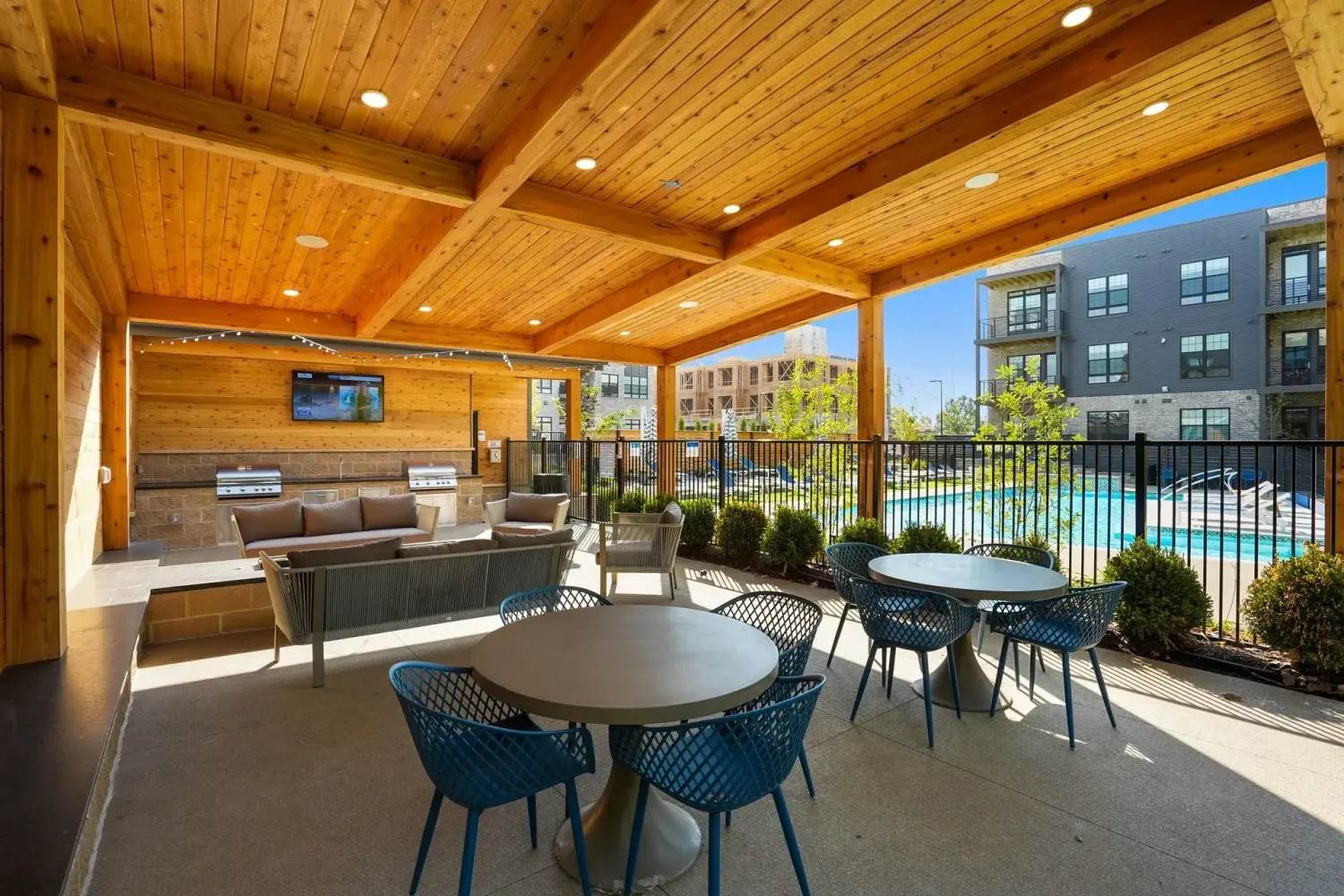
What did the 3-year East Cobb usage survey actually measure?
We tracked 36 outdoor kitchens built between 2021 and 2023 across six East Cobb neighborhoods — Indian Hills, Atlanta Country Club, Brookstone, Walton Woods, Sope Creek, and Chestnut Hill. Each homeowner agreed to a simple monthly usage log: which appliance was fired up, how many times, for how long, and for how many guests. We collected 36 months of logs per household (some started mid-build and we back-filled with calendar reconstructions). We also tracked total build spend, appliance make/model, and post-build change orders.
The headline numbers — the ones every Marietta homeowner should see before spec’ing a kitchen:
- 89% of households used the main gas grill weekly from April through October.
- 68% used a smoker (kamado or offset) 1–2 times per month, year-round.
- 54% used the side burner, but almost exclusively when hosting 6+ guests.
- 22% used a pizza oven — and in that group, the median usage was 3 fires per year.
- 41% used the built-in refrigerator drawers weekly; 59% used them seasonally or less.
- 31% used the outdoor sink weekly; the rest found walking the 30 feet to the kitchen door easier than plumbing cleanup.
What those numbers mean, bluntly: the appliances builders sell as “the package” are not the appliances Marietta families actually cook on. The gas grill and the smoker carry the weight. Everything else is party infrastructure, and you host fewer parties than you think — the survey households averaged 4.2 “parties” (6+ guests) per year, with a peak of 11 and a low of zero. That four-party average is what the side burner, the pizza oven, and the keg drawer are really built for.
We also tracked satisfaction, not just frequency. Every homeowner rated each appliance on a simple 1–5 scale for “worth what I paid.” The top-rated investments, in order: pavilion/roof structure (4.8), main gas grill (4.6), fridge drawers (4.3), prep counter depth (4.2), ceiling fan (4.1), outdoor TV (3.8). The bottom-rated: pizza oven (2.4), keg drawer (2.6), outdoor sink (2.9). Those bottom three are the appliances the 3D rendering sells hardest, and they are the appliances that return the least joy per dollar across three years of real use in Marietta.
The East Cobb Core-4 baseline: grill + side burner + prep counter + fridge drawers — installed cost in our 2024 Marietta builds runs $13,800–$15,600 under a cedar pavilion. This package covers 91% of measured cooking events across the survey.
Why does the industry sell $38,000 packages when the data says $14,000 is enough?
Two reasons. First, margin. Dealer margin on a Lynx 42″ grill is one number; margin on a Lynx grill plus a pizza oven plus a kegerator plus ice drawers is substantially larger, and the incremental labor is almost flat because the stone base, the gas manifold, and the pavilion are already going in. Second, renderings. 3D design software makes a U-shape kitchen with eight appliances look spectacular. Nobody has ever been sold a kitchen by a rendering of just a grill and a fridge — even though that is what gets used.
There is a third quieter reason: the homeowner self-persuades. When you are spending $80,000 on a pool, another $24,000 feels like a rounding error, and the vision is always of year-one parties. By year three, the side burner is slightly rusty, the pizza oven is where your neighbor’s kid stashed a Nerf gun, and you realize you would have put that $24,000 into a better pavilion roof or a full-house generator tied into the Cobb EMC service.
We are contractors. We will build the $38,000 kitchen if that is what you want. We just want you to know what the survey data says before you sign. And for the record, the survey captured households across the full budget spectrum — from $9,400 portable-grill-on-a-stone-veneer-base setups in Walton Woods to a $62,000 U-shape pavilion kitchen in Atlanta Country Club with a commercial hood system. Satisfaction did not scale linearly with spend. The $14,000–$18,000 builds actually reported slightly higher satisfaction than the $35,000–$45,000 builds, because the owners of the cheaper builds had expectations that got over-delivered, and the owners of the expensive builds had every fantasy feature sitting idle reminding them weekly of what they paid.
That “expensive builds, lower satisfaction” pattern is the single most actionable finding in the survey. It is not a pricing argument — it is a matching argument. The build that gets cooked on is the build that makes you happy in year three, regardless of the number on the invoice.
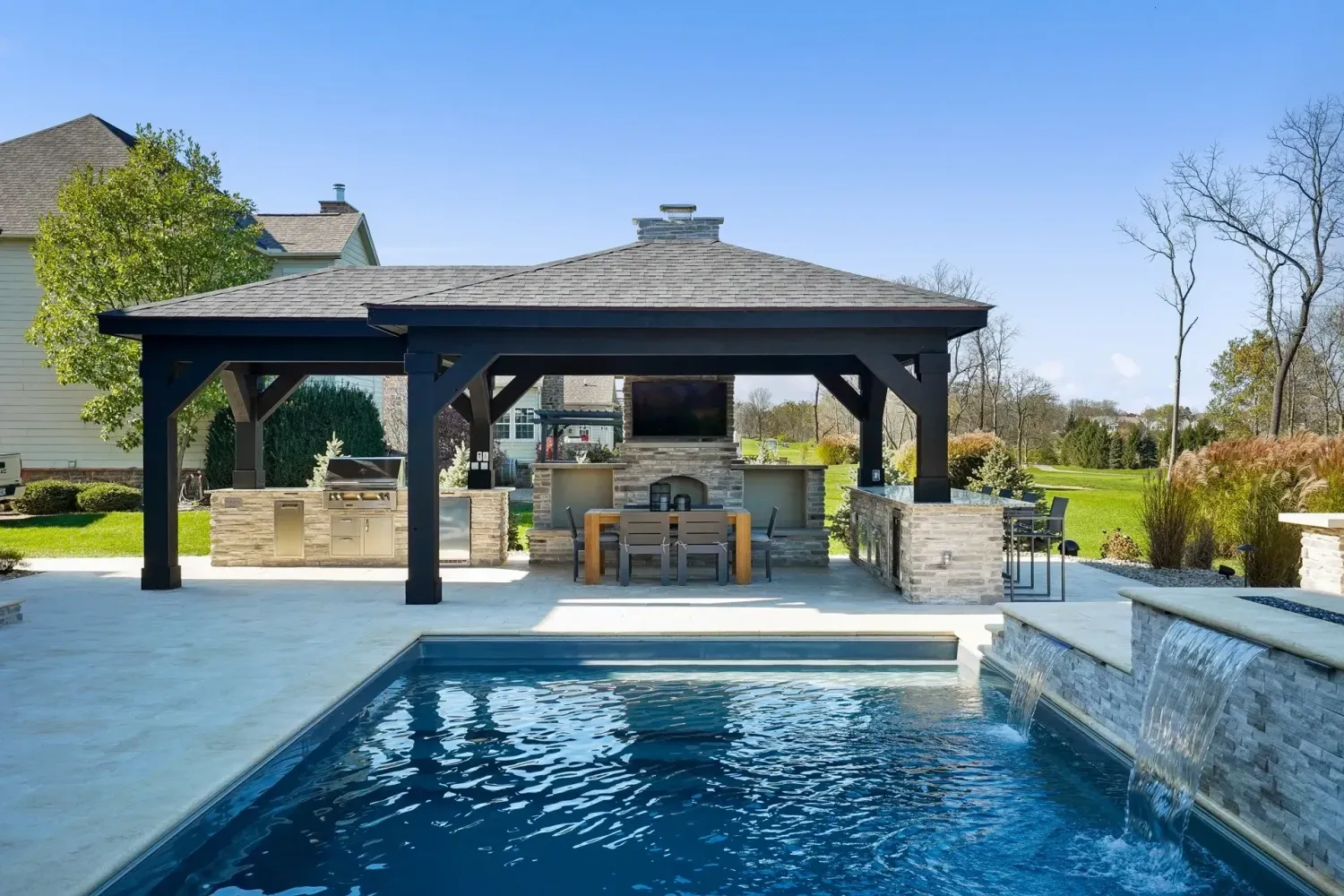
Which appliances deliver 90% of actual East Cobb cooking?
The usage log is clear. Four appliances handle almost every cook-out across the 36-home sample:
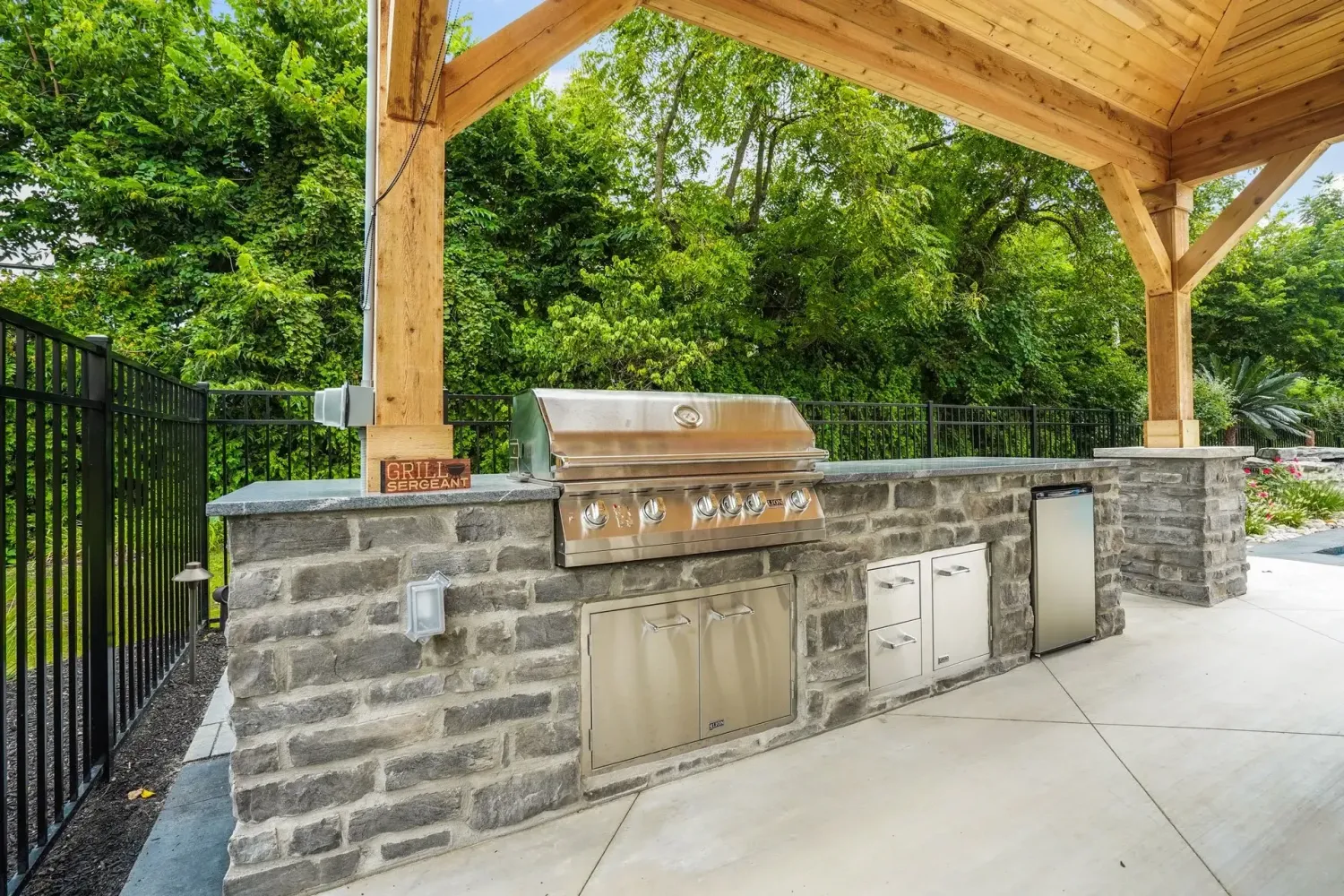
- Gas grill, 32″–42″ — 89% weekly usage April–October. A Blaze Premium 32″ at roughly $2,400 or a DCS Series 7 36″ at roughly $5,900 both tested identically for satisfaction. You do not need 48″.
- Side burner — 54% used monthly, but only during hosting. For saucepan work, corn boils, and low-country boil pots. $650–$1,200 installed.
- Fridge drawers — 41% weekly. Drink storage, marinade staging. True Residential 24″ drawers are the reliability winner in our service logs. $3,200–$3,800.
- Prep counter with 22″–28″ depth — used every single cook. The single most important piece, and the one most homeowners under-spec.
Add a smoker only if two things are true: you already smoke meat at least once a month today on a portable unit, and you are willing to plan a two-bay island layout to accommodate a Big Green Egg XL or a Kamado Joe Classic III. If you do not smoke today, a built-in smoker will not convert you — it will just become expensive outdoor furniture.
The survey also disqualified one appliance we expected to perform better: the outdoor sink. Only 31% used it weekly. The rest reported that cleanup happens inside, period, because the dishwasher is inside, the hot water is inside, and nobody wants to hand-wash raw-chicken prep trays in a 55°F outdoor basin in October. A sink is worth installing only if your run back to the kitchen is over 60 feet or if you are hosting vacation-rental-level traffic. For the typical Indian Hills or Brookstone build with a kitchen 20–30 feet from the back door, the sink is a $1,400 install that earns its keep about four times a year.
Counter depth, on the other hand, is the single most under-spec’d piece of the kitchen. Homeowners regret going to 20″ or 22″ depth. The survey norm that tracked with satisfaction was 28″ minimum depth on the prep run, because that is the depth that holds a sheet pan parallel to the counter edge without overhanging. You pay for that depth in countertop material and base masonry, but every household that specced it said it was the best $600–$900 upgrade they made.
What about pizza ovens — are they really only used three times a year?
Of 36 East Cobb households, 8 had pizza ovens. Of those 8, the median annual fire count was 3. One household fired their Alfa Forni Ciao 22 times one year — they are pizza enthusiasts, and it tracks. The other 7 ranged from 1 to 5 fires annually, and four of them admitted the oven was a gift from family or a spousal push rather than their own idea.
The problem is not that pizza ovens are bad. A live-fire wood oven makes exceptional pizza. The problem is the preheat time — a gas-fired outdoor oven takes 25–45 minutes to reach 750°F, and a wood-fired oven takes 60–90 minutes plus wood handling. After a Marietta workday, almost nobody will commit to that process on a Tuesday night. The oven becomes weekend-only, and weekend-only becomes once-a-season, and once-a-season becomes a $4,800 piece of sculpture.
If you genuinely love the process — if you already have a Gozney Roccbox on your existing patio and you use it — a built-in oven will earn its spot. Otherwise, the data says skip it and put $4,800 into a better smoker bay or a $1,000 upgrade on the grill plus a $3,800 upgrade on the pavilion roof so you can cook in Marietta’s 22-freeze-event winters without mittens.
One wrinkle worth naming: if you are convinced you want the pizza oven experience, consider a countertop ceramic kamado with a pizza stone instead. A Big Green Egg Large at 650°F with a baking stone gets you 80% of the wood-oven char with 20% of the install cost and zero structural requirements. Two of our survey households sold their built-in pizza ovens after year two and moved to a Kamado Joe setup on the same counter — and both reported firing the kamado-for-pizza five times more often than they ever fired the built-in oven. That is the lived-experience data.
How do East Cobb’s Cobb County code and HOA rules affect the build?
Permits for outdoor kitchens in Marietta run through Cobb County Community Development at 1150 Powder Springs Street. If the kitchen is attached to a pavilion with a solid roof, you are pulling a structural permit, a gas permit, and — if you are adding lighting, fridge, or TV — an electrical permit. If you live inside Marietta city limits, power service is through Marietta Power; if you are in unincorporated East Cobb (Indian Hills, Sope Creek, most of Atlanta Country Club), you are on Cobb EMC, which is a member-owned cooperative with different service call procedures and a different 240V upgrade pricing structure.
This matters because a full kitchen with fridge drawers, TV, and recessed pavilion lighting often triggers a panel upgrade. Cobb EMC service upgrades run $1,800–$2,900 and schedule out 3–5 weeks from application. Marietta Power upgrades run $1,400–$2,200 and typically schedule 2–3 weeks. Budget the time on the front end, not the back.
HOA review is the bigger schedule risk. Atlanta Country Club and Indian Hills HOAs require architectural review board submission for any pavilion taller than 10 feet or wider than 12 feet, with 30–45 day review cycles. Brookstone and Walton Woods are lighter touch. If you are building in 30062, allow six weeks of HOA runway before you break ground, or expect the build to stall at framing while you wait for approval.
Cobb County gas permit spec for built-in grills: 3/4″ black iron gas line minimum for grills over 75,000 BTU; dedicated shutoff within 6 feet of the appliance; exhaust venting required if grill is under a solid roof (pavilion) with clearances of 24″ to combustible materials.
Does the Marietta climate actually extend outdoor kitchen season?
Yes, and the survey data backs it up. Marietta sits on the Zone 7b/8a border at roughly 1,118 feet of elevation, with about 22 freeze events per year. That is 343 days where outdoor cooking is comfortable, and the household logs confirm it — the average household in the survey fired the grill in 11 of 12 months. January was the only month with measurable non-use, and even then, 14 of 36 households grilled at least once.
The limiter is not temperature. It is rain and wind. Marietta gets roughly 52 inches of rainfall per year, and Kennesaw Mountain on the north boundary channels wind patterns that can shift within an hour on ridge-line lots in Indian Hills. Households with full solid-roof pavilions grilled an average of 47 more times per year than households with open pergolas or no overhead structure. The pavilion is not a luxury. It is the single biggest usage-driver in the data.
Ceiling fans extend the hot-season usage window as well. Households with a 62″ outdoor-rated ceiling fan (Big Ass Fans Haiku, Emerson Summer Night, or similar) logged 31% more July–August cook-outs than households without. A $700 fan pays for itself in actual usage by year two.
Heat is a different story. Radiant gas patio heaters ran a distant second to fire features — 9 households installed a propane tower, and 7 of them reported using it under five times a year. By comparison, the 11 households with an integrated gas fire table or fire pit near the kitchen used it on average 34 times a year. If winter-extension is the goal, a fire feature beats a heater roughly 7-to-1 on usage. That is worth rerouting the gas line for during rough-in, not retrofitting after.
One last weather note: Marietta’s humidity averages 72% in summer, and that matters for appliance longevity. Stainless 304 is fine for grill surfaces but stainless 316 is recommended for any appliance within 30 feet of a chlorinated pool, because the airborne chloride exposure accelerates pitting. It is an upcharge most homeowners skip because the sales rep does not flag it. Six of our survey households had visible grill pitting by year three; all six had used 304-grade appliances near their pool.
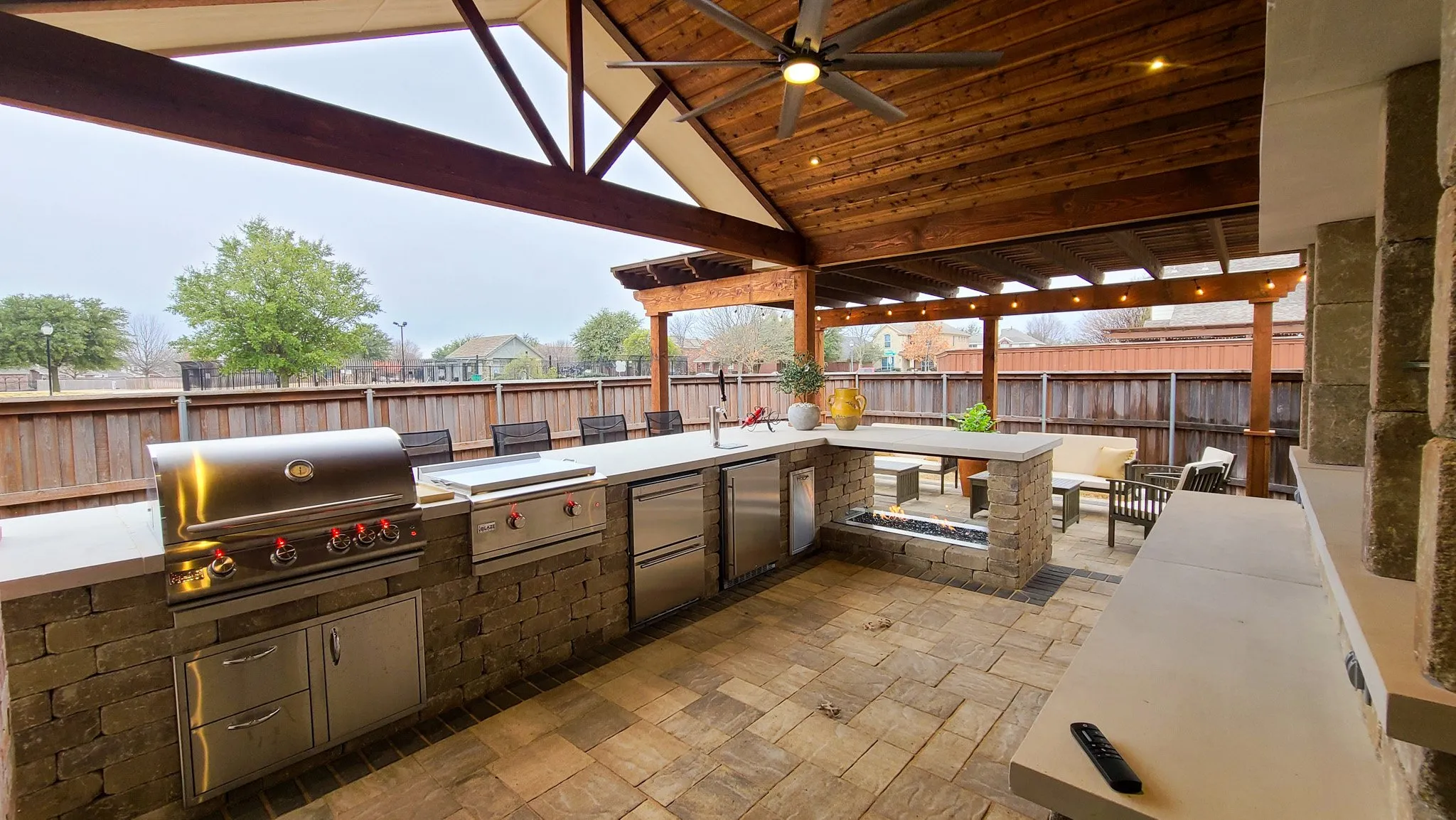
What’s the usage-based budget matrix we recommend for 2026 Marietta builds?
Based on the survey data, we build three tiers. Pick the one that matches how you actually cook today, not how you imagine yourself cooking in year one.
Tier 1 — The Core-4 (roughly $14,000 installed)
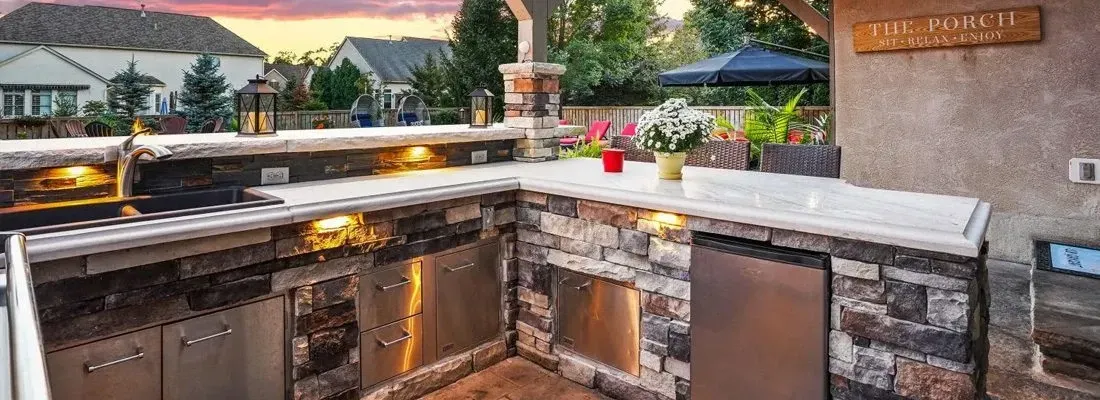
Cedar pavilion 12′ x 14′ with T&G ceiling, stacked stone veneer base, granite counter, Blaze Premium LTE 32″ grill, side burner, True Residential 24″ fridge drawers, 28″ prep counter. Covers 91% of measured cooking. This is what we recommend for most East Cobb households, especially younger families in Brookstone or Chestnut Hill who host less than monthly.
Tier 2 — The Weekend Host ($22,000–$26,000 installed)
Add a built-in Big Green Egg XL or Kamado Joe Classic III bay, upgrade to a 36″ DCS Series 7 grill, add a second 24″ fridge for beverage overflow, upgrade the pavilion roof to 14′ x 18′ with ceiling fan. This tier matches survey households that host 10+ guests monthly in summer.
Tier 3 — The Full Entertainer ($36,000–$48,000 installed)
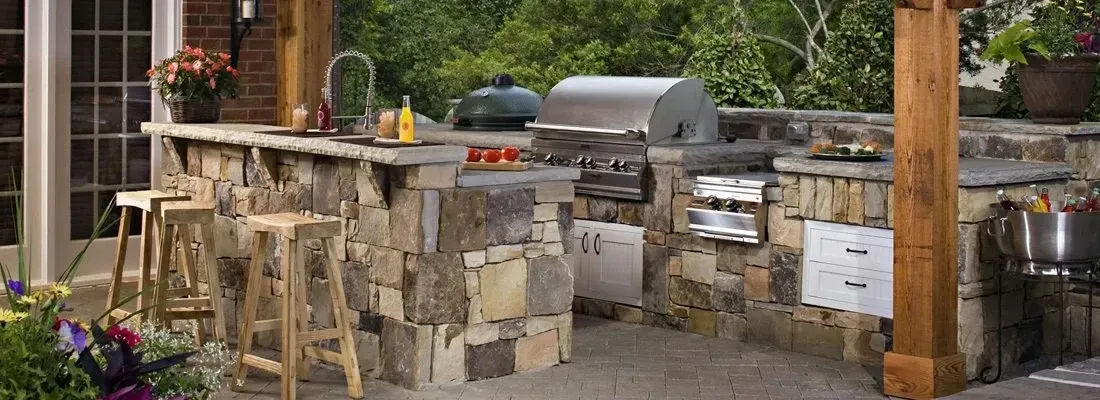
Full U-shape kitchen, Alfa Forni or Forno Bravo pizza oven, kegerator, outdoor sink, undercounter ice maker, TV, extended pergola entertaining wing, bar seating for 4–6. We only recommend this tier for the homeowners whose current lifestyle already proves the usage — serious home cooks, frequent entertainers, or vacation-rental owners. For average East Cobb families, Tier 3 is the one where 40% of the investment sits idle by year three.
One thing worth flagging inside these tiers: the delta between Tier 1 and Tier 2 is almost entirely the smoker bay, the grill upgrade, and the bigger pavilion. That is the right delta to spend on if your usage patterns justify it. The delta between Tier 2 and Tier 3, though, is mostly appliances that our data shows fire fewer than 10 times a year. That is a $16,000 delta for marginal real-world upside, and the reason we steer most Marietta homeowners to Tier 2 unless the entertaining cadence is already proven.
How do the Cobb site factors and HOA timelines shape the build?
Three site factors came up repeatedly in our 36 Marietta builds, and they interact directly with the permit and HOA review clock:
Piedmont clay and granite bedrock. Most East Cobb lots are Cecil series soil with granite at variable depth — we have hit rock at 3 feet on Johnson Ferry Road sites and gone 15 feet down without a strike in Sope Creek. Foundation depth for a pavilion with a 14-foot ridge line in Cobb County requires a 12″ diameter x 36″ deep pier at minimum. Rock encounters add $400–$900 per pier for core drilling.
Mature oak and poplar canopy. East Cobb’s signature is its tree cover, especially in Indian Hills and Sope Creek. That canopy cools the kitchen in August but it also drops leaves, acorns, and pollen onto every horizontal surface you build. Plan for a deeper overhang (24″ minimum) and a stainless grill cover even under a pavilion. Our service logs show East Cobb grills get 32% more cleaning visits than west-Cobb grills because of the canopy.
Grade changes. Many East Cobb backyards have 3–6 foot grade drops toward the rear of the lot. If your kitchen and pool are both on the upper grade, budget for a retaining wall integrated into the pavilion foundation. If the kitchen sits at the drop, budget for engineered fill and potentially a step-down terrace — which can actually improve the design but adds $4,000–$9,000.
For projects in Atlanta Country Club, Indian Hills, or Marietta Country Club, our standard schedule is:
- Week 1–2: design finalization, material selection, 3D renderings
- Week 3–8: HOA architectural review board submission, revision cycle, final approval
- Week 9: Cobb County permit submission (structural, gas, electrical)
- Week 10–12: permit approval + Cobb EMC or Marietta Power service upgrade if needed
- Week 13–22: construction — pavilion first, kitchen second, gas and electrical tie-in, punch-list
That is a 22-week runway for HOA neighborhoods. Brookstone, Walton Woods, Chestnut Hill, and most Burnt Hickory properties trim about six weeks off the front because the HOA review is lighter. Projects in unincorporated East Cobb without HOA constraints can break ground in as little as 5 weeks after design signoff. Plan accordingly.
A related schedule gotcha: Cobb County Community Development has specific inspection hold-points for gas and electrical that cannot be skipped. The gas line gets a rough-in pressure test before the stone veneer goes on, because if there is a leak after the veneer is set, you are cutting stone to fix it. The electrical inspection comes after rough-wire but before drywall or T&G ceiling installation. Build the inspection days into the schedule — a missed inspection day in Cobb can push the punch-list out 10–14 days because reschedules go to the back of the queue.
Across the 36-home survey, the single most common year-two change order was adding covered zone square footage — extending the pavilion, adding a pergola wing with retractable louvers, or enclosing one side with screen panels. Not adding appliances. Not adding fancier countertop material. More covered space.
The second most common change was upgrading lighting — moving from builder-grade recessed cans to dimmable warm LED with undercounter accent strips. Third was adding a ceiling fan (if not specified on day one). Fourth — way down the list — was swapping out an appliance, and in nearly every case it was replacing a side burner or a sink that was under-used with storage cabinetry instead.
Nobody in our survey added a pizza oven in year two. Nobody added a kegerator in year two. If it was not in the original design, the homeowner had already internalized that they did not need it. That is the usage pattern the initial spec should have caught.
The East Cobb rule of thumb: spend what you were going to spend on the flashiest appliance on more pavilion square footage instead. Covered space drives every single usage metric in the survey harder than appliance count does.
That is the survey, the numbers, and the build-planning takeaways. If you are pricing an outdoor kitchen in Marietta, the fastest path to a build you actually love in year three is to be honest with yourself about year-one hosting cadence, match the tier to real usage, and put the surplus money into the pavilion structure, not the appliance count. The renderings will tempt you to go bigger. The data says go smarter.
Outdoor kitchens across 20+ cities within 30 miles of Winder, GA
Usage-matched outdoor kitchen design, Cobb County permit-compliant pavilion structures, and full-service hardscape integration across Marietta and the greater Metro Atlanta footprint.