
A Lake Lanier thunderstorm can dump 2 to 4 inches of rain in 30 minutes, and most of the hardscape drainage we inspect across Forsyth County was never sized for that reality. It was sized for the smaller, gentler rain events a textbook calls “average” — and then one August storm proves the textbook wrong in the most expensive way possible.
Here is the post-storm walk we do more often than we’d like. A homeowner calls on a Monday. A wall blew out Sunday afternoon. The paver patio behind it is cracked, the backyard slope is a slurry of washed-out fines, and the neighbors on the downhill side are asking why a river suddenly runs through their pool equipment pad. By the time we arrive, the damage is done. The question is no longer whether the drainage system failed. The question is which specific part failed first, what sequence it triggered, and what the original installer did — or didn’t — put in the ground four years ago.
That is what this post is about. Not a gentle overview of hardscape drainage. A forensic walk through the way hardscape in Cumming actually fails when the sky opens up over Sawnee Mountain and rolls east toward Lake Lanier. We will name the pipe sizes, the capacity math, the code provisions, and one $42,000 retaining wall that blew apart because a contractor used standard small-storm numbers on a lot that needed big-storm engineering.
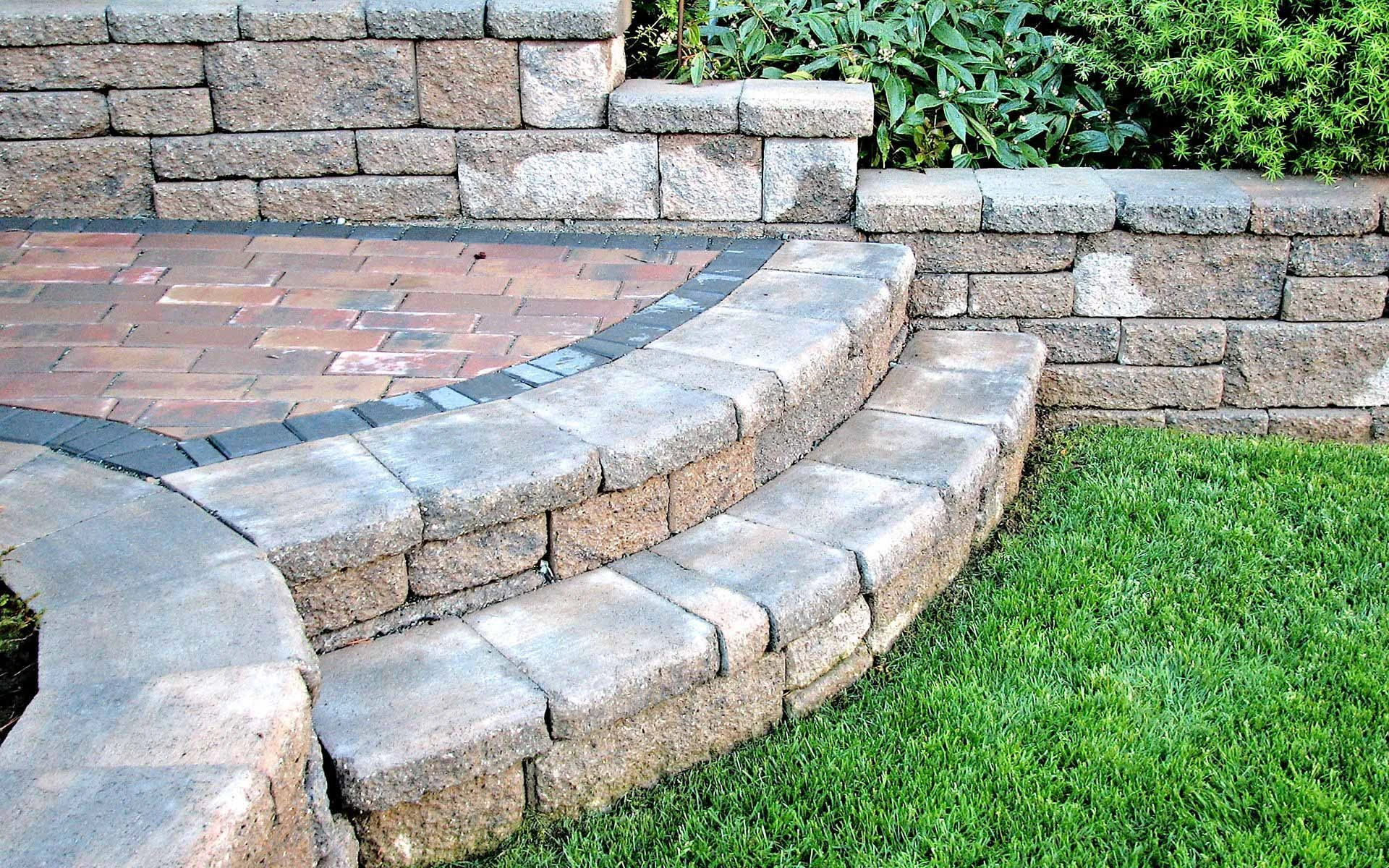
The Lake Lanier Storm Profile That Breaks Standard Hardscape Math
Hardscape drainage in Forsyth County has to pass a different test than hardscape drainage 40 miles south in Atlanta. The reason is the lake. Lake Lanier is a 38,000-acre water surface sitting a few miles north and east of almost every Cumming subdivision we work in. Summer heat pulls moisture off the lake. Afternoon thunderstorms stack against the 1,963-foot Sawnee Mountain ridge. The result is high-intensity cells that release more volume per minute than the county-wide rainfall averages suggest.
When a contractor in Vickery or Hampton Park sizes a subdrain using the old rule of thumb — “a 4-inch pipe handles most residential runoff” — they are designing for an average storm. A 4-inch smooth-wall pipe at 1% fall carries roughly 35 gallons per minute. That number is fine for a light afternoon shower. It is catastrophically undersized for a half-inch-in-five-minutes burst rolling off the lake. The math stops working somewhere around 50 GPM, and every gallon above that line has to go somewhere. It goes behind your retaining wall. It goes under your paver patio. It goes into the backfill void that you cannot see.
The storms that broke everything we rebuilt last summer weren’t 100-year events. They were 5-year and 10-year events. The system was sized for something smaller than that — call it a statistical average — and the gap between “average” and “what actually shows up” is where the damage lives.
Cumming storm design baseline we use: All hardscape subdrains we install size for a 100-year, 1-hour storm event — NOAA Atlas 14 for Forsyth County puts that at roughly 3.6 inches per hour. That translates to minimum 6-inch SDR-35 subdrain behind any retaining wall over 30 inches, with a sediment cleanout every 50 linear feet. Standard 4-inch corrugated pipe does not appear in our drawings.
The $42,000 Retaining Wall That Blew Out in St. Marlo
The call came in on a Monday morning in August. Homeowner in St. Marlo — golf-course community off McFarland Parkway — said his retaining wall had “moved” overnight. We drove out expecting a bulge. What we found was a 34-foot section of tumbled block pushed forward roughly 18 inches at its midpoint, with the raised travertine patio behind it cracked in three places and one paver section sitting six inches lower than its neighbor. The original contractor had quoted and built the wall four years earlier. The scope was a $42,000 retaining wall package including backfill, subdrain, and the patio it supported.
The forensic walk told the whole story in 20 minutes. The wall’s subdrain was 4-inch corrugated black ADS — pulled from the ground in one long piece, mostly crushed by the point-load of stones that had washed down behind it. No geotextile separator had been installed between the drainage aggregate and the native Piedmont clay. The “drainage aggregate” was not drainage aggregate at all. It was #57 gray crusher-run mixed with clay fines, which is what you get when someone dumps stone directly into a wet trench and the clay washes in around it within the first rainstorm.
The storm that killed the wall wasn’t a freak event. NOAA logged 2.8 inches in 42 minutes at the Cumming station that Sunday. The contractor had sized the subdrain for a 50-year storm based on state-averaged tables, not a 100-year event using Lake Lanier-adjusted Atlas 14 data. The gap between those two numbers — roughly 40% more peak flow — was the gap that tore the wall apart.
What the homeowner didn’t know at signing, and nobody told him, was that his lot specifically collected runoff from the golf course cart path that ran along the rear property line. Every storm, his wall was catching not just his own roof and patio runoff, but the concentrated flow off an additional quarter-acre of impervious asphalt upslope. A contractor doing a proper drainage survey walks the upslope tributary area before writing the subdrain spec. Nobody had walked it. The wall was doing twice the water-handling work the design assumed. When the peak event hit, the pipe was already at capacity from routine rainfall; this storm was just the part that couldn’t fit anymore.
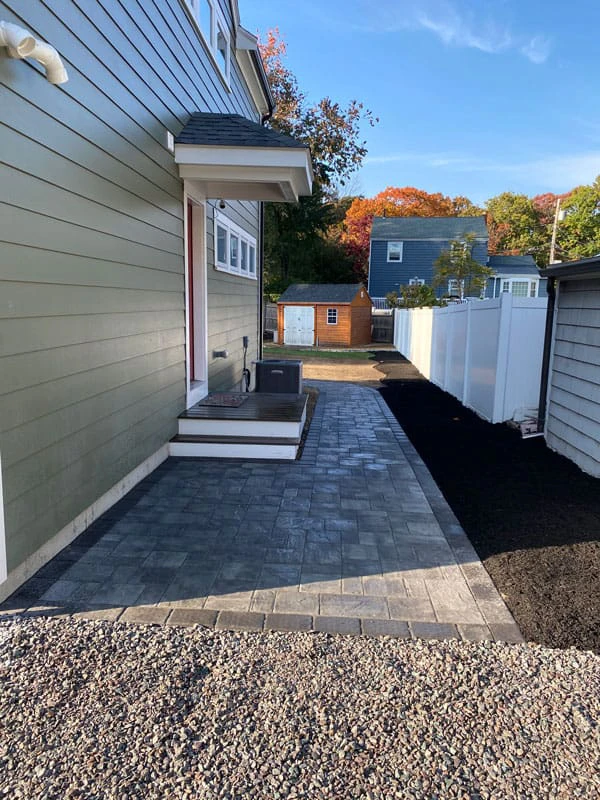
The Forsyth County Neighbor Discharge Rule Nobody Reads
Here is something most homeowners never hear before they sign a hardscape contract. Forsyth County has a concrete stormwater discharge provision that says, in plain language, you cannot alter your property drainage in a way that sends concentrated flow onto your neighbor’s lot. The county’s Development Services Division enforces this under the stormwater management ordinance, and the fine for a substantiated violation runs up to $1,500 per day of ongoing impact.
What this means in practical terms is that when your contractor installs a big paver patio, a raised travertine pad, or a curved retaining wall that redirects water, the discharge point is the contractor’s problem to solve on your parcel. Not your neighbor’s. Not the subdivision’s. Not the county’s. Yours. If that water ends up spilling onto the downhill lot at Lake Windward or Polo Fields, the county can cite you, and your only recourse is to rebuild the drainage you already paid for.
We have been called into two neighbor-dispute situations in the last 18 months where the homeowner had a beautiful patio, a beautiful fire feature, a fully permitted project — and an enforcement letter. The fix in both cases was a retrofit dry well sized to hold and infiltrate the peak 15-minute discharge on the homeowner’s side of the property line. Neither retrofit was cheap. One was $11,200. The other was $18,400. Both would have been a fraction of that if the drainage had been designed correctly on day one.
Enforcement in Forsyth County tends to move slowly until a neighbor files a formal complaint, at which point it moves fast. The letter references the county ordinance and gives the homeowner a compliance window — typically 30 days — to submit a remediation plan. Miss the window and the daily fine clock starts. On top of the county exposure, the downhill neighbor can file civil tort action for water damage, which in Georgia carries a 4-year statute of limitations from the date damage is discovered. We have seen homeowners in Three Chimneys and Haw Creek subdivisions absorb $40,000-plus in combined remediation and settlement costs because the original hardscape bid didn’t include a legitimate discharge plan.
The rule in one sentence: You own the water that lands on your property until it reaches an approved county drainage easement. If your hardscape pushes that water across a property line, you are liable for it — regardless of which contractor built it.
The Three-Part Subdrain and the Six Ways It Fails
A retaining wall subdrain is not a pipe buried behind a wall. It is a three-part system, and when any one of the three fails, the whole thing fails. Any contractor who talks about “drain pipe” without talking about the other two is skipping the parts that do the actual work.
The first part is the filter fabric. A non-woven geotextile separator — Mirafi 140N is our standard — wraps the full drainage zone before any stone goes in the trench. This fabric is what keeps the native Piedmont red clay fines from migrating into the drainage aggregate and sealing it shut. Without it, you have maybe two years before clay infiltration reduces the stone’s void space below the percolation threshold. We pull apart failed walls and the stone trench is a solid block of clay-coated gravel. That is not a drain anymore. That is a clay wall.
The second part is the aggregate. Clean #57 washed stone — never crusher-run, never stone screenings, never “whatever came on the truck today” — gives you about 35% void space, which is where the water actually lives and moves. The aggregate extends from the wall’s base footing up to within 6 inches of the finished grade, and it wraps the pipe completely. Minimum 12 inches wide, 18 inches for walls over 4 feet tall.
The third part is the pipe. SDR-35 solid white PVC is the only thing we put behind walls over 30 inches tall in Forsyth County. Corrugated black ADS — the product most landscapers use because it rolls off the truck and cuts with a razor knife — crushes under point-loading from settling backfill within about 5 years. SDR-35 holds its shape. It also has cleanouts we can snake and camera. The corrugated pipe does not.
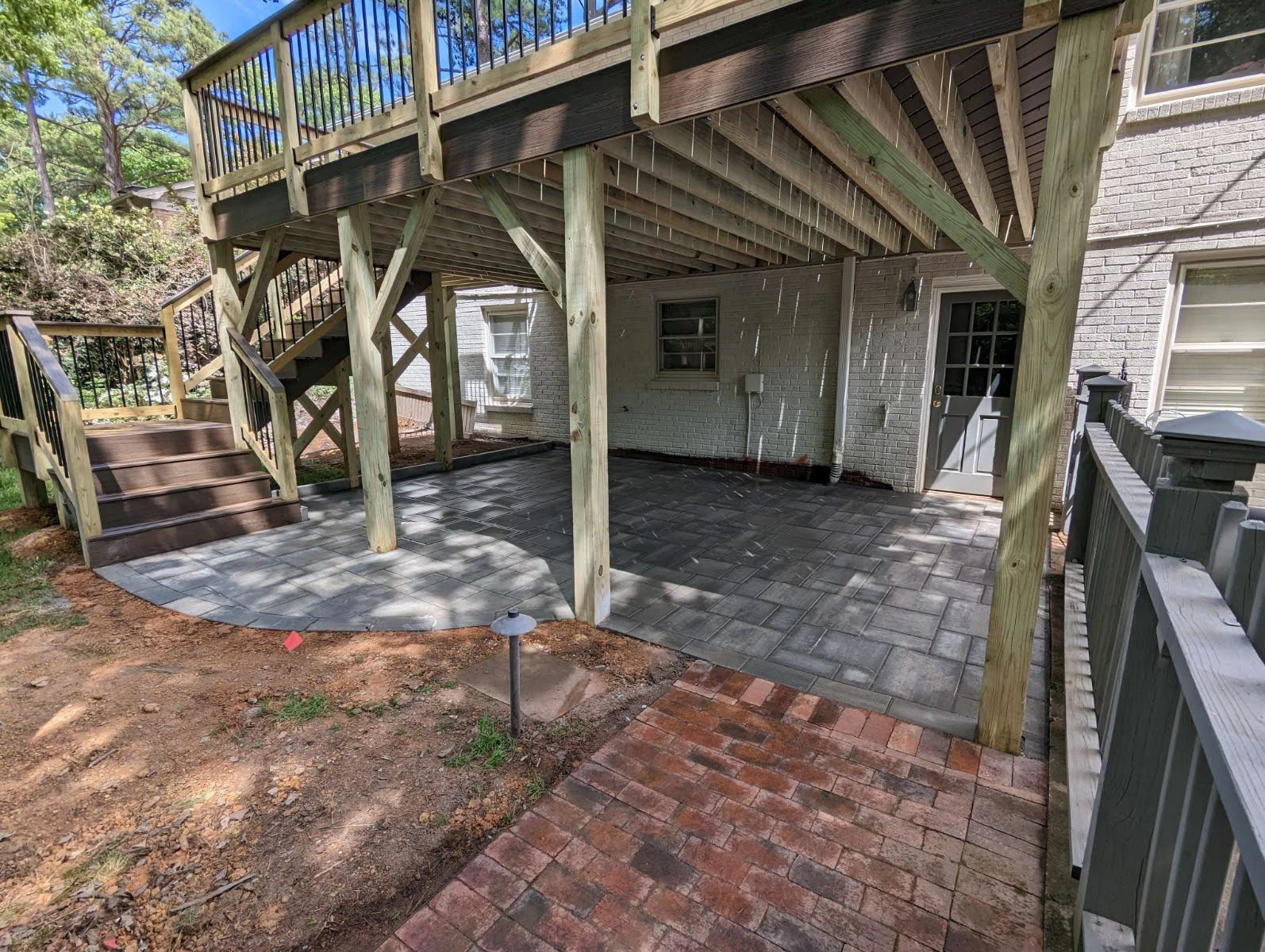
After building and rebuilding hardscape in Cumming for long enough, you stop being surprised. The same six failure modes show up in the same order, storm after storm. Here is what the forensic walk keeps finding when any of those three components has been compromised.
Failure one: undersized outfall pipe. The subdrain behind the wall is sometimes okay — 6-inch SDR-35 is in the ground — but it discharges into a 4-inch corrugated pipe at the daylight point. The outfall is the bottleneck. Water backs up, pressure builds, and the wall moves. We fix this by matching the outfall to the subdrain size, minimum.
Failure two: missing geotextile separator. Covered above. The contractor skipped the Mirafi 140N and the stone has been loading with clay fines since day one. By year 4 or 5, the drain has no void space left. It is now a barrier, not a drain.
Failure three: no sediment cleanout. The pipe runs 80 linear feet behind the wall with no access point. When it clogs — and it will — there is no way to clear it without excavating the wall. Which is the very thing the homeowner is trying to avoid. We put a cleanout every 50 feet minimum, and always at direction changes.
Failure four: bad slope on the drain pipe. Gravity-fed drain pipe needs a minimum 1% fall. We see installs with zero slope, reverse slope, and — our favorite — negative slope where the pipe has sagged between two rigid reference points and now holds standing water that freezes in Cumming’s roughly 22 freeze events per year.
Failure five: no weep holes in the wall face. Belgard, Techo-Bloc, and the other quality retaining wall block manufacturers spec face drainage through the wall itself as a secondary path. Installers routinely skip it because it slows the build down by half a day. When the primary subdrain is overloaded, the weep holes give water a pressure-relief path. Without them, the wall is the relief valve.
Failure six: patio drainage pointing the wrong way. This one is about the patio above the wall, not the wall itself. A paver patio is supposed to shed water away from the house at a minimum 1.5% slope — per the Interlocking Concrete Pavement Institute’s installation guidelines. When the patio pitches the wrong way, every rainstorm adds volume to the wall’s backfill zone that was never in the design assumption.
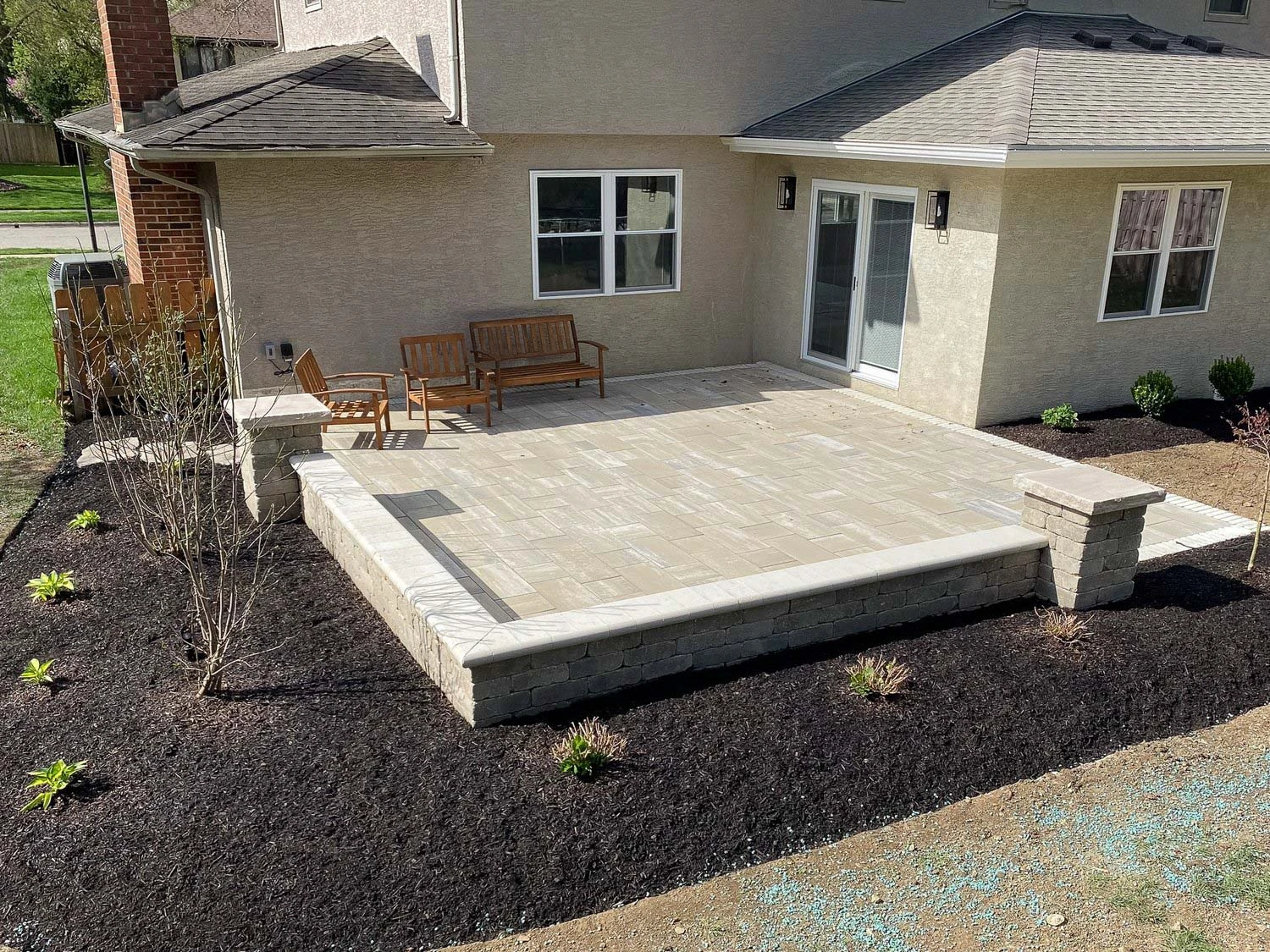
What the 100-Year Storm Design Actually Costs
Homeowners frequently ask the obvious question after we describe this engineering. How much more does the correct system cost versus the builder-grade system? The honest answer, on a typical $38,000 to $55,000 Cumming retaining wall project, is roughly $2,200 to $3,800 more up front. That is the delta between a 4-inch corrugated subdrain with no geotextile and a 6-inch SDR-35 subdrain with Mirafi 140N, weep holes, cleanouts every 50 feet, and an outfall sized to match.
That delta is why the correct system is rare on the market. It is the part of the bid nobody sees in the before-and-after photos. An installer trying to win against three cheaper bids has every incentive to strip it out. The homeowner does not know to ask. The permit from the Forsyth County Department of Planning & Community Development at 110 E. Main Street does not specifically require subdrain sizing over 30 inches of wall height — it just requires “adequate drainage,” a term that means whatever the inspector’s patience level that Tuesday says it means.
Compare the $2,200–$3,800 delta to the cost of rebuilding a failed wall. The St. Marlo wall above cost the homeowner $58,900 to rebuild properly, because the failure had also destroyed the patio, part of the pool deck, a French drain run, and two mature Japanese maples that had to be removed during excavation. The original $42,000 wall became a $101,000 total when you add the rebuild. That is the cost of the wrong engineering on a Lake Lanier storm event.
What to put in your contract: Ask the contractor to write in the subdrain specification verbatim. “6-inch SDR-35 solid wall PVC subdrain, wrapped in Mirafi 140N non-woven geotextile separator, surrounded by #57 washed stone aggregate, with sediment cleanouts every 50 linear feet, discharging to a 6-inch minimum outfall at daylight.” If the contractor cannot write that sentence into the contract, the contractor is not building that system.
The Inspection We Run Before We’ll Quote a Retrofit
Not every hardscape project in Cumming is a new build. A meaningful share of what we do is forensic retrofit work on someone else’s installation — usually because a wall is bulging, a patio is cracking, or a neighbor has filed a complaint. Before we quote that kind of job, we run the same inspection protocol every time. It takes an afternoon. It costs nothing. And it tells us exactly what the original contractor did and didn’t do underground.
Step one is a camera scope of the existing subdrain, run from the closest cleanout (if there is one) or from the outfall at daylight. We are looking for pipe size, pipe material, pipe condition, standing water, sediment load, and crushed sections. Roughly 70% of the drains we camera show one or more critical deficiencies on the first run.
Step two is a targeted excavation at the wall’s wettest face — usually identified by efflorescence staining on the block or a moisture crescent in the patio behind. We open a 3-foot window into the backfill zone and take samples. We are checking for geotextile presence, aggregate type, aggregate contamination, native soil intrusion, and organic material. Five minutes with a soil sample bag tells the story.
Step three is a slope survey. We shoot elevations on the patio, the wall cap, the outfall daylight point, and any transitions. We compare what we measured to the ICPI minimum slope specs and to the hydraulic capacity of the installed pipe. This is the math step. This is where we decide whether the system can be retrofit with added capacity or whether it needs to be rebuilt from the footing up.
Retrofits we recommend after that inspection generally fall into one of three buckets. A bucket-one job is a cleanout retrofit and outfall upsize — roughly $3,800 to $7,200 and saves the existing wall. A bucket-two job is a full subdrain replacement behind an intact wall face, by pulling the top two courses and trenching — $11,000 to $19,000. A bucket-three job is a full teardown and rebuild because the backfill has lost its structural integrity — which is a new project at new-project pricing.
Cumming’s population growth — Forsyth County is the fastest-growing county in Georgia and the housing stock skews heavily toward 2000-2015 subdivisions — means there is a large inventory of 15-to-25-year-old hardscape that was never engineered for the storm intensity the lake produces. A large share of it will need intervention in the next decade. The homeowners who do the inspection work now, before a failure, pay roughly a third of what the failure-driven rebuild costs.
A handful of factors make the Cumming timing particularly urgent right now. Rainfall intensity across the Southeast has measurably increased over the last two decades, and NOAA updated the Atlas 14 precipitation tables for Georgia with numbers roughly 15-20% higher than the tables that were in use when most of this hardscape was originally designed. That means a wall built to the then-current code can be undersized against the now-current storm data without anyone having done anything wrong — the ground rules moved. On top of that, the HOA architectural review boards at subdivisions like St. Marlo and Polo Fields now require post-storm drainage certification before approving any hardscape modification. A wall that failed once and got rebuilt without proper engineering will fail the review on the second attempt, adding a 2-3 week delay to the process.
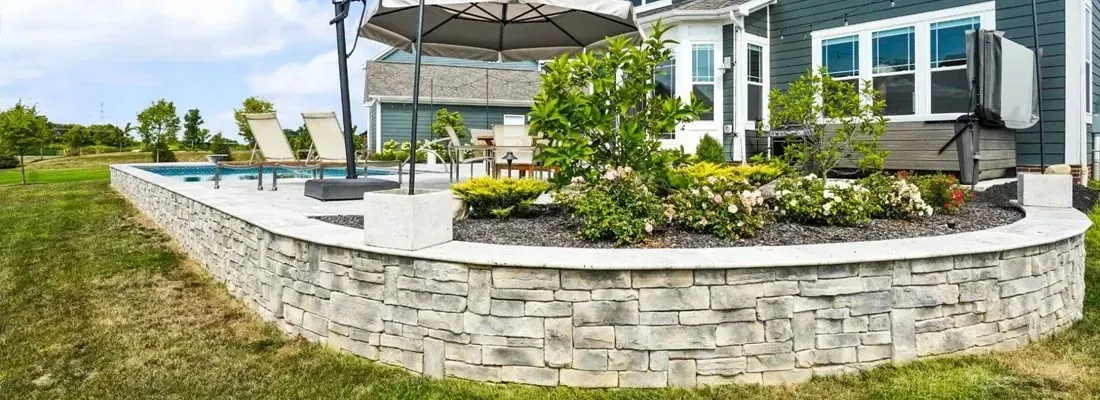
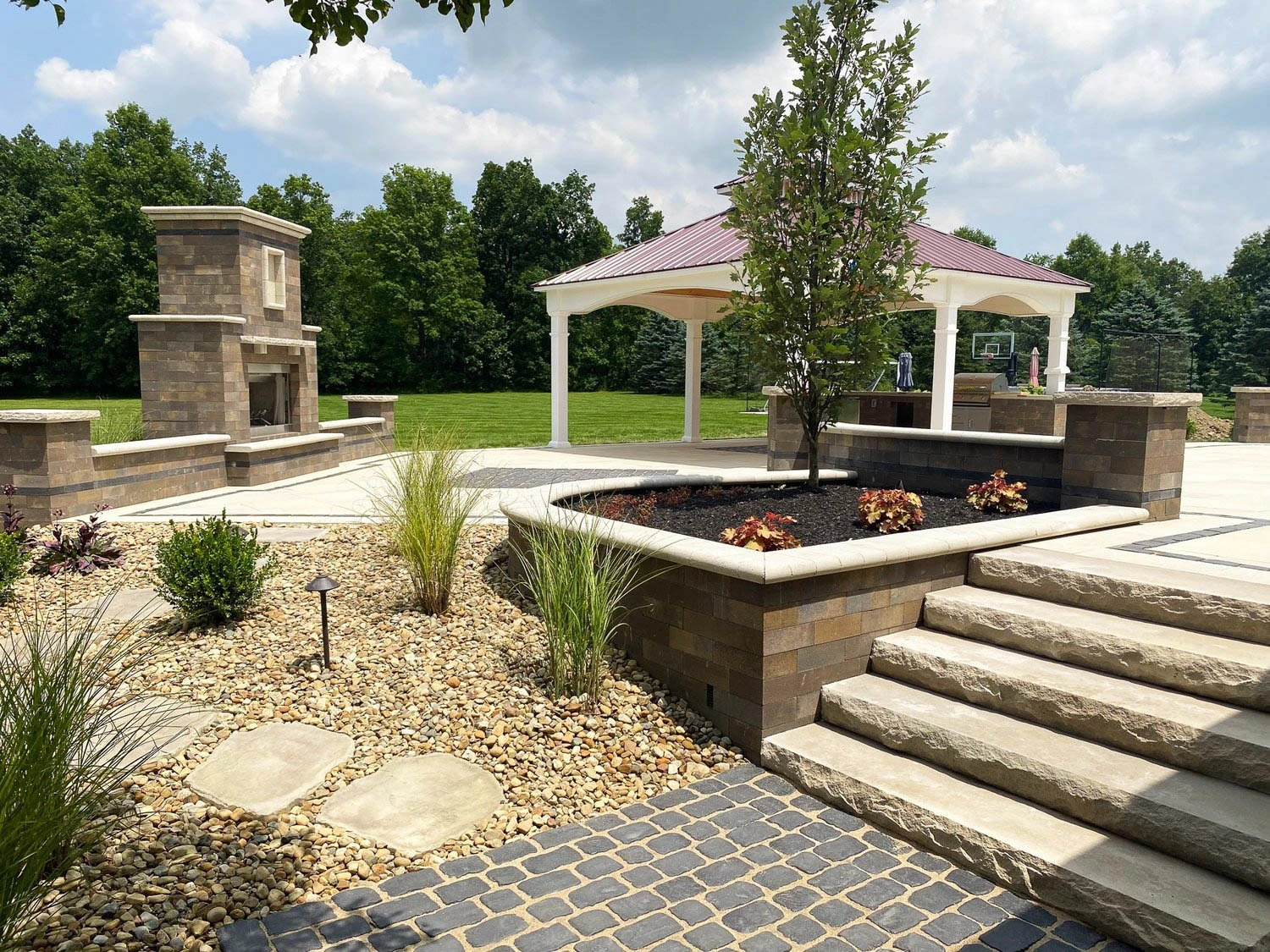
Hardscape design and construction across 20+ cities within 30 miles of Winder, GA
We engineer hardscape drainage for the storm intensity the lake actually produces — not the averaged number a textbook suggests. From Cumming to Gainesville to Dawsonville, every retaining wall, paver patio, and raised pad we build is sized for a 100-year event with Mirafi 140N, 6-inch SDR-35, and sediment cleanouts on the drawings.