
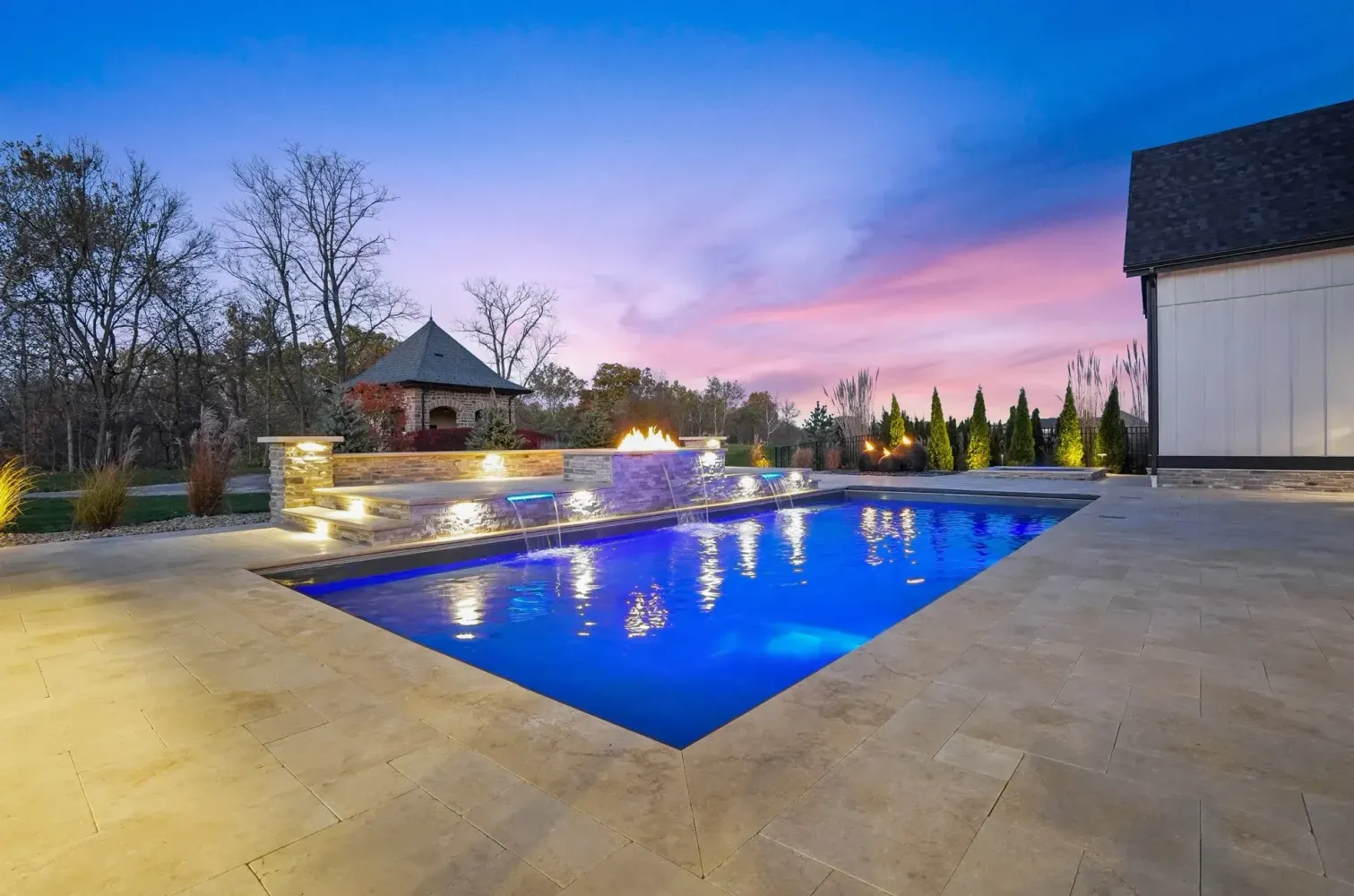
Here is what a correctly lit Alpharetta pool deck looks like at 9:45 p.m. in July. One — the water glows cool white from inside the basin. Two — the deck itself carries a soft amber wash that lets you see the coping joint without squinting. Three — the canopy of mature water oaks overhead is lit from below, turning the whole backyard into a ceilinged room. Three tiers. One scene. Not a lighting package anyone sold you — a design decision made before the gunite went in.
Walk any Windward or Country Club of the South backyard after dark and you can tell within six seconds whether the pool deck was lit by a pool builder, a landscape lighting crew, or nobody at all. The builder-only decks look like a blue bathtub in a dark field. The landscape-only decks have pretty trees and a black pool. The nobody decks are the most common — a single floodlight on the back of the house, one pool bulb from 2004, and a family that stopped using the pool after 8:30 p.m. without realizing why.
The fix is not more fixtures. It is three tiers of fixtures, each running at a different color temperature, each on its own zone, each answering a different problem. This post is how we build it in Alpharetta specifically — the fixtures, the kelvin choices, the control layer, and why the tree canopy over a Fulton County backyard changes the math.
Why Alpharetta’s Canopy Changes Everything About Deck Lighting
Nearly all evening-lighting advice you read online was written for open backyards — suburban Florida, desert Southwest, new-build Midwest lots without mature trees. Alpharetta is not that. The older established subdivisions — Windward, Hutchinson Farm, Haynes Manor, Brookhollow, Martins Landing — were cut into an existing hardwood canopy in the late 1990s. Homeowners in those neighborhoods paid a premium for mature oaks and tulip poplars and they kept them. The result is a pool environment where roughly 60-75% of the backyard overhead is leaves, branches, and shadow for six months of the year.
That canopy does two things to your lighting design. First, it eats ambient sky light. A backyard in a tree-less subdivision in, say, Cumming or Dawsonville will carry 3-4x more residual brightness at 9:30 p.m. from reflected sky than an equivalent Windward backyard. The Alpharetta yard goes darker faster and darker deeper. Second, the canopy is itself a surface — a massive overhead ceiling that desperately wants to be lit. A ceiling in a room you cannot light is a ceiling that feels oppressive. Uplit, that same canopy reads as an intentional architectural feature, and the entire yard shifts from “dark outside” to “lit room.”
If you are only lighting the pool and the deck and ignoring the trees, you are designing for a backyard that doesn’t exist here. You are lighting the floor of a room and leaving the ceiling black. That is why the third tier — the canopy tier — is not optional on a correctly designed Alpharetta deck. It is the difference between a pool area that gets used until 11 p.m. in July and a pool area that closes when the sun drops behind the ridge at 8:40.
Tier 1 — Pool LED at 6,000K for Water Color Contrast
The first tier is the easy one, but the one most builders still get wrong. The pool itself needs LED lighting at a cool-white 6,000K color temperature — not RGB color-change, not 3,000K warm, not the color-of-the-week programmed scene you tested once and never used again. Cool white at 6,000K is what makes the water read as water. It keeps the plaster white, the tile true-blue, and the reflected light bouncing up off the pool floor onto the coping cool enough to contrast against everything else on the deck.
Our default fixture for a 16×32 rectangle in Alpharetta is three Pentair IntelliBrite 5G color-changing LEDs run in the 6,000K cool-white preset. Three fixtures in a 16×32, not two. Two leaves a dark triangle in the deep end that your eye catches from the deck every time. For an 18×36 or larger add a fourth, centered on the long wall opposite the skimmer. IntelliBrite 5G fixtures run through a standard Pentair niche, come with a 150-foot cord for flexible electrical routing, and carry a 2-year warranty that Pentair actually honors if the fixture was installed by a licensed pool builder — which matters in Alpharetta because Pentair’s Atlanta regional rep tracks installer registrations.
Cost for a properly specified Tier 1 on a 16×32: $2,400 to $3,100 including niches, conduit, and transformer. That is the fixture package only — not the controller, which we’ll cover in tier four (yes, there’s a fourth thing, and it is not a tier — it is the glue).
Why not RGB color-change as the primary: You’ll use the color scenes three times in year one, once in year two, and never in year three. Plan the design around 6,000K as the everyday state. Treat the RGB modes as a party trick you keep for July 4th and a kid’s birthday.
Tier 2 — Deck-Level Bullet Fixtures at 2,700K Warm White
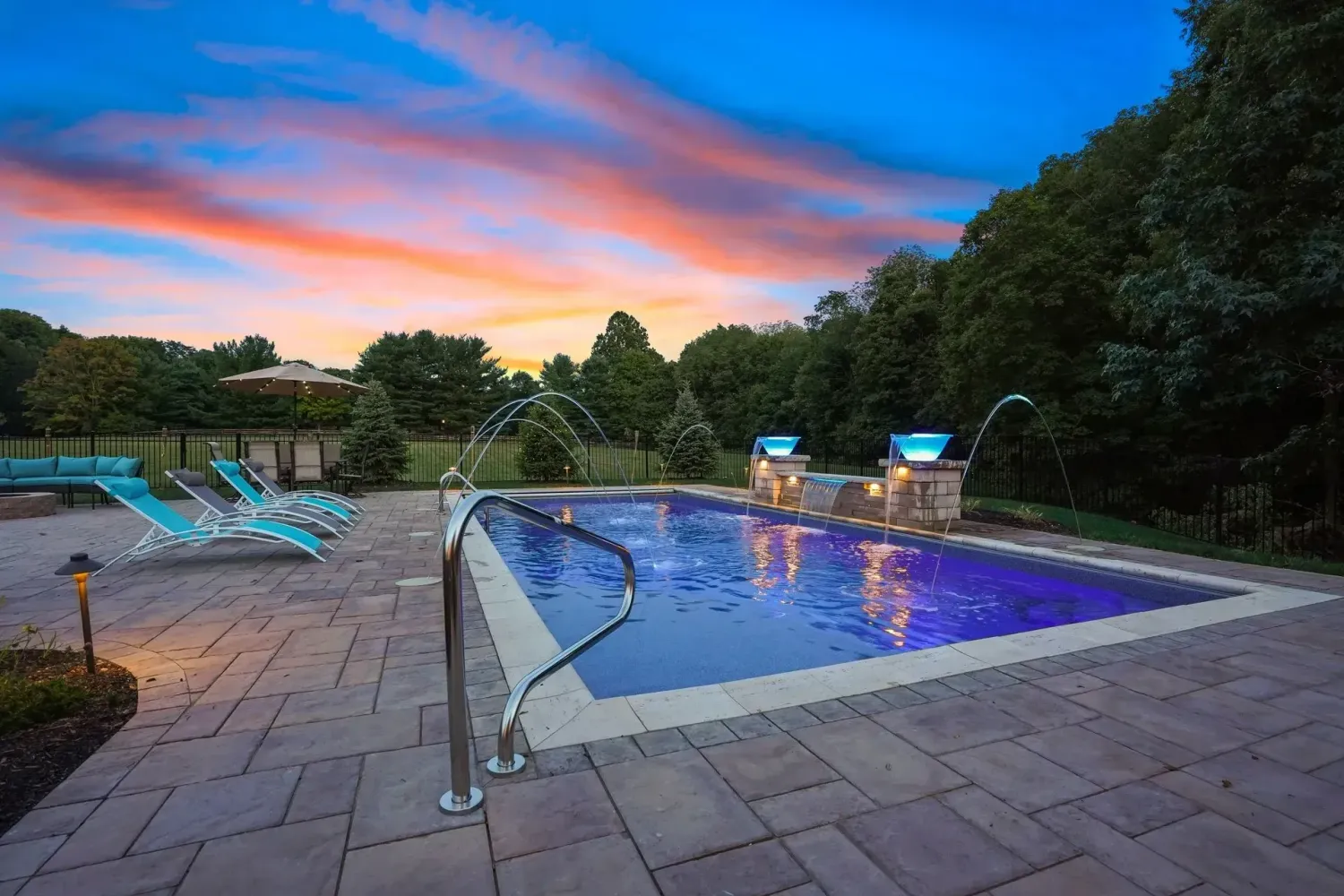
This is where the magic happens, and it is also the tier that untrained crews butcher. The second tier is the deck itself — the hardscape plane you walk on. Its job is to let people see the coping edge, the steps, the transition from pool deck to lawn, and the seating area, without creating any glare visible from the water. A swimmer looking toward the deck from the shallow end should never see a bare lamp source.
The fixture we specify in Alpharetta is the FX Luminaire Zonda — a solid brass in-grade bullet with a 60-degree glare shield and interchangeable lamp modules. For a 16×32 pool with an 18-foot-wide deck on the long side and 8-foot returns on the ends, we run 8 to 12 Zondas around the perimeter. Zondas install flush to the deck surface (no path lights, nothing at knee height), which matters because Alpharetta homeowners in their 40s and 50s who just moved here from a tech-corridor relocation — Microsoft, CDW, and the cluster of corporate HQs off Windward Parkway — consistently cite a clean-lined, sculpted, uncluttered deck as a requirement. They do not want path lights that look like dollhouse lanterns.
Color temperature on the Zondas is 2,700K warm white, not 3,000K and not cooler. The warm-white deck paired with the cool-white pool is what creates the signature contrast — pool glows crisp and clean, deck glows soft and amber, and the boundary between them reads as a sharp, intentional edge. Flip it (cool deck, warm pool) and the whole scene flattens. This is a testable claim — dim each tier alone and then together and your eye will tell you instantly which direction the temperatures should run.
Lumen output on each Zonda is modest by design — 150-220 lumens per fixture — because the goal is not to floodlight the deck, it is to define its edges. Overlit decks make the pool water look black by comparison. The eye adjusts to the deck brightness and the water recedes into a dark void.
Tier 3 — Canopy Uplight at 3,000K on Specimen Trees
Tier three is where most Alpharetta pool projects die on the vine — not because the homeowner doesn’t want it, but because the pool builder doesn’t design it, the landscape lighting crew comes out two years later, trenches the yard, and installs fixtures that fight the pool lighting instead of completing it. The canopy tier has to be designed at the same time as tiers one and two, with shared conduit pathways, shared transformer planning, and shared controller integration.
For a typical Windward or Country Club of the South backyard with 6-8 mature specimen trees, we run FX Luminaire Nox or Vernal brass uplights with 5W-9W LED modules at 3,000K. The color temperature is warmer than the pool (cool) and very slightly cooler than the deck (warm-warm), which puts the canopy in the middle of the range and makes it feel connected to both layers without competing.
Placement matters more than fixture count. One uplight 4-6 feet out from the trunk, angled 15-25 degrees off vertical, typically produces a better canopy result than three uplights clustered at the base. For a 60-foot mature water oak — common in Alpharetta, particularly near the Chattahoochee River floodplain on the western edge of the city — we often run two fixtures on opposite sides of the trunk at different aim angles to build dimensionality in the canopy. Single-source uplighting on a big oak produces a flat silhouette. Dual-source produces depth.
Budget for a full Tier 3 install covering 6 trees: $2,800 to $4,200 in fixtures, transformer capacity, and low-voltage wire. The cost of NOT doing Tier 3 is real — you will use the backyard 2-3 hours less per night in July and August. Multiply that by the number of usable pool nights per season in Zone 8a, and the canopy tier pays back in usable-hours within one summer.
The Controller — Lutron RadioRA 2 or Pentair IntelliCenter as the Glue
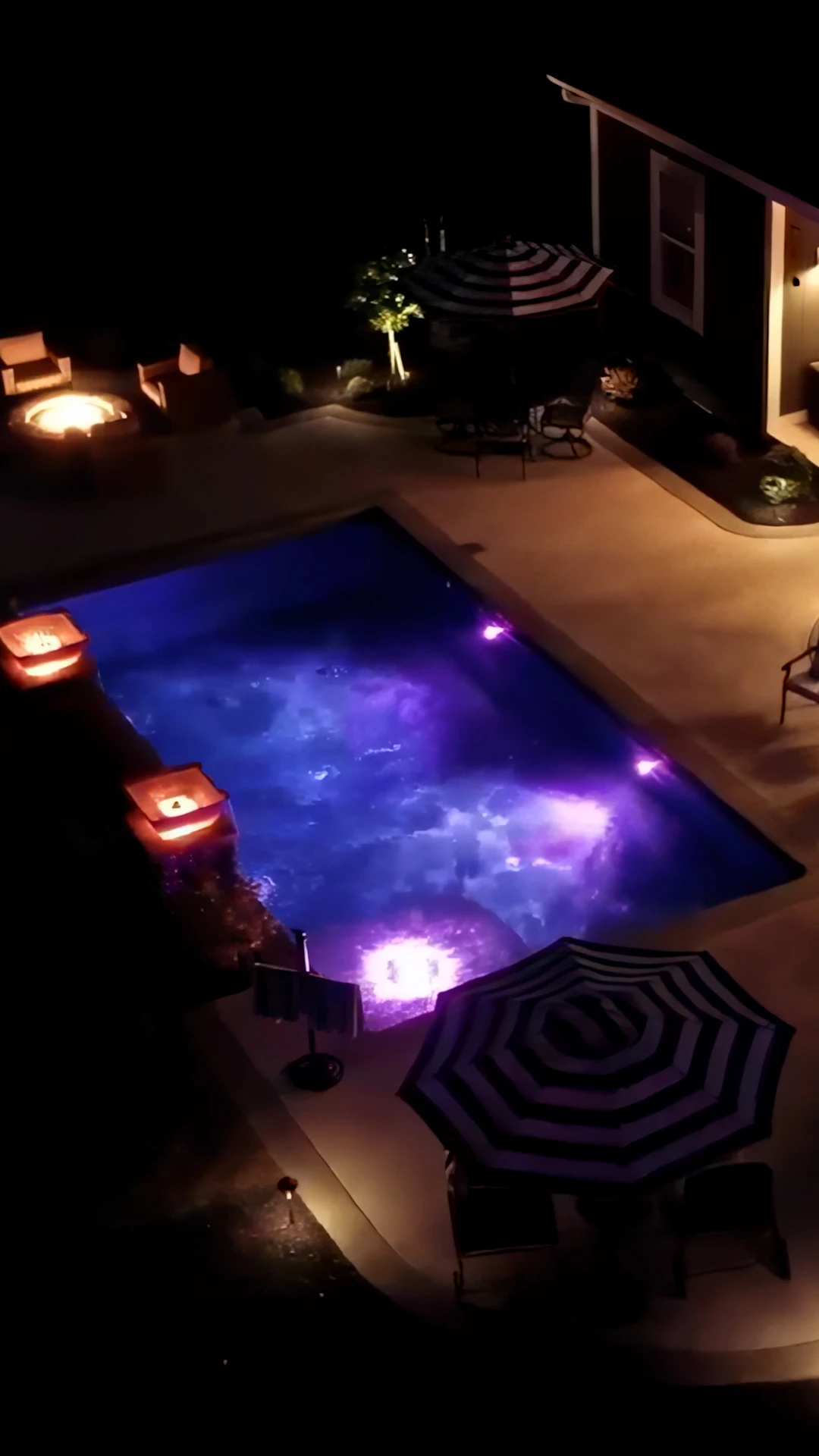
Three tiers with three different color temperatures on three different circuits is not a design — it is a mess — unless there is a unified control layer binding them into scenes. The two controllers we specify in Alpharetta are Lutron RadioRA 2 (when the homeowner has an existing Lutron lighting setup inside the house, which is common in the Country Club of the South price tier) or Pentair IntelliCenter (when the pool equipment is already Pentair and the client wants pool + deck + canopy unified through one app).
What a correctly programmed controller does is eliminate the moment at 9 p.m. when someone has to go flip four switches. You build three scenes — “Dinner” (Tier 2 at 80%, Tier 3 at 60%, Tier 1 off), “Swim” (all three tiers at 70-100%), “Late” (Tier 2 at 30%, Tier 3 at 40%, Tier 1 off) — and you press one button. The entire yard transitions. Without this layer, the three-tier system becomes three separate decisions nobody wants to make four times a night, and within six weeks the homeowner is using one scene (everything on) or none (everything off).
Controller cost installed and programmed: $4,200 to $6,800 depending on whether we’re integrating into an existing Lutron system or building a standalone IntelliCenter setup. Plan for the low end on a greenfield install and the high end when we have to bridge Pentair equipment to an existing Lutron panel in a Country Club of the South home that was built in 1998 and wired before the modern smart-home era.
Why this matters for resale: A three-tier lit deck with scene-based control reads as a finished luxury amenity in the $750K-$3.5M home bracket typical of Country Club of the South and Windward. An unfinished lighting package reads as deferred work the buyer has to finish. It is one of the few pool-area upgrades that measurably shows up in photo-driven listings.
Permits, Utilities, and ARB — The Alpharetta Execution Path
Here is where local knowledge separates a clean install from a six-week delay. Alpharetta runs its own permits through the City of Alpharetta Community Development office at 2 Park Plaza — not Fulton County unincorporated. If your pool is inside city limits (most of the zip codes 30004, 30005, 30009, and 30022 are), the electrical permit for the low-voltage and line-voltage lighting runs through the city’s permit portal and typically clears in 8-12 business days, which is materially faster than Fulton County unincorporated’s 3-4 week turn.
Utility-side, most of Alpharetta is Georgia Power service territory, but a narrow band along the northern city edge toward Milton falls inside Sawnee EMC footprint. This matters because the two utilities run on different inspection calendars and different meter-drop protocols. A pool-equipment pad rewire in Sawnee EMC territory goes on a different schedule than one in Georgia Power territory. We confirm utility service before we commit an install date — this has caught clients off-guard more than once in the transition areas near Cambridge Parks and the northern edge of White Columns.
The ARB layer is the other Alpharetta-specific factor. Windward and Country Club of the South both operate 3-4 week architectural review windows, and the review boards in both communities are attentive to nighttime light spill. That cuts both ways — they will reject over-bright fixtures aimed at neighbors, but they will also approve a well-documented three-tier lighting plan quickly because it demonstrates intentional design rather than the ad-hoc tack-on lighting they see in most submittals. If your designer cannot produce a written lighting photometric plan for ARB submission, that designer is not the right fit for these two communities specifically.
We’ve also run into the Avalon-adjacent luxury townhome infill situation more than once. Small backyards (often 30×50 or tighter), dense ambient light from the lifestyle-center district, and homeowner expectations imported from restaurants and hotels make lighting design in those homes a different exercise entirely. Tier 3 is often impossible (no mature canopy), so we compensate with architectural uplight on the home itself and a taller Tier 2 using pier-mounted fixtures to build verticality. Different math, same principle — three layers that read as one scene.
Case Study — A 16×32 Rectangle in Windward, Installed April 2026
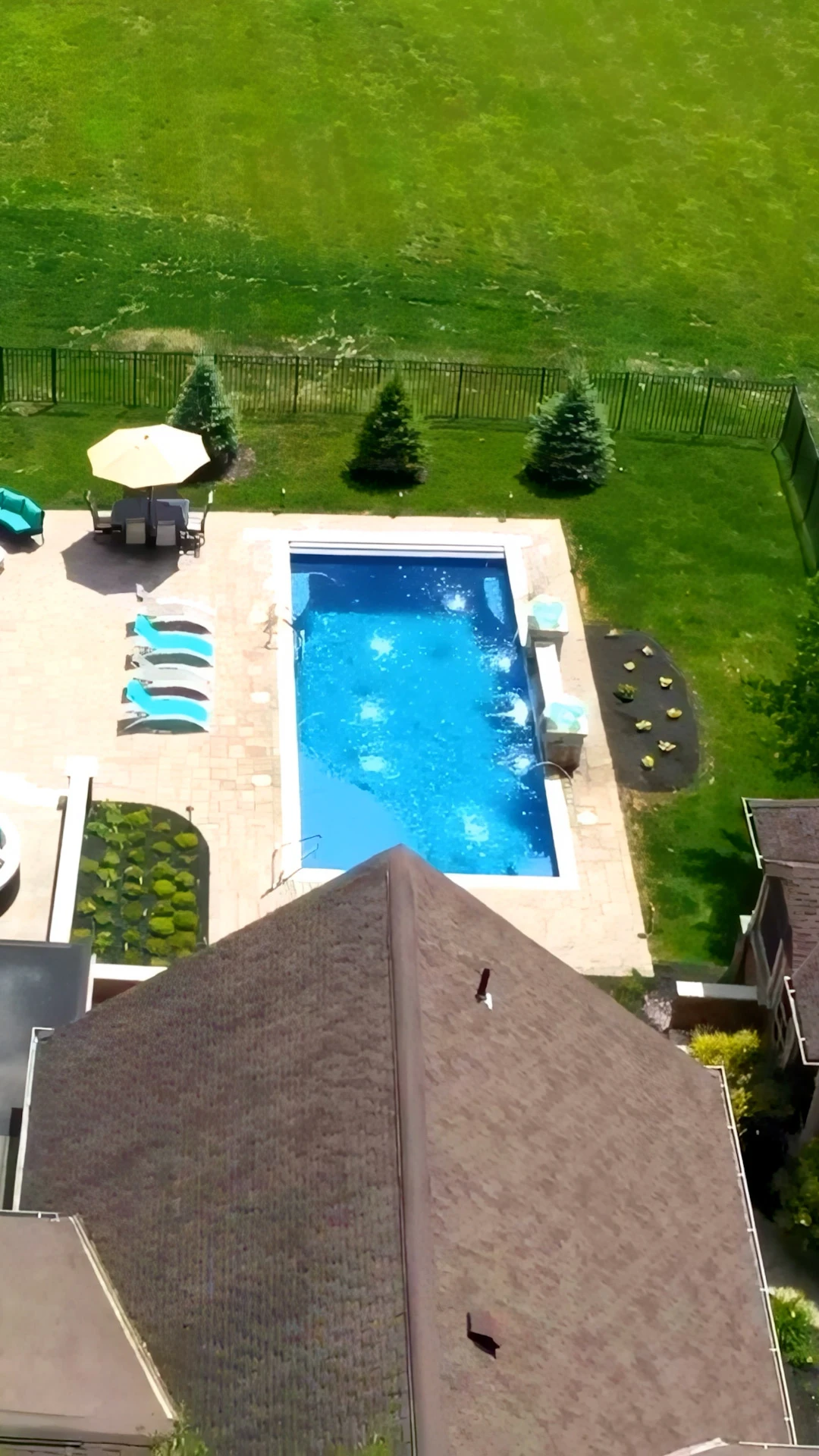
The cleanest way to show how the three tiers actually add up is a real project cost breakdown. This is a 16×32 geometric rectangle pool we completed on a Windward lot off Windward Parkway in early 2026. Pool was new construction (not a retrofit), deck was travertine cut in French pattern, and the backyard had five mature specimen trees — three water oaks, one tulip poplar, and one mature magnolia — that stayed in place through construction.
- Tier 1 (pool): 3 × Pentair IntelliBrite 5G LED fixtures, 6,000K preset, niches and conduit — $2,750
- Tier 2 (deck): 10 × FX Luminaire Zonda in-grade brass bullets, 2,700K, 5W modules, 300W transformer and wire — $4,900
- Tier 3 (canopy): 9 × FX Luminaire Nox uplights on 5 trees (dual-source on the three largest water oaks), 3,000K, 9W modules, shared 300W transformer with Tier 2 — $3,400
- Controller: Pentair IntelliCenter integrated with a Lutron RadioRA 2 keypad in the house — $5,600
- Electrical rough-in and inspection (City of Alpharetta): $2,400
- Scene programming and commissioning: $950
All-in for the lighting package: $20,000 on a pool build that landed at a total of $142K. Roughly 14% of project cost went to lighting. That is on the high end of what a lighting package runs on an Alpharetta custom pool — the norm is 8-12% — but this project’s mature canopy and the client’s insistence on a full Lutron integration drove the spec up. Every dollar of it is the kind of dollar that shows up nightly.
The homeowner’s first July with the pool, by their own accounting, averaged 11-13 usable evening hours per week of actual pool deck occupation — dinner, swimming, or just sitting out. That number is a function of the lighting design more than the weather. A dark deck on the same lot would have run 3-5 usable hours per week in the same month.
The Mistakes We See Most in Alpharetta Backyards
Four patterns repeat constantly when we get called to a post-install evaluation — someone else built the pool, the lighting is underwhelming, and the homeowner is trying to figure out why evenings feel off.
Mistake one: single-color-temperature everywhere. Someone specified 3,000K for the pool, the deck, AND the trees. It looks warm and muddy. The pool water goes amber, the deck reads yellow, and the whole scene feels like a motel parking lot. Fix: re-lamp the pool to 6,000K (or replace the fixture). Cost on a 16×32: $800-1,400 for lamp/fixture swap.
Mistake two: Tier 2 fixtures aimed at the pool instead of along the deck edge. This creates direct glare into the eyes of anyone swimming or sitting in the water. The deck gets lit but it is uncomfortable to look back at. Fix: rotate each fixture 90-180 degrees so it throws light outward (toward seating and landscape beds) rather than inward toward the water. Free if the fixtures are adjustable.
Mistake three: no canopy lighting at all. The most common Alpharetta mistake. Easy and expensive to correct — $2,800-4,200 in Tier 3 fixtures added after the fact, plus trenching through an existing deck if conduit wasn’t pre-run. This is the one that justifies pre-planning during construction. Trenching a finished travertine deck to run new low-voltage conduit is $1,800-3,500 in avoidable rework.
Mistake four: no controller. The three tiers exist but they’re on three separate switches on three separate walls. Nobody uses them together. The family defaults to one scene (pool light on, everything else off) and pretends the tier-two and tier-three fixtures aren’t there. Fix: add a scene controller. Pentair IntelliCenter retrofit runs $3,200-4,400 on an existing Pentair pool; Lutron RadioRA 2 retrofit runs $4,500-6,800 if the house is already Lutron-capable.
The underlying principle: Three color temperatures, one control layer, one scene. If you cannot say “press this button and the backyard becomes an evening room,” the design isn’t done.
A final note on climate. Alpharetta runs roughly 20 freeze events per year in Zone 8a, and summer highs in the 89-94°F range mean the pool gets used heavily May through late September. That usage profile — six months of active evening use — is what makes the three-tier investment pay back. In a backyard that only gets three months of usable pool weather, the math looks different. In Alpharetta, the lighting budget runs alongside the pool budget, not after it.
The short version: a pool without a three-tier lighting plan is a pool that gets used half as much as it could. The fix is not complicated and it is not exotic. It is 3 fixtures in the water, 8-12 fixtures on the deck edge, uplighting on 5-8 trees, and a controller binding it all into scenes. Design it at the gunite stage, install it with the pool, and program it before the plaster crew leaves. That is the whole play.
Three-tier pool deck lighting design across 20+ cities within 30 miles of Winder, GA
If your Alpharetta backyard closes at sunset, the fix is a coordinated design across pool, deck, and canopy — not another floodlight bolted to the house.