
Two summers ago we walked a Hamilton Mill backyard off Bailey Ridge Drive with a homeowner who had already fired one contractor. The yard dropped seven feet across twenty-two feet of turf. Three national builders had pitched him a 16×32 rectangle with a “little bit of retaining wall.” We sat on the back steps with a hand level and said the quiet part out loud: on a slope like this, the pool is the easy part — the earth is the hard part.
That conversation is the starting point for almost every custom pool we build between Hamilton Mill Parkway and Lake Lucerne Road. The golf-community lots west of GA-124 look flat from the street. They are not. Subdivisions out here were cut into Piedmont saprolite hillsides and finished with 18 inches of cosmetic topsoil. Once you punch a hole for a 30,000-gallon pool, you find out what is actually under the sod: weathered granite, stiff clay, lenses of rock fines, and the occasional stump pocket the original grader buried in 1998.
This post is the long-form version of the conversation we have with every Dacula client whose backyard slopes. We walk through the four failure modes slope introduces into a concrete pool build — hydrostatic pressure, differential settlement, coping heave, and deck separation — and exactly how we engineer around each one. Specs, numbers, and the reasoning behind them.
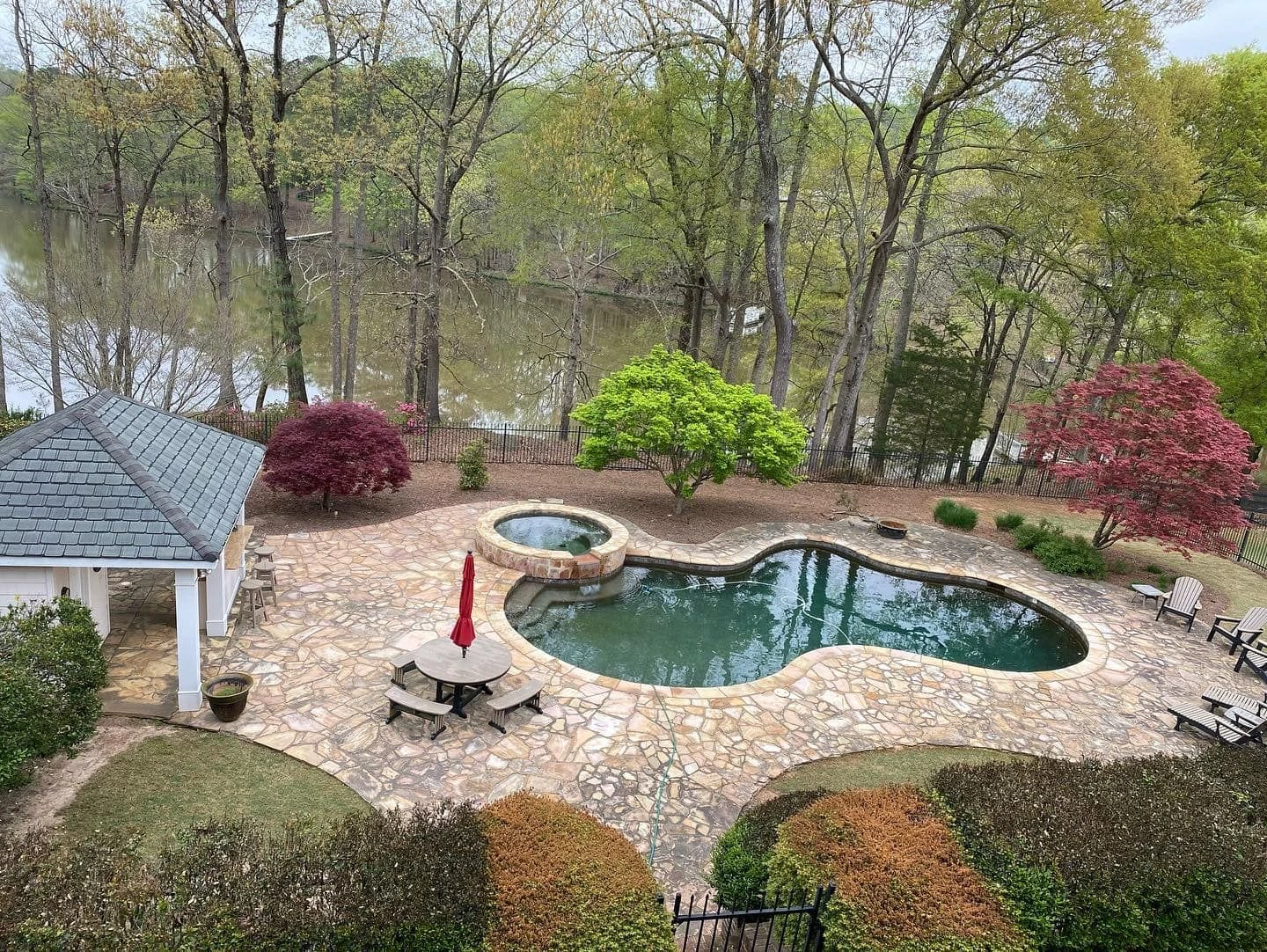
The Bailey Ridge homeowner’s build is finished now. Three summers of freeze-thaw, two wet Georgia springs, one tropical remnant that dumped nine inches in forty-eight hours. The pool is tight. The coping lines are true. That outcome is not luck — it is a geotechnical plan, a structural detail that respects the slope, and a pour sequence that accounts for the way clay moves when saturated.
Why Hamilton Mill and the West Side of Dacula Are Harder Than They Look
Dacula sits on the northeastern edge of Gwinnett County, and the terrain ramps up steadily as you move west from Winder Highway toward Hamilton Mill Ridge. The elevation gain is not dramatic on a topo map, but it is enough to make a meaningful percentage of backyards unbuildable with a standard pool template.
The soil story matters more than the elevation. Under Hamilton Mill, Sycamore Ridge, Chandler Ridge, Providence Club, and Ivey Chase, you are almost always on the Cecil series: a weathered granite saprolite capped with Piedmont clay. The parent material is stable. The top two to four feet of imported fill and screened clay is not. That creates a plane of differential behavior right where your pool shell wants to sit.
The practical threshold every Dacula homeowner should commit to memory: a four-foot drop over eighteen feet of run is where engineering requirements kick in. Below that, we can usually grade a pool into the yard with a standard 6” reinforced beam. Above it, you are in structural-engineer territory, and the Gwinnett Department of Planning & Development at 446 W. Crogan Street in Lawrenceville will want to see a stamped drawing before they issue the permit.
Sloped-lot engineering add-on (Dacula builds): expect +$4,200 to $7,800 on top of the base custom-pool price for a geotechnical study plus structural engineer sign-off when your yard exceeds the 4-foot-over-18-foot threshold. That figure covers two test borings, a soil-bearing report, and a PE-stamped shell and deck detail. We submit the stamped set with the Gwinnett pool permit application.
A base Gwinnett County residential pool permit runs roughly $220 to $450 depending on valuation, and the plan reviewer expects a grading plan with spot elevations, a silt-fence detail, and the structural drawings for any pool wall acting as a retaining wall. Skip that paperwork and you will be digging the pool out a second time in eighteen months when a hydrostatic failure cracks the shell.
Failure Mode 01 — Hydrostatic Pressure: The Pool That Floats
Hydrostatic pressure is the force groundwater exerts against the outside of your pool shell. On a flat lot, groundwater sits well below the deepest point of the pool. On a sloped Dacula lot, groundwater runs downhill through the saprolite and the pool shell becomes a dam. When it rains hard, the uphill side sees a pressurized column of water that can lift an empty pool out of the ground.
Concrete pools do not pop the way fiberglass pools do, but they crack. Water builds up behind the uphill wall, the shell deflects inward a fraction of an inch, and a crack propagates from the transition between the floor and the wall. Once that crack exists, groundwater pushes clay fines into the pool every time the water table rises. You see it as a tea-colored stain around a specific tile joint that will not scrub off.
How We Engineer It Out
Three details, always together, non-negotiable on any Dacula slope build.
Hydrostatic relief valve in the deep end. This is a brass fitting set flush with the floor at the deepest point. If groundwater pressure outside the shell ever exceeds pool water pressure inside, the valve opens, lets groundwater bleed into the pool, and prevents the shell from being pushed upward. It costs about forty dollars. It has saved us more call-backs than any other single component.
Gravel drainage chimney behind the uphill wall. A vertical column of #57 stone, 18” wide, wrapped in non-woven geotextile, running from the bottom of the pool wall up to a daylighted 4” perforated pipe that carries water away to a splash block beyond the deck. The chimney intercepts water moving through the saprolite before it ever reaches the pool shell. Cost: about $1,800 in material and labor on a typical Hamilton Mill build. It is the single most important thing we do on a sloped pool.
Extended dewatering during construction. We keep a submersible pump running in the deep-end sump for the full fourteen-day cure window after the shotcrete shoot. If the hole fills with groundwater while the concrete is gaining strength, you get a weaker bond at the cold joints. That pool will fail. The contractor will blame the homeowner.
Failure Mode 02 — Differential Settlement: When Half the Pool Drops
Differential settlement is the quiet killer. A pool settles a quarter inch uniformly and nobody notices. A pool settles a quarter inch on one end and stays put on the other, and you get a hairline crack at the tile line within twelve months and a visible step in the coping within five years.
On Dacula’s sloped lots, the trigger is almost always the same: the downhill half of the pool sits on fill, the uphill half sits on undisturbed parent material. Fill consolidates under the weight of 30,000 gallons of water. Parent material does not. The pool tilts downhill by a fraction of a percent and never stops.
How We Engineer It Out
The fix starts before the dig. Our geotech sub takes two hand-auger borings to 15 feet, logs the soil profile, and gives us a bearing capacity at the anticipated bottom of the pool. If the bearing at the downhill corner is below 2,500 psf, we have four options, in increasing cost order.
- Over-excavate and re-compact. Dig 18 to 36 inches below the target pool bottom, replace with crushed stone compacted in 6-inch lifts to 95% Modified Proctor density using a 4,000 lbf plate compactor. Works for modest fills and adds 1–2 days to the schedule.
- Extend the wall footing. Widen the footing at the bottom of the downhill wall so the bearing pressure drops below the soil’s capacity. Cheap, fast, limited range.
- Grade-beam foundation. A reinforced concrete beam runs the full length of the downhill side of the pool, spanning across the soft zone to bear on competent material at each end. This is the default on most of our Hamilton Mill builds.
- Helical piers. Steel piers driven through the fill into the saprolite, pool shell bears on a pier cap. Used on the worst lots — the ones where the original builder landed a 40-foot fill slope behind the house. Adds $9,000 to $18,000.
Shell spec for Dacula sloped builds: we shoot 4,000 psi shotcrete at 28 days, 0.45 water-to-cement ratio, #4 rebar on 12” on-center grid with #5 corner bars at floor-wall transitions. The uphill wall on any slope build gets doubled vertical rebar at 6” on center to resist lateral earth pressure. That is the same detail a licensed engineer will put on a residential retaining wall, which is exactly what the uphill wall of a sloped-lot pool is.
Failure Mode 03 — Coping Heave: The Stone That Moves In Winter
Coping is the horizontal stone cap at the top of the pool wall. On a flat lot, coping heave is rare — a cold snap deep enough to freeze the ground under the coping happens once a decade in Gwinnett County.
On a sloped Dacula lot the geometry is different. Water from the uphill side migrates through the backfill and collects in the first foot of soil directly under the coping. When that saturated zone freezes overnight, the expansion lifts the coping a few millimeters. The stones fall back when it thaws, but the mortar joints crack, and each cycle opens them wider. Two winters in, you have a gap you can slip a credit card into. Four winters in, you have a coping stone that rocks when you step on it.
How We Engineer It Out
Three layered details. All three, always.
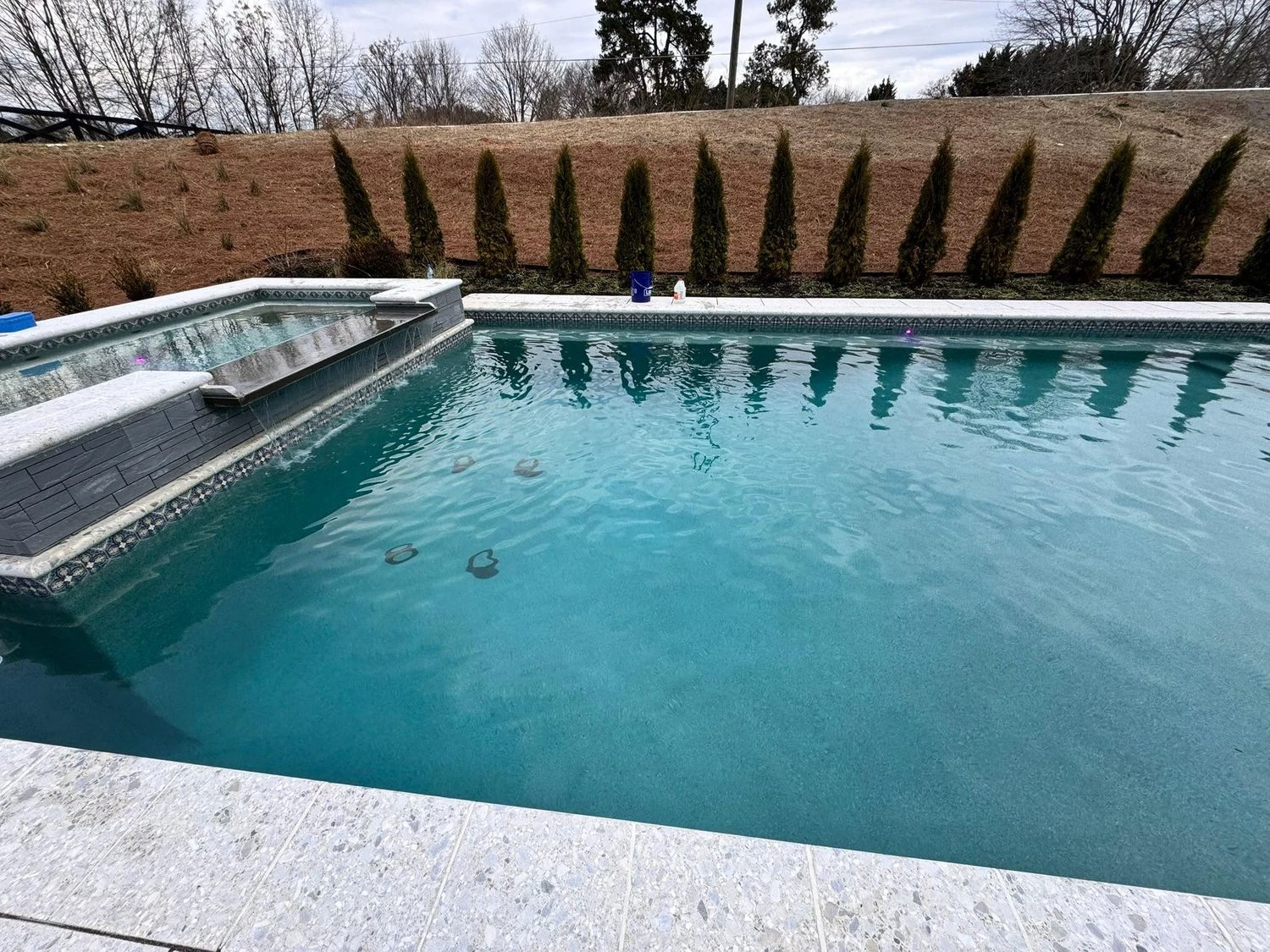
Wider bond beam. The bond beam is the thickened concrete cap at the top of the pool wall that the coping sits on. We pour it 14” wide on slope builds instead of the standard 10”. The extra mass pins the coping in place against small frost movements and gives the mortar a stable substrate. Cost adds maybe $300 across the perimeter of a 16×34 pool. Worth it.
Closed-cell backer rod plus self-leveling sealant at the coping-to-deck joint. Never caulk. Never mortar. The joint between the back of the coping and the front edge of the deck has to move, because the coping and the deck sit on different structural systems. A sanded caulk cracks in a year. A self-leveling polyurethane sealant over closed-cell backer rod moves with the joint for ten-plus years. We buy it by the case.
Perimeter drain in the coping backfill. A 4” perforated pipe in a gravel bed, set 18” below grade behind the coping, daylighted downslope. Water never accumulates in the zone that freezes. No frost wedging, no heave.
The travertine on most of our Dacula builds is the same bullnose profile: 12” deep, 2” thick, tumbled edge. It stays cooler underfoot in July and does not spall the way poured concrete coping does after ten freeze cycles.
Failure Mode 04 — Deck Separation: The Gap That Opens at the Coping
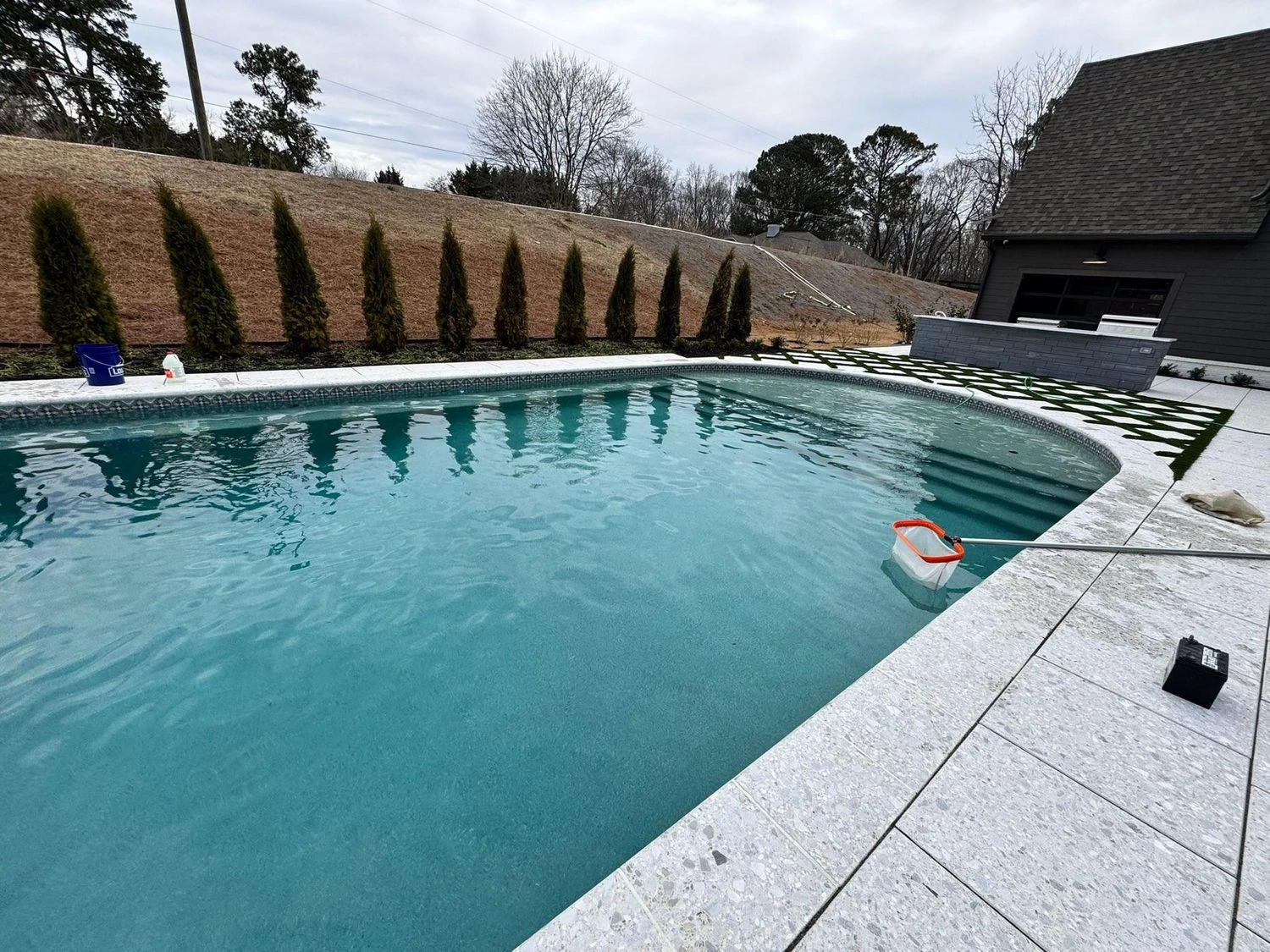
This is the one most homeowners notice first, because it is visible. A dark line appears at the joint between the coping and the pool deck. Next year it is a gap wide enough to lose a pool skimmer net into. The year after, grass is growing in it.
The deck separates from the pool for one of two reasons. Either the deck is settling downhill and pulling away from the stationary pool, or the pool is settling and the deck is staying put. On a Dacula slope, it is almost always the deck, because deck subgrade is almost always cheaper fill than pool subgrade.
How We Engineer It Out
The deck is a separate structural system from the pool shell, and we design it that way on purpose. The goal is not to lock them together — it is to let them move independently without showing a gap.
Engineered subgrade for the deck. Same 95% Modified Proctor compaction spec as the pool-side work, extended out to cover the full deck footprint plus two feet beyond. We pull core samples if the geotech report flagged a soft zone. On the deepest-fill lots in Hamilton Mill we have built reinforced slabs spanning onto concrete grade beams, effectively floating the deck on a raft.
Expansion joint at the coping, tooled control joints every 10 to 12 feet. The expansion joint decouples the deck from the coping. The control joints give the slab a planned place to crack instead of a random one. Both get sealed with the same self-leveling polyurethane we use at the coping joint.
Deck drainage that moves water off the slab, not under it. We slope the finished deck surface 1/4” per foot away from the pool and toward a linear trench drain or a dedicated low corner. Water that runs under the deck undermines the subgrade and accelerates settlement. Water that runs off the deck disappears into the yard drainage system and does nothing harmful.
We have taken out four-year-old decks on Dacula properties built by national franchise companies where the drainage plan was “the slab is pitched.” That is not a drainage plan. That is a shrug.
The Permit, Timeline, and Finished Build on a Dacula Slope
Every Dacula pool we build goes through Gwinnett County’s plan review before we break ground. For a sloped-lot custom pool, the submittal package includes a site plan with spot elevations, a grading plan, structural drawings for any pool wall or retaining wall over four feet tall, a silt-fence and tree-protection plan, and the pool permit application. The inspection sequence runs steel, bonding, pre-plaster, final. Every piece of steel in the pool has to be electrically continuous — a code requirement national chains sometimes miss.
A sloped-lot build runs roughly eight to twelve weeks of active construction after permits are in hand: excavation and grade beams in weeks 1–2, rough-in and steel inspection in week 3, shotcrete shoot in week 4 with extended dewatering, coping and equipment through weeks 5–6, deck and pre-plaster in week 7, interior finish and start-up through week 10, punch list through week 12. Weather moves that timeline. A week of heavy rain in April can push the shotcrete shoot back five working days because we refuse to shoot into a wet hole.
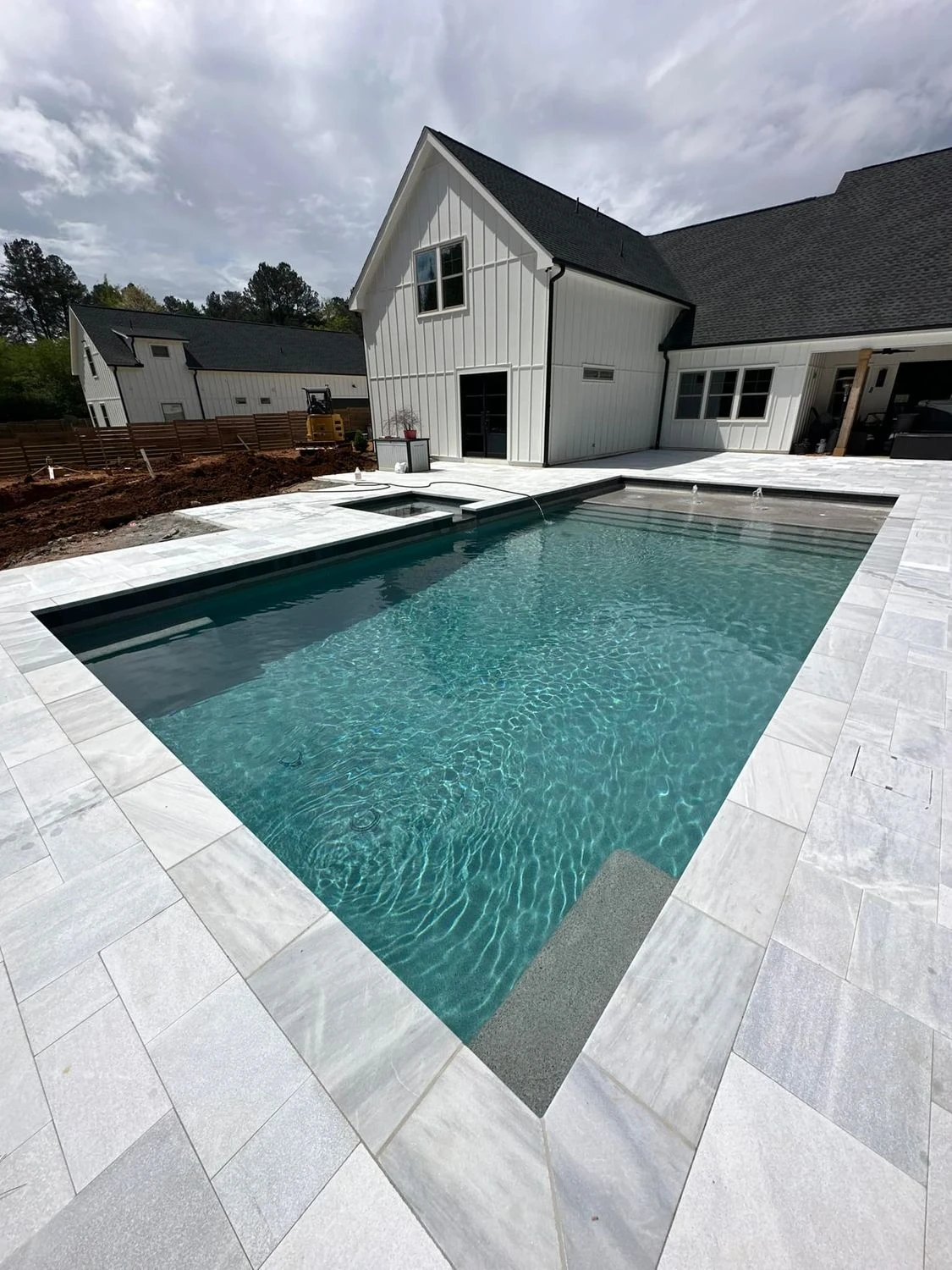
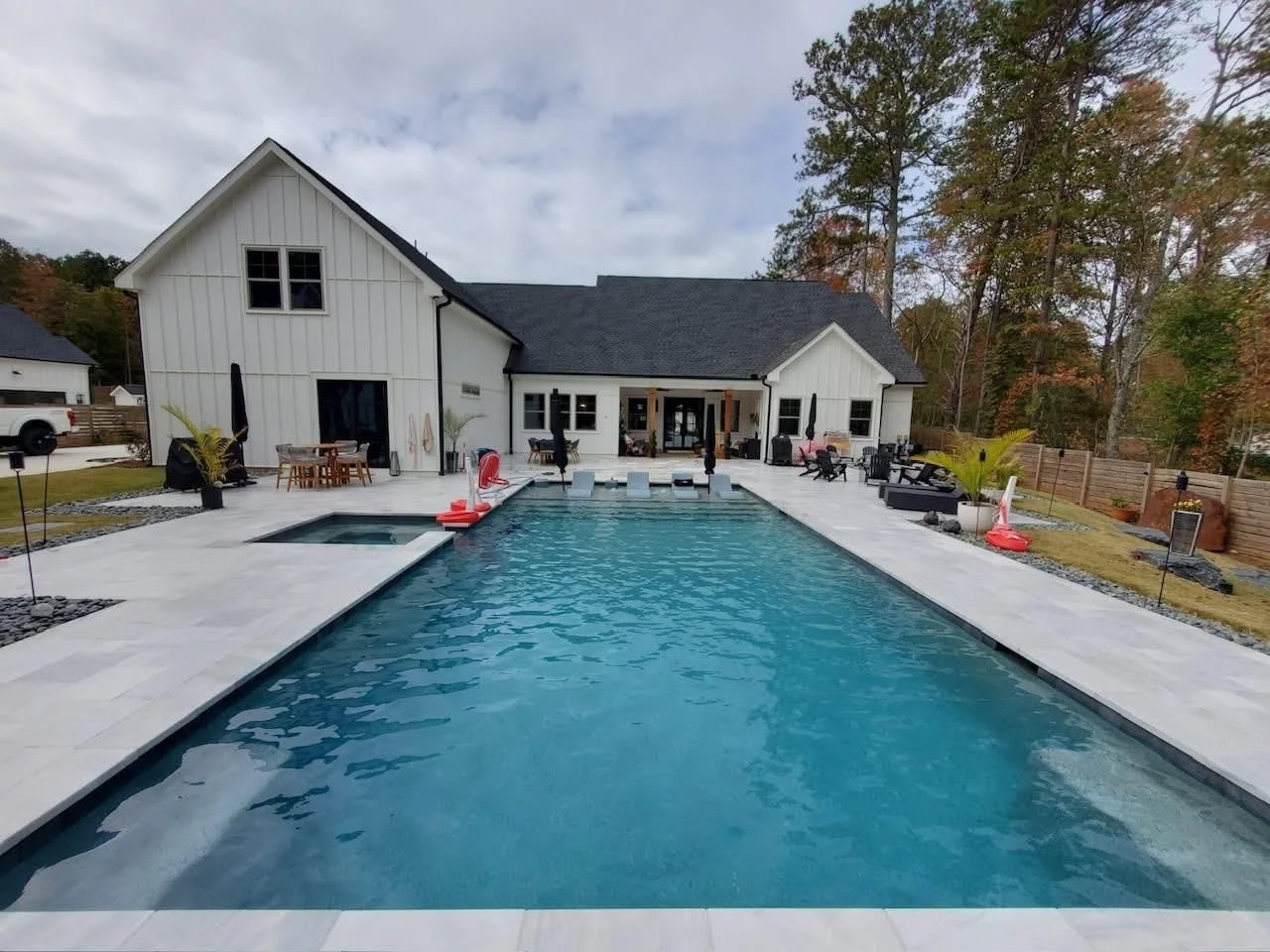
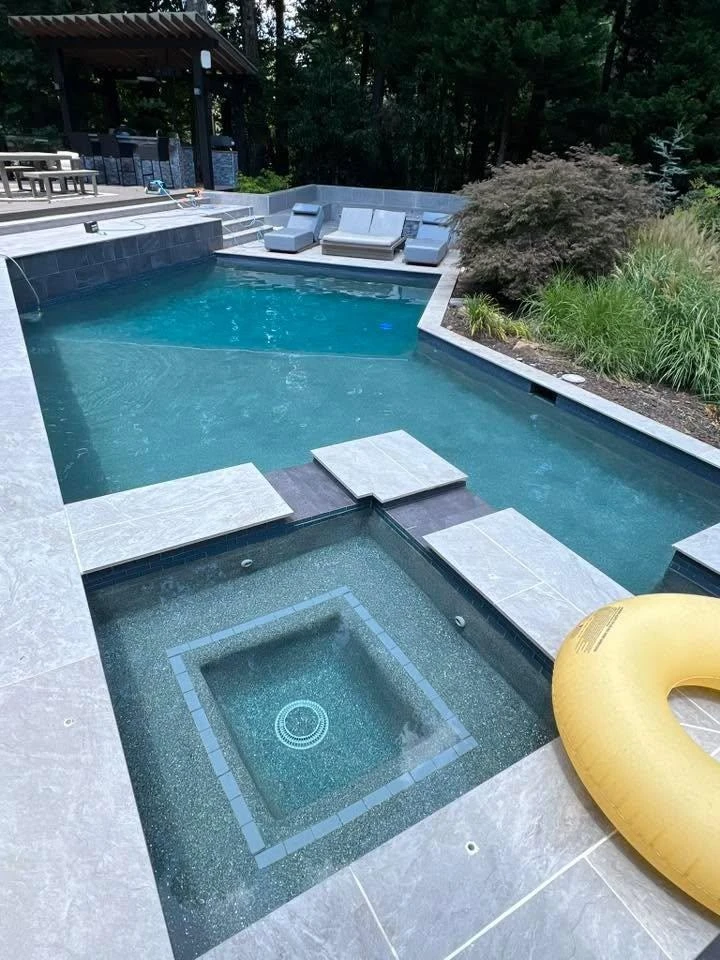
The most common build we deliver on a Hamilton Mill or Ivey Chase backyard is a 16×34 or 18×38 rectangle with a raised spa integrated into the uphill wall, travertine coping, a paver deck on the main level, and a secondary fire-pit terrace or outdoor kitchen stepped up at the high end of the yard. The design works because the hardscape does double duty — the raised spa wall is also a retaining wall, the fire-pit terrace stabilizes the uphill grade, and the paver deck absorbs the transition. Total grade change from the back door to the far end of the yard is often ten feet; every elevation change is a structural feature doing real work.
Budget-wise, expect a true custom gunite pool on a sloped Hamilton Mill lot to run $105,000 to $165,000 for the pool and immediate surround, with the deck and hardscape adding another $25,000 to $65,000. Those numbers are direct, not padded. The geotechnical add-on and structural engineering sit inside the pool line item and show up clearly on our bid.
Three questions to ask any pool builder quoting a sloped Dacula lot:
1. Will you pull a stamped structural drawing for the shell as a retaining wall, and is that cost already in the bid?
2. What is your shotcrete spec — psi, water-to-cement ratio, rebar size and spacing?
3. How do you handle drainage behind the uphill wall, and is there a hydrostatic relief valve in the deep end?
If the answers are vague, you are looking at a bid that will become a change order once the hole is open.
Why We Work This Way on Every Sloped Dacula Project
You can build a pool into a Hamilton Mill slope cheaply and have it survive the first year. Nobody’s pool fails in year one. Failures show up in years three through seven, after the warranty paperwork is filed in a drawer and the builder has moved on. A coping stone rocks. A crack opens at the tile line. The deck pulls away from the pool. Each of those problems is a five-figure repair, sometimes six, and the repair is always harder than getting the detail right the first time.
Our position is simple: we build pools in Dacula the way we would build one in our own backyards. The geotech report gets ordered. The structural engineer stamps the drawings. The shotcrete spec is written on the job-site plan, not remembered by the finisher. The drainage chimney goes in before the wall steel. The hydrostatic relief valve is installed, because forty dollars in brass is cheaper than replacing a shell.
If you are planning a custom pool on a Hamilton Mill, Sycamore Ridge, Chandler Ridge, Providence Club, Ivey Chase, or Auburn Park lot — or anywhere else west of Dacula Road where the grade starts working against you — the conversation we want to have starts at the hand level and the tape measure, not at a rendering. The rendering comes later. The engineering comes first.
Custom pool construction across 20+ cities within 30 miles of Winder, GA
If your Hamilton Mill, Providence Club, or Ivey Chase backyard slopes more than four feet across eighteen feet of run, the engineering on your pool matters more than the finish. We build for the next thirty years, not the next thirty days.