
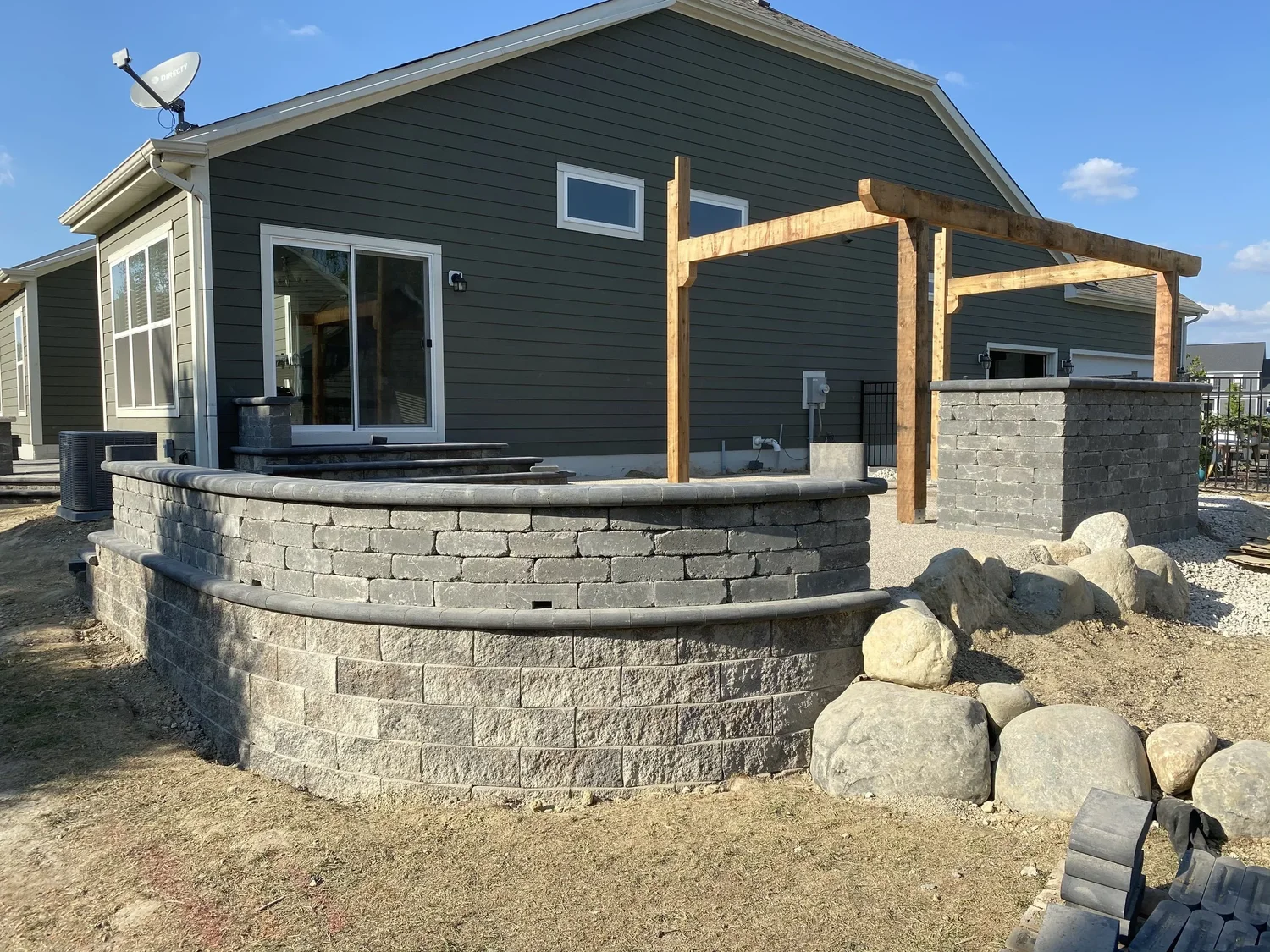
A homeowner in Kensington Ridge walked us around a three-year-old patio where the tight curve around the fire pit had opened into a set of wedge-shaped gaps wide enough to drop a nickel through. The installer had run a 5-foot radius — and on Dawsonville’s freeze cycle, that number guarantees failure.
The curve looked fine the summer it was built. It looked fine through the first winter. By the second spring, the soldier course — the perimeter band of pavers set on their long edge — had rotated outward on the cuts, and the joints at the apex were no longer parallel to the next paver over. They were fanning. That’s the tell. Once soldier joints start fanning on a cut curve in this elevation band, the wall of the patio isn’t restraining the field anymore; it’s being pushed by it. And that push only gets worse every November through March.
This post is about one number: 8 feet. It’s the minimum interior radius we’ll cut for a soldier-course patio edge in Dawsonville, and below that number we redesign the curve before we redesign the failure. Here’s why the number exists, where it came from, and what to build instead when the site calls for a tighter arc than that.
Why 8 Feet Is the Number in Dawson County Specifically
At 1,270 ft elevation, Dawsonville sees roughly 30 freeze events per year against Dacula’s 20. That’s a 50% increase in the number of times the water in a saturated joint goes from liquid to solid, expands, and wedges the paver above it outward. The mechanism isn’t dramatic — each cycle moves a soldier paver a few thousandths of an inch — but the movement is cumulative, and it’s multiplied by the geometry of the cut.
Here’s the geometry part. When you radial-cut a rectangular paver to follow an arc, the top face of the cut is longer than the bottom face. On an 8-ft radius cut with a standard Belgard Mega-Arbel-sized paver, the top-to-bottom face difference on a single cut is about 3/16 of an inch. That’s the “wedge” you’re jamming between two neighbors. At a 5-ft radius, that wedge grows to roughly 3/8″ — double. At 3 ft, you’re past 1/2″.
The joint sand can absorb some of that difference, but polymeric sand isn’t mortar. It can’t carry a compressive load across a wedge-shaped gap through 30 freeze cycles. So the water gets in, freezes, and levers each paver outward from the curve’s center. We measured three Dawson County patios last winter with tight-radius cuts and found soldier joints opening at roughly 3x the rate of the straight-run soldier joints on the same patios. Same weather, same sand, same installer — just tighter geometry.
The 3x rule: On cuts under an 8-ft interior radius in Dawson County, expect soldier joints to open at roughly triple the rate of straight-run joints over a 10-year service window. At 5 ft and under, it accelerates again.
The Saprolite Factor — Why This Isn’t a Dacula Problem
Dawsonville’s subsoil isn’t Piedmont clay. At typical excavation depth — 2 to 6 feet — you’re often into saprolite and weathered granite, the decomposed rock of the North Georgia foothills. The drainage is actually better than Gwinnett County clay, which sounds like good news. It isn’t, not for tight curves.
Clay holds water up in the base. Saprolite lets it move through faster, which means the soldier course on a Dawson County patio gets wet-dry cycled more often and more completely than the same spec in Snellville. More complete drying means more capillary pull the next time it rains. More capillary pull means the joint sand gets saturated deeper into the paver stack. Combine that with 30 freeze events and you have a system that hits the expansion geometry harder than any metro Atlanta zip code south of here.
There’s also the rock factor. Dawsonville excavations sometimes hit weathered granite shelves that require a small blast charge at an $8 to $14 per cubic yard premium over standard digging. When we blast, we’re not just removing rock — we’re fracturing the shelf underneath the patio subgrade. A tight radius cut sits directly above a zone that’s already been micro-fractured. The stability math gets worse, not better.
Compound Curves: The Workaround That Actually Solves It
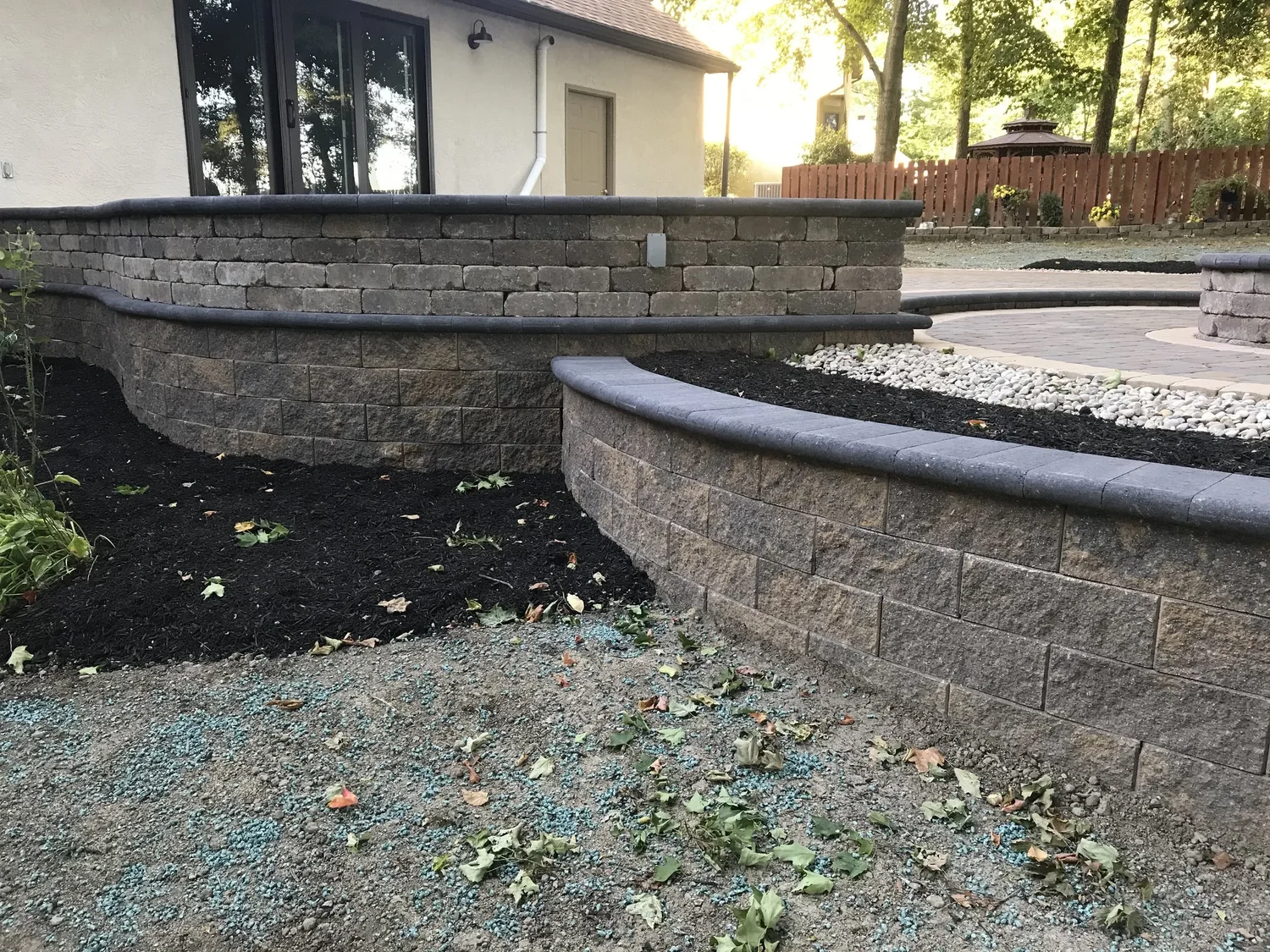
Clients want curves. A fully rectangular patio around a pool in Etowah River Club looks like a parking lot. The answer isn’t “straight edges only” — it’s compound curves built to an 8-ft minimum with short tangent breaks.
A compound curve is a single apparent curve made from two or more arcs with different radii, joined by tangent lines. To the eye from the patio deck, you see one flowing shape. Geometrically, no single arc ever drops below 8 ft. The tangent sections — straight runs, typically 3 to 5 feet long — do the work of transitioning from one arc radius to another without the eye registering the break.
Practically: if a client wants what looks like a 6-ft radius to hug a planter or a pool step, we’ll build an 8-ft arc on one side, a 5-ft tangent, then a 10-ft arc on the other side. The apparent tightness is there visually. The actual tightness at any cut is 8 ft minimum. Freeze-thaw stays within the sand’s working range, and the joints hold.
- Single curves: 8-ft interior radius minimum, never less.
- Compound curves: two or more 8-ft-or-greater arcs joined by 3–5 ft tangent sections.
- S-curves: same rule — each arc keeps its own 8-ft minimum, with a tangent of at least 4 ft at the inflection.
- Reverse (convex outside) curves: 10-ft minimum, because the soldier course bows outward and wants to walk off the curve faster.
The Design Impact: What You Give Up, What You Keep
Accepting an 8-ft minimum changes what’s possible inside a fixed footprint. This is where the design conversation happens early — in the sketch phase, not during layout on the subgrade.
An 8-ft interior radius sweeps out roughly 50 square feet of curve transition. On a 600 sq ft backyard patio, that’s about 8% of usable area consumed by the curve geometry alone. On a smaller Applewood patio of 400 sq ft, it’s 12%. That’s the honest number clients need in front of them when they’re deciding between a tight curve that fails in four winters and a proper curve that holds for the service life of the pavers.
What you keep: long-run sight lines, continuous flow around fire pits and pool steps, visual softness against vertical elements like pergola posts and planter walls. What you lose: the ability to hug an irregular obstacle at close range. If there’s a rock outcrop, a mature oak at the patio edge, or an existing foundation kick-out that the patio needs to turn around, the answer usually involves either (a) extending the curve wider with a compound arc set, or (b) breaking the soldier course entirely at that obstacle and terminating into a hard edge — a steel edge restraint, a concrete curb, or a capped stone wall like the ones our crew installs along most Dawson Forest Road corridor homes.
Driveways: Why the Minimum Jumps to 12 Feet
Patio curve rules don’t translate to driveways. Drivers do. A paver driveway in Dawsonville takes two kinds of load the patio never sees: the weight of a vehicle (3,500 to 7,500 lbs on four contact patches, not a distributed 60 lbs/sq ft of furniture and foot traffic) and the torsional load of tires pivoting on a curve. A tire turning inside a tight radius drags laterally across the soldier course with each pass.
The minimum interior radius for a paver driveway edge in Dawson County is 12 feet. Below that, the torsional scrub on the soldier course during a tight turn from, say, a Ford F-150 pulling out of a garage accelerates the same wedge-gap mechanism the freeze cycle causes — but at driving frequency instead of seasonal frequency. We’ve seen tight-curve driveway edges fail inside 18 months with daily use.
The 12-ft rule applies to the interior (concave) radius. The exterior (convex) curve of a driveway can run tighter because the tire tracks naturally toward the widest part of the arc, not the tightest. But if you’re trying to fit a turnaround or a parking pad curve into a Dawsonville lot with typical grade change — the rolling, steeper-than-Piedmont topography here makes the math harder — the answer is usually either (a) widen the curve by giving up some landscape bed, or (b) switch the curve zone to poured concrete with a paver field on either side. Poured concrete inside a 6-ft curve holds. Pavers at the same radius won’t, not on 30 freeze events a year with tire scrub layered on top.
Driveway radius rule: 12-ft interior minimum for paver driveways in Dawson County. Tighter than that, switch the curve zone to poured concrete with paver inlays or field on either side.

Permits, Inspections, and How This Gets Written Into the Spec
Dawson County permitting for paver patios and driveways runs through the Dawson County Department of Planning & Development at 25 Justice Way. The department doesn’t prescribe a minimum radius for paver curves — that’s not in the code. What the code cares about is drainage, setbacks, lot coverage, and whether you’re touching an easement.
The radius minimum is a construction spec, not a code item. We write it into every Dawsonville paver contract explicitly: “All soldier-course interior radii set at 8 ft minimum for patio applications, 12 ft minimum for vehicular applications. Cuts tighter than stated minimums require client approval in writing and are excluded from the 30-year paver patio warranty coverage.” That last clause is the one that matters. Nobody’s stopping a client from overriding us — but if they do, the warranty on the affected curve is void, and we put it in writing before we cut the first paver.
Utility coordination is the other piece. Amicalola EMC service drops run overhead in most Dawsonville subdivisions, and the transformer pads frequently sit at grade-change points in the yard. If a curve needs to pass within 3 ft of a pad, the county locate process gets slower and the design usually has to shift — that’s where an 8-ft minimum becomes an 11-ft minimum by the time we’ve respected the pad clearance. Building in that margin up front saves a redesign during layout.
The Pre-Construction Checklist
- Stake the curves first. Paint lines on the subgrade with a pivot string — if any arc comes in below 8 ft of interior radius, redraw before the base goes in.
- Confirm the tangent lengths. On compound curves, tangents between arcs should read as at least 3 ft of visible straight run on the final paver layout.
- Check driveway radii separately. 12-ft minimum, interior only. Plot the actual vehicle turn circle if in doubt — a Suburban and a Mini Cooper ask for different things.
- Walk the curve from the house. If the curve looks visually tight, it probably is. Trust the eye, measure the number, then redesign if needed.
- Note any blast zones. If excavation is hitting weathered granite, curves above that zone get built wider by default — the fractured subgrade doesn’t carry tight geometry.

When a Client Insists on the Tight Curve Anyway
Some homeowners fall in love with a rendering that shows a 4-ft sweep around a fire pit or a tight kidney curve at the pool end. The answer isn’t to lecture them about freeze geometry. The answer is to show them what failure looks like at year three, explain the 30-year warranty exclusion, and offer the two paths forward that don’t involve a rebuild in 2029.
Path one: the compound curve redesign. We sketch it over the original rendering so they can see the visual difference. In 80% of cases, once the compound curve is drawn in, clients can’t tell the difference from 10 feet away. The sweep reads the same.
Path two: the materials switch. If the tight curve is non-negotiable — a mature tree the client won’t trim, an existing wall they won’t move, a pool feature that’s already cast — the zone under the tight curve shifts from paver to poured concrete. We treat the concrete as a curved apron, set the pavers back 18 to 24 inches from the curve, and build the soldier course on a straight or wide-arc run outside of that. The apron takes the freeze-thaw on a monolithic slab that can’t fan because it’s not jointed. The pavers stay on a geometry that actually holds.
Path three, which we mention but rarely recommend: cut the curve, accept the warranty exclusion, and rebuild the curve zone at year 5 to 7. We’ve done this twice in the last three years, both times for clients with specific design anchors they wouldn’t move. Both projects had the rebuild scheduled and quoted as part of the original contract. Eyes open, numbers on paper, no surprises at winter six.

The Cost of Getting It Right the First Time
A radius rebuild on a 4-year-old patio in Dawsonville runs $1,800 to $3,400 per linear foot of failed curve — demo, new base, new soldier course, joint sand, and blending the new work into the existing field. The original cost to build that same curve at 8 ft minimum, versus a 5-ft curve, is a design change, not a material cost change. The square footage of paver is the same. The labor hours are the same. The only thing that changes is the layout line on the subgrade.
That’s the argument. The 8-ft rule costs nothing extra at build time. It saves a five-figure rebuild at year four. The math isn’t subtle.
The patio in Kensington Ridge that opened this post had about 22 linear feet of curve failure. We rebuilt it at a true 8-ft compound radius last spring. The client kept the visual language of the original design — the curve still sweeps around the fire pit, the eye still reads one continuous arc. What changed is that the geometry now respects the freeze, the saprolite drainage, and the 30 annual cycles that make Dawson County different from every zip code south of GA-400. Four winters from now, those joints will still be where we left them.
Paver patios engineered for Dawson County freeze cycles across 20+ cities within 30 miles of Winder, GA
We design every curve to the 8-ft patio minimum and 12-ft driveway minimum from the first sketch — not as a field adjustment. If you have a Dawsonville site with tight geometry or grade change, we’ll walk it with you before we quote.