
A homeowner in St. Marlo sent us a photo last spring of a four-year-old curved patio off the back of a builder-grade home off Bethelview Rd. The soldier course looked like a mouthful of crooked teeth — pavers heaved, rotated, lipped up half an inch in places. The original contractor had pushed a 6-foot radius curve through Forsyth red clay. It never stood a chance.
The curve is what draws the eye on a paver patio. It is also what fails first when the radius is too tight and the base is too shallow. On gently rolling Cumming lots — the kind you find in Hampton Park, Vickery, and the older sections around Haw Creek — the tightness of that arc is a structural decision, not a design one. Pick the radius wrong and the soldier course telegraphs every freeze-thaw cycle that Forsyth County throws at it. Pick it right and the patio still looks hand-laid when the grandkids inherit it.
This post is about one number: the 10-foot minimum radius. Why it matters here, why tighter curves fail on Piedmont clay, and how we detail a compound-radius patio on an irregular lot when the backyard refuses to behave like a rectangle.
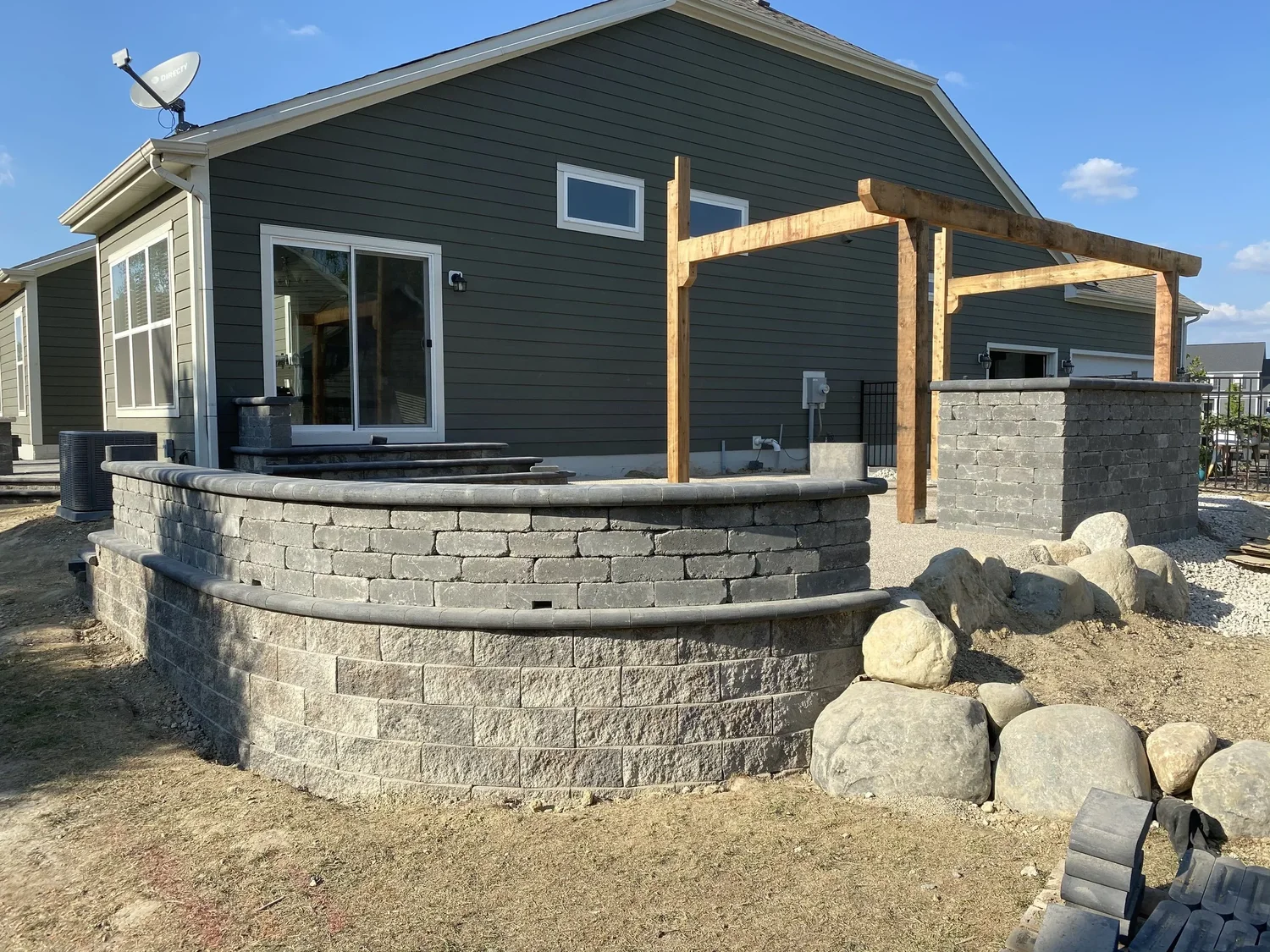
Why Forsyth County Clay Punishes Tight Radii
The soil under most backyards in Cumming is Cecil series Piedmont clay. It is dense, it holds water, and it moves. When saturated, it swells vertically. When it dries in August, it shrinks and cracks. The rule for paver patios over Cecil clay: every curve is a leverage point. A tight curve concentrates stress into a smaller number of pavers, and those pavers have less surface area sharing the load.
Here is what happens on a 6-foot radius curve cut through Cecil clay with a skimped base. In year one the patio looks perfect. By year three, 23 freeze events have cycled through the soldier course. Moisture gets under the edge restraint through hairline joint gaps. The clay swells. The outermost soldiers rotate outward a few degrees. The interior field pavers lose their edge support. By year five the curve has the telltale “picket fence” look — every other soldier tipped out, sand joints washed out, the whole edge looking tired.
On a 10-ft radius the math changes. The arc is gentle enough that each soldier paver still meets its neighbor at close to a right angle. Cut kerfs are wider. Joint widths stay under the 1/8-inch ICPI tolerance. Edge restraint spikes have room to anchor into undisturbed subgrade instead of the compacted fill that sits under a tight bend. The curve moves less because it has more pavers sharing the load.
The Cumming soldier course rule: On Forsyth County Cecil clay, we will not cut a soldier course radius tighter than 10 feet without adding a second interior soldier band and a poured-concrete curb hidden below grade. Cheaper the first year. Catastrophic by year five.
The 10–12 ft Sweet Spot — What It Actually Looks Like
“Ten feet” sounds abstract until you walk a yard with a tape measure. Ten feet is roughly the radius of a two-car garage door. On a 20×30-foot patio — a typical size for a Hampton Park or Three Chimneys backyard — a 10-ft radius produces a curve that reads as a strong, confident arc from the back door. It is visible from the second-story windows. It throws a flowing shadow line in evening light. It is deliberate, not timid.
Push to 12 feet and the curve gets more architectural. It pairs beautifully with the longer rooflines of the 2018+ luxury tracts around Vickery and Windermere, where the house itself has sweeping hip lines. A 12-ft radius curve echoes that without competing with it. It is the default radius we specify for any pool-adjacent patio in those neighborhoods.
Tighter than 10 feet is where trouble starts. A 6-ft or 8-ft arc looks fussy — it fights the geometry of the home instead of complementing it. It also costs more per square foot because cut overage climbs fast, and it fails sooner because every structural principle above is working against it.
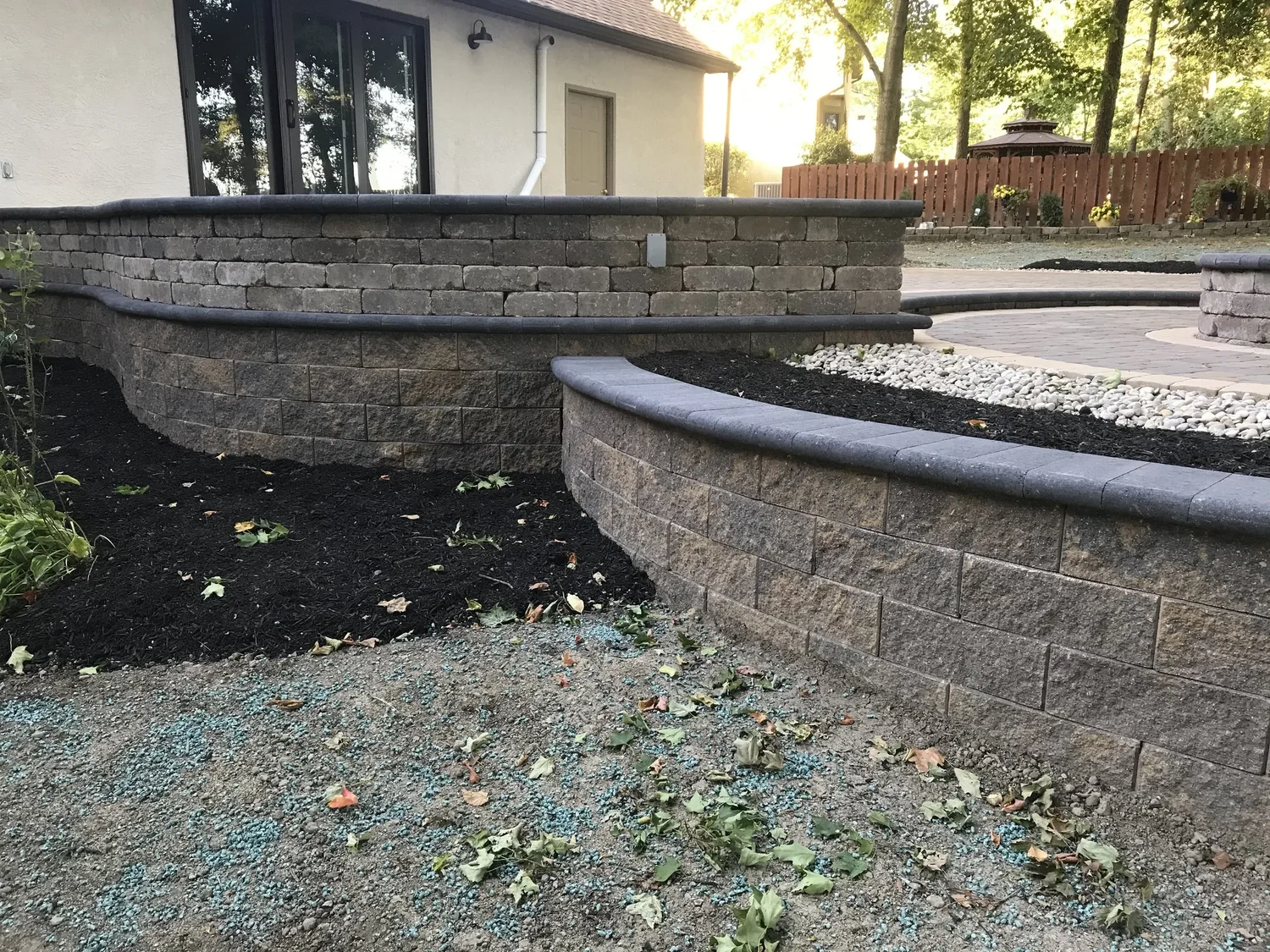
Compound Radius Design for Irregular Cumming Lots
A lot of older Cumming lots — particularly the 1990s-era subdivisions along Post Rd and the Haw Creek corridor — are not clean rectangles. Lots zigzag around easement setbacks, septic fields, tributary drainage into Big Creek, and the grade drops of 3 to 8 feet that are typical as you head down toward South Forsyth. A single-radius curve does not fit that geometry. What does fit is a compound radius — a curve made of two or three different radii spliced together so the arc flows without breaking.
The standard compound we use for an irregular Cumming lot is a 12-ft primary radius blending into a 10-ft secondary radius, with a short 15-ft transition curve joining them. The eye cannot detect the splice. The patio still reads as a single flowing edge. But structurally, the 10-ft section hugs the tight corner against the house while the 12-ft section opens out toward the lawn.
We lay compound curves out with a length of garden hose pinned at the exact radius points on the subgrade, then shoot it with a laser level before cutting a single paver. If the hose bends in a way that pleases the eye from the kitchen window, the pavers will read the same way when laid. If it does not look right on the dirt, it will not look right when it is finished.
Cutting the Curve — Wet Saw, Diamond Blade, 15–20% Overage
Every curved paver patio is a cut-heavy project. On a tight soldier course you can expect to cut every single paver on the curve face. On a gentler 10-ft radius curve using a modular paver like Techo-Bloc Blu 60 or Belgard Cambridge Cobble, roughly one in three pavers on the field edge gets trimmed as well.
The only acceptable tool for this work is a wet saw with a continuous-rim diamond blade. A dry chop saw chatters the paver face and leaves a gray halo along the cut that is visible the first time the patio gets wet. A wet saw cut stays crisp, shows the full color of the paver through the chamfer, and does not dust out the joint sand before the patio is even finished.
Material overage on curved work runs 15 to 20%. A rectangle patio runs 5 to 8%. That overage is not optional. It is the cost of getting a curve that actually closes cleanly on both ends without the homeowner having to look at a four-inch sliver paver where the arc meets the house. We write the overage into every contract in Cumming, and we leave the extra pavers on a pallet at the side of the house so the homeowner has color-matched replacements for the next decade.
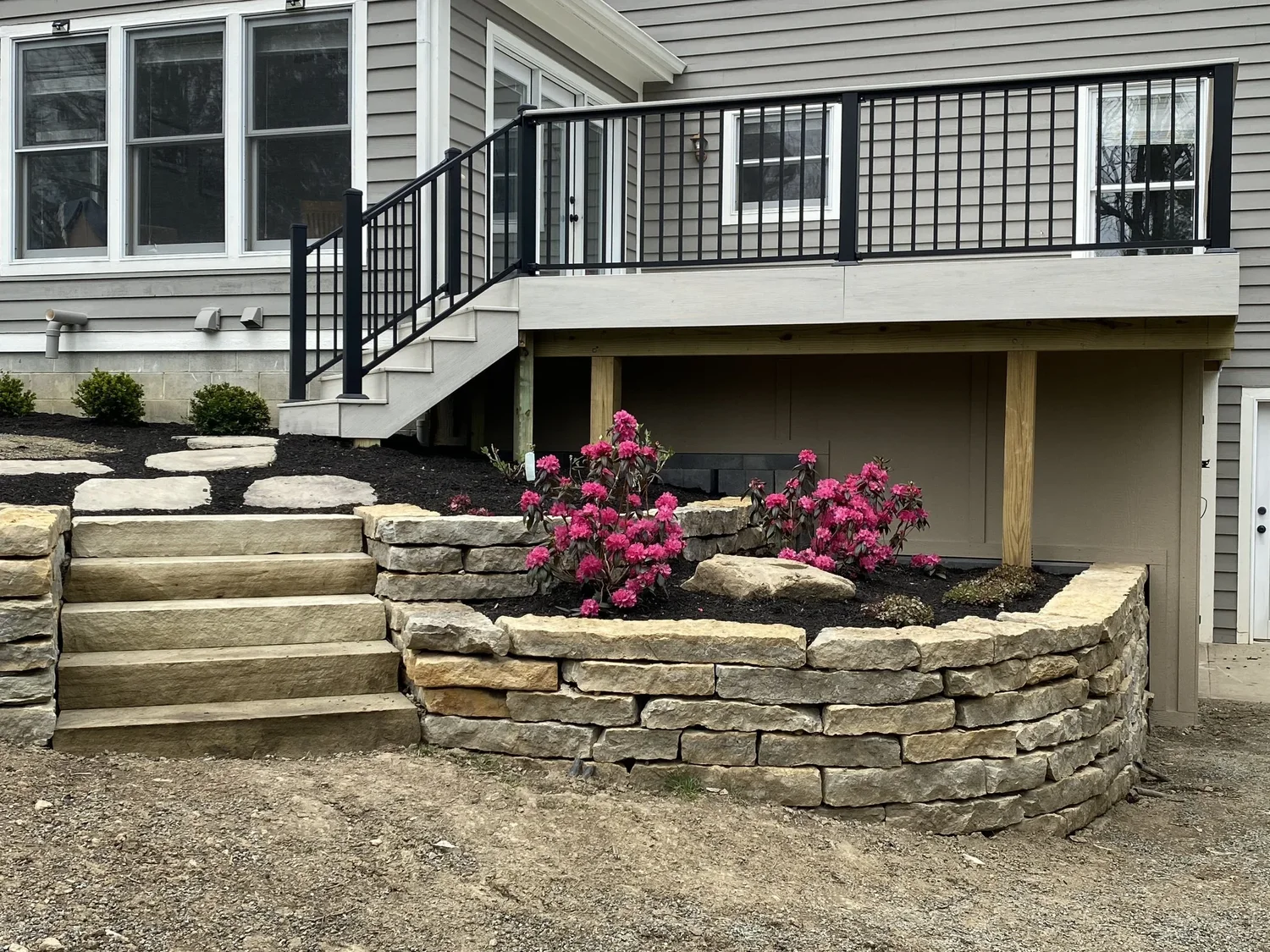
Write this into your contract: “Soldier course cut with wet saw, continuous-rim diamond blade. Minimum radius 10 feet. Material overage 15–20% for curved sections. Leftover pavers delivered to homeowner for future repair.” Any contractor who will not sign this is not the contractor for the job.
Base, Edge Restraint, and the Grade Drop Most Cumming Builders Ignore
The curve does not fail because of the curve. It fails because of what is underneath it. For a curved patio on Cecil clay in Forsyth County, the base spec that actually holds a 10-ft radius for 30 years looks like this:
- Excavation: 10 to 12 inches below final grade, wider than the patio footprint by 6 inches on every edge.
- Geotextile separator: non-woven 6-oz fabric over raw subgrade so clay fines do not migrate up into the base stone.
- Base stone: 8 inches of GAB (graded aggregate base) compacted in 2-inch lifts with a plate compactor capable of at least 4,000 lbs of centrifugal force.
- Bedding layer: 1 inch of clean concrete sand screeded — not swept, screeded — to final grade.
- Edge restraint: rigid paver edge (not plastic spiked edge) anchored with 10-inch landscape spikes every 10 inches along any curved section.
Rigid metal or concrete edge restraint on curves is non-negotiable. Flexible plastic edging bends to the radius, but it flexes under soil movement too. On a 10-ft curve with properly compacted base, rigid aluminum edge or a buried concrete curb beam holds the soldier course in position through decades of freeze-thaw. Plastic edging gives up by year 7.
One more detail specific to Cumming: if the patio sits on a lot with a 3-foot or greater grade drop — which is half the yards we see in Forsyth County — the downhill edge of the patio needs either a retaining wall or a buried drainage chase to carry water away from the edge restraint. We do not build a curved patio on a grade without addressing where the water goes, because the first storm that pools along a soldier course is the one that ends the warranty conversation.
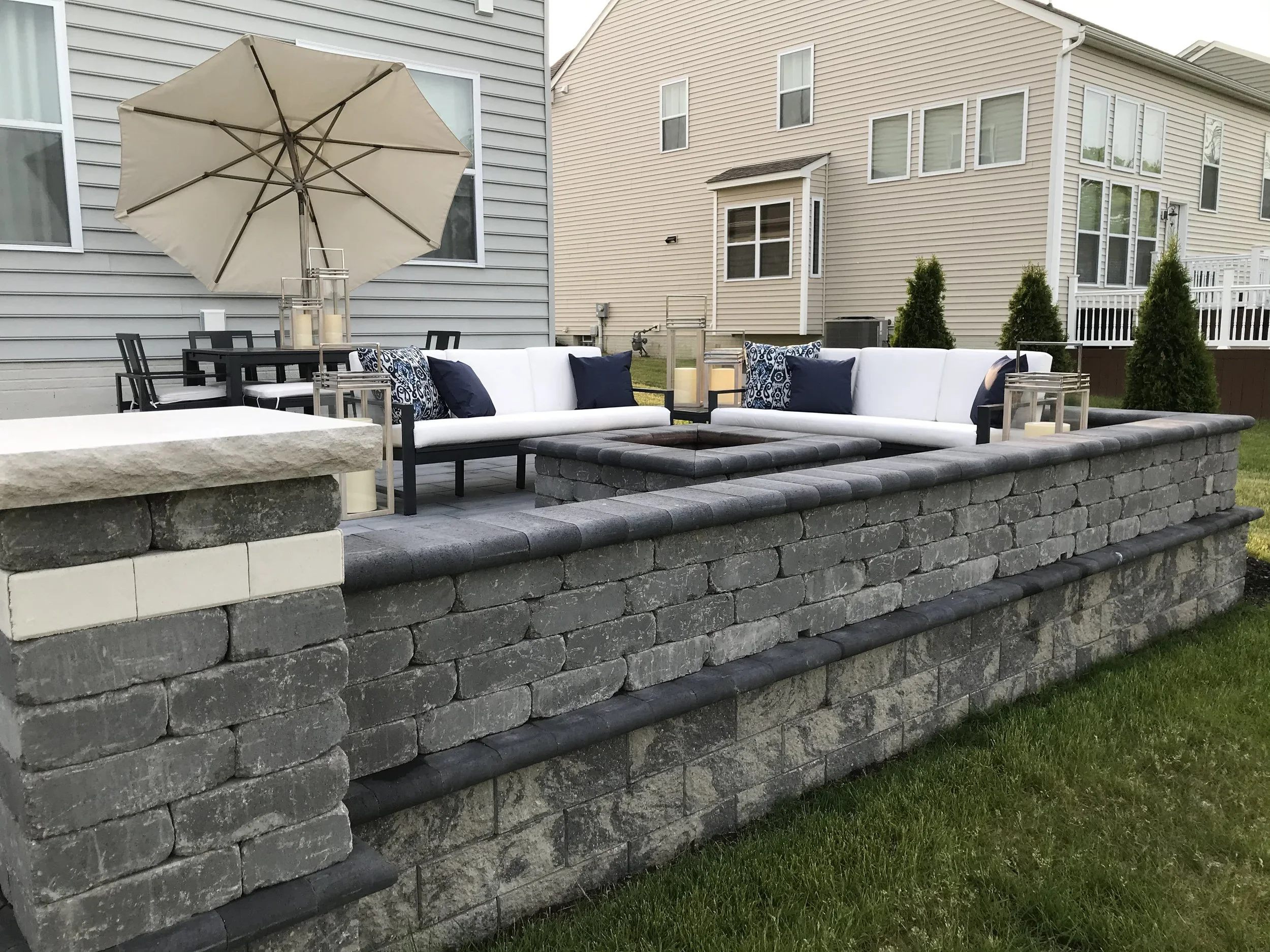
Permits, HOA Review Boards, and the Cumming Timeline
Paver patios in Forsyth County do not usually require a building permit when they are at-grade and under 30 inches in height. What does require review — and this surprises homeowners every season — is the HOA architectural review board in the high-end subdivisions. Polo Fields, Windermere, and The Collection at Forsyth all require a submitted site plan, material samples, and a rendering or elevation before you swing a shovel.
The typical HOA turnaround in those neighborhoods is 2 to 3 weeks. The ones that get flagged and bounced back are always the ones that submit a vague “curved patio” sketch without specifying the radius, the paver, or the edge detail. We submit to these boards weekly. The submittal package that gets approved first time in Cumming includes a plan view with every radius dimensioned, a material sample board with paver + cap stone, and a note explaining the grade drop and drainage approach. Three pages. Approved in one pass, every time.
For walls over 4 feet — which come into play on any raised patio that doubles as a retaining structure — Forsyth County Dept. of Planning & Community Development at 110 E. Main St. requires an engineered stamp. That is a separate permit and a separate timeline, typically another 10 business days. If your curved patio design includes a wall element over 4 feet, plan the project with the engineering lead time baked in.
What 10-ft Radius Curved Patios Actually Cost in Cumming
The honest pricing range for a done-right curved paver patio in Forsyth County in 2026 sits at $28 to $42 per square foot installed, with curved sections on the high end and straight runs on the low end. A 400-square-foot curved patio in Hampton Park therefore runs roughly $11,200 to $16,800. A 700-square-foot wrap-around patio with a compound radius in St. Marlo lands closer to $22,000 to $29,000.
What pulls the price up on Forsyth County curved work, in order of impact:
- Grade correction. A 3-ft+ drop needing a buried drainage chase or integrated retaining wall adds $4,000 to $9,000.
- Paver tier. A premium paver like Techo-Bloc Blu 60 Smooth adds roughly $3 to $5 per square foot over a standard tumbled cobble.
- Cut overage on compound curves. Adds 10 to 15% over a rectangle patio of the same size.
- HOA-required stone cap upgrade. Some St. Marlo and Polo Fields designs require a natural-stone cap rather than a matching paver cap. Adds $40 to $65 per linear foot.
The number that should make you walk away from a bid: anything under $22 per square foot for curved work in Cumming. At that number the contractor is skimping on base depth, edge restraint, or overage — usually all three. The patio will look fine the day of the final walkthrough. It will look like the St. Marlo example we opened this post with by year four or five.
What to ask for in writing: base depth in inches, compaction lifts in inches, geotextile fabric weight in ounces, edge restraint material, minimum soldier course radius, and cut overage percent. All six. If any are missing from the contract, they will be missing from the project.
A curved patio is the most visible detail in a backyard and the most common place the craft shows or falls apart. Ten feet is not a magic number because it sounds nice. It is the point at which Piedmont clay, freeze-thaw cycles, ICPI joint tolerances, and Forsyth County grade drops all stop fighting the design and start working with it. Specify the radius. Specify the base. Specify the overage. The patio does the rest for 30 years.
Curved paver patio design and installation across 20+ cities within 30 miles of Winder, GA
We specify, cut, and lay 10-ft minimum radius curves on Forsyth County clay because it is the radius that still looks right thirty years in. If you are planning a curved patio in Cumming, let’s talk about your lot’s grade and the exact arc your back elevation wants.