
We walked a Windward backyard last spring where three willow oaks had been quietly running the property for forty years. The homeowner wanted a rectangular patio. The trees — and their 10-foot critical root zones — had other plans. What we drew instead was a compound-radius curve that gave the family 640 square feet of usable patio without cutting a single feeder root.
That job wasn’t unusual. It’s the default condition in about a third of the Alpharetta backyards we bid. The city’s mature-oak canopy — particularly in the older sections of Windward, Deerfield, Ashebrooke, and the original build-out of Country Club of the South — is dense, established, and protected by both HOA architectural review committees and plain old homeowner sentiment. Nobody wants to kill a 60-year-old white oak for an extra 80 square feet of patio.
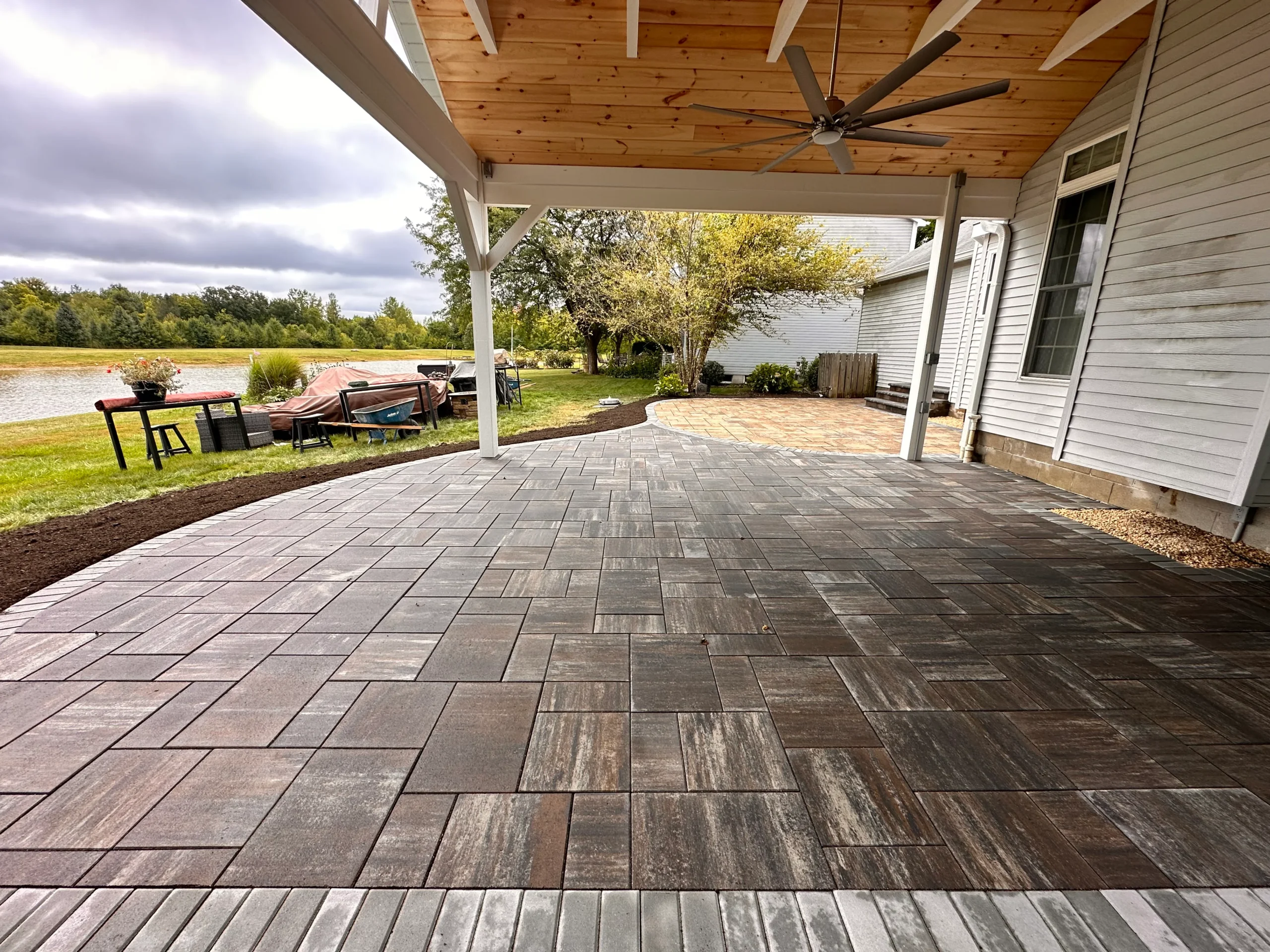
So the patio has to work around the trees. And working around trees means curves. Not the lazy, single-radius arc a landscape designer draws to soften a corner — compound curves with three or four different radii chained together so the edge of the patio traces the outer edge of the drip line without ever straight-lining through a root zone.
This is the design problem that shapes most of our paver patio work inside the 30004, 30005, 30009, and 30022 zip codes. It’s not the dominant problem in Loganville or Dacula, where lots tend to be cleared farm conversions with younger trees. It’s an Alpharetta problem — and Johns Creek and Milton share it — because this stretch of the GA-400 corridor was developed around the canopy, not in spite of it.
Why the Tree Drip Line Becomes the Patio Edge
An arborist will tell you a tree’s critical root zone — the area you can’t disturb without shortening the tree’s life by a decade — extends roughly one foot outward for every inch of trunk diameter at breast height. A 24-inch white oak has a 24-foot CRZ radius. Most protection ordinances round that down to something manageable; the industry convention we use for patio design is a 10-foot minimum buffer from the trunk of any tree over 12 inches DBH, flexed outward to match the actual drip line when the canopy is wider.
On an Alpharetta lot with three mature oaks clustered 18 to 22 feet apart — a typical Windward or Country Club of the South condition — those 10-foot buffers overlap and interlock. Drop a rectangular patio into that backyard and you’re either (a) cutting into at least one CRZ, (b) shrinking the patio to something unusably small, or (c) pushing the patio so far from the house that the walk-out from the kitchen door becomes a hike.
The compound curve solves all three. By chaining a tight arc (say, 3-foot radius) into a medium arc (6-foot) into a lazy sweep (9-foot), the patio edge can thread between tree trunks while staying within a reasonable distance of the back door. The curve isn’t decorative. It’s structural. The geometry is doing the same job a survey line does on a flat lot — defining what you can build on without violating a constraint.
We sit with homeowners and show them the overlay: house footprint, existing trees, 10-foot CRZ circles, proposed patio outline. Once someone sees the circles, the curve explains itself. The patio isn’t curved because curves are pretty. It’s curved because straight lines would kill the trees.
How We Set Compound Radii on a Real Alpharetta Job
Here’s the sequence we used on a Country Club of the South project in 2026. The house sits on a 1.1-acre lot off Rivermere Drive, three mature willow oaks clustered about 28 feet off the rear elevation, grade falling 4 feet from the back door down to the property line.
First radius: 3 feet, tight enough to pinch the patio edge against the outside of the first oak’s CRZ. Second radius: 6 feet, sweeping out to create the main seating zone between trees one and two. Third radius: 9 feet, the lazy curve that traces the outer canopy of tree three and delivers the patio edge to the pool coping without another hard angle. Total patio: 710 square feet of usable space inside roughly 940 square feet of footprint. The other 230 square feet is the curve premium — the area “lost” to the geometry compared to a rectangle of the same envelope.
Curve cost premium on Alpharetta canopy lots: Expect an 18% to 24% labor and material premium over a straight-edge patio of the same finished square footage. The premium covers radius cuts (12-inch wet saw with diamond blade, 2-3 pavers per cut vs. near-zero waste on running bond), extra edge restraint material (PVC bendable edge runs about $4.20 per linear foot), and the labor time to fit each radius piece.
The edge restraint matters. A straight paver edge holds up under a standard Pave Edge aluminum L-channel at $2.60 per foot. Curves demand bendable PVC or, for tighter radii under 4 feet, hand-bent aluminum snake edge. We’ve tried every product on the market. For Alpharetta’s freeze cycle — about 20 freeze events a year at Zone 8a — the PVC bendable edge outlasts aluminum by two to three years before it needs any attention.
Which paver lines actually cut cleanly on a compound radius
Not every paver on the market takes a radius cut well. Most don’t. Anything over about 2.5 inches thick will either chip at the saw line or require so many cuts it triples your labor time. We’ve narrowed our field to two primary product lines after eight years of cutting radii in the Alpharetta market.
Techo-Bloc Blu 60 is the workhorse. Sixty-millimeter (just under 2.4 inches) dense concrete, dimensionally stable, and Techo-Bloc makes a dedicated radius piece called the Blu 60 Circle Pack that gives you pre-shaped inside-curve and outside-curve units. We use the Circle Pack on the tight inner arc (the 3-foot radius sections) and standard rectangular Blu 60 units hand-cut on the 6- and 9-foot arcs. Mixed that way, the cut waste runs about 9% — tolerable.
Belgard Dimensions is the second option, usually when a homeowner wants a slightly more modern, long-plank look. Dimensions takes a clean radius cut with a wet saw but doesn’t offer a dedicated circle pack, so every radius piece is field-cut. Waste runs higher — call it 12% to 14% — and labor time is meaningfully longer. We recommend Dimensions when aesthetics push that direction and the budget can absorb the extra labor.
The brands we don’t use on compound curves: anything in the tumbled cobblestone family where the edges are already rounded (the rounded edge plus a saw cut reads as broken, not finished), and anything above 80mm thickness — 80mm pavers are vehicular-grade and the radius cuts on them take twice as long without adding performance on a pedestrian patio.
The Piedmont Clay Problem Under Every Curved Patio
Alpharetta sits on Cecil-series Piedmont clay — the same iron-rich, moderately shrink-swell soil that runs from Roswell up through Cumming and east to Lawrenceville. On a straight patio, clay behavior is predictable: the patio heaves and settles as a unit, movement averages out across the field, and failures tend to be slow and obvious.
On a compound-radius patio, clay movement is less forgiving. The curve concentrates stress at every transition point between radii. A 3-foot radius swinging into a 6-foot radius is a stress node — the pavers on either side of that transition want to move at different rates as the base contracts and expands with moisture. If the base isn’t prepped correctly, the transition shows up as a hairline separation in year two or three, and it widens every freeze-thaw cycle.
Our fix is a deeper and more uniformly compacted base under curved patios than we’d use on a rectangle. 10 inches of GAB (graded aggregate base) compacted in 2-inch lifts with a 5,000-pound plate compactor, over a non-woven geotextile separator laid directly on the subgrade. On a flat, well-draining Appling sandy loam pocket, we can cut that to 8 inches. But on Cecil clay — which is almost all of Alpharetta’s older subdivisions — the 10-inch base is non-negotiable.
We also add a French drain behind the patio edge anytime the upslope side of the curve is within 15 feet of a downspout or a natural drainage channel. A 4-inch perforated pipe wrapped in filter fabric, bedded in #57 stone, tied into daylight at the downslope property line. That drain is not cosmetic. It pulls the water away before it can saturate the clay under the compound curve and trigger the differential movement we’re trying to prevent.
Navigating Alpharetta’s Architectural Review and Permit Timeline
Alpharetta permits through its own Community Development office — not through Fulton County unincorporated. The office sits at 2 Park Plaza downtown, and the turnaround on a residential hardscape permit runs about 7 to 10 business days when the plan set is clean. Fulton County unincorporated, by comparison, is currently running 14 to 21 business days for the same kind of submittal. If you’re building inside the city limits, you get your time back.
The complicating variable is the HOA architectural review committee. Windward’s ARB runs a 3-week review cycle on any exterior modification, including patios. Country Club of the South’s ARB runs 4 weeks, with a site visit required before approval. Both ARBs want to see a tree protection plan as part of the submittal — which plays directly into the compound-curve design, because the curve itself is the tree protection strategy.
We build the ARB submittal around that story. Page one is the site plan with existing trees, CRZ circles, and proposed patio outline. Page two is a planting and protection plan that shows orange tree-protection fencing set at the outside of each CRZ during construction. Page three is the paver spec sheet (brand, color, pattern, thickness) and the drainage plan. ARBs approve that packet fast because it answers their questions before they ask them.
Outside the HOA subdivisions — older Academy Street neighborhoods near the historic district, the luxury townhome infill around Avalon, the newer Cambridge Parks pocket — permit timelines run off the city schedule only, and jobs move faster. The Avalon-adjacent townhome market has become a dense pocket of custom-pool and curved-patio demand over the last three years, driven by tech-corridor relocation buyers coming in from Microsoft, CDW, and the other corporate HQs along Windward Parkway.
What the Finished Patio Actually Costs — Honest Numbers
The bids we write on curved patios in Alpharetta land in a narrower range than most homeowners expect. The variability comes from size and paver selection, not from the curve premium itself — the curve premium is a known quantity once you’ve built a few dozen of them.
Straight paver patio on a flat Alpharetta lot, Techo-Bloc Blu 60 in a running bond, 400 square feet: $22 to $26 per square foot installed. That’s turnkey including base, geotextile, pavers, polymeric sand, and edge restraint. No curves, no demo, no tie-in to existing hardscape.
Compound-curved paver patio on an Alpharetta canopy lot, same Blu 60 product, same 400-square-foot finished size but with three radii and tree-protection staging: $28 to $34 per square foot installed. That’s the 18-24% premium showing up in the ticket. On a 700-square-foot job, the absolute difference comes out to roughly $4,200 to $5,600 over a straight-edge equivalent.
What should be in your contract: Base depth in inches (specify 10″ on clay, 8″ on sandy loam). Geotextile separator type (non-woven, 4 oz minimum). Edge restraint type (PVC bendable edge on curves, aluminum L-channel on straight runs). Tree protection fencing installation and removal. Permit cost included or excluded. Polymeric sand brand and color. Any of those left vague is a future argument.
Belgard Dimensions or a premium Techo-Bloc line like Industria Velour pushes the range upward to $32 to $40 per square foot for the curved version, depending on pattern complexity and whether the pattern requires extra cutting at every radius transition. Industria’s long-plank format, in particular, adds waste at compound curves because a 24-inch plank doesn’t conform to a 3-foot radius cleanly.
The jobs where we see bids come in meaningfully higher than that range are jobs with significant grade work, drainage tie-ins to stormwater, or demolition of an existing concrete pad. On a 4-foot grade change across a typical Windward backyard, add $3,500 to $6,000 for retaining wall and step integration. Existing concrete demo and haul-off runs another $1,800 to $3,200 depending on thickness and access.
How the Patio Ages — Year 1, Year 5, Year 10
The first year after install, a curved patio on Alpharetta clay will shift about a quarter-inch to three-eighths as the base consolidates and the clay settles under the new load. That’s normal. If the polymeric sand joint is set correctly — swept in dry, activated with a fine mist (not a soak), allowed 24 hours to cure — the joints will self-level through that first year without visible separation.
Years 2 through 5, the patio behavior depends almost entirely on drainage. A patio with a French drain on the upslope edge and positive 1.5% slope away from the house will look nearly identical at year 5 to how it looked at year 1. A patio without that drainage — or with a flat slope — will start showing differential movement at the radius transitions by year 3. Hairline joint separations that widen each freeze-thaw cycle. The fix at that point is a joint refresh: vacuum out the old poly sand, sweep in fresh, re-activate. About $1.80 per square foot for the refresh service. Not catastrophic, but not what anyone wants to pay.
Years 5 through 10, the paver itself starts showing its real quality. Techo-Bloc and Belgard both warranty their Zone 8a performance for 25 years or longer on color stability. In practice, we’ve opened Alpharetta patios at year 8 and seen color retention at 92% or better with no freeze-thaw spalling on the surface. The joints need a poly refresh somewhere between year 5 and year 7 on almost every curved patio. The pavers themselves rarely need anything.
Year 10 and beyond, what fails first is almost never the field. It’s the transitions — where the patio meets a step riser, the pool coping, a retaining wall, or an existing concrete pad. We design those transitions with a sacrificial soldier course (a single row of pavers set on end against the transition) that can be lifted and reset in an afternoon without disturbing the field. That’s a decision we make on day one of the design, not a repair we discover in year 12.
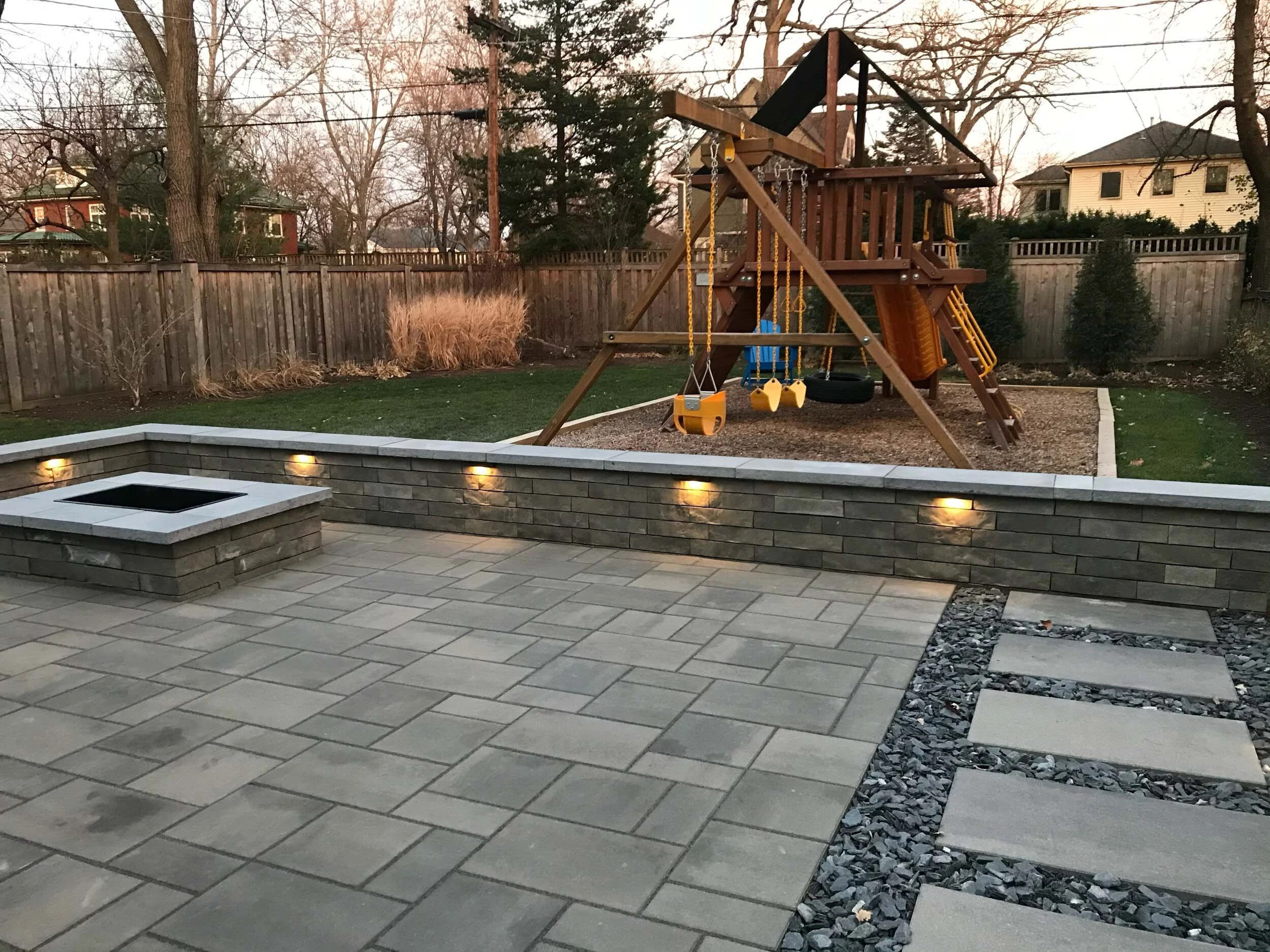
The larger point is that a compound-curve patio on a mature Alpharetta canopy lot is not a compromise on a rectangle. It’s the right design. A straight patio in a yard that wants a curve reads as forced, crowds the trees, and fails earlier because the geometry fights the site. The curve works with what’s already there — the oaks, the grade, the clay — and ends up both longer-lasting and better-looking than the rectangle a homeowner might start out asking for.
The first conversation we have on any Alpharetta canopy site is about the trees. The second is about the house footprint. The third is about the patio shape. By the time we get to the third conversation, the shape has usually designed itself.
Curved paver patios across 20+ cities within 30 miles of Winder, GA
If your Alpharetta backyard has mature oaks, a 3-to-6-foot grade change, or an HOA architectural review ahead of it, the compound-radius approach is usually the right call. We’ll draw the tree-protection overlay before we price the patio.