
Imagine the plat map for your 3.2-acre lot off Kelly Mill Road — five boundary lines, not four, and the back corner where the lawn meets the Sawnee-Mountain-facing woodline sits at a stubborn 148 degrees. That one angle is the difference between a patio that feels designed and a patio that feels squeezed in.
We get this call three or four times a month. A homeowner in unincorporated Forsyth — Coal Mountain, Shady Grove, Ducktown, Brookwood — has spent the last six months looking at square-edged patios on Pinterest and quietly realizing none of them fit the shape of their actual yard. Their property line runs at an angle a GA-400 surveyor clearly enjoyed drawing. The house sits on fill behind a walkout basement. The back lawn rolls downhill toward a creek easement. A rectangular paver patio dropped into that yard looks like it landed there by accident.
Forsyth County is the fastest-growing county in Georgia for the past decade, and the subdivisions developers pushed through between 1995 and today account for roughly 85% of the housing stock. Many were cut out of foothill terrain rather than flattened farmland. That’s why we see so many 140-to-160-degree corners instead of clean 90s — the lot lines follow the topography, not the other way around. Curved paver patios aren’t a style choice in that context. They’re the only honest response to the geometry.
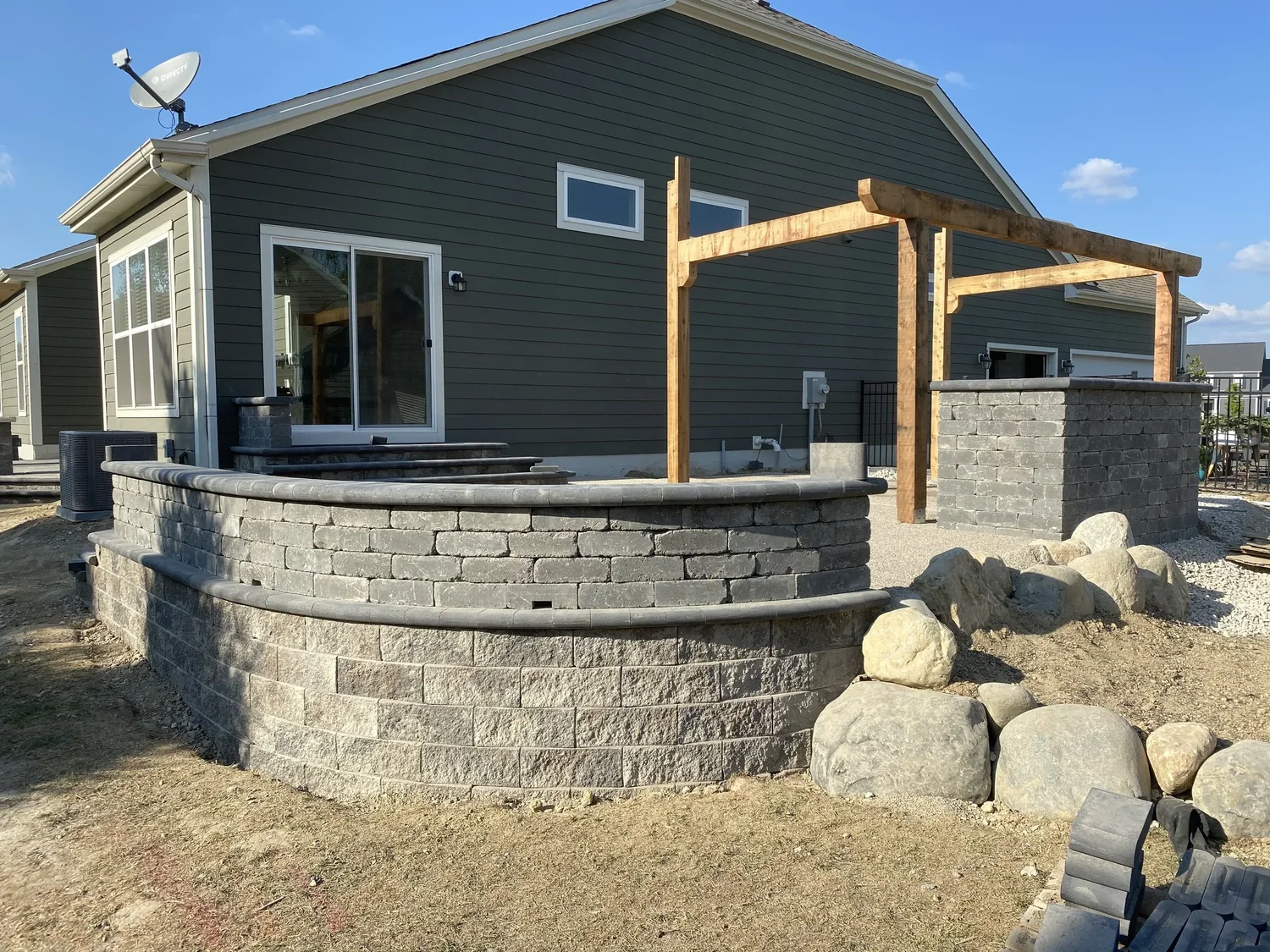
1. Why Forsyth Lots Don’t Want 90-Degree Patios
Before we cut a single paver, we pull the recorded plat. On a typical 30041 south-Forsyth subdivision lot — Bethelview, Post Road, Shoal Creek corridor — the back-yard polygon has five or six sides, not four. The side setback angles in to follow a drainage easement. The rear lot line kinks around an HOA-mandated tree-save buffer. The house itself is often rotated 10 to 15 degrees off the street grid to optimize southern exposure.
Drop a rectangle onto that geometry and you get three problems: wasted usable space in the corners, awkward grass slivers you can’t mow, and a patio edge that reads as an argument with the yard. A curved patio — one that echoes the property line or the house footprint — actually resolves the geometry. The eye stops hunting for the missing fourth corner.
We build the patio’s perimeter from one of three curve families, chosen per lot:
- Single-radius arc — one consistent radius (usually between 8 and 18 feet) sweeping from one house-wall anchor point to another. Simplest layout, cleanest cut pattern.
- Compound curve — two or more tangent arcs of different radii, blending so the edge shifts tension gradually across the patio. This is what mountain-view Coal Mountain lots usually need.
- Free-form spline — a flowing line laid out with a garden hose on site, then surveyed back onto paper. Feels organic but takes the most waste and the most layout time.
2. The Layout Day — How We Actually Draw the Curve
Layout on a curved patio is a field exercise, not a CAD export. We show up with a 100-foot steel tape, a bag of marking paint, wood stakes, and a 200-foot mason’s line. First move is a property-line-to-house tri-measurement to confirm the plat matches reality — in older 30028 north-Forsyth acreage tracts it often doesn’t, because a 1996 property pin has migrated six inches in three decades of freeze-thaw.
Then we find the curve’s center point. On a single-radius arc that’s literally a stake in the ground, with the mason’s line tied to it. One crew member walks the line out to the design radius and sprays paint every two feet — ten minutes later we have the entire arc marked on the lawn. Compound curves take two or three center stakes, each hit sequentially, blending at the tangent points.
This is the part clients don’t expect: we let the curve live on the lawn for 24 hours. The homeowner walks it at morning coffee, at sunset, from the master-bedroom window, from the kitchen sink. Ninety percent of the time the first drawn arc gets tightened or loosened by a foot or two after that sit-with-it period. Our foreman adjusts it before excavation starts. That one night of looking saves a five-figure change order later.
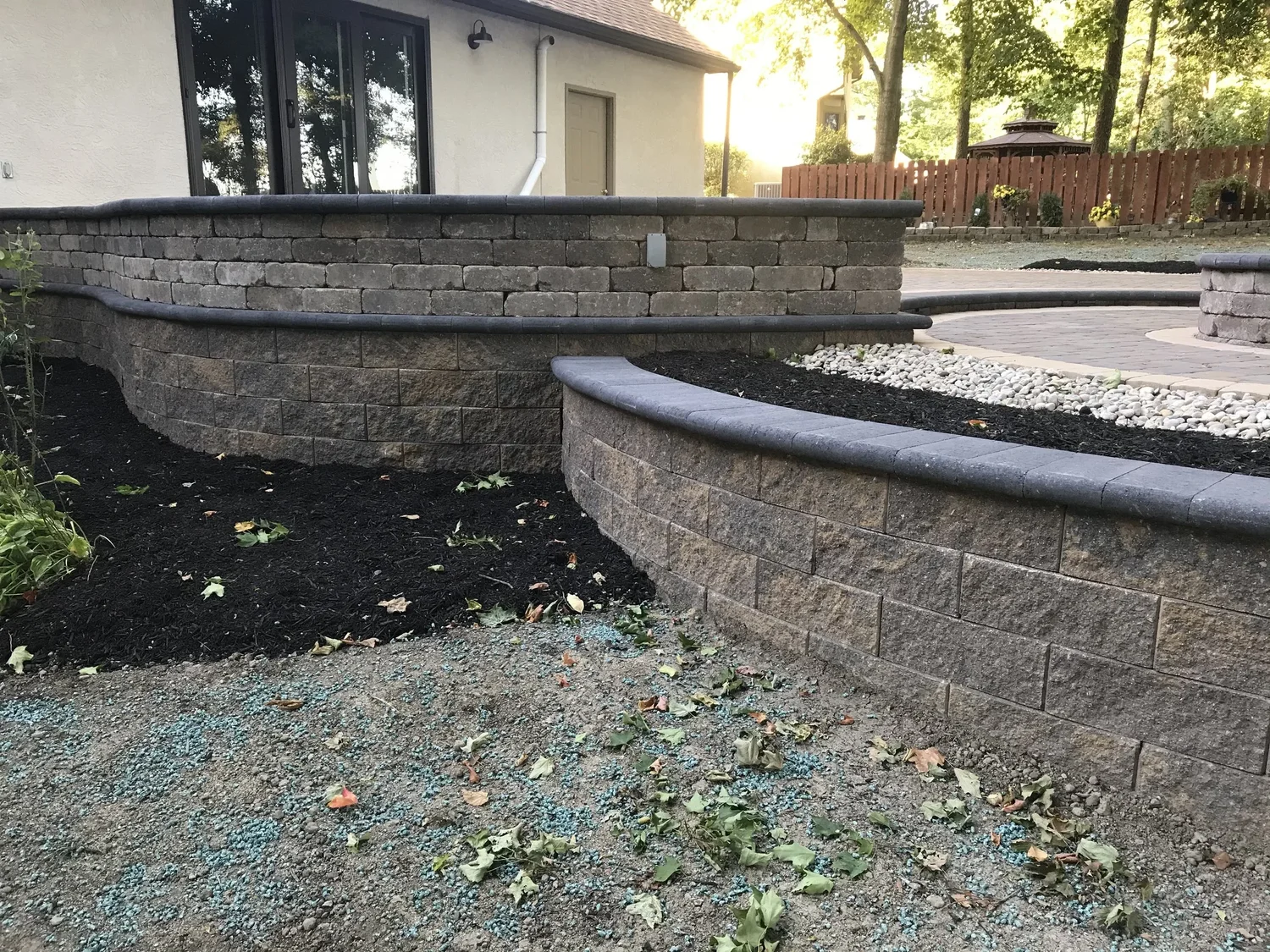
3. Compound Curves, Radius Math, and the Waste-Material Factor
Here’s the number every Forsyth homeowner eventually asks about: how much more paver do you have to buy for a curved patio versus a rectangular one? The honest answer — we’ll source roughly 18 to 25 percent more material for a curved layout, compared with the 8 to 12 percent standard overage on a rectangular patio.
The extra waste is real. Every curved edge gets hand-cut, paver by paver, on a wet saw. A 600-square-foot rectangular patio with a 42-inch soldier course border might produce two five-gallon buckets of cut-offs. The same square-footage patio with a compound curve produces eight buckets — roughly a cubic yard of scrap paver, most of it too small to re-use on the same job.
Waste factor by patio shape: Rectangular with one soldier course: 8–12% overage. Rectangular with multiple inset patterns: 12–15%. Single-radius curve: 15–20%. Compound curve / free-form: 18–25% overage. We buy that extra material up front — never mid-job — because pallet-to-pallet dye-lot variance in Techo-Bloc Blu Grande and Belgard Mega-Arbel is real, and a late re-order almost always shows color-batch drift.
Compound curves bring a second complication: radius math. A curved border using a 6-by-9-inch Techo-Bloc Blu soldier will lay cleanly on any arc with a radius of 8 feet or greater without visible wedge gaps between units. Tighter than that, either the joint gaps open above the 3/16-inch spec or every unit has to be cut at a slight taper. On radii below 5 feet we switch to a smaller-format paver — typically Belgard Dublin Cobble 6×6 or Pavestone Holland 4×8 — because the shorter face length hides the radius geometry.
The rule we brief clients on before layout: bigger pavers love straight lines, smaller pavers love tight curves. Mixing them on a single compound-curve patio — big-format field, small-format border — is usually the right answer. It’s also why the material list for a curved patio isn’t just “more of the same” — it’s a different SKU count altogether.
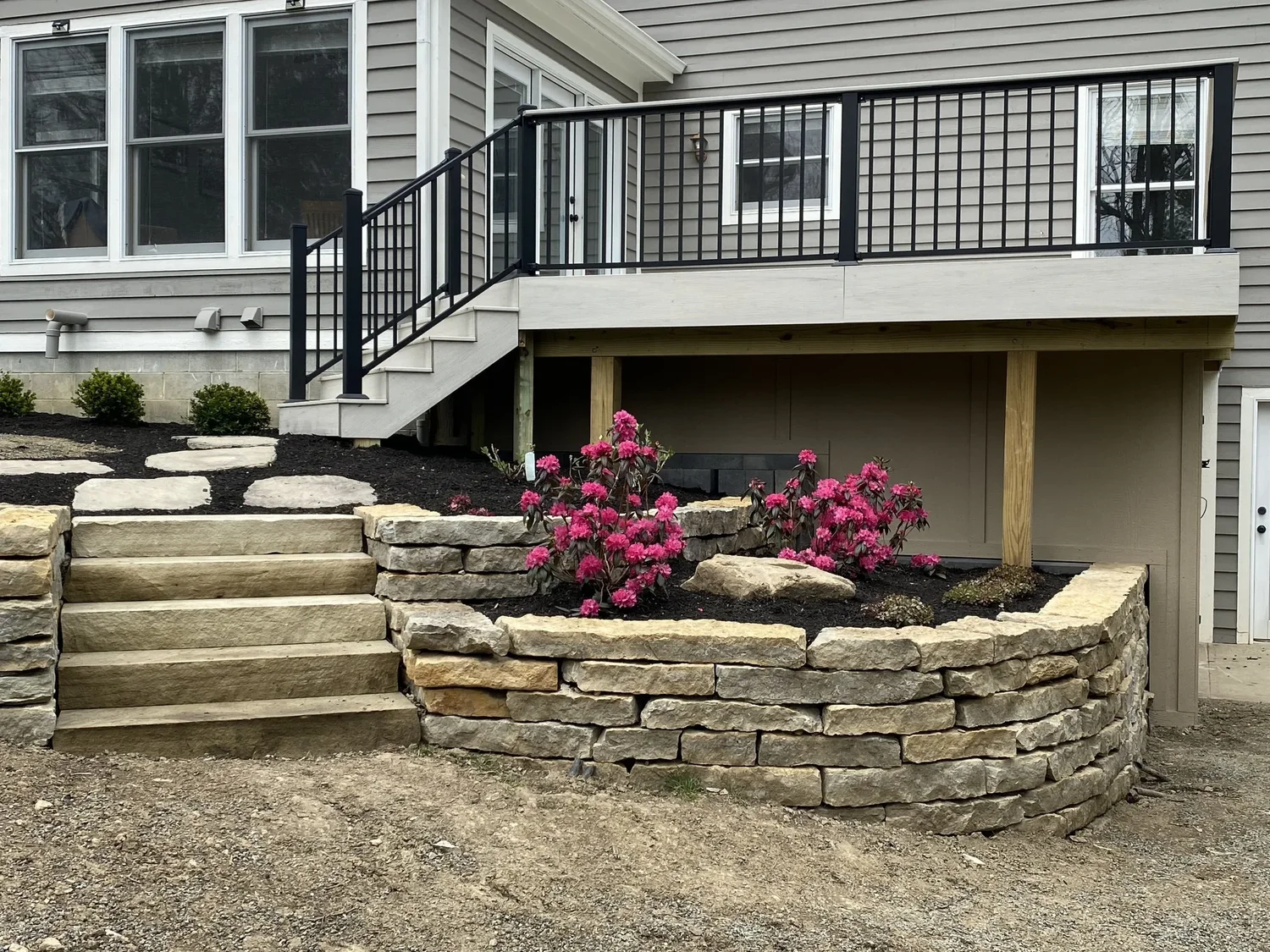
4. The $4-to-$7 Per Square Foot Curve Premium — Where It Actually Comes From
We’re straight about pricing. A curved paver patio in Forsyth County costs $4 to $7 per square foot more than a rectangular patio of the same size and material. On a 700-square-foot backyard patio that’s a $2,800 to $4,900 premium, and clients are entitled to know exactly where the extra dollars go before they sign.
Three line items drive almost all of the difference. First, labor — curved layout and cutting add 35 to 45 percent to the install hours. On a project that would take a rectangular crew three days, the curved version runs four or five. Second, material waste — those eight buckets of scrap we already described. Third, base prep complexity — a curved edge requires a curved base excavation, which means more hand work at the perimeter and more careful screeding as the radius tightens.
What we don’t charge extra for: design time, plat review, or the 24-hour curve-on-lawn sit. Those are built into the proposal at zero additional cost because skipping them creates tens of thousands of dollars of rework. The clients who balk at the curve premium almost always come back a year later after seeing a neighbor’s rectangular patio fight the lot — and this time they pay for it and stop arguing.
One caveat worth naming: the curve premium is flat per square foot regardless of material grade. If you’re already buying Techo-Bloc Blu 60mm at $14 per square foot installed, the curve premium is a smaller percentage of the total than it is on an entry-level $8-per-foot Holland-style paver. The richer the base paver, the cheaper the curve becomes in relative terms. This is why we rarely recommend bargain pavers for curved installations — the upcharge ratio works against you.
5. North Forsyth vs. South Forsyth — Two Different Design Languages
The same 700-square-foot curved patio gets designed two different ways depending on which half of Forsyth County it’s going into. That’s not marketing talk — it’s geometry meeting geography.
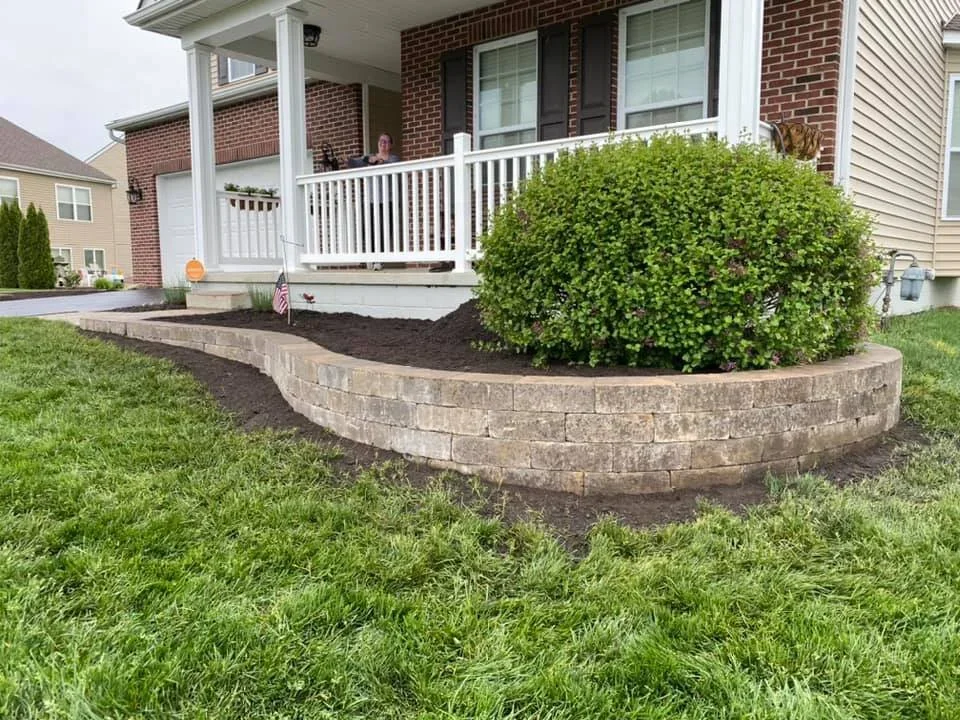
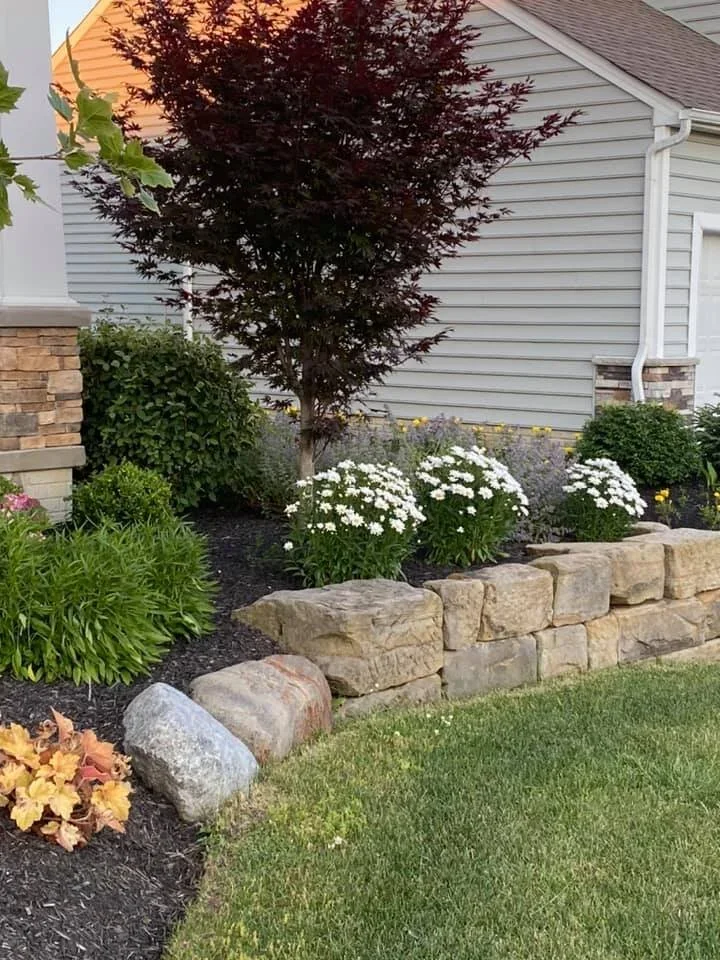
North Forsyth (30028, Coal Mountain, Ducktown, Shady Grove, Shiloh) — big lots, rolling foothill terrain, Sawnee Mountain sightlines, rocky Cecil-series clay with granite intrusions. Our curved patios up here tend toward large single-radius arcs opening toward the view. Border material often natural stone (fieldstone or bluestone) to match the landscape. Retaining walls behind the patio are frequent because the grade change from house to usable back-lawn is often 3 to 6 feet. The aesthetic target: a patio that reads as a natural shelf carved out of the hillside.
South Forsyth (30040, 30041, Bethelview, Post Road, Big Creek corridor) — tighter subdivision lots, flatter grades, more HOA constraint, less Piedmont rock. Curves here are smaller-radius and more decorative — echoing the back of the house or an existing pool shape rather than a distant view. Border material is typically a manufactured Techo-Bloc or Belgard soldier course in charcoal or earth-brown. Aesthetic target: a patio that looks like it was always part of the house’s back elevation.
Forsyth County processes roughly 200 pool-and-patio-related permits per year, which is one of the highest volumes in the state relative to population. That volume means the county permit office has seen every configuration — but it also means HOA boards have seen them too, and they’re picky about precedents. A compound-curve patio in a south-Forsyth HOA sometimes needs a sketch and a plat-markup submitted to an Architectural Review Committee before excavation begins. North Forsyth’s larger unincorporated lots usually skip that step entirely.
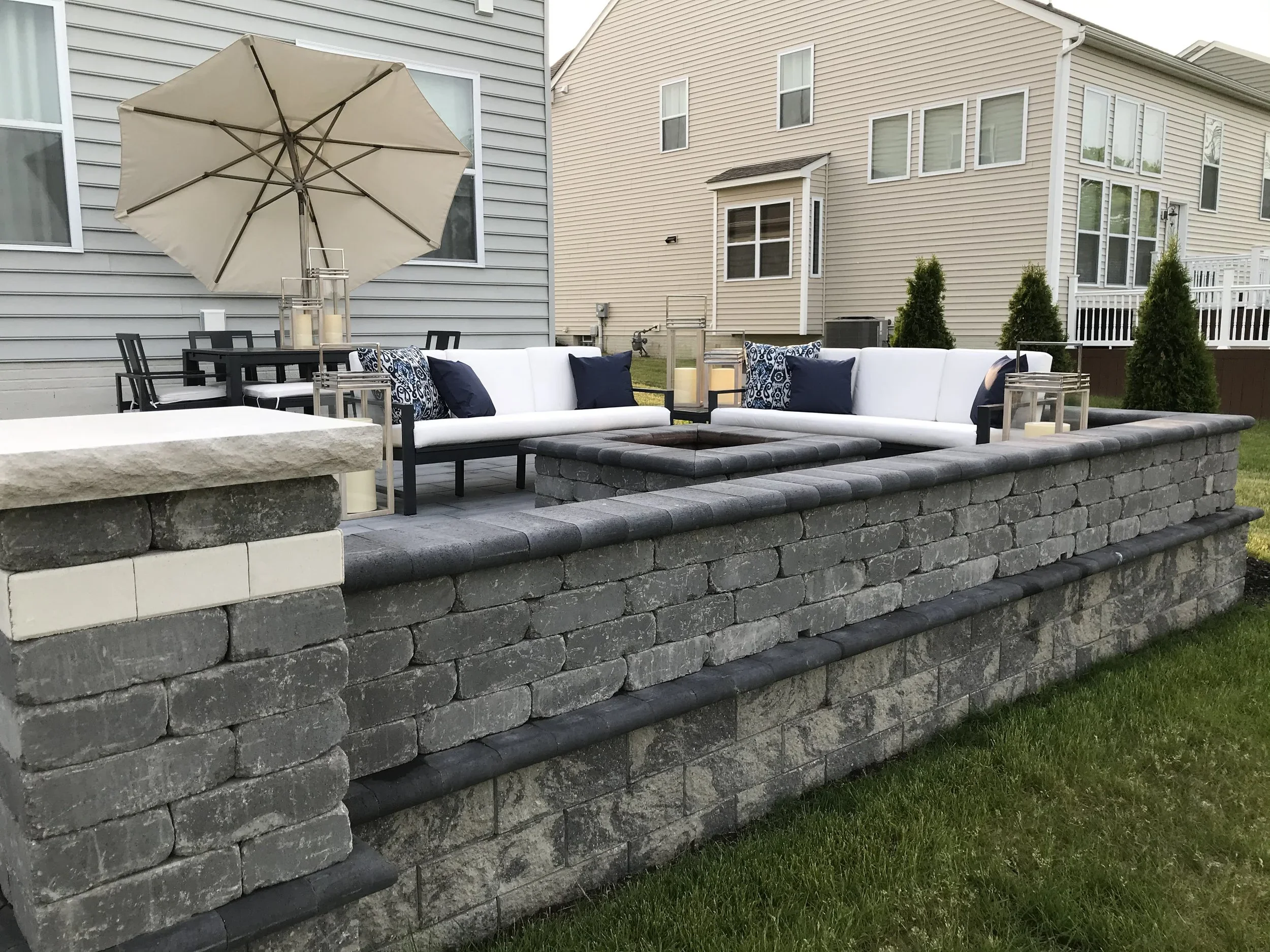
6. Drainage, Base Prep, and the Freeze-Thaw Reality on a Curved Edge
A curved paver patio fails the same way a straight one does — edge restraint lets go, the perimeter settles, and within two years the joints spider and the field tilts. On a curve that failure mode is worse, because the eye reads a straight settling edge as “the ground moved” but reads a settling curved edge as “someone built this badly.” The cure is disciplined base prep.
Our base spec for curved patios in Forsyth’s Cecil-series clay runs a half-inch thicker than rectangular: 6 inches of GAB crusher run compacted in two 3-inch lifts, rising to 7 inches under any radius below 8 feet. We oversize the excavation footprint 12 inches past the finished paver edge on all curves — that extra 12 inches of compacted base gives the edge restraint something to bite into when the clay underneath decides to move, which it does.
Forsyth sits in USDA Zone 8a and averages around 22 freeze events a year, more at elevation near Sawnee Mountain. Each freeze-thaw cycle lifts and drops unprotected clay by up to a quarter-inch. Multiply that by 22 cycles a year and your patio base is being asked to absorb 5 to 6 inches of cumulative vertical movement over its lifetime. The base does absorb it — if the base is correct. If it’s a homeowner-special 2-inch layer of crushed stone over undisturbed clay, it won’t.
Drainage on a curve is its own small discipline. The finish grade has to slope away from the house at a quarter-inch per foot minimum, but on a curved edge “away from the house” is a moving target — every few feet along the arc, the direction of steepest descent rotates. We screed curved patios in 8-foot radial sections, each one pitched on its own axis toward the lowest point of that segment’s perimeter. The result is a subtle dome across the finished field that sheds water off the edge regardless of which compass direction that edge happens to face.
Polymeric joint sand matters more on curves than straights. Because every curved unit has a slightly wider joint on the outer edge than the inner edge, standard polymeric products can crack or wash out at the wider points within two seasons. We use SRW Tech-Bond or Alliance G2 Gator Maxx joint sand on any curved patio — both are rated for variable joint widths up to 4 inches and handle Forsyth’s summer thunderstorm-intensity rainfall without mobilizing.
The last hidden detail: edge restraint along a curve can’t be the standard 10-foot L-section paver-edge product most contractors default to. Straight L-sections force a curve into a series of short chords — the patio edge ends up looking faceted, like a 20-sided die. On curves we use Pave Tech Pave Edge Flexible or SnapEdge Flex, both formulated to bend to a 3-foot radius without kinking, spiked into the compacted base every 8 inches with 10-inch galvanized spikes. That’s 50 percent more spikes than a straight edge. It’s also why the edge holds its radius when a summer storm dumps an inch in twenty minutes.
The Forsyth County Takeaway
A curved paver patio is what happens when a design respects the land under it. In 247 square miles of Forsyth County — 260,000 residents stretched from the Lake Lanier south shore up through Sawnee Mountain Preserve and Coal Mountain — almost no backyard is a perfect rectangle. Treating every lot as if it were one produces patios that don’t fit and don’t age well.
The $4-to-$7-per-square-foot premium a curve adds isn’t a luxury upsell. It’s what it costs to handle the compound-curve layout, the 18-to-25-percent material waste, the thickened base, the flexible edge restraint, and the radial screeding that keeps the finished field flat across an irregular shape. Do it right once and the patio still reads as designed in year fifteen. Skip any of those line items and the patio starts telling on itself in year three.
If you’re on a Forsyth lot with a 148-degree back corner, a view toward Sawnee Mountain, or a subdivision back-yard polygon with five sides instead of four — the patio you want already exists. It’s shaped like your lot, not like a catalog page.
Curved paver patios designed to fit Forsyth County’s irregular lots — across 20+ cities within 30 miles of Winder, GA
From Coal Mountain mountain-view estates to south-Forsyth subdivision backyards, we lay out, cut, and install curved paver patios that honor the geometry of your actual lot — not a catalog rectangle.