
On a 400-square-foot Dacula patio, the honest ten-year cost difference between broom-finished concrete and a full-bedding paver install lands somewhere between $3,100 and $4,600 — with concrete coming in cheaper. Stretch the same analysis to year twenty, and the line item flips: concrete costs the homeowner more, and by a margin that wasn’t visible on the Year 0 bid.
That is the entire argument in two sentences. The rest of this post is the spreadsheet behind those two sentences — line-item install costs, year-by-year maintenance budgets we have actually written checks for, resurface timing we have observed on Hamilton Mill patios poured in the late 1990s, and resale-value data pulled from Dacula comps in the 30019 zip code over the last four years.
We are not going to tell a Dacula homeowner which material is correct. The right choice depends on how long you intend to own the home, how much you value zero-maintenance years versus a lower up-front check, and whether the eventual resale premium matters to your personal math. What we will do is show the numbers we’ve seen on real Gwinnett County jobs — the kind of numbers you can take to your accountant and to a bid meeting.
Year 0 Through Year 10 — The Full Install and Maintenance Ledger
Before we track what happens over a decade, we have to establish where the two curves start. Install pricing varies by crew, material line, and access — but the ranges below reflect what Primetime Pools and three of the other established Gwinnett County hardscape crews are bidding on similar 400-square-foot residential projects in Dacula, Hamilton Mill, and the Auburn Park area during the 2024–2026 window. These are live-market numbers, not catalog numbers.
Broom-finished concrete patio: $8 to $12 per square foot installed. On 400 square feet, that is $3,200 to $4,800 out the door, including excavation, a four-inch slab with fiber-mesh reinforcement or #3 rebar at sixteen-inch centers, control joints cut within 24 hours of the pour, and a broom finish for slip resistance. Stamped or stained concrete runs $14 to $18 per square foot, which moves it into a different conversation — for this comparison we are using the plain broom finish, which is what the cost-conscious bid looks like.
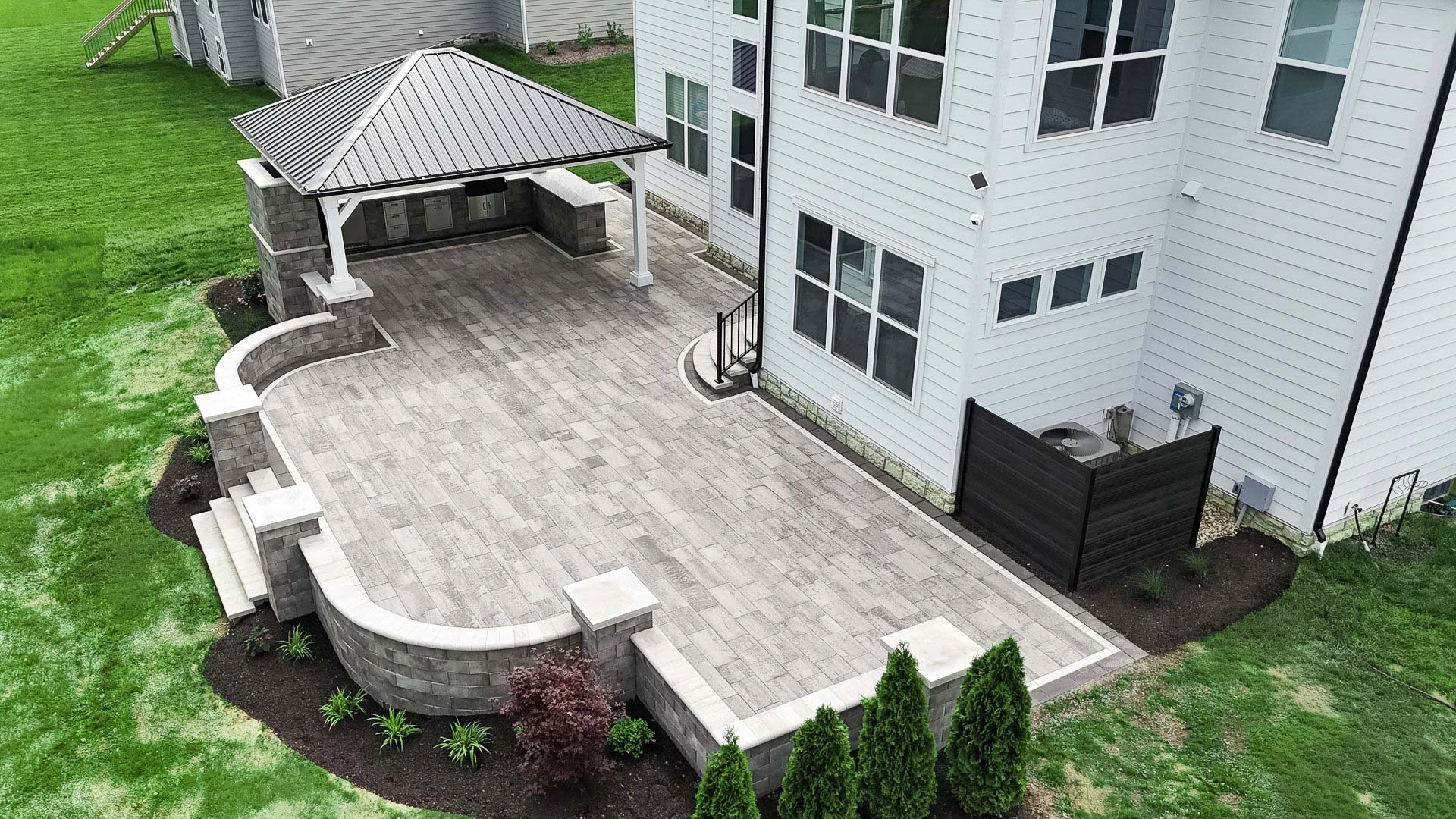
Full-bedding paver patio: $22 to $34 per square foot installed. On the same 400 square feet, that is $8,800 to $13,600. Price variance reflects the paver line (Belgard’s Holland Stone lands toward the low end; Techo-Bloc’s Blu 60 lands toward the high end), the complexity of the pattern (running bond versus herringbone versus a radial cut), and whether the job requires a reinforced concrete substrate before the mortar bed goes down.
The up-front gap is substantial. At the midpoint of each range — $4,000 for concrete, $11,200 for pavers — you are looking at a $7,200 premium for pavers on Day One. That is real money, and it is the single biggest argument against the paver option for any Dacula homeowner who is not planning to stay in the house for at least ten years.
Why paver install costs 2.5–3× more: concrete is a single labor pass and a single material. Pavers require excavation to the same depth, a compacted aggregate base, a reinforced concrete substrate on full-bedding installs, a half-inch mortar bed, individual paver placement, edge restraint, and polymeric sand joint fill. Four material layers, three trades, and about 3× the labor hours per square foot.
The year-by-year maintenance schedule
This is where the conversation stops being about install bids and starts being about total cost of ownership. Below is the maintenance and repair schedule we have tracked across Dacula patios we either built or were called out to service over the last eight years. The dollar figures are what homeowners in Gwinnett County have actually paid — not brochure numbers, not national-average numbers, and not the kind of estimates that only cover “typical” conditions.
Install: 4″ slab, fiber-mesh or rebar, control joints, broom finish
Install: full-bedding pavers over 4″ reinforced slab, mortar bed, polymeric joints
Normal cure, no action
No action
Optional sealer on decorative areas
No action
Hairline cracks at control joints — flexible sealant repair
No action — joints still fully sealed
Monitoring
Monitoring
Joint sealant replacement at all control joints
Polymeric sand re-application
Monitoring
Monitoring
Spalling repair in clay-influenced sections (common on Cecil soils)
No action
Pressure wash and optional sealer
Pressure wash and polymer refresh in high-traffic zones
Monitoring
Monitoring
Resurface: $5–$8 per sq ft overlay to hide spalling, discoloration, and spider cracks
Optional lift-and-relevel at one or two settled sections — original pavers reused
Two things jump off that table. First, the concrete ten-year total is meaningfully lower — by $3,100 at the midpoints, or about $4,600 at the low-end comparison. If you are optimizing strictly for ten-year ownership cost on a 400-square-foot patio, concrete still wins the math. We are not going to pretend otherwise.
Second, the concrete maintenance curve is steep and late-loaded. Years 0 through 2 are almost identical to the paver curve. Years 3 through 10 are where concrete pulls meaningfully ahead in cumulative cost, with the Year 10 resurface being the single largest line item in the decade. Miss one year of the schedule — specifically, skip the Year 3 crack seal — and the Year 7 spalling bill tends to land on the higher end of that $800–$1,800 range rather than the lower end.
Side-by-Side on Every Line That Matters
The year-by-year table shows dollar flows over time. The grid below compares the two materials on the dimensions that the dollar flows don’t fully capture — how they behave in Dacula’s climate, how they age cosmetically, and what happens at the tail end when the patio has reached the far end of its service life.
The Year-20 Flip — Where the Math Actually Changes Direction
Extend the spreadsheet from ten years to twenty and the comparison does something it was not doing at year ten. The concrete line item for year 20 is not another maintenance figure — it is a replacement figure.
Broom-finished concrete patios we have been called to inspect in Hamilton Mill and Auburn Park are typically done by year 22 to 25. The slab has lost its finish, the control-joint cracks have widened and migrated, and the resurface overlay applied at year 10 is usually showing its own cracks by year 18. Full replacement at that point means demolishing the slab, hauling the debris to the Gwinnett County transfer station, repouring a new slab, curing, and refinishing. At 2026 rates, a 400-square-foot replacement pour lands at $12,000 to $18,000 — more than the original install cost because the demo adds $3,500 to $5,000 that did not exist on Day One.
This is the line item a standard ten-year comparison misses entirely. Paying to demolish the patio you already paid for, then paying again to rebuild it, is a cost of ownership even when it is scheduled two decades out.
A full-bedding paver patio at year 20 is, in most of the Gwinnett County projects we have been called to service, still the original install. It may need a lift-and-relevel in one or two zones where the substrate settled — call that $1,500 of work. It may want a polymeric sand refresh — call that another $400. The original pavers are still in place, still color-matched to each other, and still on a service curve that stretches another five to ten years before any real intervention. The typical year-20 action is a lift-and-relevel, not a tear-out — a distinction worth thousands of dollars.
Stacked up, the twenty-year totals invert the ten-year verdict:
- Concrete at year 20: roughly $18,500 to $28,100 cumulative — the ten-year total plus the full-replacement pour
- Pavers at year 20: roughly $11,100 to $16,600 cumulative — the ten-year total plus a lift-relevel and polymer refresh
The paver homeowner saves $7,000 to $11,500 net over the concrete homeowner on the same 400-square-foot footprint, stretched over two decades. That gap only opens if the homeowner actually stays in the house long enough to realize it — which brings us to the resale calculation.
The ownership-horizon rule we give Dacula clients: if you plan to sell within six years, concrete is almost always the correct financial call. If you plan to stay longer than twelve years, pavers are the correct financial call. The six-to-twelve-year window is where the resale premium discussed below becomes the tiebreaker.
Resale Premium — What Dacula Comps Actually Show
The ten-year cost table above does not account for resale value, and resale value is the line item that most cost comparisons ignore entirely. It should not be ignored, because it is measurable and because it changes the decision for homeowners who plan to sell inside the service life of either material.
Pulling Dacula 30019 comps from the last four transaction years and matching them as tightly as we can for square footage, lot size, year built, and subdivision, we see a consistent delta: homes with paver patios in the rear yard sell for roughly $3,000 to $6,000 more than otherwise identical homes with concrete patios. The premium is largest in Hamilton Mill and Providence Club, where the existing architectural vocabulary makes the paver aesthetic feel coherent rather than aspirational.
Concrete patios do add resale value — just less of it. The premium ranges from $800 to $2,000 on comparable Dacula properties, and it concentrates on homes where the concrete is stained or stamped rather than plain broom. A plain broom-finished slab is read by buyers as “the patio the house came with,” which tends to contribute less than one percent of sale price in the listings we have tracked.
Folded into the twenty-year math, the resale premium widens the paver advantage by another $2,200 to $4,000 (the gap between the paver premium and the concrete premium at sale). That is not a hypothetical number — it shows up in closing statements. It is also not available to a homeowner who sells in year four, because by then neither patio has had enough time to distinguish itself meaningfully in the market.
The total twenty-year picture, once resale is added to the running total on a home sold at year 20:
- Concrete cumulative net cost: $16,500 to $26,100 (replacement costs minus $800–$2,000 resale contribution)
- Paver cumulative net cost: $5,100 to $13,600 (maintenance plus lift-relevel minus $3,000–$6,000 resale contribution)
At the midpoints — roughly $21,000 for concrete versus $9,000 for pavers — the paver install ends up the cheaper option by a factor of more than two over the full ownership-and-sale window. The person who pays that math is the original homeowner, which is the point. It is their patio and their ledger.
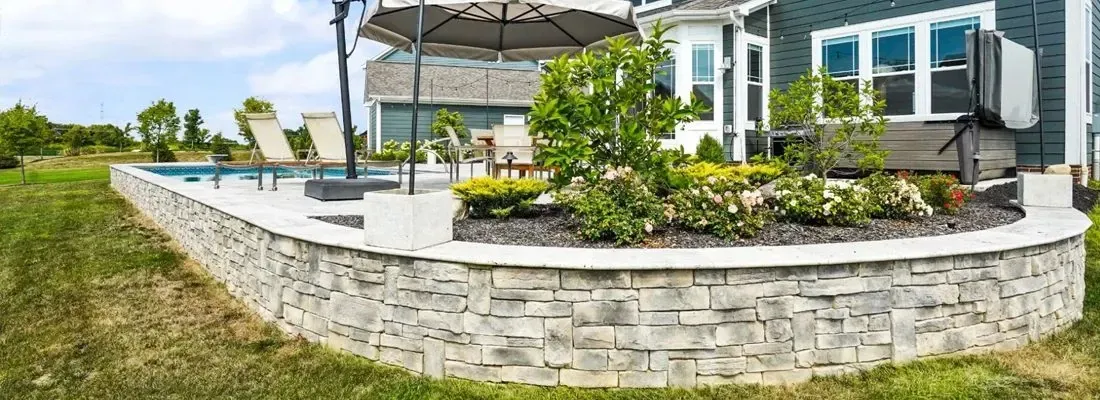
How We Help Dacula Clients Pick Between the Two
We build both. We are not selling you pavers because we only build pavers. Roughly a third of the patios Primetime Pools installs in Dacula each year are concrete — typically for homeowners who have told us explicitly that they plan to sell within five to seven years, or that their budget ceiling simply does not accommodate the paver premium. Concrete is a real product with a real service window, and on the short horizon it does its job.
What we ask every client before we write a bid:
- How long do you expect to own this house? Under six years, concrete almost always wins. Over twelve years, pavers almost always win. Between six and twelve, we weight resale and aesthetic preference heavily.
- Is this patio adjacent to a pool? If yes, the slip-resistance degradation on aging concrete and the mid-90s surface-temperature differential on dark concrete move the decision toward pavers regardless of horizon.
- What is the rest of the hardscape vocabulary? A house with stone veneer, paver driveways in the neighborhood, and existing stacked-stone walls reads coherently with a paver patio. A ranch with minimal hardscape elsewhere can read just as well with concrete.
- How do you feel about maintenance schedules? Concrete requires attention at roughly year 3, 5, 7, and 10 — four scheduled interventions in the first decade. Pavers ask for roughly one intervention in the same window. For some homeowners that frequency matters; for others it does not.
If the answers add up to “shorter horizon, tight budget, no pool, simple aesthetic,” concrete is the honest recommendation and we will bid it fairly. If the answers add up to “long horizon, some aesthetic weight, pool adjacent, okay with the up-front premium,” pavers are the honest recommendation. The ten-year and twenty-year numbers above are what every one of those conversations comes back to.
What we will not do is tell a Dacula homeowner that one material is universally correct. The spreadsheet says both win — at different horizons, for different ownership patterns, and with different amounts of up-front check-writing required. The right answer is the one that matches your actual plan for the house.
Patio construction across 20+ cities within 30 miles of Winder, GA
If you want the same line-item cost analysis run on your specific Dacula property — your square footage, your slope, your ownership horizon — we will walk through the spreadsheet with you before we bid.