
A 400-square-foot stamped concrete patio in Clarkston costs about $7,200 to pour. Ten years later, after resealing, crack repair, one sawcut section and a re-color, the same homeowner has usually spent close to $12,900 on it, which puts it within a few hundred dollars of the paver patio they turned down for being “too expensive.”
Concrete wins on install day, and that’s the only number most bids show. Nobody hands you the ledger for years two through ten: the reseal every other spring, the crack that becomes a lifted edge, the patch that never matches, the faded color that makes a ranch in Idlewood look older than it is.
Clarkston makes that ledger longer than it would be in a lot of places. The town sits at about 1,036 feet in DeKalb County on older Piedmont ground east of I-285. It gets roughly 52 inches of rain a year, runs humid under a heavy tree canopy, and still sees 8 to 14 freeze events every winter. That’s enough to work water into every pore and crack a patio has. Lots in Lake Capri, Brockett and Toney Valley were graded in the 1960s and 1970s, with thin topsoil over dense clay that swells when wet and shrinks when dry. A rigid slab and a flexible paver field respond to that ground very differently.
So this post skips the install-price comparison. Below is the full ten-year cost of ownership per square foot, covering sealing, crack and settlement repair, section replacement, and fading curb appeal, with both materials side by side.
Year Zero: Install Price per Square Foot, Side by Side
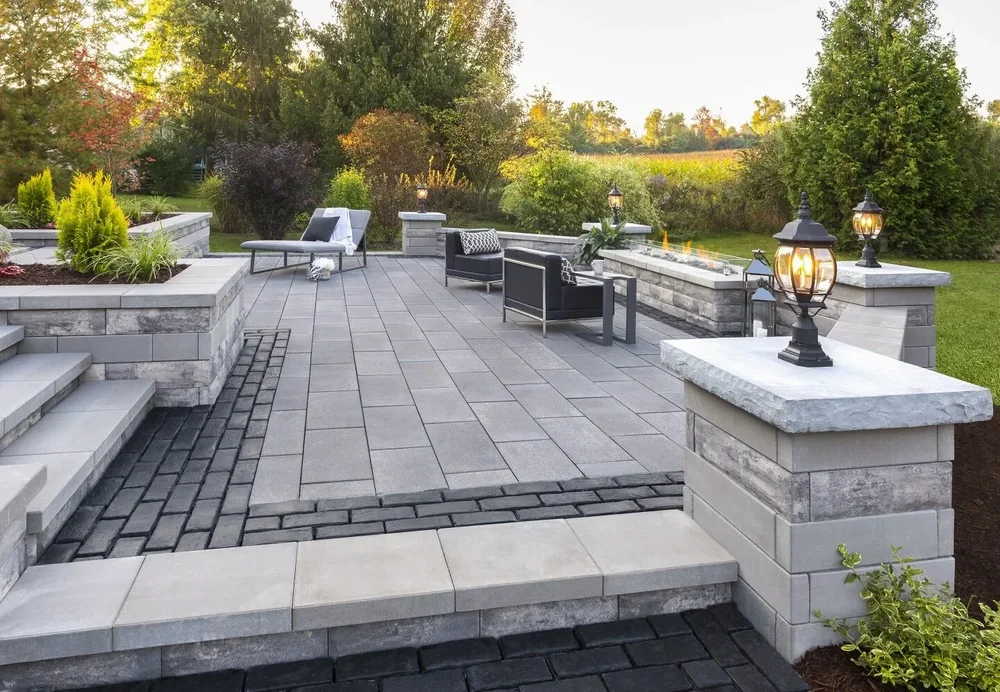
Every ten-year model starts with the check you write on day one, so let’s set the baseline honestly. Concrete comes in three tiers in the Clarkston market. Plain broom-finish flatwork is the cheapest. Stamped and integrally colored concrete sits in the middle. Stamped concrete with a hand-applied release color and a border band costs the most. Pavers have their own spread, from basic tumbled brick-format units up to large-format slabs and premium textured lines from manufacturers such as Belgard, Pavestone, Unilock and Techo-Bloc.
On a 400-square-foot patio, the kind of footprint that fits behind a split-level on the Sycamore Drive corridor, those ranges translate to roughly $4,000 for plain concrete, $7,200 for mid-tier stamped, and $10,400 for a mid-tier paver installation at $26 a foot. Judged on install price alone, pavers look like a $3,200 premium over stamped. The next four sections are about how much of that premium is still there by year ten.
One Clarkston note: either material can trigger DeKalb County review if it involves a retaining wall, a stream buffer, or the lot’s impervious-surface limit, which matters for yards draining toward Pole Bridge Creek. Residential review goes through DeKalb County Planning & Sustainability at 178 Sams St. in Decatur, not Clarkston City Hall, and turnaround there runs 3 to 4 weeks. Pavers set on an open-graded base can sometimes be designed as a permeable system, which changes the impervious math. Poured concrete never can.
Sealing Intervals: The Maintenance Bill That Never Stops
Sealing is where the two materials part ways first, and where concrete’s low install price starts to wear down. Stamped concrete depends on its sealer. The color on a stamped slab is mostly a surface treatment: a release agent and sometimes a dusting of color hardener, locked under an acrylic sealer. Once that sealer breaks down, the color goes with it. In Clarkston, with shade and humidity from the canopy on one side and full summer sun at 90 to 94 degrees on the other, a solvent-based acrylic lasts about two to three years before it starts to whiten, peel or turn slick with mildew.
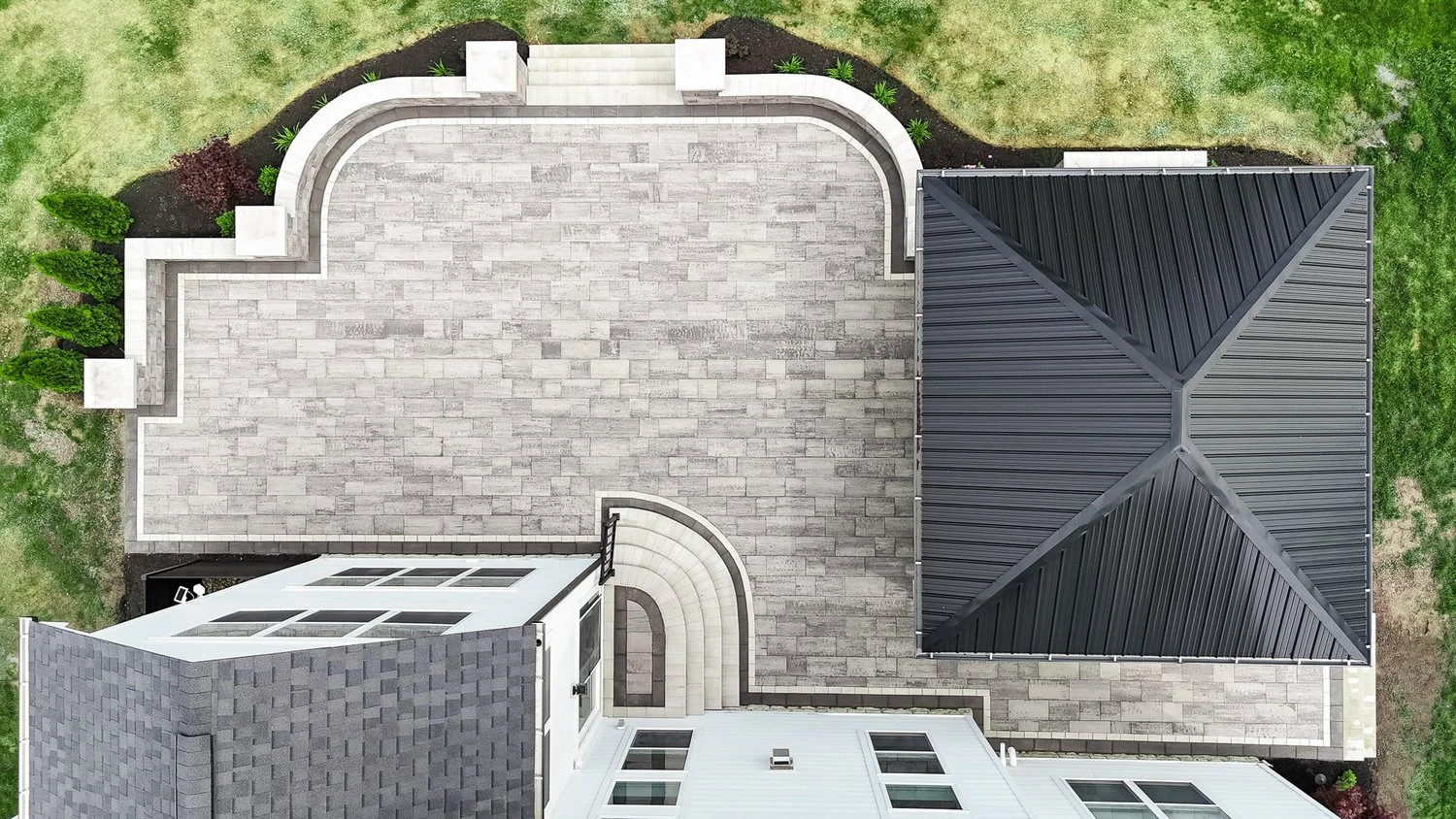
Pavers work the other way. The pigment is mixed through the full thickness of the unit, so sealing is optional. It deepens the color and makes cleanup easier, but the patio doesn’t depend on it. Where pavers do need regular care is the joints. Polymeric sand such as Alliance Gator Maxx G2 or Techniseal HP NextGel keeps out weeds and ants and holds the field together, but the top of the joint wears over time under pressure washing and heavy rain.
Run the 400-square-foot example again. Four stamped-concrete reseals at a midpoint of $1.60 a foot come to $2,560 over ten years. Two paver maintenance cycles at $2.00 a foot come to $1,600. Plain broom-finish concrete is cheaper still, since it only needs a penetrating silane-siloxane sealer every three to five years at roughly $0.60 to $1.00 a foot, so about $640 for the decade. The catch with plain concrete is that it never looked like much to begin with, and the next two sections hit it just as hard.
The humidity factor nobody prices in: Solvent acrylics on shaded Clarkston slabs, especially lots backing onto the Friendship Forest canopy or a creek corridor, tend to trap moisture and go cloudy, or “blush,” well before year three. A breathable water-based product lasts longer but costs more per coat. Ask any concrete bidder which sealer they use and how often they expect you to reapply it. If the answer is “never,” get another bid.
Cracks and Settlement: Rigid Slab vs. Flexible Field
Concrete cracks. A good contractor controls where by sawcutting or tooling control joints about every 8 to 10 feet, but that controls the pattern, not the fact. Clarkston’s dense clay subgrade makes things worse. After a wet February with several freeze nights, the clay under a slab heaves unevenly. After a dry August, it shrinks back and leaves voids. A 4-inch slab spanning those voids eventually breaks across them. On the older lots around Brockett Rd and Rockbridge Rd, where the original builders often left only a few inches of topsoil over the clay, we regularly see stamped patios with their first structural crack by year three or four.
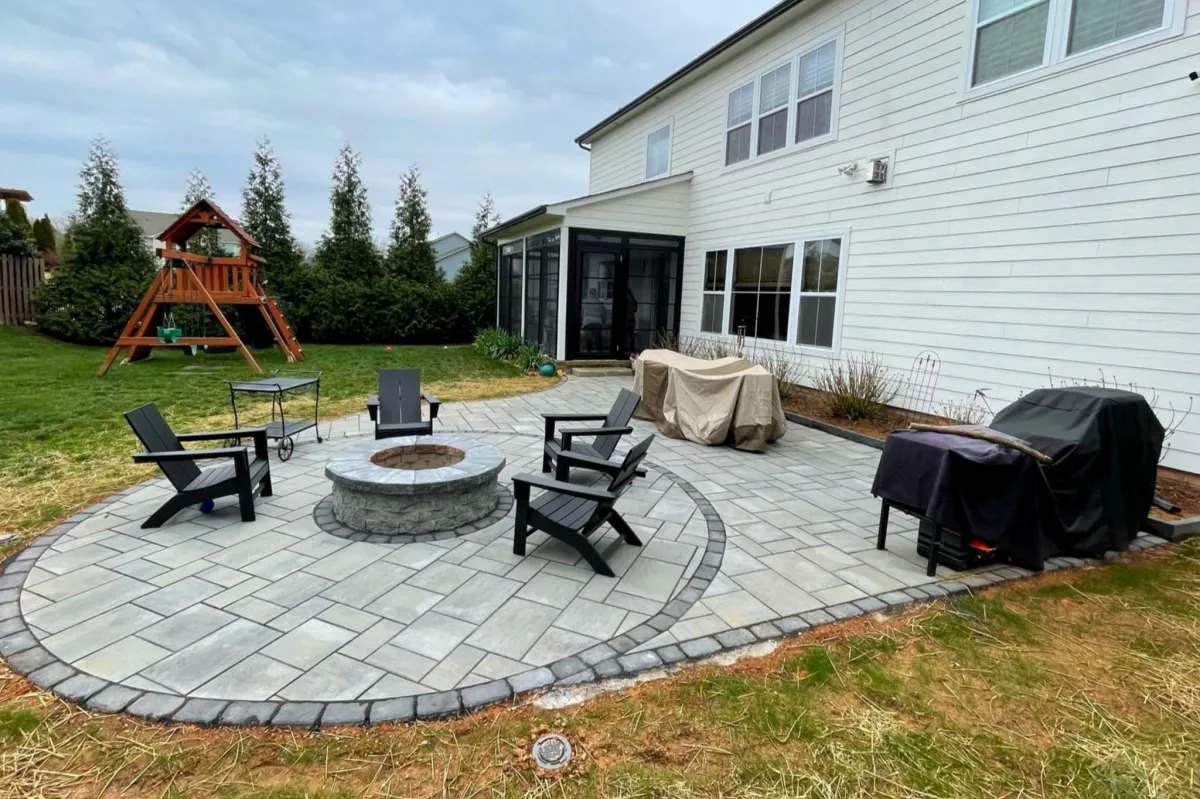
Pavers handle the same movement differently. The field is thousands of separate units on a compacted aggregate base, typically a 6-inch compacted base for foot traffic on clay, laid over a geotextile separator with an inch of bedding sand on top. When the ground moves, the joints take up the movement. If a low spot forms, you get a shallow dip, not a break. That shallow excavation also stays well above the decomposed granite that shows up 4 to 8 feet down on lots closer to the Stone Mountain pluton, so rock is rarely a line item on a patio the way it can be on a pool dig.
In raw dollars those lines are close. The difference is what’s left afterward. A sealed crack is still a crack, and the gray bead through a slate-texture stamp tells every home inspector the slab has moved. A relaid paver section looks like day one.
Section Replacement and Color Decay: The Two Costs That Surprise Clarkston Owners
Sooner or later, a cracked concrete section gets bad enough that sealing won’t fix it. It might be a corner that dropped half an inch where the downspout discharged for six years, or a panel next to an old oak on a Hambrick Rd lot that the roots finally lifted. At that point the fix is sawcut, demo, re-compact, re-form and re-pour. For stamped concrete in DeKalb County today, that runs $18 to $28 per square foot of replaced area. Small jobs cost more per foot because the crew and truck minimums don’t shrink with the square footage.
The bigger problem is matching. A new pour almost never matches a slab that’s been weathering for seven years. The integral color batch is different, the release agent is different, and the old surface has faded under years of UV. You end up with a bright rectangle in the middle of a faded patio. Owners who can’t stand the patch end up paying for a full re-color, an acrylic stain or tinted sealer across the entire slab, at $3 to $5 per square foot. That’s how a single failed section turns into a whole-patio expense.
Pavers get around this almost completely. Any competent installer sets aside a few spare units at the end of the job, usually 3 to 5 percent overage kept in the garage or the crawlspace. When a unit chips or stains, it gets popped out and replaced with one from the same production run. A blended or tumbled field also hides small color differences in a way a uniform concrete surface can’t.
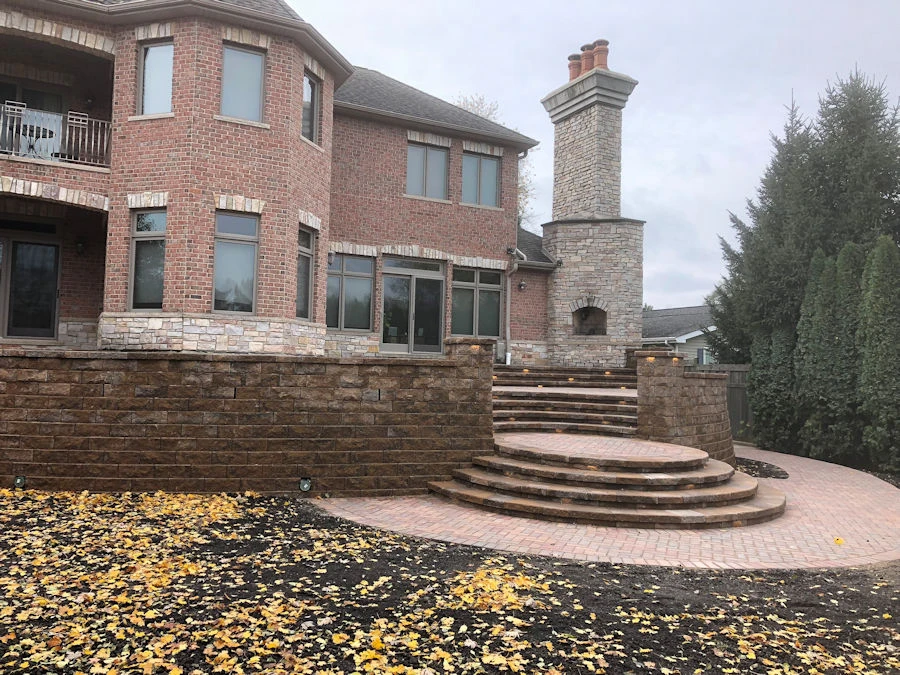
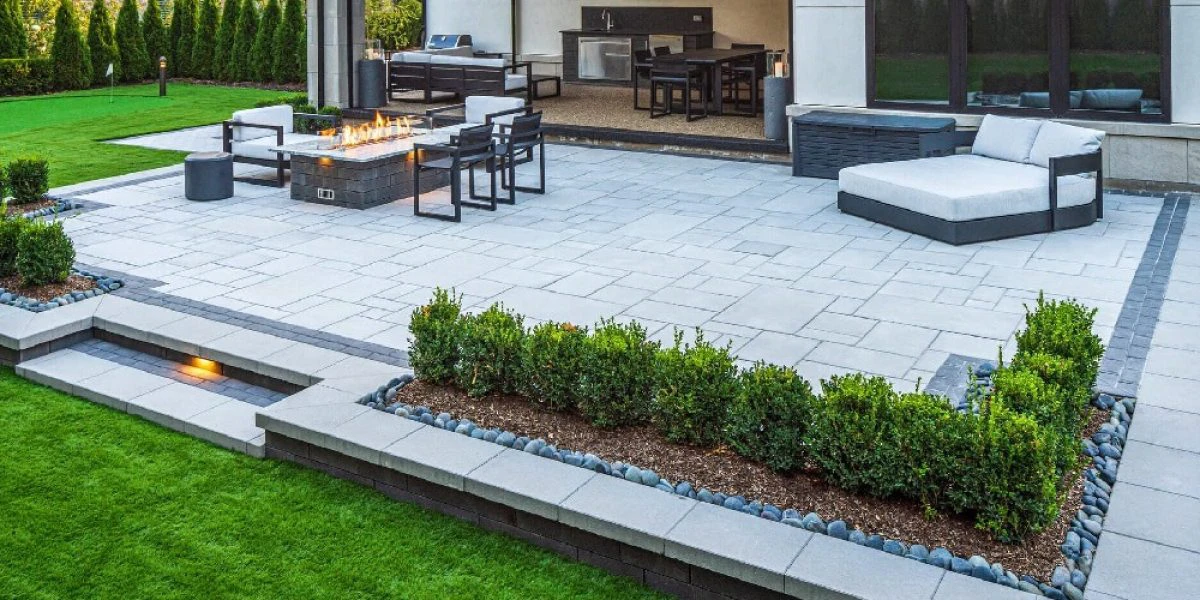
Then there’s resale, which is harder to put a number on but just as real. Clarkston homes typically trade between $260,000 and $520,000, and much of the local demand comes from buyers renovating 1960s through 1980s ranches rather than buying new construction. Those buyers are pricing their own renovation budget as they walk the property. A peeling, patched stamped slab reads as a teardown line item, since removal and disposal alone runs $3 to $6 a foot. A clean paver courtyard like the raised one above reads as finished. No appraiser itemizes the patio, but buyers price what they see into their offers.
The 10-Year Ledger: Total Cost of Ownership per Square Foot
Here is the full model on a 400-square-foot Clarkston patio, using the midpoint figures from each section above. We’ve included plain broom-finish concrete as a third column in the notes, because for some homeowners it’s the honest right answer, and we’d rather say that than oversell.
The two totals end up about $200 apart. The paver owner came out slightly ahead in cash, but the bigger gap is in what’s left. The paver patio at year ten is structurally sound, holds its color, and hasn’t been visibly patched. The stamped patio has a patch, a re-color that will need upkeep of its own, and its next reseal already overdue. Extend the model to year fifteen and the lines pull further apart: another two or three concrete reseals and probably a second section replacement, against one more paver maintenance cycle.
Plain broom-finish concrete tells a different story. Install at $10 a foot is $4,000. Add about $640 in penetrating sealer, the same $540 in crack work, and one 48-square-foot replacement at $22 ($1,056), and the ten-year total is around $6,236, or roughly $15.60 per square foot. That’s about half the cost of either decorative option. If the patio is a utility pad for a grill and a few chairs behind a rental or a starter home in the 30021 zip, and nobody will care about a patched panel, plain concrete wins and we’ll tell you so.
Where the math tips hard toward pavers
Pavers pull further ahead on patios with levels, steps, curves, or utilities underneath. A cracked stamped step is a form-and-pour job; a paver step unit lifts off. Repairing a firepit gas line or lighting run under concrete means sawcutting the slab, while pavers are pulled up and set back. On a two-tier design like the one above, one service call can erase the install premium.
Where concrete still makes sense
Concrete is the rational pick when the budget is fixed at install, when the patio is a simple rectangle on well-drained ground, and when the owner plans to sell within three or four years, before the reseal and repair cycle really gets going. It’s also fine as the base for an overlay down the road. If that’s you, get the sealer type, the control-joint spacing and the base spec written into the contract, and budget $1.25 to $2.00 a foot every other spring from the start.
Get these four lines in writing before you compare bids: (1) base depth and material, since a paver bid should specify a compacted aggregate base over geotextile, not “gravel as needed”; (2) the polymeric sand product by name; (3) the concrete sealer product and expected reapplication interval; (4) the number of spare pavers left on site. A bid that won’t commit to all four isn’t really comparable to the others.
Clarkston homeowners are practical about money, and they should be. With so many original pools and patios here now 35 to 50 years old, most projects in town are renovation spending, and renovation money has to last. The right choice comes from the full ten-year cost, not the install bid, and on most decorative patios we build east of I-285 from Indian Creek Dr out toward Stone Mountain, that total ends up favoring pavers.
Paver patio design and installation across Metro Atlanta from our home base in Winder, GA
Every Clarkston patio bid we write spells out base depth, joint sand, sealer and spare-unit count by name, so you can compare ten-year costs line by line instead of guessing from the install price.