
Stamped concrete on a 1,400-square-foot Milton patio runs roughly $22,000 to $31,000 installed. A Techo-Bloc paver patio on the same footprint runs $39,000 to $53,000. The 15-year math decides which one actually costs less.
Most estate-lot homeowners in Milton ask the wrong question first. They ask which material costs more today. That framing makes paver work look like a luxury upsell. Over 15 years on a 1,400-square-foot patio — the average footprint we install on AG-1 zoned lots off Freemanville Rd, Hopewell Rd, and inside Crooked Creek — the number flips. Stamped concrete carries a midlife refresh cost that concrete quotes never show. Paver carries a sand-joint refresh cost that looks trivial by comparison. Once you layer both curves on the same chart, the crossover arrives somewhere between year 17 and year 19.
This isn’t a philosophical debate about which surface “looks better.” Both work. Both can be specified well. The question on a Milton estate is which total-cost-of-ownership curve fits a house you plan to own for more than a decade — and whether the patio you install this spring will need to be ripped out while your kids are still in high school.
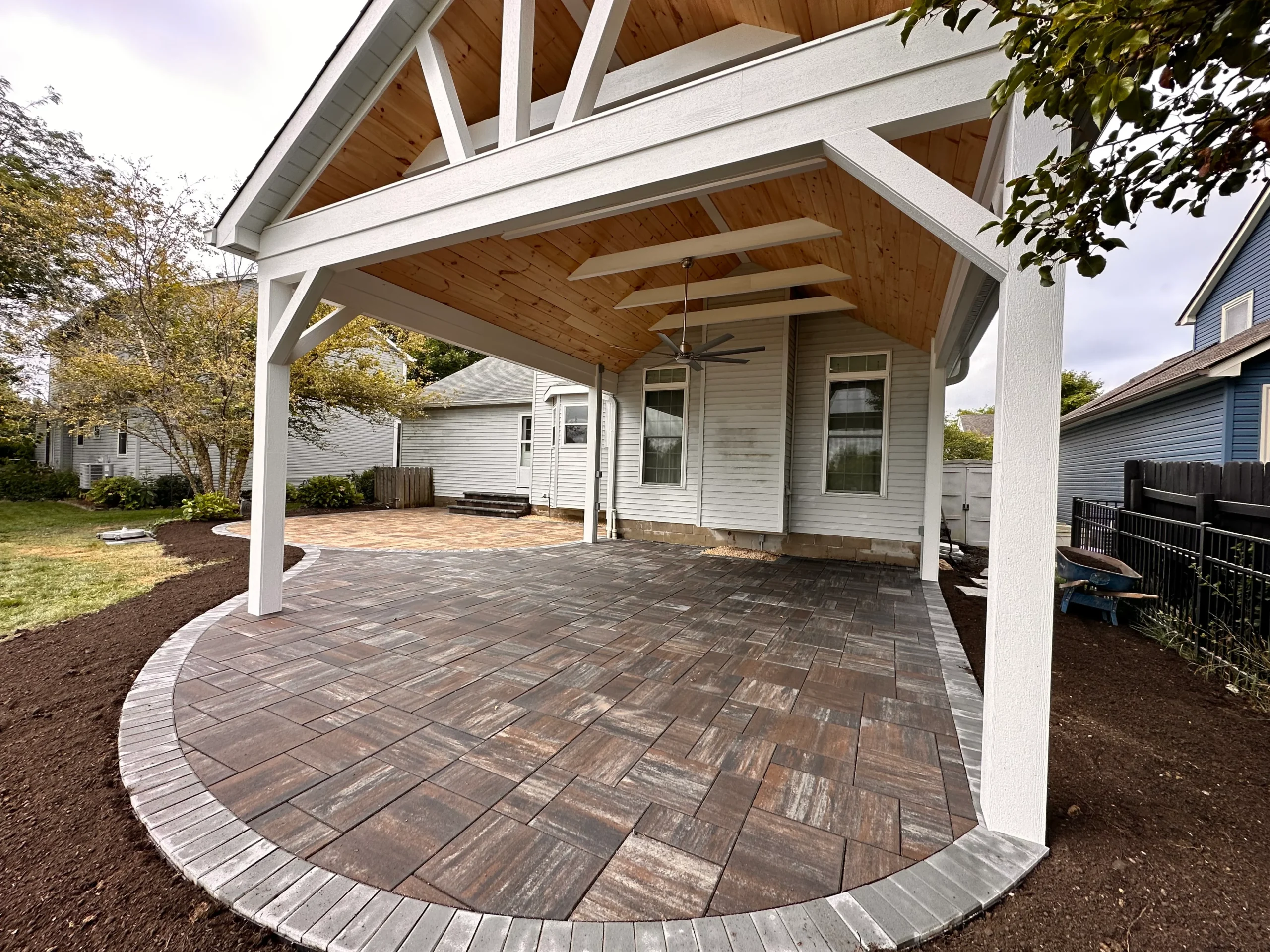
Why Milton Patios Run Bigger Than the Metro Average
Subdivision patios in Duluth or Suwanee typically land between 600 and 900 square feet. Milton is different. Under the equestrian preservation ordinance, AG-1 zoning enforces a 1-acre minimum lot — and across Cogburn Estates, King Estates, Milton Forest, and the fringes of The Manor Golf Club, the buildable pad next to the house often supports a patio footprint in the 1,200 to 1,800 square foot range. We use 1,400 as the planning midpoint because it hits the sweet spot for a dining zone, a lounge zone, and enough circulation around a pool or pavilion without crowding the pool coping.
The rural zoning also changes the design pressure. A Crabapple historic preservation parcel or a Hopewell Plantation estate isn’t competing with a neighbor’s 400-sqft concrete slab — it’s competing with the visual weight of a 5,000+ sqft house on a gentle 6 to 14-foot grade drop. At that scale, texture matters. A 1,400-sqft field of poured-and-stamped concrete reads as one uninterrupted plane from 40 feet away. A 1,400-sqft paver field reads as scale, pattern, and craft. That perception gap is the first real cost you don’t see on a spec sheet.
Milton footprint planning rule: On AG-1 lots in Milton, plan patio square footage at roughly 0.5% to 0.8% of lot area for the primary entertaining pad. A 1-acre (43,560 sqft) parcel typically supports a 1,200 to 1,800 sqft primary patio without overwhelming setback compliance.
Stamped Concrete: What the 15-Year Curve Actually Looks Like
Stamped concrete is not a bad product. Installed correctly on a 4-inch slab with #4 rebar on 18-inch centers, a compacted GAB base, and properly cut control joints at 10-foot intervals, it will perform predictably for a decade. The problem on Milton’s Cecil clay residuum isn’t the slab in year one. It’s what the slab becomes in year 10.
Installed pricing across our active Milton project base tracks consistently at $16 to $22 per square foot for a 1,400-sqft pour with a mid-complexity stamp pattern (Ashlar, Roman slate, or a saw-cut tile look), integral color, and one accent-band release powder. That puts the upfront ticket at $22,400 to $30,800. You write one check at the start, and from year 2 through roughly year 8, the slab performs well — assuming no expansive movement in the subgrade.
The curve bends at two points. First, the color topical sealer needs re-application every 2 to 3 years. On a 1,400-sqft patio, that’s $900 to $1,400 per cycle, roughly 5 cycles over 15 years — call it $5,500 in sealer alone. Second, somewhere between year 9 and year 14, one of three things happens: hairline cracks migrate through the color layer, freeze-thaw spalling starts lifting the stamp texture near field edges, or differential settlement opens a control joint wider than the slab was designed to handle. Milton sees roughly 22 freeze events per year, and the patio edge (where the saturated soil meets the slab) is always the first to go.
The fix isn’t cheap. A full resurface with a micro-topping overlay and re-stamp on 1,400 sqft lands at $10,000 to $14,000. A tear-out and replacement — which you’ll face if the base has shifted or if the cracks have pattern-followed the color bands visually — lands at $19,000 to $28,000. Most Milton homeowners discover this cost curve at year 12, not year 1.

Paver Patio: What the 15-Year Curve Actually Looks Like
A Techo-Bloc or Belgard paver patio on the same 1,400-sqft footprint costs more upfront and less to maintain. The installed pricing tracks between $28 and $38 per square foot for a Techo-Bloc Blu 60 or Belgard Dublin Cobble field over a proper 6 to 8-inch compacted GAB base, geotextile fabric on saprolite-prone ridgelines, polymeric sand joints, and a concrete edge restraint or aluminum edge system. That puts the upfront ticket at $39,200 to $53,200.
The maintenance curve is flat for years. Polymeric sand joints need a refresh roughly every 7 years on a patio that sees normal traffic — call it $1,200 at year 7 and $1,800 at year 14 for a 1,400-sqft field (the second cycle costs more because it typically includes spot re-leveling of any pavers that have migrated near drainage transitions). No topical sealer is required unless the homeowner wants a wet-look finish, which is optional.
The service life before structural intervention is 25 to 35 years. At year 20, individual pavers can be pulled and replaced in an hour without disturbing the surrounding field. If the base fails — rare on properly-installed work, but possible where saprolite shelves cause uneven compaction — 200 to 400 sqft of affected area can be lifted, re-based, and re-laid using the original pavers. The unit nature of the material is the entire financial argument.
Base depth for Milton Cecil clay: Standard patio base is 6 inches of compacted GAB. On Milton’s Cecil clay residuum, we specify 8 inches of compacted GAB over geotextile fabric wherever saprolite is encountered above 36 inches of excavation depth. The additional $2.40 to $3.80 per sqft in base cost is the single highest-return specification line on any estate project.
The 15-Year Total Cost of Ownership — Side by Side
Here’s the math both contractors and homeowners tend to avoid running because it requires discipline about midlife costs. All figures assume a 1,400-sqft patio in Milton, current 2026 Metro Atlanta material and labor pricing, and a single midlife intervention on the concrete side (not two).
Stamped concrete, 15-year total:
- Year 0 install: $22,400 to $30,800 (midpoint $26,600)
- Sealer cycles (5 cycles over 15 years): $4,500 to $7,000 (midpoint $5,750)
- Year 10–13 resurface (micro-topping + re-stamp): $10,000 to $14,000 (midpoint $12,000)
- 15-year midpoint TCO: ~$44,350 (range $32,000 to $45,000 depending on severity of midlife intervention)
Paver patio, 15-year total:
- Year 0 install: $39,200 to $53,200 (midpoint $46,200)
- Year 7 polymeric sand refresh: $1,200
- Year 14 polymeric sand refresh + minor re-leveling: $1,800
- No topical sealer required
- 15-year midpoint TCO: ~$49,200 (range $42,000 to $57,000)
The paver patio costs roughly $4,850 more over 15 years at midpoint — and that delta assumes only one midlife intervention on the concrete side. If the Cecil clay moves, if the freeze-thaw cycle takes out the edge earlier, or if the homeowner wants a full tear-out rather than a resurface, the stamped concrete TCO can easily exceed the paver TCO by year 12.
Where the Break-Even Point Actually Lives
If you extend the curve past 15 years, the crossover becomes unambiguous. Stamped concrete that received a resurface at year 12 needs a second intervention — or a full replacement — somewhere between year 22 and year 26. Paver is still in its first service cycle at year 20 with another 5 to 15 years of life left before anything structural is required.
The break-even point — the year after which the paver patio has cost you less total dollars than stamped concrete — lands between year 17 and year 19 on a 1,400-sqft Milton installation. Before that window, stamped concrete is cheaper. After that window, stamped concrete is materially more expensive every year you own the house.
This is why the decision is almost entirely about ownership timeline. Homeowners planning to sell within 6 to 8 years have a defensible case for stamped concrete — especially if the patio is a secondary feature rather than the primary outdoor living surface. Homeowners in Crooked Creek, The Manor, Atlanta National, or Bethany Creek planning a 15-plus year hold have a much harder case to justify anything except properly-installed pavers.

The Milton-Specific Variables That Move the Numbers
The cost math above assumes a typical 1-acre AG-1 lot with standard Cecil clay residuum and no unusual site conditions. Three Milton-specific variables can push the numbers in either direction:
Saprolite shelves. On ridgeline parcels in north Milton — particularly along Freemanville Rd and New Providence Rd — excavation can hit weathered granite saprolite at 24 to 48 inches below grade. For a concrete pour, this can actually reduce base prep cost (you’re building on rock). For a paver install, it complicates compaction uniformity and typically adds $2.40 to $3.80 per sqft to the base spec via extra GAB and geotextile. Either way, the site needs to be probed before the bid is finalized.
Grade drop. Milton’s rolling topography produces 6 to 14-foot grade drops across estate pads. A 1,400-sqft patio on flat ground is one price. The same footprint terraced across a 4-foot drop, with a retaining wall element or step system integrated, can add $8,000 to $18,000 regardless of surface material. The grade cost applies to both concrete and paver roughly equally, so it doesn’t change the crossover math — but it does change the total budget conversation.
Creek-buffer setbacks. Parcels backing onto Cooper Sandy Creek, Chicken Creek, Lake Creek, or Etowah tributaries fall under 25 to 75-foot creek-buffer setbacks enforced through Milton Community Development at 2006 Heritage Walk. The setback doesn’t change material cost per sqft, but it can reduce the available patio footprint and push homeowners toward a more vertical design (pavilion, second-level deck) where the cost-per-experience ratio shifts again.
Specification Lines That Actually Matter on a Milton Install
Whether you ultimately choose stamped concrete or paver, the lines on the contract that matter are mostly below grade. A properly-specified concrete patio and a properly-specified paver patio share about 70% of their pre-surface spec in common: excavation depth, base compaction, drainage, and edge detail.
For stamped concrete on Cecil clay, specify: 4-inch minimum slab thickness, #4 rebar at 18-inch centers on chairs (not dragged), 4 to 6 inches of compacted GAB below the slab, saw-cut control joints at 10-foot maximum spacing within 12 hours of the pour, 3,500 psi mix minimum with air entrainment appropriate for Zone 8a freeze cycling, and a perimeter edge detail that drops an additional 2 inches to resist frost heave lift at the outer 18 inches.
For pavers on Cecil clay, specify: 6 to 8-inch compacted GAB base (8-inch on saprolite parcels), geotextile fabric between native soil and base on anything with clay content above 30%, 1-inch bedding sand (coarse, not fine), ICPI-compliant paver installation with 90% compaction achieved via plate compactor before sand set, polymeric sand joint fill, and a concrete or aluminum edge restraint on every linear foot of perimeter — not just the sides facing heavy traffic.
The single most common failure mode on Milton paver patios: inadequate edge restraint on the pool-facing perimeter. Without a continuous concrete or aluminum edge, foot traffic transferring from coping to paver migrates the field 1 to 3 inches over 5 to 8 years, opens the first joint, and accelerates the entire field’s sand loss. Spend the extra $400 to $600 on continuous edge restraint — every single time.
When Stamped Concrete Is Actually the Right Call on a Milton Lot
For the sake of being useful rather than dogmatic: there are Milton projects where stamped concrete is the correct answer. They share three characteristics.
Short ownership timeline. If you’re planning to sell within 5 to 7 years and the patio is a pre-sale feature rather than a long-term living surface, stamped concrete’s lower upfront cost and 5 to 7-year performance window align with the hold period. You won’t be there for the midlife intervention, and a well-sealed stamped slab at year 5 still shows well to buyers.
Secondary surface. If the patio is a grilling pad, a fire-pit apron, or a low-use surface off a rarely-used door — not the primary entertaining footprint — the per-square-foot cost differential matters more than the durability differential. A 400-sqft secondary pad doesn’t justify the same material spend as a 1,400-sqft primary pad.
Heavy pattern dependence. A few design directions — specifically, tight seamless stone-slab looks or large-format saw-cut tile simulations — read better in stamped concrete than in pavers. If the architecture of the house demands that visual continuity and the homeowner understands the midlife cost curve, stamped concrete is a defensible specification.
Outside those three cases, on a 1-acre Milton estate lot with a 15-plus year ownership horizon and a primary outdoor living pad, the paver patio wins the 15-year cost math — and by year 20 it isn’t close.

Paver patio installation across 20+ cities within 30 miles of Winder, GA
We design patios for the 15-year cost curve, not the 15-minute quote. If your Milton estate needs a surface that will still look right when the mortgage is paid off, that’s the conversation to have.