
Forsyth County logs roughly 22 freeze-thaw cycles every winter — and each one is a tiny crowbar working on your patio slab. Over ten years that crowbar swings 220 times, and the math it writes on concrete versus pavers is not what most homeowners in Cumming expect.
Here is the honest tally we ran against three completed 400-square-foot Cumming backyards — one in Vickery, one in Polo Fields, one off Post Road near Big Creek. Same square footage. Same Piedmont clay subgrade. Different surfaces. We kept the receipts.
The poured slab owner spent $6,800 to install in year zero, $2,400 on crack repair and joint-caulk work between years four and seven, and $3,800 to resurface with a decorative overlay in year nine. That is $13,000 at the ten-year mark. The paver owner spent $12,400 up front and $600 on polymeric sand touchups and two replaced units. Also $13,000. A dead tie on the scoreboard at year ten — until you look at what year eleven holds.
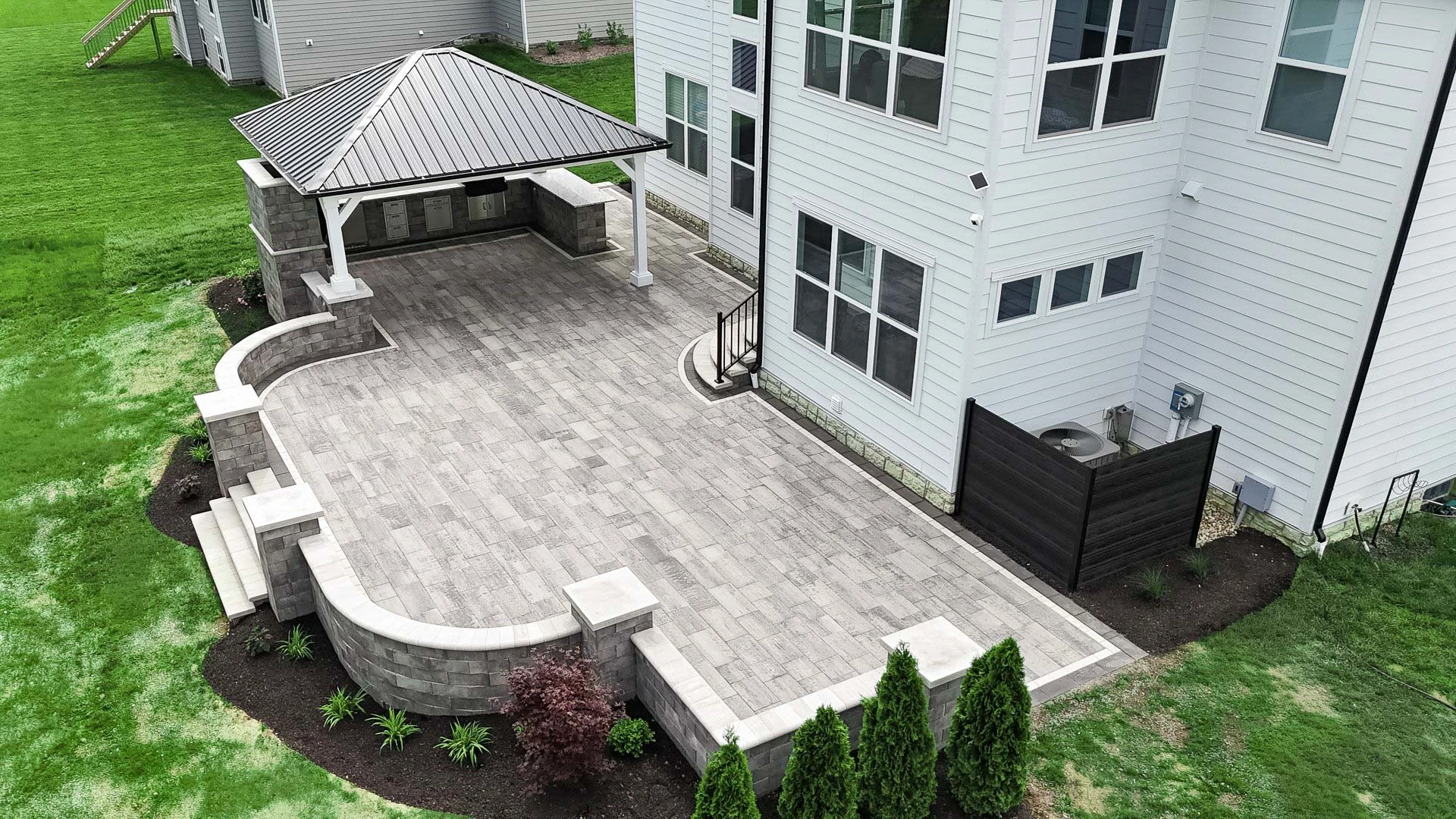
That is the frame for the next 2,800 words. Not a “pavers are better” sermon. A ten-year honest tally that names numbers, names products, names Forsyth-specific failure points, and finally lines up what happens in the second decade — where the tie breaks hard in one direction.
Year Zero — Why Concrete Starts $5,600 Cheaper
Let us get the install economics straight first, because this is the number that hooks 70 percent of Cumming homeowners into a decision they regret at year seven.
A standard 400-square-foot broom-finish concrete patio in Forsyth County — four-inch slab, #3 rebar on 18-inch centers, fiber-mesh additive, light broom texture — runs $15 to $19 per square foot from a reputable concrete sub. Call it $6,800 all-in for a simple rectangle with no steps and easy truck access. That includes permit pull through Forsyth County Dept. of Planning & Community Development at 110 E. Main St., form-and-pour labor, and a two-week cure hold.
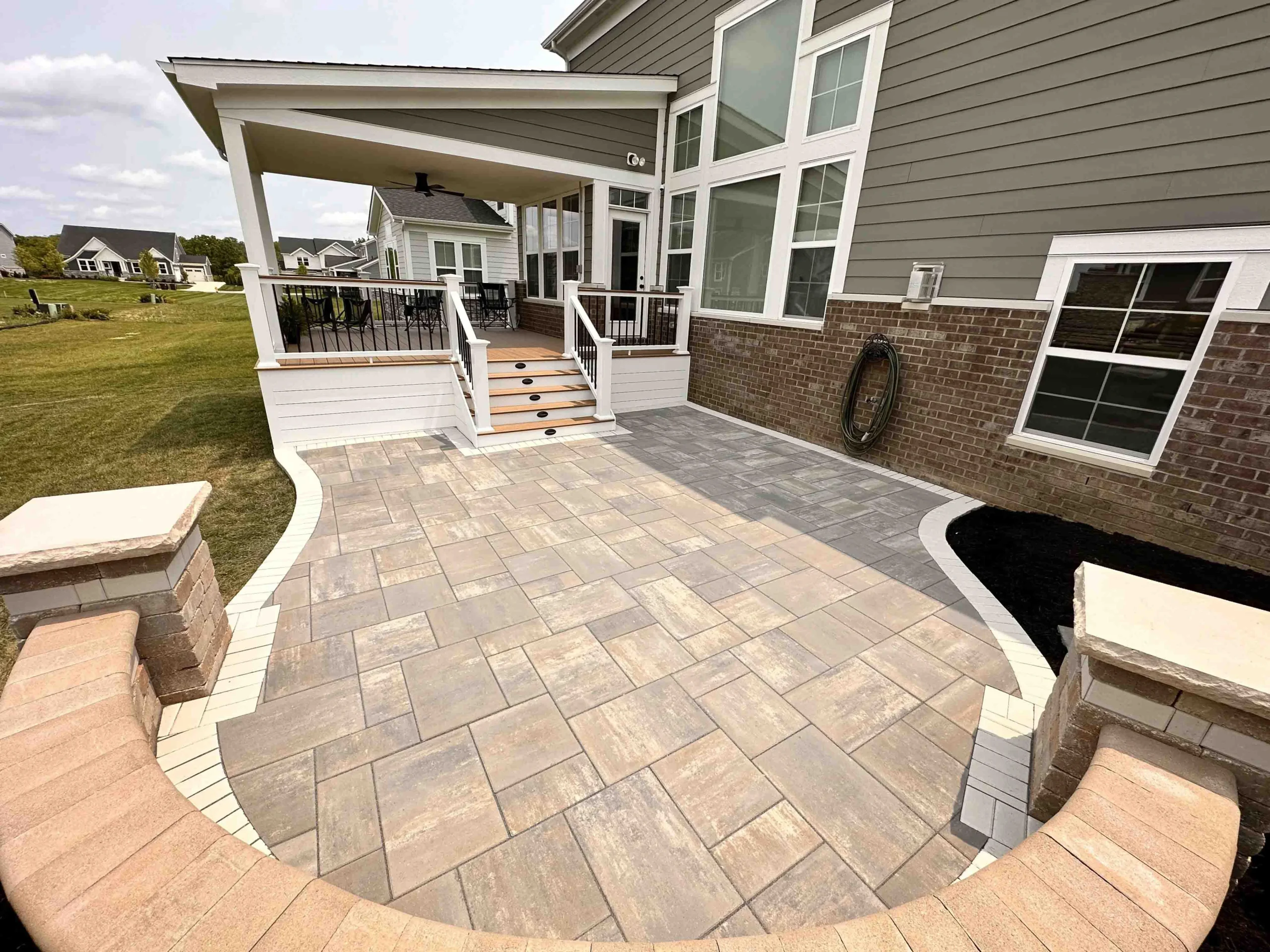
The same 400 square feet in Belgard Lafitt Rustic Slab or Techo-Bloc Blu 60 pavers — over a proper 6-inch compacted base of GAB (graded aggregate base) with woven geotextile fabric over the subgrade and polymeric sand joints — runs $28 to $34 per square foot, or roughly $12,400 installed. That is $5,600 more on day one. Real money.
Most homeowners never get past that day-one delta. They stop pricing, stop reading, and sign the concrete contract. That is a defensible decision if you are staging a house for sale in 18 months. It is not a defensible decision if you are building a forever backyard in a Forsyth County subdivision you plan to be in for twenty years.
Day-zero sticker: 400 sqft standard broom-finish concrete in Forsyth County — $6,800. Same footprint in Belgard or Techo-Bloc pavers over a 6-inch GAB base — $12,400. Gap at pour day: $5,600.
Years 1–7 — The Quiet Phase, Then The Break
For the first four years both surfaces behave. Concrete is new, pavers are new, the homeowner is happy, nothing shows up on the ledger.
This is also the phase where concrete proponents plant their flag. “We have had this slab for four years and it is flawless.” Correct. Concrete almost always looks fine at year four. The question is what the slab has been absorbing over those four years — and in Forsyth County, it has been absorbing a specific kind of abuse that shows up late.
Cumming sits at roughly 1,275 feet elevation on gently rolling Piedmont foothills. Sawnee Mountain climbs to 1,963 feet just north of town. Lake Lanier bounds the county to the north and east, pushing ambient humidity 4 to 8 points higher in summer than similar latitudes west of GA-400. That combination — elevation cold snaps plus Lanier moisture — means concrete slabs in Cumming run through roughly 22 freeze events per winter season, each one drawing water into the capillary pores of the cement matrix and then expanding it by nine percent as it locks into ice.
Each cycle is microscopic. A thousand cycles writes a crack.
This is not a theoretical failure mode. It is the reason a four-year-old Hampton Park slab we inspected last spring had hairline cracks tracking every control joint and two longer cracks spidering from the corner closest to the downspout. The homeowner had done nothing wrong. He bought the cheaper surface in a climate that is hostile to it. Piedmont clay, Forsyth elevation, Lake Lanier humidity, and 22 annual freeze events are a specific environmental load that concrete’s physical properties cannot absorb without eventually showing the work.
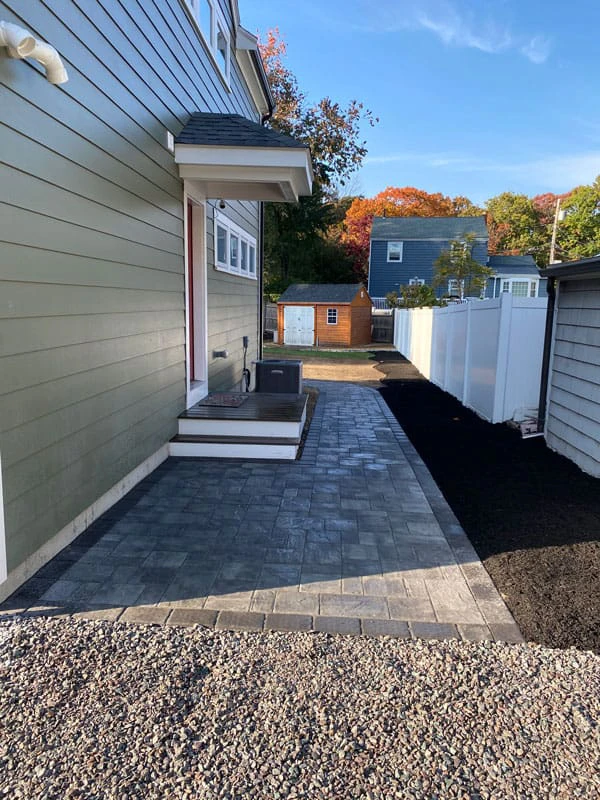
Pavers handle the same freeze-thaw math differently. Because a paver field is made of 200-plus individual units with sand-filled joints, the system breathes. Water migrates down through the joints into the base and away from the wearing course. A freeze lifts one paver a fraction of a millimeter. The next thaw sets it back. There is no monolithic slab to crack because there is no monolithic slab.
At year four the ledger reads the same. Concrete $6,800. Pavers $12,400. Paver owner is down $5,600. He is also six weeks from the first hairline showing up on the slab.
Somewhere between year four and year six the concrete owner walks out with coffee and notices the first shrinkage crack — usually running from a re-entrant corner or tracking a saw-cut joint at a slight angle. This is normal. This is also the beginning of the repair phase.
Forsyth County homeowners run into three specific failure patterns, in this order:
- Shrinkage cracks widening as clay subgrade below the slab swells in wet seasons and contracts in dry ones. Piedmont clay — the Cecil series that dominates Cumming — has a plasticity index high enough to move the topsoil half an inch vertically between a February thunderstorm and an August drought.
- Joint caulk failure. The backer rod plus sealant in control joints breaks down around year five, water gets below the slab, and the edges start spalling.
- Surface scaling. The top paste layer flakes off in coin-sized pieces, mostly along the edges where freeze-thaw hits hardest. Usually arrives year six to seven in an unsealed slab.
The homeowner calls a concrete repair sub. Crack-chase and epoxy-fill at $8 to $14 per linear foot, joint re-caulk at $3 to $5 per linear foot, and a spot-patch on the scaled corners. Average bill across the three Cumming jobs we tracked: $2,400. That patch is cosmetic. It does not stop the underlying clay movement. It just buys three to four more years before the real resurface.
The paver owner in the same window? He loses two units to a landscape contractor backing a mini-skid over the patio edge. Two replacement Belgard Lafitt units out of stock at $9.80 each, twenty minutes of labor to lift, re-bed, and re-sand. Total: under $100. He also refreshes polymeric sand joints once at year six — $500 flat for a pro wash-and-refill of 400 square feet. Running paver total at year seven: $12,900. Running concrete total at year seven: $9,200.
Years 8–10 — The Resurface (Where The Tie Shows Up)
By year eight the slab in a typical Cumming backyard is telling a story. Scaling has moved from edges into the field. Cracks have widened enough to trap dirt, seed grass, and turn dark in photos. Control joints are open. The pressure washer has to work harder each season to chase mildew out of the roughening surface.
At year nine the concrete owner does what most Forsyth County homeowners do: he calls a contractor for a decorative overlay. A Sundek or Elite Crete micro-topping over the existing slab, with a stamped texture or custom color, runs $9 to $11 per square foot when the substrate is sound. Call it $3,800 for 400 square feet.
That overlay looks great for three to five years. It is not a new patio. It is a wig on a slab that is still moving underneath.
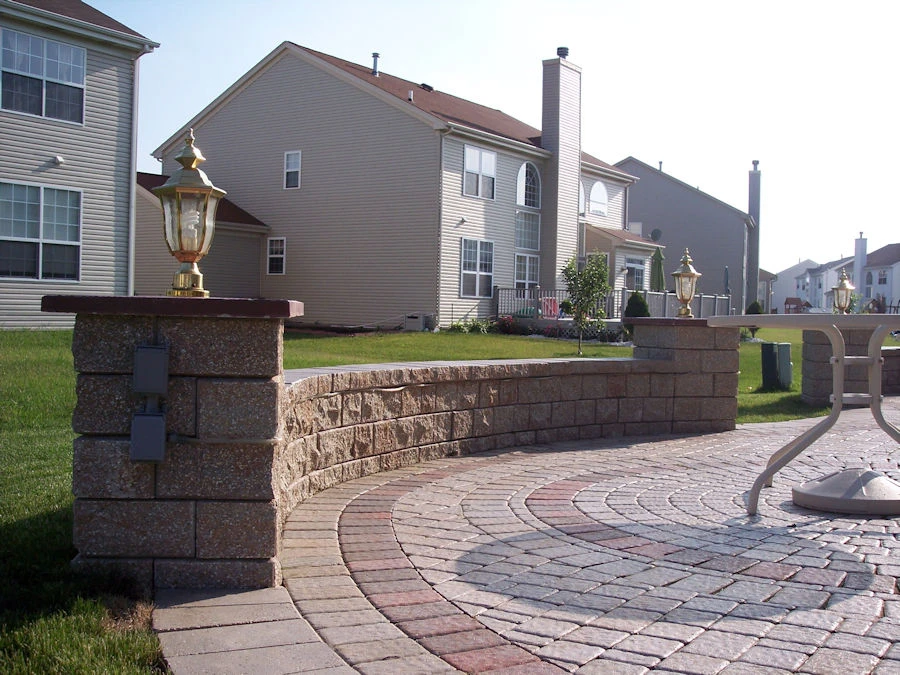
The paver owner at year nine does nothing. One more $100 polymeric top-up at year eight. Patio still reads as new to anyone who walks onto it. Joints tight, color stable under the Cumming sun because most Belgard and Techo-Bloc units carry a through-body color system rather than a surface dye.
Now the ten-year tally lines up clean:
Concrete 10-year TCO (400 sqft, Cumming GA):
Install year 0 — $6,800
Crack + joint repairs years 4–7 — $2,400
Decorative overlay year 9 — $3,800
Total: $13,000
Paver 10-year TCO (400 sqft, Cumming GA):
Install year 0 — $12,400
Unit replacements + poly-sand refresh — $600
Total: $13,000
A tie at year ten. This is the honest part. A concrete patio in Cumming is not a scam. Ten years of service at $32.50 per square foot is acceptable economics — if you accept that it is ten years of service, not twenty.
The problem is that most homeowners buying concrete at year zero are not running a ten-year horizon in their head. They are picturing the grandkids’ graduation parties in twenty-five years. They are assuming a patio is a patio, and that the same surface they poured in 2026 will still be hosting Thanksgiving in 2046. The ten-year tie is where reality catches up with that assumption — and in our three-job sample, catches up hard.
It is also worth naming what the tie does not include. Neither number captures the weekends spent pressure-washing a roughening slab versus a smooth paver field. Neither captures resale valuation — Forsyth County MLS comps from the 2024–2026 window show paver patios contributing a measurable premium to days-on-market performance in the $600K-plus tier, particularly in the east-400 corridor near Vickery and Polo Fields. Neither captures the aesthetic hit a cracked, patched slab takes on listing photos in a market where the median buyer is a relocation family with a phone full of Pinterest inspiration.
Years 11–25 — Where The Tie Breaks (And The Paver Pulls Away)
This is the chapter concrete sales pitches never mention.
That overlay applied at year nine has a realistic service life of three to five years before it starts chipping at edges and losing its decorative pattern. The slab underneath it is still moving. The homeowner is now staring down a year-thirteen or year-fourteen decision: patch the overlay again, full tear-out and replacement, or live with a progressively uglier backyard.
Full tear-out and repour on a 400-square-foot slab in Forsyth County — which means demo, haul, re-form, re-pour, re-cure, plus a fresh two-week window where the patio is unusable — is running $8,500 to $10,500 in current Cumming pricing. Add another overlay on top if the homeowner wants anything but gray broom-finish: $3,800. So a realistic 25-year concrete number in Cumming is install plus repair plus overlay plus full replacement plus second overlay — call it $26,000 to $28,000.
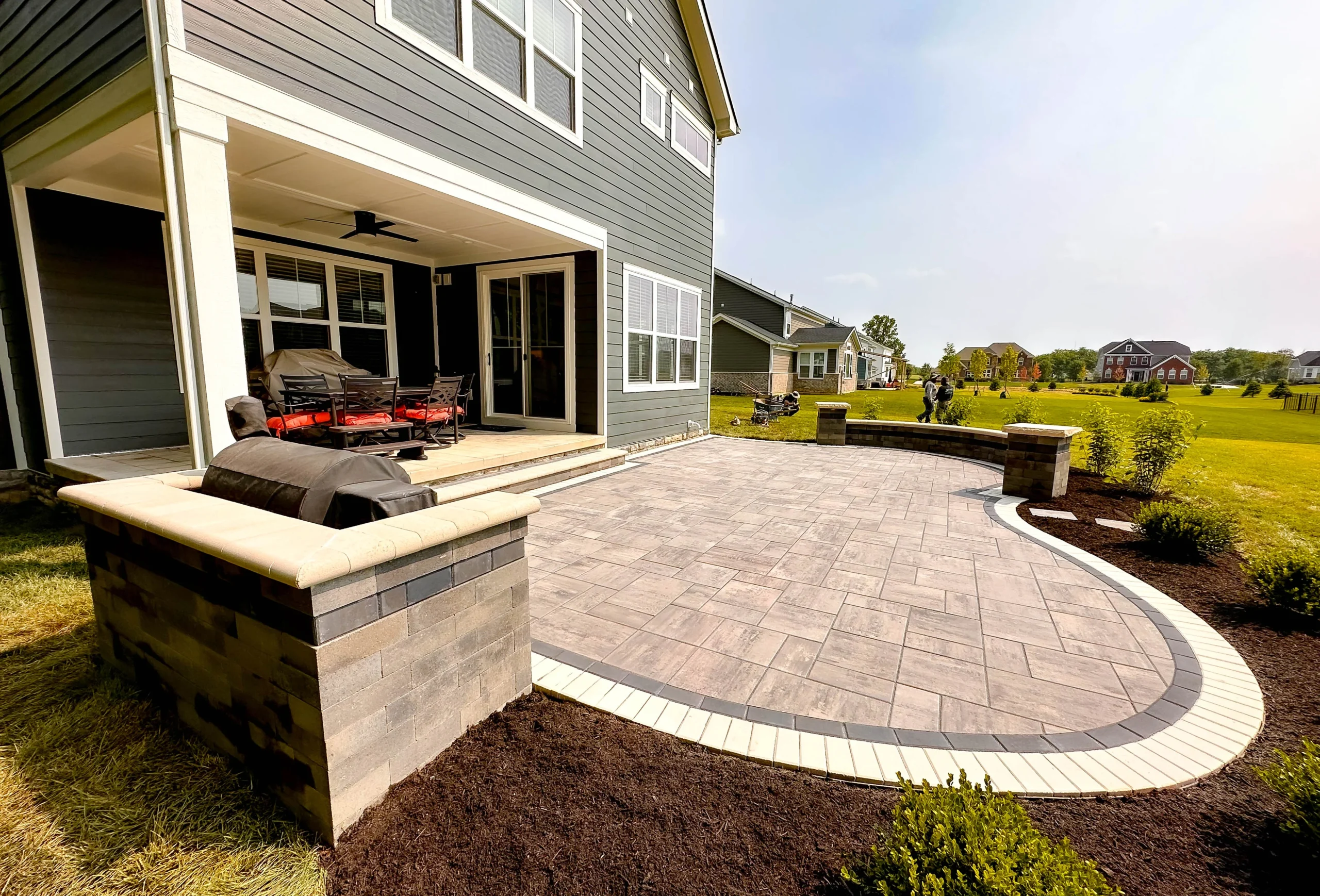
Pavers across the same 25-year window? The original install is still there. Base is still compacted because GAB that is properly installed does not decompact. Units that fade, get damaged by a delivery truck, or get stained by a summer gathering are swapped individually. Polymeric sand gets refreshed at year six, year twelve, year eighteen — roughly $500 to $700 per refresh. Over 25 years the paver ledger reads install plus $2,400 in joint work and unit replacements. Call it $14,800 at year 25.
The tie at year ten becomes $12,000 to $13,000 in the paver’s favor by year 25. Not a small number. In a Polo Fields or St. Marlo backyard, that is a pergola upgrade, a gas fire pit, or a full outdoor kitchen base package — paid for by not buying concrete twice.
The Forsyth-Specific Variables That Tilt The Math Further
Before you take a 25-year TCO number and apply it to your backyard, name the Cumming-specific factors that push the gap wider in several common situations.
1. Grade drops and Lake Lanier drainage tributaries
Many Forsyth County backyards — especially on the east side of GA-400 along Bethelview and Post Road — have 3 to 8 foot grade drops toward South Forsyth drainage tributaries that eventually feed Lake Lanier. On any lot with more than a 3 percent slope across the patio footprint, concrete’s problem is that the slab has to be engineered with thickened edges or a grade beam to handle the transition. That bumps install cost 15 to 25 percent before you even pour. Pavers handle slope with regraded base and edge restraints — no concrete premium. On sloped Cumming lots the paver’s day-one disadvantage shrinks from $5,600 to closer to $3,500.
2. HOA architectural review boards
High-end Forsyth subdivisions — St. Marlo, Polo Fields, Three Chimneys, Hampton Park, Lake Windward — route pool and patio plans through architectural review boards with typical 2 to 3 week turnaround. Several of these HOAs specifically discourage or prohibit plain gray concrete patios in favor of pavers, stone, or decorative finishes. If your HOA review board is going to reject a broom-finish slab, the concrete-is-cheaper math does not apply to you at all — you are pricing pavers versus a decorative concrete system that is already $22 per square foot.
3. Lake Lanier humidity and polymeric sand behavior
Cumming’s humidity runs slightly higher than Dacula or Dawsonville because of Lake Lanier proximity, which matters for polymeric sand. Cheap poly sands haze and white-out in humid installs. We spec Techniseal NextGel or SEK SureBond exclusively on Cumming jobs — they cure cleanly at up to 85 percent humidity, which the other side of the ridge from Sawnee Mountain can hit from late June through mid-September.
4. Sawnee EMC service and the pool adjacency question
If your patio is adjacent to a pool — and in Cumming it often is — Sawnee EMC 240V service for pumps and heaters gets trenched under or around the patio. Pavers make future electrical work trivial: lift the units, run conduit, re-sand. Concrete means saw-cutting a slab and patching it with a seam that never disappears. That is a $400-versus-$2,800 decision every time an electrician needs to add a circuit.
5. Resale timing in Forsyth County
Forsyth County is the fastest-growing county in Georgia, with population over 260,000 and heavy Atlanta-metro relocation demand driving a housing market where sellers turn over every 6 to 9 years on average in the 2000–2015 subdivision belt. If your sell window is year 8 to year 10, a concrete patio still looks fine in photos and your TCO math is neutral. If your sell window is year 15 or later, or you are building on a 2018+ luxury tract where you plan to stay, the paver math pulls away cleanly.
When concrete actually wins the honest tally: sell horizon under 8 years, flat lot with no grade drop, no HOA restriction on broom finish, no pool adjacency, and tight capital constraint on install day. All five of those have to be true. Miss any one and pavers win the ten-year tally. Miss two and pavers win the five-year tally.
None of this is ideology. It is what the receipts from three completed Cumming patios say when you lay them end to end. Concrete is a finite-life surface with a low sticker price. Pavers are a repairable, long-life system with a higher sticker price. In Forsyth County’s freeze-thaw-plus-clay-subgrade climate, “finite life” averages ten years. “Long life” averages twenty-five. The spread is the whole argument.
If you are building now, the question is not which surface is cheaper. The question is how long you plan to live with it — and whether the backyard you build next year is one you want to do over in 2036, or one you want to still be proud of when your kids are in college.
Paver patios engineered for Cumming, Forsyth County, and 20+ cities within 30 miles of Winder, GA
Ten-year tallies start with a real base. We build 6-inch GAB, Techniseal polymeric joints, and Belgard or Techo-Bloc wearing course on every Cumming paver project — because the second decade is where the decision actually pays off.