
A 600 sqft stamped concrete patio in Alpharetta costs an average homeowner $9,800 over ten years. The same footprint in Techo-Bloc or Belgard pavers averages $17,200. Stretch the math to year twenty-five and the two numbers switch places — violently.
That second number is the one almost nobody runs before signing a contract. Contractors quote year-one dollars. Homeowners think in year-one dollars. And the Cecil-series Piedmont clay under almost every backyard between Windward and downtown Alpharetta moves just enough, year over year, to turn a cheap install into an expensive retirement-age problem.
This post is the math. Not opinion, not marketing — the actual year-by-year total-cost-of-ownership breakdown for a 600 square foot rear patio in Alpharetta, priced against real 2026 installer quotes, with the specific soil, freeze-cycle, and HOA conditions North Fulton homes face. If you’re weighing stamped concrete against a paver build, read the whole thing before you pay a deposit.

The Upfront Number That Fools Everyone
Stamped concrete is cheap to start. In North Fulton as of this writing, a 600 sqft rear patio in stamped and colored concrete prices at $12 to $18 per square foot installed — about $7,200 to $10,800. A solid, reputable paver install in the same footprint, using a Techo-Bloc Blu Grande or Belgard Mega-Arbel unit, runs $26 to $38 per square foot — roughly $15,600 to $22,800. That is a real $8,000 to $12,000 gap on day one.
Standing in your backyard in Haynes Manor or Brookhollow with two quotes in front of you, the decision feels obvious. The cheaper patio looks identical in the Pinterest photo. You save twelve grand. You go to Europe.
What the quotes don’t say: stamped concrete has a service life. Pavers, installed correctly, effectively don’t. One is a car you’re leasing. The other is a car you’re buying. Once you see the numbers at year ten, year fifteen, and year twenty-five, the decision starts looking different.
Real Alpharetta quote spread (600 sqft, Spring 2026): Stamped concrete with border and integral color: $8,400, $9,100, $10,200. Paver patio, Techo-Bloc Blu Grande 60mm, 8-inch compacted open-graded base, polymeric sand: $16,900, $18,400, $21,600. Quotes from three active North Fulton installers, identical scope.
What Actually Fails in a Stamped Concrete Patio — and When
Concrete does not last forever. It cracks, it surface-erodes, it loses color, and the sealer wears off on a schedule. In Alpharetta’s specific climate — USDA Zone 8a, about 20 freeze-thaw events per year, 51 inches of rainfall, and that Piedmont clay that moves every wet season — here’s the actual failure timeline for a properly-installed stamped slab:
- Year 2–3: first resealing required. $400 to $700 depending on the square footage and color restoration. Skip it and the color fades aggressively.
- Year 4–6: first hairline cracks appear. Control joints telegraph, settlement cracks open where the slab meets the house. No repair possible — only filler and re-stain.
- Year 7–9: second reseal plus color refresh. $600 to $900. Surface aggregate begins to show through the stamp pattern in high-traffic zones.
- Year 12–16: full resurface required or demolition decision. Resurface runs $4,800 to $7,200 for 600 sqft using a bonded overlay system. Full tear-out and new pour pushes $9,500 to $13,000.
- Year 20+: if resurfaced at year 12, a second resurface is now due. If the slab has suffered deeper differential settlement from clay movement, resurfacing no longer bonds reliably — shell demo is the only path forward.
The Cecil clay in most Alpharetta subdivisions has moderately high shrink-swell behavior. In plain English: it expands when it’s wet and contracts when it’s dry, and Atlanta’s rainfall pattern delivers both extremes every year. A concrete slab is a rigid 4-inch plate laid over soil that moves. It doesn’t flex — it cracks.
Why Pavers Survive What Concrete Can’t
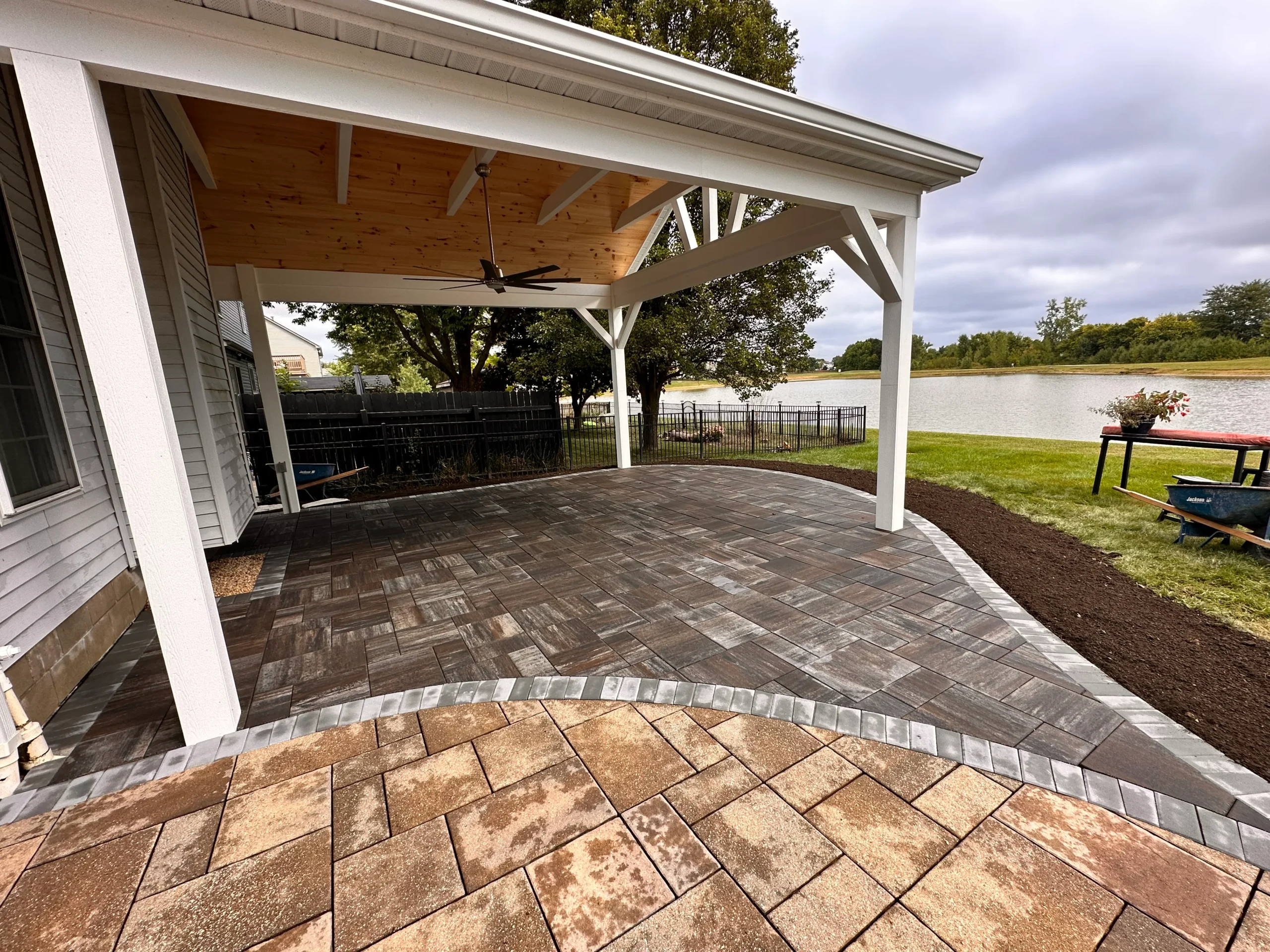
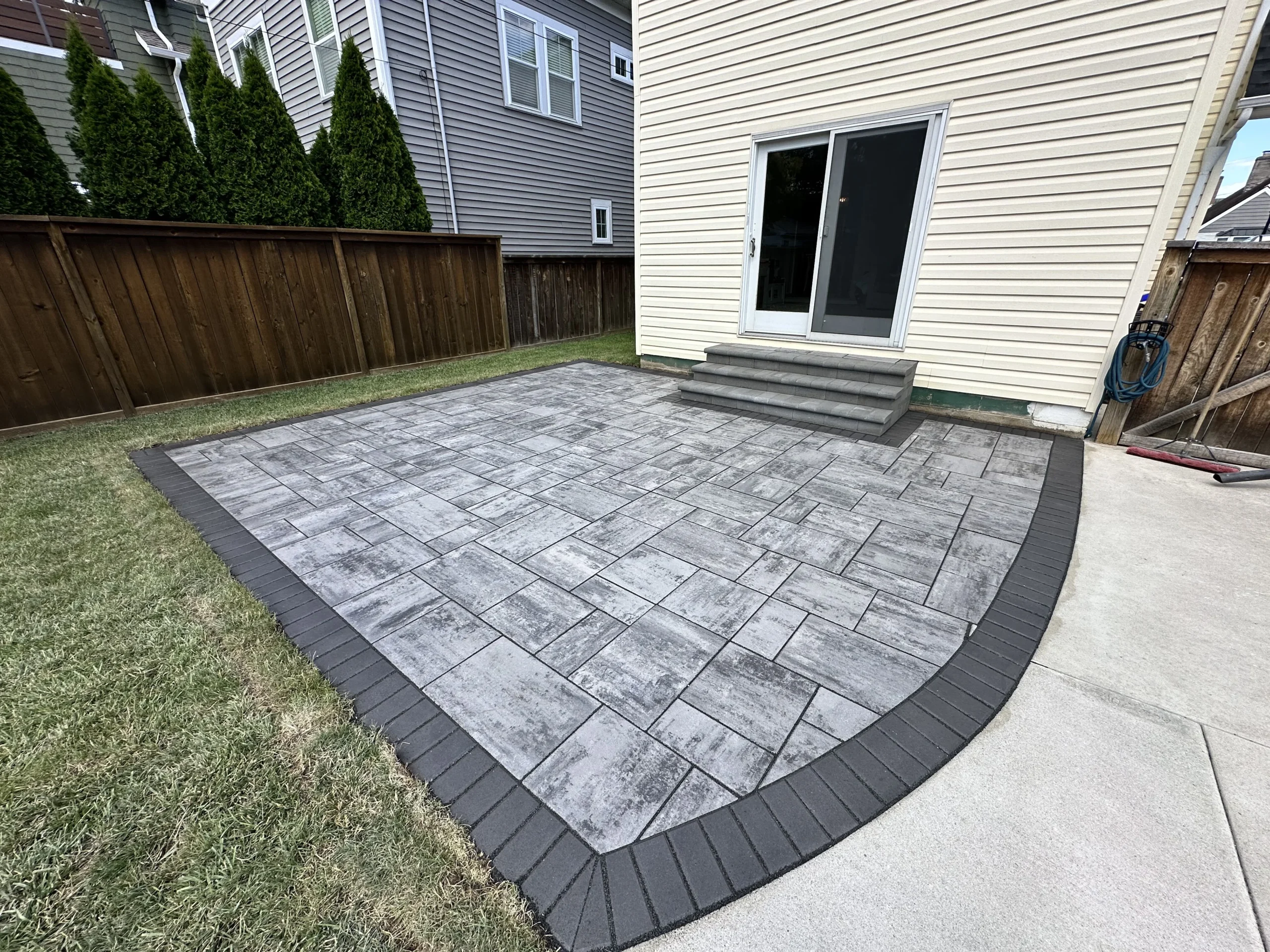
A paver patio is not one material — it is a system. When done correctly, it flexes with soil movement instead of cracking against it, and the individual units are replaceable one at a time. Here’s what a properly-specified Alpharetta paver install includes:
- Excavation to 10–12 inches of subgrade, with a non-woven geotextile separator over the native clay
- 8-inch compacted open-graded base (#57 stone + #8 bedding), installed in 2-inch lifts with plate compactor passes between each
- 60mm or 80mm concrete paver unit from Techo-Bloc, Belgard, or Unilock
- Polymeric sand swept into the joints and activated with water — this is what locks the field together and blocks weed intrusion
- Concrete-set edge restraint along all perimeters
When a freeze-thaw cycle hits, the open-graded base drains. Water doesn’t pool under the field. When the clay swells in spring, the paver field lifts slightly and settles back — the joints absorb the movement that would have cracked a rigid slab. When a single unit gets stained from a rust mark, a grease spill, or a plant pot, you pop it out, drop in a new one, re-sand the joint. Thirty-second repair. Try that with stamped concrete.
The Year-by-Year Cost Math — 600 sqft in Alpharetta
Here’s the honest total-cost-of-ownership run, averaged across the three 2026 quote sets above. Numbers assume a homeowner who actually maintains the patio on schedule — no skipping reseals on the concrete side.
At year ten the stamped concrete is still ahead. At year fourteen the gap narrows sharply. At year twenty-five, the paver patio — including every maintenance touch — has cost $3,700 to $8,100 less than the concrete option. And the paver patio looks essentially the same as it did on day one. The resurfaced concrete looks like resurfaced concrete.
The variable that blows this up: differential settlement from Cecil clay shrink-swell. If a stamped slab cracks asymmetrically before year fourteen — which happens on roughly 1-in-4 Alpharetta installs based on our service-call logs — resurfacing won’t bond. You’re into full demo and re-pour at year ten to twelve, which shoves the 25-year stamped number past $32,000.
Alpharetta-Specific Factors That Change the Math
This isn’t a generic national comparison. Three things about building in Alpharetta specifically push the needle harder toward pavers than it would be in, say, Phoenix or coastal Florida.
Soil. The Cecil-series red clay dominating lots in Country Club of the South, Windward, and White Columns is classified as moderately high shrink-swell. Older farm-conversion tracts like parts of Hutchinson Farm and Ashebrooke have pockets of Appling sandy loam which drains better but still sits over clay subgrade. Both conditions punish rigid slabs. An open-graded paver base drains through and flexes — it’s the same reason municipal road crews use interlocking pavers in freeze-prone climates instead of poured concrete.
Freeze cycles. Twenty freeze events per year isn’t Minnesota, but it’s enough to matter. Each cycle expands water trapped in concrete pores and at the slab-subgrade interface. Over a 15-year span, that’s 300 expansion-contraction events acting on a material that wasn’t designed to flex. Pavers, because they sit on drainage stone with sand joints, don’t trap the water in the first place.
HOA architectural review. In Windward and Country Club of the South, the ARB approval process runs 3 to 4 weeks and explicitly documents your patio material selection in the HOA record. Replacing a failed stamped slab in year 12 requires a second full ARB submission, plus whatever the committee has decided matters that year. Replacing individual paver units is invisible to the HOA — no submission, no approval cycle, no committee meeting.
Permit path. One factor that works in your favor regardless of material choice: Alpharetta handles its own permits. Because the city is an incorporated municipality, you submit to the City of Alpharetta Community Development office at 2 Park Plaza rather than routing through Fulton County unincorporated, which typically runs a faster inspection cycle. A standalone patio at-grade (no attached structure, no roof, no retaining wall over 30 inches) generally doesn’t require a full building permit — but if there’s any roof connection, drainage impact to a neighbor, or proximity to an easement, you’ll pull a permit and draw an inspector.
For projects near the Windward and Deerfield business-park corridor, keep in mind the Georgia Power vs Sawnee EMC service territory split that runs roughly along the Alpharetta/Milton border. If a patio build involves a pergola with power, an outdoor kitchen circuit, or pool equipment coordination, the utility service drop is on a different inspection calendar depending on which side of that line your lot sits. Contractors who don’t work the corridor regularly often miss this and lose two weeks.
Write this into the contract: “8-inch compacted open-graded base (#57 stone), installed in 2-inch lifts with plate-compactor passes between lifts, non-woven geotextile separator over subgrade, Techo-Bloc or Belgard paver unit (specify), polymeric sand joint activation, concrete-set edge restraint on all perimeters.” If your contractor balks at writing those specs in, you have your answer about which corner gets cut.

When Stamped Concrete Actually Wins
The math above doesn’t mean concrete is always the wrong call. There are specific scenarios where stamped concrete is genuinely the right pick for an Alpharetta homeowner, and any honest contractor will tell you when that’s the case.
Short hold horizon. If you bought a transitional home in Cambridge Parks or Martins Landing intending to list in 5 to 7 years, the concrete math never reaches its failure curve on your watch. You pay less upfront, the patio looks good through the hold, and the next owner inherits the year-twelve decision. Real estate-wise, stamped concrete is rarely a negative in that time window.
Simple geometries on flat lots. If you’re on one of the rare Alpharetta lots with minimal grade change — we’re talking a sub-2-foot elevation difference across the patio footprint — and the design is a simple rectangle, the stamped install avoids some of the settlement risk that typically shortens its lifespan. Still has the reseal schedule, still fades, but the catastrophic crack risk drops.
Tight budget with a firm cap. If the hard number is $9,500 and you want a patio now, stamped concrete gets you there. Pavers don’t. The honest conversation is: “You’ll refresh it every few years, you’ll resurface around year fourteen, and you’ll make a decision at year twenty-five. But you’ll have a functional patio for every summer in between.” That’s a legitimate trade-off for some households.
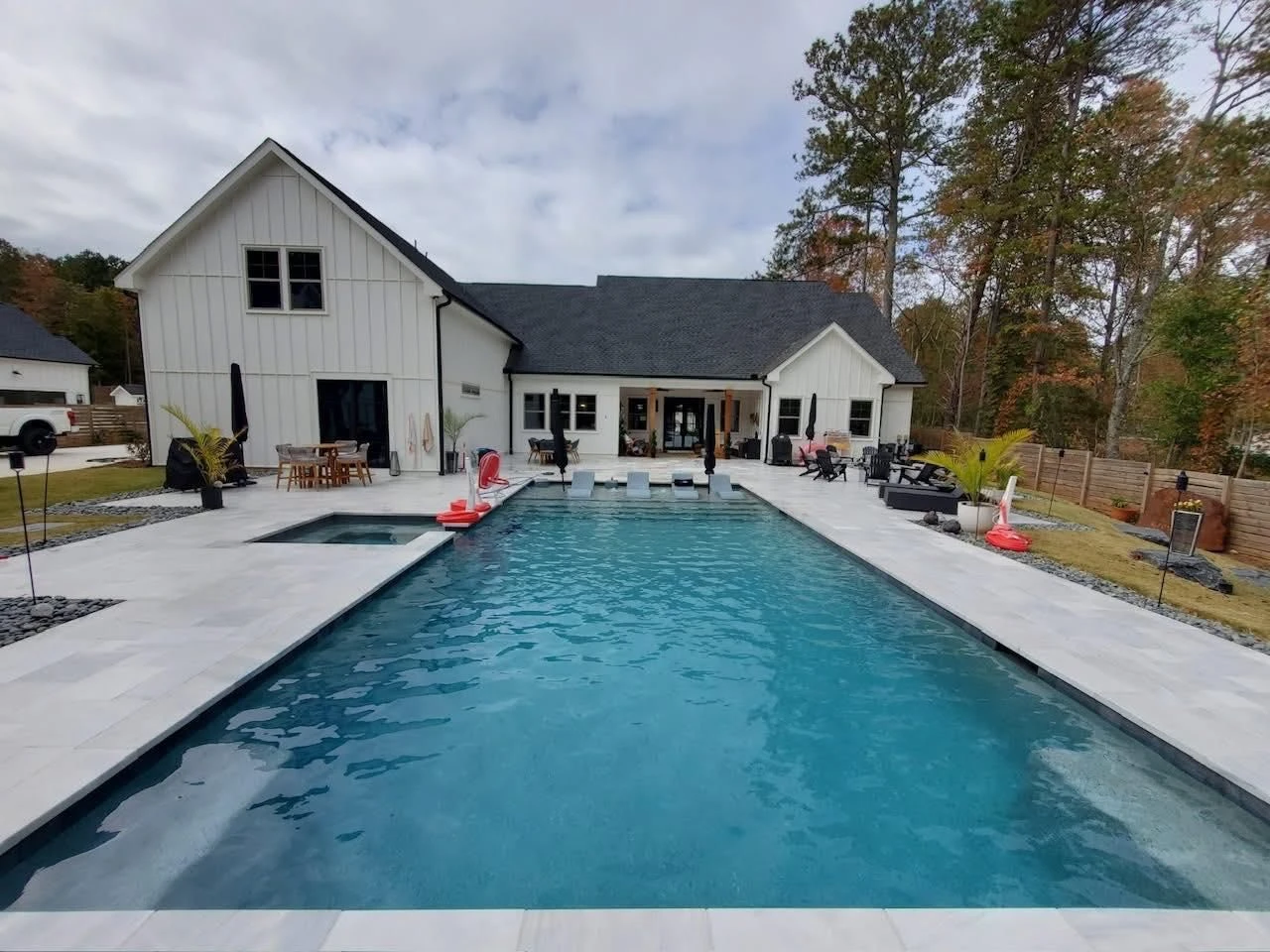
The two scenarios where stamped concrete is clearly wrong: long-term hold (10+ years) on a lot with any meaningful grade change, and any patio footprint that wraps around a pool. The second is its own subject — pool decks experience chemical exposure, hydrostatic pressure from the pool shell, and constant freeze-thaw cycles at the coping line that stamped concrete simply isn’t designed to survive. That’s a paver or travertine decision, and anyone quoting stamped concrete for a pool deck should be asked a lot of follow-up questions.
The vetting script once you’re leaning paver. A bad paver install fails faster than a decent concrete slab. The base is everything. Here’s the question set that separates contractors who know the craft from contractors who are about to hand you a field of loose units in five years.
- “What’s the exact base depth and spec — written into the contract?” Answer you want: 8 inches of compacted open-graded stone, installed in 2-inch lifts, non-woven geotextile over native soil. Answer that should worry you: “standard base” or “4 inches is plenty.”
- “What edge restraint are you using?” Answer you want: concrete-set haunching on all perimeters, no spike-down plastic edging on curves or gradients. Plastic edging on a sloped yard is how paver fields drift in year three.
- “What paver unit and from which manufacturer?” Answer you want: a named product — Techo-Bloc Blu Grande, Belgard Mega-Arbel, Unilock Brussels Block. Answer that should worry you: “a concrete paver” with no brand attached.
- “What sand do you use in the joints?” Answer you want: polymeric sand, named brand, activated with a fine water mist. Answer that should worry you: “regular mason sand” — that washes out in the first hard rain.
- “What’s your failure callback policy?” Answer you want: written warranty, typically 2 to 5 years on workmanship, longer on the product itself. Answer that should worry you: anything verbal, or the phrase “we don’t usually get callbacks.”
One more filter: ask to see a paver project they installed in Alpharetta or in North Fulton specifically, and ideally one that’s at least 5 years old. Photos are fine. A drive-by is better. Any contractor who has been doing this for more than a few years can point to work around Avalon, along the Rucker Road corridor, or in one of the Windward or Deerfield subdivisions. If they can’t, they’re newer than they said they were.
The last thing: get three quotes, not two. Two quotes is a false choice. Three is the minimum to see the actual spread, the actual median, and the outlier. On a $18,000 patio decision, the 90 minutes it takes to get a third estimate is the best-paid 90 minutes of the project.
Paver patios and pool decks built to survive Alpharetta clay, 30+ miles around Winder, GA
Every patio we build starts with a written base spec, a named product from Techo-Bloc, Belgard, or Unilock, and a 25-year design life — because the cheapest patio is the one you only pay for once.