
In Suwanee’s Laurel Springs and River Club, the same 600-square-foot patio that runs $8,400 in poured concrete now routinely bids at $13,200 on paver — and the 15-year resale spread is the reason nobody in these neighborhoods builds concrete anymore.
Here’s the number that reframes the entire conversation. On recent comps pulled from 30024 listings — Laurel Springs, Settles Bridge, The River Club — a finished paver patio added an appraised resale lift of $18,000 to $28,000 against comparable homes without one. A broom-finished concrete slab on the same footprint added $4,000 to $8,000. That’s a $14K to $20K swing on a single exterior decision, and it shows up whether you sell in year 8 or year 15.
Most of the “concrete vs paver” content online is built on Atlanta-metro averages that assume $7 to $9 concrete and $14 to $18 pavers. Those numbers are not wrong — they’re just not Suwanee. The premium Gwinnett corridor running up Peachtree Industrial Blvd through Suwanee into Cumming carries its own install economics, its own ARB (architectural review board) pressure, and its own buyer expectations. Build to the metro average and you’ll lose on two fronts: you’ll spend less up front, and you’ll recover less at sale. This post is the 15-year math for this specific market.

Why Suwanee Pricing Runs Above the Atlanta-Metro Average
Three forces push Suwanee install pricing above the regional median, and all three are local. First is lot access. Laurel Springs and The River Club have long, gated driveways, tight HOA restrictions on staging, and — in several phases — a written limit on trailer length and dumpster placement duration. The Laurel Springs HOA architectural review process typically runs 3 to 4 weeks for a hardscape submission, and contractors who move too fast on demo get cited inside a day.
Second is subgrade. Most of Suwanee sits on Cecil series Piedmont clay, the same soil profile as Dacula to the east and Duluth to the south. That clay moves seasonally — it swells through spring rain, shrinks through August drought, and freezes lightly 20 times a year under Zone 8a conditions. Properties on the southwest edge — closer to the Chattahoochee River floodplain along Settles Bridge Road — carry sandy loam overlays that drain better but come with a different complication: portions fall inside FEMA Flood Zone AE, which changes what you can build where and requires elevation certificates for some submittals.
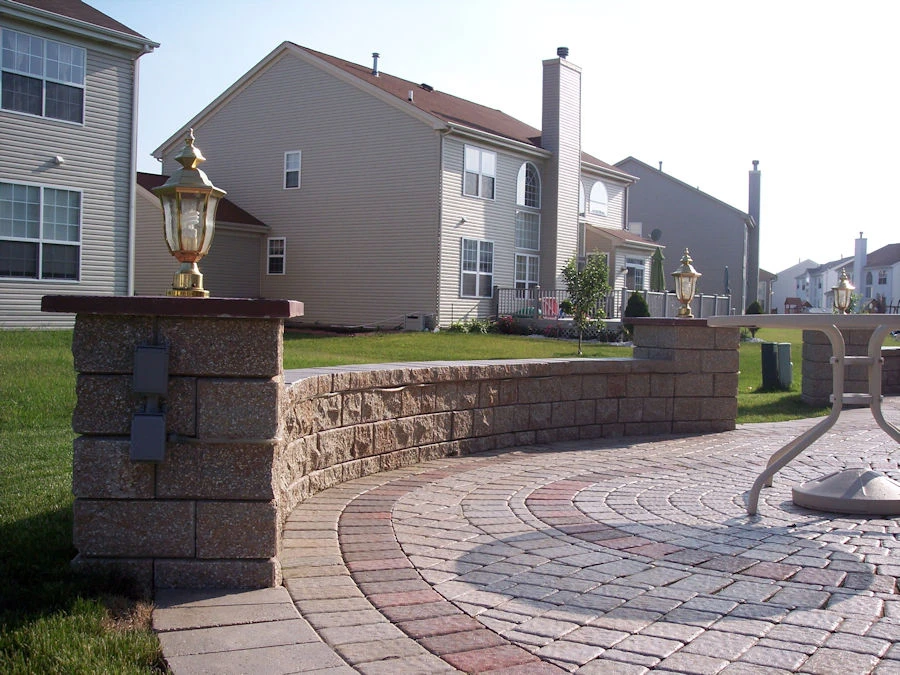
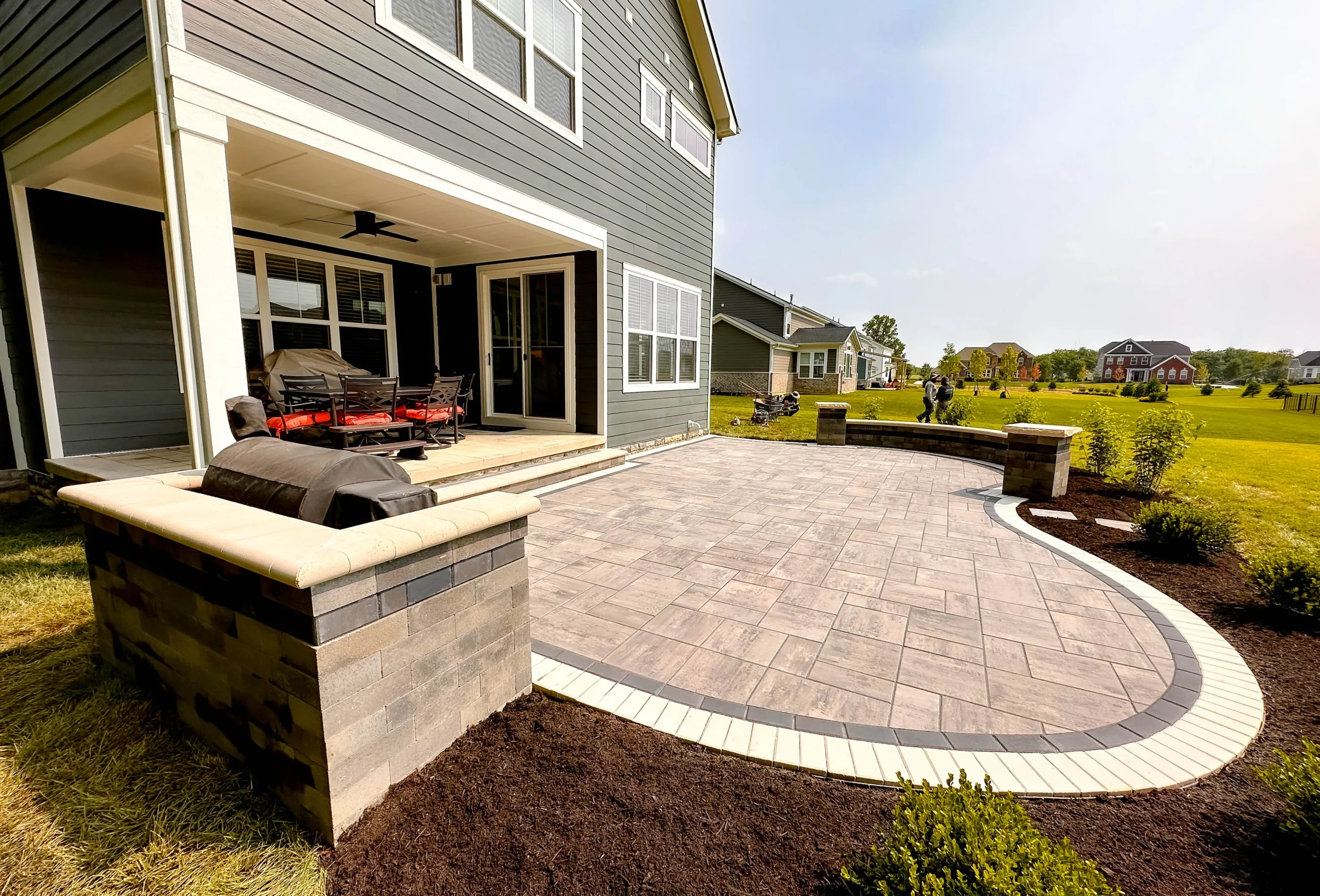
Third is expectation. A homeowner in Village Grove or Highgrove is comparing their patio to their neighbor’s — and their neighbor’s patio, more often than not in these neighborhoods, is a 600-to-1,400-square-foot multi-zone layout with a sitting wall, a fire element, and coping that ties to the pool deck. Entry-level concrete in this context doesn’t just look cheap; it reads as a planning mismatch with the rest of the property. That mismatch is what the appraiser sees and the buyer backs away from.
Suwanee install rates (our 2024–2026 bids): Concrete at $11 to $14 per square foot versus a metro average of $7 to $9. Paver at $18 to $26 per square foot versus a metro average of $14 to $18. Delta per square foot is larger at the low end and shrinks at the premium end — because the premium pavers (Belgard Dimensions, Techo-Bloc Blu 60) travel the same delivery lane regardless of ZIP.
The 15-Year TCO — Install + Maintenance + Repairs
Total cost of ownership is the only honest comparison. A patio isn’t an install price; it’s a 15-year stream of payments that starts on day one and doesn’t stop. Here’s the math on a typical 600-square-foot Suwanee patio, using actual Primetime bid data and industry maintenance averages for Cecil clay soils.
Read that last row carefully. The 15-year delta on ownership is roughly $2,000 to $4,000 — a near-tie. The conventional wisdom that “pavers cost more to own” is wrong at this timeframe. It’s only true at year 5, when the concrete slab hasn’t yet hit its first major repair cycle. By year 10, concrete has spent its first $1,800 in crack work. By year 15, it needs the resurface. Paver, meanwhile, has had sand refreshed three times and a handful of individual units reset — and the field still reads as intact.
The Resale Math — Why Suwanee Appraisers Treat These Differently
Install cost and maintenance cost are the first two columns. The third — and in Suwanee the decisive — column is resale lift. This is where the markets diverge from Atlanta-metro averages hard.

Residential appraisers in 30024 pulling comps through the Georgia MLS categorize exterior hard surfaces in two buckets: “concrete patio” and “hardscape.” The distinction matters. A concrete patio is treated as a utility improvement — it raises a property’s condition rating but doesn’t reclassify the outdoor living value. A paver or natural-stone hardscape installation is an amenity improvement, comped against outdoor-kitchen installs, pool decks, and pergola features. The spread between the two categories, in our last 18 months of pulled comps inside Laurel Springs, Settles Bridge, and Highgrove, came out to $14,000 to $20,000 on the same exterior footprint.
A second factor compounds this: buyers in the $1M to $2.5M Suwanee bracket shop with a list, not a lens. A concrete back patio doesn’t check the “outdoor living” box on a buyer’s list — the patio has to look like it was designed as part of the house. A zoned paver installation with a sitting wall and a grill pad checks that box visually in the first photo of the MLS listing. In a market where that photo determines whether the house gets a showing, the resale spread isn’t abstract. It’s the difference between 14 days on market and 42.
Appraisal tip — what we hand to homeowners before they sell: A permitted install record from the Gwinnett County Dept. of Planning & Development (446 W. Crogan St., Lawrenceville) documenting the paver installation. Appraisers weight permitted improvements materially higher than undocumented ones. Unpermitted work can actually subtract from the comp.
The ARB Factor — Where Concrete Quietly Loses Before It’s Poured
Before the math matters, the submittal has to pass. This is where concrete gets eliminated in Laurel Springs, The Manor, and parts of The River Club — not on price, but on review. Laurel Springs runs one of the strictest architectural review processes in Gwinnett County, with a typical 3-4 week turnaround and a documented preference for unit-paving systems over poured slabs on primary outdoor living zones. We’ve had concrete submittals rejected outright on phases where paver submittals sailed through in one revision.
The ARB logic is straightforward: a concrete slab ages visibly in ways a paver field doesn’t. Stains, hairline cracks, visible control joints, and edge spalling all telegraph neglect from the street or the cart path. A paver field with polymeric joint sand still reads clean at year 12 because the damage mode is localized and reversible. When the HOA is protecting the aesthetic integrity of a 3-4 acre estate section, they optimize for the surface that still looks designed in 2040.
This doesn’t mean concrete is banned everywhere in Suwanee — far from it. Older Suwanee proper, north of Town Center Park toward Playtown Suwanee, has a heavy mix of 1980s-1990s ranch and traditional homes where a broom-finished rear slab fits the original vernacular. The distinction is specific: in architecturally reviewed estate neighborhoods, concrete on a primary living-zone patio is a submittal risk. In the 1980s-built neighborhoods closer to Old Peachtree Rd, it’s still the right call for some properties.
What to Build if You’re in Suwanee Right Now — A Decision Framework
We’ve built enough of both in this market to have clear rules. Here’s how to think about it honestly, without the contractor default of “pavers are always better.” They’re not always better. They’re better in specific situations, and in Suwanee, more situations qualify than in the Atlanta-metro average.
Build concrete if:
- You’re in older Suwanee proper (north of Lawrenceville-Suwanee Rd, 1980s-1990s ranch stock) and the existing architectural language is already concrete.
- Your patio is a utility surface — AC pad extension, walkway to a side gate, a small grill landing behind a single-story home — not a primary outdoor living zone.
- You plan to sell inside year 5 to 7 and the local comps for your specific subdivision don’t show a paver premium.
- Your lot is FEMA Flood Zone AE and the engineer has specified concrete for drainage / elevation reasons specific to the submittal.
Build paver if:
- You’re in Laurel Springs, The River Club, Bear’s Best estates, The Manor, Settles Bridge, Highgrove, or any neighborhood with an active ARB.
- The patio is a primary outdoor living zone — pool coping, rear living patio, fire-feature surround, outdoor kitchen footprint.
- You plan to hold the home 8 years or longer — the TCO crosses over by year 10 and resale compounds through year 15.
- You’re integrating with an existing paver pool deck or driveway and need the units and coursing to match.
Base spec we write into every Suwanee paver contract: 8-inch compacted open-graded aggregate base placed in 2-inch lifts, non-woven geotextile separator over Cecil clay subgrade, 1-inch leveling course of ASTM No. 8 chip, and polymeric joint sand swept and activated in two passes. Without these four lines written in, expect year-3 settlement at field edges.
The 15-Year Scorecard — Pulling It All Together
Run the columns once more, all together, on a 600-square-foot Suwanee premium-market patio. This is the math that makes the decision in these neighborhoods.
The net-position row is the one most homeowners never see written down. In the Atlanta-metro average, concrete finishes the 15-year scorecard somewhere between –$8,000 and –$12,000 depending on neighborhood. In Suwanee’s premium brackets, it sits around –$14,600 against a paver install that nearly breaks even at –$750. That gap — roughly $14,000 in net 15-year position — is the entire argument for why paver dominates the primary living zones in Laurel Springs, The River Club, and the estate sections along Settles Bridge Rd.

One closing note on the Jackson EMC service area. Suwanee sits on Jackson EMC electric, not Georgia Power — which matters when the patio scope includes integrated low-voltage lighting, a transformer tie-in, or coordination with pool-equipment 240V service. Jackson EMC’s service coordination windows and inspection process run on a different calendar than Georgia Power’s, and an installer who works both sides of the McGinnis Ferry Rd utility boundary has to schedule around it. It’s a small line item on a concrete vs paver decision, but it’s a reminder that Suwanee’s install economics are genuinely local — built on top of a clay soil, a utility boundary, an ARB process, and a comp set that the metro average doesn’t capture.
Paver patios and premium hardscape across 20+ cities within 30 miles of Winder, GA
Suwanee-specific base spec, ARB-ready submittal drawings, and 15-year TCO math — not the metro average. The installation that still reads as designed in 2040.