
Over 15 years on a 500-square-foot patio in Marietta, a poured concrete slab costs a homeowner $16,400 all-in, while a properly installed paver patio costs $15,200 — and still has two full decades of life left when the concrete is already on its third repair.
That is the entire story of this post, stated up front. No suspense, no slow reveal, no “it depends.” The number is the number. We ran it on a standard Cobb County backyard — the kind of 500 sqft back patio you find on a 1980s split-level off Lower Roswell Road or a 1990s two-story in Chestnut Hill — and the math came out the same way every time. Paver wins on 15-year total cost of ownership. Paver wins on residual life. And in East Cobb specifically, under mature oak and poplar canopy, paver wins by a wider margin than the national average because of how concrete behaves around tree roots.
The reason this math is rarely shown to Marietta homeowners is simple: the install quote is the only number most contractors talk about. Concrete looks cheaper the day you sign the contract. It is not cheaper the day your kid graduates high school. What follows is every line item, every assumption, and every local variable that shifts the outcome, so you can decide on real numbers instead of install-day sticker price.
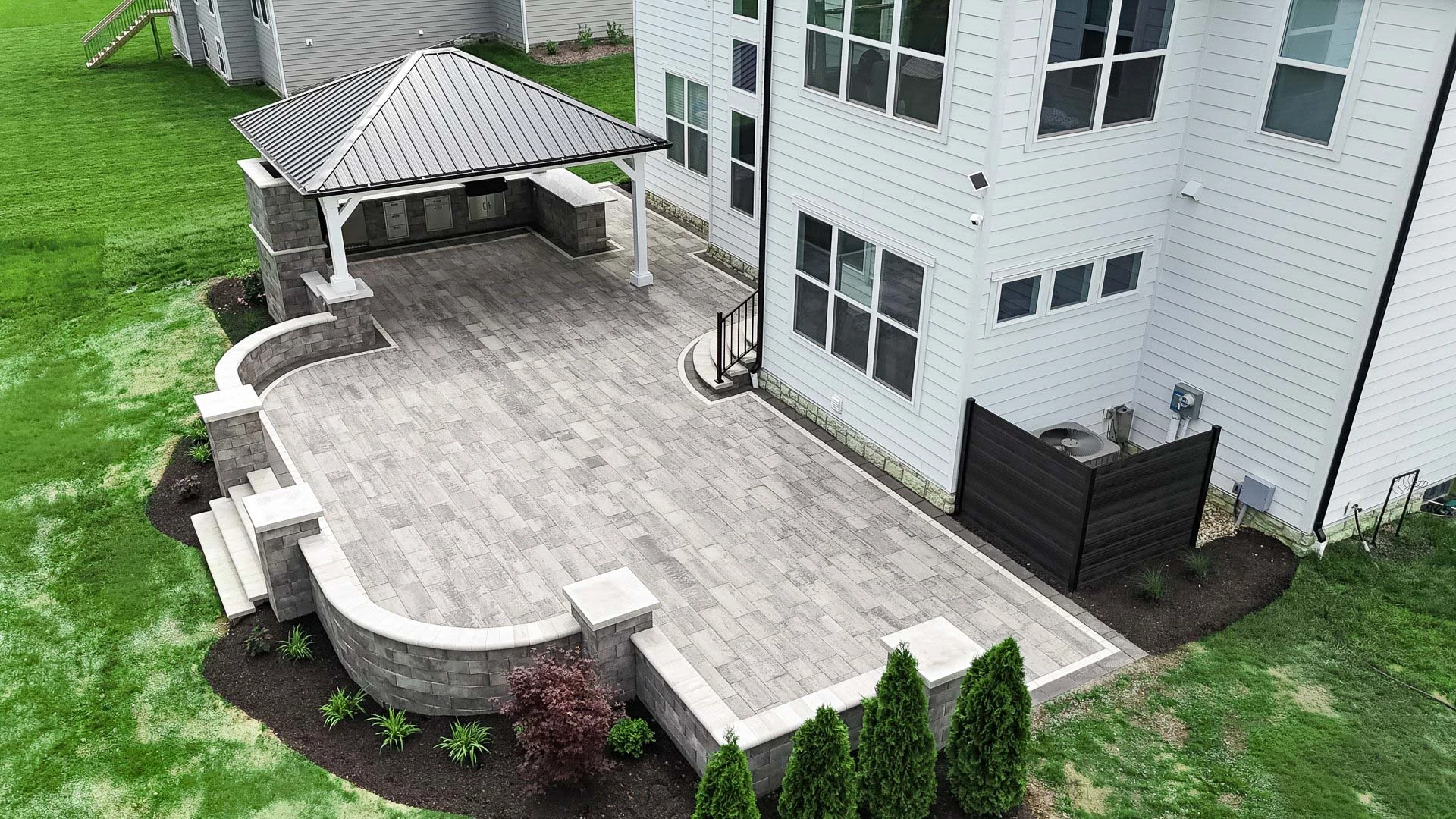
The 15-Year Line-Item Breakdown on a 500 SqFt Marietta Patio
Let’s put both products side by side on the exact same backyard. Assume 500 square feet of finished patio, a level pad (no walls, no steps), standard access, and a house in one of the 30060-30068 zip codes. Both quotes are 2026 Marietta labor-and-material rates from builders actually working in Cobb County — not a national average pulled from a blog that reprints the same line every year.
Concrete, 4-inch poured slab, broom finish, control joints cut:
- Install (excavation, 4″ base, rebar or mesh, pour, finish): $7,400
- Year 5-8 crack repair + surface sealer (typical in Piedmont clay): $1,400
- Year 9-11 secondary crack repair, spall patching: $2,400
- Year 12 full resurface with overlay or tear-out-and-repour: $5,200
- 15-year total: $16,400
- Condition at year 15: patched, resurfaced, with a known 3-5 year remaining life before the next intervention
Paver patio, 60mm concrete paver, compacted aggregate base, polymeric sand joints:
- Install (excavation, 6″ compacted base, bedding sand, pavers, polymeric joints, edge restraint): $13,800
- Year 4 and year 10 polymeric sand refresh: $900 combined
- Year 7 pressure wash + re-sand: $500
- Year 12-15: no major intervention required
- 15-year total: $15,200
- Condition at year 15: structurally intact, aesthetically refreshable, with a documented 20+ year remaining service life
The paver patio is $1,200 cheaper at the 15-year mark, and that is before we factor in the resale difference (appraisers in Atlanta Country Club and Indian Hills routinely mark paver hardscape as a long-life improvement and concrete as a depreciating surface). The gap is small at year 15. By year 25, it is not small — the concrete has been resurfaced twice by then, and the paver is still the paver.
Base spec that drives the outcome: 6 inches of compacted Georgia-mined #57 granite aggregate, compacted in two 3-inch lifts with a 3,000 lb reversible plate compactor, over geotextile fabric on top of scraped subgrade. This is the spec that makes paver behave like paver. Skip any of those layers and the math changes — toward concrete’s favor, not away.
Why Concrete Cracks Faster in East Cobb Than the National Average
National concrete durability studies assume a generic subgrade and a generic tree load. East Cobb is not generic. Two Marietta-specific factors compress concrete’s service life by roughly 30 percent compared to a hypothetical flat, treeless suburb.
Factor one: Cecil series red clay. The Piedmont clay across most of Cobb County has a measured shrink-swell potential that moves the subgrade noticeably between a saturated March and a bone-dry August. A 4-inch slab on this soil is not sitting on a stable platform. It is sitting on a surface that lifts, drops, and twists across seasons. Control joints mitigate the cracking, but they do not eliminate it. Every slab we have inspected older than 8 years in Burnt Hickory, Seven Oaks, or off Johnson Ferry Road has at least one crack that started at a joint and walked.
Factor two: specimen-tree root load. East Cobb’s signature mature oak-and-poplar canopy is beautiful and it is aggressive. A 60-year-old white oak off Sope Creek pushes lateral roots 40 feet from its trunk. Those roots lift concrete. They do not lift pavers, because pavers are individual units on a flexible base that redistributes load. A paver patio handles root movement by shifting — one unit rises 3mm, the neighboring unit absorbs it, and you re-level the affected zone during the routine polymeric sand refresh. A concrete slab handles root movement by cracking. There is no second option.
Put those two factors together and you get what we see on every East Cobb pre-sale inspection: concrete patios 10-12 years old with visible cracking, surface spalling, and control-joint failure. The homeowner either resurfaces, tears out and re-pours, or lives with the cosmetic damage. None of those three options is free.
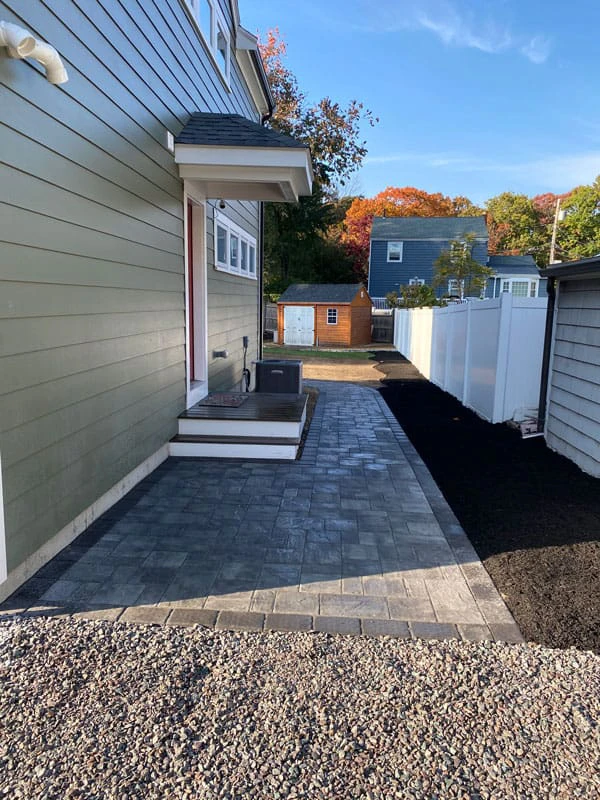
The Three Line Items Nobody Quotes You For Concrete
Every concrete quote we’ve reviewed in Marietta includes install. Almost none include the three follow-on costs that make concrete’s 15-year number what it is. If you are comparing written quotes right now, here are the line items to ask your concrete contractor to price in writing before you sign:
- Year 5-8 crack remediation and sealer. Piedmont clay guarantees this. Budget $1,200-$1,600 for a 500 sqft patio, more if you have a specimen tree inside 20 feet.
- Year 9-11 secondary crack work and spall repair. This is the first “real” repair — not just sealer, but epoxy injection, joint routing, and surface patching where freeze-thaw cycling has pitted the finish. Budget $2,000-$2,800.
- Year 12 resurface or repour decision. By year 12 the slab is cosmetically past saving. You either overlay with a polymer-modified cementitious topping ($4,800-$5,600 for 500 sqft) or demo and repour ($7,800-$9,200). Overlay is the common choice. Both reset the clock, but the clock starts at a shorter interval the second time.
Note that we gave the concrete side the benefit of the overlay option — $5,200 at year 12 — not the tear-and-repour. If you picked tear-and-repour, concrete’s 15-year number climbs past $19,000 and the comparison gets embarrassing.
Marietta Permits, Drainage, and the Cobb County Code Factor
Permits are the same either way in Marietta — both patio types pull through Cobb County Community Development at 1150 Powder Springs Street when they exceed 200 sqft, sit within a setback, or tie into an existing structure. Permit fees are not the variable. The variables are drainage, grading, and HOA pre-approval.
Drainage. Cobb County requires positive slope away from any structure — typically ¼-inch per foot over the first 10 feet from the foundation. Pavers handle this easily because the joint system is partially permeable; a properly built paver field sheds water through the surface and across it. Concrete sheds water across it only. On a 500 sqft patio against a 1960s East Cobb ranch with a slab-on-grade foundation, that difference shows up as moisture intrusion on the concrete side within a decade. It shows up as nothing on the paver side.
Grading. Marietta backyards off Lower Roswell Road, Roswell Road, and Johnson Ferry Road average 3 to 6 feet of grade change front-to-back. That grade often requires a small retaining wall or step riser where the patio terminates. A paver patio integrates with wall systems natively — same base, same edge restraint, same installer, same day. A concrete patio requires a separate retaining wall scope, separate mobilization, and the joint where the two surfaces meet is where long-term failure tends to start.
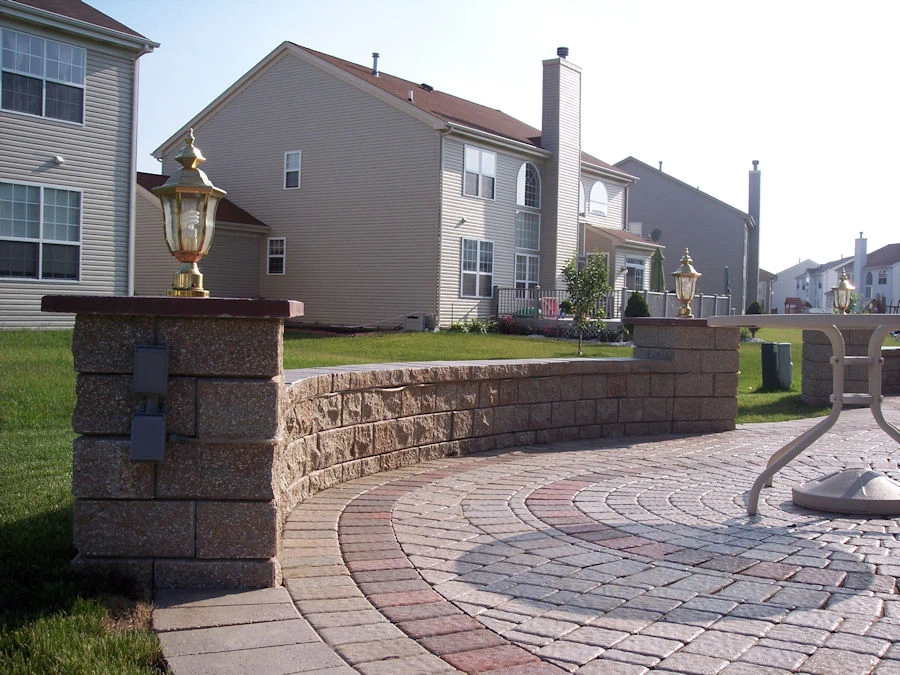
HOA approval. In Atlanta Country Club, Indian Hills, and Marietta Country Club, architectural review boards approve or reject surface materials and colors on submittals before work begins. Pavers pass almost universally because they present as an upgrade. Poured concrete in these neighborhoods is more scrutinized and sometimes requires a topping or overlay to match existing aesthetic guidelines — a cost concrete quotes never account for until the ARB rejects the submittal.
Utility note: Most of Marietta sits on Cobb EMC’s electrical grid, not Georgia Power — incorporated residents are served by Marietta Power. Neither affects patio construction directly, but it affects pool equipment, lighting loads, and 240V runs if your patio scope connects to a pool or spa. Always confirm the service provider before any hardscape quote that includes electrical.
When Concrete Actually Wins — And It’s Narrower Than You Think
We are not pretending concrete has no place. It has a specific place. Below 150 square feet, on a level pad, with no tree canopy within 30 feet, serving a purely utilitarian function (shed floor, equipment pad, HVAC slab) — concrete’s install advantage holds over its lifespan and the 15-year math flips. Below about 200 sqft the concrete number and the paver number run close enough that install cost becomes the deciding factor.
Concrete also wins if the patio will be demolished within 8 years — say, as a placeholder before a full backyard renovation or pool installation. No reason to spend paver money on a surface you plan to break up. Every Marietta homeowner we have advised who was pre-planning a pool within 5-7 years got the same answer from us: pour a cheap slab now, build the real hardscape when the pool goes in.
Outside of those two scenarios, concrete is losing the long-run. A standard 500 sqft back patio in East Cobb, with trees, with kids, with 15+ year ownership intent, is not where concrete wins. It is where concrete underperforms quietly for a decade and then presents you with a $5,200 bill.
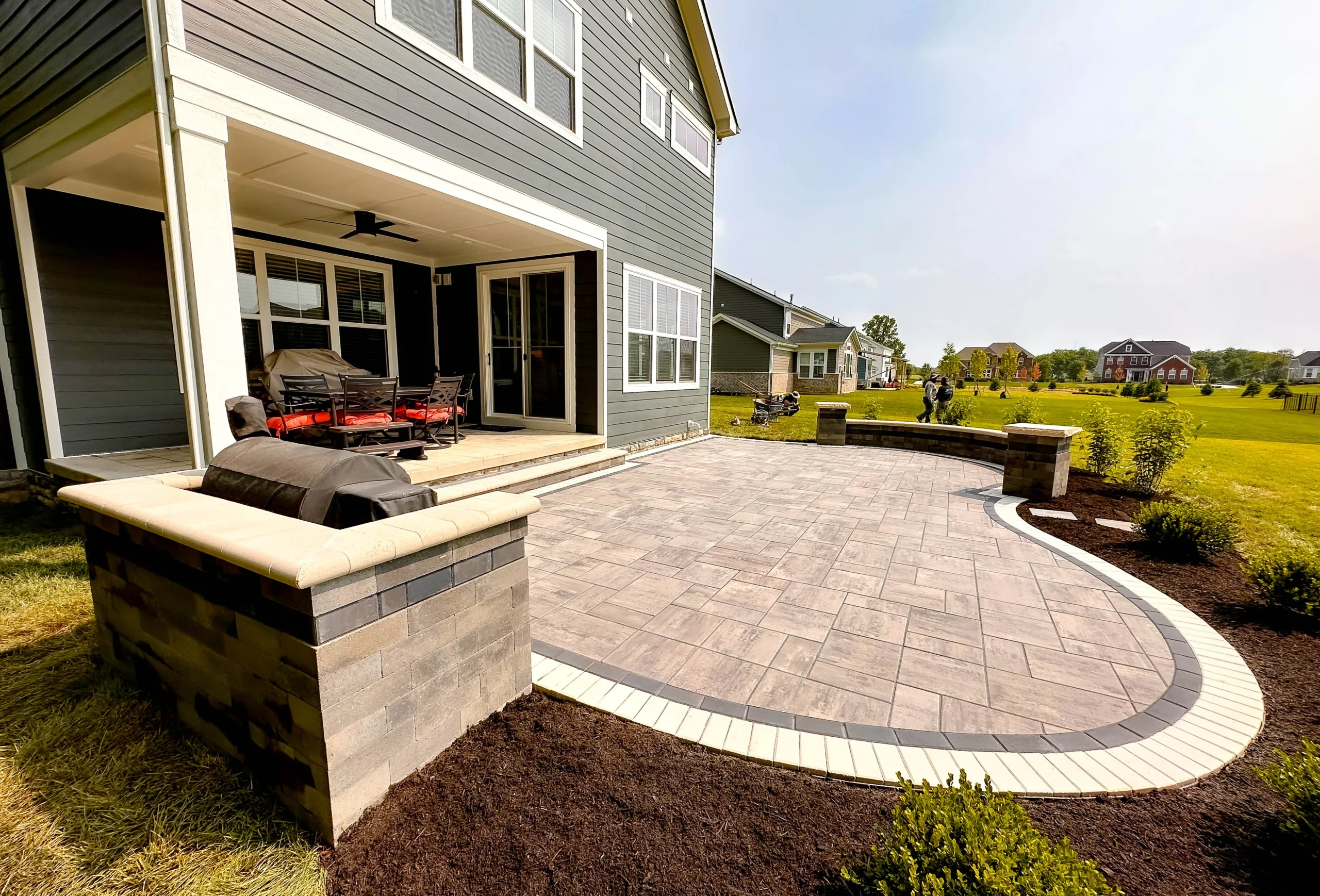
How to Read a Marietta Paver Quote — The Five Numbers That Matter
A paver patio quote is not just a square-footage price. If all you see is a $/sqft number, you are being shown the wrong quote. Here are the five specs that drive paver durability in Marietta’s soil-climate-canopy combination. Any quote that doesn’t name them should be reworked before you sign.
- Paver thickness. Minimum 60mm (2⅜”) for residential patio use. 80mm for driveway crossings. Anything thinner is a walkway product being sold as a patio product.
- Base depth and composition. Minimum 6″ of compacted #57 granite aggregate for patio. 8-10″ if the patio carries vehicle load or sits on fill. Geotextile fabric under the base on Piedmont clay is not optional — it’s the separation layer that keeps clay from migrating into the aggregate.
- Compaction method. Two lifts, reversible plate compactor rated at minimum 3,000 lbs of centrifugal force. A small walk-behind doesn’t get the density. If the quote doesn’t specify lift count and compactor weight, the base is going to settle.
- Edge restraint. Spiked polymer edge restraint along every unbounded edge. No sand-only edges. No concrete haunch on residential unless specifically spec’d — it traps water against the paver field and accelerates joint failure.
- Joint sand. Polymeric joint sand, swept and activated, not loose masonry sand. Re-sanding cycle every 5-7 years. Brand tier matters here — Techniseal or SRW VS1 outperform bargain poly sands in longevity by a measurable margin.
Get those five numbers in writing, in a line-itemed quote, and you will have a paver patio that performs to the 15-year math shown at the top of this post. Skip any of them and you are buying a patio that behaves more like concrete — expensive to fix, prone to settlement, and disappointing at year 10.
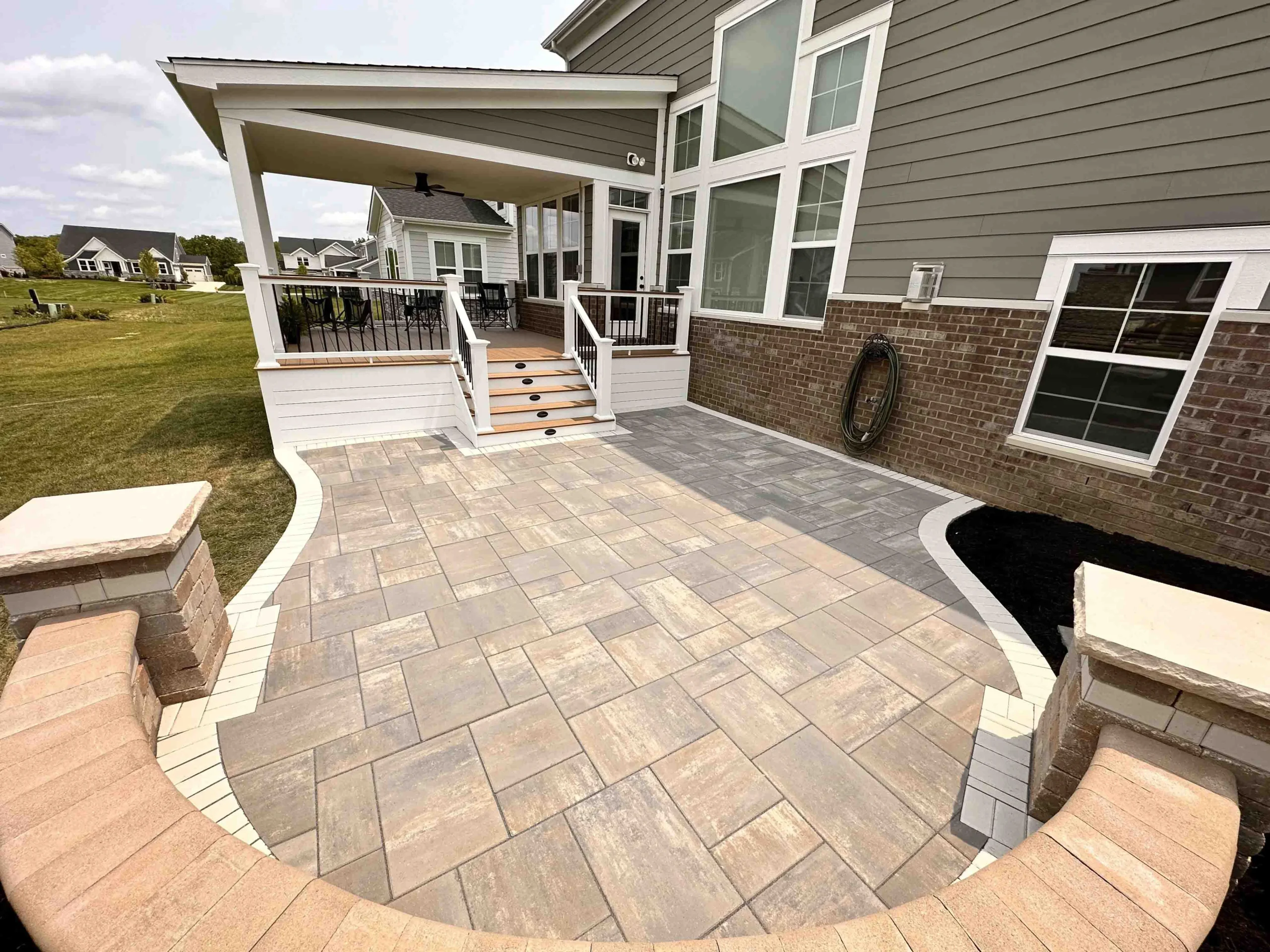
If you want us to price the exact 500 sqft patio specified in this post — 60mm paver, 6″ compacted base, polymeric joints, edge restraint, Techniseal sand — on your specific Marietta lot, bring us the address and we’ll walk the grade, look at the canopy, and quote the real number. Same spec as the 15-year math above. No substitutions, no surprise line items at year 5.
Paver patios built to the 15-year spec across 20+ cities within 30 miles of Winder, GA
Every patio we install in Cobb County is priced against the exact 15-year math in this post — 60mm paver, compacted granite base, polymeric joints, and the service life to back it up.