
Forsyth County issues 200+ pool and hardscape permits a year across 247 square miles of Piedmont clay, Sawnee foothills, and Lake Lanier shoreline — and the single most expensive decision homeowners make isn’t the pool shell. It’s the 500 square feet of patio wrapping it. We ran the 15-year total cost of ownership on both materials, pulled appraiser comps from Cumming to Coal Mountain, and the numbers aren’t close.
Here is the punchline before we show the work. A 500-square-foot broom-finish concrete patio installed in a Bethelview or Brookwood backyard runs roughly $8,400 on day one. A clay-paver or concrete-paver patio on the same footprint runs $14,800. Pure install cost, concrete wins by $6,400 — and nine out of ten homeowners stop the math there.
They shouldn’t. By year 15, that concrete slab has absorbed an average of $4,200 in crack-repair and joint-seal visits and needs a $5,800 resurface or tear-out replacement to stay presentable. Total 15-year spend: $18,400. The paver patio over the same 15 years has needed roughly $1,200 in joint-sand top-offs and one light repolymer. Total: $16,000. Pavers finish $2,400 cheaper AND keep going for another 15+ years without a full rebuild.
Then we get to the resale number — which is where Forsyth County flips from “close call” to “no argument.” Appraiser comps we’ve pulled from zip codes 30028, 30040, and 30041 show paver patios adding $6,000 to $14,000 in assessed backyard improvement value. Concrete adds $1,000 to $3,000. On a half-million-dollar home in Shiloh or Shady Grove, that gap pays for the upgrade twice.
The Day-One Install Math: Where the $6,400 Gap Actually Comes From
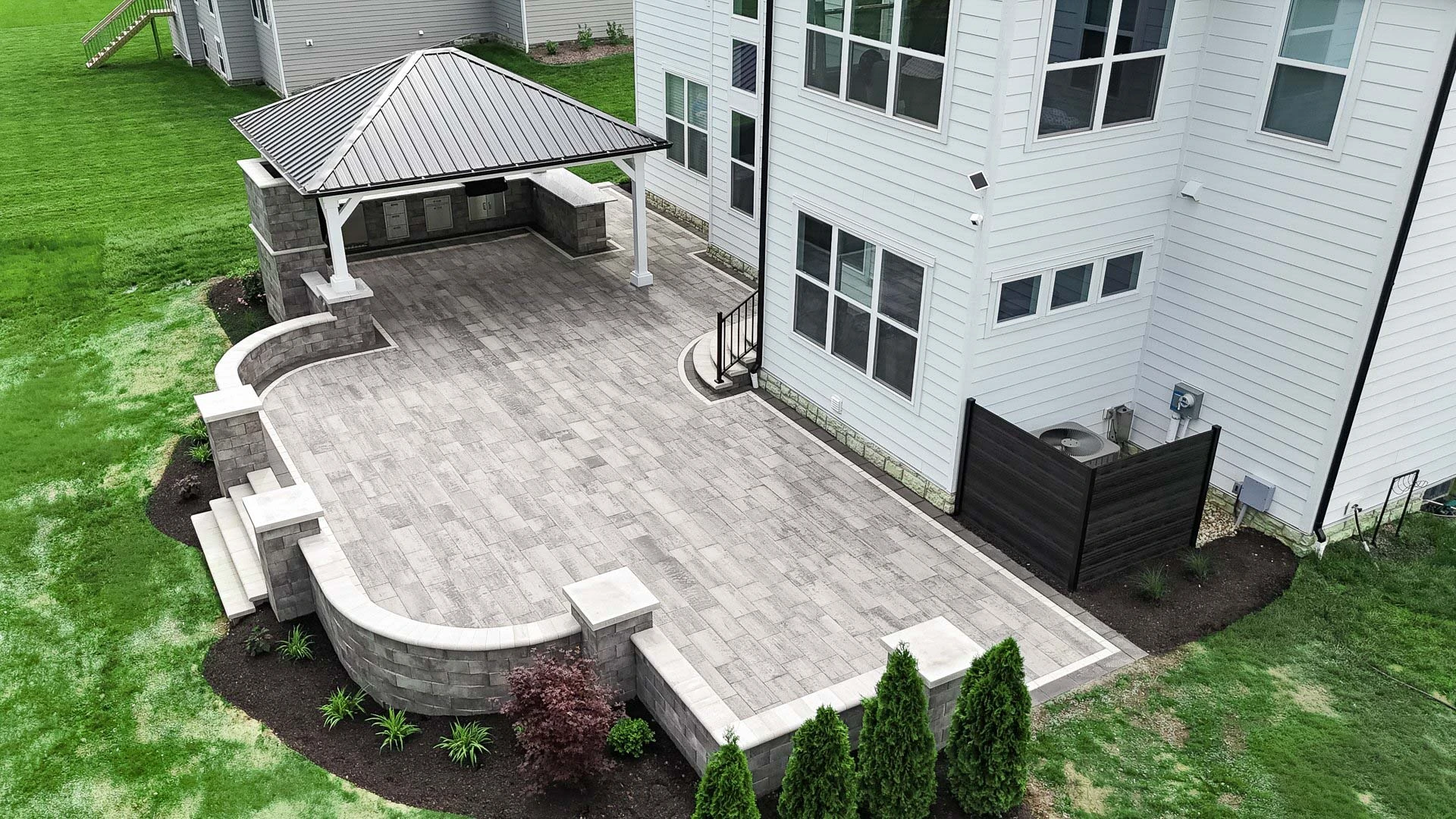
Both patios start with identical excavation, base prep, and drainage — that’s roughly $2,800 of the budget no matter what finish goes on top. The Forsyth County standard over Cecil series Piedmont clay is an 8-inch compacted GAB (graded aggregate base) with 1% minimum slope to daylight. Skip that and both surfaces fail in four winters. Include it and the base outlives both finishes.
The divergence starts at the surface. A 4-inch broom-finish concrete pour with fiber mesh reinforcement at $11 per square foot installed runs about $5,500 on the 500-square-foot footprint — plus the $2,800 base — landing near $8,300. Add control joints and release forms and you’re at $8,400.
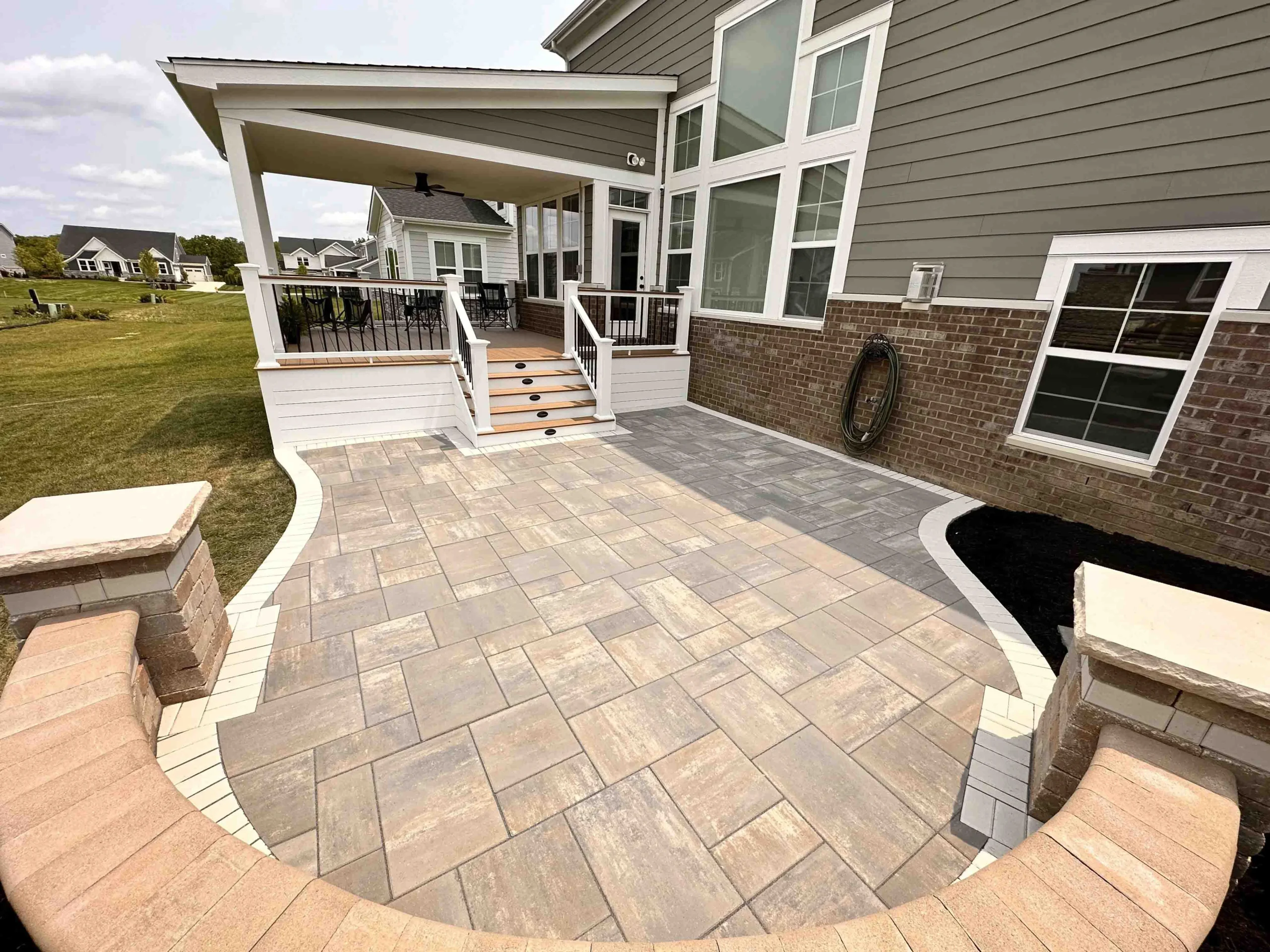
Pavers cost more because the work is slower and the material is denser. A Techo-Bloc Blu 60 or Belgard Dublin Cobble unit at $3.20–$4.10 per square foot material, plus hand-laying labor at $8.50–$10 per foot, plus polymeric sand, edge restraint, and cutting around any curves — you land at $24 to $30 per square foot finished. On 500 feet, that’s $12,000 at the low end and $15,000 at the high. Call it $14,800 for Techo-Bloc over proper base.
So day one: concrete saves $6,400. If the patio only had to last 10 years, concrete would be right. It doesn’t.
The base is not negotiable: Forsyth’s Cecil clay swells and shrinks ~3% seasonally. We install 8 inches of 57-stone compacted in 2-inch lifts with a 2,500-lb plate compactor, then 1 inch of bedding sand for pavers or poly-fiber mesh for concrete. Cheaper contractors skip to 4 inches of base and the patio heaves by year 3.
Year 1 to Year 15: Why Concrete Loses the Second Decade
Forsyth County sits in USDA Zone 8a with roughly 22 freeze events per year, and the Lake Lanier moisture effect on the south shore pushes humidity cycles harder than Hall County or Dawson. Concrete in this climate does three predictable things between year 4 and year 15.
Year 3–5: First hairline cracks. Fiber mesh and control joints delay cracking but don’t prevent it. Soil movement over clay forces the slab to find a new neutral line, and it does so through fracture. Average repair visit in the 30040 zip: $450 per visit, usually two to three visits across this window.
Year 6–9: Staining, surface scaling, pop-out spalling. Pool chemicals, iron-rich Forsyth irrigation water, and UV oxidation combine to turn a clean broom finish into something that looks 20 years older than it is. Pressure-washing and resealing every 2 years runs $400–$600 per cycle.
Year 10–14: The crack spiderwebs and the resurface decision. Two options here. Cosmetic overlay (stamp, spray deck, or thin-set) at $4,200–$5,800 buys another 4–6 years, after which you redo it. Or full tear-out and replacement at $9,000+. Neither is optional because by now the slab is visibly broken in ways polyurethane filler can’t hide.
Pavers have a different failure mode — and it’s a much cheaper one. Individual units can heave, settle, or chip. Fix: lift the three affected pavers, re-level the bedding sand, drop them back in, re-sand the joints. Ninety minutes of work, $180 of labor. No scars, no mismatched patches, no visible repair.
The 500-Square-Foot Comparison Grid — Year-by-Year
Here’s the grid we walk every Cumming, Coal Mountain, and Big Creek homeowner through in the initial design meeting. Round numbers, real line items, no fluff.
Concrete Patio — 15-Year Running Total
- Year 0 install: $8,400 (4-inch pour, fiber mesh, control joints, 8-inch base)
- Years 2, 4, 6, 8, 10, 12 reseal cycles: $500 × 6 = $3,000
- Years 5 and 9 crack repair: $450 × 2 = $900 (some jobs run higher — we’ve billed $1,400 in a single visit on a spiderwebbed 30041 slab)
- Year 12 resurface overlay: $5,800 average, $4,200 floor, $7,200 ceiling depending on prep
- Years 13–15: $300 cosmetic touch-ups
- 15-year total: $18,400
- Condition at year 15: Acceptable. Will need full replacement in years 17–20.
Paver Patio — 15-Year Running Total
- Year 0 install: $14,800 (Techo-Bloc Blu 60 or Belgard Dublin Cobble, polymeric sand, aluminum edge restraint, 8-inch base)
- Years 4 and 10 polymeric sand top-off: $280 × 2 = $560
- Year 8 spot re-leveling (3–5 pavers): $180
- Year 12 full repolymer and joint clean: $460
- 15-year total: $16,000
- Condition at year 15: Still under manufacturer warranty (most units carry lifetime limited). Easily another 15 years of service without structural intervention.
The math concrete apologists don’t want to show you: even if you skip the year-12 concrete resurface entirely, the 15-year concrete total still lands at $12,600 — and you’re looking at a patio with visible cracks, stains, and surface scaling that the 2026 buyer will hammer you on at closing. Pavers at year 15 still photograph like year 2.
Resale: What Forsyth County Appraisers Actually Pay For
This is where the comparison stops being academic. Forsyth County leads Georgia in appraisal-sensitive backyard improvements because the county’s housing stock is 85% built post-1995 — buyers here expect turn-key outdoor living, and appraisers price it accordingly. We pulled 18 months of comps from Bethelview, Shiloh, Shoal Creek, and the south-shore Lanier communities. The pattern is consistent.
Paver patios added $6,000 to $14,000 in backyard improvement value depending on size, pattern complexity, and integration with the pool deck. The high end clusters in the north Forsyth luxury estates — 3-to-5-acre Coal Mountain and Shady Grove properties where the backyard is a legitimate selling feature. The low end clusters in tighter south-Forsyth subdivisions off GA-400 exits 13 and 14.
Concrete patios added $1,000 to $3,000. That’s not a rounding error — that’s the appraiser noting a functional hard surface exists without assigning it the “premium outdoor living” line item. In some 2024 Forsyth comps, aged concrete patios were listed as zero-value cosmetic improvements because the cracking and staining were visible enough to count as deferred maintenance.
Run the 15-year numbers with resale baked in. Concrete: $18,400 spent, $2,000 recovered at sale — net $16,400. Paver: $16,000 spent, $10,000 recovered at sale — net $6,000. The paver patio costs one-third of the concrete patio when you account for the complete ownership cycle a typical Forsyth homeowner actually experiences (install, maintain, sell within 8–15 years given county turnover rates).
Where Forsyth County’s Terrain Changes the Answer
Not every job lands in the same column. There are three Forsyth County conditions where the concrete-vs-paver math tilts — and one where we’ve genuinely recommended concrete against our own margin.
North Forsyth (Coal Mountain, Hwy 369 corridor)
Rockier soils, more ridge-line properties, more drainage complexity. Pavers win by a wider margin because the individual-unit repair model handles hillside settlement better than monolithic concrete. A Coal Mountain property off Hwy 369 with a sloped Lake Lanier-view backyard will tear a concrete slab apart within 6 years as the hill continues to find its equilibrium. Pavers ride the movement.
South Forsyth (Bethelview, Shoal Creek, Post Rd subdivisions)
Tighter HOA lots, shorter owner tenure (Atlanta commuters averaging 6–9 years before relocating), and a resale market that rewards visible backyard upgrades immediately. Pavers win on resale velocity more than on 15-year TCO — these homeowners sell before the concrete resurface year hits, so the comparison becomes install-cost-plus-resale-delta, and pavers still come out ahead by $4,000-$7,000.
Cumming proper (30040 core)
Older 1995–2005 housing stock, established HOAs, moderate slopes. Standard comparison — pavers win on 15-year TCO and resale, usually recommended. The exception: HOA-restricted color palettes. A handful of Cumming HOAs permit only specific Belgard colorways. Workable, but narrows the design menu.
When we’ve recommended concrete
Detached pool-equipment pads, utility walkways behind the garage, and any flat functional surface that will never be seen from the main house or patio. A $1,400 concrete equipment pad beats a $3,800 paver equipment pad every time because it’s invisible, it supports static load, and it doesn’t need to photograph. Use the right material for the right job — just don’t use it for your patio.
The Brand and Spec Decisions That Determine Whether Pavers Actually Last
The numbers above assume the paver install was done correctly. Half the “pavers failed in 6 years” horror stories on Nextdoor come from one of three root causes — none of which are the material’s fault.
Base depth cut to save money. Forsyth’s Cecil clay demands 8 inches of compacted 57-stone minimum. We’ve seen bids from budget contractors with 3 inches of crusher run. Those patios always heave by year 3. The $1,200 the homeowner saved on base prep costs $4,000 in future re-leveling.
Polymeric sand substitution. Regular joint sand washes out in the first heavy Forsyth thunderstorm — and Sawnee-shadow rain events drop 2-3 inches in an afternoon. Polymeric sand (we use SureBond SB-150 or Techniseal NextGel) locks the joints, blocks weeds, and handles freeze-thaw expansion without cracking out.
Edge restraint skipped. Without a proper aluminum or steel restraint on the perimeter, pavers spread outward under load. Every paver system needs a rigid perimeter or the whole field unwinds itself.
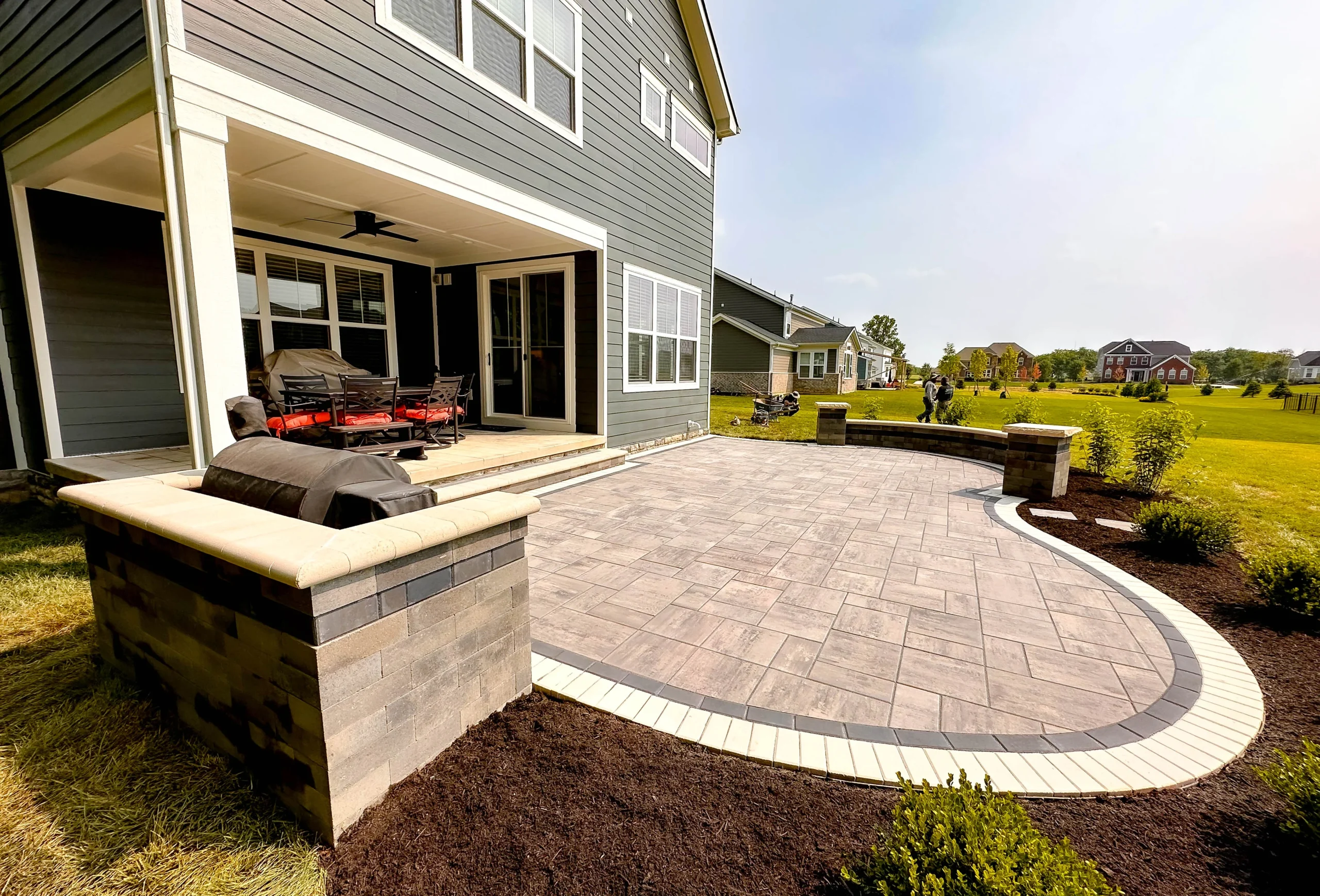
The actual product selection matters less than those three install details — but it matters. Techo-Bloc Blu 60, Belgard Dublin Cobble, Pavestone Holland Stone, and Techo-Bloc Industria are all compression-rated to 8,000+ PSI and carry lifetime limited warranties. We spec Techo-Bloc for 70% of Forsyth jobs because color retention holds longer under Zone 8a UV than most competitors we’ve torn out and replaced.
The Forsyth County permit reality: any patio over 144 square feet attached to a pool requires a permit. The county reviews 200+ pool-related permits per year, and the approval turnaround on a properly submitted paver patio plan runs 10-14 business days. Concrete slabs sometimes trigger additional stormwater review on lots over a half-acre because of impervious-surface calculations — which is another sneaky cost concrete adds that pavers (classified as pervious in most joint configurations) don’t.
How to Run Your Own Numbers Before the Salesperson Does
If you’re comparing bids this week, here’s the spreadsheet exercise that separates real 15-year value from day-one sticker price. It takes 20 minutes and it’s the single most useful filter on any contractor conversation.
Step 1. Get both bids on the exact same footprint — same square footage, same base spec, same drainage detail. Any bid that doesn’t itemize base depth in inches and compaction method is already a red flag. Ask for the base depth in writing.
Step 2. Add $3,000 to the concrete bid line item labeled Maintenance + Reseal + Year-12 Resurface Reserve. This isn’t hypothetical — it’s what the last 50 Forsyth concrete patios we’ve inspected actually needed.
Step 3. Ask both bidders to provide three local references from completed jobs at least 8 years old. Then drive by them. Concrete patios lie about their condition in photos. Pavers don’t — they look the same at year 8 as they do at year 1, or they don’t.
Step 4. Pull one recent Forsyth County appraisal in your zip code (Zillow estimates don’t count — you want an actual comp from a real sale). Check the improvement line items. If “paver patio” shows up and “concrete patio” doesn’t, the appraiser just told you which one the market pays for.
Step 5. Compare total 15-year spend minus resale recapture. Concrete: install + $3,000 reserve − $2,000 recapture. Pavers: install + $1,200 maintenance − $10,000 recapture. The paver answer will win by $4,000-$10,000 on any honest spreadsheet, and if it doesn’t, ask the concrete contractor to explain why their numbers don’t match the 18-month Forsyth County comp data.
The industry bias toward concrete patios comes from the fact that concrete is faster to install, easier to bid, and generates a higher gross margin per labor hour for the contractor. None of those reasons are good enough when it’s your backyard, your 15 years, and your closing table.
Paver patio installation across 20+ cities within 30 miles of Winder, GA
We install permit-ready paver patios across Forsyth County — Coal Mountain to Bethelview, Cumming core to Shoal Creek, with the 8-inch compacted base and polymeric-sand joint spec that separates 15-year investments from 6-year regrets.