
A client on Freemanville Road called us out to look at a pool project last spring with one stipulation. The pergola had to look like it had been sitting next to the 1998 Morton horse barn for twenty-five years — same stain, same roof pitch, same stone pier bases. What we built ended up reading as an extension of the barn itself, and it changed how we quote every equestrian estate in Milton.
The estate sat on 4.2 acres in the AG-1 zoning district north of Birmingham Crossroads, with a six-stall timber-frame barn anchoring the east edge of the property. The homeowner had spent $94,000 restoring that barn the year before — new cedar siding, Sikkens Cetol re-stain, standing-seam metal roof at a 10/12 pitch. When it came time to add a pool and an outdoor dining structure, her directive was clear. Nothing should look new. Nothing should look like a catalog kit. The pergola had to match.
That project kicked off what we now call our barn-match spec, and it’s become one of the most requested pergola builds in Milton over the last eighteen months. Homeowners in Cogburn Estates, King Estates, and The Manor Golf Club aren’t asking for pergolas anymore — they’re asking for structures that extend an architectural language already on the property. Below, we’re walking through exactly how we do it, what it costs, and why the rural character of Milton makes this the right approach for almost every estate build we touch here.
Why Milton Equestrian Estates Demand a Different Pergola Spec
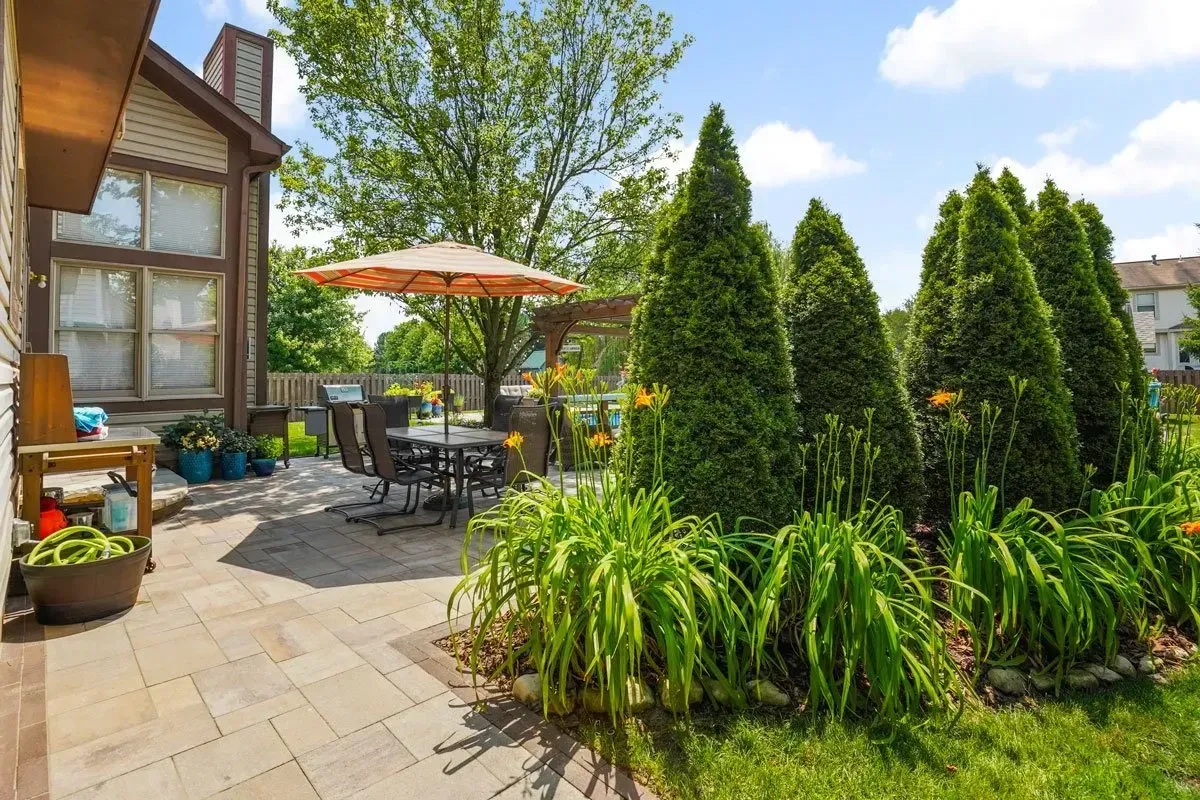
Most of the pergola work we bid across the Snellville and Dacula corridor lives on 0.3 to 0.8 acre subdivision lots. The pergola is a standalone feature. It sits near the pool, it holds up a ceiling fan and some string lights, and it doesn’t have to answer to anything else architecturally. That’s not the conversation in Milton.
Milton’s equestrian preservation ordinance requires minimum lot sizes of 1 to 3+ acres in the AG-1 zone, and the city’s incorporation as a separate municipality in 2006 means preservation review goes through City of Milton Community Development at 2006 Heritage Walk rather than through Fulton County. On paper that’s a 10-14 business day turnaround for standard permits — faster than the old county process. In practice, the structural review committee is stricter on visual compatibility for any accessory structure built within sightline of an existing barn, carriage house, or historic farmhouse. We’ve had pergola plans kicked back twice for reasons that had nothing to do with engineering and everything to do with roof pitch not matching the primary outbuilding.
That’s the shift. On a Milton estate, the pergola isn’t a standalone feature. It’s an accessory to a larger architectural story the property is already telling, and the review process enforces that whether the homeowner requests it or not. We’ve learned to bid that reality into every proposal from the first site walk.
Milton permit window: City of Milton Community Development typically issues accessory structure permits in 10-14 business days for AG-1 zoned parcels when the submittal includes elevation drawings showing visual compatibility with existing outbuildings. Submittals without those elevations routinely extend to 4-6 weeks.
The Four Specs That Make a Pergola Read as Barn Extension
After thirty-plus of these projects across Milton, we’ve narrowed the barn-match down to four non-negotiable specs. Get any of them wrong and the pergola reads as a detached kit structure regardless of how much you spend. Get all four right and it reads as if it was framed the same week as the barn.
1. Cedar stain match — half-shade tolerance. Every serious horse barn in Milton built in the last thirty years was finished with either Sikkens Cetol SRD or Cetol 1/23 Plus, almost always in Cape Cod Gray or Natural Oak. The stain weathers to a distinct warm silver-brown that’s hard to replicate with anything off a shelf at Home Depot. We pull a siding sample from the barn, color-match at the Sikkens distributor in Alpharetta, and apply two coats on the pergola’s cedar before install. Re-stain every 3-4 years at $1,200-$2,400 per application keeps the two structures aging at the same rate.
2. Roof pitch to the degree. Most pergola kits ship flat-top or at a shallow 3/12 pitch. Milton horse barns run 8/12 or 10/12 — steep enough to shed snow loads during the roughly 22 freeze events per year we get in USDA Zone 8a, and steep enough to read as a real roof from across a paddock. We copy the barn pitch exactly. If the barn is 10/12, the pergola is 10/12. Nothing splits the visual worse than a pergola sitting next to a steep-pitched barn with its own roof running flat.
3. Post dimensions at 8×8 minimum. The standard kit pergola runs 6×6 posts. On an estate lot where the barn is framed with 8×8 or 10×10 structural timbers, a 6×6 pergola post looks spindly and temporary. We spec 8×8 cedar minimum, and on the Manor and White Columns builds we’ve gone to 10×10 to match the barn framing dimension exactly.
4. Stone pier bases matching barn foundation. Almost every Milton horse barn sits on a dressed fieldstone or cut-stone foundation — Tennessee fieldstone is common, Crab Orchard stone shows up on the higher-end builds. We wrap the pergola’s post bases in the same stone type, usually 24 to 32 inches up the post. This single detail does more than any other to pull the pergola into the barn’s architectural family.
What a 16×24 Barn-Match Cedar Pergola Costs in Milton
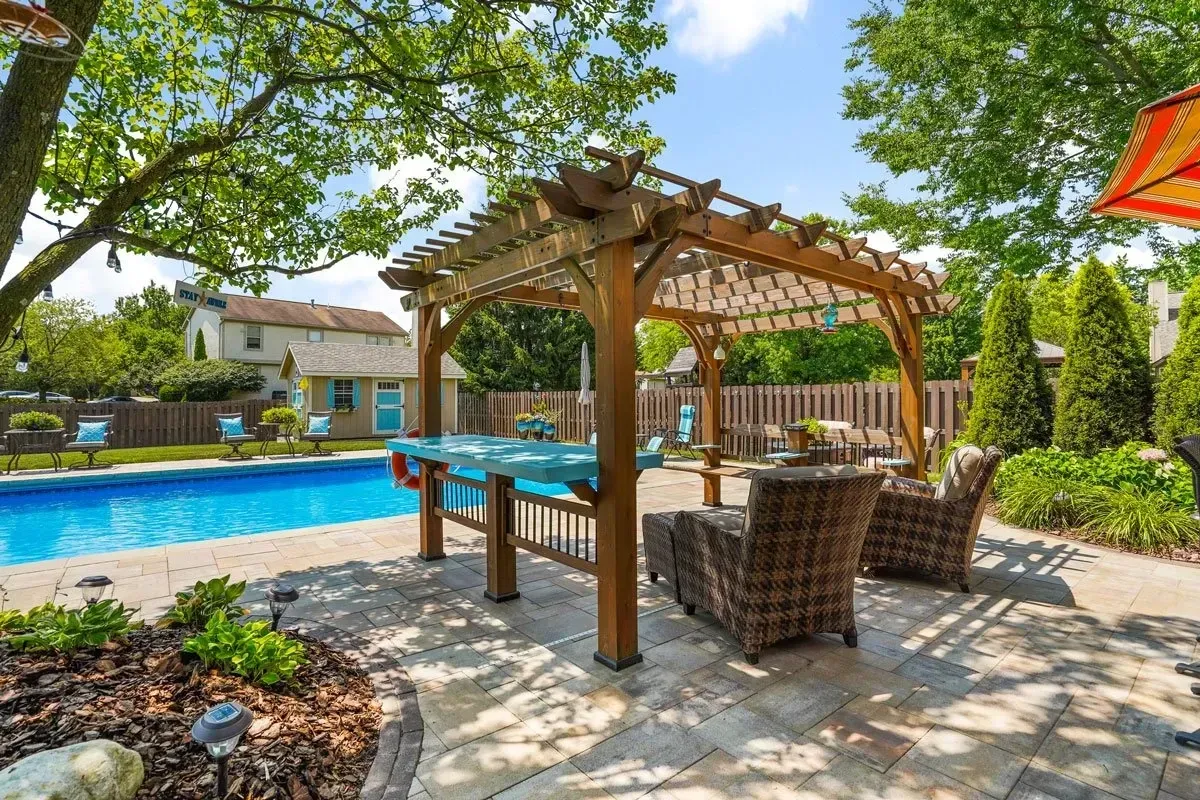
The project we referenced at the top — the Freemanville build — came in at $26,400 installed. That’s the middle of our range. On the broader Milton market, a 16×24 matching-style cedar pergola lands between $18,000 and $32,000 installed, depending on four cost drivers we walk every client through on the first site visit.
Driver one — cedar grade. We bid two tiers. Construction-grade rough-sawn Western Red Cedar runs the low end. Clear-vertical-grain (CVG) Western Red Cedar, which is what premium horse barns use for siding and trim, runs 40-55% more per board foot. On the Manor build in 2024, we used CVG because the barn was CVG — total pergola material cost came in at $14,200 versus $9,100 had we used construction grade.
Driver two — site access. Estate lots in Milton have 6-14 ft grade drops that subdivision lots don’t. If the pergola site sits below the barn on the downhill side of a creek corridor — and Milton has Cooper Sandy Creek, Chicken Creek, and Lake Creek tributaries cutting through a significant percentage of AG-1 parcels — we’re running the material drop at the top of the driveway and walking or side-by-side-hauling to the build site. Adds roughly $1,800-$3,400 to labor on the worst access sites.
Driver three — stone pier work. If we’re matching Tennessee fieldstone piers on all six posts of a 16×24, the stone package runs $3,800-$5,200 depending on the exact stone and the height of the wrap.
Driver four — permit and review. Straightforward AG-1 parcel, ten-day turnaround, $340 permit. Parcel sitting inside The Manor Golf Club requires both Milton permit and the internal Manor architectural review committee — typically 4-5 weeks of additional review time, and we budget two rounds of revision drawings into the proposal.
Total installed range — 16×24 barn-match cedar pergola: $18,000 (construction-grade cedar, simple pier bases, easy access) to $32,000 (CVG cedar, full Tennessee fieldstone wrap, Manor architectural review, difficult grade access).
Integrating Pergola, Pool, and Paddock Sightlines
The single biggest mistake we see on Milton estate builds — almost always from contractors who normally work subdivision lots down in South Fulton or Gwinnett — is siting the pergola without thinking about the paddock. On an equestrian estate, the owner spends an enormous amount of time on horseback or watching horses in the ring. The pergola can’t block that sightline. It also can’t be sited so far off the house that it breaks the visual connection between the entertaining area and the barn.
We run a sightline study on every Milton estate project before we stake the pergola. It takes maybe two hours with a transit, some flags, and the client walking us through where she rides, where the horses go out in the morning, and where the farrier parks. From that we pick a pergola location that does three things. One, it preserves the line from the main house kitchen window out to the primary paddock. Two, it frames the barn rather than blocking it. Three, it sits close enough to the pool that guests using the pool don’t feel disconnected from the covered dining area.
On the Crooked Creek project we did in late 2024, that study moved the pergola eighteen feet north of where the client originally wanted it. The view from her kitchen window to the north paddock stayed open. The barn became a backdrop to the pergola instead of a thing being blocked by the pergola. Those eighteen feet probably saved the project from looking wrong for the next thirty years.
We also think hard about prevailing wind — Milton’s ridgelines catch afternoon winds off the west, and a pergola that’s oriented wrong pulls grill smoke directly into the outdoor dining area every summer evening. Standard fix is orienting the ridge north-south when the house and pool allow it, which also gives east-west shade patterns that track the sun through dinner hour.
Why Maintenance Economics Favor Cedar Over Everything Else
We get asked about aluminum pergolas and composite pergolas on almost every Milton bid. Homeowners have seen them on YouTube, they look maintenance-free in the brochure, and the material pitch is compelling — no staining, no warping, no replacement. For a Milton equestrian estate, though, the math almost always breaks toward cedar, and it’s worth walking through why.
An aluminum pergola looks like an aluminum pergola. It does not patina. It does not age into the architectural language of a 1998 cedar barn. The visual disconnect is permanent, and on a $3M+ estate property where the barn itself is often appraised separately at $300K-$500K, the aesthetic cost of that disconnect is significant.
Composite pergolas — the ones using extruded PVC wrap over structural steel — solve the aesthetic issue for about five years. After that, the UV degradation on Milton’s south and west exposures starts to chalk the PVC surface, and the color drifts away from the original match. We’ve been called to replace three composite pergolas in Milton in the last two years that were less than eight years old.
Cedar, properly spec’d and re-stained on a 3-4 year Sikkens cycle, has a functional lifespan of 25-35 years in Milton’s climate. The re-stain costs $1,200-$2,400 per application. Run that over 30 years and you’re looking at roughly $12,000-$24,000 in maintenance — against a cedar pergola that’s actively gaining visual weight and authenticity year by year, aging into the barn instead of drifting away from it.
30-year lifecycle math: Cedar pergola $26,400 build + $18,000 lifetime re-stain ($2,000 x 9 applications) = $44,400 total. Aluminum pergola $31,000 build + $0 stain + one panel replacement around year 20 at $6,500 = $37,500 total. Cost difference: $6,900 over 30 years, or roughly $230/year — for a structure that reads as part of the estate architecture rather than an appliance dropped next to the pool.
Soil, Footings, and What Milton’s Saprolite Means for Pergola Foundations
One piece of the barn-match spec that rarely gets discussed upfront is what happens underground. Milton sits on Cecil clay over weathered granite, with thicker topsoil in creek bottoms and thinner residuum on the ridgelines. During pool excavation, we occasionally hit saprolite shelves — partially decomposed granite that behaves neither like soil nor like rock, and that can force a re-engineered footing strategy mid-project.
For pergolas, the implication is straightforward. On a ridgeline lot in Cogburn Estates or King Estates, we often hit saprolite within 30-42 inches of grade when we dig footings. That’s actually good news for the pergola — it means we’re setting posts into a dense, high-bearing-capacity material. Standard footing spec is a 24-inch diameter by 42-inch deep concrete pier with a galvanized post base anchor. We up-spec to 30-inch diameter on the 10×10 post builds and on any parcel where we expect significant wind loading off the west ridges.
On the creek bottom lots — the ones that sit along Cooper Sandy Creek or closer to the Etowah River tributaries up in north Milton — we’re usually in thicker topsoil with higher organic content and wetter subsurface conditions. The footing spec there goes deeper, typically 54 inches, and we use a sonotube with a bell bottom to get better bearing on the wet clay. Chicken Creek floodplain parcels also require us to verify with Milton Community Development that the pergola site sits outside the 25-75 ft creek-buffer setback depending on the named tributary — failure to verify has killed two projects we bid in 2023.
None of this shows up in the finished pergola. The client sees posts and stone. But the footings decide whether the pergola is still plumb in year twenty-five, and on a Milton estate where the pergola is meant to age alongside a barn built thirty years earlier, year-twenty-five plumb is the whole game.
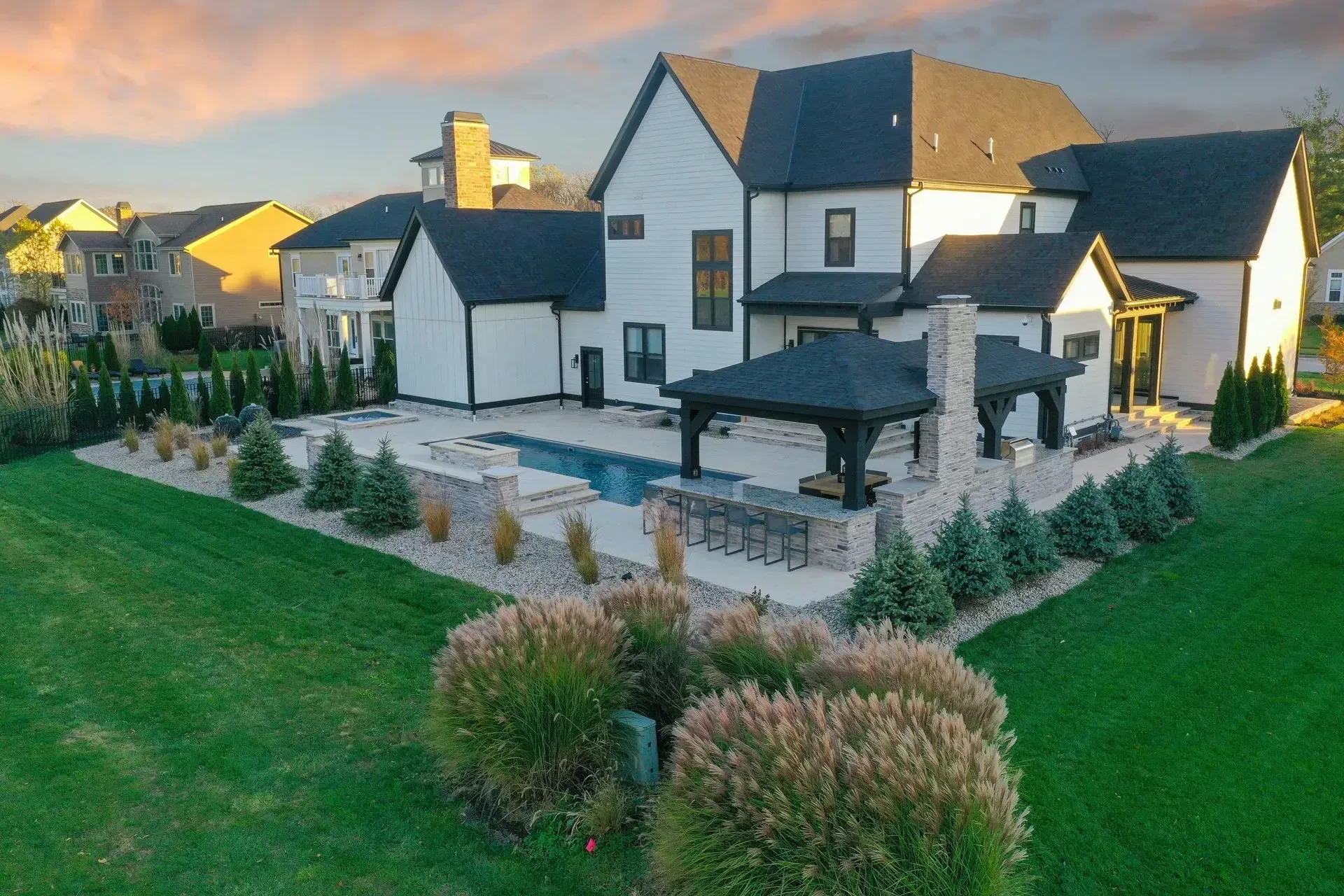
The Freemanville Project — From First Walk to Final Stain
To pull all of this together, here’s how the Freemanville project ran from start to finish. The client called us in March of 2024 after interviewing three other contractors. Her original brief was a 14×20 pergola “that matched the barn.” Total budget line she had in mind: about $15,000.
First site walk took two hours. We walked the property with her, studied the 1998 Morton barn, identified the original Sikkens Cape Cod Gray stain on the siding, measured the 10/12 roof pitch, and pulled dimensions off the existing 8×8 post framing on the barn porch. We also ran the sightline study from her kitchen window to the primary paddock and the round pen, and flagged a location that preserved both views.
Back in the office, we bid three options. The $15K option was honest — construction-grade 6×6 cedar, 3/12 pitch, no stone piers, concrete footings only, 14×20 footprint. We wrote in the proposal that this structure would not match the barn and would look like a detached pergola next to an estate barn. The $26,400 option was the barn-match — CVG-adjacent cedar, 10/12 pitch, 8×8 posts, Tennessee fieldstone piers, 16×24 footprint. The $38,000 option was a covered pavilion with standing-seam metal roof that would match the barn roof material as well as architecture.
She picked the middle option. Permit submittal went to Milton Community Development with elevation drawings showing the visual compatibility with the existing barn — approved in 11 business days. Construction took five weeks including stone pier work. Final stain happened in a tight 72-hour window between two rain events. Eighteen months later, the pergola already reads like it’s been next to the barn for a decade.
That’s the barn-match approach, and it’s the reason we’ve narrowed our Milton estate pergola work almost entirely to this spec. It costs more than a kit pergola. It takes longer. It requires specific stain matching, specific stone sourcing, and a sightline study most contractors don’t run. But on an equestrian estate where the barn is the defining architectural element on the property, the pergola has to answer to the barn or it doesn’t belong there at all.
Cedar pergola design and build across 20+ cities within 30 miles of Snellville, GA
Whether you’re matching a 1998 timber-frame barn in Milton or integrating a pergola with a new pool and outdoor kitchen across the broader metro, we engineer every structure around the architecture it’s answering to.