
A homeowner in Laurel Springs walks us through her back lawn on a Tuesday in October. She wants an outdoor kitchen for Thanksgiving. She has two quotes on her counter — one for a cedar pavilion with tongue-and-groove ceiling at $64,000, one for a 14 x 20 StruXure aluminum louvered roof at $41,000. She asks the question every premium Suwanee owner eventually asks us: which one will I actually use more?
We hear this in every estate-scale backyard between Settles Bridge and The River Club. The budget can go either way. The HOA usually approves either one. The grill, the fridge, and the ledgestone base are identical across both quotes. What changes is the roof overhead — and the roof is where the argument lives.
This post is the answer we give when a Suwanee homeowner sits down at our table with two quotes and asks us to stop selling and start telling the truth. Cedar is warmer, louvered is smarter, and the right answer depends less on the aesthetic you like at noon and more on how you actually live outside in Gwinnett’s shoulder seasons. We’ll break down real cost, real ARB approval timing at Laurel Springs, real usage data from the owners we stayed in touch with — and a small number of Jackson EMC wiring details nobody quotes until the permit is pulled.
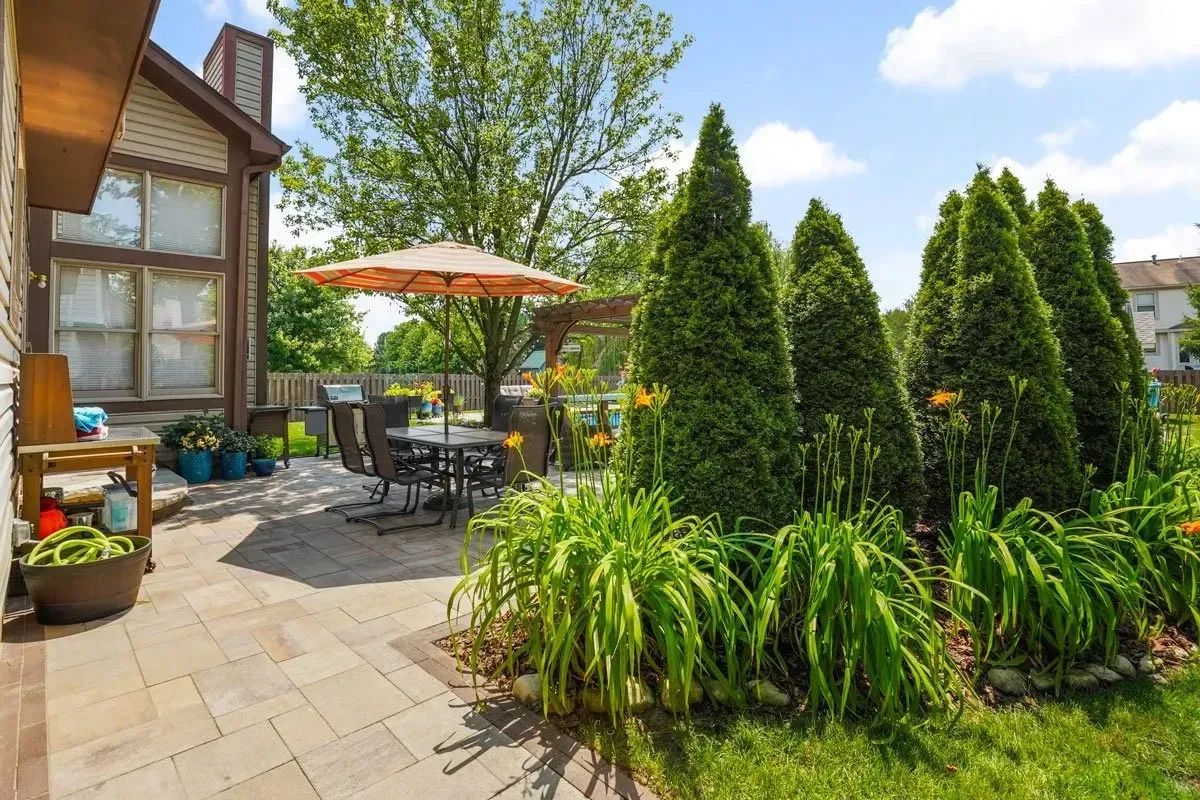
The Two Quotes Every Premium Suwanee Owner Gets
We operate across Gwinnett County every day, and Suwanee is where the same two quotes keep landing on the same kitchen counter. The cedar option runs roughly $48,000 to $78,000 delivered, depending on span, post count, and whether you’re going with a simple gable or a stepped hip with a cedar tongue-and-groove ceiling. The aluminum louvered option runs about $32,000 to $52,000 for a comparable 14-by-20 footprint from StruXure, Renson, or Struxure Outdoor Living.
Those ranges are not builder markup games. They reflect real material math. Clear-grade western red cedar at the dimensions we build with — 6×6 posts, 6×14 beams, 2×8 rafters, 1×6 tongue-and-groove decking above — runs close to $9 a board foot right now at the specialty lumberyard off Buford Highway, plus finish carpentry labor that is not cheap. A StruXure Pergola X in the same span, by comparison, is a factory-engineered product; the price includes motor, louver, flashing, and the structural calcs that a Gwinnett plan reviewer wants to see.
The three numbers that move the cost of either one the most are span, attachment, and roof complexity. A freestanding cedar pavilion in the middle of a River Club lawn, 16 by 24, with a cedar T&G ceiling, is going to live in the $68,000 to $78,000 zone. Attached to the back of the house, with a hip roof that ties into the existing gable, it can land in the low $50,000s. The louvered side is flatter — about $2,800 per linear foot of louver bay for the better systems, plus installation.
Real Suwanee budget ranges (2026): Cedar pavilion, 14×20, T&G ceiling, stained: $48,000–$68,000 attached / $58,000–$78,000 freestanding. StruXure or Renson louvered, 14×20, motorized + rain sensor: $32,000–$42,000 attached / $38,000–$52,000 freestanding.
Laurel Springs ARB — What Actually Gets Approved
The Laurel Springs architectural review process is, in our experience, the strictest in Gwinnett. Submissions go through the community’s design committee with a typical turnaround of three to four weeks, and the committee’s preference leans toward materials that read as traditional and site-built. A cedar pavilion with dimensional trim and a shake-friendly roofline almost always sails through. We have never had one rejected in Laurel Springs.
Louvered aluminum is a newer conversation. Five years ago, most Gwinnett ARBs would red-mark it on sight. That has changed. StruXure, Renson, and the better Struxure Outdoor Living systems now come in powder-coat color matches — bronze, matte black, clay — that the Laurel Springs committee has approved in the last 18 months on at least six projects we know of. The submission needs to include a material sample, a powder-coat chip, a rendered elevation, and a note on whether the roof opens toward the street. That last detail matters. If the louvered roof is visible from a public road in the neighborhood, the review takes longer.
The Bear’s Best Atlanta estates and the River Club both sit under separate review processes, and both have approved louvered within the last two years. Smaller Suwanee subdivisions like Village Grove, Highgrove, and Woodbury generally don’t have ARB restrictions at that level — permits go through Gwinnett County Department of Planning and Development at 446 W. Crogan St., Lawrenceville, and that’s it.
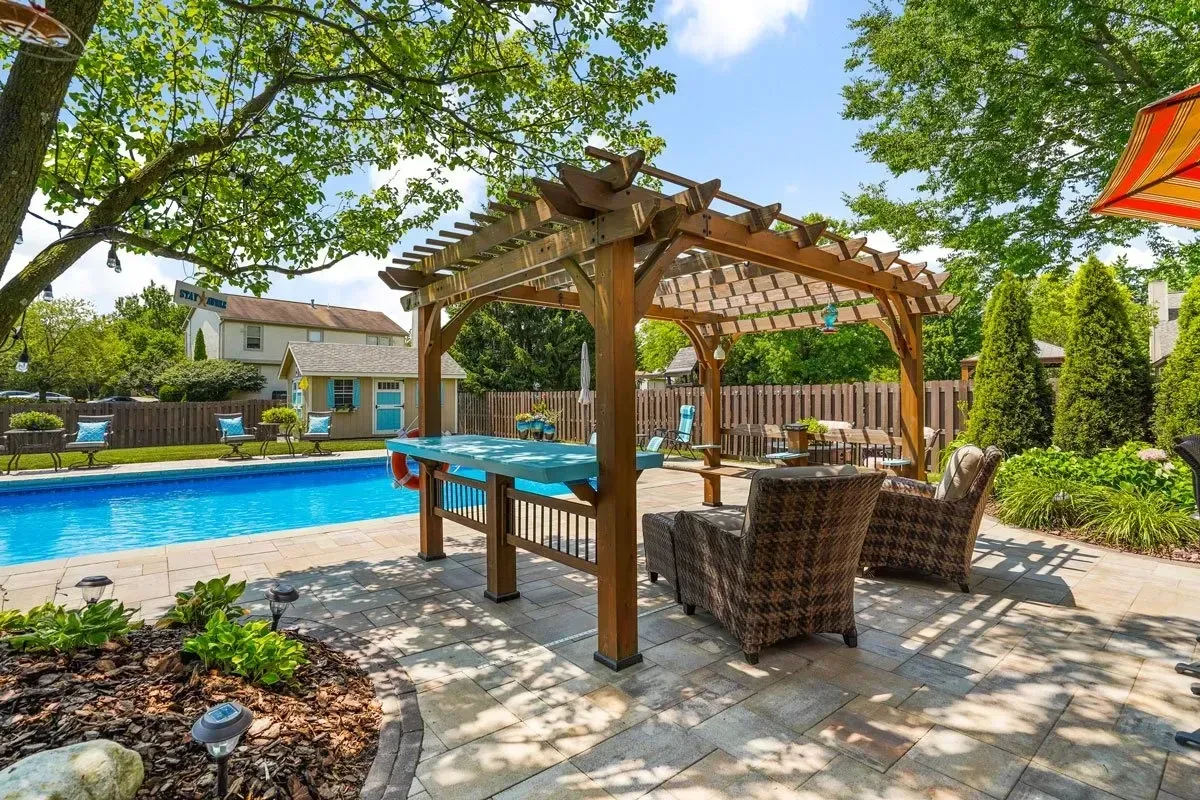
The Usage Data — What Premium Owners Actually Do
We stay in touch with the owners we build for. Over the last four years we’ve kept informal notes on how often people actually use these structures, broken out by roof type. The numbers surprised us enough that we started asking the question on every follow-up visit.
Cedar pavilion owners in Suwanee use their outdoor kitchen, on average, about 42 evenings a year for full dinners, plus another 30 or so afternoons for grilling or quick use. Louvered aluminum owners, same class of home, same kitchen spec, same proximity to the pool — around 78 evenings a year. That’s nearly double.
The difference is entirely weather flexibility. A cedar pavilion is a fixed roof. It’s beautiful. It works in rain and dappled sun. But on a 94-degree late-July afternoon, the cedar holds heat under the T&G ceiling and the space gets muggy. On a 50-degree November evening, the open gable lets the warmth of a radiant heater escape. A louvered roof solves both — you close it tight and crank the heater, or open it flat to vent grill smoke.
The rain-sensing closure on a StruXure roof is the feature most Suwanee owners tell us they never thought mattered until they had it. A Chattahoochee River fog morning that breaks into an afternoon thunderstorm — common in September and October around Fowler Park and George Pierce Park — triggers the roof to close before the cushions get wet. A cedar pavilion with open-beam sides is also dry, to be clear. But it doesn’t adjust. And the ability to open the roof flat for grill ventilation on a hot night is, in owner interviews, the single most-mentioned convenience.
Wind, Snow, and the Jackson EMC Question Nobody Asks
Both structures have to meet Gwinnett County structural code. The current code requires 90 mph wind load and 20 psf snow load in this zone. Cedar pavilions, built with 6×6 posts embedded in 30-inch concrete piers and proper hurricane strapping at the ridge, clear that spec comfortably. StruXure Pergola X is rated to 140 mph wind closed and roughly 40 psf snow load closed — well over code.
What matters more in Suwanee than the raw numbers is the anchoring detail. On Laurel Springs lots sloping toward the creek, and on the handful of Settles Bridge properties that sit inside FEMA Zone AE near the Chattahoochee floodplain, the pier depth and lateral bracing calc get more attention from the county reviewer. A freestanding cedar pavilion on those lots often needs 42-inch piers instead of the standard 30. The louvered system handles it through engineered base plates — no change in the quote.
The utility question is the one almost no contractor raises before signing. Suwanee is served by Jackson EMC, not Georgia Power. That matters because Jackson EMC’s service panel practices for backyard subpanels are different — cleaner, in our experience, but with a few quirks. For a louvered roof with a motor, a rain sensor, LED uplighting, and a ceiling heater, you’re pulling a dedicated 20-amp 120V circuit for the motor plus a 30-amp 240V for the heater. Jackson EMC’s underground service to most Laurel Springs lots is already sized for that, but the subpanel in the pool equipment pad needs to be confirmed before the kitchen scope is locked. We’ve had three Suwanee projects where a subpanel upgrade added $1,800 to $2,400 that the original quote didn’t include — always on the louvered side, because the cedar option pulls less power.
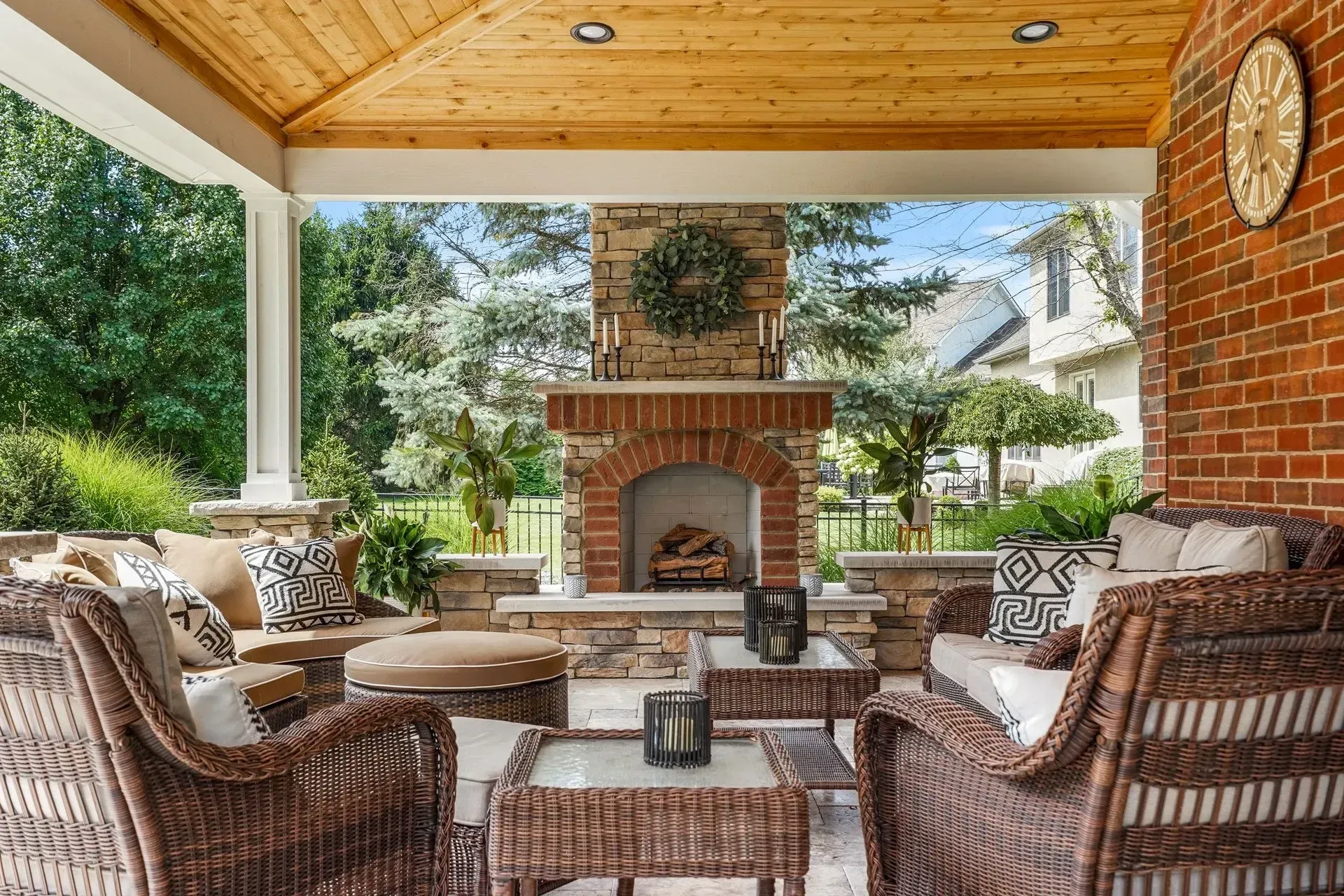
The Cedar Case — When We Recommend It
We don’t build louvered roofs every time. There are four conditions in Suwanee where cedar is the right answer, and we’ll tell a client that directly before they commit.
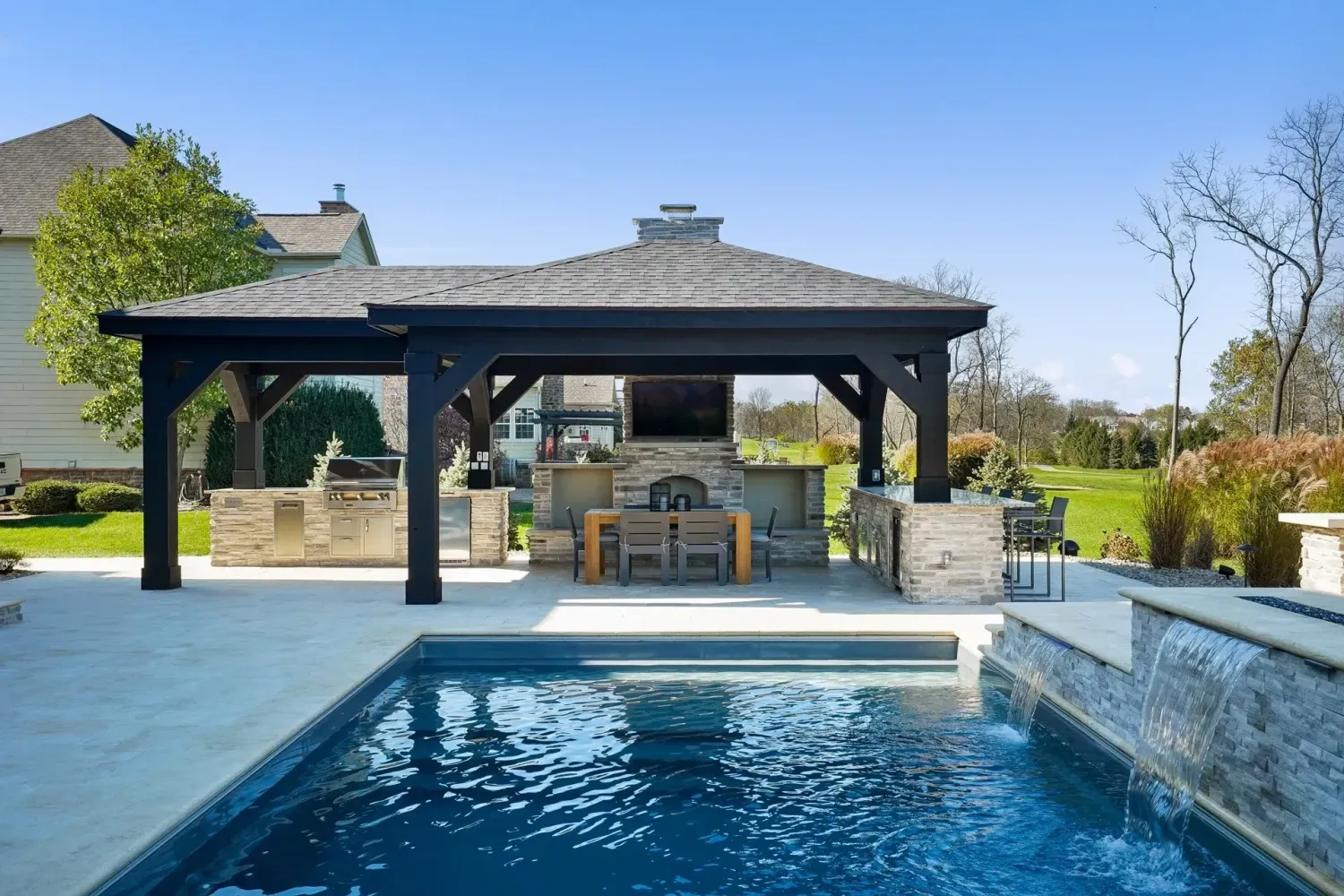
First, if the home is a traditional brick or stone-veneer build — which describes most of The Manor, the older Laurel Springs sections, and the estate lots in River Club — a cedar pavilion with matching trim details reads as architecture. An aluminum roof, even in a powder-coat bronze, reads as equipment. On resale in the $1.4M-plus band that dominates those pockets, the cedar option holds its perceived value better.
Second, if the outdoor kitchen is primarily a social-entertaining space rather than a daily-use space, cedar wins. Someone who hosts four big dinners a year for 20 people wants the ceiling, the warm cedar tone, and the pendant lights you can hang off a real beam. The weather flexibility that drives louvered usage numbers doesn’t matter at that scale of use.
Third, if the owner wants a ceiling fan, recessed cans, and hanging pendants — the full-ceiling lighting package — cedar is simpler. Louvered systems accommodate lighting now, but the fixture placement is constrained by the louver bays. If you want a 60-inch paddle fan dead center over the island, cedar gives you cleaner options.
Fourth, if the ARB process is uncertain and the owner wants a short approval timeline. We already noted Laurel Springs has approved louvered, but a stone-veneer cedar pavilion with a shake-pattern roof is the fastest guaranteed approval in any strict ARB in Gwinnett. If someone wants ground-broken in 30 days, cedar is the safer path.
When cedar wins in Suwanee: traditional architecture, entertainment-first use, full-ceiling lighting package, tight ARB timeline, and primary weather pattern is sun rather than heat.
The Louvered Case — Why We Increasingly Recommend It
Over the last two years the louvered recommendation has moved from “consider it” to “probably the right call” for most Suwanee premium projects. Here’s the shift.
On the USDA Zone 8a calendar we actually have — summer highs in the 90 to 94 range, roughly 20 freeze events a year, ~52 inches of rainfall including the late-afternoon convective storms that stack up along the Chattahoochee corridor — the louvered roof extends the usable season on both ends. March through November becomes functional outdoor-dining weather. Cedar gives you May through October for full use.
The smart-control layer matters more than we expected. A StruXure system pairs with a phone app, and more importantly, it integrates with the Jackson EMC-fed smart home systems that are already running on most of these homes. Opening the roof from inside the kitchen while the steaks are still on the grill, closing it remotely when a storm is forecast, scheduling the louvers to open at sunrise — those are small conveniences that add up to the 78-evening-a-year usage pattern.
Maintenance is often misunderstood. A cedar pavilion needs restaining every three to four years in Suwanee’s humidity, plus beam inspections for rot at the post-to-pier transitions. A louvered roof needs the louver pivots greased once a year, the drainage channels cleared in fall, and the motor checked at the same interval. Neither is hands-off. The cedar cost over 20 years, in our experience, runs higher than the louvered cost over 20 years — about $6,000 to $9,000 more in total maintenance.
The resale story is also changing. Three years ago, a louvered roof was a neutral — buyers didn’t know what it was. Today, in the $900K-and-up Suwanee market, we’re starting to see listings specifically call out StruXure or Renson roofs as features. The feature is becoming a draw rather than a curiosity.
How We Decide for Suwanee Homeowners
When a Suwanee homeowner sits down with us and two quotes, the conversation is the same five questions every time. We ask them in this order.
How often will you actually eat out here between November and March? If the answer is “rarely,” cedar is fine. If the answer is “we want to, and that’s kind of the point,” louvered. The shoulder seasons are what separate the two products.
Is your home traditional or contemporary? A stone-clad traditional in the older Laurel Springs sections calls for cedar. A transitional or contemporary build in Highgrove or The Preserve reads better with a powder-coat aluminum louvered system in matte black or bronze.
What’s the approval window? If someone wants to break ground in 30 days and ARB is the long pole, cedar removes risk. If the project timeline is already four to five months out, louvered has time to clear approval.
What is the owner’s relationship with the thermostat? This sounds like a joke and isn’t. People who run the AC at 68 in summer and the heat at 74 in winter are exactly the people who want a louvered roof outside. They’ll close it and run a heater. People who are comfortable at 76 year-round don’t need it.
What’s the equipment delivery path? Cedar arrives on a lumberyard flatbed and unloads by forklift. A louvered system arrives in crated sections and needs a small crane or heavy forklift for the larger spans. Most Suwanee lots can accommodate either, but on the tighter driveways off Peachtree Industrial Boulevard and the older Suwanee proper pockets, the cedar path is simpler.
Our default recommendation, 2026: For a Suwanee homeowner who uses the space more than 60 evenings a year and has no tight ARB timeline, we lead with a louvered aluminum roof in a powder-coat finish that matches the home’s trim. For an entertainment-first owner on a traditional estate in Laurel Springs or River Club, we lead with cedar. Either answer is defensible; the wrong answer is the one that doesn’t match the actual usage pattern.
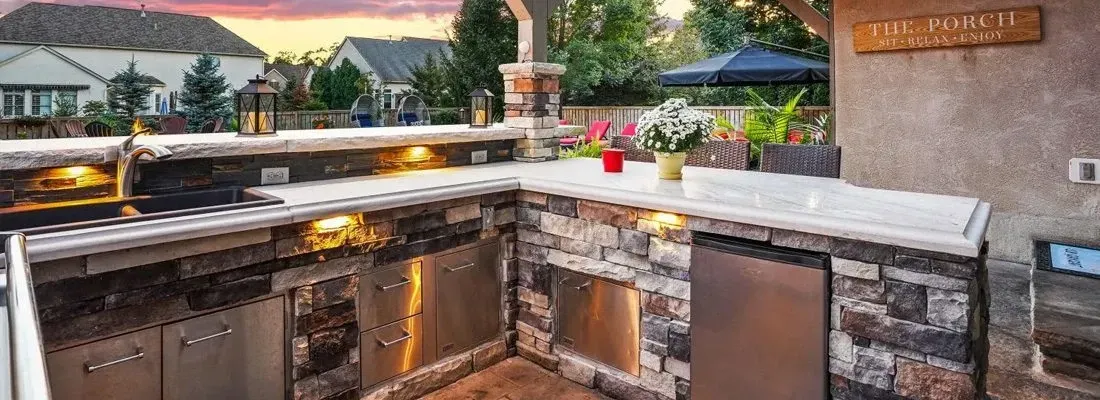
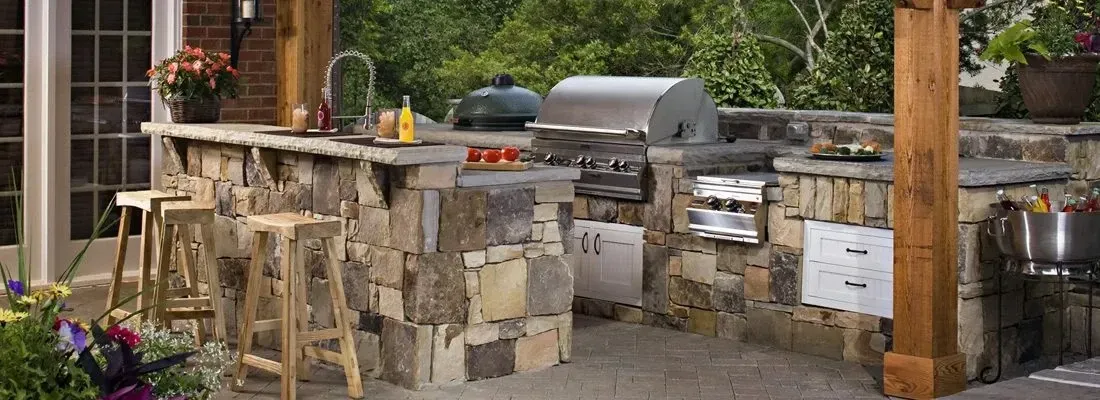
Whichever direction the project goes, the kitchen underneath is the same set of decisions we walk every Suwanee homeowner through — a Techo-Bloc ledgestone base, dark granite counters, built-in 32-inch stainless grill, side burner, refrigerator, and the option for a pizza oven or Kamado insert. The cabinetry, the lighting, the gas line from the meter, the plumbing to the sink — all identical. What you’re really choosing between cedar and louvered is a 20-year pattern of how many times you’ll actually sit down under it.
Outdoor kitchens across 20+ cities within 30 miles of Winder, GA
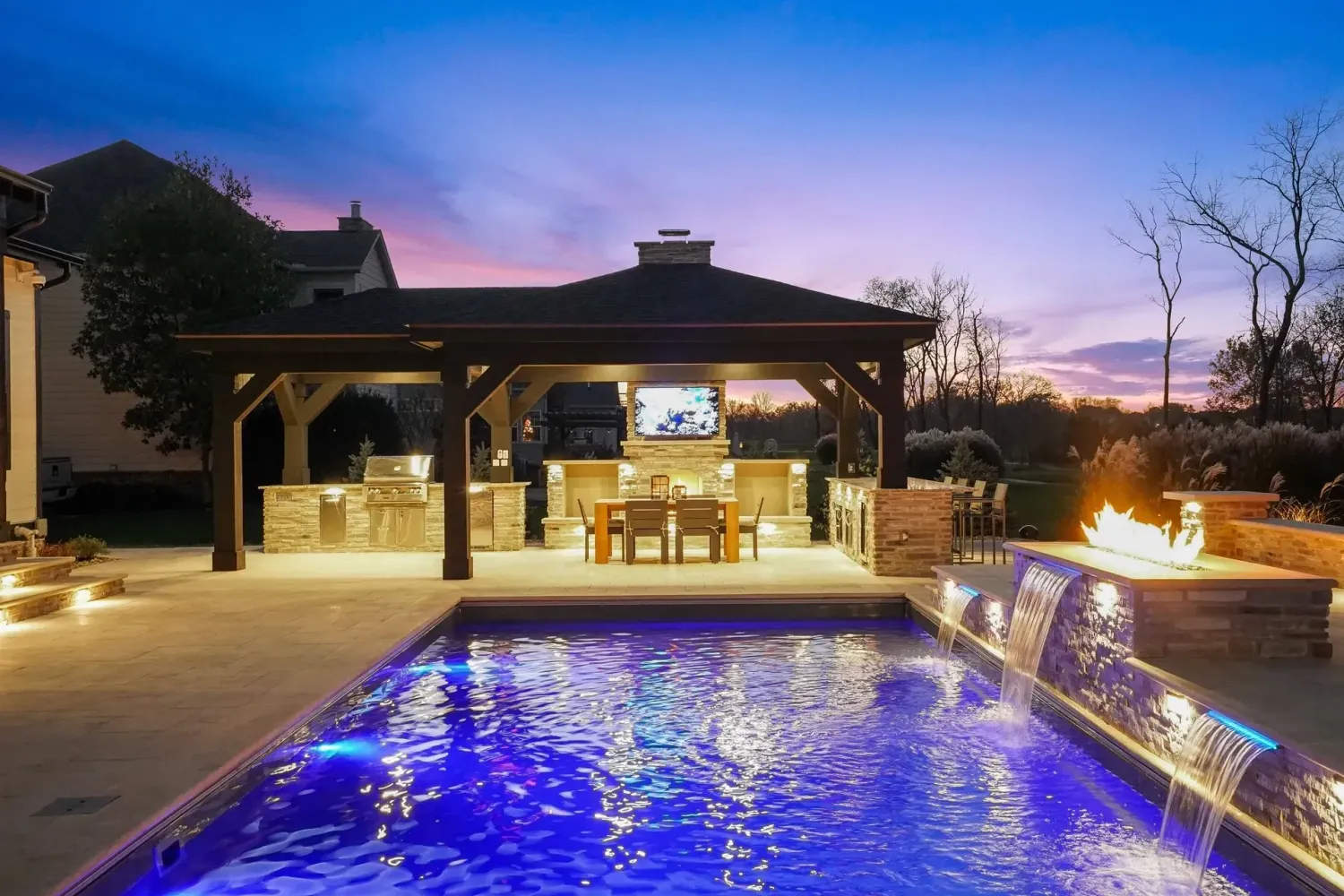
Cedar pavilion or louvered aluminum, we build both to the same spec in Suwanee, Laurel Springs, River Club, and every Gwinnett neighborhood in between.