
Every other Cumming homeowner who calls us about an outdoor kitchen already owns a ceramic kamado or a pellet smoker — and they’ve already decided the new island has to swallow it whole. The argument isn’t BGE vs Traeger. The argument is which one your kitchen, your lot, and your Sawnee EMC service can actually host without fighting you for the next decade.
We’ve integrated both into pavilion kitchens from Vickery to St. Marlo to Polo Fields, and the rough split across Forsyth County sits at about 60/40 in favor of Big Green Egg — but that tilt reverses fast once you look at who’s cooking how often and who wants what on the counter. Traeger owners in Cumming cook an average of 1.8 times per week. BGE owners cook 2.2. That gap drives the entire design decision downstream of it.
This post is a direct, contrarian take on the integration question. We’re not going to tell you which cooker is better — that debate is exhausted. We’re going to tell you what each one demands from your island, your roof, your electrical panel, and your HOA, so you pick the one your backyard can actually carry.
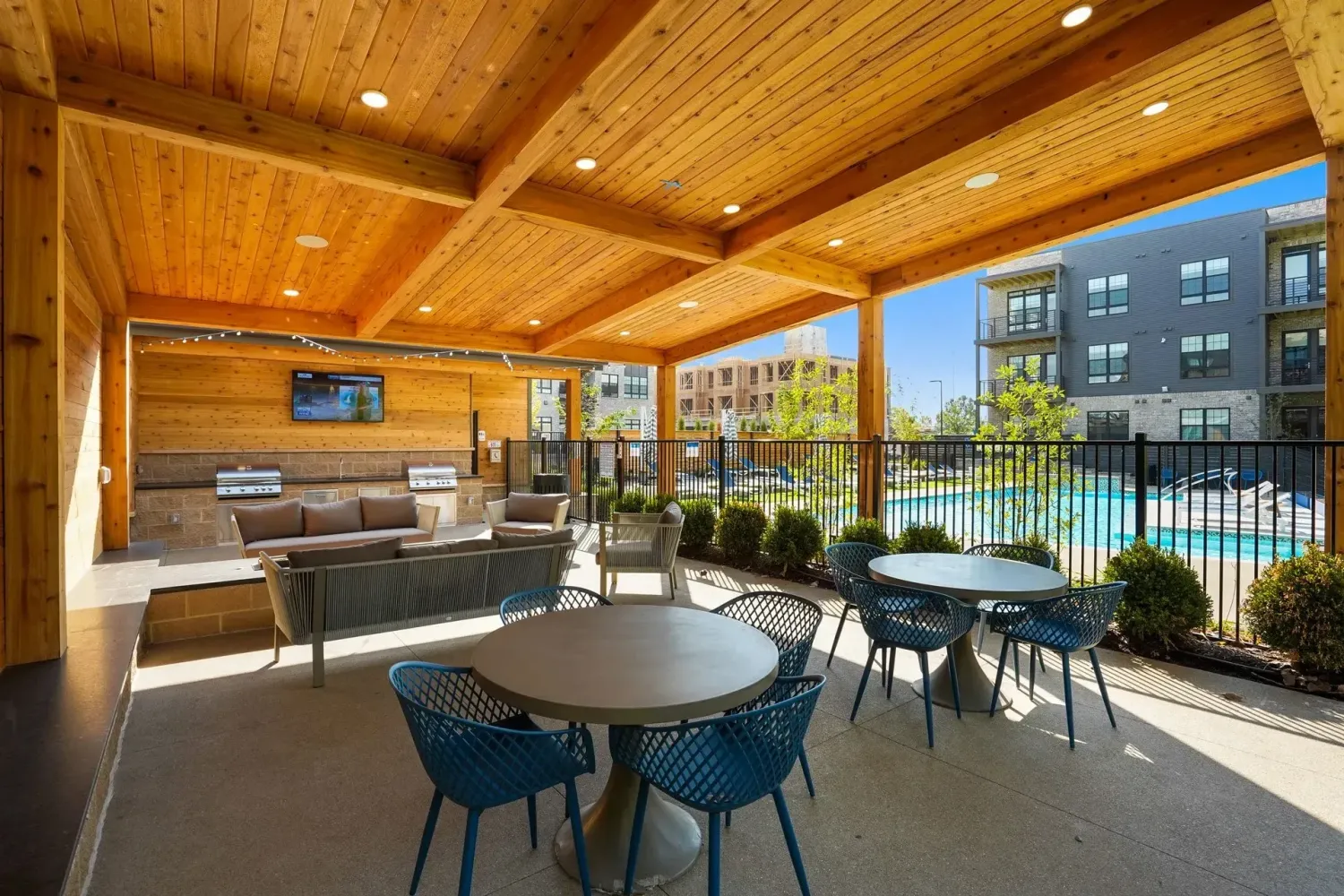
Is It Really BGE vs Traeger, or Is the Real Question Integration Load?
Ask ten contractors whether a Big Green Egg or a Traeger Ironwood XL is the better cooker and you’ll get ten opinions shaped by which one they personally own. That’s not useful. What matters is integration load: the set of non-negotiable demands each unit makes on the island framing, the countertop cutout, the ventilation strategy, and the electrical rough-in.
A Big Green Egg sitting in a purpose-built island isn’t a grill — it’s a 200-pound ceramic furnace that hits 750°F on the dome and needs an 8-inch air gap on every side. Drop it into a stock countertop cutout with no shielding and you’ll cook the wood around it for the first two seasons before the substrate fails. We’ve seen islands in Haw Creek and Three Chimneys with carbonized plywood substrate pulled out at year four because the original installer ignored clearance.
A Traeger, by contrast, is a plug-in appliance. It doesn’t radiate the same heat, but it demands a dedicated 20A NEMA 5-20R outlet within six feet of the cabinet location, a weatherproof in-use cover, and dry pellet storage that stays under 15% relative humidity — which, next to Lake Lanier, is not trivial in August. Those are two fundamentally different engineering problems dressed up as the same counter decision.
The confusion comes from retail showrooms that display both cookers side by side on polished slab and make them look like drop-in equals. They are not equals, and any contractor who treats them as interchangeable line items on a quote is going to miss the spend that makes the install actually work. We’ve walked into year-three failures in Vickery and Hampton Park where the previous builder treated a Big Green Egg like a Weber kettle with a fancier lid — no heat shield, no vent, no flared cutout — and the homeowner was paying for a full island rebuild by the time they called us.
The real clearance spec for a built-in BGE Large: 8 inches of non-combustible material on every side of the ceramic body, with a flared top opening so the gasket sits proud of the countertop. Written into the contract. Not “we’ll figure it out on site.”
What Does a Big Green Egg Integration Actually Demand from the Island?
A Big Green Egg built into a Cumming outdoor kitchen isn’t a drop-in. It’s a structural decision that starts at framing. The cooker weighs between 162 and 219 pounds depending on size (we do mostly Large and XL in this market), which means the island can’t be stick-framed 2×4 with cement board. It needs a steel-stud skeleton or a CMU block core, and the bay cutout itself needs heat shielding — typically a steel heat shroud or a ceramic fiber blanket bonded to the cutout face.
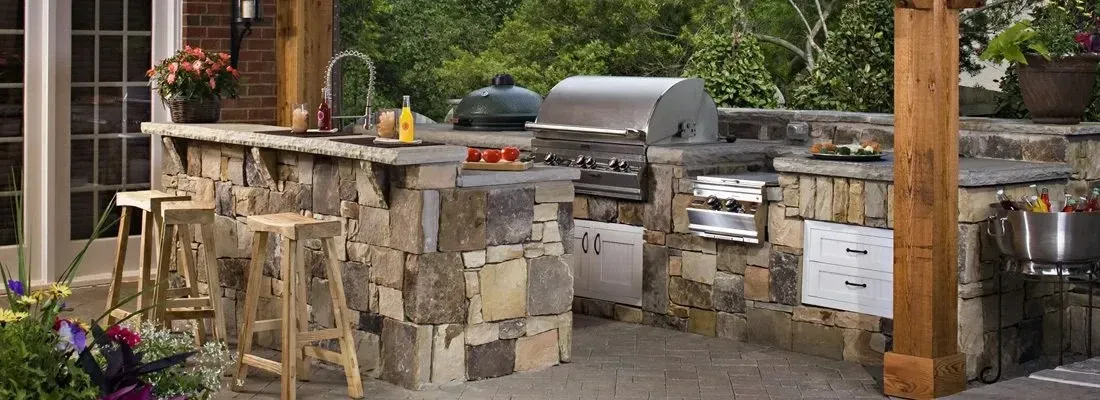
The countertop cutout matters as much as the bay. BGE publishes a template, and every serious stone fabricator in the metro — we use Granite Depot in Buford most often — already has the dimensions cached. The mistake isn’t cutting too small. The mistake is cutting too clean, without the flared rim BGE specifies, which causes the dome gasket to bind on the edge every time you open the lid. One year of that and the gasket is toast.
Ventilation is where the budget conversation gets real. Under a solid pavilion roof, a kamado still pushes enough heat upward over a long low-and-slow cook that you need either a louvered soffit vent or a dedicated mushroom vent cap in the ridge. On a standard 12′ x 14′ pavilion we spec a 6-inch static roof vent plus a gable louver. That’s another $400-$700 in framing and sheet-metal work most quotes never mention.
What a real BGE integration costs in Forsyth County
Built correctly, a Big Green Egg integration — meaning steel-stud framing, ceramic fiber heat shield, flared countertop cutout, and proper pavilion ventilation — adds $3,800 to $5,600 on top of the base island cost in the Cumming market as of 2026. The cooker itself is separate. That number catches people off guard, which is why we put it in writing before any stone goes in.
What drives the range? The bottom of the band is a BGE Medium in a 9-foot straight run with buff ledgestone veneer and a flamed granite cap. The top is a BGE XL in an L-shape with a mitered waterfall edge, integrated ash drawer, and a painted-to-match chimney cap penetrating the pavilion ridge. The XL integration adds about $1,200 in extra ceramic fiber blanket and another $600 in steel flashing work because the dome clearance geometry is more aggressive. Either way, the number includes the heat shield and the pavilion vent — two items that don’t show up on most competing quotes, which is how you end up comparing a $12,000 bid against an $18,000 bid on what looks like the same island.
How Is Traeger Integration Different — and Why Is Electrical the Real Cost?
Traeger integration is the opposite kind of problem. There’s no heat clearance conversation to speak of — the unit is a sealed steel chamber with insulated walls and the exterior rarely breaks 140°F during a long smoke. What a Traeger needs is electricity, pellet management, and a covered cabinet bay that the unit can slide into and out of without wrestling.
The electrical side is where Sawnee EMC service actually matters. Most Cumming homes built between 2005 and 2018 were spec’d with a 200A main panel and a 15A exterior GFCI at the back of the house — totally fine for grilling lights and a minifridge, but borderline for a Traeger Ironwood XL plus a built-in icemaker plus pavilion can lights on the same branch. We pull a dedicated 20A home run from the panel with its own breaker for every Traeger integration we do. It’s not optional.
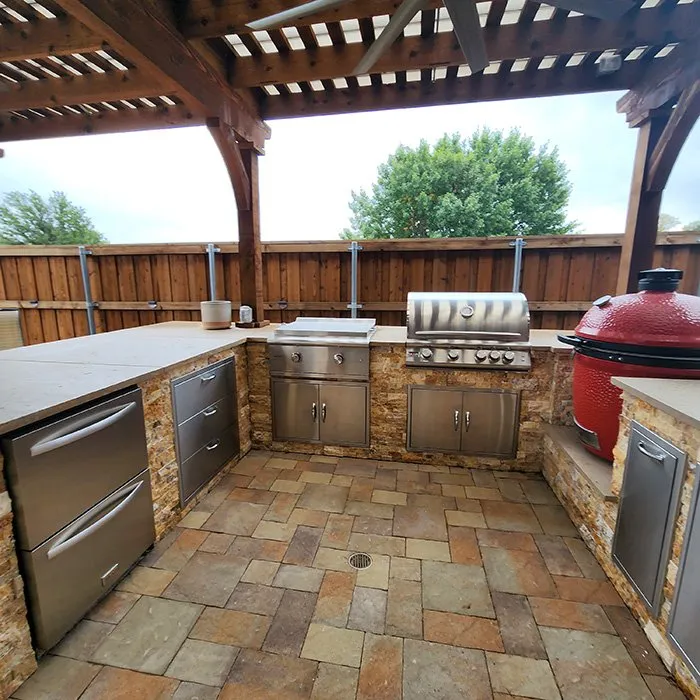
Pellet storage is the second half of the problem and the half every competitor skips. A 20-pound bag of hardwood pellets that absorbs humidity stops feeding the auger evenly and starts producing uneven smoke — the stuff that makes a brisket taste like an ashtray. In South Forsyth, between 52 inches of annual rainfall and Lake Lanier pushing summer humidity into the mid-80% range, you can’t just lean a bag against the island. We build a sealed pellet cabinet with a silicone door gasket and a small desiccant tray into every Traeger install. Adds about $400 in cabinet work. Saves thousands in ruined cooks.
The cabinet bay itself needs to be sized to Traeger’s specific model footprint, not a generic 30-inch hole. An Ironwood XL is 26 inches wide at the cook chamber but the hopper shroud extends another 4 inches and the chimney clears 12 inches at the back of the unit. If you build the bay to catalog width, the unit slides in flush but the rear chimney bangs into the back cabinet every time you pull the grill out for maintenance. We frame bays at 30 inches wide and 26 inches deep — the extra two inches on each dimension gives you clean pull-out clearance and room for the weatherproof cover to sit without bunching.
Traeger Ironwood XL electrical spec in writing: dedicated 20A circuit, NEMA 5-20R weather-resistant GFCI receptacle within 6 feet of unit, home-run conductor sized per NEC §680 if the kitchen is within 10 feet of a pool, weatherproof in-use bubble cover. All four items listed as separate line items — not rolled into “electrical.”
Can You Integrate Both Cookers in One Cumming Outdoor Kitchen?
About 18% of our Cumming outdoor kitchen builds end up dual-cooker — a BGE bay on one end and a Traeger cabinet on the other, with a stainless gas grill in the middle for weeknight quick cooks. That’s more common in the Windermere and St. Marlo tier of build where the kitchen budget starts at $45k and the homeowner has committed to cooking as a lifestyle, not just a weekend amenity.
A dual-cooker island changes the counter run length. A proper BGE bay with clearance eats roughly 36 inches of island face. A Traeger cabinet with pellet storage eats 30 inches. Add a 36-inch gas grill, a sink, a minifridge, and trash pull-outs, and you’re at 14 feet of island before prep surface — which is why dual-cooker kitchens almost always end up L-shaped or U-shaped, not straight-run.
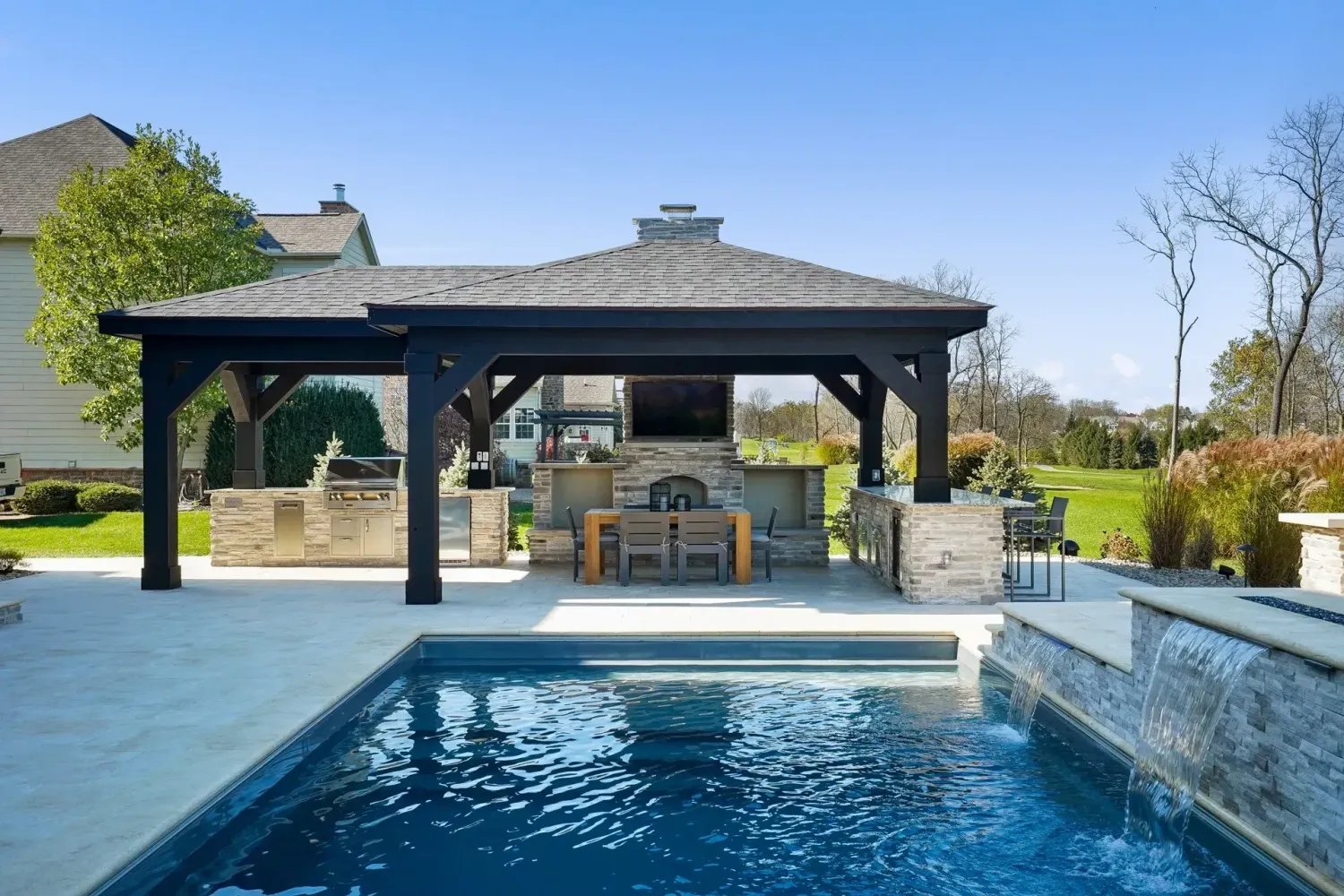
The contrarian take: most of the dual-cooker quotes we write get value-engineered back to single-cooker plus infrastructure for the second. That means we frame the second bay, run the circuit, and cap the countertop — but leave the cutout blind until year two or three when the homeowner decides which cooker they actually use more. That phased approach saves $4,200 to $6,800 upfront without closing the door on the expansion.
Which Pavilion Roof and Ventilation Strategy Fits Cumming’s Climate?
Cumming sits in USDA Zone 8a at about 1,275 feet of elevation, which gives us roughly 22 freeze events per year and summer highs in the 89-94°F range. That climate pair has two consequences for outdoor kitchen integration most homeowners don’t think about until the second winter: the cooker needs to be usable in January, and the pavilion has to shed summer heat without trapping smoke.
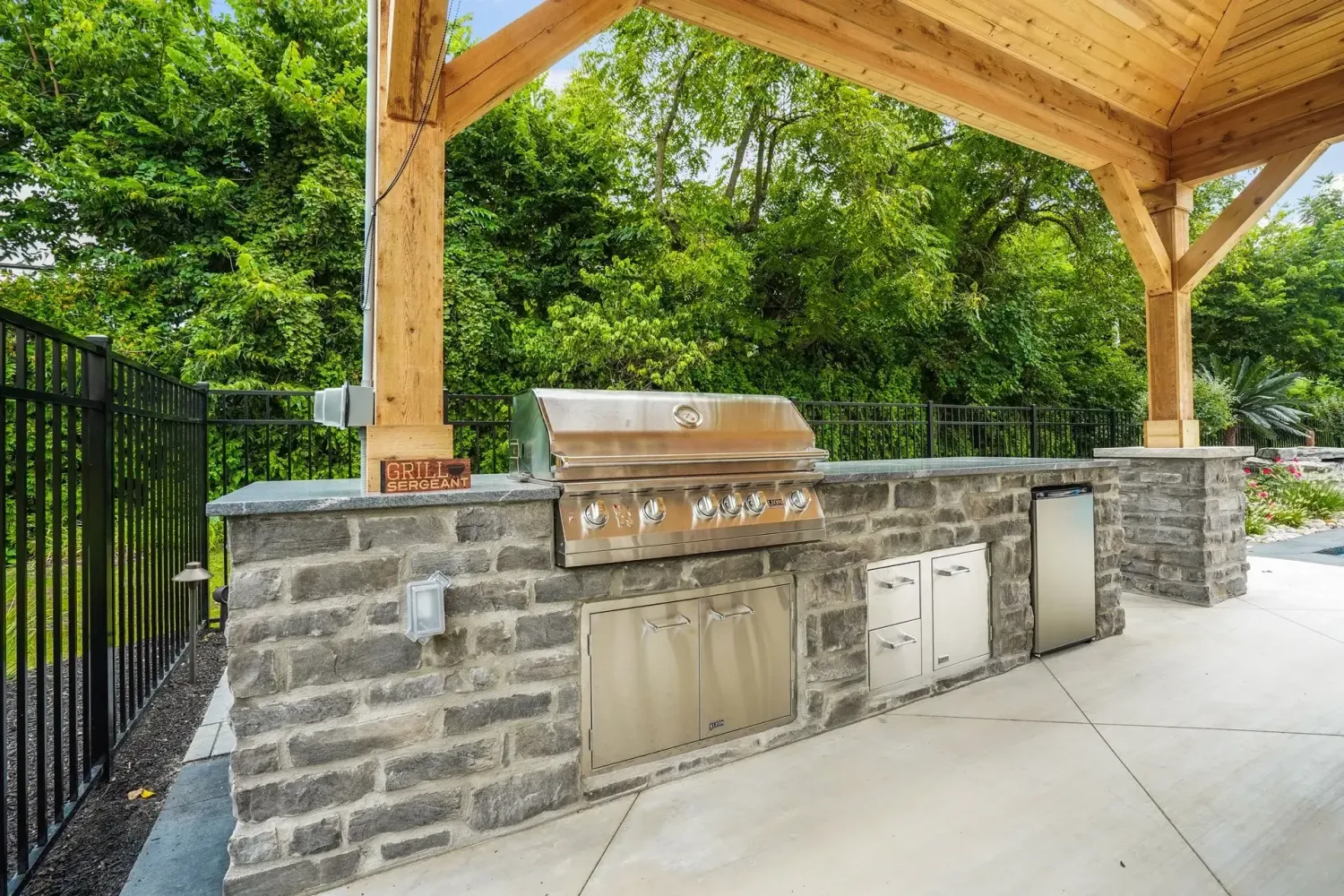
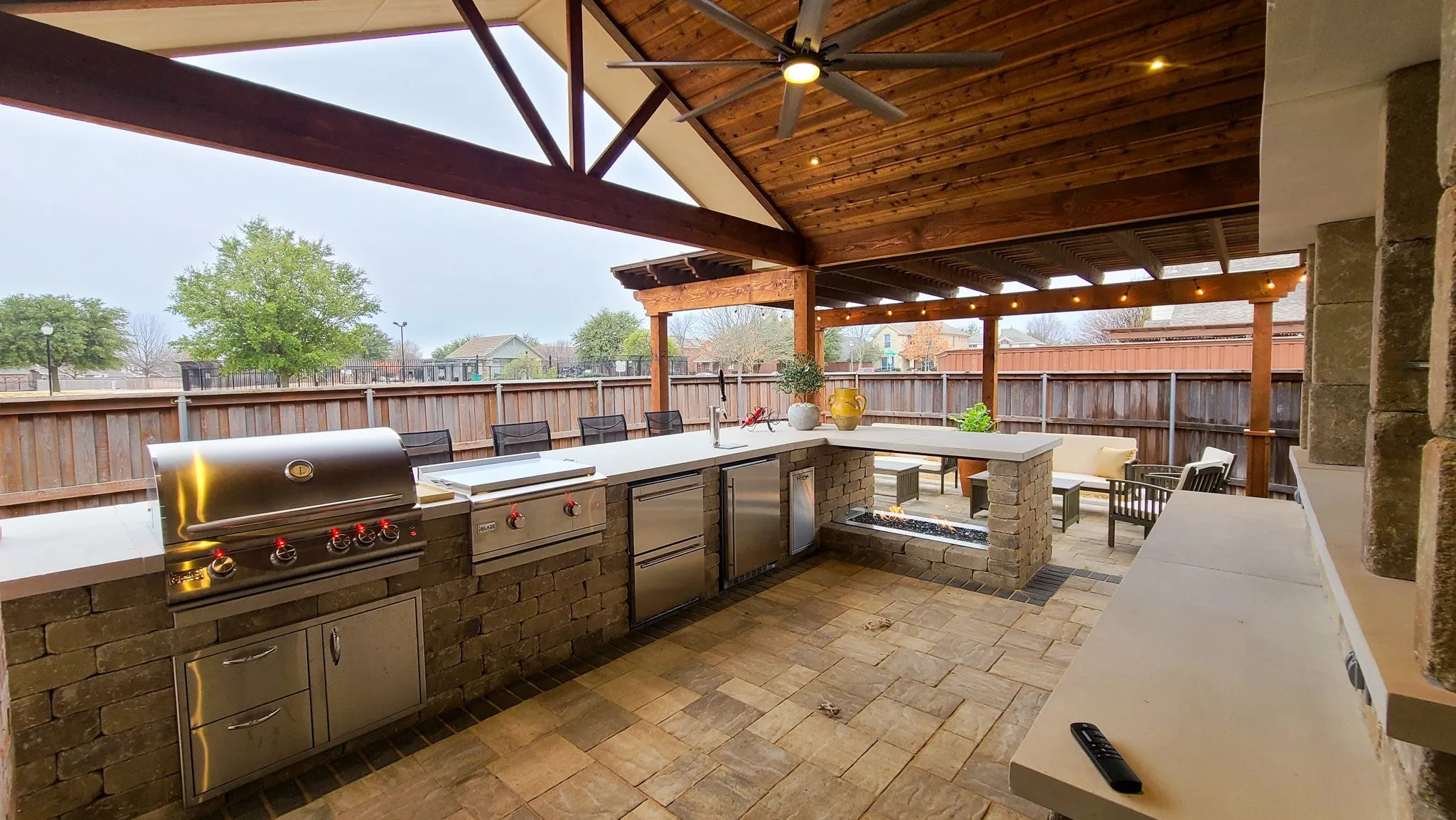
A Big Green Egg under a solid pavilion with no ventilation becomes a smoke trap fast — the ceramic holds enough latent heat that a pork shoulder at 250°F over 14 hours will coat your cedar T&G ceiling in a fine brown film. Traegers do less of that because the smoke path is more concentrated and the unit vents from one point, but even a Traeger needs a cross-breeze path under a solid roof. Louvered slat roofs (like the one on the kamado kitchen we built near Fowler Park) solve this mechanically without fans. A gable vent plus soffit vent solves it too. A dead-air pavilion ceiling does not.
Winter usage is the other side. Kamados hold heat better than pellet smokers in the cold — a BGE can smoke at 225°F in 32°F ambient with barely a pellet-to-charcoal adjustment. A Traeger in the same conditions burns through 1.4x the pellet volume because the unit fights ambient heat loss through its steel walls. That efficiency gap widens below freezing, which is another reason BGE owners out-cook Traeger owners by about 22% annually in this market.
Summer is a different story. A BGE in a closed pavilion on a 93°F August afternoon pushes the ambient under the roof up another 15 to 20 degrees within an hour — uncomfortable enough that guests drift away from the island, which defeats the point of the outdoor kitchen. A Traeger puts out less radiant heat and the pellet plume exits through a narrow chimney port. For clients who entertain more than they cook competitively, the Traeger’s thermal signature under a solid pavilion roof is the quieter neighbor. That’s a real design consideration in tight lots near Cumming City Center where the pavilion sits 15 feet from a dining table.
What Do HOA Review and Forsyth County Permits Actually Require?
Before a single footing goes in on any Cumming pavilion-plus-kitchen build, two clocks start running: the Forsyth County Dept. of Planning & Community Development permit queue at 110 E. Main St., and the HOA architectural review board of whichever subdivision the house sits in. Both matter. Both take longer than most homeowners expect.
HOA turnaround for high-end subdivisions — St. Marlo, Polo Fields, Hampton Park, Mashburn Plantation — runs 2 to 3 weeks for pavilion plans, longer if you’re introducing a ventilation chimney that breaks the ridge line. We submit renderings, not just floor plans, because the review boards in these communities want to see the massing and the roof material in context. A pavilion with an exposed stainless vent cap gets asked about. A pavilion with a painted-to-match mushroom cap gets approved.
County permits for a pavilion over 200 square feet require structural drawings stamped by a licensed Georgia engineer. The fee runs $180-$360 depending on square footage, and the review window in 2026 is currently hovering around 11 business days. Electrical permits for the 20A Traeger home run or a 240V service extension for the kitchen are separate — plan for two permits on the same project, not one.
The overlooked detail for golf-course subdivisions: if the pavilion sits within the HOA’s designated rear-yard setback — often 25 feet from the golf-course boundary in St. Marlo and Polo Fields — you’ll need both a variance letter and a survey stamp, not just the standard plan submission. Budget four to six extra weeks.
Which Cooker Actually Fits Your Cumming Backyard, Soil, and Cooking Habits?
Piedmont red clay — Cecil series dominant across Forsyth County — is not an easy soil to build a 4,000-pound stone-veneer kitchen on. The clay swells when it takes water and shrinks when it dries, and the differential movement is what cracks stone veneer at the second winter. Pockets of Appling sandy loam near older farm areas make it worse because the transition line is where the most movement happens.
For any integrated kitchen island over 12 linear feet, we pour a continuous concrete footing 24 inches below grade with #4 rebar on 12-inch centers, tied into a 4-inch reinforced slab under the full pavilion footprint. That’s more footing than a deck needs and more than many contractors bid. It’s also the reason we don’t have callbacks on veneer cracking at year three, and why our quotes for heavy stone kitchens tend to land $2,000 to $3,500 higher than the low bid in the market.
Grade is the other piece. Many Cumming backyards — especially the 2000-2015 subdivision stock in Haw Creek and Sadie Farms — have 3 to 8 foot grade drops toward the South Forsyth drainage tributaries. A pavilion kitchen on a falling grade either needs a full retaining wall system behind it or a terraced approach with the kitchen sitting on the upper pad. We push the terraced solution on every call-back because a retaining wall behind a kitchen eats the view and the budget simultaneously.
After integrating roughly 90 of these across Cumming and the surrounding county over the last four years, the decision pattern is clear enough to write down. If you cook two or more times per week and your primary cuisine is Southern low-and-slow — brisket, pork shoulder, ribs — the Big Green Egg integration wins on cost-per-cook and on winter usability. You’ll spend more upfront on heat shielding and pavilion venting, but you’ll cook more, longer, through more of the year.
If you cook weeknight family dinners and occasional weekend smokes — burgers, chicken thighs, the occasional pork butt — the Traeger integration wins on convenience and on counter real estate. You’ll pay less on the framing side and more on the electrical side, and you’ll get a cooker that’s set-and-forget in a way a kamado never will be.
If you cook competitively or entertain 12-plus people with any frequency, the dual-cooker island is worth the $45k starting point. It’s not a flex. It’s a workflow decision — you’ll use both surfaces the same afternoon, and the island will be the reason people drive from Alpharetta, Suwanee, and Dawsonville to your house in October. None of these answers are about which brand we prefer. They’re about which integration your backyard, your soil, your HOA, and your service panel can actually carry without eating your budget twice.
Outdoor kitchens across 20+ cities within 30 miles of Winder, GA
Whether your build calls for a Big Green Egg bay, a Traeger cabinet, or a dual-cooker pavilion, we engineer the island, the footing, and the ventilation around the cooker you actually plan to use — not the one the stock quote assumes.