
Milton estate lots don’t forgive paver decisions. When a driveway runs 8,000 square feet through a Crooked Creek gateway, or a pool deck wraps a Manor Golf Club pavilion, the wrong brand choice shows up as mismatched dye lots, a patchwork of replacement pallets two years in, or a warm-stone palette that fights the Cecil-clay landscape around it.
Here’s the contractor-level breakdown of the four paver lines that actually work on Milton estate builds — Belgard Mega-Arbel, Belgard Cambridge Cobble, Techo-Bloc Industria Amber, and Techo-Bloc Villagio — plus a note on where Unilock Beacon Hill Flagstone beats both. This is the grid we hand to homeowners in Cogburn Estates, King Estates, and White Columns when they ask why their neighbor’s driveway still looks right after a decade and the one across the street doesn’t.
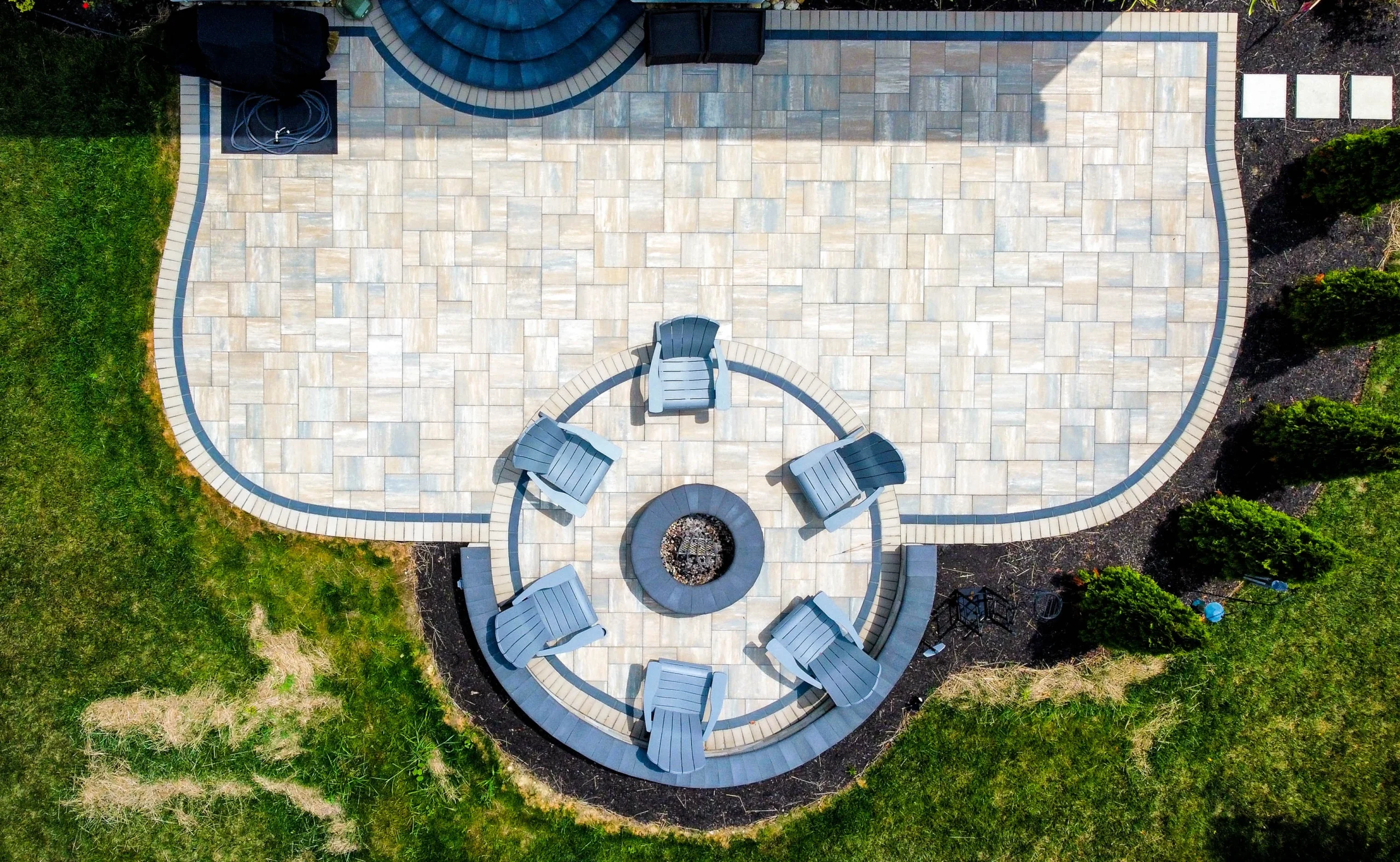
Quick comparison: Belgard wins on supply-chain consistency for orders above 5,000 sqft — dye batch stays tight across a full delivery. Techo-Bloc wins on warm earth-tone palette depth (Amber, Champlain Tan, Fieldstone). Both meet Milton’s preservation-overlay aesthetic. Unilock Beacon Hill dominates natural-stone-look specs in Cogburn and Greystone.
Why Milton Scale Changes the Brand Conversation
In a typical subdivision driveway, you’re buying 600 to 1,200 sqft of paver. One pallet drop, one dye batch, one afternoon of install. Color variance is almost impossible to see because the quantity is small and the eye reads the whole field at once.
Milton is different. AG-1 zoning sets a one-to-three-acre minimum on most estate parcels, which means driveways that run 150 to 400 feet from the road to the motor court, pool decks that wrap 2,500 to 5,000 sqft, and integrated pavilion-and-outdoor-kitchen pads that push total hardscape well past 10,000 sqft on a single build. That quantity is where supply-chain discipline stops being invisible and starts dictating the finished look.
When a paver manufacturer can’t ship a single order from one kiln run — when they have to pull from two or three regional warehouses to fill 8,000 sqft — the dye variance between those batches shows up as a visible band across the field. It’s not catastrophic, but a homeowner standing on a Bethany Creek motor court at dusk can absolutely see where one delivery ended and the next began. This is where Belgard’s scale matters: their Georgia distribution can typically hold a single dye batch across orders up to roughly 8,000 sqft when the PO is placed four to six weeks ahead.
Belgard Mega-Arbel: The Milton Pool Deck Default
Mega-Arbel is a large-format, tumbled, flagstone-profile paver that Belgard built specifically to compete with natural travertine and bluestone without the natural-stone price tag or sealer-maintenance cycle. On Milton estate builds, it has quietly become the default pool-deck spec.
The reason is the slab size: Mega-Arbel ships in a multi-piece pattern where the dominant slab is roughly 16 by 24 inches, large enough that the grid pattern reads as a stone terrace rather than a modular paver field. At estate scale, that matters. A Cambridge Cobble pattern at 4,500 sqft reads as a lot of joints. A Mega-Arbel pattern at 4,500 sqft reads as a slab floor with warm mortar lines.
Color specification on Mega-Arbel for Milton consistently lands in three palettes: Bella (a warm tan-and-cream blend that pairs with Crabapple-district farmhouse architecture), Toscana (a deeper clay-and-amber blend that reads against brick and board-and-batten), and Victorian (the grey-and-charcoal palette, which works on transitional contemporary builds in Atlanta National but usually loses to the warm tones inside The Manor’s architectural review).
Slip resistance on Mega-Arbel tests at a dynamic coefficient of friction above the ANSI 0.42 wet threshold, which matters on a pool deck where bare feet move fast and insurance underwriters occasionally ask. The tumbled finish gives enough texture for grip without being aggressive enough to chew up a swimsuit.
Milton installed cost, Mega-Arbel pool deck (2026 range): $28 to $38 per sqft installed, including 6-inch compacted GAB base, 1-inch concrete sand setting bed, polymeric jointing sand, and 24-inch concrete restraint edge. Mud-sets or mortared-over-slab installs run $42 to $55 per sqft.
Belgard Cambridge Cobble: Driveways, Motor Courts, Crabapple-District Pavers
Where Mega-Arbel owns the Milton pool deck, Cambridge Cobble owns the Milton driveway and motor court. Cambridge Cobble is a three-piece, tumbled, old-world cobblestone profile — the piece sizes are roughly 5×7, 7×7, and 7×10 inches — and it was engineered to mimic European cobble without the rocking-chair ride you get from actual salvaged granite setts.
On a Freemanville Road estate driveway running 280 feet to the motor court, Cambridge Cobble in a Toscana or Bella color blend reads exactly the way Milton’s preservation overlay wants a driveway to read: rural, established, and not suburban. The tumbled edges soften the grid, the random three-piece pattern breaks the repetition, and the warm color blend picks up the surrounding Cecil-clay landscape rather than fighting it.
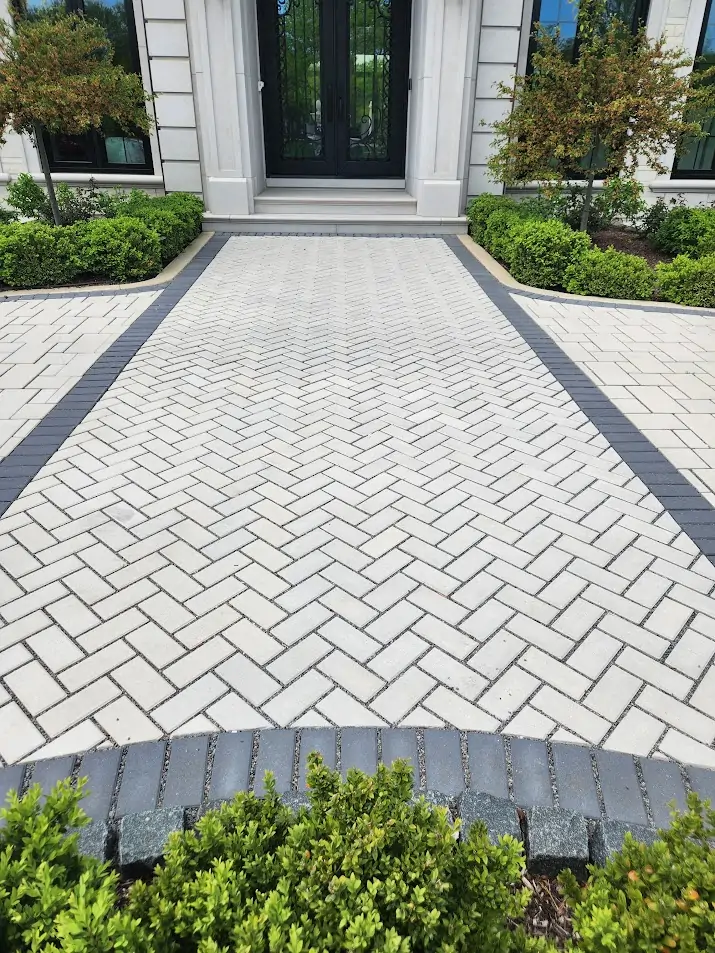
Structural spec matters more on a Milton driveway than a subdivision driveway because the loading case is different. Estate motor courts regularly park a landscape dump trailer, a concrete pump truck during pool construction, or a moving van. The H-20 loading standard — 16,000 pounds per axle — is the baseline we specify for any Milton driveway, which means an 8-inch compacted GAB base, a 1-inch bedding sand layer, and 80mm (3.125-inch) paver thickness minimum. Cambridge Cobble ships in both 60mm and 80mm; we refuse the 60mm for driveways every time.
Where Cambridge Cobble earns its keep over poured concrete or asphalt is the repair case. When a subsurface drain shifts, or a tree root lifts a section, or a homeowner later wants to extend the motor court by 600 sqft, you lift the affected pavers, fix the base, and reset. No sawcut, no patch line, no permanent scar. At Milton scale, where landscape changes happen over 20-year ownership arcs, that flexibility is the real value.
Techo-Bloc Industria Amber: The Warmest Warm Tone in the Market
Techo-Bloc’s Industria line is a rectangular, tumbled, modernist-leaning paver — the signature piece is roughly 4×8 inches with smaller 4×4 accent pieces. Industria’s brand position is transitional contemporary, which usually means grey and charcoal palettes on urban Atlanta projects.
The color that changed the Milton conversation is Industria Amber. Amber is an intensely warm, almost sunset-colored blend of deep terracotta, honey, and cream that Techo-Bloc’s dye process produces in a color range Belgard’s manufacturing simply cannot match. It is the single warmest paver color available from any major manufacturer in the Georgia market.
On a Manor Golf Club driveway or pool deck, where the architectural review committee is pushing toward warm, established, Tuscan-adjacent palettes, Industria Amber lands exactly where the review wants it to. We have watched Manor ARC packets approve faster when the paver sample board leads with Industria Amber than when it leads with any Belgard color — not because Belgard is wrong, but because Amber reads warmer than anything Belgard ships.
The trade-off on Industria is supply. Techo-Bloc’s Georgia distribution is regional, and large orders above 6,000 sqft sometimes require a four-to-eight-week lead time to hold a single dye batch. On a Milton estate build where the hardscape phase is already driving the schedule, that lead time has to get priced and scheduled at the contract stage, not discovered during the material order.
Techo-Bloc Villagio: The Old-World Profile for Crabapple and Historic-Overlay Builds
Villagio is Techo-Bloc’s answer to Cambridge Cobble — a tumbled, multi-piece, old-world cobblestone profile designed to read as reclaimed European granite sett. The piece profile is slightly different from Cambridge: Villagio’s dominant piece is squarer (roughly 6×6 inches), and the tumbled edges are more aggressive, which gives it a more weathered, “this-has-been-here-100-years” appearance out of the pallet.
For Crabapple historic-overlay builds — where the City of Milton’s preservation review at 2006 Heritage Walk scrutinizes driveway materials against the district’s 1880s-to-1920s character — Villagio in Champlain Tan or Dune Grey is the most frequently approved specification we submit. The review committee reads Villagio’s aggressive tumbling as compatible with the district’s visual vocabulary; they sometimes read Cambridge Cobble as slightly too uniform.
Structurally, Villagio ships in 60mm and 80mm thicknesses and handles the same H-20 driveway loading as Cambridge when the base is spec’d correctly. The aesthetic trade-off: Villagio’s aggressive tumbling means every paver has a slightly rounded top edge, which creates a visible bevel between adjacent pieces. On a pool deck where bare feet track a wet return path, that bevel can be felt underfoot. We use Villagio on driveways and motor courts, not on primary pool decks.
Where Unilock Beacon Hill Flagstone Beats Both
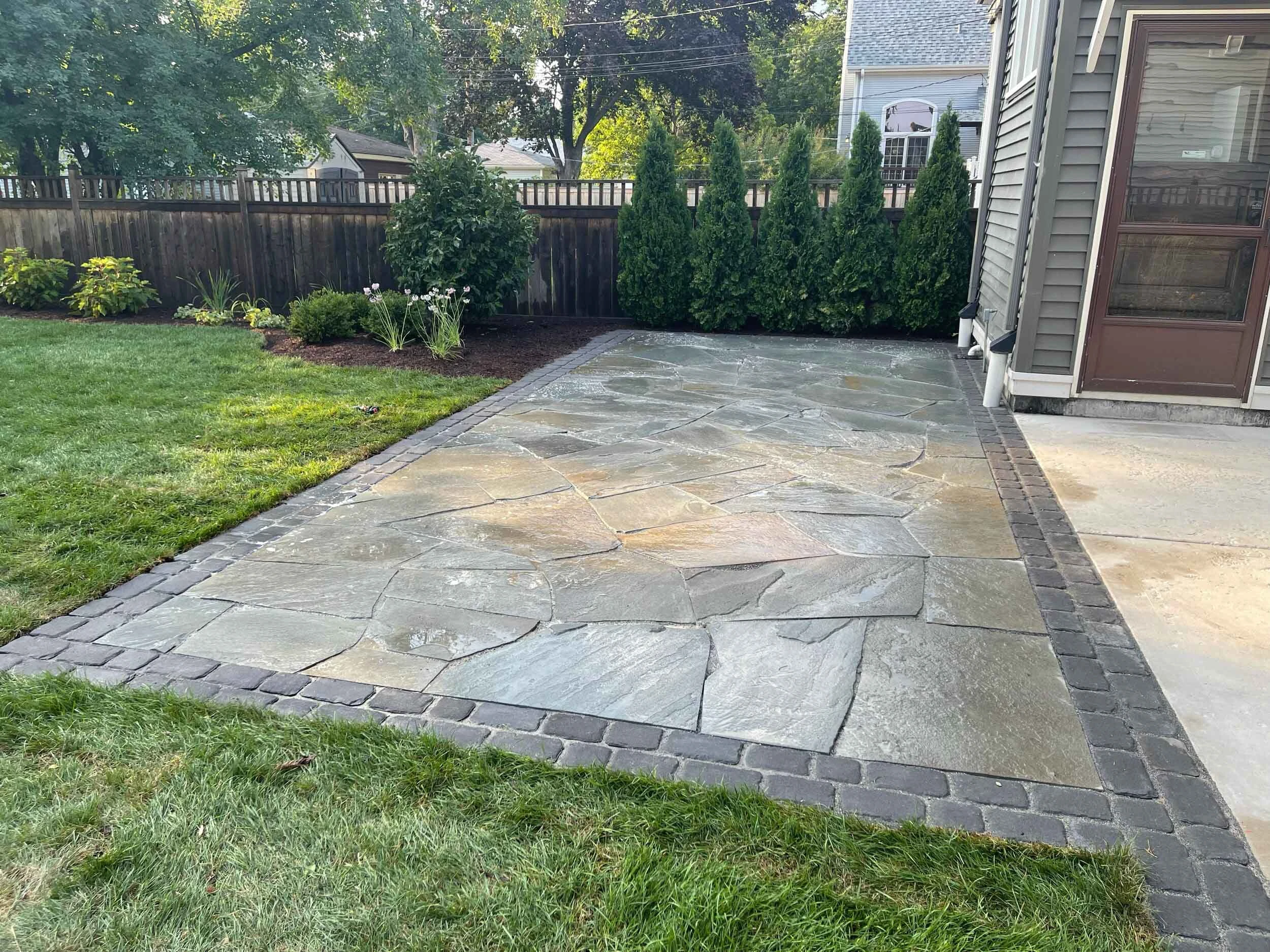
Belgard and Techo-Bloc dominate the Milton market on volume, but Unilock Beacon Hill Flagstone earns specific placements on nearly every estate build we bid in Cogburn Estates, Greystone, and Hopewell Plantation. Beacon Hill Flagstone is a random-cut, natural-stone-look paver where the pieces are shaped and textured to mimic irregular flagstone rather than a geometric grid.
On a property where the homeowner wants the pool deck to read as hand-cut bluestone but doesn’t want the sealer cycle, the price-per-sqft, or the porosity issues of actual bluestone, Beacon Hill Flagstone is the closest mainstream paver match. At a Cogburn Estates build last season, a Beacon Hill Flagstone deck in the Basalt color passed the ARC committee’s natural-material preference without carrying the $72-per-sqft installed cost of actual Pennsylvania bluestone.
The case against Beacon Hill Flagstone at Milton scale is install labor. Random-cut patterns require a skilled install crew making real-time decisions about piece placement and rotation. A Mega-Arbel field runs at 180 to 220 sqft per installer per day; a Beacon Hill Flagstone field runs at 110 to 140. On a 4,000 sqft deck, that’s a week of additional labor priced into the bid.
Mixing Brands on One Estate: The Field-and-Border Strategy
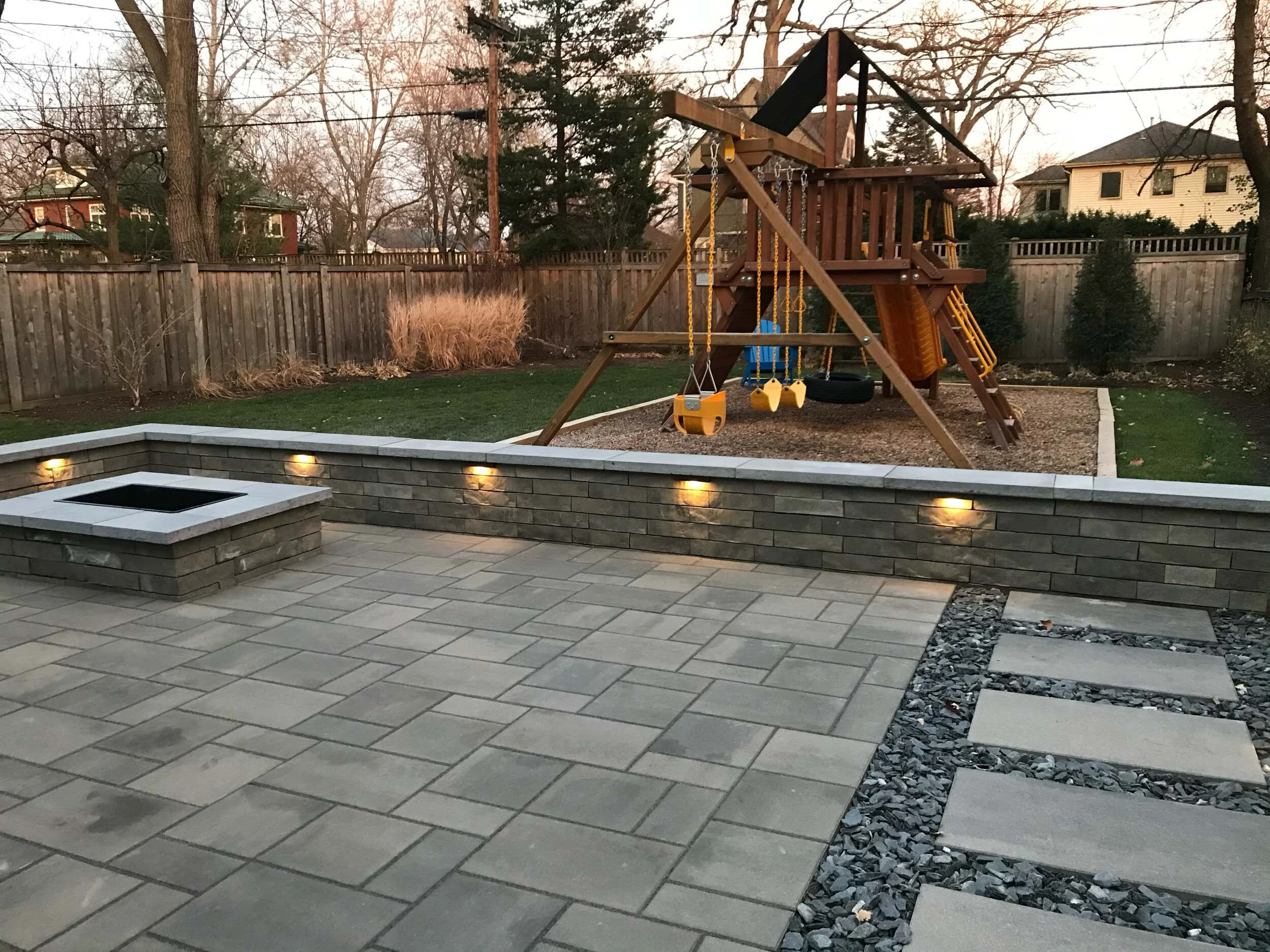
The question we get every week from Milton homeowners: “Can we mix Belgard and Techo-Bloc on the same build?” Yes — but only with a deliberate field-and-border strategy, never as a random mix.
The strategy that works at estate scale is single-brand, single-color fields with contrasting brand-and-color borders. A pool deck in Belgard Mega-Arbel Bella with a Techo-Bloc Industria Amber 12-inch soldier-course border will read as intentional and custom. The same deck with Mega-Arbel and Industria mixed randomly through the field reads as a mistake, every time.
The border brand difference creates a visible color-and-texture frame that defines the deck. Around a pool in a Bethany Creek build, we specified Mega-Arbel Victorian (grey-charcoal) in the field with an Industria Amber soldier course at the coping line and around the spa. The Amber border picked up the warm stone on the pavilion columns; the Victorian field kept the deck visually calm. That mix passed The Manor ARC on the first submission.
Where single-brand discipline matters most is on driveways and motor courts. A Cambridge Cobble motor court with a Villagio apron at the garage line reads as a stumbled design decision, because the tumbled profiles are similar enough that the eye questions why the pattern changed. Stick to one brand across a continuous driveway surface.
Supply-Chain Discipline: The Milton Estate-Build Reality
Two supply facts determine how we spec pavers for Milton estates.
First, dye batch rules the outcome. Concrete paver color comes from iron oxide and carbon black pigments mixed into the face-mix during manufacture. Every kiln run produces a slightly different dye result within the tolerance band. A single kiln run covers roughly 12,000 to 18,000 sqft of finished paver, depending on profile. When your project needs 9,000 sqft, you want the entire order on one kiln run. When your project needs 22,000 sqft, you need to accept that the order will span at least two runs and plan the install so the break between runs falls at a natural transition (pool deck to walkway, driveway to motor court) rather than mid-field.
Second, lead time rules the schedule. Belgard’s Atlanta distribution can usually hold a single dye batch on orders placed four to six weeks ahead. Techo-Bloc’s regional distribution needs six to ten weeks for orders above 6,000 sqft in colors like Industria Amber that move slower than greys. Unilock Beacon Hill Flagstone in uncommon colors like Smoke or Basalt sometimes needs 12 weeks. On a Milton estate build where the pool shell is cured and waiting for decking, a three-week paver delay compresses the entire landscape install into weather you don’t want.
Permit reality: Milton’s Community Development at 2006 Heritage Walk typically turns hardscape permit review in 10 to 14 business days. The Manor Golf Club ARC typically adds 4 to 5 weeks with structural review. Crabapple historic-overlay review adds 2 to 3 weeks. Build the paver lead time around the review window, not the other way around.
The Milton Palette We Recommend by Neighborhood
After enough builds across Milton’s major developments, the brand-and-color matches that consistently pass architectural review and look right against the surrounding landscape have settled into a recommendation grid.
- The Manor Golf Club: Belgard Mega-Arbel Bella field with Techo-Bloc Industria Amber borders. Warm, Tuscan-adjacent, ARC-friendly.
- Atlanta National: Belgard Mega-Arbel Victorian or Techo-Bloc Industria Smoke. Transitional contemporary works here.
- Crooked Creek: Cambridge Cobble Toscana driveways; Mega-Arbel Bella pool decks.
- Cogburn Estates: Unilock Beacon Hill Flagstone Basalt pool decks; Cambridge Cobble driveways.
- White Columns: Mega-Arbel Toscana pool decks; Cambridge Cobble Bella driveways.
- Crabapple historic overlay: Techo-Bloc Villagio Champlain Tan driveways exclusively. Historic review requires the aggressive tumbled profile.
- Bethany Creek, Greystone, Hopewell Plantation: Mixed specifications — the architecture varies, so the paver spec follows the house.
The mistake we see most on self-directed Milton estate builds is buying a paver that worked beautifully on a friend’s subdivision project in Alpharetta or Johns Creek and scaling that same paver to a one-to-three-acre Milton lot. The color and profile that looked correct at 1,200 sqft often read flat and repetitive at 6,000 sqft. Estate scale requires larger-format pavers (Mega-Arbel, Industria), more piece-size variance (Cambridge Cobble, Villagio), or natural-stone-look randomness (Beacon Hill Flagstone) — not a scaled-up version of a small-lot design.
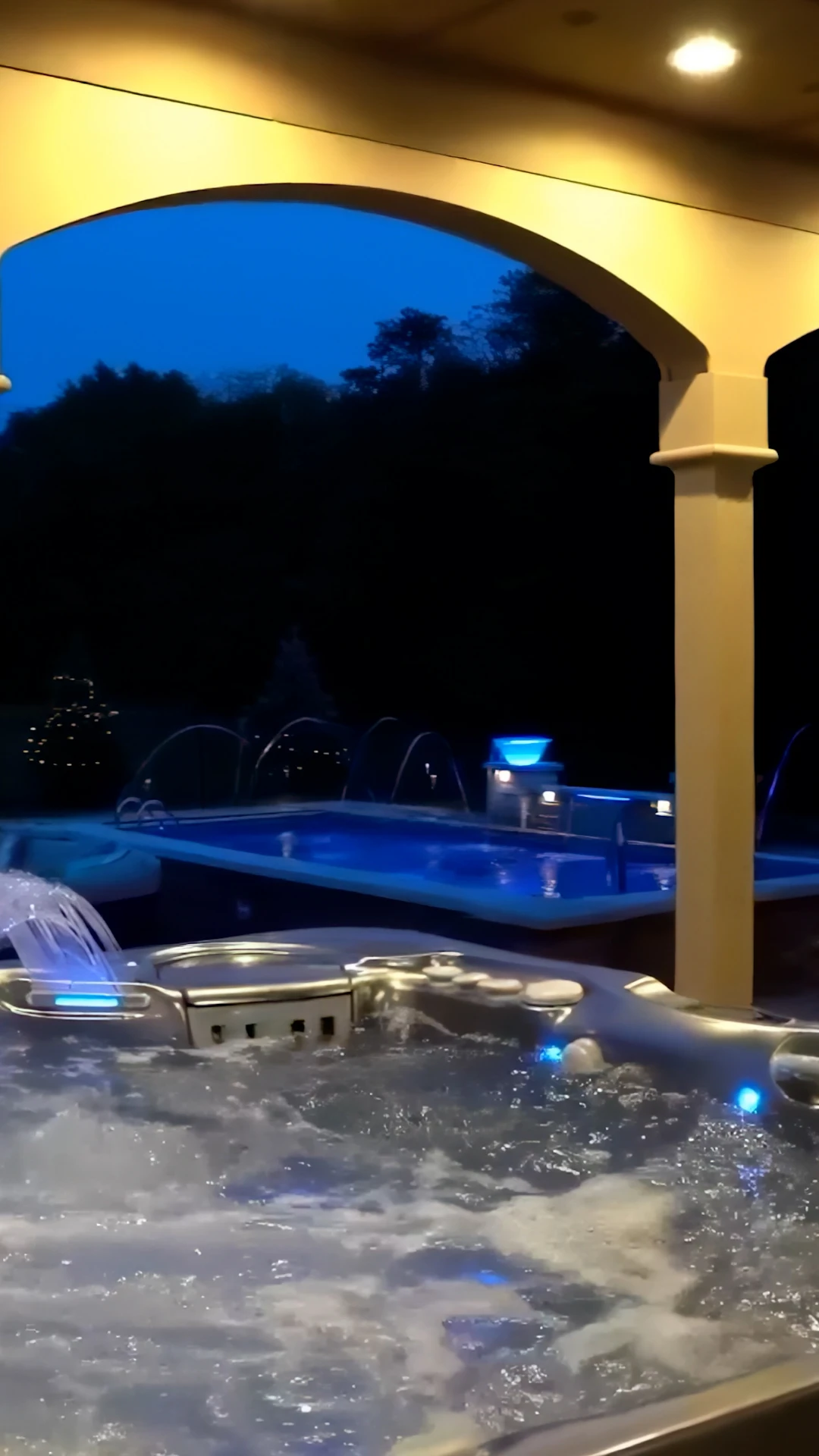
Two other Milton-specific factors feed into the spec. Grade changes on estate lots run six to fourteen feet between the motor court and the pool terrace on many Milton parcels, which means paver choice has to account for retaining-wall coursing and step runs. Belgard’s Weston Stone and Techo-Bloc’s Mini-Creta wall systems match cleanly to Cambridge Cobble and Villagio respectively, so we usually lock the paver brand and the wall brand together. The second factor: creek-buffer setbacks at 25 to 75 feet from named tributaries like Cooper Sandy Creek and Chicken Creek sometimes compress the usable hardscape footprint. Large-format pavers (Mega-Arbel) give a visual scale advantage when the deck is forced narrower than the homeowner wanted.
The right Milton paver specification starts with the architectural review’s color window, cross-checks against the supply-chain reality for the order size, and lands on a brand-and-color combination that will still look right in 15 years — not just on install day. That’s the difference between a paver decision a Milton estate owner regrets and one they forget about because it just keeps working.
Paver design and installation across 20+ cities within 30 miles of Winder, GA
Belgard, Techo-Bloc, and Unilock paver work sized to Milton estate scale — single-dye-batch orders, ARC-ready sample boards, and supply-chain lead times priced at contract.