
A 16×20 black powder-coat aluminum pergola on a Crooked Creek rear terrace costs roughly twice what the equivalent cedar frame does — and on a 14-to-20-year ownership horizon, that’s the cheaper build. The modern-farmhouse palette is the reason why.
Walk any Milton street built after 2015 — Freemanville, Hopewell, Bethany Bend, the newer pockets of Cogburn Estates — and the architectural language is consistent enough to feel like a style guide. Standing-seam black metal roof. White or warm-white lap siding in 6-to-8-inch reveal. Painted brick or dry-stack stone at the foundation. Black-frame windows in grid-mullion patterns. Gas lanterns at the entry. It’s modern-farmhouse, and it dominates the post-incorporation housing stock across 30004, 30075, and 30076.
That palette forces a specific answer to the pergola question. Cedar greys. Ipe requires oiling. Painted pine turns into a maintenance line item by year five. The finish that actually matches the roof, the window frames, and the gutter line — and holds that match for two decades — is black powder-coated aluminum. That’s the whole argument of this post, and the next 3,000 words unpack what that actually costs, what it takes to permit through Milton Community Development, and how the three systems homeowners keep asking us about (StruXure, Renson, Sienna Outdoor) compare on the ground at a real Milton build site.
Aluminum vs. cedar, at a glance
- 16×20 black powder-coat aluminum pergola (StruXure Pergola X): $38,000–$58,000 installed, motorized louvers, integrated LED, rain sensor. Zero finish maintenance for 18–25 years.
- 16×20 cedar pergola, stained: $18,000–$26,000 installed. Stain refresh every 2–3 years ($1,800–$2,600 each). Structural replacement window 12–18 years on rear-elevation Milton exposures.
- 16×20 Renson Camargue: $48,000–$72,000 installed, fully integrated screens, heaters, louvers, and rain management.
- 16×20 Sienna Outdoor louvered pergola: $32,000–$46,000 installed, motorized louvers, simpler control package.
On a cash-flow timeline for an owner who plans to be in the house 14–20 years — the median hold on a Milton estate lot in the $1.2M–$3M band — the aluminum build is the cheaper option by year 9 and meaningfully cheaper by year 15. It also matches the roof from day one.
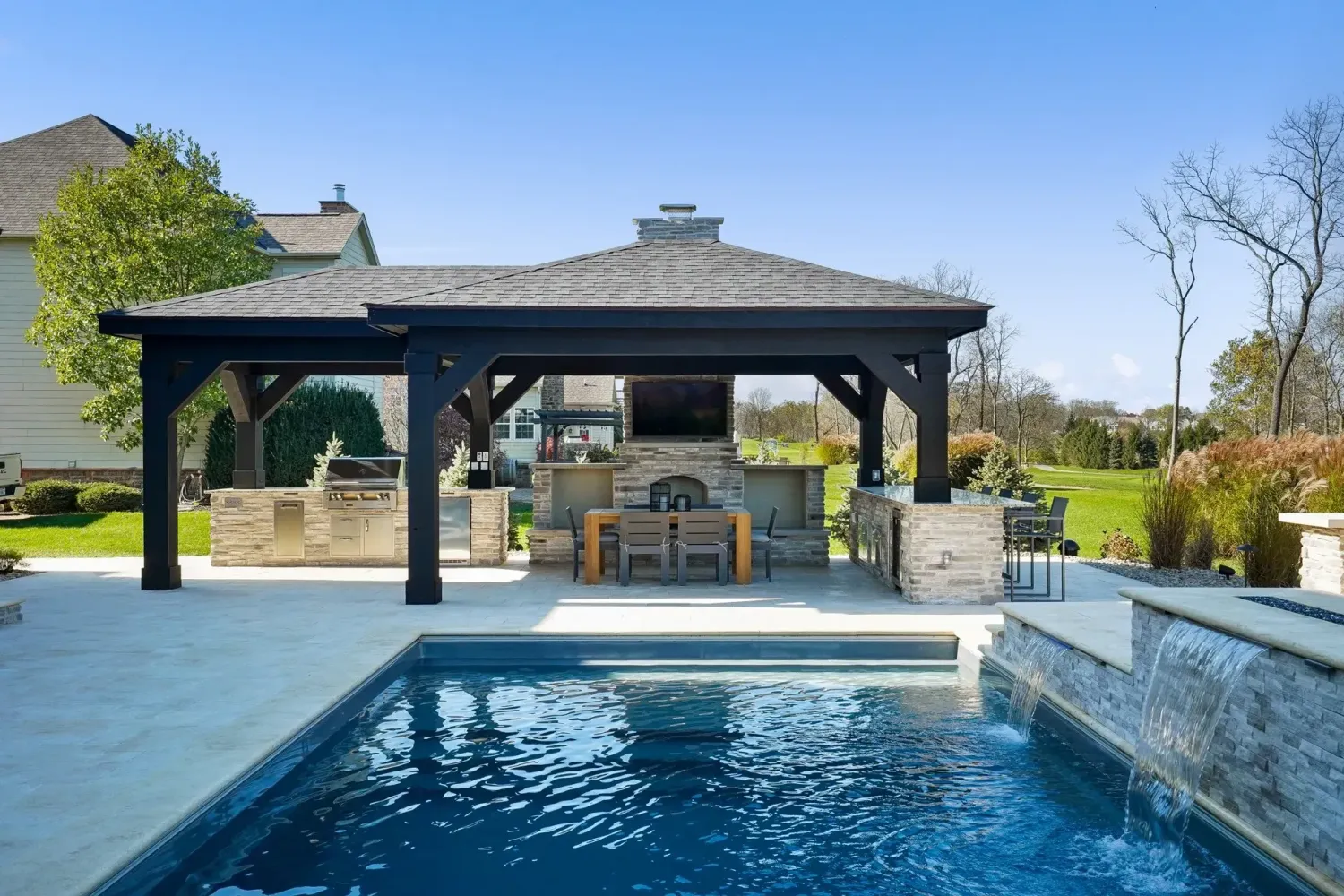
Why black powder-coat aluminum is the only finish that matches a 2015+ Milton home
The modern-farmhouse trend that swept Milton’s estate market after 2014 standardized on a four-color palette: black roof, white body, black trim, warm-wood accents at porch ceilings and entry doors. The pergola over the pool deck or outdoor kitchen has to read as a fifth architectural element — not a contrast piece, not a wood-garden afterthought — or the rear elevation looks bolted together.
Powder-coat finishes on 6063-T6 aluminum extrusions hit the match three ways that stain on cedar cannot:
- Color stability. A quality architectural powder-coat (AAMA 2604 or 2605 spec) holds color with less than 5 Delta-E shift over 10 years of direct sun. Stained cedar in Milton’s rear-yard exposures — open to afternoon western sun on most Freemanville Rd and Bethany Bend lots — drifts visibly in 18 months.
- Sheen match. The roof standing-seam and window frames are typically satin or matte black. Powder-coat is specified in that same sheen family. Stain is either glossy, satin, or flat — and never matches exactly to the steel roof.
- Edge crispness. Extruded aluminum produces 90-degree structural edges. The modern-farmhouse design language reads from crisp geometric lines. Cedar corners soften and check within three Milton summers.
The finish also survives the microclimate. Milton sits at ~1,150 ft elevation with USDA Zone 8a and roughly 22 freeze events per year. Thermal cycling between 28°F overnight January lows and 93°F August afternoons is the kiln that kills cedar finishes. Powder-coat is factory-baked at 400°F — the delta doesn’t register.
Architectural spec: On modern-farmhouse Milton builds, specify an AAMA 2605 powder-coat in satin jet black (RAL 9005 is the common match). AAMA 2604 is acceptable for covered locations, but open rear-elevation pergolas should run 2605 for the full 20-year color warranty.
StruXure Pergola X at 16×20: the baseline spec for Milton backyards
Of the three systems we’re regularly asked to quote in Milton, StruXure Pergola X is the one we build most often — because it hits the modern-farmhouse palette cleanly, ships in reasonable lead times, and its motorized louver system handles the rear-yard shade problem without screens or drop-shades that fight the black-frame window aesthetic.
A typical Milton install — 16 ft by 20 ft footprint over a pool deck or outdoor kitchen — runs between $38,000 and $58,000 installed. The spread depends on six variables:
- Louver type: standard aluminum vs. R-blade insulated louver (adds $4,200–$6,800 for the insulated upgrade).
- Integrated LED: perimeter downlight standard; in-blade uplight adds $2,400.
- Rain sensor + auto-close: $900–$1,400 for the sensor package.
- Integrated heaters: $1,800 per infrared unit, typically two on a 16×20 in Milton’s climate.
- Post footing engineering: standard 24″ x 24″ x 36″ footing on good Cecil clay is $600–$900 per post; saprolite shelves or slope conditions bump this to $1,800–$2,400.
- Attached vs. freestanding: attached (ledger to fascia) is $2,000–$3,500 cheaper than freestanding four-post.
What 16×20 actually covers
A 16×20 Pergola X covers a 320 sq ft deck — enough for an 8-person dining table plus a coordinating 6-seat lounge configuration, or a full outdoor kitchen island with a 4-seat bar plus room for grill clearance. Below 16×20, the scale reads small against a modern-farmhouse rear elevation where the ridge line is typically 28–34 ft high. Above 22 ft on the long dimension, you’re into multi-bay pergola territory, and the system cost jumps 40–60% because of the mid-span beam engineering.
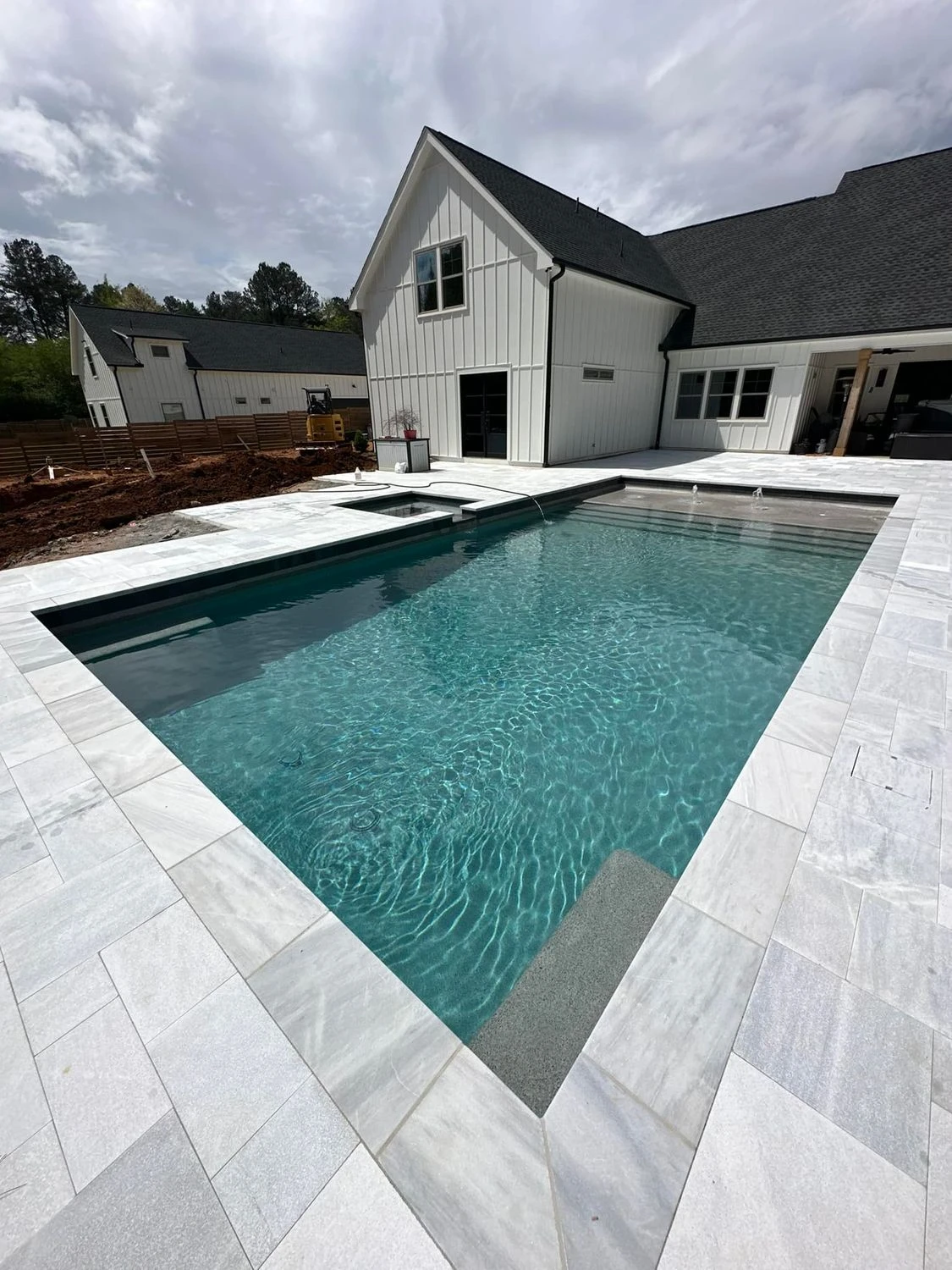
The louver mechanism — what matters in a 20-year build
StruXure’s louver mechanism is a pivoting aluminum blade driven by a 24V DC actuator at one end of each blade. On a 16×20 at 40 blades per run, that’s 40 actuators, 40 pivot bearings, and 80 end caps. The failure mode on poorly built louvered pergolas (most of the sub-$25K import systems you’ll find online) is bearing wear at 4–7 years. StruXure’s specified bearing life is 100,000 cycles — at 2 cycles/day that’s 137 years, realistically 20–25 years with dust, pollen, and Milton’s oak pollen load.
The rain sensor is the feature that actually matters in practice. Milton gets ~53″ of rainfall per year, much of it in fast summer storms. Without auto-close, the pergola deck is wet inside the hour. With it, blades shut at first sensor trigger in under 15 seconds and the deck stays usable through the storm.
Permits, architectural review, and the Milton-specific process
Milton incorporated as a separate city in 2006 — one of six cities carved out of north Fulton County in that window. The permit jurisdiction for any pergola over 120 sq ft is City of Milton Community Development at 2006 Heritage Walk, not Fulton County. This matters for two reasons: turnaround is faster (10–14 business days typical vs. Fulton County’s 18–25), but the review is stricter on rural-character and preservation overlay concerns.
The permit package for an aluminum pergola over 120 sq ft includes:
- Site plan showing setbacks from property lines (35 ft front, 15 ft side, 40 ft rear on most AG-1 zoning parcels).
- Creek-buffer compliance — Milton enforces 25–75 ft buffers from named tributaries including Cooper Sandy Creek, Chicken Creek, and Lake Creek. The 50 ft state buffer is the default; Milton adds a 25 ft undisturbed buffer on top for named streams.
- Signed/sealed structural drawings from a Georgia-licensed engineer — the manufacturer’s engineering package is typically stamped; the permit office accepts it as long as anchorage details match the actual site footing conditions.
- Architectural elevation showing color and materials, for preservation-overlay parcels in Crabapple and along the Birmingham Crossroads corridor.
- Impervious-surface calculation if the pergola is part of a larger hardscape package — Milton’s threshold triggers additional stormwater review above 25% lot coverage on parcels under 2 acres.
The Manor Golf Club note: Lots inside The Manor run an additional Architectural Review Committee process on top of Milton permits. Typical ARC turnaround is 4–5 weeks with structural review. Submit concurrent to the Milton permit application — ARC will require the powder-coat color sample, a rendered elevation against the existing home, and a site plan showing relationship to the Paul Tesori golf course view corridor.
For Atlanta National, White Columns, and Bethany Creek, the HOA review is lighter but still requires color approval. Powder-coat black is universally approved — the issue arises when homeowners propose bronze or dark-gunmetal finishes, which several ARCs reject for non-conformance with the community palette.
Footings, saprolite, and what Milton’s soil means for post anchorage
Milton’s soil profile is Cecil clay over weathered granite (saprolite) with thicker topsoil in creek bottoms and thinner residuum on ridgelines. For pergola footings, three conditions show up repeatedly:
Condition 1: Good Cecil clay, flat terrace
Standard 24″ x 24″ x 36″ concrete footing with J-bolt anchor cage. No engineering surprises. Most backyard builds in Crooked Creek, Greystone, and Milton Forest hit this condition. Footing cost per post: $600–$900.
Condition 2: Saprolite shelf within 18–24″ of grade
Common on ridgeline lots in Cogburn Estates and along the higher benches of Hopewell Plantation. The saprolite is competent rock, but it’s uneven. The footing has to either rest directly on the saprolite (confirmed by a geotech spot check) or be drilled-and-pinned into it with epoxied rebar dowels. Cost per post bumps to $1,400–$2,000, plus a one-time engineering review at $450–$800.
Condition 3: Creek-bottom topsoil, high water table
Shows up on parcels near Cooper Sandy Creek and along the Lake Creek corridor. Topsoil is deep, water table is within 4–6 ft seasonally, and standard footing depths aren’t enough. Either deeper 48″ footings with gravel drainage collar or helical piles at each post. Helicals run $1,800–$2,400 per post and are our standard recommendation on any lot with a named tributary inside the rear setback.
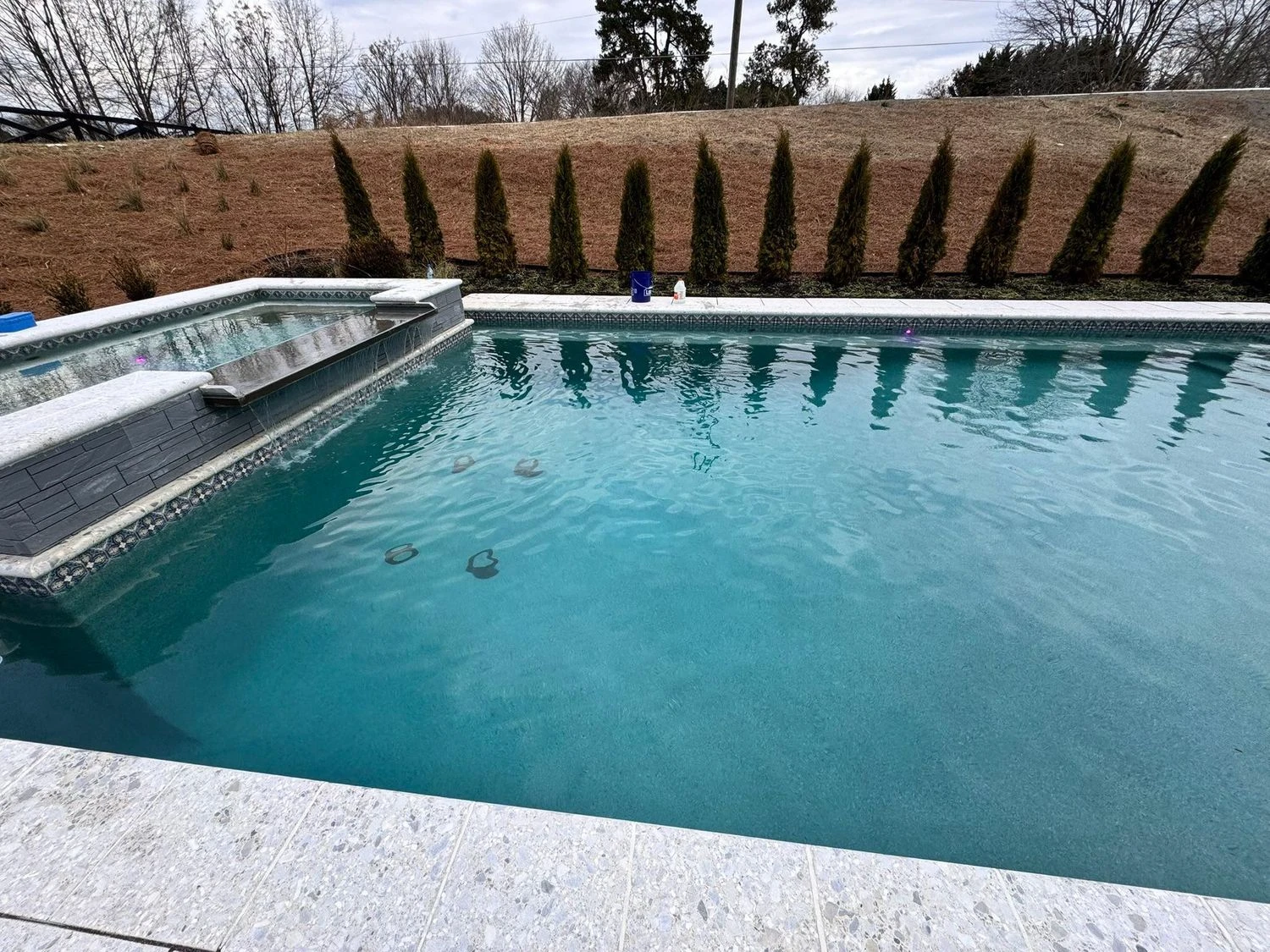
Renson Camargue vs. StruXure vs. Sienna: the real-world comparison
These three systems dominate the aluminum louvered-pergola market at the Milton price point. Here’s how they actually compare on a 16×20 build to the same rear-yard spec:
StruXure Pergola X — the baseline
Price: $38K–$58K installed. Lead time: 6–9 weeks. Louver: 6-inch aluminum blade, motorized, rain sensor. Electrical: integrated LED and rain sensor included; heater and screen packages are add-ons. Warranty: 10-year structural, 5-year motor, 2-year electronics. Why it wins: the price-feature ratio. You get the core louvered experience without paying European freight and import markup.
Renson Camargue — the European premium
Price: $48K–$72K installed. Lead time: 10–14 weeks (container shipping from Belgium). Louver: 8-inch aerodynamic blade, motorized, integrated rain gutter in the louver itself (water routes through the blade rather than over it). Electrical: integrated LED, heater, and screen packages available as tightly engineered add-ons that maintain the clean-line aesthetic. Warranty: 10-year structural, 5-year motor, 5-year electronics. Why it wins: the integration. Every accessory — drop screens, infrared heaters, LED, side wind screens — is engineered into the frame rather than bolted on. On a $3M+ build in The Manor or Cogburn Estates where the pergola is the center of the rear elevation, the $14K premium over StruXure reads as worth it.
Sienna Outdoor — the value play
Price: $32K–$46K installed. Lead time: 4–7 weeks. Louver: 6-inch aluminum blade, motorized. Electrical: basic LED perimeter; heater and screen packages are third-party add-ons. Warranty: 10-year structural, 3-year motor. Why it wins: if the pergola is one piece of a larger project budget (pool, outdoor kitchen, hardscape, landscape lighting), Sienna frees up $8K–$14K that can go into the pool decking or the kitchen island. The build quality is solid; what you lose is finish detail and electronics integration.
What a complete aluminum-pergola project costs on a Milton estate lot
The pergola itself is one line item. On a Milton build we’re almost always quoting the full rear-elevation package:
- 16×20 StruXure Pergola X installed: $46,000 typical mid-spec
- Footing + structural engineering allowance: $3,600–$5,200
- Electrical rough-in, sub-panel, dedicated circuits: $3,800–$6,400
- Travertine or porcelain deck extension under the pergola footprint: $18–$32 per sq ft installed ($5,760–$10,240 on a 320 sq ft footprint)
- Gas stub for integrated heater or fire feature: $1,400–$2,600
- Low-voltage lighting integration with the house control system: $1,800–$3,200
- Milton permit + engineering stamp: $650–$1,200
- Architectural Review Committee submission (Manor/Atlanta National): $0–$450 submission fee
Total installed package for a complete pergola-over-pool-deck build on a Milton estate lot: $62,000–$92,000 for a standard mid-spec StruXure build, $78,000–$115,000 for a Renson equivalent. These are the numbers we’re quoting in real time on 30004 and 30075 projects through early 2026.
The ownership math: At a 16-year hold (median for Milton estate buyers), the aluminum build’s total cost — install + zero refinish — is $46,000. The cedar equivalent over 16 years runs $24,000 install + ~$12,000 in stain refreshes + $8,000–$14,000 in partial structural replacement by year 14. Total: $44,000–$50,000. The aluminum wins outright on maintenance avoidance alone, before you factor in the finish match.
The rear-elevation design rules we follow on every Milton pergola
A pergola that matches the modern-farmhouse palette is a three-part exercise: structure, placement, and relationship to the pool. Here are the rules we apply on every Milton build:
1. Post spacing to ridge line
The pergola’s long dimension should align with the strongest architectural axis on the rear elevation — almost always the ridge line of the main house or the dominant gable. A pergola laid perpendicular to the ridge fights the roof geometry. Parallel, it reinforces it.
2. Post diameter relative to window mullions
The 6-inch square aluminum posts on a StruXure or Sienna system should read as structurally proportional to the window trim. On a house with 4-inch trim, the 6-inch post is right. On a house with chunkier 6-inch trim (common in the Bethany Creek and Hopewell Plantation estate builds), consider a 7-inch post option.
3. Integration with pool coping and deck edge
If the pergola covers part of a pool deck, the post footing should never land inside the pool’s 18-inch coping offset zone. The standard rule we enforce: 24 inches minimum from coping edge to post face. This prevents deck-slab cracking at the pergola footing perimeter and keeps the pool mechanical chase clear.
4. Deck material continuity
The deck material under the pergola should match the rest of the pool deck, not change to concrete pad or decorative paver. On modern-farmhouse Milton projects we’re using French-pattern travertine in ivory or silver, large-format porcelain plank (24×48), or brushed bluestone in larger 18×36 cuts.
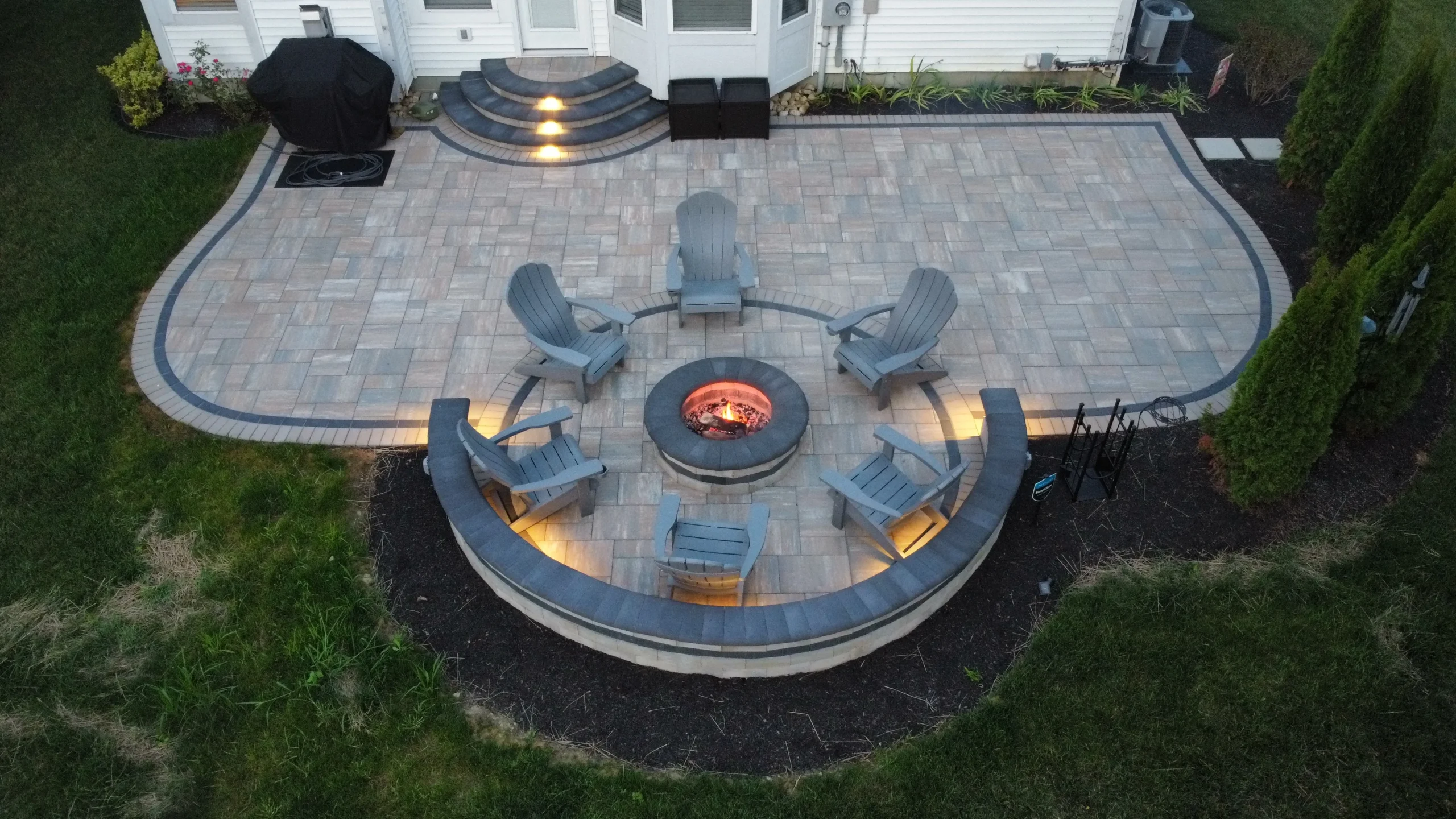
5. Color match discipline
The powder-coat should match the roof and window frames to within 1 Delta-E. That usually means a custom pull sample rather than the stock factory black, which can read slightly blue or slightly warm depending on the batch. Our standard spec is RAL 9005 satin in AAMA 2605 — verified against a physical sample pulled from the roof standing-seam and the window frame before the pergola order is released.
6. Lighting temperature
Integrated pergola LED should match the existing exterior lighting temperature. Modern-farmhouse Milton homes are almost universally lit at 2700K (warm white) from the gas-lantern entry down to the soffit downlights. The pergola LED default is often 3000K, which reads cooler by comparison. Always spec 2700K on the integrated package.
When aluminum isn’t the right call — and what to build instead
Not every Milton home is modern-farmhouse. The older Greystone builds, the traditional-Georgian homes along Hopewell Rd, and the craftsman-leaning houses in the Potters Road estates have their own architectural logic, and a black aluminum pergola reads wrong on all three.
For those homes:
- Traditional Georgian with brick exterior and white trim: painted-white cedar or fiberglass pergola with decorative rafter tails. Aluminum reads too modern; the white powder-coat option reads too industrial next to historic brick.
- Craftsman with stained wood accents: stained cedar or ipe, accepting the maintenance burden. The warmth of real wood is the architectural answer and aluminum won’t match.
- Ranch and rustic traditional in the Crabapple preservation overlay: the overlay review is stricter on materials. Natural wood with a matte sealer is the path of least resistance through the overlay committee.
The right question isn’t “aluminum vs. wood.” It’s “what does the rear elevation ask for?” On a post-2015 modern-farmhouse Milton build, the elevation asks for aluminum. On everything else, the answer changes.
What to do next if you’re building on a Milton modern-farmhouse lot
If the rear-elevation pergola is on your 2026 project list, the sequence that works cleanly through Milton Community Development is this:
- Confirm the architectural style. If the home is post-2014 with black standing-seam roof, white lap siding, and black window frames, aluminum powder-coat is the answer. If it’s traditional, Georgian, or craftsman, stop and reconsider.
- Pick the product tier. StruXure Pergola X for the standard build. Renson Camargue if the rear elevation is the feature and the integration budget supports it. Sienna Outdoor if the pergola is one piece of a larger pool-plus-kitchen package.
- Survey the footing conditions. Good Cecil clay is cheap; saprolite and creek-bottom are not. A two-hour soil probe before the quote eliminates the worst cost surprises.
- Get the color sample pulled against the house. Roof standing-seam, window frame, existing exterior trim. Powder-coat matched to within 1 Delta-E.
- Run permits concurrent to HOA/ARC review. Milton’s 10–14 business days + The Manor’s 4–5 weeks of ARC is 6–7 weeks if run concurrent, 11–12 weeks if run sequential.
- Integrate the pergola electrical with the house control system on day one. Retrofitting the Lutron or Control4 integration after the fact costs three times as much as building it in during rough-in.
The math, the material, and the architectural logic all point the same direction on modern-farmhouse Milton lots. The pergola that belongs on the house is black powder-coat aluminum, the system worth specifying is one of three, and the build cost is a known number rather than a range that balloons over 15 years of refinishing.
Aluminum pergolas and modern-farmhouse pool decks across 20+ cities within 30 miles of Snellville, GA
From Milton’s estate lots to Dacula’s new-build subdivisions, we specify, permit, and install black powder-coat aluminum pergolas that match the architecture the home was designed around.