
In Alpharetta’s tech-corridor neighborhoods, seven out of ten backyard-upgrade inquiries that cross a $50,000 threshold end up specifying a full outdoor kitchen — not an add-on grill, not a bump-out counter, but a framed, vented, plumbed cooking structure that carries a dedicated line on the general contract. The budget that keeps surfacing in Windward, Hutchinson Farm, and the newer Avalon-adjacent infill is $65,000.
That number isn’t arbitrary. It’s what a 12-to-14-foot L-shaped outdoor kitchen costs in 2026 once you’ve specified a stacked-stone base that matches the existing hardscape, a granite or leathered-quartzite counter run, a commercial-grade gas grill with a functioning side burner, a ceramic kamado, a stainless sink, a refrigerator, electrical and gas rough-in, the paver or travertine apron around it, and a realistic contingency. It’s also a number that sits inside the architectural review bandwidth most North Fulton HOAs will approve without escalation.
What follows is the line-item breakdown — nine cost centers, in the order a builder actually quotes them — with what $65K delivers and, just as important, what it does not.
Why $65K Is the Alpharetta Sweet Spot
The number stays consistent across three independent data points. First, it’s the median outdoor-kitchen ask inside completed landscape contracts on $900K-to-$1.6M Alpharetta homes — homes large enough to warrant the scope but not so large they skip straight to the $125K Kalamazoo tier. Second, it’s the price point where the appliance stack changes from “nice residential” to “legitimately commercial-grade” without tipping into the premium import bracket. Third, it’s the number that moves through Windward and Country Club of the South architectural review on the first submission — above roughly $85K, ARBs start asking for structural drawings stamped by a Georgia-licensed engineer, which adds calendar time and design fees nobody budgeted.
Think of $65K as the ceiling of “standard luxury” and the floor of “serious build.” Below it, compromises show up in visible places — undersized grill, veneer that reads too manufactured, base that fails in year four. Above it, the money goes into features most homeowners use less than twice a year.
The Nine-Line Breakdown
1. The Stacked-Stone Base and Counter — $18,000
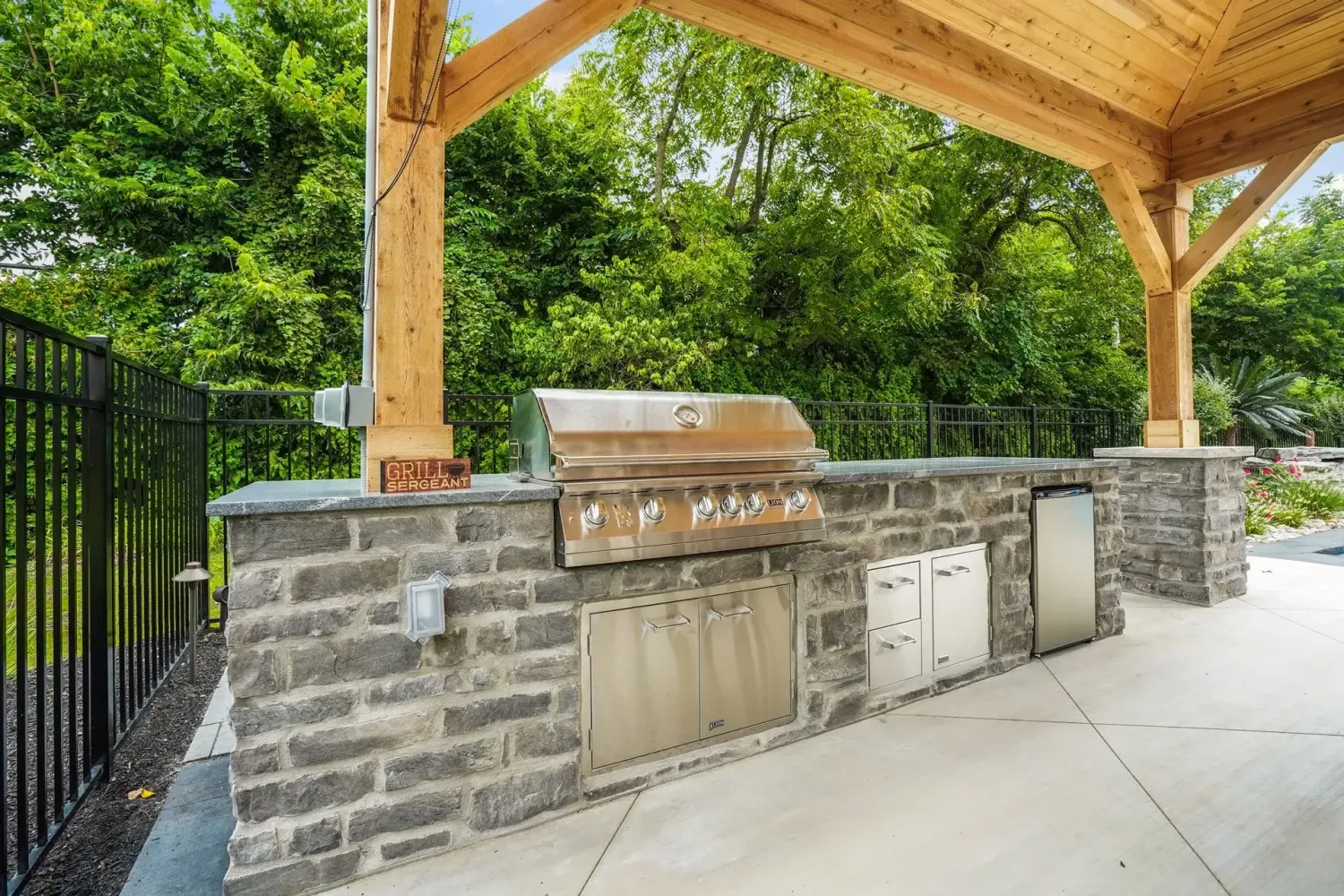
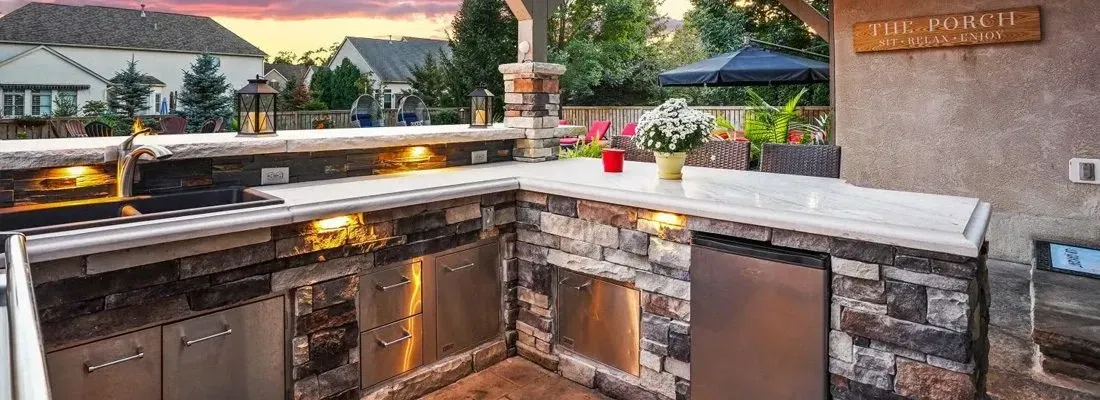
The kitchen structure itself is the biggest single line, and it’s where most homeowners are surprised. Inside a $18,000 allowance, you are paying for a concrete-block core wall, stucco scratch coat, stacked-stone veneer on three sides, cap detail at the counter line, and a granite or leathered-quartzite top fabricated, templated, transported, and installed. Granite is standard at this number. Premium quartzite runs about 12–18% above, and at that point something else in the stack has to give.
In Alpharetta specifically, the stone selection matters for HOA reasons. Country Club of the South and Windward both run architectural review committees that hold veneer samples against the existing home’s masonry. Stacked-stone that reads too orange, too red, or too manufactured-pattern-regular tends to get flagged. We spec Tennessee fieldstone blend or Telluride Gold dry-stack as defaults because they pass ARB review on the first submission in about four out of five cases.
Linear footage assumption: roughly 14 running feet of kitchen wall, L-shaped, with a 36-inch-deep counter and a 15-inch raised bar ledge on the back side. Push past 16 linear feet and the base line item rises to $22,000–$24,000 before you’ve added a single appliance.
Alpharetta ARB note: Windward and Country Club of the South both require veneer samples submitted for a 3-to-4-week review before excavation. Budget that calendar time — not money — into every spec.
2. The 42-Inch Grill and Side Burner — $6,800
The grill is the second-largest line, and it’s the line where specification rigor pays off the most. A 42-inch Bull Brahma stainless built-in with rear infrared burner and integrated rotisserie lands at roughly $5,400. A DCS Series 9 in the same cutout size runs about $6,800 with the dedicated side burner. Both are appropriate at this budget. Neither is a Kalamazoo, and that’s the trade.
The 42-inch size is deliberate. A 36-inch grill feels undersized inside a 14-foot counter run — the proportions read wrong and you lose the two-zone cooking discipline most homeowners adopt inside a season of ownership. A 48-inch grill, by contrast, typically pushes the BTU draw past what a standard 3/4-inch gas line on a mid-2000s Alpharetta home can feed without upsizing the meter. Check this before you spec the grill, not after.
Side burner selection matters more than brand snobbery suggests. A 15,000-BTU single burner does sauces and seafood boils well. A double burner at 30,000 BTU combined is the better long-term call if the kitchen will ever host a low-country boil for twenty people — and in North Fulton, it will.
3. The Big Green Egg XL With Nest and Tables — $3,400
The ceramic kamado is where Alpharetta outdoor kitchens diverge from the California spec sheets most online calculators are built around. In the Southeast, and specifically along the GA-400 corridor, the Big Green Egg XL or equivalent ceramic cooker is not optional equipment for anyone who smokes, bakes, or slow-roasts. Budget $3,400 fully loaded: the Egg itself, the stainless nest, side shelves, a convEGGtor for indirect cooking, a pizza stone, and a heat-resistant pad if the Egg is being built into a stone surround.
A note on integration: building the Egg into a masonry surround instead of leaving it on the nest adds roughly $1,200 to $1,600 to this line because of the custom cavity, the stainless insert frame, and the additional stone cut. At $65K, most homeowners keep the Egg on its nest and use the saved money on lighting or the refrigerator upgrade. It can be built in during a later phase without tearing anything apart.
4. The Sink, Refrigerator, and Ice Maker — $4,800
These three small-appliance lines are where budgets quietly inflate. The defensible spec at $4,800 is a 15-inch bar sink with a cold-water-only line (hot water isn’t worth the winterization headache), a Summit SPRF26OS or equivalent 24-inch stainless outdoor refrigerator, and a Scotsman CU50 undercounter ice maker if the homeowner entertains more than twice a month. If they don’t, drop the ice maker and reallocate to lighting.
Homeowners reliably ask about outdoor dishwashers. We recommend against them at this price point. The drainage requirement adds plumbing cost, the freeze-protection protocol for Zone 8a winters is not homeowner-friendly, and the usage rate in our Alpharetta client survey runs under six cycles per year. It’s the wrong money.
5. Framing and Veneer Labor — $11,000
This is the line that doesn’t have a Home Depot equivalent and therefore feels opaque. Framing and veneer labor at $11,000 covers the CMU block lay-up, the rebar schedule, the stucco scratch, three days of stonemason work for the veneer, the grout color-matching, the counter template and template-cut, the appliance cut-outs, and the final seal.
The reason this line doesn’t compress below $11K in Alpharetta is labor availability. Skilled masonry crews in North Fulton book six to ten weeks out during the spring build season — March through early June — and the premium on that availability is real. Quotes that come in dramatically under this number are either using apprentice-grade masons or pulling from crews that skip the CMU core in favor of metal stud framing, which is the wrong long-term move in a climate with 51 inches of annual rainfall.
6. The Paver or Travertine Apron Around the Kitchen — $8,000
A kitchen without a proper surrounding deck reads like a stage set. The paver or travertine apron — the 200-square-foot zone around the kitchen counter that accommodates the cook, two prep helpers, and the trash-pull path — runs about $8,000 installed with a proper 8-inch compacted base, geotextile fabric over the Piedmont clay subgrade, polymeric sand, and edge restraint. Travertine runs 10–15% higher than pavers and, in our experience, is the better call in Alpharetta because the stone doesn’t get punishingly hot around the grill in August.
Piedmont clay subgrade is the reason the base work cannot be skimped here. Cecil-series clay is the dominant soil across Alpharetta’s 30004 and 30005 zip codes, and it exhibits moderately high shrink-swell behavior — meaning it moves with moisture. A 4-inch base works on paper and fails in year four. An 8-inch base, properly compacted in two lifts, is the only specification we write.
7. Lighting and Electrical — $3,000
Lighting is the line that disappointed-homeowner reviews almost always reference. At $65K, the allocation is $3,000 for under-counter LED task strips rated for wet location, two downlights over the prep zone on a dedicated switch, one warm wall-wash at the stone veneer, and the dedicated 20-amp GFCI circuit required by NEC for the refrigerator and ice maker. Control is a weatherproof switch box at the kitchen edge, not a smart-home app. Apps break. Switches don’t.
Permit note: the City of Alpharetta Community Development office at 2 Park Plaza handles electrical permits for kitchens inside city limits — not Fulton County unincorporated. The review cadence is faster than county and the inspector will specifically look at GFCI, wet-rated fixtures, and the gas-line bond. Code compliance at this level is not optional — it’s what protects the homeowner’s homeowners’ insurance policy in a claim scenario.
8. Gas and Plumbing Rough-In — $4,000
Alpharetta homes built between 1995 and 2005 overwhelmingly have a gas meter sized for interior-only load. Pulling a 3/4-inch black iron line or, preferably, a larger CSST feed out to a 14-foot run, trenching across the backyard at 24 inches below grade, terminating at a shutoff valve inside the kitchen base, pressure-testing, and scheduling the Atlanta Gas Light inspection runs about $4,000. The plumbing for the bar sink — a cold-water line and a gravity drain to the nearest stub — is folded into this number.
Homes in Windward and Country Club of the South on Sawnee EMC’s service territory along the northern Alpharetta/Milton border sometimes need a gas-meter upsize before the kitchen inspection will clear. That’s a separate utility coordination — not a contractor line item — but worth flagging at the initial walk-through so it doesn’t become a surprise in week six.
9. The Contingency — $6,000
Every outdoor-kitchen quote that arrives without a 9-to-10% contingency line is either optimistic or uninformed. On a $65K spec, the contingency is $6,000. It exists because the Piedmont-clay subgrade sometimes reveals a wet pocket that requires extra base, because one in every four kitchens hits an unknown irrigation line during trenching, because the granite fabricator occasionally finds a flaw mid-template that pushes a material reorder, and because ARB sometimes sends a veneer sample back and costs a travel day at the stone yard.
If none of that happens, the homeowner gets the $6,000 back at closeout. That’s a real conversation we have at the kickoff, and it’s how we keep the change-order count near zero on these builds.
What $65K Does Not Buy (And What It Would Cost To Add It)
This matters as much as the breakdown itself. Spec honesty up front prevents the mid-project “can we just add…” conversation that blows budgets in every category.
A full wood-fired pizza oven is not in the $65K spec. A proper Forno Bravo or Mugnaini dome oven with chimney, insulation, stone hearth, and veneer surround adds $8,000 to $14,000 depending on dome size and whether it shares the kitchen roofline. A pizza attachment for the Big Green Egg delivers 85% of the experience at zero additional cost.
A Kalamazoo K-series hybrid grill is not in the spec. The K-500HB starts at roughly $18,000 and replaces both the Bull/DCS grill line and the Egg line. It’s defensible at a $90K kitchen, not a $65K one.
A dedicated offset smoker (Yoder YS640, Lone Star Grillz) is not in the spec. The Big Green Egg handles low-and-slow well enough that 90% of homeowners never miss the dedicated smoker. If a homeowner is a serious competition-style smoker, that’s an $2,500–$4,000 add, usually on a concrete pad off the kitchen rather than built-in.
An overhead pergola or louvered roof is not in the spec. A proper 14-by-16-foot cedar pergola runs $11,000–$15,000 fabricated and installed. A louvered aluminum system (Struxure, Azenco) runs $22,000–$34,000 for the same footprint. Both are legitimate phase-two additions that don’t affect the kitchen build itself.
A full outdoor TV and audio package is not in the spec. A 55-inch outdoor-rated TV, a weatherproof audio pair, and the dedicated circuit add roughly $3,500–$5,500 depending on TV spec.
The $65K line in context: This spec sits comfortably inside the kitchen-budget bandwidth of a $750,000 to $1.5M Alpharetta home. Homes in Country Club of the South at $2M+ typically spec up to the $90K–$125K tier with Kalamazoo appliances, wood-fired oven, and a louvered roof system.
The Sequence That Protects the Budget
The order of operations is what separates a $65K build that lands at $65K from a $65K build that lands at $78K. On every Alpharetta kitchen we’ve delivered inside 6% of the initial spec, the sequence held to this order.
- Week 1–2: HOA / ARB veneer sample submission. Three options pre-selected. Windward and Country Club of the South require this before permit submission makes sense.
- Week 2–3: Alpharetta Community Development permit filing at 2 Park Plaza — electrical, gas, plumbing. Alpharetta city permits typically clear in 8–12 business days versus 14–20 for Fulton County unincorporated.
- Week 3–5: Gas-line coordination with Atlanta Gas Light if an upsize is needed. Electrical meter check with Georgia Power or, on the Milton-border homes, Sawnee EMC.
- Week 5–6: Excavation, base prep, and CMU block lay-up. Gas and electrical rough-in before veneer.
- Week 6–8: Stacked-stone veneer install. Counter template at the end of week 7, granite fabrication off-site during week 8.
- Week 8–9: Counter set, appliance drop-in, final plumbing and electrical connect, inspections called.
- Week 9–10: Paver or travertine apron, sealant, final walkthrough, punch list.
Ten weeks from contract to handover is realistic for a $65K Alpharetta kitchen that avoids the spring-build crunch. Start in late June for an October delivery — in time for the 20 freeze events per year that begin in mid-November to become the first real test of the gas rough-in and exterior plumbing.
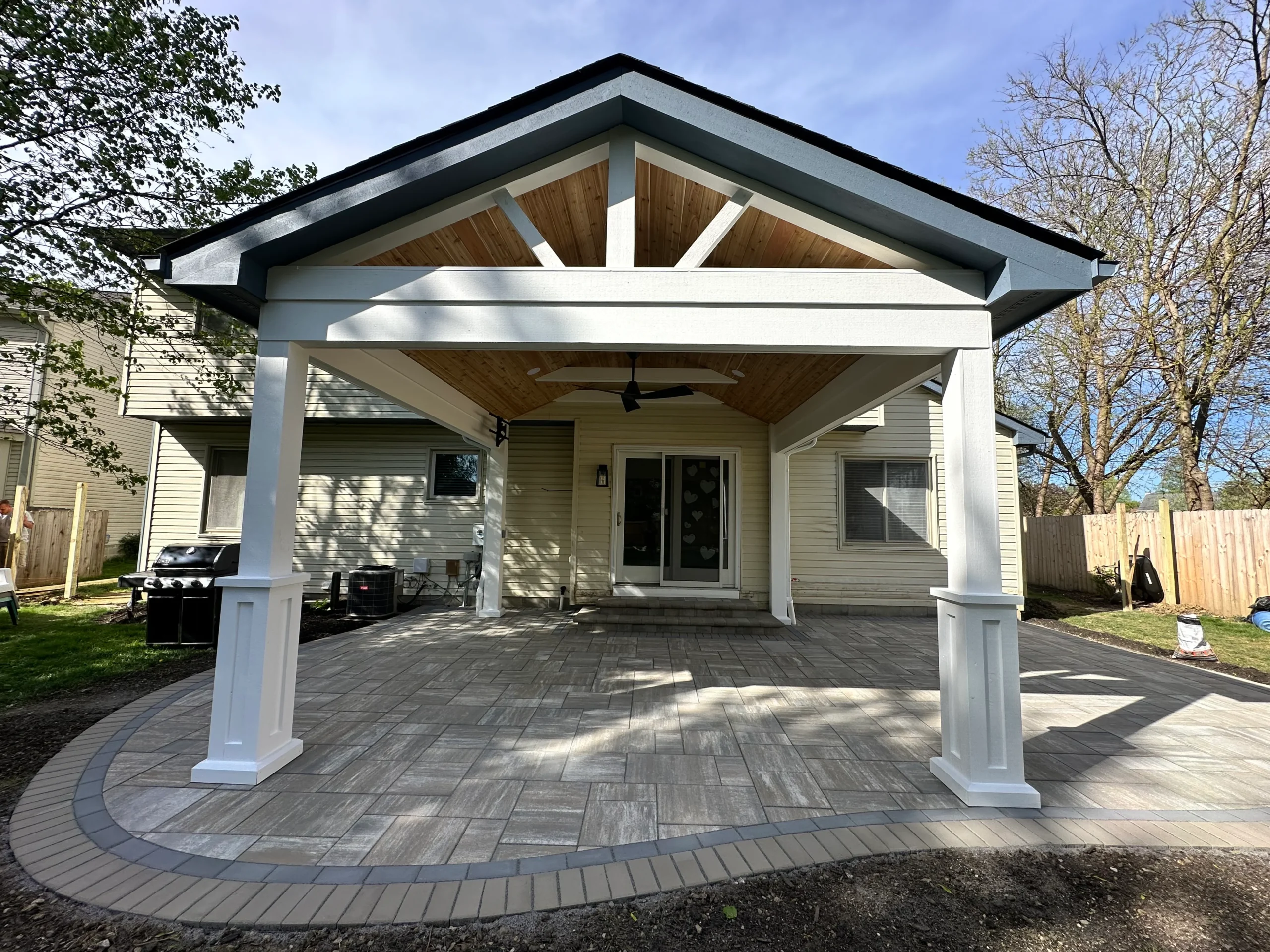
The sequence matters more than any single appliance choice. A build that jumps from masonry straight to appliance drop-in without the intermediate gas and electrical rough-in step ends up with chase-cutting and retrofit work that costs real money — usually $2,400 to $3,800 in un-budgeted re-work. We’ve seen that failure pattern on every Alpharetta project we’ve rescued from another builder mid-course.
The Avalon-Adjacent Townhome Variation
The 2015+ luxury townhome infill near Avalon and the Alpharetta Downtown Historic District operates under tighter constraints. Lot footprints are smaller, HOA restrictions on structure height and veneer palette are stricter, and the budget that works for a freestanding Windward home often can’t be spent the same way on a townhome terrace. The right $65K spec on a townhome shifts toward a compact 8-foot straight-run kitchen with higher appliance grade — think a DCS Series 9 with a built-in Kalamazoo side burner — and a smaller, higher-end travertine surround instead of the paver apron. Same dollar total, different allocation.
The structural detail that drives this shift is the shared-wall constraint. Townhome terraces share demising walls with neighbors, which means a stacked-stone veneer can’t cantilever past the property line and the gas line routes through a stacked-riser system rather than a trenched horizontal run. The $4,000 gas rough-in line on a freestanding home drops to about $2,800 on a townhome, which is what frees up the allocation for higher-grade appliances.
What Separates the Builds That Land On-Budget From the Ones That Don’t
The homeowners who land these builds cleanly — meaning within 6% of the signed-contract number — are almost always the ones who came in with a written budget ceiling, accepted the nine-line breakdown on the first review, and signed off on what the $65K does not buy before trenching started. The ones who go over budget are the ones who added the pergola, the pizza oven, and the outdoor TV in week five — after the masonry was already set to the original spec.
The second pattern: on-budget builds almost always involve a homeowner who has done one or two prior home-improvement projects of comparable scope — a finished basement, a kitchen remodel, a pool build. They have calibrated expectations on how construction-week schedules slip, how subcontractor coordination works, and why change orders carry a price premium over originally-spec’d work. First-time luxury-outdoor-project homeowners need more up-front education, and we build that time into the kickoff meeting.
The third pattern, specific to Alpharetta: the builds that land cleanly are also the ones where the homeowner has already read their HOA’s architectural review guidelines before the first design meeting. In Windward, that’s a 14-page document. In Country Club of the South, it’s 22 pages. Reading those upfront prevents the veneer-sample-rejected-at-week-three problem that costs two weeks and roughly $1,800 in restocking fees.
Alpharetta is not a cheap place to build an outdoor kitchen. But at $65,000, with the nine lines specified above and held to sequence, it is a predictable one. That predictability is what most homeowners actually want — not the lowest number, not the highest feature count, but the spec that goes in, gets used, and doesn’t need a callback in year three.
Outdoor kitchens across 20+ cities within 30 miles of Winder, GA
From $65K stacked-stone kitchens in Windward to $125K kitchens with wood-fired ovens in Country Club of the South — every spec starts with the same nine-line budget conversation.