
Milton sits at roughly 1,150 ft of elevation and logs about 22 freeze-thaw events per year on Cecil clay over weathered granite — a subsoil combination that will destroy a builder’s standard 8-inch base spec inside a decade. A 30-year service life is achievable, but only with a base section that treats the ground under your patio as the structural problem it actually is.
Most of the paver patios failing in north Fulton right now are not failing because of the pavers. They are failing because somebody poured 6 to 8 inches of graded aggregate base over saprolite shelves and Cecil clay residuum, ran a plate compactor over it twice, and called it done. In Alpharetta’s tighter subdivision clay that spec will get you 12 to 18 years. In Milton, where estate lots ride across ridgelines and creek bottoms inside the same 3 acres, that same spec will give you rolling heave, corner settlement at the pool coping, and blown polymeric sand joints inside 8 to 10 years. The soil is not forgiving the way a compacted subdivision pad is.
This post is not a general paver patio overview. It is the exact base, edge, compaction, and maintenance specification Primetime Pools GA engineers for Milton estate builds when the client wants the hardscape to outlast the house’s first roof replacement. Every section serves one thing: the 30-year spec.

Why Milton’s Subsoil Breaks the Alpharetta Playbook
Drive 15 minutes south into Alpharetta and the residuum is relatively uniform: Cecil clay, sometimes a thin veneer of loamy fill, moderately consistent bearing. A competent installer can lay an 8-inch GAB base over that and get a patio that behaves for two decades in a subdivision backyard. Milton does not offer that uniformity.
North Fulton was carved by Cooper Sandy Creek, Chicken Creek, Lake Creek, and the Etowah tributaries. Those drainages create 6 to 14 ft of grade change inside a single estate lot. On the ridgeline you get thin Cecil residuum sitting almost directly on weathered granite — saprolite — with bearing values all over the map. Drop 200 ft toward the creek buffer and the topsoil thickens, the clay goes plastic, and the bearing collapses under freeze expansion. A patio built on one base spec across that gradient cracks exactly where the soil type changes.
That is the Milton problem in one sentence: the 1-to-5-acre estate lot that makes this city desirable is the same lot that makes paver hardscape engineering harder than it is anywhere else in metro Atlanta. The 30-year spec exists because the standard spec assumes a uniformity this ground does not provide.
Milton site reality: 6–14 ft of grade change across a typical estate lot, Cecil clay thinning to saprolite on ridgelines, creek-buffer setbacks of 25–75 ft from named tributaries. Permitting routes through City of Milton Community Development at 2006 Heritage Walk — not Fulton County.
The 10-Inch Compacted GAB Base — Not 8, Not 6
The spec starts with excavation to 14 inches below finished paver elevation. Not 10. Not 12. Fourteen. That buys us the structural section: 10 inches of compacted GA DOT Type I GAB, placed and compacted in two 5-inch lifts, over which we lay the bedding assembly. The subdivision industry norm — 6 to 8 inches of GAB in a single lift — is the single biggest reason Milton patios fail early.
Two lifts matter more than total thickness in a lot of ways. A single 10-inch lift cannot be compacted to 95% Modified Proctor density by a walk-behind plate, full stop. The compaction wave dies by about 5 inches of depth. Split the section, compact each lift to refusal under a 15,000 lb-force reversible vibratory plate with four passes per lift, and the bottom of the section is as dense as the top. Miss that step and every pound of load you put on the patio — the pool deck furniture, the outdoor kitchen island footing, the occasional pickup backed up to deliver firewood — concentrates at the soft interface and drives micro-settlement for the next 15 years.
Moisture matters equally. Compacting GAB at optimum moisture content is non-negotiable. Dry aggregate skates under the plate and never locks up. Saturated aggregate pumps water to the surface and leaves voids when it dries. On Milton’s ridgelines in July, that means wetting the stockpile before placement. In March near Chicken Creek, it means tarping overnight.
The Geotextile Separator That Actually Earns Its Keep
Between subgrade and the first GAB lift we lay a non-woven 8 oz/sy geotextile — Mirafi 180N or equivalent. Not a woven weed fabric. Not a 4 oz landscape cloth. A full 8 oz non-woven with a rated puncture strength above 200 lbs, overlapped 18 inches at seams and pinned every 3 ft with 10-inch landscape staples.
The geotextile does three jobs at once. It separates the base aggregate from the Cecil clay subgrade so fines cannot migrate up into the GAB under freeze-thaw pumping. It distributes load laterally across the subgrade instead of letting the base act like a series of independent columns. And it gives the excavator operator a visual tell on final grade — if you can see the fabric peeking through your GAB, your lift is too thin.
The failure mode when this layer gets skipped or downgraded is predictable. You lose fines from the clay up into the aggregate, the base grades get contaminated, drainage drops, and the freeze-thaw cycle starts acting on a soil-aggregate mix instead of clean stone. Two winters later the pavers are rolling. We have rebuilt patios in Crooked Creek and the White Columns extension where the original installer skipped the separator to save $0.40/sf. Full tear-out and rebuild ran the homeowner north of $38/sf after demolition, haul-off, and replacement.

The Crushed Stone and Sand Bedding Layers
On top of the compacted GAB goes a 4-inch layer of #57 or #78 clean crushed stone. This is the open-graded drainage layer that most residential installers skip entirely — and it is the single biggest difference between a 15-year patio and a 30-year patio in Milton’s climate.
Here is why. Cecil clay holds water. Weathered granite holds water in fractures. Even a perfectly compacted GAB will, over years, accumulate moisture at its base interface. When November hits and the ground goes below 32°F for the first real night, that moisture tries to expand upward. If the only thing above it is a 1-inch sand setting bed, the expansion lifts the pavers. If there are 4 inches of #57 clean stone with 35-to-40% void ratio sitting between the GAB and the setting bed, the expansion vents laterally into the open stone and dissipates. No lift. No paver displacement.
Above the crushed stone comes the setting bed: 1-1/4 inches of ASTM C33 concrete sand, screeded flush, never compacted before paver placement. The pavers are set, then the entire field is compacted in one final pass with the plate compactor riding on a neoprene pad to seat the pavers into the sand without scuffing. This is the step where amateurs cut corners — they skip the neoprene pad, grind the paver faces, and deliver a job that looks tired after one season.
Full base section from subgrade up: 8 oz non-woven geotextile → 10 inches compacted GAB (two 5-inch lifts) → 4 inches #57 clean crushed stone → 1-1/4 inches ASTM C33 concrete sand setting bed → pavers. Total dig depth: 14 inches below finished paver elevation.
Edge Restraint at 4-Foot Centers
Edge restraint is the second mechanical failure point that standard specs underbuild. Most residential installs use a spiked PVC restraint pinned at 6-ft centers with 10-inch spikes. That spacing is an ICPI minimum, not a Milton-appropriate spec.
On estate-scale Milton patios — 800 to 2,400 sf typical — we drop the pin spacing to 4-ft centers and specify 12-inch galvanized steel spikes driven through the restraint into the subbase below the crushed stone layer. The restraint itself is heavy-gauge aluminum or a concrete soldier course, not PVC, on any run over 20 ft or any run adjacent to a pool coping detail.
Why? Because the horizontal force pushing pavers outward is not constant. It spikes during freeze expansion, it spikes when a saturated clay subgrade tries to flow, and it spikes when the compactor finishes the initial pass. At 6-ft centers, PVC restraint will bow between spikes under those spikes in force. Once the edge bows, the field has nowhere to transfer load and the perimeter course walks outward roughly 1/8 inch per year. Ten years in, the field is visibly open along the edges, polymeric sand is blown out, and water is getting under the pavers.
At 4-ft centers with 12-inch spikes through aggregate and into stable subbase, we measure edge displacement in thousandths of an inch over a decade. That is the difference.
Polymeric Sand, Sealer, and the 7-Year Maintenance Cycle
Joint stabilization is the one piece of the 30-year spec that homeowners have to participate in. Everything buried is done by us, once. Everything at joint level is shared maintenance.
We install with a high-performance polymeric joint sand — Techniseal NextGel, Alliance G2, or SEK Pave Tech — activated with a controlled water pass, never a flood. The activation window matters. Too little water and the polymer does not fully cure; the joints look fine at year one but wash out in the third big thunderstorm. Too much water and the polymer floats to the paver face, cures as a haze, and has to be acid-washed off.
On Milton’s climate — 53 inches of annual rainfall, 22 freeze events, and a summer UV load that degrades joint sand faster than most contractors admit — we specify a polymeric sand re-application every 7 years. Not 10. Not “when it starts looking bad.” Seven. A penetrating breathable sealer — siloxane-based, not film-forming — goes on at year one and gets refreshed on the same 7-year cycle. Film-forming sealers trap the moisture that the whole 14-inch base section was designed to vent. Do not use them on Milton pavers, period.
Permitting, Preservation Review, and the Milton Timeline Reality
Milton incorporated as a separate city in 2006, which means hardscape permits for anything triggering impervious surface calculations route through City of Milton Community Development at 2006 Heritage Walk, not Fulton County. For homeowners coming from Alpharetta this is a net positive — Milton’s review turnaround runs 10 to 14 business days versus 18 to 25 at the county. But it comes with stricter preservation review on estate builds.
A few specifics worth knowing before your first design meeting. Milton’s AG-1 equestrian preservation zoning enforces 1-to-3-acre minimum lots and limits impervious coverage more tightly than suburban residential zoning. Any patio expanding the impervious footprint above ordinance thresholds triggers stormwater review. Creek-buffer setbacks of 25 to 75 ft from named tributaries — Cooper Sandy Creek, Chicken Creek, Lake Creek — are enforced against the patio edge, not the house, and the 75-ft trigger applies to perennial streams on larger parcels.
HOA overlays add a second filter on top of city review. The Manor Golf Club’s architectural review committee — which includes a structural review step on any hardscape over 600 sf — typically runs a separate 4-to-5-week approval window in parallel with the city permit. Crooked Creek, Atlanta National, and Cogburn Estates each run their own ARC processes with variable timelines. Factor the full calendar upfront or the pool deck you wanted by Memorial Day becomes a July install.
One Milton-specific signature: the Crabapple historic crossroads district sits inside a preservation overlay that influences material palette for visible hardscape, even on private residential lots within sight of Crabapple Rd. Tumbled pavers with earth-tone blends clear review faster than sharp-edged modern formats on those parcels.
Integration with Pool Coping, Outdoor Kitchens, and Pavilion Footings
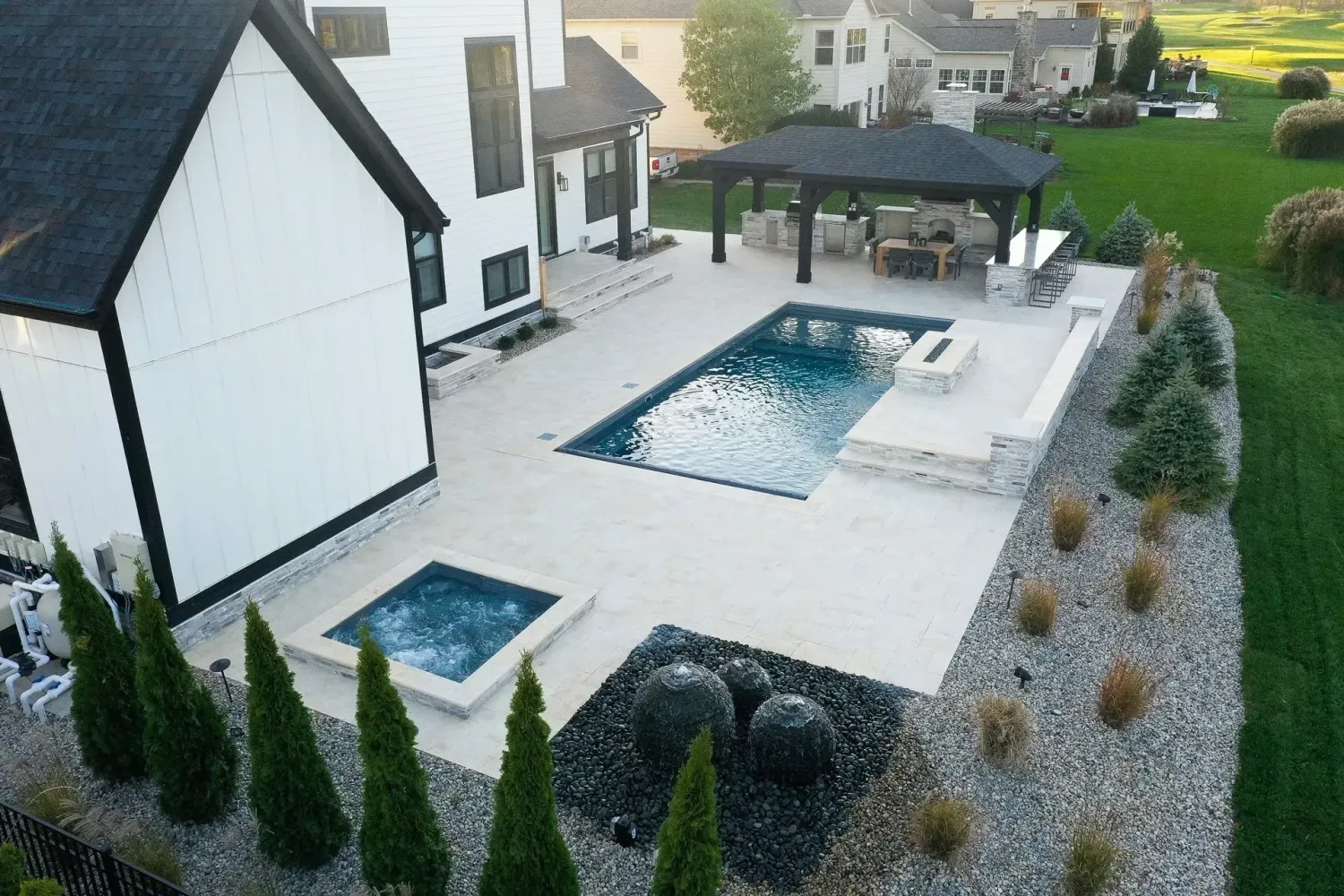
Milton clients rarely build a paver patio as a standalone. The typical scope integrates a gunite pool, a covered pavilion, an outdoor kitchen with built-in grill and refrigeration, and sometimes a detached pool house. The 30-year base spec gets more complicated — and more important — wherever those systems meet the paver field.
At the pool coping joint we step the base section up locally: the 10-inch GAB runs continuous under the coping bond beam, with a compressible bond-break joint between the beam and the paver field so seasonal pool shell movement does not telegraph into the patio. Coping-to-paver joints get a flexible urethane sealant, not polymeric sand, on the first 6 inches adjacent to the pool.
At pavilion footings and outdoor kitchen islands the issue is different. A 4-ft-square pavilion footing at 36 inches deep bears on soil that is at a completely different stiffness from the paver base. If the patio is poured around the footing with no articulation joint, the differential settlement between the rigid footing and the flexible paver field opens a visible crack along the structure within three seasons. The spec calls for a sand-filled expansion joint with a backer rod and a polyurethane cap on every structure-to-paver interface.
On the outdoor kitchen specifically, the gas line and electrical conduit routing get laid below the crushed stone layer — never in the sand setting bed — with access sleeves at the point where they exit the patio field. Repairing a buried line under a 15-year-old paver field is a $4,000 problem. Getting the sleeving right on day one is a $180 problem.
Budget reality for the 30-year spec: Base installation on an estate-scale Milton patio runs $28 to $36/sf installed for mid-range pavers (Techo-Bloc Blu 60, Belgard Lafitt, Pavestone Eco-Dublin), rising to $42–$58/sf for large-format porcelain or travertine with the same base section. The base spec adds roughly $6/sf over a standard subdivision build — buying 12 to 15 additional years of service life.
What the 30-Year Spec Actually Buys You
Clients ask us one version of the same question at every estimate: is this over-engineered for what I actually need? The honest answer is no, not in Milton. Over-engineering would be a 14-inch GAB section, a double-layer geotextile, and a reinforced concrete sub-slab. That exists; we build it for commercial jobs. The residential 30-year spec — 14-inch dig, 10-inch GAB in two lifts, 4-inch crushed stone, 1-1/4-inch sand, 4-ft edge restraint, 7-year polymeric sand and sealer cycle — is not over-engineered. It is correctly engineered for Cecil clay over weathered granite in a Zone 8a climate with 22 freeze cycles a year.
What it buys is predictability. The paver field does not walk. The polymeric joints do not blow out after the first hard winter. The pool coping stays level with the deck across a decade of freeze expansion. The outdoor kitchen island does not crack away from the patio field. The pavilion footing does not telegraph. At year 15, the deck looks like year 3. At year 30, the pavers may be tired and a sand-and-seal refresh may not bring them all the way back — but the base section is still doing its job, and a re-surface with new pavers on the same base is a fraction of a full rebuild.
The alternative — the 8-inch GAB, the skipped geotextile, the 6-ft edge restraint, the “maintenance-free” polymeric sand claim — is a patio that needs rescue work at year 10 and replacement at year 18. On an estate lot where the paver field runs 1,600 to 2,400 sf and integrates with a pool, the rescue and replace cycle is a six-figure decision. The 30-year spec is a conversation you have once.
If you are planning a paver install in Crooked Creek, The Manor, Cogburn Estates, White Columns, Atlanta National, or anywhere along the Freemanville / Hopewell / Bethany corridor, the base section under your finished surface is the decision that will define how the hardscape ages. Everything above it is replaceable. The base is not.
Paver Patios engineered for Milton’s soil across 20+ cities within 30 miles of Winder, GA
From Cecil clay ridgelines in Milton to saprolite shelves along Chicken Creek, we build the base section the ground actually requires — and deliver a paver field that behaves for 30 years.