
On a 60-year-old East Cobb lot shaded by four mature water oaks, the patio fails twice: once at year five when the roots lift the soldier course, and again at year ten when the field pavers dish toward an unseen low spot. Both failures are preventable. Both require spending $6 to $9 more per square foot at install to avoid.
Most Marietta paver patios are specced to live about twelve years before they need a rebuild or a serious lift-and-relay. The ones that make it to thirty share a narrow list of detailing choices — not exotic materials, not designer brands, just three construction steps that a volume installer almost always skips to keep a bid competitive. This post walks through exactly what those steps are, what they cost, and what happens on a typical Indian Hills or Atlanta Country Club backyard when they are left out.
If you are pricing a patio in 30062, 30068, or 30064 right now and the quotes in your folder look confusingly close together, that is because every bid on your table is using the same baseline spec. The premium installers aren’t charging more for a prettier paver. They’re charging more to build the three layers under the paver that determine whether your patio lives through year fifteen with a crown still pitched the way it was poured.
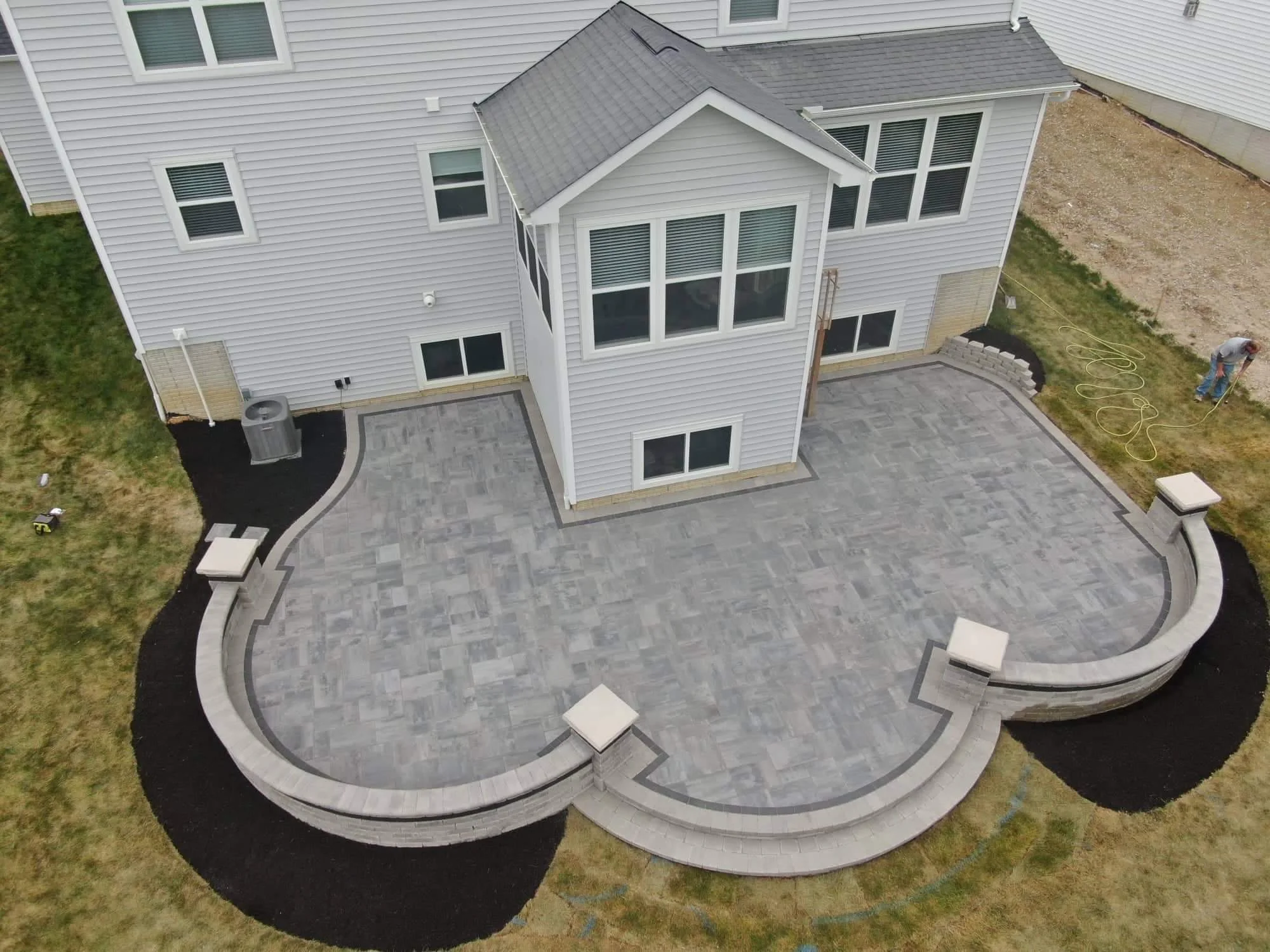
1. Why Marietta’s East Cobb Canopy Is Harder on Pavers Than Anywhere Else in Metro Atlanta
Tree roots don’t politely stop at the edge of your patio. A mature water oak in Indian Hills or off Lower Roswell Road has a root zone that extends roughly 1.5 to 3 times the canopy diameter, and the feeder-root mat lives in the top 12 to 18 inches of soil — the exact horizon your paver base sits in.
What happens over time is predictable. Pavers compact and create a flat, moist, protected thermal layer underneath. Roots grow toward it. Five to eight years in, a lateral root finds the edge of your base course, drives upward, and lifts the soldier course by a quarter to a full inch. The edge restraint snaps, and from that point the failure cascade accelerates quickly — edge pavers pop loose, polymeric sand washes out of the joints, water gets into the base, and the next freeze cycle starts breaking the bond down the field.
This is worse in Marietta than in most of the Atlanta metro for two reasons. First, the East Cobb housing stock — much of the 1960s–1980s Sope Creek, Walton Woods, and Chestnut Hill area — sits under genuinely mature canopy. Second, Cobb’s Piedmont clay (Cecil series) stays moist longer than the sandier soils west of town, which keeps roots moving longer into the dry season. Your backyard in 30068 is not the same substrate problem as a backyard in Powder Springs, even though they’re both “Cobb County.”
What root lift actually looks like in year five
It almost never shows up as a crack. It shows up as one paver — usually a soldier-course end paver near the edge closest to a trunk — sitting a quarter inch proud of its neighbor. Homeowners walk past it for six months. By the time they call, the adjacent three soldier-course pavers are loose and the joint sand is gone to the first course of the field.
Marietta permit note: Patios under 30 inches of grade change and not attached to the primary structure generally don’t require a permit through Cobb County Community Development at 1150 Powder Springs St., but retaining walls over 30 inches and any patio tied to deck footings or pool decking do. When in doubt, the permit desk will tell you in one phone call.
2. The Root Barrier Spec — 4-ft HDPE, Canopy Side Only, Installed Vertical
The single most expensive failure on a Marietta paver patio is the one you prevent with a sheet of plastic that costs under $400. A 4-foot-deep HDPE (high-density polyethylene) root barrier, buried vertically along the canopy-facing edge of the patio, redirects lateral root growth downward past the base material. It does not kill the tree. It does not stop the tree from drawing water. It simply forces the feeder roots to go around the patio footprint instead of under it.
The material to ask for by name is DeepRoot UB 48-2 or equivalent — a ribbed 48-inch HDPE panel that installs in a vertical trench cut with a chain trencher or a narrow-bucket mini-ex. The ribs prevent girdling and give the barrier its lateral stiffness. The installed cost on a typical Marietta job, for a 40-foot canopy-side edge, runs $1,400 to $2,200 including the trencher rental and the backfill compaction.
The critical detail most installers get wrong, even when they include a barrier in the spec, is installing it too shallow. A 24-inch barrier is almost useless against a mature water oak — the roots go under it within two growing seasons. Forty-eight inches is the working minimum for Burnt Hickory, Seven Oaks, and anywhere in the Indian Hills corridor where the canopy predates your house.
One more point: barrier on only the canopy side. Running HDPE around the full perimeter of a patio is a waste of material and a drainage headache. Root pressure is directional. Spend the money where the pressure actually comes from.
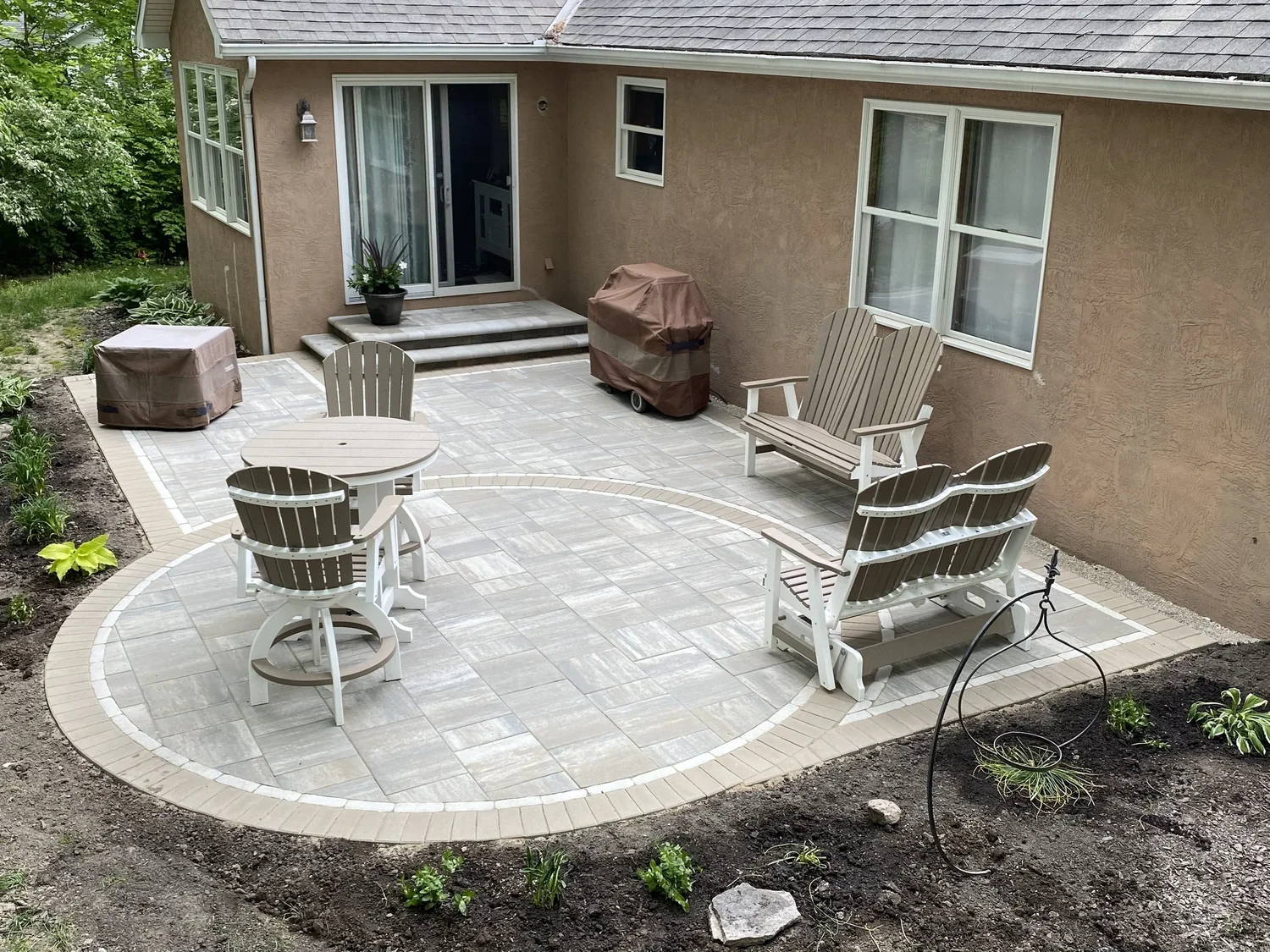
3. The 8-Inch Base Rule — Why 4 Inches of Crusher Run Is a 12-Year Decision
Industry convention in Atlanta residential paver work is a 4-inch compacted base of crusher run #57 over the subgrade. It is adequate for a patio built on undisturbed sandy loam in a sunny yard with no canopy and no frost cycling. That describes approximately zero Marietta backyards.
The spec that earns a 30-year life is 8 inches of open-graded base aggregate (ASTM #57 or #4), compacted in two 4-inch lifts, with a non-woven geotextile separator (Mirafi 140N or equivalent) laid directly on the subgrade before the first lift goes down. Above the open-graded base, one inch of ASTM #8 chip (bedding layer), screeded, never re-disturbed.
The reason open-graded beats crusher run on Cobb County clay has nothing to do with crusher run being a bad product. Crusher run compacts beautifully — too beautifully. It holds water like a sponge sitting on top of clay that also holds water, and when Marietta gets its 22 annual freeze events, that saturated interface expands, lifts the base, and cracks the polymeric sand joints. Open-graded #57 drains in minutes. The freeze has no water to grab.
The extra four inches of excavation plus the upgraded material runs about $4 to $6 per square foot over a baseline quote. On a 600-square-foot patio, that’s $2,400 to $3,600. It is the single highest-leverage dollar in the entire build.
Contract language to demand: “Base shall be 8-inch compacted open-graded ASTM #57 aggregate installed over non-woven geotextile separator, compacted in two 4-inch lifts at a minimum of 2,500 plate-compactor passes per lift. Bedding shall be 1-inch ASTM #8 chip, screeded, not compacted.” If it isn’t written this way, it won’t be built this way.
4. Geogrid — When It Matters and When It’s an Upsell
Geogrid is a high-tensile plastic mesh laid between base lifts to distribute point loads and bridge soft subgrade. A lot of Marietta contractors either include it on every job (to justify a higher bid) or never include it (to keep the bid low). Both positions are wrong.
Geogrid earns its place on three specific Marietta conditions: patios within 8 feet of a retaining wall over 24 inches tall, patios built on recently disturbed fill (common on the newer infill builds in Atlanta Country Club and the luxury redevelopment going on in Marietta Country Club), and patios crossing a grade change of 3 feet or more where the downslope side is cut fill. If none of those conditions apply, geogrid is optional and the money is better spent on the base depth upgrade described above.
When you do need it, Tensar BX1200 biaxial geogrid installed between the two base lifts adds roughly $1.25 to $1.75 per square foot. On a lot like the rolling 4-foot-grade backyards common in Brookstone or along Johnson Ferry, it is the difference between a patio that settles a half-inch over twenty years and one that dishes two inches by year twelve.
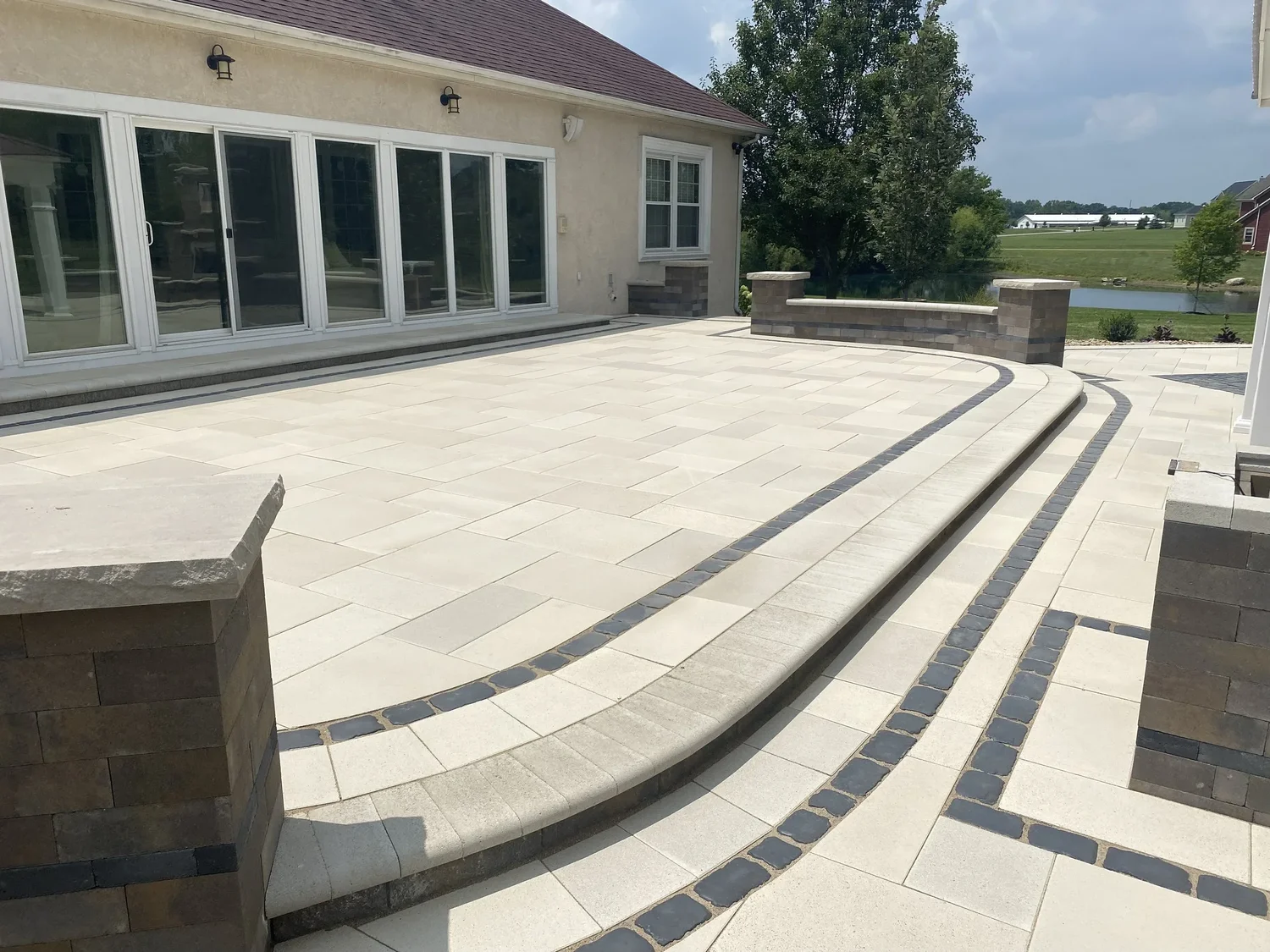
5. Flexible-Mortar Soldier Course vs. Dry-Set — Why the Edges Fail First
Edge restraint is the single component most likely to fail on a dry-set paver patio, and it is the component most Marietta installers spend the least time on. The conventional spec is an aluminum or PVC L-shaped edge restraint staked every 12 inches with 10-inch spikes, covering a field of dry-set soldier-course pavers. It is cheap, it is fast, and it lasts about ten years before the spikes rust or pull and the soldier course starts to drift.
The 30-year alternative is a flexible polymer-modified mortar-set soldier course. The outermost row of pavers is bedded in a polymer-modified thinset — typically Techniseal HP Nextgel or SRW Maxx Bond — bonded to the chip bedding and backed by a small concrete toe footing extending 4 to 6 inches beyond the paver edge. The soldier course becomes a structural ribbon. It holds the field even when a root lifts against it. It takes a freeze cycle without telegraphing. And it keeps polymeric sand in the joints for an extra decade.
The cost premium on a typical 160 linear feet of perimeter is roughly $1,100 to $1,600 — negligible against the value of a soldier course that doesn’t need to be reset at year ten.
6. Drainage to Daylight — The Covered PVC Spec That Actually Works
Every paver patio needs a drainage strategy. Not “it drains through the joints” — that is a wish, not a strategy. The question is where the water that falls on and around the patio actually exits, and whether the subgrade gets a chance to dry before the next rain.
The Marietta signature-detail spec: a 4-inch solid-wall SDR-35 PVC collector (not flexible black corrugated pipe, not 3-inch perforated) buried along the low edge of the patio base, sloped a minimum of 1% toward daylight, tied into two or three cleanouts, discharging to a pop-up emitter at the property edge or into an existing stormwater inlet. Cost runs $1,800 to $3,400 depending on run length and the fight you have with roots during excavation.
Flexible corrugated pipe is almost always what ends up installed when a homeowner doesn’t know to ask. It crushes. It ponds. It traps silt. After three years of Cobb County clay and leaf load, it is functionally a clogged straw. Rigid PVC is the material you want under a 30-year patio, full stop.
The “to daylight” part of this spec is the piece most installers skip, either because the property doesn’t have an easy daylight exit or because the homeowner didn’t push for it. If you do not have grade to daylight on your lot, the fallback is a properly sized dry well sized to a 2-inch rain event over the patio area — which on a 600-sqft patio is roughly 100 cubic feet of #57 stone in a buried reservoir. Not optional on a flat lot.

7. Freeze-Thaw Detailing — What Marietta’s 22 Freeze Events a Year Actually Do
Marietta sits on the USDA Zone 7b / 8a boundary. That means your patio will see around 22 freeze events each winter — most of them shallow overnight freezes that thaw by 10 a.m. That freeze-thaw cycling is more destructive to paver joints and base substrate than a single deep freeze. Each cycle expands water in the base and contracts it. Over five winters, that is roughly 110 flexing events. Your polymeric sand and your bedding layer each have to survive all of them.
Three specific detailing moves handle this: use a polymeric sand rated for wet-activation and freeze-thaw (Techniseal RG+, SEK-1 Super Sand Bond, or SRW PermaSand), not the cheap builder-grade stuff that fails in three seasons. Maintain a minimum 2% slope away from the house and any attached structures — 1% is the code-minimum, but in Zone 7b/8a, 2% gives you margin for the subtle settlement that happens year over year. And specify a chamfered or rolled-edge paver on the field; straight-cut-edge pavers chip at the corners under freeze cycling, and once they chip, water gets into the body of the paver and accelerates spalling.
Paver body spec that matters in Marietta: ASTM C936 compressive strength ≥ 8,000 psi, absorption ≤ 5%, thickness ≥ 60 mm (2-3/8″). Belgard, Techo-Bloc, Cambridge, and Unilock production pavers all meet this. Most import and big-box-store pavers do not. Ask for the mill certification sheet — any legitimate contractor will have it in their bid package.
8. The 30-Year Total-Cost-of-Ownership — Honest Numbers
Here is the math most contractors don’t show a homeowner, because it is genuinely hard to pitch a $32,000 patio against a $19,500 patio without it.
Basic spec (4-inch crusher-run base, aluminum edge restraint, flexible corrugated drain, no root barrier): $28 to $34 per square foot installed. On a 600-sqft Marietta patio, that is $16,800 to $20,400 installed. Expected major intervention at year 5–7 (root lift, edge re-set): $2,500 to $4,500. Expected rebuild at year 12–14: $18,000 to $23,000 (demo adds cost). Total 30-year cost: roughly $42,000 to $52,000 if you push it to the third decade, which most homeowners don’t.
30-year spec (4-ft HDPE barrier, 8-inch open-graded base with geotextile, flexible-mortar soldier course, covered SDR-35 drainage to daylight, freeze-rated polymeric sand, ASTM-compliant paver body): $34 to $43 per square foot installed. On the same 600-sqft patio, that is $20,400 to $25,800 installed. Expected major intervention at year 15–18 (polymeric sand re-sand, minor field-level re-set): $1,800 to $3,200. No rebuild required through year 30 on a properly detailed install. Total 30-year cost: roughly $22,200 to $29,000.
The premium spec costs $6 to $9 more per square foot up front. It saves $18,000 to $23,000 over thirty years. That is not a marketing number. That is the arithmetic of not rebuilding.
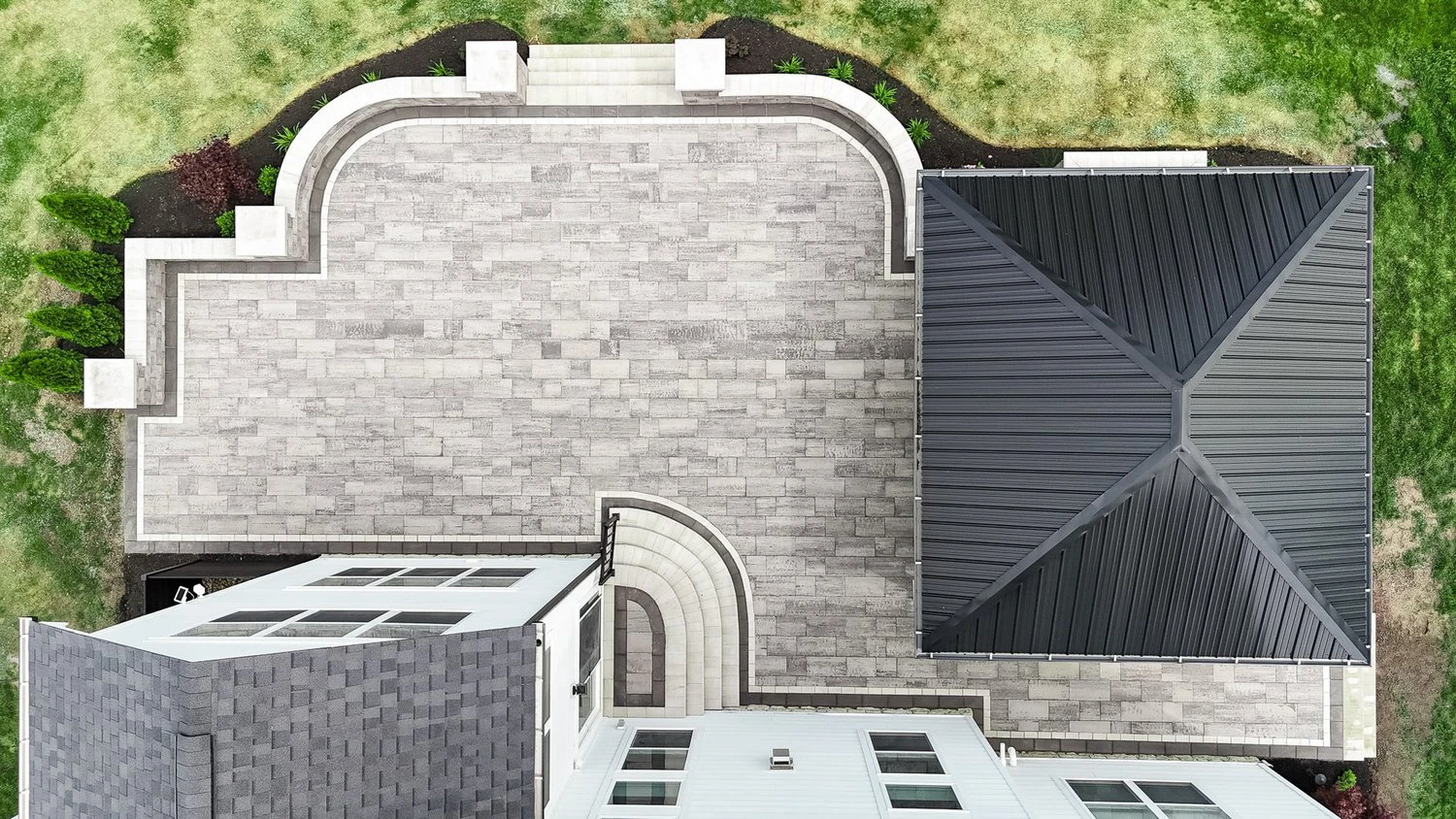
What a 30-year contract should actually say
If the contract does not spell out base depth, base material (open-graded vs. crusher run), geotextile, drainage pipe type, edge restraint method, and polymeric sand product by name, you do not have a 30-year spec. You have a handshake. Every quality paver installer in Cobb County who bids this work will put those lines on the proposal when you ask. The ones who won’t are telling you something useful about their process.
Separate from the spec, two practical notes for Marietta lots: if you are in one of the older HOA-heavy neighborhoods like Atlanta Country Club or Indian Hills, request the architectural review in writing before you sign a contract — some committees restrict paver colors, soldier-course orientation, and plant-bed transitions in ways that affect your design. And if your lot is served by Cobb EMC rather than Georgia Power, any planned low-voltage patio lighting tied to a new 240V run needs to be confirmed against Cobb EMC’s service panel spec, which differs in minor but important ways from the Georgia Power default most electricians default to.
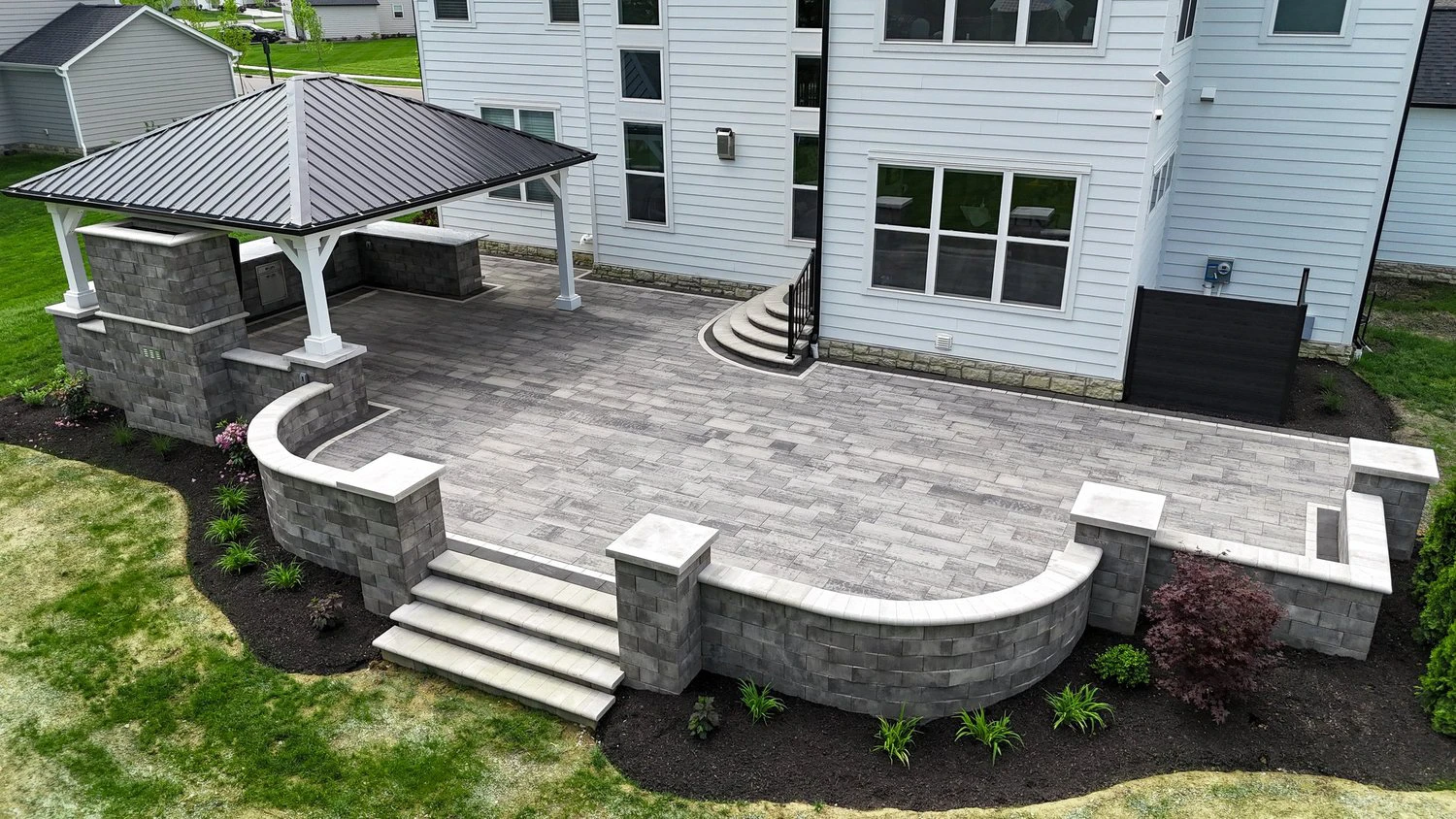
The Kennesaw Mountain side of town has a secondary consideration worth mentioning briefly: wind. Lots sitting on the northeast shoulder of the mountain get measurably stronger winter wind loads than lots south of Marietta Parkway. That affects pergola attachments and shade-sail anchoring more than it affects the patio itself, but if your design includes an overhead structure, the engineer will spec different footings on a Burnt Hickory lot than on a Sope Creek lot. Your patio base doesn’t care. Your pergola does.

The short version, if you only remember three things from this piece: put the HDPE root barrier in at install on any canopy-facing edge, put eight inches of open-graded base under the pavers, and route drainage in rigid PVC to daylight. Skip any one of those three and you have built a 12-year patio. Do all three and the rest of the patio — the pattern, the color, the size — is a design decision, not a structural one.
Paver patio construction across 20+ cities within 30 miles of Winder, GA
We build to the 30-year spec — HDPE root barrier, 8-inch open-graded base, covered drainage to daylight, and freeze-thaw-rated soldier detailing — on every Marietta-area installation.