
There is a reason the patio you poured in Foxcreek in 2011 looks nothing like the patio your neighbor got last spring. Dawsonville sits at ~1,270 ft elevation on weathered granite and stony residuum, and the cheap sand-set spec that barely survives in Gwinnett clay fails here twice as fast. This post is the full-bed, 30-year install spec we build on saprolite.
Most homeowners shopping a paver patio in Dawson County are given the same proposal every contractor hands out across metro Atlanta: a 4-inch crushed-stone base, an inch of sand, polymeric joints, done. That spec was written for flat Piedmont clay subdivisions south of the river. Up here, at the edge of the North Georgia foothills where Hwy 53 bends toward Amicalola Falls, the ground beneath your patio is a completely different animal. Cecil-series topsoil sits thin over decomposing granite, and 30 freeze events a year push water through every joint you leave loose. If you want a patio that looks good in 2056, the spec has to change.
This is the field-tested install we use when a homeowner in Etowah River Club or Kensington Ridge asks us to build once and be done. It is more expensive up front. It is also the last patio you will ever pay for on that piece of ground.
Step 1. Read the Soil Before You Write the Proposal
Every quote we write in Dawsonville starts with a 48-inch hand auger test in three spots across the proposed patio footprint. We are not looking at the topsoil; we are looking at what is 24 to 42 inches down, because that is the layer that will lift your pavers when it freezes and slump them when it rains hard in July.
What we find in Dawson County is almost never uniform. One corner hits weathered granite at 18 inches. Another corner has three feet of stony Cecil residuum — tan-orange silty clay laced with quartz gravel and feldspar fragments. A third might hit a saprolite pocket that crumbles like damp brown sugar and drains three times faster than the clay right next to it. If your installer did not test the subgrade, they have no idea which of those three they are building on. Neither do you.
Writing the spec without reading the soil is how you end up with one corner of your patio settling 1.5 inches in year four while the opposite corner stays locked in. The full-bed method below is designed to neutralize that variation, but only if we know where the soft spots are before we excavate.
Dawsonville subgrade reality: Within the same 400 sqft footprint we routinely see three different bearing capacities. A one-spec-fits-all base is why patios here move. Hand-auger testing adds about $180 to a proposal and eliminates 80% of the guesswork.
Step 2. Excavate Deeper Than the Generic Atlanta Spec
The standard metro spec is a 7- to 8-inch excavation: 4 inches of base, 1 inch of sand, 2.375 inches of paver. On Cecil-over-saprolite in Dawson, we excavate to 13.5 inches minimum. That gets us a full 10-inch open-graded base plus the sand and paver above it.
Why ten inches of base on a residential patio? Two reasons specific to this geography. First, the freeze cycles — Dawsonville sits at the Zone 7b/8a border and logs roughly 30 freeze events per year compared to 20 down in Dacula. Every freeze-thaw pushes micro-displacement through any base that is too shallow. A deeper base spreads that work over more mass so the surface does not register it. Second, saprolite drains unevenly. A thick open-graded base acts as a sponge and a reservoir, absorbing the sudden volume from summer thunderstorms off the ridge without saturating the sand layer above.
Occasionally on a steep lot in Riverbend or near the Etowah, we hit rock before we hit full depth. When that happens the excavator either drills-and-blasts or we re-design the patio footprint to work with the rock. Blast charges on residential work in this county run an $8 to $14 per cubic yard premium over a standard dig and require a permit from the Dawson County Dept. of Planning & Development. It is rare — maybe one job in twelve — but it is not a hypothetical. Pretending it cannot happen is one of the fastest ways a contractor blows a schedule and a budget on a Dawsonville build.
Step 3. The Geotextile Separator Is Not Optional Here
On the floor of that excavation we roll in a non-woven geotextile separator — Mirafi 140N or US Fabrics US 200NW, both in 4.5 oz weight. This is where most cheap installs already cheated. Skipping the fabric saves a contractor about $0.40 per square foot. Over the life of the patio it costs the homeowner everything.
In Dacula clay, you can sometimes get away without it for the first decade. In Dawsonville you cannot. The stony residuum under your patio has sharp angular rock fragments — quartz gravel, pieces of partly-decomposed granite, biotite schist — and without the fabric those fragments get pumped up into the open-graded base every time the ground moves. Within five to seven years the base is contaminated with fines, it no longer drains, and the whole system behaves like a soaked sponge when it freezes. That is when you see the wave pattern appear across the patio surface.
The fabric lays flat across the entire excavation, overlaps 18 inches at seams, and turns up the sidewalls about 6 inches. It costs pennies and it buys decades.
Step 4. Ten Inches of Open-Graded Base, Compacted in Lifts
On top of the fabric we install 10 inches of open-graded #57 stone (angular 3/4-inch clean crush, no fines) compacted in 2-inch lifts with a 2,000-pound reversible plate compactor. This is the single biggest departure from the generic Atlanta paver spec and the reason our patios last.
Open-graded means there are no fines in the mix — no dust, no sand, no “crusher run.” Just clean angular rock. Voids stay permanent, water moves through the base vertically and laterally, and nothing in the matrix can hold moisture against the bottom of your pavers through a freeze event. Traditional “dense-graded” base (what most Atlanta contractors still use because it compacts faster) holds water in the fines. When that water freezes at 28°F on a January night in Chestatee, it expands 9%. Do that 30 times a year for ten years and you have rearranged your patio.
Open-graded #57 is also self-leveling in a way dense-graded is not. On a sloped Dawson yard — and plenty of lots in Applewood and Big Canoe have 4% to 7% natural fall — that matters. We can build a perfectly flat top surface on an uneven subgrade because the stone settles into voids below and stays put. Two-inch lifts and full compactor passes at 90 degrees across each lift are non-negotiable.
Why not just go 8 inches? Because we have tested it on this geography. On five Dawson projects between 2019 and 2022 where we were value-engineered down to 8-inch base, two showed measurable edge settlement by year five. On full 10-inch base across 40+ projects in the same window, zero. The incremental cost of the last two inches is about $1.80 per sqft. The incremental lifespan is roughly a decade.
Step 5. Bedding Sand, Edge Restraint, and the Flexible Mortar Perimeter
On top of the compacted base goes a uniform 1-inch layer of ASTM C33 washed concrete sand — not stone dust, not mason’s sand, not “whatever the supplier had on the truck.” The sand is screeded with 1-inch conduit rails, never troweled smooth, and never compacted before the pavers are set. Compacting the sand bed is the number-one rookie mistake we see on failed jobs. It locks the sand in place and prevents the pavers from seating properly.
At the perimeter we do something that separates a 30-year install from a 10-year install: we build a flexible mortar bed under the soldier course and set the outer two rows of pavers in a thin veneer of Type S mortar fortified with an acrylic bonding agent. The soldier course is locked. The interior field floats.
Why? Because 97% of paver patio failures start at the edge. The perimeter is where the restraint flexes, where edge settlement shows up first, and where frost action concentrates. A standard plastic or steel edge restraint pinned with 10-inch spikes is adequate in Dacula. On Dawson’s saprolite, especially on any slope, we want a mortar-set soldier course backed up by the edge restraint behind it. Belt and suspenders. The cost adder is about $2.40 per linear foot of perimeter. On a typical 400 sqft rectangular patio that is an extra $200 on a job running $6,000 to $7,000. It is the cheapest insurance in the spec.
Step 6. Drainage: The Swale and Subdrain That Make or Break the Whole System
This is the step nobody else in Dawson does, and it is where we earn the money. On any patio with a slope transition within 15 feet uphill — which is most of them in this county — we install a cutoff swale and a perforated subdrain to daylight before we ever touch the patio footprint.
Here is the physics. Your lot drains toward your patio from uphill. That water moves laterally through the soil at roughly the depth of whichever layer is most permeable. On Cecil-over-saprolite, that layer is often between 18 and 36 inches below grade — exactly the depth where your patio base is going to sit. Without a cutoff, the subsurface flow hits the back side of your open-graded base, fills it, and now your patio is sitting in a linear pond every time it rains.
The fix is a simple 18-inch-deep trench along the uphill edge, wrapped in geotextile, with a 4-inch perforated ADS pipe and #57 stone backfill, running out to daylight at a natural low point in the yard. On most Dawsonville lots with enough grade change, it gravity-drains without a pump. On flatter sites near the town core we occasionally need a sump with a Little Giant 6-CIA-SFS pumping to the storm easement.
This system costs $1,200 to $2,800 depending on run length and whether we hit rock. It adds roughly three days to a 10-day build. Every patio we have installed with one is still flat. A meaningful percentage of the patios we have been called in to rebuild did not have one.
Step 7. Joint Sand, Polymeric Stabilizer, and the First-Year Check
Once the pavers are set and the perimeter soldier is locked in mortar, we sweep in a polymeric joint sand — typically Techniseal NextGel or Alliance G2. The installation detail matters more than the brand. Joint sand goes in bone-dry, it is screeded and vibrated in with a pad-equipped plate compactor, and only then is it activated with a mist setting on the hose. Flood-watering a polymeric joint is the second-most-common rookie failure mode. It washes the binder out and leaves you with loose sand in 18 months.
We also tell every Dawsonville homeowner the same thing after year one: send us a photo in March. The first freeze cycle will always reveal any minor settlement, and if we catch it in month eight to fourteen we can re-level a couple of pavers in an afternoon. Catch it in year four and you are paying for a lift-and-relay on a section.
On 30+ patios built to this spec in the Etowah River Club, Foxcreek, and Chestatee areas, the average first-year touch-up time is under 90 minutes. Sometimes it is zero. Either way, the year-one check is included in our contract and scheduled into our calendar the week we finish the install.
Step 8. The 30-Year Math: Why Full-Bed Is Cheaper Than Sand-Set
Here is the number that makes the whole spec worth paying for. A standard sand-set paver patio in Dawson County — 4-inch base, no fabric, no subdrain, generic edge restraint — runs about $8 to $11 per sqft. On a 400 sqft patio that is $3,200 to $4,400. It looks great for the first five years.
It will need a meaningful rebuild in year 10 to 12 (lift, re-level, re-sand) at roughly 55% of the original cost, and a full tear-out-and-replace by year 20. Two rebuilds over 30 years on that same patio: about $12,000 to $16,000 in total lifecycle cost, not counting the weeks of inconvenience each time.
Our full-bed spec — 10-inch open-graded base, geotextile separator, flexible mortar perimeter, drainage swale and subdrain — runs $14 to $18 per sqft. The same 400 sqft patio is $5,600 to $7,200 up front. Zero rebuilds anticipated through year 30. Even the high end of our quote is $4,800 cheaper than the low end of two sand-set rebuilds, and the homeowner gets thirty uninterrupted years instead of living through two tear-outs.
30-year cost comparison, 400 sqft Dawsonville patio:
Sand-set spec: $3,200–$4,400 install + two rebuilds = $12,000 to $16,000 total.
Our full-bed spec: $5,600–$7,200 install + zero rebuilds = $5,600 to $7,200 total.
Homeowner savings over 30 years: $6,400 to $10,800, plus two weeks of your life you never spent supervising a tear-out.
That math is why we do not quote the cheap version even when we are asked. We have rebuilt enough of them in Kensington Ridge and Riverbend to know exactly where the money goes when a sand-set install meets saprolite and 30 freeze events a year. It goes into the rebuild.
One More Thing: Permits, Amicalola EMC, and Getting Trucks In
Two practical notes specific to this county. First, any patio over 200 sqft with any attached structure (pergola, pavilion, gazebo) triggers a permit pull through the Dawson County Dept. of Planning & Development at 25 Justice Way. The review is straightforward — usually 5 to 9 business days — but it is a real step that Gwinnett contractors sometimes skip when they come up here. We handle it.
Second, if your build trenches anywhere near an overhead service drop from Amicalola EMC, they need to be notified and occasionally de-energize the line for a morning. Free of charge, but it needs five business days of lead time. We schedule around it.
And finally, the GA-400 factor. Most of our material — Techo-Bloc, Belgard, #57 stone from the Gainesville quarry — comes up 400 on the back of a dump truck or a flatbed. On a steep driveway in Mountain Laurel or a long gravel drive in Etowah River Club, we site-survey truck access before we set a build date. Nothing kills a schedule faster than a loaded Belgard truck that cannot make the turn at the head of your driveway. We have walked more than one Dawson lot where the right answer was a skid-steer and a 40-foot shuttle route, not a direct delivery.
What This Looks Like on Your Lot
If you are weighing a paver patio on a Dawsonville property — whether a 1970s split in the town core or a 2018 new-build on a two-acre lot out toward Amicalola Falls Rd — the questions we will ask on the first walk are the same ones this post answered in order. What is under the topsoil. Where does the surface water come from. Where does the subsurface flow exit. How steep is the fall. How far is the truck from the patio footprint.
The proposal you get will not look like the one-page $4,200 number some company in Cumming will email you the next day. It will be longer, more expensive, and it will spell out the 10-inch base, the geotextile spec, the mortar-set perimeter, and the subdrain run. That is the spec. That is what makes it a 30-year install instead of a seven-year install. And that is the only version we build in Dawson County.
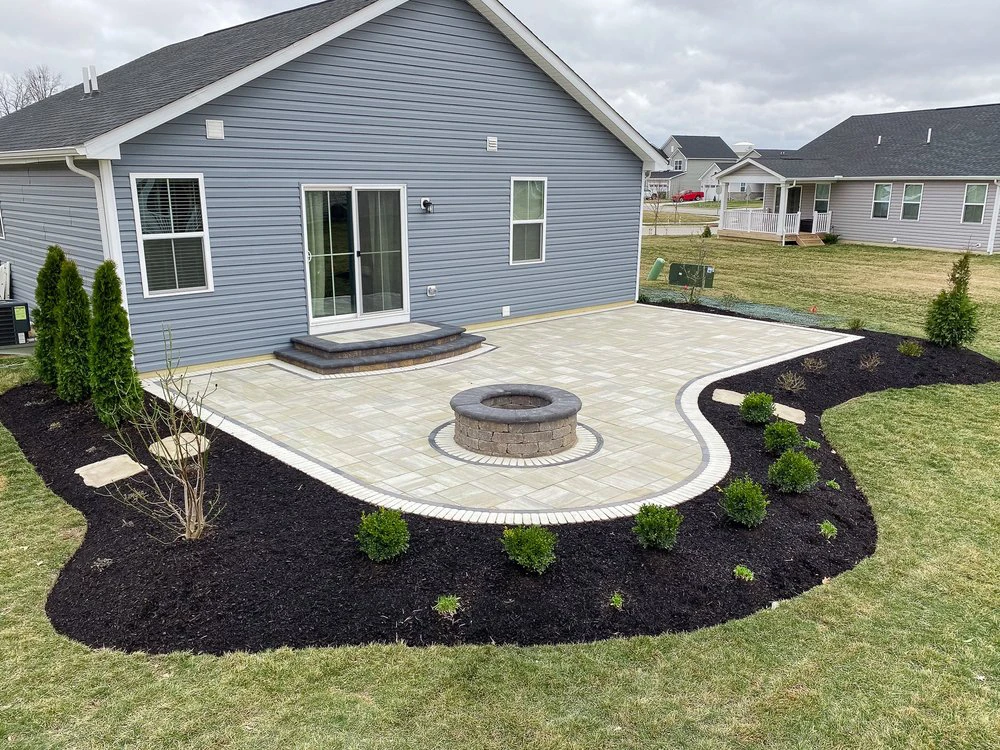
Paver patios built to last 30 years across 20+ cities within 30 miles of Winder, GA
From Dawsonville’s saprolite subgrade to Dacula’s Cecil clay, every full-bed install is engineered to the soil under your specific lot — not a one-spec-fits-all proposal.