
Five to ten years after a paver patio gets installed in Coal Mountain, Bethelview, or Shady Grove, Cecil clay fines begin migrating up into the crushed-stone base. The pavers don’t fail because the installers skimped on pavers — they fail because a $0.40-per-square-foot fabric was left off the plan.
Forsyth County has been the fastest-growing county in Georgia for the past decade. Roughly 260,000 residents now spread across 247 square miles, and the housing stock reflects it: 85% of homes here were built from 1995 onward, with heavy new construction continuing along GA-400 exits 13 through 18. The county approves more than 200 residential pool permits a year, plus thousands of hardscape permits. Volume that big means most homeowners are buying the patio that came with the builder package, or hiring on the cheapest bid.
The cheapest bid almost never includes a separator fabric between the native subgrade and the compacted aggregate base. That single omission is why paver patios in 30040, 30041, and 30028 zip codes are failing at a higher rate than the pavers themselves were rated for. The pavers are fine. The base is fine. What’s failing is the interface between the two.
This post is about that interface — what Cecil clay actually does over a decade under compacted stone, why Mirafi 140N and its equivalents solve it, and what a genuinely 30-year installation looks like in a Forsyth County backyard.
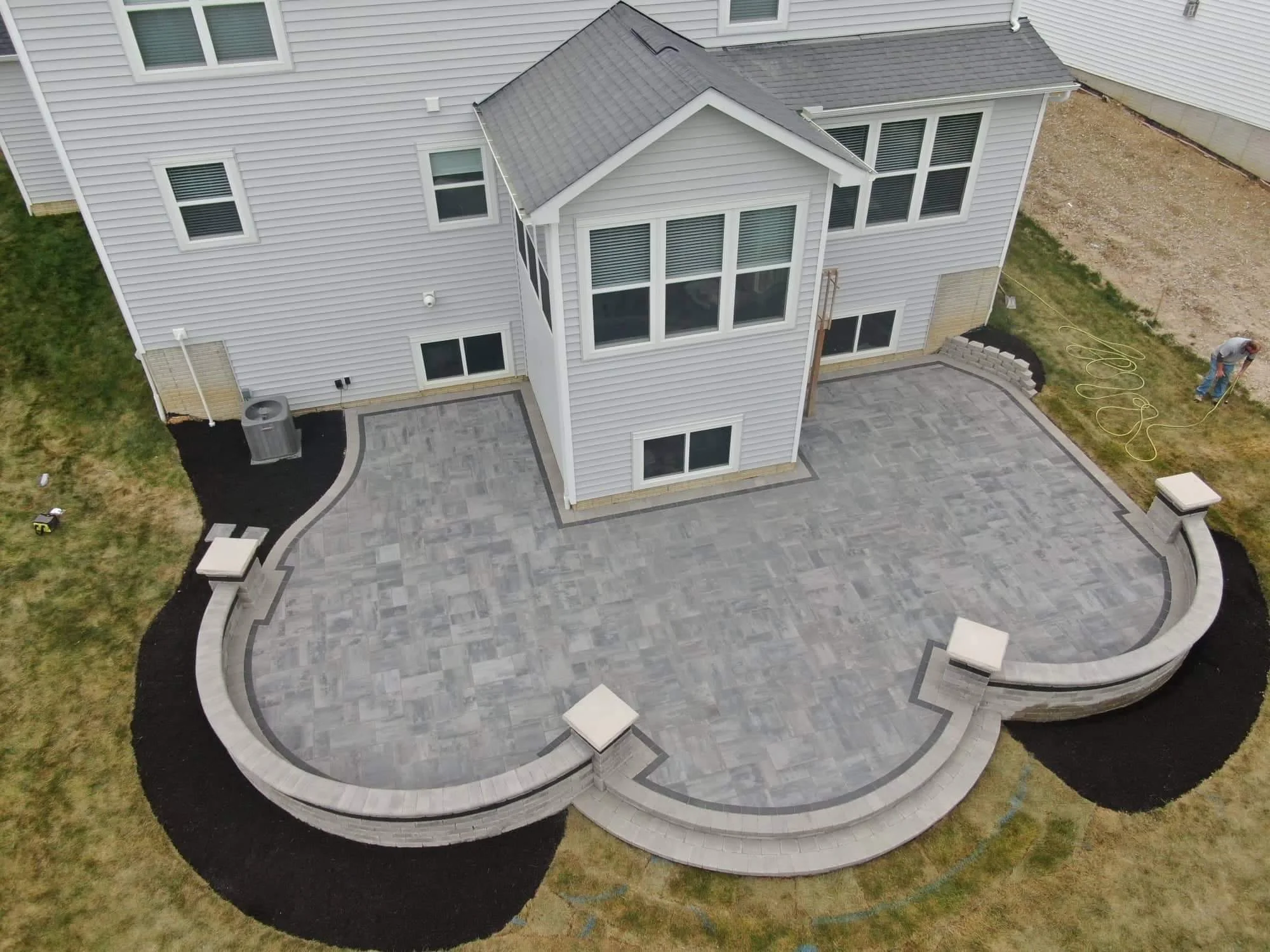
1. What Cecil Clay Actually Does Under a Paver Patio
The soil across Forsyth County is dominated by the Cecil series — a red-to-yellow Piedmont clay loam with a clay-rich B-horizon typically 6 to 24 inches below the surface. North toward Coal Mountain the profile turns rockier and thinner; south toward Big Creek and Shoal Creek it deepens into heavier, wetter pockets. Either way, the fines that make up Cecil clay are extraordinarily small — most particles sit under 2 microns across.
When you excavate a patio pad and compact GAB (graded aggregate base) over raw Cecil clay, the two materials have radically different void structures. The stone has large angular voids. The clay has no voids — it’s a near-plastic mass when wet. Under repeated load cycles — foot traffic, furniture, a rolling cooler, a seasonal freeze — the clay fines pump upward into those voids every time the stone deflects and rebounds.
Engineers call this “fines migration” or “pumping.” Over five to ten years, fines climb four to eight inches up into the base layer. The base gradually turns from a draining, load-bearing matrix into a mud-bound sponge. Pavers start to settle unevenly. Joints open. Bedding sand washes through. By year twelve the patio is doing everything wrong: holding water, heaving in winter, and settling along traffic paths.
2. The $0.40 Fabric That Stops It: Mirafi 140N and the Woven vs. Nonwoven Question
A geotextile separator is a thin fabric laid directly on the compacted subgrade before any stone goes in. It does one job: it keeps fines from migrating up while letting water pass down. Two fabrics dominate Forsyth County jobsites — Mirafi 140N (a nonwoven needle-punched polypropylene) and Mirafi 500X (a woven polypropylene with higher tensile strength).
For patio separation on Cecil clay, the nonwoven 140N is the correct choice roughly 90% of the time. It has a higher permittivity — water flows through it more freely — and its thicker mat does a better job of trapping fines against the subgrade. Woven fabrics like 500X are stiffer and stronger in tension, which matters for retaining walls and roadway base, but they pass more fines through their more open weave.
Cost in the Cumming and Atlanta supply market as of this quarter: $0.40 to $0.80 per square foot for 140N rolled out, overlapped, and stapled. On a 600-square-foot patio, you are looking at roughly $240 to $480 in total fabric cost. Compared with a $14,000 to $22,000 patio build, it is the cheapest insurance money you can buy.
Mirafi 140N spec reference: AOS (apparent opening size) 70 US sieve, permittivity 1.5 sec⁻¹, grab tensile 120 lb, trapezoidal tear 50 lb. These numbers are what qualifies the fabric as a “separator” under AASHTO M288 Class 2.
3. Why 65% of Forsyth County Residential Installs Skip It
Separator fabric is not required by the International Residential Code. It is not called out in most homeowner-facing contractor bids. Forsyth County’s own hardscape permit review focuses on setbacks, stormwater, and structural attachments — not the soil interface buried under the base stone.
The result: in a sample of Forsyth residential paver jobs we have inspected during remodel consultations — predominantly in Brookwood, Shiloh, and the south-Forsyth subdivisions off Post Road — roughly two-thirds had no fabric of any kind between the native clay and the base. In most cases the contractor excavated, tamped, dumped four to six inches of crusher run, and ran a plate compactor over it. Fabric costs them time and a trip to the supply yard. They skip it, knowing the patio will outlast their warranty.
The math from the contractor’s side is ugly but rational. A two-year warranty window is comfortably within the period before fines migration becomes visible. A ten-year warranty, like the one Primetime offers on full-build patios, is not — and cannot be honored on any job that skipped the separator. This is why we write it into every Forsyth County proposal and line-item it separately so homeowners can see exactly what they are paying for.

4. The 30-Year Build Sequence, Step by Step
A patio engineered to last three decades on Cecil clay follows a sequence that is not complicated, but is uncompromising at every stage. Here is how a Primetime crew runs it from stakeout to final sand.
Step 1 — Excavate to the right depth, not the convenient depth.
A standard pedestrian patio is cut 9 to 11 inches below finished grade: 1 inch of bedding sand, 6 inches of compacted GAB, plus the paver thickness (typically 2⅜ inches) plus a margin for the fabric. On heavy-clay lots, or jobs that will see vehicle traffic (driveway edges, golf-cart paths common in Bethelview estates), we go deeper — 12 to 14 inches.
Step 2 — Compact the subgrade to refusal.
Once the cut is made, the native Cecil clay subgrade gets compacted with a reversible plate compactor at a minimum 4,000 lb-force output. We run it in perpendicular passes until the plate stops sinking. Proof-roll check: if a loaded wheelbarrow leaves ruts, keep compacting.
Step 3 — Roll out the geotextile.
Mirafi 140N rolls out of 12.5-foot-wide rolls. Seams overlap 18 inches minimum, more on sloped pads. We staple the perimeter with 6-inch landscape staples every 3 feet. Edges turn up and over any permanent curb or retaining wall.
Step 4 — Place and compact the base in lifts.
GAB goes on in two lifts of 3 inches each, not one lift of 6 inches. Each lift is plate-compacted independently, damp but not wet. A single 6-inch lift can never achieve the 95% Proctor density you want under pavers — the lower half stays loose.
Step 5 — Screed bedding sand, lay the pavers, cut the field.
One inch of clean concrete sand, screeded dead flat to depth using 1-inch electrical conduit as screed guides. Pavers go in according to the chosen pattern — herringbone at 45° for heaviest load zones, running bond for visually quiet fields. Field cuts get made with a wet saw and a continuous-rim blade.
Step 6 — Edge restraint and polymeric sand.
Rigid edge restraint (we use Snap-Edge Pro or Pave-Edge Rigid) pinned every 12 inches with 10-inch spikes. Polymeric sand swept into the joints, broomed clean, misted in three passes. The patio gets fenced off 24 hours to let the polymer cure.

5. Where Cecil Clay Behaves Differently Across Forsyth County
Forsyth is not soil-homogeneous. North Forsyth (30028, toward Coal Mountain and Ducktown) sits on thinner, rockier Cecil profiles often broken by saprolite — weathered bedrock that shows up as flaky, crumbly material when you cut into it. Patios here see less fines migration but more settlement from uneven bedrock contact. The fabric is still useful, but base compaction matters more.
South Forsyth (30041, around Shoal Creek, Big Creek, and the Chattahoochee River bottomlands) sits on deeper, wetter clay with more organic content. This is where fines migration runs worst. In these zip codes we often pair the 140N with a 2-inch choke layer of #57 stone under the GAB to break capillary rise.
Central Forsyth — Cumming proper (30040) and the Bethelview / Brookwood corridor — is textbook Cecil. Standard sequence with 140N handles it. The lots off Kelly Mill Road and Post Road especially benefit from the fabric because they tend to be flat graded pads over recently disturbed construction fill, which behaves even more erratically than undisturbed Cecil.
Lake-adjacent properties along the Lake Lanier south shore — Browns Bridge Road off Hwy 369, Shady Grove, and the Shoal Creek peninsulas — deal with higher seasonal soil moisture. Moisture accelerates clay pumping. Fabric on lakefront patios is not optional if you want the installation to survive its tenth winter.
6. Signature Details Worth Specifying by Name
Generic “geotextile” on a proposal is weaker than a specific brand and spec. If you are evaluating contractor bids in Forsyth County right now, the following are the names and numbers to look for, and what they cost as a pass-through line item.
- Mirafi 140N nonwoven separator: $0.40–$0.80 per sqft installed. Best for patio bases on Cecil clay.
- US Fabrics US 120NW: functionally equivalent to 140N, often priced a few cents lower in the Cumming supply chain.
- Techo-Bloc Blu Grande or Villagio pavers: $7.20 to $11.50 per sqft material only, depending on color and blend.
- Belgard Holland Stone or Bergerac series: $5.80 to $9.40 per sqft material, with strong availability at Cumming supply yards.
- Polymeric sand (Alliance Gator Maxx G2 or SRW Weather-Tight): $38 to $52 per 50-lb bag, one bag per ~90 sqft joint coverage.
- Snap-Edge Pro rigid paver edging: $1.80 to $2.40 per linear foot installed with 10-inch spikes on 12-inch centers.
An honest Forsyth County proposal should line-item the fabric separately. If the bid reads “install paver patio, 600 sqft, $17,400 turnkey” with no fabric specification, you are very likely looking at a job that will not make it to year fifteen.
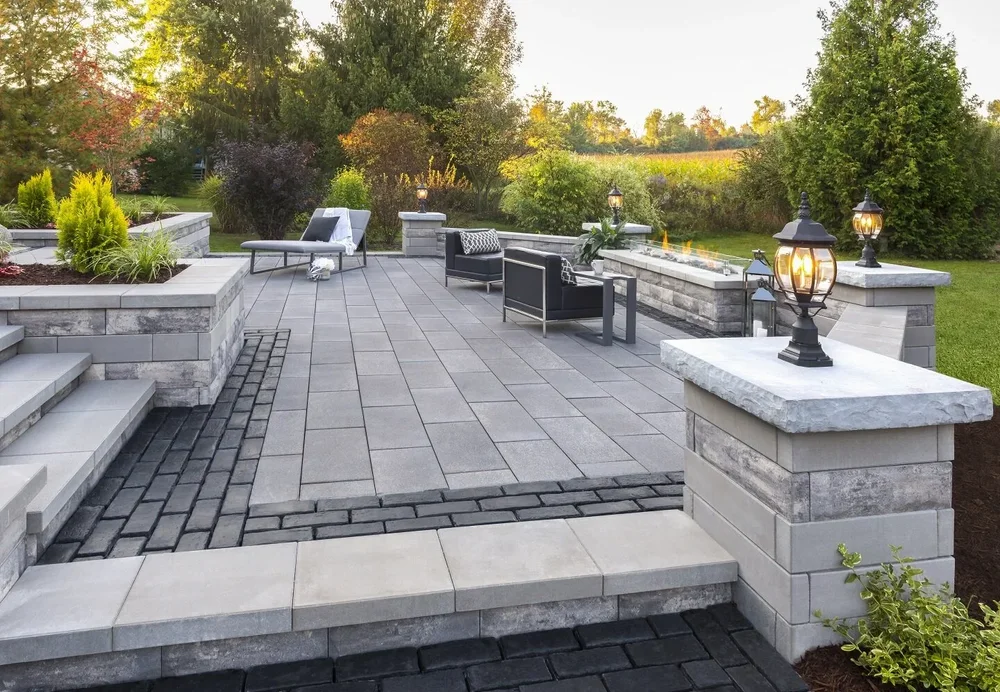
HOA reality check: Almost every subdivision in Forsyth County has an active HOA — a side-effect of 85% of housing stock being post-1995 master-planned construction. Most require pre-approval of hardscape plans. Submitting a plan that specifies Mirafi 140N and a two-lift compacted base often speeds approval because it signals the installer understands soil behavior.
7. The Freeze-Thaw Multiplier: Why Forsyth’s 22 Annual Freezes Matter
Forsyth sits in USDA Hardiness Zone 8a with an average of 22 hard freeze events per year, and the Lake Lanier moisture effect along the south shore pushes those events further into early spring than inland counties see. Each freeze-thaw cycle behaves like a miniature pump on an unprotected base. Clay fines wet from a late-winter rain hold water, freeze, expand, thaw, shrink — and with every cycle some of that water-borne fine silt climbs upward into the stone above.
A patio without a separator experiences this pump 22+ times a year. A patio with a separator experiences it zero times where it matters — at the subgrade-base interface where the damage accumulates. The arithmetic compounds. Twenty-two cycles a year, over ten years, is 220 pump events. Over thirty years it is 660. The difference between a well-specified fabric and no fabric is the difference between a patio that ages slowly and a patio that disintegrates in slow motion.
Sawnee EMC’s freeze-tracker data, which a lot of contractors use as an informal project scheduler, shows a narrow sweet spot for paver installation in Forsyth: late March through early May, and mid-September through early November. Installing in the dead of summer heats the poly sand past cure tolerance; installing in January puts a freshly screeded bedding layer at risk overnight. This is a real constraint most homeowners never hear during a bid conversation.
8. What a 30-Year Patio Looks Like at Year 0, Year 10, Year 20, and Year 30
Year 0. Polymeric sand cured. Edges crisp. Pattern reads cleanly. The joints look slightly glossy for the first few rains — that is the polymer locking.
Year 10. On a patio built on 140N separator, there is no settling along furniture paths. Joints have darkened uniformly from weather but have not opened. The pattern still reads as clean as the day it was laid. Light surface efflorescence — normal mineral bloom from concrete pavers — may have appeared briefly in year two and weathered off by year four.
Year 20. Edge restraint has started to show slight corrosion at the spike heads (normal). Individual pavers exposed to de-icing salt near a pool edge may have hairline surface spalling. The field itself is flat to within the original installation tolerance. Critically, the base layer — if you were to pull a test paver — is still visibly separated from the native clay by the intact fabric. Stone is still stone; it has not turned to mud.
Year 30. A well-built patio on fabric looks tired but not failed. A pressure-wash and rejoint brings it back. Individual pavers may need replacement from freeze spalling at unsheltered corners. The patio as a system is still functioning as designed. Compare this with the vast majority of no-fabric patios in central Forsyth subdivisions built in the 2005–2012 era — most of those have already been torn out and rebuilt at least once.

Forsyth County rewards homeowners who build for the long curve. The county is growing, the housing stock is young, and the homes that hold their value longest are the ones where the outdoor living investment ages as well as the interior kitchen remodel. A paver patio is not a disposable purchase here. It shouldn’t behave like one.

Across 260,000 residents and 247 square miles, Forsyth County generates a staggering volume of backyard projects every year. The ones that will still look like themselves in 2056 are the ones built by contractors who know what Cecil clay does to a base layer, and who spec the $0.40 fabric that stops it.

30-year paver patios across Forsyth County and 20+ cities within 30 miles of Winder, GA
Every Primetime paver build in Forsyth County specifies the separator, the two-lift base, and the edge restraint by name — on paper, in writing, line-itemed on the proposal. That is the only way a 30-year build survives 30 years of Cecil clay.